“Walk yourself. That’s what happens when you marry a nobody.”
My father said it at the back of the chapel, in a voice pitched to carry, four minutes before I was supposed to be married.
Then he sat down in the last row beside my mother, folded his hands, and settled in like my wedding was a courtroom and he had already handed down the sentence.
The chapel went completely silent.
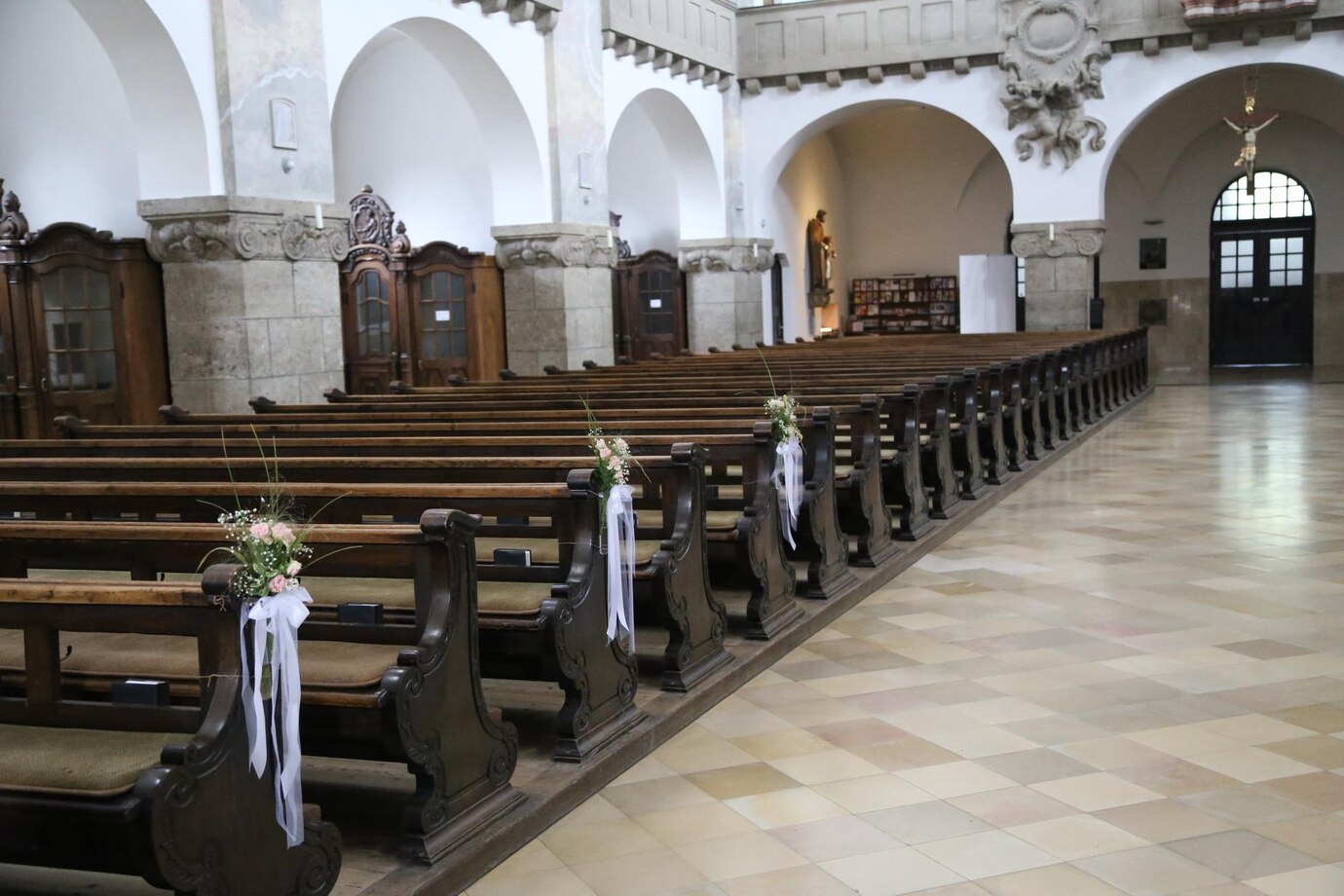
I stood at the double doors in my ivory dress with my bouquet gripped so tightly the stems had bent under the ribbon.
Ethan was at the altar with his hands folded in front of him. His face had gone pale, but his eyes stayed on me and did not move.
A hundred and forty people turned around in their seats.
My mother looked down into her purse.
My younger brother Caleb stared at the carpet between his shoes.
Nobody said one word.
I want to explain how we got there, because that sentence did not come out of nowhere. It came out of six months of construction.
My father, Richard Whitmore, owns three car dealerships in the Charleston area and has believed his entire adult life that money is proof of character. Not a result of it. Proof of it.
Ethan Cole is a public defender.
He makes fifty-eight thousand dollars a year and he carries a caseload that would kill most people, and he is the single most stubborn human being I have ever met about things that matter to him.
My father met him once, in April, at a dinner he insisted on hosting.
He asked Ethan four questions across two hours. What his salary was. Whether he had student loans. What his father did. And whether he had, quote, considered private practice at any point or whether this was going to be it.
Then, for six months afterward, he told everybody who would listen that Ethan was beneath us.
He said it to his golf group. He said it to my mother’s friends. He said it at a Chamber of Commerce lunch where somebody later repeated it back to me at a bridal shower with a sympathetic face.
He said it to me, on the phone, forty-one days before the wedding: “You are throwing away everything I built so you can be a poor man’s wife in a rented house.”
When he told me in August that he would not be walking me down the aisle, I cried in my car for twenty minutes and then I told myself the same thing I had been telling myself since I was about twelve.
At least he’ll be quiet about it.
He was not quiet about it.
So I walked.
The pianist started again after a beat too long. Every step I took felt louder than the music.
I kept my chin up because I had decided in the car that I would, and my eyes burned the entire way, and I did not let one tear out.
Ethan took a step forward at about the fourth row, ready to come meet me halfway.
I shook my head very slightly.
I wanted to make it to him on my own.
And halfway down that aisle — I have thought about the timing of this for two years and I still can’t decide whether it was mercy or chaos — the doors behind me swung open.
Thirty people in matching gray suits walked into that chapel.
Not a march. Nothing theatrical. Just thirty people moving with a kind of quiet precision, filing in and separating and lining both sides of the aisle, leaving the path between them open.
Men and women. Young and old. Black, white, Latino. A woman in her sixties with a cane. A man about twenty-five who looked terrified to be there.
Several of them wore small pins shaped like silver shields on their lapels.
The piano stopped mid-phrase.
One of them, a tall Black man in his fifties with a close-trimmed beard and very steady eyes, stopped beside my father’s row and turned toward him.
“Sir—”
My father stood up, going red.
“Who the hell are you people?”
The man took off his glasses and folded them.
“My name is Marcus Bell. I’m an investigator with the South Carolina Bar’s Innocence Review Network.”
I heard Ethan make a sound behind me.
Marcus turned to face me, and his whole manner changed. It went gentle.
“Maya. I’m very sorry to come in like this. We tried to reach you privately this morning and your phone was off.”
My phone had been off since seven a.m., in a hotel room, at the specific instruction of my wedding planner.
“What is this?” I said.
Marcus looked past me at Ethan. Then back at me.
“Your fiancé kept my son from serving twenty-five years for something he did not do. Every person standing in this aisle is here because of somebody Ethan Cole defended when nobody else would listen to them.”
A woman standing three feet from me started crying.
And Marcus turned back to my father.
“You called him a nobody, sir. I heard you say it from the parking lot.” He paused. “Half the people in this room are standing here because that nobody gave our families our names back.”
My father’s mouth opened and nothing came out of it.
I have never in my life seen that happen to him.
Then Marcus reached into his jacket and took out an envelope.
“And there’s one more thing. Mr. Whitmore, before this ceremony continues, you should know that your daughter’s fiancé also uncovered evidence relating to your company’s charitable fund.”
He glanced toward the doors.
“The state attorney general’s office is outside.”
My bouquet slid down in my hands until I was holding it against my hip.
Ethan came off the altar step and got close enough to say, very quietly, “Maya. I was going to tell you tonight. I swear to God I was going to tell you tonight.”
The chapel doors opened again.
Two officers stepped in and stood just inside them. They didn’t approach anybody. They just stood there, and the sound of the door closing behind them went all the way up into the rafters.
Nobody moved for three full seconds.
Then my father laughed.
Not his ribbon-cutting laugh. Not the warm one he uses at fundraisers with one hand on somebody’s shoulder.
This one was sharp and ugly and scared.
“This is ridiculous,” he said, to the room, to anybody. “Maya, tell your little courthouse husband to stop embarrassing himself in public.”
Ethan’s jaw went tight. He didn’t answer.
I turned around to face him fully.
“What evidence?”
He swallowed.
“After your father called my office in June and told me he’d destroy my career if I didn’t end it with you, I looked into the foundation he mentioned in that call.”
My stomach turned over.
“The Whitmore Hope Fund.”
The Whitmore Hope Fund was my mother’s project. It has been since 2009.
Scholarships for foster youth aging out of the system in three counties. Every December we all posed with an oversized check outside the Rivers Avenue dealership for the local paper.
My father loved those photographs. He stood in the center of every one of them with a hand on my shoulder, smiling like he’d personally invented generosity.
There is one on the wall of my mother’s old dining room from when I was nineteen.
Marcus stepped closer, still completely calm.
“Ethan noticed that a number of the scholarship recipients named in the foundation’s public filings do not exist. The listed addresses are empty lots, a closed dry cleaner, and in four cases, homes belonging to current Whitmore Automotive employees.”
My mother lifted her head.
Her face had gone gray. Not pale. Gray.
My father pointed at Marcus across two rows of seats.
“You have no idea what you’re talking about.”
And a woman in a gray suit stepped forward out of the group.
“We know enough.”
She held up a badge.
“Assistant Attorney General Denise Walker. Mr. Whitmore, we have a warrant.”
The whispering that went through that chapel sounded like weather.
I watched my father look around the room for somebody to save him.
He looked at Tom Reddick, who has been at every Whitmore Christmas party for eleven years, and Tom looked at the stained glass.
He looked at the Cavanaughs. They looked at their programs.
Nobody in that chapel would meet his eyes except my mother, who stood up slowly out of the pew.
“Richard.” Her voice was shaking. “Tell me this isn’t true.”
He snapped at her without even turning his head.
“Sit down, Helen.”
And that was the thing that did it.
My mother flinched. I watched her body do it, this small automatic recoil I have seen ten thousand times since childhood.
And then she did not sit down.
She stood in that pew in her good dress with her hands at her sides.
For the first time in twenty-nine years, I watched my father lose control in public. Not the polished, controlled frustration he performs when a deal goes wrong. Not the stern family-man voice.
Actual panic.
He turned to me.
“Maya. Come here.”
I did not move.
His eyes narrowed. “I said come here.”
Ethan came down off the altar entirely.
“Don’t speak to her like that.”
My father sneered at him. “You think a rented suit makes you a man?”
And Marcus Bell said, mildly, without moving at all:
“Mr. Whitmore, I’d be careful. There are two cameras in this chapel and one of them is running.”
My father’s face twitched.
Denise Walker signaled to the officers by the door.
“Richard Whitmore, you are not under arrest at this time. You are being served with a search and seizure warrant relating to suspected wire fraud, charitable fraud, and obstruction. I need you to step outside with me.”
He took the papers and looked down at them like they were written in a language he had never seen.
Caleb stood up in the back row.
“Dad?”
“Shut up,” my father barked.
It cracked across that whole chapel like something breaking.
My brother sat back down.
He is twenty-four years old and he sat back down like he was nine, and in that moment I saw something I had been too angry to see for about a decade — that Caleb had not been on my father’s side all those years.
He had been afraid of him. He’d just been afraid in a different direction than I was.
Ethan came to my side.
His hand hovered near mine without touching it, waiting.
I nodded, and he took it.
“I didn’t want it here,” he said, very low. “I told them I was getting married today only because they couldn’t reach you and the warrant was being executed this afternoon regardless. Maya, I swear to you, I did not want it here.”
I believed him.
And I want to be honest about why I believed him so fast, standing there in my dress in front of a hundred and forty people.
Because my father had turned my wedding into a punishment six months before anybody in a gray suit walked through those doors.
Denise Walker looked over at me.
“Ms. Whitmore. We may need to speak with you at some point. You are not accused of anything, and I want to be very clear about that in front of these witnesses.”
And my father, from the aisle, exploded.
“Of course she isn’t! She doesn’t know anything. She’s never known anything.”
That sentence hurt considerably more than it should have.
Because he meant it as an insult. He was defending me and insulting me in the same breath and he did not notice he was doing it, and that is the most accurate summary of my entire childhood that has ever been produced.
I lifted my chin and looked at the man who had refused to walk me down that aisle.
“You’re right,” I said. “I didn’t know.”
He blinked.
“But I’m listening now.”
They did not drag my father out in handcuffs.
Real life is not as clean as the movies, which I learned that afternoon at the age of twenty-nine.
They served the warrant. They asked him to step outside. They took his phone and put it in a bag, and he kept saying he’d call his attorney and then remembering, each time, that his phone was in the bag.
The chapel stayed painfully still.
My wedding planner, Elise, was standing near the front pew with both hands over her mouth.
Ethan’s mother Grace was crying silently in the second row with her sister’s arm around her.
My four bridesmaids were frozen in place, clearly unsure whether to come to me or stay where they were.
And Pastor Mitchell stood at the altar looking at the empty space where a ceremony was supposed to be happening, waiting for somebody to make a decision.
For twenty-nine years, decisions in my family had belonged to my father.
Where we lived. Which school I attended. Which internships were appropriate. Which friends were useful. Which boyfriends were temporary, a category he applied out loud to three different men before Ethan.
Even that chapel was his choice. I had wanted a small stone church out on Johns Island that my grandmother was married in, and he called it cheap and sentimental, and I gave in like I always gave in.
But the man who had controlled every room he had ever entered was outside now, in a parking lot, surrounded by state investigators, trying to explain himself without any of the equipment he normally used.
I stood in that aisle holding Ethan’s hand.
“Do you want to stop?” he asked me.
There was no pressure anywhere in his voice. That’s one of the reasons I love him. Ethan does not corner people. He opens doors and lets them decide whether to walk through, and he will wait as long as it takes.
I looked toward the back of the chapel.
My mother was still standing.
Caleb was sitting with his elbows on his knees, staring at the carpet.
And through the open doors I could see my father out in the sun beside a black state vehicle, pacing, his jacket pulled tight across his shoulders the way it does when he’s got his fists closed.
Every instinct I had built since childhood told me to go out there.
Calm him down. Manage the scene. Apologize for a disaster I had not caused and had no part in creating.
That reflex is so old in me that I actually took half a step.
Then I looked at the people in gray.
Marcus Bell stood with his hands folded, watching me without any expectation on his face at all.
Next to him was the woman who had been crying, who I later learned was named Alina Torres. Her husband spent eighteen months in county before Ethan found a security recording that a prosecutor’s office had never requested.
There was an older man named Peter Lang whose grandson had been charged after a traffic stop went badly wrong.
A nurse named Celeste Grant, whose brother had been one signature from a plea that would have followed him the rest of his life.
They had not come to wreck my wedding.
They had come, on a Saturday, in matching suits somebody had clearly organized, because Ethan Cole mattered to them.
And my father — with three dealerships and a foundation with his name on it and a table at every fundraiser in Charleston County — had never in his life inspired anything like that from anyone.
He had inspired fear. Dependence. Silence.
I turned to Pastor Mitchell.
“Can we continue?”
His eyes went soft.
“Only if you’re sure, Maya.”
“I’m sure.”
Ethan’s breath caught. I heard it.
I faced the altar and I started walking again.
And this time I was not alone.
Marcus stepped back. And then the others in gray shifted slightly, without a word between them, and formed two lines along both sides of that aisle.
Nobody planned it. Nobody announced anything. They just made space and stood up straight.
I have watched the video about forty times since. You can see the exact moment they do it, and you can see that not one of them looks at another one first.
When I got to the front, Ethan took both my hands.
“I’m sorry,” he said.
“Don’t apologize for telling the truth.”
“I should have told you sooner.”
“Yes,” I said, because I was not going to start my marriage by lying to make him comfortable. “You should have.”
His face fell.
“But I know why you were afraid.” I glanced back at the doors. “You thought he’d make me choose.”
Ethan nodded.
“He already did,” I said. “Just not the way he planned it.”
Pastor Mitchell cleared his throat and began again, and his voice was steadier than anybody else’s in that building.
The ceremony was not perfect.
My father was in a parking lot. My mother cried through most of it. Caleb looked like he wanted the floor to open. Half the guests were whispering and the other half were performing not whispering.
But when Ethan said his vows, that whole room changed temperature.
He held my hands and he didn’t look at a card once.
“Maya. I can’t promise you a life without hard days. I can’t promise I’ll always have the right words, because you’ve met me. I can’t promise people will understand what we’re choosing.”
He took a breath.
“But I promise you I will never use love as a leash. I will never ask you to be smaller so that I can feel bigger. And I will stand beside you, not in front of you — unless you ask me to block the wind.”
A broken laugh came out of me through the tears.
Then it was my turn.
I had written vows three weeks earlier. Folded up, tucked under the ribbon of my bouquet. I had practiced them in a hotel mirror until they came out elegant.
Standing there with my father outside and the truth inside, elegance was completely useless to me.
So I just talked.
“Ethan. Before I met you, I thought peace meant keeping everybody calm. I thought love was something you earned by being approved of. I thought family meant accepting whatever hurt came from the people who raised you, because they raised you, and that was the price.”
My voice was shaking and I kept going anyway.
“You taught me that kindness can be firm. That honesty can be gentle. That a man with no money at all can be rich in the only currency that has ever mattered to me.”
I looked back down the aisle at thirty people in gray.
“Today I walked alone because somebody wanted me to feel unwanted. But I got to you. And I got here because you have never once in three years made me feel alone.”
Ethan wiped his face with his thumb.
“I choose you,” I said. “Not because today was easy. Because today showed me exactly who you are, in front of everyone, when it cost you something.”
Pastor Mitchell pronounced us husband and wife at 3:42 in the afternoon.
When Ethan kissed me the applause started slowly and then came up until it filled that whole chapel.
My mother did not clap at first.
She stood in the back row with one hand pressed over her mouth, looking at me like she was seeing me from a great distance, or from a long time ago.
And then, slowly, she brought her hands together.
Caleb clapped too.
Outside, my father turned around at the sound.
Through the open doors, for about two seconds, I saw his face.
He looked furious.
He also looked, for the first time in my entire life, small.
At the reception, everything changed again.
Some guests left early. Almost all of them were my father’s people. They came through the line with excuses about babysitters and long drives and one man told me he had an emergency at a property in Summerville, which he said while looking at my left ear.
The people in gray stayed.
They did not take over anything. They were almost careful, like they knew they had walked into something fragile and were trying not to put a foot wrong. They ate. They found a corner. Three of them helped Elise move chairs when the band set up.
Marcus found me near the cake table while Ethan was talking with his mother across the room.
“I’m sorry about the timing,” he said again.
I looked at him for a second.
“Did Ethan really save your son?”
And the professional calm came right off his face, and a father was standing there instead.
“Jordan was nineteen,” he said. “Wrong place, wrong jacket, wrong witness. Armed robbery, two counts. The public defender he had before Ethan told him to take the plea — fifteen years with good behavior, out at thirty-four.”
His hands were flat on the table.
“Ethan got assigned to it eleven days before trial. He stayed up three nights going through bus depot footage that nobody had ever pulled. Found the actual man stepping off at the next stop wearing the same jacket.”
He stopped.
“My son is studying mechanical engineering at Clemson. He’s a junior.”
I looked across the room.
Ethan was laughing at something his mother had said, with his head tipped back.
His suit was not rented. We bought it together in March, at a small shop on King Street during a sale, and he had worried out loud four separate times that it cost too much, and I had told him he looked handsome and he had turned red like a sixteen-year-old.
Marcus followed my eyes.
“Your husband isn’t flashy,” he said. “But he shows up.”
That sentence has stayed in me for two years.
About an hour later, my mother came over.
The first thing I noticed was that she had taken off her pearls.
My mother has never once removed her pearls at a formal event in my lifetime. My father says they make her look finished.
“Maya,” she said.
I braced myself. I actually put my hand on the table.
“Are you here to tell me I embarrassed the family?”
Her face came apart.
“No,” she whispered. “I’m here to tell you I’m sorry.”
I did not know what to do with that. I stood there holding a napkin.
She reached for my hand and then stopped halfway, giving me the choice, which she had never done before either.
I let her take it.
“I should have stood up when he said that to you at the doors,” she said. “I should have stood up a great many times.”
“Why didn’t you?”
She looked down at our hands.
“At first because I thought marriage meant loyalty no matter what. Then because I was afraid of him. And then because I’d been quiet for so long that I genuinely did not know how a person starts.”
It would have been so easy to forgive her right then. She was crying and it was my wedding day and every part of me that had been trained since childhood wanted to make it soft.
But real hurt doesn’t dissolve because somebody finally names it out loud.
“I needed you,” I said.
“I know.”
“You watched him humiliate me in front of a hundred and forty people. And then you looked in your purse.”
“I know.”
“You let me believe I was difficult for wanting to be treated with respect. For fifteen years.”
My mother closed her eyes.
“I know.”
And she did not defend herself.
She didn’t tell me about his hard childhood. She didn’t say he loves you in his own way. She didn’t ask me to understand him or to be the bigger person or to think about how hard this was for her.
That was the first honest gift that woman had given me in a decade.
“I don’t know what happens next,” she said. “But I’m meeting with an attorney Monday. And with the investigators on Wednesday. If Richard used my foundation to move money, I need to know exactly how much and I need to know all of it.”
I squeezed her hand once.
“Good.”
She looked across the room at Ethan.
“He’s a good man, Maya.”
“Yes,” I said. “He is.”
Near the end of the night, Caleb found me out on the patio.
It had gone cool. The Spanish moss was moving in the oaks past the venue lights and the band was thumping through the wall behind us.
My brother leaned on the railing. He was still turning that expensive watch around his wrist, the one Dad gave him at his college graduation, the way he does when he’s working up to something.
“I used to think you were dramatic,” he said.
I laughed, tired. “Great opening line.”
“I’m serious.” He looked genuinely ashamed. “Every time you fought with him I thought you were making it worse. I thought if you’d just let it go he’d stop.”
“He never stopped.”
“I know that now.”
We stood there a while.
Then he said, “The foundation paid the deposit on my condo.”
I turned and looked at him.
His eyes were wet.
“Dad said it came out of a bonus account. Twenty-two thousand dollars. I didn’t ask a single question because I didn’t want to know.”
My chest went tight.
“Caleb.”
“I don’t know if it was clean money. I don’t know anything about any of it.” He wiped his face with the back of his hand. “But I’m calling that woman Monday. The AG. I’m telling them.”
That was the moment I understood that the day had not only broken something open.
It had opened something else.
The investigation ran fourteen months.
My father was not arrested that Saturday, but he was indicted the following spring. Wire fraud. Tax fraud. Falsifying charitable records. And one count of witness intimidation, from an email he sent an employee in July.
He pleaded not guilty and went on a local morning show and called the whole thing a politically motivated attack on a respected businessman. He said Ethan was a bitter public defender with a grudge and a girlfriend.
Then Denise Walker’s office produced the emails.
Spreadsheets. Twenty-nine scholarship recipients who did not exist. Transfers routed through two vendors that turned out to be a mailbox in North Charleston. And a message to an office manager in June, four days after Ethan started asking questions, instructing her to clean up the older files.
He changed his plea eleven days before trial.
Forty-one months in federal prison, plus restitution.
The dealerships were sold. The house I grew up in on Marlowe Drive went on the market in the fall. My mother filed for divorce three weeks before sentencing and did not attend it.
The local paper called it a downfall.
I called it an ending that had taken far too long to arrive.
And I want to be honest about what happened to us, because a story like this makes it sound like the truth came out and everything got better.
Ethan and I had a very hard year.
I was angry that he’d kept a nine-month investigation from me while we planned a wedding. He was hurt that I asked him — once, in February, in the worst argument of our marriage — whether some part of him had wanted it to happen at that chapel.
He didn’t. I knew he didn’t. I said it anyway because I was in pain and he was standing there.
We went to counseling for eight months with a woman named Dr. Reyes who did not let either of us get away with anything.
I learned how often I apologize for things I have not done. She had me count them for a week. Thirty-one times in six days.
Ethan learned that protecting somebody by withholding the truth can still land on them as a betrayal, and that his instinct to carry things alone is not the virtue he’d always been told it was.
We got through it. Not neatly. But we got through it.
One year after the wedding we had a dinner in our backyard.
No cameras. No oversized check. No business partners.
Folding chairs, string lights, a barbecue Ethan nearly ruined, and the people who showed up when it mattered.
Marcus came with Jordan, who brought two engineering textbooks because he had an exam Tuesday and studied at the table for forty minutes while everybody left him alone about it.
Alina and her husband brought tres leches cake in a dish that we still have because she keeps forgetting to take it home.
Grace made potato salad.
Caleb came an hour early to help set up chairs and stayed an hour late to help fold them.
And my mother brought flowers from the balcony of her new apartment on Rutledge, where she lives by herself for the first time in thirty-four years and has taken up watercolors, badly.
At sunset, Ethan tapped his glass with a fork.
“I’m not giving a speech.”
Everybody laughed, because Ethan hates speeches and gives one about every four months anyway.
He looked at me.
“I just want to say that one year ago today, Maya walked down an aisle by herself.”
I raised an eyebrow. “You promised no speech.”
“I lied a little.”
More laughing.
He took my hand.
“But she didn’t walk alone after that. And not because of me. Because she picked the truth over being comfortable, in front of everybody, in about four seconds. And the rest of us got brave enough to follow her.”
My mother started crying again. This time she smiled through it.
Late that night, after everyone had gone, we sat on the back steps. The yard smelled like smoke and cut grass and the rain that had come through that afternoon.
“Do you ever miss him?” Ethan asked.
I knew exactly who he meant.
I thought about lying, and then I thought about what the truth had cost us and what it had saved.
“Sometimes,” I said. “Not the man he actually is. The father I kept waiting for him to turn into.”
Ethan nodded and didn’t try to fix it.
I put my head on his shoulder.
For years, I had pictured my wedding aisle as a bridge between two families.
It turned out to be a dividing line between the life I was handed and the life I picked.
My father wanted me to walk alone so I would feel small.
But halfway down that aisle, the doors opened.
And by the time I reached the altar, I finally understood something I should have known a long time before.
Being rejected by people who only ever loved control is not abandonment.
Sometimes it’s a rescue.

Laura Bennett writes about complicated family dynamics, difficult conversations, and the quiet moments that change everything. Her stories focus on real-life tensions — inheritance disputes, strained marriages, loyalty tests — and the strength people find when they finally speak up. She believes the smallest decisions often carry the biggest consequences.