The Ledger of Ghosts
At a family dinner, my niece pulled the bracelet from my wrist and told her livestream, “Mom says it came from a flea market.” Then she broke the clasp.
That night, I permanently canceled the sixty thousand dollar conservatory tuition I had been paying for her.
“Mom says you bought it at a flea market.”
Madison said it without looking at me. She was sixteen, sitting at the patio table in a cream colored sweater, holding my bracelet up in front of her phone like a piece of evidence. Her followers were watching live. Her mother’s ring light glowed at the far end of the table. My brother Ryan wrapped one hand around his mimosa and behaved as though he had heard nothing.
I reached toward her. “Madison. Give it back, please.”
She smiled. “Calm down, Aunt Nat. I’m just showing everyone.”
Then she tried to force the bracelet over her hand. It was too small. A reasonable person would have stopped. A reasonable person would have asked how the clasp released.
Madison pressed her lips together, pulled harder, and snapped the platinum safety chain.
The sound was almost nothing. The silence afterward was not.
Eighty years of my family fell onto the patio stones in two glittering pieces.
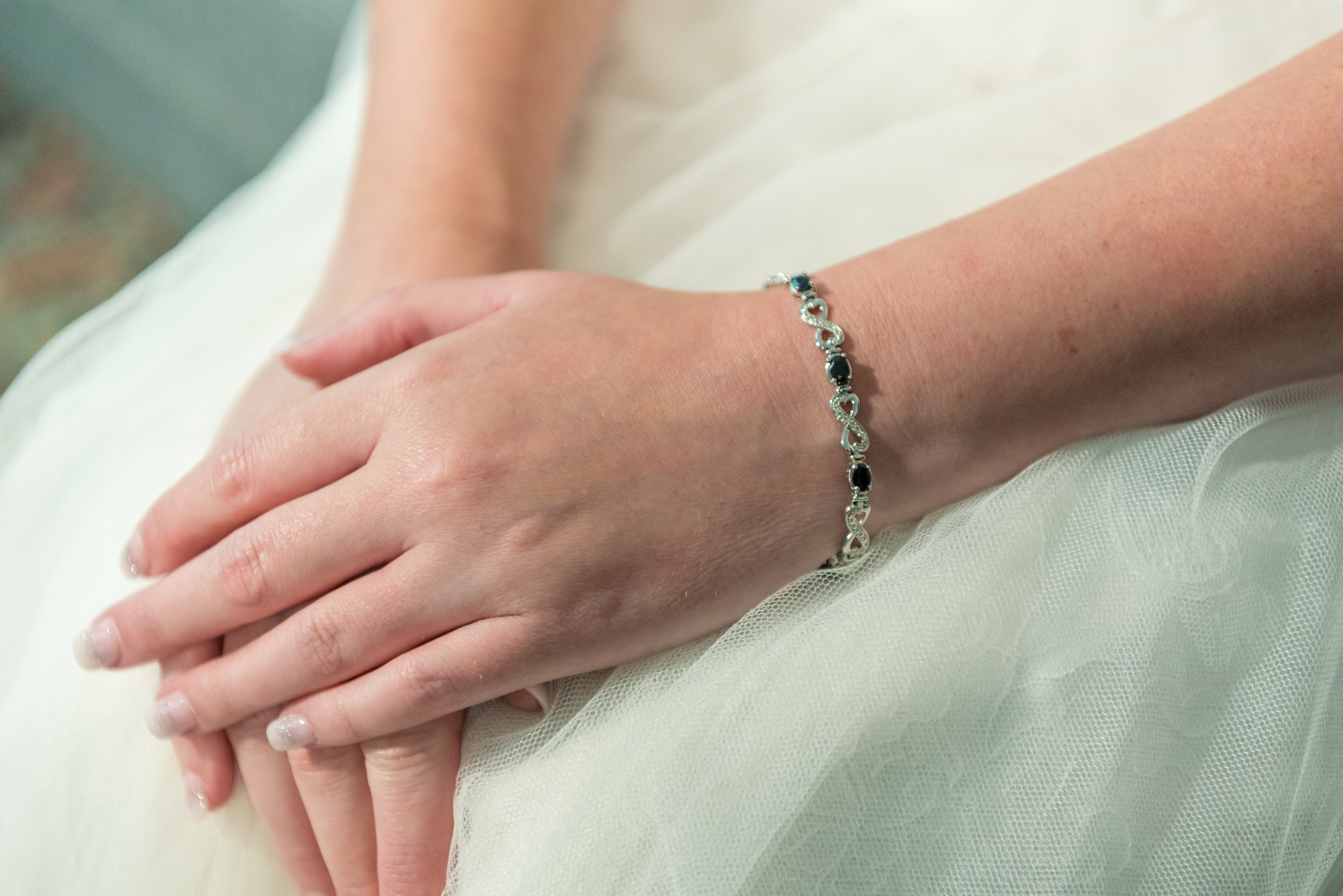
That bracelet had belonged to my grandmother, and to her mother before that, and it had come across an ocean sewn into the hem of a coat by a woman fleeing something she never spoke about. It was the one object my family had carried through everything it had survived. It was not from a flea market. It was the reason there was a family at all.
Madison looked down at it for less than a second and then laughed at the camera. “Oops. It was junk anyway.”
Nobody moved. Not Ryan, ten feet away in linen trousers I had effectively paid for. Not Tiffany, my sister in law, who was checking her reflection in her phone screen and seemed more concerned about her brunch video than the heirloom broken at my feet.
I bent down and picked up both pieces. The metal was cold and heavy and wrong in my palm.
Tiffany finally looked at me. “Don’t be so dramatic, Nat. It looked ancient anyway. You could probably sell it for scrap.”
Madison giggled. Ryan took another drink and said, “Come on, Natalie. Don’t make this into a whole thing.”
And that was the moment everything inside me went very quiet.
I did not cry. I did not shout. I put the two broken pieces into my pocket, and I looked around their backyard. The imported stonework. The leased luxury SUV in the driveway. The enormous patio set Tiffany had spent three weeks posting about. The whole house they used as proof to the world that they had made it.
They had no idea how much of that life I had quietly kept from collapsing.
The property taxes, when Ryan fell behind two years running. The emergency checks after Tiffany’s boutique failed and left her with debt she hid from him. The temporary loans that were never once repaid and never once mentioned again. And the largest secret of all, the sixty thousand dollars a year that kept Madison enrolled at the music conservatory she bragged about in every single video.
They believed life simply kept rescuing them. It had never occurred to any of them to wonder whose hands were holding everything up.
“I’m going home,” I said.
Ryan barely glanced at me. “Fine. See you next week. Don’t forget Mom’s birthday present.”
I walked through their kitchen, past the marble island where the overdue bills lived in a drawer, and I let myself out the front door. I did not slam the car door. I closed it gently, which frightened me more than slamming would have.
The drive home was unnervingly quiet, and my hands stayed perfectly steady on the wheel, and that steadiness scared me too, because I understood what it meant. It meant I had stopped bargaining. When I go quiet and steady, I have already decided.
My apartment smelled of old books and lemon furniture polish. No ring lights. No performed laughter. No one pretending to a wealth they had never earned. I made a cup of tea, and I sat down at my laptop, and I opened an empty spreadsheet, and I named it, with a bitterness I allowed myself just that once, The Ledger of Ghosts.
Ryan’s mortgage rescue, two years back. Forty two thousand dollars.
Tiffany’s failed boutique. Twenty five thousand.
Their house down payment, which everyone at the time had called a gift. Eighty thousand.
I typed them all in, the invisible architecture of their visible success, and then I signed into the donor portal for the conservatory.
My identity had always been confidential. The school knew who I was. Ryan and Tiffany did not. Madison certainly did not. For three years the tuition had simply appeared, and she had accepted it the way she accepted everything, as her natural due.
Her record loaded. Madison H. Artistic Merit Grant. Fully funded. Active. Sixty thousand dollars per year.
I had paid it in silence for three years because I wanted her to have the chance her talent deserved, and because I did not want the instability her parents generated to cost her something she had actually earned. Because she did have talent. That is the part that made all of it hard. Madison was genuinely gifted. Her hands on a violin were the one honest thing in that entire family.
And foolishly, somewhere underneath the generosity, I had hoped that giving quietly might one day produce something like respect.
But you cannot respect what you are never required to acknowledge. I had made myself invisible, and invisibility, I finally understood on that patio, does not produce gratitude. It produces the flea market comment. It produces the broken clasp and the laugh at the camera. They could treat my grandmother’s bracelet as garbage precisely because I had trained them, for years, to believe that everything I gave was free and therefore worthless.
I looked at the two broken pieces beside my laptop.
Then I clicked manage funding. My finger rested over the trackpad for one second. Cancel recurring transfer. Are you sure? Yes. The page refreshed. Status, inactive. Funding withdrawn.
I finished my tea before it went cold.
Tiffany called before nine on Monday. She did not say hello. “Nat, thank God. We have an emergency. The conservatory says Madison’s tuition payment failed.”
“Failed?”
“They said the funding source was withdrawn. Can you imagine? She’s already in rehearsals. If it’s not fixed today they might remove her from the program.”
“That sounds stressful.”
“Stressful? It’s humiliating. Ryan’s useless with administrative things and I’m buried in a sponsorship campaign. You work in archives, you’re good with institutions. Call the school. Use that professional voice of yours and tell them it was a clerical error.”
Even now, in a crisis, she was assigning me a task.
“I can’t call them, Tiffany.”
“Just say you’re Madison’s business manager. Fix it, Natalie.”
“I’m sure the donor had a reason.”
She went quiet for a beat. “What reason could there possibly be? Madison is a prodigy. Some jealous loser probably saw her livestream and decided to punish her.”
She was closer to the truth than she knew.
“I can’t help you,” I said. “You and Ryan will have to sort this out yourselves.”
I ended the call before the screaming started.
They called for two days. Then they moved to social media. Tiffany posted a tearful video about malicious relatives and a scholarship account that had supposedly been hacked. Madison messaged me as though I owed her both a replacement bracelet and a new violin bow, in the same breath, without apparent irony.
By Thursday evening all three of them were pounding on my apartment door.
Ryan pushed in first, red faced. Tiffany followed with her makeup smeared. Madison came last with her arms folded and a bored expression, as though accountability were just another tedious room she had been dragged into.
“They gave us forty eight hours,” Ryan said. “We need sixty thousand dollars or she’s out of the conservatory.”
Tiffany’s voice shook. “The letter mentions ethical violations, Nat. Ethical violations. You have to lend us the money until Ryan’s next commission comes in.”
Madison dropped onto my sofa without asking, and put her shoes up on my clean rug.
“This is so unfair,” she said. “I didn’t even do anything.”
I looked at her shoes on my rug. Then I turned to my brother.
“It wasn’t a clerical error.”
The room went silent.
I walked to my desk, picked up a single printed sheet, and held it out to him. Ryan snatched it. “What is this?”
“Read the signature at the bottom,” I said.
He read it. I watched his face do the arithmetic, the same arithmetic none of them had ever once done, and I watched him arrive at the sum.
It was the confirmation of the recurring transfer I had just canceled. Donor of record. My name. Natalie. Not a foundation, not a jealous stranger, not a hacker. Me. Three years of it, sixty thousand a year, in black and white, with my signature at the bottom.
“You,” Ryan said. It came out strange, half a question. “You’ve been paying for the conservatory.”
“For three years.”
“That’s, why would you,” he stopped. He looked at the paper again, as though the signature might change. “Why would you hide that?”
And there it was, the real question, the one that opened the whole thing, and I answered it honestly because I had finally decided to stop protecting them from the truth of themselves.
“Because you asked me to,” I said. “Not those words. But every time I gave anything, the arrangement was always the same. I gave, and we all agreed to pretend it hadn’t happened, so that you could go on believing you’d built this yourselves. The mortgage. The boutique. The down payment on the house. Madison’s tuition. I kept all of it invisible because that’s what you needed, so I did it, and I told myself I was being generous, when really I was just agreeing to let you take from me and feel good about yourselves at the same time.”
“Nat—”
“And then your daughter held my grandmother’s bracelet up to a camera and called it flea market garbage, and broke it, and laughed, and not one of you moved. Tiffany told me to sell it for scrap. You told me not to make it a thing.” I kept my voice level. “That bracelet is eighty years old, Ryan. Our great grandmother carried it out of a place she never talked about, sewn into her coat. It is the reason this family exists. Madison called it junk because I taught all of you, for years, that everything I give is free and worthless. So I’ve stopped giving. That’s all that happened. The invisible thing became visible, and then it stopped.”
Tiffany found her voice. “You’re punishing a sixteen year old for a bracelet? That’s insane, that’s, Natalie, that’s her entire future—”
“No,” I said. “I’m declining to secretly fund a family that treats me as a resource and my history as garbage. Madison’s future was never mine to owe. I gave it to her as a gift for three years, freely, and a gift can be stopped, especially when the people receiving it show you exactly what they think of you.”
Madison, on my sofa, said, “So because I broke some old bracelet, I don’t get to be a musician? That’s so unfair I can’t even—”
“Madison,” I said, and something in my voice made her stop. “You are genuinely talented. That is the truest thing about you, and it is the only reason this hurts me at all. But you did not break some old bracelet. You broke the one object your family carried through everything, and you did it for a video, and you laughed. And your talent does not entitle you to be cruel and then have the cruelty paid for. Those are two separate things. The violin is real. What you did on that patio is also real. You don’t get to keep only the first one.”
Here is what happened after, because a confrontation in a living room is not an ending, and the year that followed is the part that actually matters.
I did not turn the funding back on. Ryan and Tiffany raged, and then they pleaded, and then they tried, over the following weeks, every angle a family develops over a lifetime of never facing consequences. Ryan told relatives I had cruelly destroyed his daughter’s future over a piece of jewelry. Tiffany’s version, delivered to a wider audience, cast me as a bitter, childless aunt jealous of a beautiful young girl’s success. Some people believed them. The ones who had known me a long time were quieter, because some of them had wondered, over the years, how Ryan and Tiffany afforded a life that visibly exceeded their income, and now they had part of an answer.
Madison did lose her place in that conservatory. I want to be honest about that, because it is the hard center of this story and I will not soften it. She was removed when the tuition went unpaid, and I did not intervene, and for a while I was the woman who ended a gifted child’s musical education over a broken bracelet, and I had to live inside that description, because from a certain angle it was true.
But it was not the whole truth, and the whole truth revealed itself slowly.
Because Ryan and Tiffany, faced with a sixty thousand dollar bill they could not pay and could no longer route to me, had to confront the actual shape of their finances for the first time in a decade, and the shape was catastrophic. The house they used as proof of success was leveraged past its value. The lifestyle was entirely performance. Without my invisible hand underneath it, the whole structure began to come down, not because I pushed it, but because I stopped holding it up, and it had never been able to stand on its own.
They did not lose everything at once. But they had to sell the SUV, and then downsize the house, and Tiffany had to get a real job, and Ryan had to face that the commissions he always described as imminent were mostly imaginary. The patio where Madison broke my bracelet belongs to someone else now.
And Madison. This is the part I did not expect, and the part that redeemed the whole miserable episode.
She did not stop playing.
She could not afford the elite conservatory, but talent, real talent, does not actually require sixty thousand dollars a year, whatever that school’s brochure implied. She enrolled in the music program at a state university, on a genuine scholarship, one she earned by audition rather than by an aunt’s secret check. And something happened to her there that I do not think could have happened at the conservatory, which is that she had to be good in a place where nobody was funding her, nobody was livestreaming her, and nobody was pretending she was a prodigy. She just had to play, among other serious students, for teachers who did not care who her mother’s followers were.
She got better. And she got, slowly, humbler, in the way that a person gets humble when the scaffolding of other people’s money and attention is removed and they discover they can actually stand.
She wrote to me about two years after the patio. A real letter, handwritten, which touched me before I even read it because it meant she had chosen a form that could not be performed for an audience.
She apologized for the bracelet. Not the way her parents apologized, which was always really a demand wearing an apology’s clothes. She apologized the way a person does when they have actually understood the thing they did. She wrote that she had been sixteen and performing her whole life for a camera and had genuinely not understood, until it was gone, that some objects are not props. She wrote that she had learned what the bracelet was, had asked her grandmother about it, and had cried. And she wrote that losing the conservatory had been the best thing that ever happened to her, though it had not felt that way at the time, because it was the first thing in her life she’d had to earn back with her own hands, and earning it had shown her who she actually was underneath all the funding and the ring lights.
The last line said: I don’t expect you to pay for anything ever again. I’m not writing for that. I’m writing because you were the only adult in my whole childhood who told me the truth, even though it cost you, and it took me years to understand that was love and everything else was just money.
I read that line more times than I can count.
I wrote her back. We are in contact now, carefully, on terms that have nothing to do with money. She sends me recordings of her playing sometimes. She is very good. She got there without me, which is exactly as it should be.
Her parents and I do not speak. Ryan has never acknowledged what the years of invisible rescue actually were, and I have stopped waiting for it, because some people cannot survive the knowledge of what they took, and my brother is one of them. Tiffany tells a version of the story in which I am the villain, and she is welcome to it. I have made my peace with being the villain in a story told by people I stopped funding.
I had the bracelet repaired. It took a specialist, and it cost more than the platinum was worth, and I did not care, because the value was never in the metal. It is whole again now, the safety chain rebuilt, and I wear it, and when people ask about it I tell them the true story, the coat and the ocean and the woman who never spoke about what she left behind. I do not tell them it was called garbage on a livestream. That part is not part of the bracelet’s story. That part is part of mine.
I have thought a great deal about the three years I paid in silence, and about why I did it, and about what it actually produced.
I told myself I was being generous. I was not, entirely. Generosity given in secret, on the condition that no one ever acknowledge it, is not only generosity. It is also a way of buying something, and what I was trying to buy was a place in a family that had never quite made room for the quiet aunt in the archives. I thought if I held everything up, invisibly, I would matter. And it did the opposite. It made me the thing you take for granted, the floor you stand on without looking down, the woman whose grandmother’s bracelet you can call garbage because everything she gives has always been free.
The bracelet breaking was the best thing that happened to me, the same way losing the conservatory was the best thing that happened to Madison. It ended the arrangement. It made the invisible visible. And once it was visible, it could stop, and once it stopped, the truth about all of us finally had room to come out.
The Ledger of Ghosts is still on my laptop. I never sent it to anyone. I never needed to. I kept it not as a weapon but as a record, a reminder of exactly how long I let myself be spent, and how much it took, in the end, for me to stop.
My grandmother’s bracelet is on my wrist. It is not from a flea market. It is the reason there is a family at all, and it is whole again, and it belongs to the one person in that family who finally understood what it was.
Which turned out, in the end, to be me and a sixteen year old who grew up, and no one else.
That is fewer people than I wanted. But it is the true number, and I have learned to prefer a true small thing to a false large one.
My grandmother would have understood that. She carried the whole family across an ocean in the hem of a coat, and she did it for the ones who were worth carrying, and she never once, I am certain, wasted a stitch on anyone who called it garbage.

Adrian Hawthorne is a celebrated author and dedicated archivist who finds inspiration in the hidden stories of the past. Educated at Oxford, he now works at the National Archives, where preserving history fuels his evocative writing. Balancing archival precision with creative storytelling, Adrian founded the Hawthorne Institute of Literary Arts to mentor emerging writers and honor the timeless art of narrative.