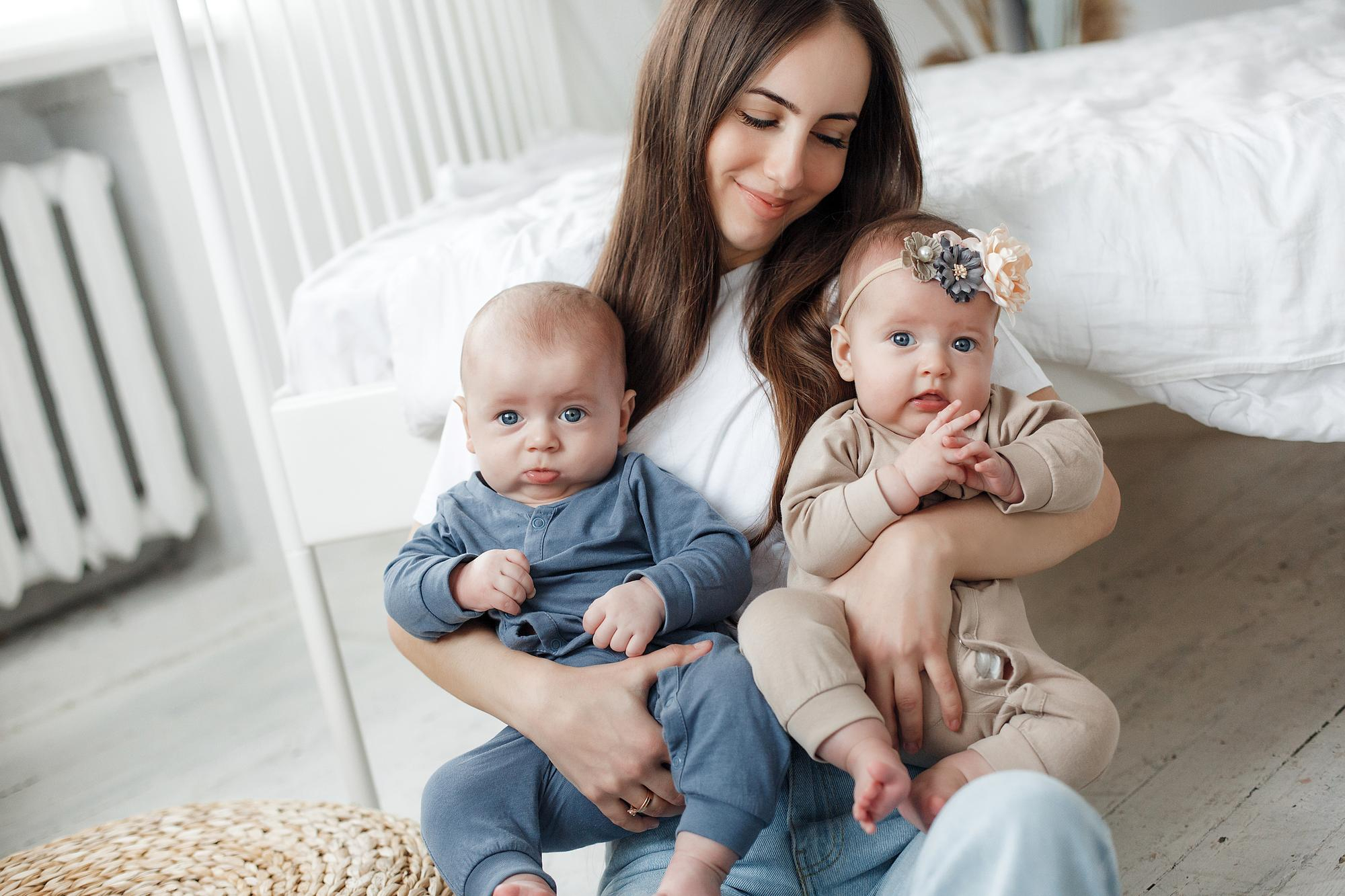
Before the babies came, Ethan was the kind of husband other women told me they envied. He remembered anniversaries without being reminded. He left notes in my lunch bag. When we started talking seriously about a future together, he was the one who wanted the big family, not me. He would get this dreamy look on his face and talk about a house full of noise and chaos and little feet, and he swore, over and over, that we would do it all as equals. Fifty fifty. A real team. I believed him because I loved him and because he said it with such conviction that it never occurred to me a person could mean something so completely in the moment and abandon it so totally the instant it was tested.
We tried for a long time. There were months of hope and disappointment, the quiet grief of a negative test, and then finally a positive one, and then the ultrasound where the technician went very quiet and then very excited and turned the screen toward us and said, “Well, there’s one. And there’s two. And, okay, there’s three.” Triplets. Ethan cried in the parking lot afterward, happy tears, holding my hands and saying it was everything he had ever wanted, that he was going to be the best father, that I would never have to do any of it alone.
I want you to remember that he said that. I would never have to do any of it alone. I have replayed those words more times than I can count.
The pregnancy was brutal in the way that carrying three babies at once is always brutal. I was on modified bed rest by the second trimester and full bed rest by the third. Ethan was attentive enough during that time, in the way that a man can be attentive when the work is mostly a matter of bringing you things and feeling good about himself for it. He brought me water. He set up the nursery, or rather he supervised while his brother set up the nursery. He posted about it online, the impending arrival of our three miracles, and collected the admiration of everyone we knew, and I did not yet understand that for Ethan the performance of fatherhood and the fact of it were two entirely different things, and that he was only ever interested in the first.
The babies came at thirty four weeks by C-section. Two girls and a boy. Lily and Grace and Sam. They were small and perfect and they spent nine days in the NICU learning to eat and breathe and regulate their own temperatures, and Ethan was there for the photographs and the announcements and gone for most of the rest. I did not think much of it at the time. He had work, and someone had to keep the income coming, and I told myself that once the babies were home he would step into the role he had promised.
He did not.
We brought them home on a Thursday. By Friday night, Ethan had moved his things into the guest room.
“I need eight hours,” he told me, as though this were the most reasonable statement in the world. “Uninterrupted. You know how demanding my job is. I can’t be running on empty in front of the executive team. One of us has to stay functional, Chels, and it makes sense for it to be me, because I’m the one bringing in the money.”
I was standing there four days out from major abdominal surgery, still bleeding, still unable to fully straighten up because of the incision, holding a newborn in each arm while a third screamed in the bassinet, and I did not have the strength to argue. So I did not argue. I told myself it was temporary. I told myself a lot of things in those first weeks that I knew, somewhere underneath, were not true.
What followed was the hardest stretch of my entire life, and I want to describe it honestly, because I think people who have not lived it cannot understand what it does to a body and a mind. Three newborns do not sleep on the same schedule. They do not eat on the same schedule. There is no such thing as all of them being asleep at once for more than a few minutes at a time, so there is no such thing as sleep for the person caring for them. I was pumping, because my milk supply could not keep up with three, and then supplementing with formula, and then feeding, and then burping, and then changing, and then soothing, and by the time I had gotten through all three of them it was time to start again with the first. Around the clock. No breaks. No help.
Ethan slept eight hours a night behind a closed door. In the mornings he would emerge, showered and rested, step over the wreckage of my night, pour himself a coffee, and complain that the house was a mess. He went to work. He came home. He ate the dinner I somehow scraped together between feedings. He retreated to the guest room. On weekends he golfed, because he was, he explained, so stressed from his demanding week that he needed to decompress. I was recovering from surgery and running on forty minute increments of sleep and he needed to decompress.
I asked him for help. I asked him so many times, in so many ways. I asked gently and I asked desperately and once, on a night when Sam had colic and would not stop screaming and I had not slept in what felt like days, I stood outside the guest room door and begged. I could hear him in there. I knew he was awake. He did not come out. In the morning he told me that my hormones were making me dramatic, that other women managed just fine, that his own mother had raised four children and never complained, conveniently omitting that his mother had a husband who worked and a mother of her own who lived next door and a sister who came every afternoon.
I stopped asking after that. Something in me went quiet and cold and clear.
When the babies were six weeks old, Ethan came home from work with an announcement. He had booked a vacation. Two weeks in Cabo. Solo.
“I’m burnt out, Chelsea,” he said, and he said it with a straight face, this man who slept eight hours a night while I hallucinated from exhaustion. “I’ve been running on fumes. I just need to reset. Two weeks in the sun, no stress, and I’ll come back a better husband and father, I promise. You’ll see. It’s an investment in us, really.”
I looked at him for a long moment. I was sitting on the living room floor because it was easier than getting up, with Lily and Grace propped against my legs and Sam at my breast, and I had cold coffee going to skin beside me because I had poured it four hours ago and never found a moment to drink it.
“You’re leaving me alone with three six week old babies,” I said. “For two weeks.”
“Don’t be like that,” he said. “You’ve got this. You’re supermom. Honestly you don’t even really need me here, you’ve got such a good system going.” He actually smiled when he said it, as though he had paid me a compliment. “And it’s already booked. Non refundable. So.”
I did not cry. That surprised me, a little. Six months earlier I would have cried, would have pleaded, would have made myself smaller and softer in the hope of reaching whatever part of him used to love me. But that part of me had been worn away, one sleepless night at a time, until what remained was something harder and more still. I simply nodded and said, “Okay.”
He seemed relieved. He had braced for a fight and I had not given him one, and he took my quiet for acceptance, because Ethan had never in his life been able to imagine that a person might go quiet for any reason other than surrender.
He spent the evening packing. He pulled out his big suitcase, the good one, the hard shell one we had bought for our honeymoon, and he laid out his resort clothes and his swim trunks and his expensive sunglasses and the linen shirts he thought made him look sophisticated. He packed sunscreen and a paperback he would never read and the nice cologne. He was, I noticed, in a wonderful mood. Humming. Excited. A man about to be rewarded.
I fed the babies. I put them down, one by one, in the small windows when they would go down. And I waited.
Around midnight, when the house was finally quiet and Ethan was asleep behind his closed door with the deep untroubled sleep of a man who has never once gotten up in the night, I got up off the couch where I had been feeding Grace, and I walked to the front hall where his packed suitcase stood waiting by the door, ready for the morning taxi.
I want to be clear about what I did and did not do, because I have thought about it a great deal since, and I have decided I am not ashamed of any of it.
I did not do anything cruel. I did not ruin his clothes or hide his passport or do any of the vindictive things a person might imagine. I unzipped the suitcase quietly, and I made a few careful adjustments, and then I zipped it back up and went to feed Sam, who was starting to stir.
What I did was this. I took out every single item of his vacation clothing, folded neatly, and I set it aside. In its place I packed the things I had spent the evening preparing while he hummed and dreamed of the beach. I packed a two week supply of newborn diapers, the giant economy boxes, broken down to fit. I packed cans of formula. I packed burp cloths and onesies and a stack of the little instructional cards I had written out by hand, feeding schedules and soothing techniques and the specific way each baby liked to be held, because Lily liked to face out and Grace liked to be swaddled tight and Sam would only calm on your forearm with his belly down.
And on top of it all, where he would see it the moment he opened the case, I placed a single photograph. It was a picture of the three of them, our children, asleep in a row, taken on one of the rare peaceful mornings, three tiny faces I had grown and birthed and kept alive alone. And tucked beside the photograph, a letter.
Then I closed the suitcase, and I went back to my children, and I did not sleep, because I never slept, but for the first time in six weeks I felt something other than despair. I felt calm.
In the morning Ethan was up early and bright, practically bouncing. He showered and dressed and rolled his suitcase to the door, and he kissed me on the cheek where I sat on the floor with all three babies, and he said, “Hold down the fort, supermom. I’ll send pictures.” And he climbed into the taxi and was gone, and I watched the car disappear down the street and then I turned back to my day. Cold coffee. Sheer grit. Three babies and one mother and the endless cycle beginning again.
At four o’clock that afternoon, my phone rang.
It was Ethan, calling from his luxurious resort room, from the beach he had flown across a country to reach so that he could rest while I could not. I answered on the second ring. I did not say hello. I did not need to.
Before I could say anything at all, he screamed at the top of his lungs, so loud I had to hold the phone away from my ear, “You really did this to me?!”
I let his voice ring out and fade. Sam was on my shoulder, and I patted his back, slow and even, and when I spoke my voice was very calm.
“Did what?” I said.
“You know what! I get here, I open my bag to change for dinner, and it’s, it’s diapers, Chelsea! It’s formula and baby clothes and there’s not one single thing of mine in here, not a shirt, not my swimsuit, nothing! I flew all the way here with a suitcase full of baby stuff! Do you have any idea how this looks? The bellhop saw! What is wrong with you?!”
“Did you read the letter?” I asked.
There was a silence on the line. I could hear the ocean behind him, the ocean he had traveled so far to sit beside.
“What letter,” he said, but his voice had changed. Some of the fury had gone out of it and something warier had crept in.
“It’s on top,” I said. “Next to the photo of the kids. Read it. I’ll wait.”
I heard rustling. I heard the suitcase again, the crinkle of a diaper box. I imagined him standing in his beautiful room, in his travel clothes with nothing to change into, holding the letter I had written at two in the morning while our son screamed against my chest. I waited. Grace began to fuss in the bouncer and I reached over with my foot and rocked her gently, and I waited some more.
When Ethan came back on the line his voice was small.
The letter was not cruel either. I had thought about that carefully. Cruelty would have let him make me the villain, would have given him a story to tell his friends about his crazy wife, and I did not want to hand him that. So the letter was simple, and it was true, and I think that is why it landed the way it did.
I had written: Ethan. You said you needed a break. So do I. But I don’t get one, because someone has to keep our three children alive, and for six weeks that someone has been only me. You’ve told me I’ve got this, that I don’t even need you, that I’m supermom and you’d only be in the way. So I’ve taken you at your word. Everything in this suitcase is what it actually takes to care for our children for two weeks. The diapers, the formula, the schedules, the sleepless nights folded up in these clothes you won’t find. I packed it so that wherever you are, you’ll be carrying what I carry. I hope the beach is nice. I hope you rest. And I hope, while you’re resting, you’ll think about whether the man who promised me an equal partnership is a man you still want to be, because the one who got in that taxi this morning is not someone I can stay married to. When you come home, we are going to have a conversation. Or you can stay in Cabo. Either way, I have made my peace. I am done asking. Chelsea.
“Chels,” he said, and his voice cracked on my name. “Chelsea, come on. This is, this is crazy, you can’t be serious.”
“I’m completely serious,” I said. “I’ve never been more serious about anything in my life.”
“I’ll fix it,” he said quickly. “I’ll come home. I’ll come home right now, I’ll get a flight tonight, I didn’t, I didn’t realize it was this bad, I thought you were, I thought you had a handle on it.”
“I never had a handle on it,” I said. “I was drowning and telling you I was drowning and you called it hormones and went golfing. So no. Don’t come home tonight. Stay. Take your two weeks. I mean that. I have survived six weeks alone. I can survive two more. What I can’t survive is going back to how it was. So take the time, and use it to decide who you’re going to be. And so will I.”
And I hung up.
He called back eleven times over the next hour. I did not answer. I fed my babies and I changed them and I sang to them in my cracked exhausted voice, and I did not answer the phone, and something in my chest that had been clenched tight for six weeks began, very slowly, to loosen.
He did come home. Not that night, because there were no flights, but two days later, having cut his precious vacation short. He walked in the door with his ridiculous suitcase still full of diapers, and he found me exactly where he had left me, on the living room floor with three babies, except that this time I did not look up at him with pleading in my eyes. I looked up at him the way you look at a stranger who has wandered into your house.
We did have the conversation. It was long and it was hard and it went on for many nights after the children were finally down. Ethan cried a great deal, and apologized a great deal, and for the first few days I did not believe any of it, because I had learned that Ethan’s feelings were real in the moment and meaningless the instant they were inconvenient. But something did seem to have shifted in him. Perhaps it was the humiliation of the bellhop and the suitcase. Perhaps it was the letter. Perhaps it was simply the first time in his life that I had stopped making myself small enough to fit around his selfishness, and he had discovered that the marriage he had taken for granted could actually end.
I told him what I needed, and I did not soften it. I needed a true partner or I needed a divorce, and I was genuinely at peace with either, and that peace was the thing that finally got through to him, because he could see it was not a threat. It was just the truth. I was no longer afraid of losing him. I had already lost him, weeks ago, on the floor with the cold coffee, and having survived that loss I was free of him in a way that made me impossible to manipulate.
He moved back into our bedroom. He started getting up in the night, clumsily at first, resentfully at first, and then less so. He learned which baby liked to face out and which liked to be swaddled and which would only settle belly down on your forearm. He took the cards I had written and he actually used them. He talked to his boss and arranged to work from home two days a week, the same boss he had sworn would never allow such a thing, which told me everything about how impossible he had decided the impossible things were. It turned out a great many things Ethan had called impossible were merely inconvenient.
I would like to tell you that he transformed overnight into the husband he had promised to be, but that would be a lie, and I have had enough of lies. The change was slow and it was uneven and there were setbacks, weeks where he slid back toward the guest room and the golf course and the language of my hormones, and each time I met it with the same flat calm, the same clear willingness to walk away, and each time he pulled himself back. Because he had learned, finally, that I meant it. That the woman who packed that suitcase was not going to spend the rest of her life begging to be helped in her own home.
The triplets are three years old now. Lily and Grace and Sam, running and shrieking and covered in whatever they most recently got into, three small tornadoes who have no memory of the terrible early months and never will, which is exactly as it should be. Ethan is, these days, a good father. I do not say a perfect one, because there is no such thing, but a real one, present and involved, a man who knows his children as people and not as props for a photograph. Some nights I watch him wrestling all three of them into pajamas, exhausted and laughing, and I feel a tenderness toward him that I was not sure, in those dark weeks, I would ever feel again.
He keeps the suitcase, by the way. The big hard shell honeymoon suitcase. He never took another solo vacation, and when we travel now we travel together, all five of us, an absurd amount of luggage and three car seats and chaos in every direction. But the suitcase stays in the closet, and once, on an anniversary, he pulled it out and set it between us and said, quietly, “I still think about opening this. In that hotel room. It was the worst moment of my life and it was the best thing that ever happened to me, and I don’t know how both of those are true.”
I told him I understood exactly how both of those could be true. I had learned that year that a thing can break you open and save you at the same time.
People who hear the story sometimes ask if I feel guilty about what I did. Sending my recovering-from-nothing husband off to a luxury resort with a suitcase full of diapers, humiliating him in front of the resort staff, hanging up on him while he panicked. And the honest answer is no. I do not feel guilty at all. I had asked for help in every gentle way a person can ask, for six weeks, while my body healed from surgery and my mind frayed from sleeplessness, and I had been dismissed and belittled and abandoned. The suitcase was not cruelty. The suitcase was the truth, packed into a hard shell case and carried across the country until he could not look away from it. Sometimes the only way to make a person understand the weight you are carrying is to hand them the bag.
I did not do it to punish him, though I understand why it looks that way. I did it because I had reached the end of asking, and I had one message left to send, and words had stopped working. So I sent it in diapers and formula and a photograph of three sleeping babies, and against all odds it arrived.
These days, when one of the kids asks me for the story of when they were tiny, which they do sometimes, because children love hearing about themselves, I tell them a gentle version. I tell them that they were the three best surprises of my whole life, and that taking care of three babies at once was very hard, and that their daddy and I had to learn how to be a real team, and that we did. Which is all true. The suitcase is a story for when they are older, if I tell them at all.
But I will always know the truth of it. I will always know that there was a version of my life where I kept begging and kept shrinking and kept accepting less and less until there was nothing left of me, and that I did not choose that version. I chose, instead, to stand up off that floor at midnight, exhausted beyond words, and to pack a suitcase that told the truth. And in doing so I did not just change my marriage. I found the part of myself that had gone quiet and cold and clear in those terrible weeks, and I discovered that it was not despair at all. It was strength, waiting for me to finally use it. And I never put it down again.

Adrian Hawthorne is a celebrated author and dedicated archivist who finds inspiration in the hidden stories of the past. Educated at Oxford, he now works at the National Archives, where preserving history fuels his evocative writing. Balancing archival precision with creative storytelling, Adrian founded the Hawthorne Institute of Literary Arts to mentor emerging writers and honor the timeless art of narrative.