Four Places
Sarah made the recording on a Tuesday afternoon in October, during the last month of her pregnancy, when the light came through the nursery window at the particular angle that turned the yellow walls almost golden. I was sitting on the floor at the time, assembling a crib with instructions written by someone who assumed the reader owned tools I did not own and had a spatial intuition I had never developed. She picked up my phone from the windowsill without telling me what she intended to do, and she pressed record, and she sang.
She sang the lullaby she had been singing to the baby for months, the one she’d heard as a child and only half-remembered, which meant she improvised freely through the forgotten sections and filled gaps with humming or words that rhymed in the approximate vicinity of the original. She sang it the way she did everything: fully committed, unconcerned with imperfection, making it her own in the process of doing it. She forgot a line in the third verse and hummed through it without breaking stride. She laughed once in the middle because the baby kicked at what felt, she said, like editorial commentary on the lyric she’d just invented.
She kept going anyway.
When she pressed stop she looked at me with the expression she used when she’d done something she found quietly satisfying.
“If our little girl inherits your stubbornness,” she said, “she’ll probably need this someday.”
I told her the stubbornness was hers, not mine. She agreed immediately and completely, which was something she did when she was right and understood it, when the point was not worth pretending to contest because the evidence was overwhelming and she knew I knew it.
Ari was born five weeks later. Sarah died six hours after that, from a hemorrhage that moved too quickly and too completely for anyone to stop. There was an explanation, delivered carefully by people whose job includes delivering explanations to people who are not in a condition to receive them, and I nodded at the right moments, and then I went home to a nursery that smelled like fresh paint and a baby who needed feeding every three hours and a phone that held one recording I could not listen to and could not delete and could not figure out how to carry.
I am not going to spend many words on the first two years, because I do not have clean words for them. What I have is a series of images, disconnected and unglamorous, that represent the actual texture of that time: cereal poured into the refrigerator and milk into the cupboard before I registered what I was doing. The nursery floor, which I slept on more nights than I slept in my bed, because Ari slept better when she could hear me breathing. The work inbox, which did not understand bereavement leave and did not care, which required my attention because diapers and formula required money and money required work. My mother, who moved into the guest room the week Sarah died and stayed for eighteen months, who cooked and cleaned and held Ari when I needed both hands to fall apart, and to whom I owe a debt I will spend the rest of my life attempting to partially repay.
I filled the house with photographs of Sarah. This was partly a conscious decision and partly the result of being unable to take them down, of moving through rooms that had been hollowed of the person who had made them feel purposeful and trying to fill the hollowness with evidence. I needed to see her face in the morning before I was fully awake. I needed Ari, who was growing with terrifying speed into a person with opinions and questions and a memory that was beginning to retain things, to grow up knowing whose face that was.
When Ari was almost two she stood in the hallway pointing at the photograph on the side table and asked, “Who dat?”
“That’s your mommy,” I said.
She studied the photograph with the serious attention she brought to new information. “She funny?”
“The funniest person I ever knew.”
“How Mama talk, Daddy?”
I had to look away before I could answer. “Beautiful,” I said. “She talked beautiful.”
“Can I hear Mama?”
Sometimes I played the recording. Sometimes I opened my phone and looked at it and could not press play, and I put the phone back in my pocket and told Ari that maybe later, and later never came. Each time Sarah’s voice came through the speaker I experienced something that felt less like grief and more like re-injury, a fresh specific wound laid over the accumulated ones, and I had not found a way to receive it without flinching. I told myself Ari was too young to fully understand what she was asking for. The true reason, which I understood later and which reflects worse on me, was simpler: I was not ready to share the recording. Sharing it meant being present for it. Being present for it meant a steadiness I had not yet built.
I was still building it when I met Claire.
Ari’s second birthday required a gift and I had no working framework for what two-year-olds needed beyond the obvious necessities we already owned. I went to the toy store with no plan. It was overstocked and loud with the productive chaos of a place designed for small people, and I stood in the middle of it holding Ari, who had wrapped both arms around my leg and pressed her face against my knee in the posture she used when she was conducting her preliminary assessment of a new environment. She did this everywhere: watched before she joined, processed before she engaged, decided on her own timeline whether a situation was one she wanted to enter.
Claire was behind the counter in a blue apron with embroidered stars across the pocket. She had a warm voice and the practiced, immediate perception of someone who has spent years in the presence of small children and has learned to see each one specifically rather than categorically. She looked at Ari for a moment, and then she did something that most people did not do: she did not crouch to Ari’s level, did not address her directly, did not try to insert herself into the assessment Ari was conducting. She simply slipped behind the counter and disappeared.
A floppy stuffed rabbit appeared slowly above the edge of the counter.
It looked left. It looked right. It announced, in a loud whisper calibrated precisely to carry to Ari’s ears, “I don’t think anybody can see me.”
The rabbit spun around elaborately and fell dramatically off the counter.
Ari laughed. It was the laugh she kept for things that genuinely surprised her, open and unguarded.
The rabbit climbed back up. “I meant to do that,” it said.
Another laugh, larger this time.
Within two minutes, Ari had taken the rabbit from Claire’s hands and was making it hop across the counter herself, fully absorbed, the careful watchfulness entirely set aside. Claire looked at me with the quiet satisfaction of someone who has found the right approach for a particular situation.
“There she is,” she said.
I understood immediately what she meant. Not that she had produced Ari’s engagement through some clever technique, but that she had recognized something true about my daughter that most adults missed. Ari did not need to be approached. She needed to be waited for. She needed patience that did not telegraph impatience, an invitation that did not pressure, a space she could enter on her own terms when she had decided it was safe.
Before we left, Claire tucked a small sticker shaped like a rainbow into Ari’s shopping bag. “For the birthday girl,” she said. Ari held the bag against her chest the entire drive home, the way she held Winston the stuffed rabbit later, with the full-body intentionality of someone protecting something that matters.
A week later I returned to the store because Ari informed me, with the certainty of a person who has thought something through carefully, that the rabbit in the store was probably lonely without us. I did not have a strong counterargument. Claire was behind the counter and she laughed when we walked in and said she had been wondering whether the rabbit would see his friend again.
Coffee became dinners. Dinners became long weekend walks that neither of us found reasons to end early. I noticed, during those walks, that I was talking more than I had talked in two years, that there was something in Claire’s quality of listening that made conversation feel like the natural thing rather than an effort.
On our third date I told her about Sarah.
Not a careful curated version with the sharp edges removed, but the actual account: who Sarah had been, how we had met, what the pregnancy had been like, how it had ended, and the particular quality of guilt I carried every morning when I woke up, the guilt that had no rational target and no rational resolution but existed anyway, attached to nothing specific and therefore impossible to address directly.
When I finished, Claire reached across the table and put her hand over mine.
“You don’t have to stop loving Sarah,” she said.
I looked at her.
“You don’t have to stop,” she said again, simply, as if clarifying something that should not have needed clarification but apparently did. “I’m not asking you to do that.”
Nobody had said this to me before. People who loved me had told me, with the best intentions and genuine care, that grief had a natural course toward completion, that love was a resource that needed to be redirected toward the living, that moving on was both healthy and possible and that the measure of recovery was the distance I had put between myself and the past. These things were said kindly and I do not blame the people who said them. But they all assumed the same thing: that making room for new love required clearing the old love away, that the two could not coexist, that Sarah had to become history before Claire could become present.
Claire did not say any of this. She made room for Sarah in the conversation, right there at the table, without asking me to move her to make space. She asked questions about Sarah, listened to the answers, laughed at the funny parts and was quiet during the hard ones. She did not rush toward reassurance or resolution. She simply stayed in the conversation with me, in the fullness of what the conversation actually was.
That was when I understood that something was happening I had not expected to happen again. It frightened me with the specific fear of someone who has learned what can be lost and therefore cannot approach what might be gained without the full weight of that knowledge. And simultaneously it felt like breathing, like the sudden awareness of having been holding your breath for a long time and finally releasing it. Both of those things were true at once and I could not separate them.
Claire met Ari the way she met everything: without rushing, without forcing, with the willingness to be patient for as long as patience was required. She colored beside her without directing the activity. She read books only when Ari selected them and carried them over and placed them in her lap, the explicit transfer of permission that Ari required before she trusted. She learned that dinosaurs needed different voices than teddy bears. She learned that Winston’s name had been Winston from the first moment Ari held him, without announcement, simply the name he had always had. She learned that the game of arranging small figures in careful configurations and then studying the result had rules that were entirely internal to Ari and should not be interrupted or inquired about.
One rainy afternoon I walked past the living room and found them under a blanket fort, laughing at something that appeared to have no external cause, both of them entirely inside a world that had assembled itself between them over the preceding weeks. Neither of them noticed I was there. I stood in the doorway for longer than I needed to and thought about patience, about what it produces when it is genuine and not performed.
When Claire eventually moved into our lives, she did it with the same care she had moved into Ari’s confidence. One step at a time, attending to what was already present before introducing anything new. She never asked Ari to call her Mom. She never suggested that Sarah’s photographs be moved or consolidated or stored somewhere less central. The evening before she brought the first photograph of the two of us to hang in the hallway, she sat beside me and asked, quietly and without the slight performance of generosity that accompanies a concession, whether I wanted Sarah’s pictures to stay exactly where they were.
I stared at her for a moment. “You would be okay with that?”
“Of course.” She said it as though this had never been a question worth asking, as though the alternative had not existed as an option. “They’re part of your family.”
As if the family that had existed before her arrival was not something she was joining and partially displacing, but something she was joining and becoming part of, intact and whole as it was.
I loved her more in that moment than I had the moment before, and the moment before I had already loved her considerably.
We married in a small garden ceremony several weeks later, close family and afternoon light and wildflowers from the yard. Ari wore a white dress she had chosen herself and threw rose petals with the full-body commitment of someone who has been assigned an important role and intends to execute it to the maximum available extent, in approximately the right direction, with more enthusiasm than precision. The photographer caught her mid-throw, arm fully extended, petals flying in a wide arc that covered mostly the grass rather than the path, with an expression of absolute and joyful purpose.
That photograph lives on our mantelpiece now, beside one of Sarah laughing at the kitchen table. The two of them together, side by side, say something true about the shape of the life we were building.
After the wedding, Claire settled into our routines with the naturalness that had always characterized how she moved through our world. She packed Ari’s lunches and danced badly and enthusiastically while making pancakes and conducted a successful diplomatic negotiation with our four-year-old’s vegetable resistance by describing broccoli as tiny superhero trees, a reframing so effective that Ari requested them by that name for the next six months. My mother visited and stood in the kitchen doorway listening to the noise coming from three simultaneous directions and said, in the tone of someone who has been waiting a long time to say something, “So this is what laughter sounds like again.”
But there were things I noticed and did not adequately examine.
After Claire braided Ari’s hair one morning with careful attention and a patience for small fidgeting hands that I had always admired, I came downstairs to find Ari standing in front of Sarah’s photograph in the hallway. Not doing anything. Not asking for anything. Standing and looking. I assumed she was thinking about something tangential, the way children’s minds work, and I called her for breakfast and she came.
Another evening, after Claire had tucked her in and read three chapters of the book they were working through together and turned off the lamp and kissed her forehead, Ari appeared in my doorway ten minutes later carrying her blanket and Winston.
“Daddy?”
“What is it, sweetheart?”
“Can Mommy sing?”
I knew immediately which mommy she meant. It was not a question that required clarification. I played the recording and she listened with Winston held against her chest and fell asleep before the song ended, as she often did, the music organizing something in her that the day had left scattered.
It happened the following week. And the week after.
Whenever Ari and Claire shared one of their happiest moments, a successful fort, a particularly good book, a laugh over something that was only funny if you were there for the precise conditions that made it funny, Ari seemed afterward to go looking for Sarah. The pattern was consistent enough that Claire noticed it and named it to me one evening after Ari was asleep.
“I feel like she pulls away whenever we get close,” she said. “Every time something good happens between us, she retreats after.”
“She’s adjusting,” I said.
“I hope so,” Claire said.
But there was something in her face that suggested she was less convinced than I was, and she was right to be less convinced, because my reassurance was not based on understanding the situation. It was based on wanting the situation to be simpler than it was.
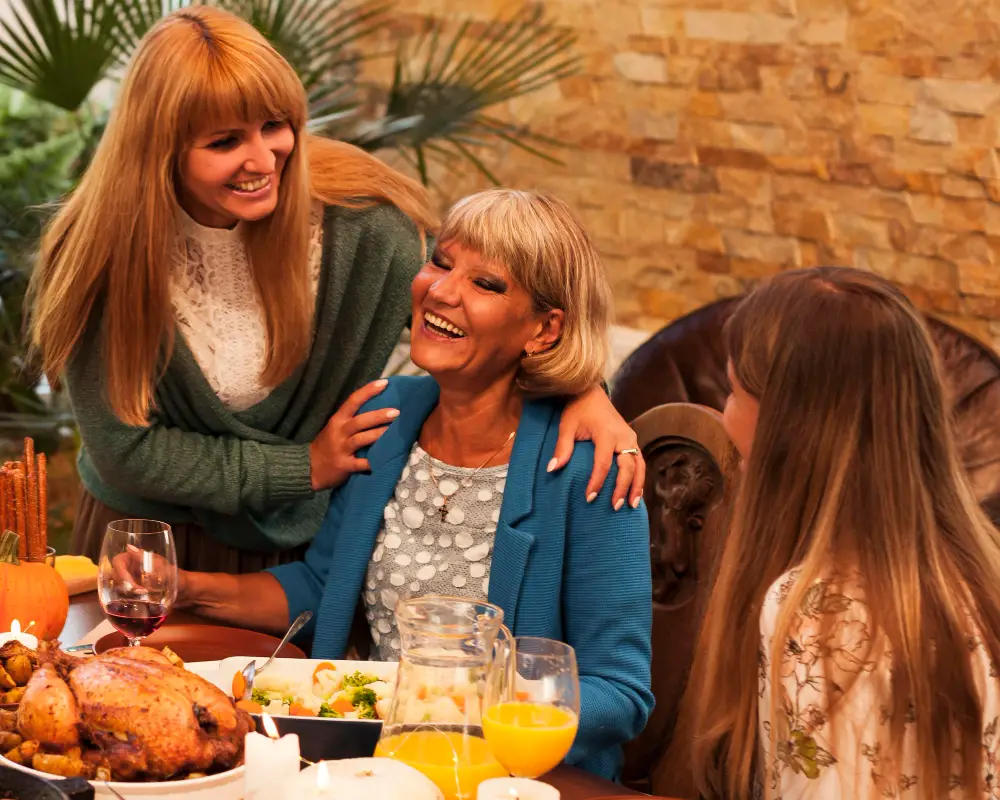
I invited my family to dinner as a thank-you, a recognition of the years they had carried us. My parents, my younger sister, an evening to show them that life had arrived somewhere hopeful. Claire cooked for the whole afternoon. Roasted chicken and fresh bread and an apple pie that cooled beneath a clean towel while the smell of all of it moved through the house. Ari helped set the table with the dedicated imprecision of a four-year-old who has been given a real job and intends to do it, placing forks on the wrong sides and napkins slightly in the wrong positions, and Claire followed behind her and corrected each thing without comment or correction, simply setting it right as part of her own movement through the space.
When my family arrived the house expanded to hold them. My mother hugged Ari until Ari squirmed free and ran ahead. My father brought flowers. My sister inhaled theatrically at the door and announced she was considering relocation. My sister convinced Ari, through a presentation I only partially witnessed, that peas were tiny planets from a distant solar system and had to be handled with appropriate scientific seriousness before being consumed, and before long there were planets being launched across the table with exaggerated sound effects while Claire laughed until tears gathered at the corners of her eyes.
Dessert arrived. Apple pie, still warm. My mother looked around the table with the expression of someone who has waited for a specific thing and is seeing it.
“I haven’t seen this house this happy in years,” she said.
She turned to Claire, and what she said next she meant with her whole heart and every word of it was true and kind and generously intended.
“I know nobody could ever replace Sarah.” Claire nodded. “And nobody should,” she said quietly. My mother covered Claire’s hand with her own. “But I’m so grateful that someone as kind as you is taking care of Paxton and Ari.” She looked at me. “I think Sarah would finally be at peace knowing they aren’t alone anymore.”
The table settled into the warm specific silence of a moment that everyone present wants to stay inside.
Then a chair scraped hard across the floor.
Ari stood.
She was four years old and small for her age and she stood at the dinner table with her finger pointing directly at Claire with the certainty of someone who has thought something through over a long time and has finally found a moment that required her to say it.
“She’s a MONSTER.”
The silence that followed was an entirely different kind.
My sister’s fork stopped. My father stared. My mother blinked, processing, waiting for a version of events that made more sense than what she had just heard. Claire sat completely still with one hand resting on her coffee cup, as though moving might change something she was not yet ready to have changed.
I produced a sound that was attempting to be a laugh and that did not succeed in convincing anyone, including me.
“Sweetheart,” I said carefully. “Why would you call Claire that?”
Ari looked at me.
Her eyes were enormous and frightened and full of something that had been living in her for a long time without a door to come out through. She was not saying it with cruelty. She was not saying it with the careless aggression of a child who has learned a word for its shock value. She was saying it with the desperation of someone who has been trying to communicate something important in a language that doesn’t have the right words yet, and who has found the closest available word and deployed it with complete sincerity.
Her voice came out barely above a whisper.
“Because… when I love Claire… Mommy starts fading.”
Nobody spoke.
Nobody moved.
Ari twisted the hem of her dress in both hands and looked toward Sarah’s photograph on the mantelpiece and the room received what she had said and held it.
“When Claire brushes my hair now…” She kept her eyes on the photograph. “I can’t remember Mommy doing it.”
A tear traveled down her face. She did not wipe it.
“When Claire hugs me…” She pressed both hands flat against her chest. “I forget what Mommy’s hugs were supposed to feel like.”
My mother had covered her mouth. My sister was absolutely still. My father looked at his hands.
“When people say she’s our new mommy now…” Ari’s lip was trembling, but her voice stayed steady with the effort of someone communicating something important. “My real Mommy goes away forever.”
She began crying then, fully, the way children cry when they have been carrying something alone past the point of being able to carry it.
“In stories…” she said through the tears. “Monsters make people disappear.”
Claire’s eyes had filled before Ari finished her first sentence. Not with hurt. Not with the expression of someone who has been wrongly accused and is waiting for the record to be corrected. With the specific quality of understanding that arrives when something you have been unable to name finally, precisely, names itself.
Every time Ari had stepped back from a moment with Claire and gone looking for Sarah afterward. Every time she had stood in front of the photographs without explanation. Every time she had asked for the lullaby before sleeping, specifically after a good evening, specifically when something had gone well between her and Claire. The pattern assembled itself in the room and declared its own meaning.
She had not been pushing Claire away.
She had been trying to hold onto a mother she had never known, with the desperate grip of a four-year-old who has understood, without having words for the understanding, that memory is not permanent, that the shape of a person’s face and the feeling of their embrace and the sound of their voice are things that fade if they are not tended, and that every new memory she made was threatening to overwrite the ones she was trying desperately to preserve.
She had been managing this alone.
I had missed it entirely.
Every question about Sarah I had answered briefly and then turned away from because turning away hurt less. Every time I had shortened the conversation because I was not ready to have it at full length. Every time I had not played the recording because my own grief made it feel like re-injury rather than honoring. Every careful protective redirect I had offered to spare us both from the discomfort of the loss.
I had believed I was protecting Ari from grief. What I had actually been doing, steadily and without realizing it, was teaching her that Sarah was something we were all in the process of leaving behind. That the natural direction of time was away from her mother. That remembering was something that happened less as you moved forward, not more.
And so she had been fighting, alone and silently, to reverse the current.
Claire stood.
No one spoke or moved to stop her. She walked out of the dining room into the living room and the table remained in its awful careful stillness while she was gone. I thought, with a specific and sinking fear, that I had watched something break in the person I loved. That the accumulated weight of Ari’s grief and my inattention and this impossible dinner had finally exceeded what Claire could hold.
She came back carrying Sarah’s photograph from the mantelpiece.
She did not make a speech. She did not offer an explanation or a reframing or a carefully chosen set of words designed to reinterpret the moment into something more manageable. She simply walked to the table and placed Sarah’s framed photograph on the empty chair beside Ari. Gently, with both hands, as if setting something precious in a place it deserved.
Then she pulled her own chair back, just slightly, creating the simple physical fact of space.
“Your mommy gets a seat too, sweetheart,” she said.
Ari looked at the photograph. Then at Claire.
“I don’t want anyone to disappear,” Claire said. She touched the frame lightly, a single finger resting on the edge. “I have never wanted your mommy’s place. I did not know you were afraid she was disappearing. I am so sorry I did not understand sooner.”
She looked at Ari with the direct and unhurried attention she had always given her, the attention that waited without pressure, that extended an invitation and then allowed the response to be whatever it needed to be.
“Would you tell me something about your mommy?”
Ari looked down at her hands.
“I don’t know enough,” she said.
Four words. Said quietly, factually, without drama. And they broke something open in the room, some seal that had been holding, and I leaned forward before I knew I was going to.
“I do,” I said.
Everyone at the table turned to look at me.
I looked at Ari.
“Your mommy could not bake blueberry muffins,” I said.
Ari looked up, surprised. “But Grandma says she could.”
“Grandma is remembering the second batch,” I said.
My mother let out a sound that was a laugh arriving through tears. “The first batch was genuinely terrible, sweetheart. I was there.”
“She forgot the sugar,” I said. “The entire recipe’s worth of sugar. And then she tasted one and told me with complete confidence that no one would notice.”
“They tasted like warm bread,” my father said. He had been quiet for a long time. “Warm bread with a blueberry in it.”
“I told her they were delicious,” I said. “I ate three of them.”
Ari giggled. It was the first sound in the room that was purely itself, without grief or tension underneath it.
“Why’d you eat three if they were bad?” she asked.
“Because your mommy made them,” I said. “And she was so proud of the second batch, which she fixed, that I didn’t want to ruin the first batch’s story.”
“Were the second ones good?”
“The second ones were perfect,” my mother said firmly.
One story became another.
Sarah singing while she cleaned the kitchen, loudly and completely without concern for accuracy, sustaining notes longer than they needed to be sustained and changing keys in the middle of a phrase for reasons that were entirely her own. Sarah crying at animal rescue commercials with the full investment of someone experiencing a genuine emergency, reaching for tissues while simultaneously insisting she was not crying. Sarah in the last weeks of her pregnancy talking to her belly at length about what she was watching on television, what the weather was like, what she was thinking about, because she believed absolutely and without requiring anyone’s agreement that Ari was already listening, that she already knew the sound of her mother’s voice and was waiting to see who it belonged to.
We did not work around Sarah’s name that night. We brought her into the room and gave her the seat beside her daughter and let her take up the space she was owed. Claire did not interrupt and did not redirect and did not manage the conversation toward any particular outcome. She listened the way she listened to everything: with her full attention, present in the specific thing that was happening rather than the thing she would have preferred to be happening. She laughed at the funny stories, and her eyes filled during the ones that carried the weight of what had been lost, and when she cried it was not the polished sympathetic response of someone engaged respectfully with another person’s history but the genuine tears of someone who has come to love the people that history produced and therefore feels its losses as her own.
Ari climbed onto Claire’s lap somewhere between one story and the next. She did it quietly and without announcement, simply moving there the way small children move toward warmth, drawn by some reliable instinct that does not require deliberation. Claire wrapped an arm around her with the careful gentleness she always used, as if Ari were something she was grateful to be trusted with.
After a silence, Ari looked up at her.
“So you still love me?” she whispered.
“Very much,” Claire said.
“Even if Mommy stays?”
Claire kissed the top of her head. “I hope she always stays.”
Ari considered this. Her face did the thing it did when she was working through something that had multiple dimensions. “But where do you go?”
Claire tapped her nose once, gently. “I don’t need your mommy’s place,” she said. “I’d like my own place.”
Ari sat with this for a moment, testing it against the understanding she had constructed, the arithmetic of love she had believed was zero-sum. Then something in her face shifted, the particular expression of a child who has been operating under a mistaken premise and has just received the information required to correct it.
She leaned her head back against Claire’s shoulder and looked at the photograph in the empty chair beside them and said nothing further, which was its own kind of answer.
The evening did not end neatly. Grief does not resolve in a single conversation over apple pie and blueberry muffin stories, and the wound that Ari had revealed was real and would require real attention in the weeks and months that followed. But something had shifted that could not be unshifted. A door had opened that had been closed for too long, and the air on both sides of it was already different.
My family left late, with long hugs and my mother holding Ari for an extra minute at the door. My sister pressed my arm on the way out and did not say anything because she did not need to.
After Ari was asleep, Claire and I sat at the kitchen table with tea neither of us was particularly drinking, and I told her what I had understood about my own failures over the previous years, the conversations I had shortened and the recordings I had withheld and the questions I had not sat still long enough to fully answer. She listened without interrupting and without rushing to tell me I had not been wrong. She let me say the whole of it.
Then she said: “We know now. That’s what matters.”
The next morning I came downstairs to find her in the kitchen with a small tin she had found in the back of the cabinet, where it had lived since the week we moved in. Inside, written on index cards in Sarah’s handwriting, were recipes. Sarah had not been a systematic cook and had not followed recipes with any particular fidelity, but she had written a handful down in the early months of our marriage with the optimism of someone who intends to become more organized than they are. The index cards were slightly stained and annotated in the margins with Sarah’s corrections and opinions and one notation that said simply DO NOT HALVE THIS, which I remembered meant she had tried halving it and had definite feelings about the result.
Blueberry muffins was on top.
Claire held it up and looked at me.
I understood without explanation. She was not trying to replace Sarah or approximate her or produce the experience of her as a comfort. She was trying to do the opposite: to open a door that I had kept partly closed, to bring Sarah into the kitchen where she belonged, to make her present rather than preserved.
We made them together, all three of us.
Ari stood on her step stool and cracked the eggs with an enthusiasm that spread batter in a radius considerably larger than the bowl, which she found satisfying rather than problematic. Flour covered the counter and Ari’s forearms and one side of Claire’s face in a way that Ari found deeply funny. Half the muffins rose unevenly. One burned slightly on the bottom, not badly, just enough to give the kitchen a specific warm smell that mixed with everything else.
“They’re perfect,” Ari announced, looking at them in the tin.
I picked up my phone.
For the first time in longer than I could calculate, I played Sarah’s lullaby without leaving the room. Without walking to the other side of the house and standing there while it played and coming back when it was finished so that I had been technically present for it without having to be fully present for it. I pressed play and stood in the kitchen where I could hear it clearly, where it had to be heard.
Her voice came through the speaker. Imperfect and warm and entirely hers. Forgetting the lyrics she had always forgotten, humming through the gap, laughing once in the middle at the kick that had been my four-year-old’s first editorial opinion.
It hurt.
It hurt in the way it always hurt, the specific re-injury of hearing her, of the voice being real and present and belonging to someone who was not. But underneath the hurt, or alongside it, I could feel something else that had not been there before, or that had been there and I had not allowed myself to feel it: the particular quality of gratitude for a recording made on a Tuesday afternoon in October by a woman who knew she was funny and loved her baby and could not carry a tune and laughed at kicks and had no idea she was making something that would matter for years beyond her.
It felt like honoring her. Like a different relationship with the loss than the one I had been having, which was avoidance dressed as protection.
Ari set three napkins at the breakfast table. She stopped, climbed down from her chair, took Sarah’s photograph from the windowsill where it lived in the kitchen, and placed it carefully at the fourth setting, smoothing the napkin beneath the frame with both hands.
Claire brought the plate of muffins from the counter and set it in the center of the table. Then she took the one that was least burned and placed it beside the photograph.
Ari looked at it for a moment.
Then she slipped her hand into Claire’s.
Not because she had decided to stop missing her mother, or because she had determined that Claire was an adequate substitute, or because she had resolved the grief into something manageable. She was four years old and she would be working through this for years, in the way that children work through the losses they are born into, gradually and not linearly and not always in ways that are visible to the adults watching.
But in that moment, she had understood something. That holding on to her mother did not require holding Claire at arm’s length. That a table could be set for everyone who belonged at it without the seats becoming competitive. That love was not a room with a fixed capacity, where adding someone required removing someone else.
That her mother was not going to disappear just because she was also loved.
I looked at the four of us, the four settings, the muffins made from Sarah’s recipe by three people who had flour on their clothes and Sarah’s lullaby still moving through the kitchen air.
I thought about my grandmother’s saying, which Sarah had loved and quoted often: that a family is not a fixed thing but a living one, that it grows in the direction of whoever needs to be held.
Ari was four years old and she was the one who had known this first.
She had simply needed us to catch up.
No one was replaced.
No one was asked to be.
Love had done what love does when you stop trying to limit it to the shape you think it should fit: it had grown large enough to hold everyone who needed holding, and it had set a place for each of them, and it had put the least burned muffin beside the photograph of a woman who forgot lyrics and laughed at kicks and left behind a recording that still, years later, knew exactly how to reach her daughter.
The kitchen held all of us.
The lullaby played through to the end.
Four places. One family. Every single person who belonged there, present.

Lila Hart is a dedicated Digital Archivist and Research Specialist with a keen eye for preserving and curating meaningful content. At TheArchivists, she specializes in organizing and managing digital archives, ensuring that valuable stories and historical moments are accessible for generations to come.
Lila earned her degree in History and Archival Studies from the University of Edinburgh, where she cultivated her passion for documenting the past and preserving cultural heritage. Her expertise lies in combining traditional archival techniques with modern digital tools, allowing her to create comprehensive and engaging collections that resonate with audiences worldwide.
At TheArchivists, Lila is known for her meticulous attention to detail and her ability to uncover hidden gems within extensive archives. Her work is praised for its depth, authenticity, and contribution to the preservation of knowledge in the digital age.
Driven by a commitment to preserving stories that matter, Lila is passionate about exploring the intersection of history and technology. Her goal is to ensure that every piece of content she handles reflects the richness of human experiences and remains a source of inspiration for years to come.