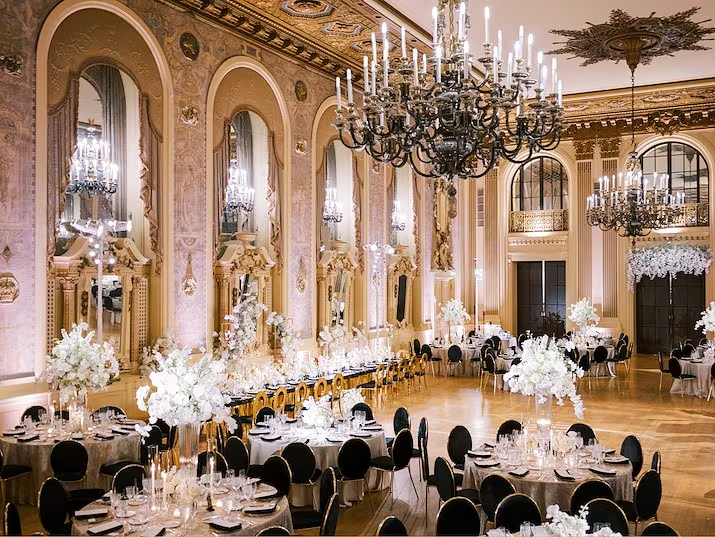
When my younger sister Madison told me I wasn’t “rich enough” to attend her wedding, she said it in our mother’s kitchen, as casually as if she were discussing a dress code.
“You’d look out of place, Claire,” she said, examining her diamond bracelet under the pendant light. “Ethan’s family is very prominent. There will be executives, donors, television people. I can’t have you arriving in that old Honda and wearing something from a department store clearance rack.”
I stared at her, waiting for the punchline. Madison and I had said cruel things to each other over the years, the way sisters do, but this was different. This was administrative. She had thought it through and arrived at a decision, and now she was delivering it to me the way you inform a vendor their services won’t be needed.
I looked at Mom, standing by the stove. Thirty-four years of history hung in that look. I was asking her, one last time, to be my mother.
Mom folded her arms and said, “Then don’t come.”
So I did not argue. I want you to understand that, because everything that happened afterward flows from that one choice. I did not cry, did not defend myself, did not list my accomplishments like a lawyer presenting exhibits. I picked up my purse, set the cream-colored invitation down on the granite counter, squared its edges neatly, and walked out of my mother’s house into the October afternoon.
What neither of them knew, what neither of them had ever bothered to know, was almost everything about my life.
The “old Honda” in the driveway belonged to my assistant, Priya. My own car was in the shop that week, and Priya had insisted I take hers rather than deal with a rental. The department store clothes were real enough. I dress simply. I always have. When you spend your days managing other people’s catastrophes, you learn that the person in the plainest suit is usually the one everyone else is afraid of.
And the thing my family had never once asked about, in six years, was what I actually did between nine in the morning and ten at night.
My name is Claire Bennett. I am the founder and chief executive officer of Northline Media, a crisis-management and broadcasting company I built from a rented desk and a used laptop. We started with local political clients, moved into corporate reputation work, and eighteen months before Madison’s wedding, we had quietly acquired three regional entertainment networks. When a scandal breaks in the Midwest, there is a decent chance the phones that ring first are mine.
I never discussed my finances with my family. In the beginning it was because there was nothing to discuss, just debt and hope. Later, it was because every conversation with Madison became a competition, and every competition I won became evidence that I was cold, and every competition I lost became a story Mom retold at holidays. Somewhere along the way, silence became easier. Then it became a habit. Then it became a wall, and I lived comfortably behind it, and I told myself that was strength.
Here is the truth I’ve learned since: silence is not strength. It’s just a different way of disappearing.
Let me tell you about the family I disappeared inside of.
Madison came along when I was four, and from the day she arrived, our house reorganized itself around her the way a solar system organizes around its sun. She was beautiful, and she cried easily, and Mom treated both of those things as talents. I was capable, so I was assigned capability the way you assign a chore. When money was tight, I got a job at fifteen. When Madison wanted things, Mom found a way. When I paid for my own college books, that was independence. When Madison dropped out of two programs, that was her finding herself.
By the time we were adults, the roles had hardened into law. Madison performed a life, all borrowed sparkle and photographed brunches, and Mom applauded from the front row. I built a life, and nobody came to see it. The one time I mentioned that my company had signed a big client, Mom said, “That’s nice, honey,” and turned to ask Madison about her new boyfriend’s boat.
The new boyfriend, eventually, was Ethan Caldwell, son of Richard Caldwell, the real-estate developer whose name is on two towers in the Chicago skyline. From the moment that relationship began, Madison’s ascent became the family religion. And I, quietly running a company with a hundred and forty employees, became the sister who was mentioned last, if at all.
So when she stood in that kitchen and told me I wasn’t rich enough for her wedding, some part of me wasn’t even surprised. The insult was just the family accounting made explicit, printed at last on a statement I could hold.
The wedding took place two weeks later at the Grand Halston Hotel in Chicago. Three hundred guests. A ballroom with two chandeliers the size of small cars. Cameras from celebrity channels lined the aisle, because the Caldwell name draws lenses the way honey draws flies.
I know all of this now in exhaustive detail. At the time, I spent the day of my sister’s wedding at home, in leggings, eating pad thai out of the container and reviewing quarterly reports. I would be lying if I said it didn’t hurt. It did. Around four o’clock, roughly when I calculated the vows were happening, I stood at my window looking out at the lake for a long while, and I let myself feel the whole weight of it. Excluded from my own sister’s wedding for the crime of imaginary poverty. Then I went back to my reports, because work has always been where I put the feelings that have nowhere else to live.
At 8:17 that evening, my phone began vibrating and did not stop.
The first message came from Jonah, my head of operations and the closest thing I have to a brother: Call me now.
The second message contained a video.
I pressed play, and there was my sister in her wedding dress, standing near a five-tier cake, red-faced, gripping her new husband’s sleeve. Someone had left a microphone live on the bandstand, and it captured every word with broadcast clarity.
“You promised your father would transfer the penthouse before the ceremony,” Madison hissed.
Ethan pulled his arm away. “You married me for a property?”
“Don’t act innocent. Your family wanted a beautiful wife for the cameras.”
And then, God help her, Madison laughed, tossed her head, and added, “At least my poor sister had the sense not to embarrass me by showing up.”
I watched Ethan’s expression change on the screen. Confusion, then disgust. “You banned your own sister because she doesn’t have money?”
Madison reached for him again.
He slapped her.
The sound carried through that live microphone into three hundred pairs of ears, and the ballroom went dead silent, and somewhere in that silence you can hear a champagne glass being set down very carefully.
Within minutes, the footage was everywhere. By nine o’clock, entertainment anchors were replaying the sequence in a loop: the insult, the accusation, the slap. Guests began leaking their own clips. Madison screaming at a server over champagne. Mom demanding the hotel confiscate phones. Richard Caldwell ordering security to lock down the ballroom, which, as anyone in my business could have told him, is the single fastest way to convince the world you have something to hide.
I sat on my couch watching my family detonate on national television, and I felt about nine different things at once, and I’m still not sure I can name them all.
Then Jonah called again.
“Claire,” he said, in the careful voice he uses when he’s about to hand me something radioactive. “Caldwell Development just called the emergency line. They want Northline to manage the scandal.”
I looked at the television, where Madison stood frozen mid-frame, one hand pressed to her cheek, her mascara beginning its long migration south.
I did not smile because my sister had been hit. I want that understood. What Ethan did was assault, full stop, and nothing that came before or after changes that. No, what pulled the corner of my mouth upward, briefly and bitterly, was the geometry of the thing. The sister who had been deemed too poor for the guest list now controlled the microphone that could decide how the whole world remembered the night.
I told Jonah to schedule the meeting for ten the next morning.
I accepted it for one reason, and it was not to rescue Ethan Caldwell. I accepted because in my business, the first meeting is where you learn what people are hiding, and something about the shape of this disaster told me there was more underneath it.
At ten the next morning, I walked into Northline’s main conference room in a navy suit and found five people waiting: Ethan, his father Richard, two attorneys with matching frowns, and the Grand Halston’s security director. Ethan looked like a man who hadn’t slept and didn’t deserve to. His right hand was bandaged. Not, I learned, because Madison had injured him, but because he had punched a bathroom mirror after security separated them. That detail told me more about Ethan Caldwell than his lawyers wanted me to know.
Richard began without a greeting, without an apology, without any acknowledgment that the woman across the table was the sister of the bride his son had struck.
“We need the video suppressed.”
“That is impossible,” I said. “It has been copied millions of times. You cannot un-ring that bell. You cannot even find the bell anymore.”
“Then change the story.”
“The story is that your son assaulted his bride in front of three hundred witnesses and a live microphone.”
Ethan flinched. “I know what I did.”
“Do you?” I asked him, and I let the question sit. “Because remorse is not a strategy, and a strategy is not absolution. You will need all three, and they are not the same thing.”
I laid out my conditions, and I watched Richard’s face redden with each one. Ethan would issue a statement accepting full responsibility, without qualifiers, without blaming Madison, without the word “regrettable.” He would cooperate with the police voluntarily rather than waiting to be summoned. He would enter an anger-management program and withdraw from all company appearances indefinitely. And Northline would not attack Madison, would not leak private information about her, and would never, under any circumstances, characterize the slap as provoked or justified.
Richard pushed back his chair. “We are paying you to protect us.”
“You are paying me to stop you from making this worse,” I said. “Those are different services. The first one doesn’t exist.”
Before he could answer, the conference-room doors opened, and my morning became something out of a play.
Madison walked in, flanked by Mom and a sharp-eyed attorney I recognized by reputation, Felicia Grant. Madison wore sunglasses indoors and a silk scarf, and beneath the heavy makeup on her left cheek, a faint bruise shadowed the bone. She stopped three steps into the room when she saw me sitting at the head of the table.
“What are you doing here?” she demanded.
“This is my company.”
Mom laughed. Once. A short, reflexive sound, the laugh of a woman who assumed I’d made a joke, because in her world I answered phones somewhere. Then her eyes drifted past me to the glass wall behind the head of the table, where the etched lettering reads:
CLAIRE BENNETT. FOUNDER AND CHIEF EXECUTIVE OFFICER.
I watched my mother’s face empty out. I have seen a lot of faces receive a lot of bad news in that conference room. I have never seen a transformation quite like that one.
Madison looked from the sign to me and back. “You own Northline?”
“Yes.”
“The Northline? The one on the news?”
“Yes.”
“Why didn’t you tell us?”
And there it was. The question, at last, arriving six years too late, in front of lawyers.
“You never asked what I did,” I said. “You only asked what things cost.”
Felicia Grant, to her credit, moved the room along. She explained that Madison intended to seek an annulment, file a civil claim, and cooperate fully with prosecutors, and that she was formally demanding Northline withdraw from representing the Caldwells due to my obvious family conflict.
“I agree,” I said, which surprised everyone on both sides of the table. “My team will transfer the Caldwell account to an outside firm today. I will have no role in representing Ethan.”
Richard stared at me. “You already accepted.”
“I accepted an initial consultation. Now I’m identifying a conflict. That’s what ethical firms do, Mr. Caldwell. You should try hiring one.”
Madison’s shoulders loosened, just slightly. For a moment, she may have believed the worst of the morning was behind her.
Then Felicia placed a second folder on the table, and everything changed again.
Inside were bank records, emails, and a draft contract, and as Felicia walked the room through them, the temperature dropped degree by degree. Madison, it emerged, had secretly negotiated with a streaming producer named Victor Lane to turn her wedding into a reality special. The paperwork was all there. The producer had encouraged conflicts, planted microphones through a compliant vendor, and offered Madison a bonus, a six-figure bonus, if the reception produced what the contract actually called “a viral confrontation.”
Ethan read the pages with his bandaged hand pressed flat on the table, and the blood left his face. “You staged this?”
“I staged an argument,” Madison said, and her voice had gone thin. “Not… that. Not what you did.”
Felicia turned on her own client with a sharpness that told me their attorney-client relationship had just entered a new phase. “You told me those documents were unrelated.”
Mom reached across the table for the folder. I pulled it away without looking at her.
I want to be precise here, because precision matters when everyone around you is drowning in spin. The contract did not excuse Ethan. Nothing excused Ethan. A man who answers words, any words, with his open hand across a woman’s face has told you everything about himself that you need to know. But the folder revealed something else, something that reframed the entire catastrophe. Madison had invited three hundred people, including her own family, including her groom, into a manufactured spectacle. She had sold tickets to her own marriage. And my absence, I would soon learn, had been part of the script.
Then Jonah came through the door with worse news, because in my business there is always worse news.
A hotel employee had sold unedited footage to a national network. And in that footage, minutes before the slap, Madison could be seen leaning toward Victor Lane’s field producer and saying, clearly, damningly, “If Ethan loses control, we own the week.”
The room absorbed that sentence in silence. Every person present understood the same arithmetic at the same moment. By nightfall, Ethan could be facing criminal charges. Madison could be facing civil claims for fraud and breach of contract from a dozen directions. And both families, the prominent one and mine, could be destroyed by evidence they had manufactured themselves, frame by frame, signature by signature.
Madison took off her sunglasses. The bruise was worse without them. She looked at me, and for the first time since childhood, there was nothing mocking in her face at all.
“Claire,” she whispered. “Help me.”
I closed the folder.
“I will help you tell the truth,” I said. “But I will not help you choose which truth survives.”
Her request did not make us sisters again. I knew that even as she asked. It made us two adults sitting across a conference table, surrounded on all sides by consequences, and that was more honest than anything we’d been to each other in twenty years.
I asked everyone except Felicia and Jonah to leave the room. Richard objected loudly. Ethan surprised his father by standing first.
“She should have her own counsel,” he said quietly. “And I should not be in the room.”
It was the first sensible thing he had done in twenty-four hours. Possibly longer.
When the door closed, Madison stared at the table. Mom sat beside her with one hand on her shoulder, as though that single gesture could stand in for thirty years of choosing her.
Felicia spoke first. “Madison, I need a complete account. No omissions. If I discover another document after we make a public statement, I may withdraw.”
Madison’s eyes flicked toward me, the old reflex, looking for someone to manage the situation for her.
“Do not look at Claire,” Felicia said. “Look at me.”
And over the next hour, in that room, the whole story came apart like wet paper.
Six months earlier, Madison had met Victor Lane at a charity gala. Victor had a talent for finding people at the exact moment their vanity and their anxiety intersected, and he found my sister at hers. He told her that weddings into wealthy families drew enormous audiences, especially when the bride came from an ordinary background. A Cinderella arc, he called it. He offered her seventy-five thousand dollars for access to the planning process, and another hundred thousand if the wedding generated enough usable footage for a special.
Madison had not told Ethan. She had signed the contract through a small shell company that Mom, my mother, helped her create.
Together, over months, they had built the machine. They encouraged vendors to provoke small conflicts. They coached bridesmaids to repeat private gossip on camera. They positioned microphones near Ethan’s parents. During one recorded planning lunch, my own mother had described me, on tape, for a television audience, as “the unsuccessful sister.”
And here is the part I will carry for a long time. My absence had been a plot point.
According to Victor’s production notes, which Felicia read aloud in a flat voice while my mother studied her hands, the original plan was this: I would attend the wedding. Madison would confront me at the reception about my supposed jealousy. She would reveal to the cameras that I had arrived in an old car and couldn’t afford a proper gift. Poor Claire would be the B-plot, the sad contrast that made the Cinderella shine brighter.
The kitchen scene, the bracelet, the clearance-rack line, “then don’t come,” all of it had been the setup. I was supposed to swallow the insult and show up anyway, the way I had swallowed everything my whole life, and walk directly into a scripted humiliation.
Except I didn’t come. For once in my life, I took the no and kept it.
And when I stayed home, Victor demanded a replacement conflict, because he had paid for a confrontation and intended to receive one. That was why Madison cornered Ethan about the penthouse in front of the bandstand microphone. She was feeding the machine she had built, with the only material she had left. Her own marriage. Four hours old.
“What did you expect him to do?” I asked her.
“Argue,” she whispered. “Walk out. Say something cruel. Victor said a ruined cake or a canceled honeymoon would be perfect.”
“But you knew Ethan had a temper.”
She did not answer. Felicia leaned forward.
“Had he hit you before?”
“No.”
“Threatened you?”
“He punched a wall once. Last spring. He apologized. I believed it was over.”
That detail mattered, and it cut in both directions. It did not transfer one ounce of responsibility for the slap onto Madison; his hand, his choice, his crime. But it proved she had knowingly engineered a public detonation around a man she had already seen crack, with cameras rolling and a bonus riding on the blast.
Mom finally spoke. “We were trying to give her a future.”
I turned to look at my mother. “By humiliating me?”
“You were never supposed to see it.”
“That is not an answer.”
Mom’s mouth tightened into the shape I had been reading my whole life. “You did not need anything from us. Madison did.”
And there it was. Spoken aloud at last. The constitutional law of the Bennett family. Because I was capable, I received less. Because Madison demanded more, Mom translated demand into need, and need into virtue. Every success I kept private became further proof that I had no feelings available for injury. I was not a daughter in that system. I was infrastructure.
“I needed a mother,” I said. “You decided I only needed independence.”
For once in her life, my mother had nothing prepared.
Felicia spent the rest of the session on triage. Madison would preserve every message and surrender the full contract. She would make no public accusation beyond what the video already proved. Mom, Felicia warned, needed separate counsel of her own, immediately, because the shell company bore her fingerprints, and the production company’s lawyers would come looking for someone to blame for the missing filming releases from three hundred unconsenting guests.
By that afternoon, Chicago police announced that Ethan had voluntarily appeared for questioning. The next day, prosecutors charged him with misdemeanor battery. His attorneys arranged his release, and he issued the statement my team had drafted before we withdrew, accepting responsibility, no qualifiers, no blame.
He never mentioned Madison’s secret contract. Not once, then or later. I don’t know if that was decency or strategy, and I’ve decided I don’t need to know. But that choice shaped everything that followed. The internet kept shouting, but the legal story stayed clean and simple: whatever Madison had planned, Ethan had struck her, and he admitted it.
Three days later, the unedited footage aired nationally.
It did not save Ethan. Nothing was going to save Ethan.
But it demolished Madison’s preferred version of herself, hour by broadcast hour. Viewers watched her berate a nineteen-year-old server for bringing the wrong champagne. They watched her mock a bridesmaid’s weight in a fitting room. They heard her calmly discuss how much public sympathy she could harvest if Ethan’s family came across as controlling. And they heard my mother, in her planning-lunch voice, say, “Claire is useful when there is a crisis, but she has never known how to impress important people.”
The network, doing its due diligence, identified the Claire in question as the founder and CEO of Northline Media.
By sunrise, there were reporters outside my building.
I refused every interview. Every single one, and there were offers that would have been very good for business. Northline issued one statement, three sentences long, confirming that I had not attended the wedding, had played no role in its filming, and would not be representing either party. I instructed security to escort away anyone who harassed my employees, and I went back to work.
Madison called seventeen times that week. On the eighteenth call, I answered.
“People are threatening me,” she said. Her voice was raw.
“Send every threat to Felicia and the police. Screenshot everything. Do not respond publicly, not once, not even to the kind ones.”
“Can I stay with you?”
“No.”
She began to cry. “You said you would help.”
“I am helping. I’m giving you the same advice I’d bill a corporation six figures for, and I’m paying for two weeks at a secure hotel under Felicia’s name. You are not moving into my home.”
“Why are you being so cold?”
I stood at my window with the phone against my ear and the lake going dark below, and I gave her the truest sentence I had.
“Because help is not the same as access.”
The silence stretched. Then she asked, quietly, “Are you enjoying this?”
“No,” I said, and it was the truth. “But I am no longer willing to suffer so you can feel protected from your own choices.”
She hung up.
The consequences multiplied through the winter the way consequences do, patiently and without mercy. Victor Lane’s production company sued Madison’s shell company for breach of confidentiality and failure to provide lawful filming releases. Several wedding guests threatened claims over being recorded without consent. The Grand Halston fired two employees who had taken money to look away from the planted equipment. Richard Caldwell tried to force Ethan out of the family business to protect the brand, and instead the board placed both men on leave after journalists, now swarming everything Caldwell, uncovered unrelated questions about company spending. Scandals are like that. You open one door and find six more behind it.
Northline handled none of it. Not one billable hour.
That boundary cost my company the most lucrative account of the quarter, and I would make the same call again without blinking, because it preserved the only asset in my industry that cannot be bought back once it’s sold: credibility. Within weeks, two national networks brought us their business specifically because we had refused to weaponize private material against my own family. Our revenue went up. Not because I exploited my sister’s humiliation. Because I didn’t.
Ethan pleaded guilty to misdemeanor battery. Probation, community service, mandated counseling, a no-contact order. The marriage was annulled five months later on grounds of fraud and duration. Madison received no penthouse, no spousal support, and no reality special. She did eventually receive a confidential settlement from the production company, after Felicia argued, effectively, that Victor had knowingly engineered a volatile confrontation without any safety measures. Most of that money went straight out the door to legal fees and to settling claims from recorded guests. Mom sold her house to cover the debts tangled up in the shell company. The house with the kitchen where she told me not to come.
For nearly a year, I saw neither of them.
I want to tell you about that year, because everyone assumes it was lonely, and it was the opposite. That was the year I learned how quiet life becomes when you stop auditioning for a place in your own family. The background hum I had lived with for three decades, the constant low-grade calculation of what to share and what to hide and how to phrase things so Madison wouldn’t compete and Mom wouldn’t dismiss, all of it just stopped. I bought a townhouse near the lake. I replaced the old-Honda story with the plain truth whenever anyone asked what I did. I promoted Jonah to chief operating officer and watched him cry a little at the announcement and pretend it was allergies.
And I started seeing a counselor. Not because I had caused the disaster. Because I had finally understood that surviving a family pattern does not automatically free you from it. You can leave the kitchen and still spend your whole life answering to it. I was done answering.
Eleven months after the wedding, a handwritten letter arrived at my office. I recognized the handwriting before I saw the return address.
Madison did not ask for money. That was the first thing I checked, and I’m not ashamed to admit it. She did not ask me to call reporters, scrub search results, or rehabilitate her name. She wrote that she had taken a job managing appointments at a dental clinic in Milwaukee. She was living in a studio apartment. She was in therapy, real therapy, the kind you go to every week whether or not you feel like it.
The last paragraph I have read enough times to know by heart.
“I thought wealth meant being invited into expensive rooms. You built a life where no one could decide your value for you. I hated that, because it made my performance look small. I am sorry I used you as proof that I was better.”
I read it twice and put it in a drawer. I did not forgive her immediately. Forgiveness that arrives on schedule isn’t forgiveness, it’s etiquette.
Three months later, I agreed to meet her at a coffee shop halfway between Chicago and Milwaukee. She arrived early. Jeans, a plain coat, no jewelry, no sunglasses. The bruise was long gone, but she looked older in a way that had nothing to do with time.
Mom was not with her.
“I didn’t bring her,” Madison said, before I could ask. “I thought you might leave.”
“I would have.”
She nodded, accepting it. “She still thinks Victor manipulated us and Ethan ruined everything. She says we were victims of powerful men.”
“You were manipulated,” I said. “And Ethan assaulted you. Both of those things are true. Neither one erases what you did.”
“I know.”
We talked for forty minutes. There was no dramatic embrace, no tears, no promise that Christmas would ever look the way it used to. I told her I was willing to meet occasionally, on neutral ground. I would not lend money. I would not manage her reputation. I would not keep secrets from her attorney. She accepted every condition without negotiating, which, for Madison, was itself a kind of miracle.
Before we left, she asked one final question.
“Why did you take that first meeting with the Caldwells?”
I considered giving her the polished answer, the one about professional obligation and industry standards. She would have accepted it. Instead, for once in our lives, I told my sister the whole truth.
“For ten minutes,” I said, “I wanted you to discover that the sister you excluded was the most powerful person in the room.”
Madison looked down at her coffee. “Did it feel good?”
“For ten minutes.”
“And after that?”
“After that, it felt expensive.”
She nodded slowly, and I could see she understood, maybe for the first time, that we had both spent our lives buying feelings we couldn’t afford.
Two years have passed since the wedding now. Ethan finished his probation and moved to Colorado, where he works outside the family company. I hope the counseling took. I’ll never know, and it isn’t mine to track. Madison is still in Milwaukee, an office manager now, promoted twice. Mom and I exchange birthday cards, polite and brief. She wants reconciliation without examination, a warm ending with no middle, and I no longer accept substitutes. Maybe that will change someday. It hasn’t yet.
At Northline’s tenth-anniversary dinner last month, Jonah stood up with a glass of wine and told the story of the day a billionaire developer tried to give orders in my conference room and got a lecture on ethics instead. The whole staff laughed. I looked around that room at a hundred and forty people who know exactly what I built and have never once needed me to arrive in a particular car to believe I deserved my seat.
During dessert, my phone buzzed. A photograph from Madison. A small kitchen table in a small apartment. Two plates of spaghetti. A grocery-store cake with too much frosting, the kind we used to beg Mom for as kids.
Beneath it she had written: “First dinner in my new apartment. No cameras. No sponsors. No guests I need to impress.”
I looked at that picture for a long moment, at the cheap cake and the mismatched plates and the ordinary, unphotogenic, entirely real little life in it. Then I typed my reply, one sentence, and sent it before dessert was over.
“That looks rich enough to me.”

Lila Hart is a dedicated Digital Archivist and Research Specialist with a keen eye for preserving and curating meaningful content. At TheArchivists, she specializes in organizing and managing digital archives, ensuring that valuable stories and historical moments are accessible for generations to come.
Lila earned her degree in History and Archival Studies from the University of Edinburgh, where she cultivated her passion for documenting the past and preserving cultural heritage. Her expertise lies in combining traditional archival techniques with modern digital tools, allowing her to create comprehensive and engaging collections that resonate with audiences worldwide.
At TheArchivists, Lila is known for her meticulous attention to detail and her ability to uncover hidden gems within extensive archives. Her work is praised for its depth, authenticity, and contribution to the preservation of knowledge in the digital age.
Driven by a commitment to preserving stories that matter, Lila is passionate about exploring the intersection of history and technology. Her goal is to ensure that every piece of content she handles reflects the richness of human experiences and remains a source of inspiration for years to come.