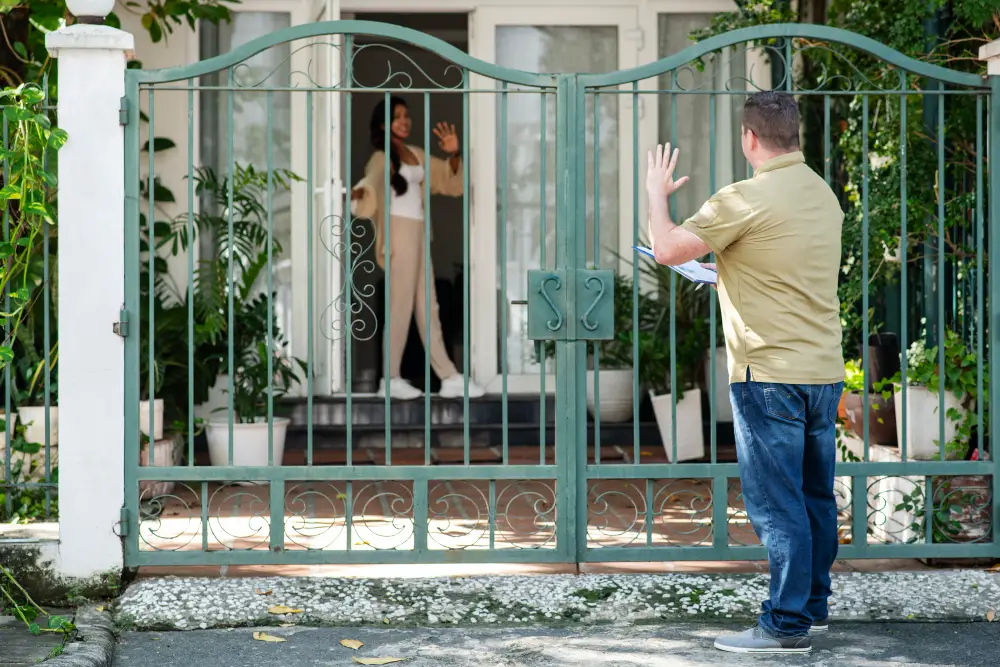
The Fence Line
I had lived in the same little house for almost five years, and until recently, life on my street had been exactly the way I liked it.
The neighborhood was the kind that people describe as quiet and mean it as a compliment. My neighbors waved from their driveways without requiring conversation to follow. We brought each other’s packages inside whenever someone was traveling. During the holidays, people left cookies on porches and chatted over fences with the easy warmth of people who had chosen to be somewhere and were satisfied with the choice. It was not the kind of neighborhood where people looked for trouble, or manufactured it when they could not find it.
At least, it had not been before Claire arrived.
I noticed her before I learned her name. She stood in the driveway across from mine on the morning the moving truck came, perfectly styled in a way that suggested considerable effort had gone into looking effortless, her blonde hair neat in the August heat, oversized sunglasses catching the light, a clipboard in her hand. She directed the movers with the authority of someone accustomed to having her directions followed, and she did it without looking particularly happy about any of it, which I noted but attributed to the general exhaustion of moving.
I was watering the flower boxes on my porch when I saw her. I smiled and raised one hand in the universal neighborhood greeting, the gesture that says welcome without requiring any particular response.
She barely acknowledged me.
I went inside and forgot about it within the hour, because there was nothing about a new neighbor failing to wave that required further consideration.
Three days later, I was wheeling my trash cans back toward the garage after the morning pickup when I heard a throat being cleared behind me with the deliberateness of someone who has rehearsed the sound.
I turned around. The new neighbor was walking across the street with her arms folded, wearing the expression of someone approaching a conversation they have been looking forward to and that the other party has not been aware was scheduled.
“Hi,” I said pleasantly, because I am the kind of person who defaults to pleasant.
She looked at my trash cans with the focused attention people usually reserve for things that have genuinely caused them harm.
“You really shouldn’t leave those where everyone can see them,” she said.
I blinked. “I’m sorry?”
“They’re too visible.” She said it slowly and with the particular patience of someone explaining something obvious to someone they have decided is slow. “It makes the whole street look messy.”
I glanced at the cans. They were sitting beside my garage, which is exactly where every homeowner on our street kept theirs until they rolled them inside later that evening. I had never received a complaint. I had, in fact, never considered that the placement was remarkable in any way.
“I usually put them away after dinner,” I said.
She shrugged. “Well. Some people care about appearances more than others.”
Before I could locate a response to that, she turned and walked back across the street with the manner of someone who has delivered a verdict and considers the matter settled.
I stood there for a moment in the particular stunned stillness that follows an unexpected rudeness, and then I laughed, because I genuinely could not imagine a situation in which this became a real conflict. People did not have feuds about trash cans. The whole thing would smooth itself over in a week when she discovered I was a decent neighbor and not, in fact, the kind of person who required monitoring.
I was wrong about that, as it turned out.
A few days after the trash can conversation, I was sitting on my porch on a Sunday afternoon with a book and a glass of iced tea. My grandmother’s wind chimes moved in the afternoon breeze, which is exactly what they were designed to do, and what they had done on that porch since the week I moved in. She had collected them throughout her life, believing with complete sincerity that every home should have something that made people smile when they heard it. The soft tinkling sound had always anchored me, transported me in the specific way that certain sounds transport you immediately to particular rooms and particular people and particular summer afternoons that have been over for years.
The next afternoon, my doorbell rang.
Claire was on my porch. She did not smile.
“I’m Claire,” she said, as though we had never seen each other.
“I’m Mia.”
She gestured toward the wind chimes with the air of someone presenting evidence. “Those. They’re too loud.”
I looked at them. The breeze had stopped. The chimes were entirely still.
“They only ring when it’s windy,” I said, carefully.
She sighed in the theatrical way of someone who has given up on expecting to be understood. “I enjoy peace and quiet.”
I almost smiled at the irony of that sentence delivered by the person who had knocked on my door to deliver it. “I’ll keep that in mind,” I said.
She gave one curt nod and left.
The conversation had lasted less than two minutes and I felt inexplicably tired afterward, the specific fatigue that comes from managing your own reactions very carefully for a sustained period.
Over the following week, Claire became a presence in my peripheral vision in a way that I had not previously experienced from any neighbor. When I trimmed my hedges, she watched from her driveway. When I washed my car, she watched. When I sat outside with coffee on a Thursday morning, she found a reason to stand at her mailbox and look across the street with the sustained attention of someone who is waiting for something to happen.
I began to understand that the trash cans had not been the point. The trash cans had been an opening. The point was something else, something I had not yet identified, something that required her to find fault with the specific details of my life on a regular basis.
One Saturday morning, I was planting new flowers along the front of my house when she crossed the lawn with the purposeful stride she used when she had something prepared to say.
She stopped at my fence and tilted her head with exaggerated consideration.
“It looks a little too tall.”
I pulled off my gardening gloves and stood. “It’s been here since before I bought the house. But thanks for letting me know.”
She rolled her eyes, said something under her breath that I did not catch, and walked away.
I watched her go and thought: what a strange, unhappy woman. I thought: whatever this is, it will eventually run out of material. I thought: there is no version of this that becomes a genuine problem for me.
Then, one Monday evening when I pulled into my driveway after a particularly long day at work, I found a bright orange notice attached to my mailbox.
I sat in the car for a moment before I got out and read it. Twice.
A formal complaint had been filed with the city regarding my fence. Someone suspected it violated local height regulations. An inspection had been scheduled.
I stood in my driveway with the notice in my hand and looked slowly across the street.
Claire’s curtains shifted.
I went inside and spread every document I owned across the dining room table. The survey from when I purchased the house. The inspection report from closing. The property disclosure forms. The original permit records the previous owner had left behind. I went through everything with the systematic attention of someone who needs to be certain before they can sleep.
Everything suggested the fence had been installed legally, years before I moved in.
Even so, I barely slept. There is something psychologically destabilizing about receiving an official notice from the city even when you believe with complete confidence that you have done nothing wrong. The official paper and the orange color and the formal language do something to your sense of security that reason cannot entirely undo.
The next morning, Claire was in her driveway with a coffee mug when I came outside. She smiled when she saw me, and it was the particular smile of someone who believes they are watching the opening moves of a game they have already won.
“Rules are rules,” she called across. “Maybe next time you’ll think before breaking them.”
I went back inside without answering, because there was nothing to say.
I spent the day at work barely able to concentrate. I called my friend Jenna at lunch and told her everything, beginning with the trash cans and ending with the orange notice. She listened without interrupting and then was quiet for a moment.
“Seriously?” she said. “Someone reported your fence?”
“Over a fence,” I confirmed.
“Some people genuinely need hobbies.”
She made me laugh, which helped.
“Keep all your paperwork together,” she said. “And photograph everything before the inspector gets there.”
That evening I went around the entire perimeter of the fence with my phone and documented every panel, every corner, every hinge. My neighbor Emily saw me and came over to ask what was happening. When I explained, she looked toward Claire’s house with a frown that told me she had already noticed the surveillance pattern.
“That fence has been there for years,” Emily said. “Nobody has ever complained about it.”
Her certainty was reassuring, but I also understood that the fence itself was almost beside the point. Claire was conducting a campaign, and the fence was simply the current instrument of it.
The inspection was scheduled for Thursday morning.
Just before nine, a white city truck pulled up in front of my house and a tall man in a city vest climbed out carrying a measuring wheel and a clipboard. He introduced himself as Greg, and he had the unhurried manner of someone who has done this many times and finds the work interesting rather than tedious.
“We’ll try to make this as quick as possible,” he said.
Before he had taken three steps toward the fence, Claire’s front door opened.
She walked out with another coffee mug, positioned herself against her mailbox, and folded her arms with the air of someone who has reserved excellent seats for a performance. She had taken the day off, I realized, specifically for this.
As Greg worked his way methodically along the fence, measuring each section and comparing the results with the records on his clipboard, Claire watched every movement. Every few minutes she called across: “Well? Is it over the limit? What are the measurements showing?”
Greg did not answer her. He continued writing his notes with the professional equanimity of someone accustomed to being asked questions by people who have no standing to receive answers mid-inspection.
He checked every corner. He measured twice. He verified the gate and every panel. His repeated measurements and the sustained attention he gave the clipboard began to attract other people. Emily came onto her porch. Howard, who lived two houses down, slowed beside his mailbox on the way back from his morning walk.
Finally, Greg closed his notebook.
He turned to me.
“Everything here is perfectly compliant. There’s no violation.”
The relief that moved through me was physical, a loosening of something I had been holding tightly since Monday evening.
Across the street, Claire’s smile disappeared as completely as if it had been wiped away.
Then Greg paused in the particular way of someone who has noticed something that requires attention, and he turned slowly toward Claire’s property.
“There is one thing,” he said thoughtfully. “I’d like to take a look at your yard.”
Claire’s expression went still.
“I’m sorry?” she said.
“When I was confirming the property boundary on this side,” Greg said, nodding toward my fence, “I noticed a few things I’d like to check.”
She made a small, unconvincing laugh. “Well, I wasn’t the one being inspected.”
“No,” Greg agreed, with perfect equanimity. “But inspections sometimes reveal adjacent issues.”
“It’s probably nothing,” she said, and there was something different in her voice now, a thinness.
“We’ll find out.”
She stepped aside with the manner of someone who has not been given a choice but intends to behave as though she has chosen freely.
Greg walked toward the front of her yard and I followed several steps behind. Claire glanced back at me.
“You don’t need to be here,” she said.
Greg shook his head. “Part of what I’m examining involves the shared property boundary. Mia may remain because any encroachment could affect her property directly.”
Claire pressed her lips together.
Greg crouched near a row of freshly planted shrubs and examined several survey markers before looking at the parcel diagram on his clipboard. He had the focused quality of someone who has found something genuinely interesting and is taking the time to understand it fully.
“What exactly are you looking at?” Claire asked.
“The survey markers and the recorded property line.”
“And?”
“They don’t correspond to where your landscaping ends.”
He measured from the sidewalk to the first marker and then from the marker toward the shrubs. Claire folded her arms and produced the laugh again, more strained this time.
“I hired professionals for all of that.”
“I’m sure you did.”
The decorative stone border surrounding her flower beds was the thing I had always found most striking about the exterior of her house. It curved neatly around the plantings with the precise appeal of something designed to look both casual and considered, and it had made the yard look finished and intentional in a way that the neighborhood generally admired. Greg measured every section of it.
“I don’t see why this matters,” Claire said.
He looked up. “It matters because this border isn’t entirely on your property.”
The particular quality of the silence that followed was unlike any other kind of silence. It was the silence of information landing and being received and being understood and being resisted all at the same time.
Greg pointed to a survey marker. “The property line runs here.” He pointed approximately three feet away. “The stone border is here.”
Claire shook her head immediately. “That’s impossible.”
“The markers match the city’s recorded parcel map and the subdivision survey.”
Her voice rose. “Those markers must be wrong.”
“The stone border and part of the landscaping extend into the city easement,” Greg said, in the patient tone of someone accustomed to delivering information that people do not want to receive. “A portion also crosses onto Mia’s property.”
Claire spun toward me. “My yard is not on her property.”
Greg showed her the measurements on his clipboard. “The improvements extend approximately thirty inches beyond your legal boundary at the widest point.”
I looked from the diagram to the flower bed. I had genuinely never noticed. The landscaping had looked exactly as though it belonged where it had been placed, which is the reliable achievement of a good contractor working with incorrect measurements.
“The decorative stone border, several shrubs, and part of your irrigation line cross into the easement,” Greg continued. “A portion also crosses onto Mia’s lot.”
Claire’s mouth opened.
“That’s ridiculous.”
“I’m documenting what the measurements show.”
“Whoever measured before made a mistake.”
“The recorded survey and today’s measurements are consistent with each other.”
She looked at me with the expression of someone who needs someone to be responsible for the information they are receiving. “You knew about this?”
“I had no idea.”
She made a sound of disbelief. “That’s convenient.”
“You could have moved those markers,” she said, and I realized she was completely serious.
I almost laughed. “You think I moved survey markers that have been secured in the ground for years?”
Greg cleared his throat. “Making unsupported accusations won’t change the measurements.”
By then, a small cluster of neighbors had assembled on the sidewalk. Howard was still by his mailbox. Emily had stopped watering her roses. Lila, who walked every morning at this hour, had paused on the sidewalk with her hands in her jacket pockets. They had all heard Claire comment on my fence over the preceding weeks. They were watching with the focused attention of people who are not certain what they are about to see but understand that whatever it is will be significant.
“Because the work extends into the city easement and crosses the approved property boundaries,” Greg continued, “you’ll receive a notice requiring corrective action.”
Claire stared at him. “What kind of corrective action?”
“The stone border, landscaping, and irrigation outside your property line will need to be removed or relocated to within your legal boundaries.”
Her eyes moved to the flower beds. She had described the landscaping project to Emily, who had told me about it in the way neighbors trade information about each other, as having taken three weeks and a considerable sum of money.
“Removed?” she said.
“Yes.”
She stared at the plantings as though they might have something useful to contribute to this conversation. “I just paid for all of that.”
“I understand.”
“Thousands of dollars.”
Greg nodded with the genuine sympathy of someone who understands that the situation is not the person’s fault in the way they might want it to be. “I recommend contacting the contractor who installed it. The appeal instructions will be included with the notice.”
She shook her head slowly.
“This isn’t happening.”
“I’m afraid it is.”
The arrogance she had been wearing since moving day had left her face completely. What replaced it was something I had not expected: not anger, but a kind of stunned exposure, the expression of someone who has been very publicly wrong about something they were very publicly certain about.
She looked at me.
“You must be happy about this.”
I considered the question honestly before answering it.
“No,” I said.
That seemed to surprise her more than anything else that had happened. It surprised several of the neighbors too, judging by the quiet.
“I never wanted this,” I said. “I wanted a neighbor. Not an adversary.”
She lowered her eyes.
Greg handed her the paperwork and told her she had thirty days to correct the violations. She accepted the notice without another word. As he returned to his truck, the assembled neighbors began drifting back toward their own houses, the way crowds disperse after they have seen what they came to see.
Before she went inside, Emily caught my eye and smiled.
“I’m glad everything worked out, Mia.”
“So am I.”
Howard shook his head with the expression he reserved for events he found both surprising and not surprising. “I guess the fence wasn’t the problem after all.”
“I guess it wasn’t,” I agreed.
The weeks that followed were not quiet for Claire. Contractors arrived almost every morning. The stone border came up first, then the shrubs, then the irrigation line was traced and adjusted and rerouted within her actual property boundary. The work took close to a month, and it was visible and prolonged and conducted in full view of the street.
The neighbors who had watched Claire examine my fence and comment on my trash cans and photograph my hedges now watched Claire’s yard being dismantled and rebuilt. Nobody said anything unkind to her about it. They did not need to. The situation said everything that needed to be said, and it said it with considerably more authority than any neighbor could have managed.
I watched the process from my porch sometimes, usually without meaning to, and I felt something I had not anticipated: something closer to sadness than to satisfaction. The flower beds had been genuinely beautiful. The stone border had been well-made. The landscaping had transformed an unremarkable front yard into something a person might stop to look at. The contractor who installed it had done exactly what had been asked of him, just in the wrong location, and now all of that work was being undone because no one had verified the measurements before the first stone went in.
One afternoon, about three weeks into the correction process, I was carrying groceries from my car when I heard footsteps on the sidewalk.
Claire stopped several feet away from me. Not at my fence, not at my mailbox. Several feet away, in the neutral territory of the shared sidewalk, with an expression I had not seen her wear before.
I waited.
“I owe you an apology,” she said.
I remained quiet and let her continue.
She looked genuinely uncomfortable, which I understood was appropriate and did not try to relieve.
“I spent so much time looking for problems at your house,” she said, “that I never thought to check my own.”
Neither of us spoke for a moment.
“I’m sorry,” she said.
It was not a long apology. There was no elaborate explanation or revisionist account of her motivations or performance of remorse. It was brief and it sounded, in its brevity, like something she had struggled to say and had said anyway.
“I accept your apology,” I said.
A small, cautious smile crossed her face. “Thank you.”
Things changed after that, as things sometimes do when two people have moved through something difficult together and arrived, unexpectedly, at the other side of it. Not dramatically. Not in any way that would make a good story about transformation. But in the small, practical ways that represent the realistic version of repair.
Claire stopped watching my house. The complaints stopped. We began to wave when we saw each other outside, the same wave I had offered her on moving day, the one she had barely acknowledged. Occasionally we exchanged a few words about the weather or the state of the street. We never became friends in any meaningful sense, but we became something considerably more useful to both of us: decent neighbors.
My grandmother’s wind chimes moved in the autumn breeze, and Claire never mentioned them again.
I thought about them sometimes, in the evenings when the light was going and the air was cooling and the chimes produced their soft particular sound. I thought about my grandmother, who had been a woman with strong opinions about what made a home feel like a home, and what made a neighborhood feel like a community, and about the difference between the two. She had believed that the gap between those things was almost entirely determined by the choices individual people made in small moments, the decision to wave or not wave, to knock on a door with a cookie or a complaint, to look across a street with curiosity or with judgment.
I had not always known what to do with the specific situation Claire had created. There had been moments during that week between the orange notice and the inspection when I had considered all the ways the situation might go wrong, all the money a contested violation might cost, all the hours of documentation and conversation and official process that a determined adversary can impose on a person who simply wants to live quietly in their own house.
What I had not anticipated was that the resolution would not require me to do anything except show up, keep my paperwork, and tell the truth.
The survey markers had been there for years, accurate and stationary, waiting to be consulted.
Greg had shown up to measure my fence and had, in the process of being thorough, noticed that something adjacent needed measuring too.
And the measurements had said what the measurements said, indifferent to who had requested the inspection or what outcome they had hoped for.
I have thought about this sometimes in the years since. About the particular satisfaction of situations that resolve themselves through the operation of their own truth, without requiring you to argue or escalate or perform any kind of victory. The stone border had been in the wrong place from the day it was installed. The survey markers had marked the actual boundary the entire time. None of that required my intervention.
What it required was patience, and paperwork, and the willingness to stand in your own driveway and receive an orange notice with your name on it and go inside and read every document you own and sleep badly and show up on Thursday morning and let the measuring wheel do its work.
The fence was fine.
It had always been fine.
And sometimes that is the only conclusion a situation requires: not a confrontation or a lesson or a dramatic reversal, but simply the steady persistence of the truth until the right person with the right measuring wheel arrives to confirm it.
My grandmother’s chimes moved in the breeze from across the street, and I heard them from my kitchen, and thought of summer afternoons and peach pie and the reliable comfort of things that ring clearly when the wind moves through them.

Adrian Hawthorne is a celebrated author and dedicated archivist who finds inspiration in the hidden stories of the past. Educated at Oxford, he now works at the National Archives, where preserving history fuels his evocative writing. Balancing archival precision with creative storytelling, Adrian founded the Hawthorne Institute of Literary Arts to mentor emerging writers and honor the timeless art of narrative.