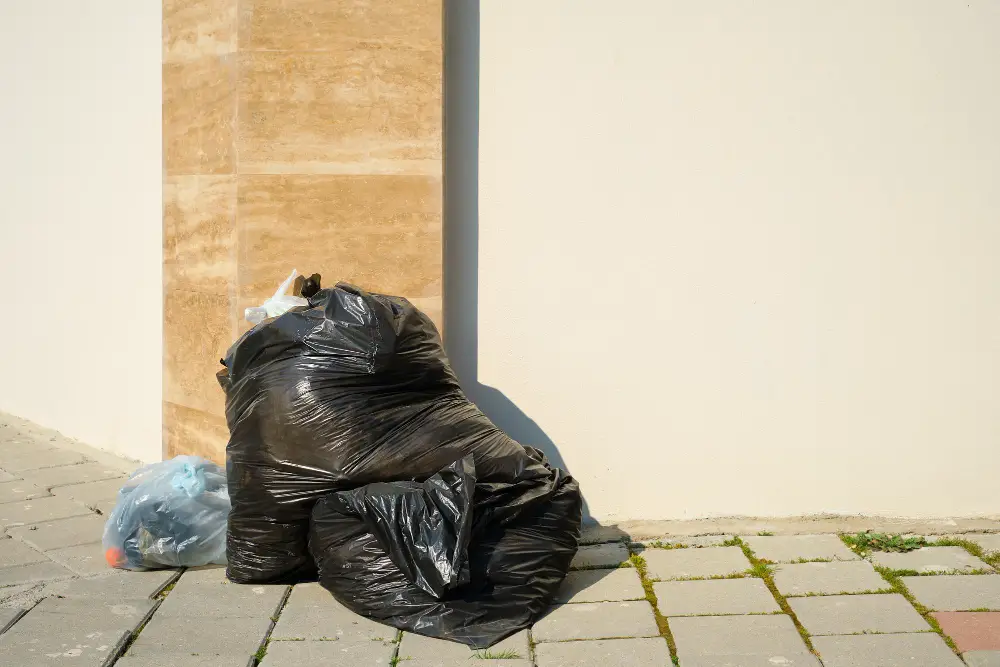
The Bags at the Curb
The street outside my kitchen window was always quiet at dawn, and I had come to rely on that quietness the way I relied on coffee and the particular angle of the early light across the linoleum. Sprinklers clicked across trimmed lawns in their methodical arcs. Somewhere down the block, a garage door would rise, a dog would bark once in protest or greeting, and the neighborhood would slowly remember it was supposed to be awake. I loved that hour with the specific love reserved for things that ask nothing of you in return.
Then I started spending it watching Barbara.
Her house stood directly across from ours, the kind of house that looks effortless until you understand how much effort it represents. The hedges were trimmed into clean geometric lines that had clearly required professional attention. The flower beds bloomed without a weed in evidence, which anyone who has kept flower beds understands is a considerable ongoing achievement. A silver SUV sat in the driveway, polished even in winter, even on days when the road was salt-stained and everything else on the block wore the grimy residue of months spent being weathered at. Barbara herself was just as composed. She wore silk scarves and neat slacks to collect the mail from the box at the end of her driveway. She wore lipstick for that errand. She waved whenever she saw us, a pleasant wave that communicated goodwill without extending an invitation, and in four years of living across from her we had never moved past polite conversation about the weather or the timing of the street’s leaf pickup.
I had assumed this was simply how she was: private, self-contained, the kind of person who maintains a bright surface and keeps the interior of things carefully off-limits. It had not occurred to me that the privacy might have a more specific explanation.
Then the trash bags started appearing, and I began paying a different kind of attention.
Every morning around seven, Barbara came through her front door in slippers and a pink robe, dragging a large black contractor bag behind her. She moved with the careful economy of someone managing something heavy, and she handled each bag with a deliberateness that I noticed without initially understanding. A garbage truck arrived around eight, collected whatever she had left, and drove away. I assumed at first that she had hired a junk-removal service for a renovation of some kind: the bags were large enough for the debris of a project, and people undertook home renovations in the spring without announcing them to their neighbors. But no workers arrived over the following days. No paint cans appeared. No furniture was delivered. The rooms visible through her windows looked the same as they always had.
Still, every morning, another bag waited at the curb. Sometimes two.
After a week, my wife Anna mentioned it over breakfast, in the light, observational tone she uses when she is actually concerned about something and is determining whether I have noticed it.
“Have you ever wondered what is inside those bags?”
I glanced toward the window. “Trash.”
“That is an impressive theory.”
“What else would be inside a trash bag?”
Anna carried her coffee to the window and stood beside me. Across the street, Barbara had stopped halfway down her driveway. She set the bag down and pressed one hand to her chest, bent slightly forward, her face turned away from us.
“Look at her,” Anna said.
Barbara stayed in that position for several seconds before straightening and continuing toward the curb.
“She looks tired,” I admitted.
“She looks ill.”
“That is a leap.”
Anna turned toward me with the patient expression she uses when she believes I have said something that does not require a direct argument to correct, only time.
“Is it? She has lost weight. She wears scarves indoors now. Last week, when I went across with a letter that came to our house by mistake, she barely opened the door. She looked as though answering it had cost her something.”
I had noticed the bags. Anna had noticed Barbara.
That should have told me something about both of us right from the beginning, and I recognized it later as the most clearly legible sentence in the entire situation, the one that explained everything that followed: I had been watching what was being removed, and Anna had been watching the person doing the removing, and those are genuinely different kinds of attention.
For the next several days, I watched more closely, though I would have described it to myself then as simply paying attention the way any alert neighbor pays attention to unusual patterns of activity on a familiar street. The truck came at nearly the same time each morning. It had no company name on the side, only a small sticker near the rear doors. Sometimes the driver placed a receipt in Barbara’s mailbox. I told myself this was the behavior of a legitimate hauling service rather than something that required interpretation.
One Tuesday morning, Barbara drove away before the truck arrived. She wore a blue blouse and a scarf wrapped high around her neck despite warm weather. Two bags remained at the curb.
Anna was reading at the kitchen table.
“Don’t,” she said, without looking up.
“I did not say anything.”
“You are thinking loudly.”
“I was going to check the mail.”
“The mail arrives at three.”
I crossed the street anyway.
I knew before I touched the bag that I had no right to open it. This was not a difficult moral calculation. The bags were Barbara’s, she was an adult, and she had chosen to send their contents away without consulting any of her neighbors. That choice belonged entirely to her. Whatever private logic governed the morning ritual of bringing something out and letting it go was not something I was owed access to.
I opened it anyway.
The moment I pulled back the tied top, I understood that nothing inside that bag was what I had been expecting to find, and the understanding arrived with the specific physical sensation of wrongness, not the wrongness of what I was doing, which I had already known, but the wrongness of finding something that demands an interpretation you cannot immediately supply.
No trash. No renovation debris. No general household discards.
Instead: a pink cardigan, folded with the sleeves crossed over the front in the careful way that someone folds something they have folded many times. A denim jacket with a butterfly patch on the left shoulder. Two pairs of jeans. Sneakers with the laces still tied, set inside as though they had simply been slipped off and placed there.
I dug further, which was a decision I am not proud of and which I made before I had consciously decided to make it.
School folders. Costume jewelry. Paperback novels with their spines creased from multiple readings. A stuffed rabbit missing one ear in the particular way that toys lose their features through sustained loving attention rather than carelessness.
At the bottom, three wooden picture frames. The glass had been removed, presumably for safety in transit, but the photographs remained inside the frames. The same girl appeared in all three. Standing on a beach with the wind pulling her hair across her face, squinting into the light and smiling anyway. Sitting at a piano in a white dress, fingers on the keys, her posture suggesting she was comfortable there. Leaning toward a birthday cake with sixteen candles, her face caught in the moment just before she blew them out.
On the back of each frame, the same name written in neat handwriting: Emily.
I stood at the curb with my hands going cold and looked at the photographs and understood that I had made an error larger than the one I had been warning myself against.
I retied the bag as carefully as I could, but the double knot Barbara had tied was beyond my ability to reproduce accurately. My version looked clumsy and obvious and exactly like someone had opened and tried to close a bag that had not been meant for them.
When I crossed back to our house and came through the kitchen door, Anna looked at me once and set down her book.
“You opened it.”
I sat at the table.
“There were a girl’s things inside.”
She waited.
“Clothes. School things. Photographs.” I paused. “The name Emily was on the backs of the frames.”
Anna’s expression changed, not with shock exactly, but with the careful seriousness of someone receiving information that requires a proper response rather than a quick one.
“That doesn’t mean something terrible happened,” she said. Then, after a moment: “Barbara has no child living with her.”
“No,” I said.
“So who is Emily?”
Neither of us answered, because neither of us knew.
“That doesn’t mean something terrible happened,” Anna said again, more firmly this time, and I understood she was saying it as much to me as to herself. “People clear out belongings for all kinds of reasons.”
“She’s doing it every morning. Bag after bag.”
“And you went through her private things without her permission.”
I looked at the table.
“You’re right.”
“That is not an apology to Barbara.”
“I know.”
We went to see Patterson that afternoon. She had lived on our street for thirty years and had accumulated, in that time, the kind of neighborhood knowledge that exists independently of gossip because it was acquired gradually and without any particular design through simple longevity. When we explained what had been happening, her face changed at Emily’s name.
“She was Barbara’s daughter,” Patterson said. “She died eleven years ago. She was sixteen years old.”
Anna reached for my hand under the table.
Patterson said it quietly and with the careful weight of someone for whom the information has not aged into abstraction, who still carries it with the original gravity it arrived with.
“She died after leaving the house during an argument with Barbara,” Patterson continued. “A drunk driver struck her while she was walking along the highway.”
I sat with that for a moment.
“Barbara has a son as well. David. He was nineteen when it happened. He left for college the following year and has not come back inside the house since.” She paused. “He blamed his mother for Emily leaving the house that night. Barbara blamed herself too. Neither of them could be in the same space with the other for very long after it happened, because being together required them to look at what they both already knew.”
“Why is she clearing the room now?” I asked.
“I don’t know,” Patterson said. “But she has not been well.”
That night I could not sleep.
I lay in the dark and thought about the photographs I had held without permission, and about a sixteen-year-old girl on a beach with wind in her hair, and about a mother who had kept her daughter’s room closed for eleven years and was now sending its contents away in contractor bags before dawn. I turned it over and over and could not find a way to make it mean something that satisfied me.
“She is erasing her,” I said into the dark.
Anna turned toward me.
“You do not know that.”
“She is giving everything away.”
“You saw one bag.”
“I saw photographs.”
“And you invaded her privacy to see them.” Her voice was sharper than her usual register, not harsh but precise. “You have no idea what is happening in that house or what Barbara’s reasons are. And you have been standing in your kitchen building a verdict about a woman who has spent eleven years alone with something the rest of us can barely imagine.”
I said nothing.
She was correct, and I knew she was correct, and knowing it did not make the images from inside that bag any easier to set aside.
The next morning, Barbara waved from her driveway when she saw me at the window.
I pretended not to see her.
Anna saw that too. She saw everything I would rather she had not.
“You are avoiding her because you are ashamed,” she said that evening. “And you are turning your shame into judgment because judgment is more comfortable to carry than guilt.”
That stayed with me in the particular way that accurate observations stay with you, repeating in different tones at different moments through the following days.
Two mornings later, I heard a sound from outside that was different from the usual sounds of that hour. A dull, heavy thump, followed by silence where sound should have continued.
I looked through the kitchen window.
Barbara was on one knee beside the curb. One hand was pressed flat against the pavement. The other still gripped the tied top of a trash bag. She had not fallen completely, but she was not getting up.
Anna was already moving.
“Come on,” she said.
We crossed the street at something close to a run. Barbara looked up when we reached her and tried to stand.
“I’m fine,” she said. The sentence was produced with complete conviction and was completely untrue.
Up close, her skin had a grayish cast beneath her makeup that I had not been able to see from across the street. Her scarf had shifted, revealing patches along her hairline where the hair had thinned significantly. She looked smaller than the bag she was still gripping.
“Don’t stand yet,” Anna said, crouching beside her. “Just breathe for a moment.”
“The truck will be here soon. I need to get the bag to the curb.”
“The bag can wait.”
“No. Please. It is the last pickup before Saturday, and I need—” She stopped. Her breath was unsteady.
“We’ll move the bag,” I said. “You don’t have to do that part.”
Between us, we helped her up and guided her toward the house. She unlocked the door and led us through to the kitchen, which was bright and spotless in the way kitchens are when their owners impose order as a form of control over spaces they can still manage. Pill bottles stood along one side of the sink in a precise row. A calendar on the refrigerator was dense with handwritten appointments, many of them marked with the names of hospitals or clinics.
We settled her at the table. Anna filled a glass of water at the sink while I stood near the doorway trying to determine what role I was supposed to occupy in someone else’s kitchen.
Barbara looked at me across the room with the evaluating gaze of someone deciding what a situation requires.
And then I said the thing I should not have said, the thing that had been building since I crossed the street two mornings ago, the confession that came out not because I had chosen to offer it but because silence suddenly felt like a worse option.
“I opened one of the bags.”
A flash of something crossed her face. Anger, clear and immediate and entirely warranted.
Then it settled back into exhaustion.
“I am sorry,” I said.
“You had no right.”
“No.”
“I don’t think you understood what you were doing. Those were private items.”
“I did understand. I did it anyway.” I met her eyes. “There is no version of this where what I did was acceptable. I am not offering an explanation. I am only telling you because you deserve to know.”
Barbara studied me for a long moment. Then she looked at Anna.
“Thank you,” she said. “For helping me inside.”
Anna sat at the table beside her. She did not say anything else immediately, which I recognized as one of Anna’s real gifts: the ability to be present without filling the space with her own presence.
After a moment, Barbara touched the edge of her scarf.
“Stage-four ovarian cancer,” she said. “The doctors think I have one or two months.”
I sat down.
The sunlight through the kitchen window was doing the same thing it did every morning, falling across the floor in the same familiar way, and everything in the room looked exactly as it always had, and none of it felt like the right context for what she had just said.
“My son is coming home Saturday,” she continued. “David. He has not been inside this house since he left for college after Emily died. Eleven years.”
“We spoke to Patterson,” Anna said. “About Emily. We had no right to ask, and I am sorry that we did. But we were worried about you, and our worry made us behave in ways we are not proud of.”
Barbara nodded. Some of the tension around her eyes softened slightly.
“The bags,” I said. “We assumed—” I stopped. “I assumed something that was wrong and unfair and that I am ashamed of. You don’t have to explain anything.”
She looked at me for a moment.
“The bags with the green tags,” she said, “go to a charity that serves teenage girls. Clothes, books, school supplies, the kinds of things that can be useful to someone.” She paused. “The unlabeled bags are for genuinely damaged items. I am not putting my daughter’s belongings in a landfill. I am sending what can be used to people who can use it, and discarding what cannot be saved.”
I thought of the frames with the photographs.
“I saw pictures in the bag I opened.”
“Duplicates. I had boxes of them. Some in my room, some in Emily’s, some in boxes in the attic. I am keeping every photograph that is the only copy of what it shows.” Her voice was composed but tight in the way of someone who is managing something very precisely. “I am not discarding my daughter. I am deciding what should live where, before I can no longer make that decision myself.”
Shame moved through me so completely that for a moment I could not say anything at all.
Anna rested her hands on the table. “Why clear the room now? You’ve kept it for eleven years.”
“Because David is coming to say goodbye to me.”
Barbara wrapped both hands around the glass, a gesture that looked like an effort to keep herself anchored.
“He has spent eleven years not being able to come back here. Not because he stopped loving me, I think, but because this house contains Emily, and he does not know how to be with Emily and also be with me at the same time. Those two things became impossible for him to do simultaneously.” She looked toward the window. “I thought if I emptied the room before he arrived, he would not have to face her when he came to face me. I thought it would make the visit survivable for him.”
The kitchen was quiet.
Anna said, carefully: “Did you ask him what he wanted?”
Barbara looked up.
“No.”
“Do you know that an empty room will hurt less than a full one?”
Barbara’s mouth opened and then closed.
“I am his mother,” she said.
“Yes,” Anna said. “But grief doesn’t make us able to read each other’s minds. Not even across a relationship that close.” She paused. “You might be right. An empty room might be easier for him. But you might also be deciding for him because asking is harder than deciding.”
The silence that followed had a different quality from the silences before it.
“I have been protecting him,” Barbara said, but her voice had shifted. There was something uncertain in it that had not been there before.
“You may have been,” Anna said. “And you may also have been protecting yourself from the conversation about what he needs, because that conversation requires you to tell him you are emptying the room, and telling him requires you to know what he thinks about that, and knowing what he thinks is frightening.”
Barbara’s eyes filled.
She did not deny it.
I leaned forward. “How much is left?”
“Two days’ worth. The closet. A storage cabinet. Boxes in the attic.”
“Let us help,” I said.
She looked at me with the careful attention of someone assessing whether an offer is genuine.
“Why?”
“Because I owe you more than an apology. And because Anna is right.” I looked at her steadily. “We should sort what can be donated. But we should not empty the room completely before David has a chance to see it. Give him the choice. Let him tell you what he needs, rather than deciding what he can survive.”
Barbara pressed her lips together.
Her eyes moved to Anna.
Anna said nothing, simply waited.
And then, finally: “It has been so hard going back into that room alone.”
Anna reached across and covered Barbara’s hand with her own.
“You won’t open it alone this time.”
That afternoon, we called Patterson, who came without hesitation and without requiring the situation to be explained at length, because she already knew the essential shape of it and was simply waiting to be asked.
Emily’s room was not what I had imagined. I had constructed a museum in my mind: a preserved, airless space held in amber, everything exactly where it had been left, dust gathering on surfaces that no one had disturbed in a decade. What I found instead was a room that had been lived with quietly, that showed the particular kind of neglect that comes not from abandonment but from the paralysis of a grief that does not know what to do with the physical evidence of the person it is grieving. Dust on the dresser. Curtains faded at the edges from years of light. Boxes filling the closet and stacked along one wall, some open and some sealed, arranged by someone who had been trying to impose order on something that resisted it.
Barbara sat on the bed while we worked. She sat with the posture of someone who has made a decision and is prepared to honor it even though it is costing her something.
We organized everything into four categories. Things for the charity, items that were genuinely damaged beyond usefulness and destined for the trash, things Barbara would keep without question, and things we set aside for David to decide about. That last category was the one we disagreed about most, and it grew larger than Barbara had expected, because every time she reached for something to direct toward the charity, Anna or Patterson would ask a question. Is this something David might want to have? Is this something he might want to decide about? Does this belong to a conversation you haven’t had yet?
At first Barbara resisted. “He does not need all of this,” she said, holding a school trophy from a science fair.
“That is for him to decide,” Anna said.
“He may hate me for keeping it.”
“He may hate you more for not keeping it.” Anna said it gently but without softening it into something it was not. “And either way, the decision belongs to him, not to you, for the same reason the decision about Emily’s room belongs to him: because he lost her too.”
Barbara flinched. Then she nodded and set the trophy in the pile for David.
As the afternoon went on and the work found its rhythm, something changed in Barbara’s manner. Not immediately and not completely, but gradually, in the way that people relax when they have been carrying something alone for a long time and have finally been permitted to set part of it down.
She began to talk about Emily.
Not with the careful, managed quality of someone performing grief for an audience, but with the easy unpredictability of real memory, the way stories surface when your hands are busy with something and your guard is not fully deployed.
“She built a volcano for the school science fair,” Barbara said, holding a photograph I had not seen before. “She used baking soda and vinegar and she miscalculated the quantities somehow and the eruption reached the gymnasium ceiling.” A pause. “She was horrified. And then she laughed, because she was always able to laugh at herself. She got second place.”
“Was she good at science?” I asked.
“Excellent at it. Confident in a way that I always thought would take her very far.” Barbara set the photograph down carefully. “She was planning to study chemistry. She wanted to work on environmental problems.” A long pause. “She had very specific ideas about what she was going to do.”
We kept several outfits that had particular significance, a stack of photographs that Patterson identified as capturing moments she remembered, the silver necklace that had been a sixteenth birthday gift, a soccer medal from her final season, the stuffed rabbit with one ear, because Barbara could not part with it and none of us suggested she should.
By Friday evening, the room had been transformed without being emptied. The bed remained. The faded curtains remained. Several books on the shelves, the titles she had loved most, according to Barbara. Framed photographs on the dresser and on the wall. The shelf above the desk held objects that told the truth about the person who had lived there: the soccer medal, a small ceramic bowl she had made in a class when she was twelve, a paper crane that Patterson said Emily had learned to fold from a library book and had made in every available spare moment for a month until she felt she had mastered it.
The room looked like a room in which a real person had lived, rather than a room being preserved or a room that had been cleared. It looked like the room of someone who was gone and who was still real.
Barbara stood in the doorway and looked at it for a long time.
“I thought an empty room would be kinder,” she said.
Anna slipped an arm gently around her.
“Sometimes kindness is leaving the door unlocked,” she said. “And letting the other person decide whether they want to walk through it.”
Saturday morning arrived clear and cool. I was at the kitchen window with my coffee, the way I had been at the beginning of all of this, watching the same quiet street.
A silver sedan turned onto the block and parked in Barbara’s driveway.
A tall man stepped out and stood beside the car for a moment, looking at the house. He was still in the way of someone who has arrived somewhere they have been both dreading and moving toward for a very long time, who is taking a moment to understand that they have actually arrived.
Barbara opened the front door.
He crossed the lawn in a few strides and she met him at the steps and he put his arms around her in the way of someone who has decided, finally, that everything they have been afraid of is less frightening than continuing to be afraid of it.
I started to step back from the window.
Anna was beside me. “Let’s give them their privacy,” she said, and I nodded and moved away.
Later that afternoon, someone knocked on our door. David was taller than he had looked from across the street, with the same quality of composed exhaustion that I had seen in Barbara during those morning trips to the curb, the look of someone who has been carrying something heavy and has not yet fully understood that putting it down is permitted.
His eyes were red.
“My mother said you helped with Emily’s room,” he said.
“We did,” Anna said. “I hope that was the right thing.”
He looked across the street at the house for a moment.
“I went upstairs,” he said. “I sat on Emily’s bed for a while.”
Anna waited.
“Was it too much?” she asked.
“Yes.” He exhaled slowly. “But I needed it to be.”
That evening, Barbara invited us all to dinner: Anna and me, David, Patterson. She cooked with the deliberate care of someone for whom cooking has always been a form of competence, of demonstrating that she can still manage the essential things. The kitchen smelled of something slow and warm.
Emily’s personal things were spread across the dining room table: the photographs, the necklace, the paper crane, the soccer medal, the ceramic bowl.
David sat at the table and looked at everything for a long time without speaking.
Then he said: “I blamed Mom for eleven years.”
Barbara kept her eyes on her hands.
“Emily left because they argued,” he continued. “And I decided that made Mom responsible for what happened to her. I needed someone to be responsible. I needed somewhere to put it.”
“I told her to leave,” Barbara said. “If she hated living here so much, I told her to leave.” Her voice was steady but fragile in the way of something that has been held rigid for a long time. “She was sixteen. You do not say that to a sixteen-year-old, whatever the argument. You do not open the door and tell them to go.”
“No,” David said. “You don’t.”
“I cannot die believing I killed her.”
David looked at his mother across the table.
“I know, Mom.” His voice broke slightly. “It was not your fault. The driver was drunk. The driver put himself on that road. You made a mistake during an argument, and Emily made a decision, and a drunk driver made a catastrophic decision, and none of that is something you caused.” He paused. “I knew that. I have known it for a long time. I told myself the blame was yours because carrying the blame myself was unbearable and giving it to you seemed like it would make the unbearable thing lighter. It didn’t.”
Barbara nodded.
David reached across the table and covered her hand with his.
“I came home,” he said.
She closed her hand around his and did not say anything, and she did not need to.
In the weeks that followed, David stayed. He drove Barbara to her appointments. Anna cooked and left food on Barbara’s doorstep in the mornings when David called to say it had been a difficult night. Patterson managed the garden, because Barbara had always kept the flower beds and the hedges with such care and it seemed important that they remain kept. I washed the silver SUV every week or so, because Barbara had always hated dust on it, and doing something concrete and small felt better than doing nothing.
Some mornings, David and Barbara sat in Emily’s room together. On those days, the door stood partly open and the window was cracked for air. Other mornings, the door was closed. They never settled into a fixed pattern, because grief does not settle into patterns, and they had given up pretending it would.
But they talked about her. Together, finally. They told each other stories. David remembered things Barbara had forgotten or had never known, things from Emily’s life that he had witnessed and she had missed. Barbara told him things he had been too young to know, stories from Emily’s early childhood, from before David’s memory was fully formed.
Together, they held the whole of her rather than the partial and separate versions each had been carrying alone.
Barbara died in early September, on a morning that was cooler than it had been, with the quality of light that announces autumn before the calendar does. The funeral was small, the way funerals are when a person has outlived much of their social world or has lived quietly, but the people who came had known her genuinely, and the grief in the room was real and specific rather than performed.
David stayed on after. Not permanently, but regularly. He drove back to the city for his work and returned on weekends and sometimes during the week, and eventually he began to refer to the house in the way people refer to places that have reclaimed their original meaning. A home. His mother’s home. Emily’s home. His home, now, in whatever the future held.
I watched the house across the street from my kitchen window sometimes, in the early mornings, in the hour I had always loved for its quietness. The silver SUV in the driveway. The hedges David was learning to maintain. The flower beds that Patterson helped him keep through the autumn. The window upstairs at the front, with its pale curtains.
I thought about the morning I had stood at the curb and opened a bag that was not mine to open and found something inside that I had not been prepared for, and about all the conclusions I had drawn from it before I understood anything, and about the specific kind of shame that comes from being wrong in a way that reveals something about how you were looking rather than what you were looking at.
I had been watching what was being removed from the house.
Anna had been watching the person doing the removing.
I understood now what those two different kinds of watching had produced, and I understood what it cost Barbara when I treated her morning ritual as something requiring investigation rather than the thing it actually was: a woman, alone with something unbearable, trying to do the right thing by the people she loved in the only way she could still reach them, making decisions that were sometimes right and sometimes born of fear dressed as love, doing her best, which is all anyone does, which is the most any of us ever manages.
She had tried to protect David by choosing what he would lose, just as she had spent years choosing what parts of her grief the world was permitted to see. She had believed she was sparing him, and she had been partially right and partially wrong, which is the realistic outcome of most of our attempts to protect the people we love from pain. We guess. We do our best with what we understand. We miss things that someone watching from a different angle would have seen.
In the end, she had opened the door. To David, to us, to the conversation she had been avoiding for years, to the version of the story that required her to be uncertain rather than controlled.
And in the opening, something that had been sealed for eleven years finally had room to breathe.
The morning bags had been sent to teenage girls who needed clothes and books and school supplies. The duplicates had been organized and distributed. The room upstairs was still a room, still containing the evidence of a real girl who had lived in it, still available to be sat in and remembered in and grieved in, still containing the paper crane and the soccer medal and the ceramic bowl and the curtains that had faded in the years of accumulated light.
The door was unlocked.
That was what mattered.
That was what had always mattered.

Laura Bennett writes about complicated family dynamics, difficult conversations, and the quiet moments that change everything. Her stories focus on real-life tensions — inheritance disputes, strained marriages, loyalty tests — and the strength people find when they finally speak up. She believes the smallest decisions often carry the biggest consequences.