The last thing I heard before the ballroom went silent was my own chair scraping across polished marble.
Preston Ashworth III had one hand wrapped around the back of it.
He was my stepfather’s older brother, the patriarch of one of the wealthiest defense-contracting families on the East Coast, and the kind of man half the Washington defense world called “Uncle Press” behind his back and “sir” to his face. He was seventy-one years old, worth somewhere north of four billion dollars, and he had spent the last eleven years of my life reminding me — sometimes with a smile, sometimes without one — that I was an accessory that had come with his brother’s second marriage, like a lamp nobody had picked out.
That evening, beneath crystal chandeliers in a grand ballroom just outside Washington, D.C., Preston pulled my chair away from the head table as casually as a man correcting a seating mistake. The legs shrieked against the marble. Heads turned at the first three tables, then the next five.
A few people laughed.
Not everyone. But enough. Enough that the sound seemed to cling to my skin like smoke.
“This table is for people who matter tonight, sweetheart,” Preston said, projecting his voice with the practiced ease of a man who had given a thousand toasts. “You don’t belong here.”
I wish I could tell you I had some brilliant answer waiting. I didn’t. I simply stood there in a navy dress I had bought on sale, holding a small clutch containing lipstick, my phone, and a folded sheet of paper I had never expected to need.
For a few seconds, I was not a grown woman in a Washington ballroom. I was eleven years old again, standing in the doorway of the Ashworth estate while a man in a cashmere sweater looked at me the way you look at weather.
Then, from somewhere near the back of the ballroom, another chair scraped against the floor.
Then another.
Then several more — almost together, measured, unmistakably disciplined. Chairs pushed back by people who had spent their lives standing on command and had long since decided for themselves when standing was warranted.
I turned.
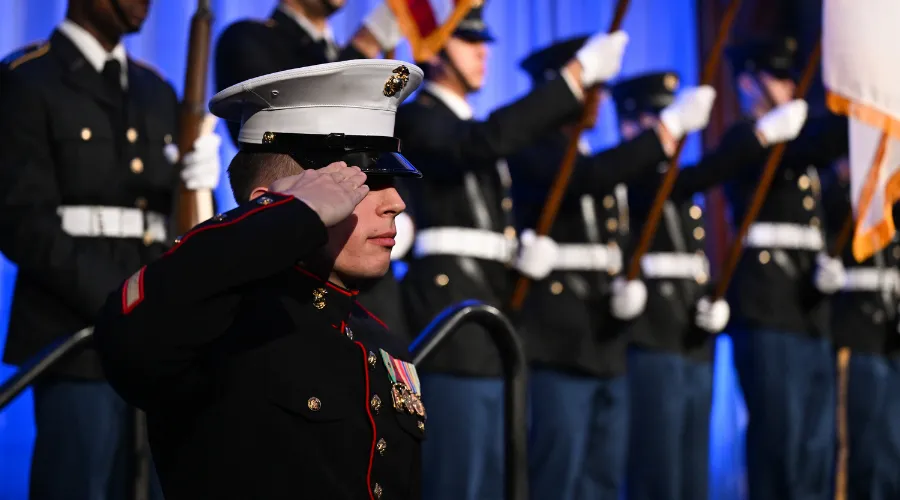
One senior officer after another was rising. Six four-star military leaders, seated at tables scattered across that glittering room, were on their feet, their dress uniforms catching the chandelier light — rows of ribbons, stars on shoulders, and not one smile among them.
The laughter didn’t fade. It vanished — so completely that I could hear the string quartet near the far wall, still playing softly, unaware that the temperature of the room had changed.
General Mariana Reyes, the ranking Army officer present that night, stood at the center of them. She had a reputation in Washington for almost never raising her voice, because she almost never needed to.
She looked directly at Preston Ashworth.
“Mr. Ashworth,” she said calmly, “I don’t believe you understand who you just asked to leave that table.”
Preston’s hand stayed frozen on my chair.
General Reyes turned toward me.
“She is our guest of honor.”
To understand how a billionaire ended up frozen in front of six four-star officers at his own gala, you have to go back almost two years — to a Sunday dinner at the Ashworth estate in McLean, Virginia, back when I still believed I might someday earn my way into that family’s good graces through sheer competence.
My name is Elena Cruz.
For six years, I worked as a forensic financial investigator, specializing in irregularities involving defense contracts and military benefit programs. It is not glamorous work. Most days involved spreadsheets, payment records, vendor files, authorization codes, corporate registrations, bank transfers — thousands of transactions that mean nothing at all until you set two of them side by side and notice the one number that doesn’t belong.
My father, Daniel Cruz, was an Army colonel. He commanded soldiers on two continents, and he died when I was nineteen, and there is not a day I don’t miss him. My mother remarried three years later. Her second husband was Robert Ashworth — Preston’s younger brother, a decent enough man perpetually eclipsed by his older sibling.
That marriage is how the daughter of an Army officer found herself folded into one of the wealthiest defense-industry dynasties in Northern Virginia. It is also how I spent the next decade being reminded, sometimes gently and sometimes with an audience, that I never quite matched the picture in their frame.
Preston had built Ashworth Dynamics into a multibillion-dollar contractor. And every spring, he hosted what he called the Guardians Gala — an elaborate black-tie benefit presented as a celebration of military families and a fundraiser for veterans’ services. The charitable work was real; I’ll give him that. So was the other purpose. Everyone attending understood that the gala also existed to remind several hundred executives, retired officers, political donors, lobbyists, and Washington power brokers exactly who Preston Ashworth was.
At that Sunday dinner two years earlier, my stepbrother Caleb asked about my work. Caleb was Robert’s son from his first marriage — an emergency medicine doctor with no appetite for family politics and the only Ashworth who had never once treated me like I needed permission to exist.
“How’s that case you mentioned going?” he asked.
I kept my answer deliberately vague, because the investigation was active and I do not discuss active cases, even with family. “I’m reviewing pension and survivor-benefit disbursements connected to a midsized defense subcontractor.”
Preston set down his wineglass with the deliberate precision of a man who wanted the table to notice him setting it down.
“Elena does spreadsheets,” he told retired Brigadier General Walcott, seated at his right hand — a man who had flown combat missions in Vietnam. Preston gave me a pleasant smile. “Numbers. Very useful. Very small picture.” He leaned back, wine in hand. “Not exactly the sort of work that changes the world. But somebody has to do it.”
Several people laughed — that quick, obedient laughter you hear around powerful men, the kind that arrives before anyone has decided whether the joke was funny, because the decision was never about the joke.
General Walcott did not laugh.
He looked at me for one second longer than everyone else did. A quiet, assessing look, almost as though he were doing arithmetic in his head. Then he returned to his dinner and said nothing.
I remembered that look. I didn’t understand it then. I would.
That was the story Preston told about me for years, at that table and a hundred others. I was Daniel Cruz’s disappointing daughter — his stubbornness without his significance. My father commanded soldiers; I pushed paper in a windowless office. Real men and women did consequential work, Preston liked to imply. People like me documented it afterward.
He repeated that version of me so often, so consistently and so charmingly, that I eventually understood something important about him: I don’t think Preston believed he was lying. He had simply never once bothered to check whether his story was true.
What he did not know — what almost no one outside a small professional circle knew — was what my “spreadsheet job” had quietly become.
The company I was examining was Sentinel Rail Group, a logistics subcontractor in the administrative chain of several federally supported military-family programs. Going in, I expected accounting errors. Sloppiness. The records looked ordinary.
Too ordinary.
The individual discrepancies were small — small enough to vanish inside enormous logistics accounts, which was precisely the point. But when I started laying disbursement records against Department of Defense authorization codes, gaps repeated. Payments approved for one purpose, routed to another. Vendor names recurring under slightly altered corporate registrations — Meridian Freight Services, then Meridian Freight Solutions, then Meridian Freight Systems, each with its own bank account, each account tracing back through two layers of shells to the same beneficiary. Invoices that matched perfectly until you checked the dates, and then didn’t match at all.
The deeper I went, the worse it got, and the quieter my apartment became at night.
A senior financial executive at Sentinel had been siphoning money from a federally administered survivor-benefits program — funds intended for the families of service members who died while serving. I want you to understand what that money actually is, because “misappropriated federal funds” is a phrase that puts people to sleep. That money is a widow in Ohio making her mortgage payment in the months after the funeral. It is a nineteen-year-old starting college on her dead father’s benefit. It is groceries, heating oil, school shoes — the thin financial floor under families who have already given more than any country has a right to ask.
Over four years, just under sixty-one million dollars had been drained out from under that floor, through falsified vendor payments and layered shell companies. The entire scheme rested on one assumption: that defense logistics were so complicated, so tedious, so gray, that no one would ever examine the transactions closely enough to notice the difference between what was authorized and what was actually disbursed.
I noticed.
And then I spent eleven months proving that what I had noticed was real. I cross-referenced disbursement logs against authorization codes until my eyes burned. I rebuilt four years of payment histories from fragments. I traced corporate ownership through three states and two offshore registrations. I worked nights. I worked weekends. More than once I fell asleep at my kitchen table with the laptop still open beside a cold cup of coffee, and I dreamed — I am not exaggerating — in account numbers.
When I finally delivered the complete evidentiary package to federal investigators, one of the prosecutors told me it was among the cleanest financial cases his office had handled in a decade. The executive responsible was convicted and sentenced to nine years in federal prison. Nearly sixty-one million dollars was recovered and redirected back to the programs — and the families — it had been stolen from.
And somewhere during those eleven months, something else happened that I didn’t fully register at the time.
My name began to circulate. Quietly. Not socially — professionally. It moved through offices and conference rooms I had never entered, attached to reports I never saw, reaching the senior officers responsible for the military-family programs my case had touched. Those officers did not know or care where I sat at Preston Ashworth’s dinner parties.
They cared that money meant for Gold Star families had been protected. And they remembered who had protected it.
My younger sister, Maya, was one of the only people in the family who ever asked real questions about my work. Four years younger than me, an ICU nurse with the kind of laugh that could make a terrible shift survivable, she would call me after night duty, exhausted and curious.
“Hold on,” she said one night. “You’re telling me you uncovered millions being stolen from military families, and Uncle Press still calls what you do a spreadsheet job?”
She never entirely understood forensic accounting — I can hardly blame her; it is not thrilling dinner conversation. But Maya understood the only thing that mattered: the way the Ashworths talked about me did not match the woman she actually knew.
Once, around two in the morning, sitting on my kitchen floor eating leftover takeout — our best conversations have always happened on that floor, don’t ask me why — she looked at me and said, “You know he’s wrong about you, right?”
“I know.”
“You know that isn’t going to be the end of the story, right?”
“I know,” I said.
But I didn’t. Not completely. What I did have was something I’d learned from watching my father: competence does not always announce itself. Sometimes it works quietly for years and lets the record speak after everyone else has finished talking.
Somewhere around month nine of the Sentinel case, I made a formal decision — I remember the night I made it. I would stop correcting Preston Ashworth. I would stop defending myself across expensive dinner tables. I would stop explaining my value to a man who had decided who I was before I ever opened my mouth.
If the record ever spoke, I would let it speak on its own.
And I would not interrupt it.
The record cleared its throat about four months before that year’s Guardians Gala.
After the case concluded, the Defense Department office overseeing the affected survivor-benefit programs completed its internal review, and that review produced a formal meritorious-service commendation — official recognition of the investigator whose analysis had directly protected military-family benefits and recovered the missing funds.
My name was on it.
As part of the process, copies of the citation and case summary circulated among the senior military liaisons connected to those programs. That — and only that — is how several four-star officers came to know the name Elena Cruz months before any of them walked into Preston’s ballroom.
I want to be precise about what happened next, because it matters to me that you understand it. I did not orchestrate the scene at the gala. But I would be lying if I said I was entirely unaware of what might happen.
When my invitation arrived, it looked exactly like every invitation Preston had ever sent me. Elena Cruz and Guest. Nothing about the investigation. Nothing about the commendation. To Preston, I was still Robert’s stepdaughter, occupying a courtesy chair.
So I made one phone call. Not to Preston.
I called Colonel Priya O’Day, the soft-spoken military liaison who had worked beside me through the final months of the case, and I asked what sounded like a purely administrative question.
“Is a commendation like this normally presented publicly, when there’s an appropriate military event?”
“It is,” she said. “It’s encouraged, actually.”
“Interesting,” I said. “Because my family happens to be hosting a gala in a few weeks. Several of the senior officers whose programs were affected will be attending.”
There was a pause on the line. A long one.
“What date?” she asked. I told her. “What venue?” I told her that too.
Then she asked whether General Reyes was on the guest list.
“She is.”
Colonel O’Day was very quiet for a moment, and when she spoke again I could hear something in her voice that I can only describe as professional delight.
“I think,” she said, “we can arrange something.”
It turned out General Reyes required very little convincing. I learned later that she had read the Sentinel case summary personally, twice, and had asked her staff at the time who the investigator was.
I told no one in my family. Not my mother, not Robert, not Caleb. Even Maya only got one instruction.
“Make sure you come to the gala this year. Don’t trade the shift.”
“Why?”
“Trust me. You want to see this one.”
Maya knew me well enough not to ask a second question. She cleared her schedule.
In the two weeks before the gala, I allowed myself — briefly, guiltily — to imagine the room. Preston’s face. My father’s old military acquaintances finally learning what I actually did, instead of what Preston said I did. It wasn’t vanity. It felt closer to relief — the relief of someone who has held her breath so long she’s forgotten what breathing feels like.
Then I made myself stop imagining it. Because imagining an outcome and earning one have never been the same thing in my experience, and I did not want to spend the moment before it arrived.
The night of the Guardians Gala came in warm and clear, one of those spring evenings in Northern Virginia when the last light lingers over the Potomac and Washington looks almost gentle from a distance. Black SUVs lined the drive. Valets moved briskly under the portico. Inside, American flags stood beside the service banners near the stage — understated, unmistakable — and the ballroom glittered with dress uniforms, tuxedos, gowns, and the restrained hum of several hundred influential people pretending they were simply there for dinner.
I arrived alone, in my sale-rack navy dress, and for most of the evening, nothing happened at all.
People shook my hand. Several didn’t remember my name and didn’t try hard to hide it. Preston circulated through the room like a mayor inspecting his city, dispensing handshakes and one-liners, trailing that obedient laughter behind him like a wake.
I saw General Reyes across the room exactly once. She gave me the smallest possible nod — a nod you would miss if you weren’t looking for it. Colonel O’Day stood nearby with a glass of sparkling water she never drank from. Neither of them approached me. Everything remained perfectly, expertly ordinary.
Until I reached the head table.
My place card was there — the events company had worked from the master list, the one Preston never bothered to read. ELENA CRUZ, in engraved script, at the head table, among the senior guests.
I had just touched the back of the chair when Preston materialized beside me, smile tight as wire.
“I think there’s been a seating mix-up.”
I looked down at the card. “It has my name on it.”
“That doesn’t mean you need to sit here.” His eyes swept the room — his room, his evening, his order of things. “This table is for senior guests.”
I thought about explaining. I had been explaining myself to this man for eleven years. Instead, I simply looked at him, and I said nothing at all.
Maybe the silence irritated him. Maybe he had spent so many years defining me without resistance that he mistook my restraint for agreement — he always had. Whatever the reason, Preston Ashworth put his hand on my chair, and in front of three hundred of the most connected people in Washington, he dragged it away from the table.
The scrape was enormous in the marble room. Heads turned. Conversations died in rings, table by table, like lights going out.
And then, the laughter. Not much. But enough.
“This table is for people who matter tonight, sweetheart,” he said, pitching it to carry. “You don’t belong here.”
And for about four seconds, everything I had done ceased to exist. Eleven months. Thousands of records. The late nights, the federal meetings, the sixty-one million dollars, the hundred and forty families who never learned how close their floor came to collapsing. None of it was in that ballroom. There was only Preston’s hand on my chair and the old, familiar sensation of being shrunk down to somebody else’s version of me.
I have thought about those four seconds many times since. Here is what I understand now: that humiliation, sharp as it was, was never the center of the story. It was simply the last thing that had to happen before the truth entered the room.
A chair scraped behind me.
Then another. Then several more, in near unison — the crisp, decisive sound of people who stand for a living.
I turned. General Reyes was on her feet. So was every senior officer in the room — six four-stars, rising from six different tables, in no hurry whatsoever.
She crossed the ballroom in full dress uniform, heels striking marble in the total silence, and she stopped in front of me. Not Preston. Me.
She extended her hand.
“Ms. Cruz,” she said, loudly enough now for the entire ballroom, “we have been looking forward to this all evening.”
Preston’s hand came off my chair as if it had grown hot.
General Reyes turned to face the nearly three hundred guests.
“Most of you know Mr. Ashworth as the man who built this gala,” she said. Then she gestured to me — the woman in the sale-rack dress with the clutch and the folded paper. “I would like you to know Ms. Elena Cruz as one of the primary reasons nearly sixty-one million dollars is back where it belongs — in the programs serving this country’s military families.”
Nobody was laughing now.
“Those funds,” she continued, in that level voice that has ended arguments in the Pentagon, “represent mortgage payments. Tuition. Household stability. Promises made to families who have already sacrificed more than anyone in this room.”
Preston stood completely still. I watched his face — I had earned the right to watch it — and I saw the sequence move across it like weather: confusion first, then calculation, then, arriving slowly and settling in to stay, recognition. The face of a man realizing, in real time, in front of everyone whose opinion he had ever courted, that he had spent eleven years constructing a story about a person without once checking a single fact in it.
Colonel O’Day approached the head table carrying a dark leather folio.
General Reyes opened it, and she read the commendation aloud. Not the shortened ceremonial version. The complete citation — every paragraph. Eleven months of forensic reconstruction. The identification of a complex scheme targeting survivor-benefit programs. The tracing of shell corporations. The cooperation with federal prosecutors. The recovery of funds. The words diligence and professional integrity, read slowly, attached to my name, under those chandeliers.
Sentence by sentence, I felt the room change. Or perhaps the room stayed exactly the same, and only its understanding of me changed — three hundred people quietly reconsidering a woman who had apparently existed in front of them for years without ever being worth the trouble of knowing.
When she finished, General Reyes closed the folio. Then she looked directly at Preston Ashworth, and she delivered the only sentence of the night that could fairly be called a weapon.
“You told this room she does spreadsheets.” Her voice never rose. “I would like the record to reflect that those spreadsheets kept approximately one hundred and forty military families financially secure during the worst period of their lives.”
Preston opened his mouth.
Nothing came out.
In eleven years, I had never seen that happen. Preston Ashworth always had something — a story, a correction, a joke, a judgment, a final word. That night, in his own ballroom, under his own chandeliers, he had none. The silence was so complete I could hear my own heartbeat, and beneath it, absurdly, the string quartet, still playing.
Then someone at the second table began to applaud. Another joined. Then the sound gathered itself and swept the room, and within seconds nearly three hundred people were on their feet — and it did not sound like polite applause. It sounded like recognition. It sounded like a correction being entered into the record.
Maya was standing before almost anyone else, tears streaking her face, mouthing something at me across the room that I couldn’t hear and didn’t need to. She had known first. She had known for free.
My mother rose more slowly, one hand over her mouth, looking at me with an expression I struggled to read — until I understood it, and then almost wished I hadn’t. She looked like a woman realizing there were important things about her own daughter she had never taken the time to learn. For one strange second, I felt sorry for her. Not because she was embarrassed. Because she suddenly, visibly, wanted to know a person she’d had twenty years to know.
As for Preston — the rest of his evening unfolded rather differently than the one he had planned. His place at the center of the celebration simply, quietly dissolved. Twenty minutes later, a member of the catering staff found him sitting alone on a folding chair near the service corridor, an untouched scotch in his hand. No audience. No ring of executives awaiting his verdicts. No laughter arriving on command. Just Preston Ashworth and the silence he had built for himself, one dinner-table joke at a time.
The consequences did not arrive dramatically. Real ones rarely do. They arrived the Washington way — through phone calls, closed-door meetings, board discussions, and carefully worded statements.
The defense-contracting community is far smaller than outsiders imagine, and the story moved through it at the speed of lunch. So did the video; there is always a video. Within six weeks, the board of the Guardians Gala Foundation formally asked Preston to step down as chairman, citing “concerns regarding the organization’s public representation.” Corporate language. Everyone translated it instantly: a foundation built to honor military families could not keep, as its public face, a man filmed dismissing the investigator who had protected those families’ benefits — in front of six four-star generals, at his own gala.
Preston did not lose everything. Men like Preston rarely do. He kept his fortune, his position at Ashworth Dynamics, his houses, his accounts. But he lost the one thing he had actually built the gala to purchase. For decades, Preston could walk into any room in Washington and expect warmth. After that night, the warmth became courtesy — and there is a difference, and no one alive feels that difference more acutely than a man like him. People still shook his hand. But the laughter around him got slower. The smiles got more careful. The distance became impossible not to see.
Eight months later, I was promoted — asked to build and lead a newly created unit within the inspector general’s operation, dedicated entirely to financial misconduct affecting military-family benefit programs. Work I had been doing nearly alone for years, I now did with a staff of eleven: investigators, analysts, real support, and a budget that would have made the twenty-six-year-old version of me laugh out loud.
The work stayed tedious. It will always be tedious. There are still nights spent reading records nobody else wants to read, still thousands of numbers, still strange discrepancies hiding in ordinary-looking columns.
I love it.
General Reyes and I stayed in touch — not frequently, but genuinely, which is better. When my unit secured its first major conviction, flowers arrived at my office with a card containing exactly one sentence: “Told you they’d catch up.” I kept it. It’s in my desk drawer, next to a photo of my father in uniform.
Colonel O’Day became a mentor, and then something closer to a friend. Caleb still works emergency medicine and still declines all Ashworth politics, which is why he remains my favorite. My mother is trying, slowly, to ask better questions. I don’t make it easy for her. But I haven’t closed the door, either. Some relationships deserve rebuilding; others deserve boundaries. Learning to tell the difference turned out to be its own kind of adulthood.
Maya moved into an apartment two blocks from mine that same year, and some nights, after one of her shifts or one of my long days, she still comes over with takeout and we still end up on the kitchen floor — older now, tired in different ways, but not so different from the sisters we were. She still asks real questions. What are you working on. Why does that transaction matter. How did you even notice that. Sometimes I answer for half an hour. Sometimes I tell her I can’t discuss the case, and she throws a spring roll at me.
She never needed the commendation. She never needed six generals to stand up in a ballroom and explain my worth to her. She had known the whole time, for nothing. That matters to me more than the folio does.
Preston contacted me exactly once, about four months after the gala. One text message.
“I hope we can move past this.”
I stared at that screen for a long time, waiting to feel anger. It never came. What came instead was strangely familiar — the feeling of finishing a long forensic audit. You spend months following inconsistencies, checking every figure twice, and then you reach the final page, run the numbers one last time, and everything balances. Not victory. Closure. The books simply close.
I typed four words.
“The record already did.”
Then I put the phone down and did not look at it again that night.
Eleven months of following sixty-one million dollars through accounts where it never should have gone taught me something I wish I’d understood a decade sooner. You do not have to spend your life arguing with people who decided you were small before they met you. You do not have to convert every insult into a debate, or explain your value at every dinner table that refuses to see it.
Sometimes the strongest answer is a record — built patiently, checked twice, filed properly — that nobody can rewrite when the time comes.
For years I thought my silence at those dinners meant Preston was winning. Eventually I understood the difference between being silent because you are afraid, and being silent because your work is not finished yet. One is surrender. The other is discipline.
My father understood that. I think that’s what I actually inherited from him — not his rank, not his uniform, not his reputation. His patience. His conviction that the work had to be right before anyone heard about it. His belief that respect worth having never needs to be demanded every five minutes.
There will always be people like Preston Ashworth — people who confuse the size of the chair they occupy with the size of the person sitting in it. Sometimes they will move your chair. Sometimes they will announce, to a full room, that you don’t belong at the table. And sometimes the room will laugh, because agreeing with power is easier than examining it.
But a chair is not a place. And another person’s opinion is not a record.
That night outside Washington, Preston believed he was removing me from a table reserved for important people. What he never understood was that my place in that room had stopped depending on him years earlier. It had been built one late night at a time. One document at a time. One carefully checked number at a time. One protected family at a time.
By the time his hand touched my chair, the argument was already over. He simply hadn’t read the record yet.
And that is the lesson I carried out of that ballroom, the one I’d offer anyone who has ever been laughed at over someone else’s wine: do your work with enough integrity that when the truth finally walks into the room, you don’t have to raise your voice.
Stand still.
Let the record stand up for you.

Ethan Blake is a skilled Creative Content Specialist with a talent for crafting engaging and thought-provoking narratives. With a strong background in storytelling and digital content creation, Ethan brings a unique perspective to his role at TheArchivists, where he curates and produces captivating content for a global audience.
Ethan holds a degree in Communications from Zurich University, where he developed his expertise in storytelling, media strategy, and audience engagement. Known for his ability to blend creativity with analytical precision, he excels at creating content that not only entertains but also connects deeply with readers.
At TheArchivists, Ethan specializes in uncovering compelling stories that reflect a wide range of human experiences. His work is celebrated for its authenticity, creativity, and ability to spark meaningful conversations, earning him recognition among peers and readers alike.
Passionate about the art of storytelling, Ethan enjoys exploring themes of culture, history, and personal growth, aiming to inspire and inform with every piece he creates. Dedicated to making a lasting impact, Ethan continues to push boundaries in the ever-evolving world of digital content.