I used to think there were two kinds of wives in the world.
There were the ones who woke up before the sun, who made coffee in the blue dark of the kitchen and packed neat little lunches in matching containers and kissed their husbands goodbye at the door like they were sending them off to war. The ones who had a system, a rhythm, a set of small daily rituals that seemed to announce, to themselves and to everyone else, that they were doing this marriage thing correctly.
And then there were wives like me.
I loved my husband. I want to say that first, before I say anything else, because everything that came after has a way of making people assume the love was never really there, and it was. I loved Jeremy with the kind of quiet, steady, unremarkable love that folds itself into the background of an ordinary life until you almost stop noticing it, the way you stop noticing the sound of your own house settling at night. I washed our sheets and remembered when we were running low on detergent before we actually ran out. I knew he liked his eggs over medium with the yolk still soft but not runny. I could tell from the particular weight of his footsteps in the entryway whether he’d had a good day or a bad one, whether to ask him about it right away or to give him twenty minutes and a glass of water first.
But I had never been the kind of wife who packed lunches every morning.
It was not because I did not care. That part matters, and I need you to believe it, because I spent a long time afterward wondering whether I had somehow failed at a test I did not know I was taking. I cared more than I ever quite knew how to say out loud. I was a stay-at-home wife, and most of my days were built around the endless, invisible, thankless work of keeping a house from quietly falling into chaos. Toys we didn’t have children for, so at least there were no toys, but crumbs on the counter that reappeared no matter how many times I wiped them, dust that gathered in the corners of rooms nobody used, laundry that multiplied in the dark. My days had a shape, but it was a soft shape, a domestic one, and it left me with a lot of hours and a lot of quiet.
Jeremy had a big corporate job in one of those tall glass office buildings downtown, the kind where everyone walks fast and talks fast and looks important even when they are only standing in line for coffee. He worked in something I could never fully explain to my own mother, a job with a title that contained words like strategy and development and partnerships, and he came home carrying the smell of the city on him, aftershave and cold air and the particular ozone smell of an office that recirculates the same conditioned atmosphere all day.
He always told me he had a cafeteria at work.
“The food is fine,” he said, the first time I ever asked if he wanted me to pack him something. We had been married maybe four months. I had offered the way you offer things early in a marriage, tentatively, still learning the borders of another person.
“Fine” was one of Jeremy’s favorite words. I came to understand, over three years, that it meant everything and nothing, that it was less a description than a door he closed gently in your face.
“Are you tired?” I would ask.
“I’m fine.”
“Was the meeting bad?”
“It was fine.”
“Do you want me to make you lunch?”
“The cafeteria is fine, Maya.”
So I stopped asking. I am the kind of person who learns quickly where she is not wanted, who reads a closed door and does not knock twice, and I told myself this was a kindness, this respecting of his space, when really I think now it was just easier for both of us, and easy is a thing that can quietly hollow out a marriage from the inside while everyone congratulates themselves on how little they fight.
For three years, that was the arrangement. He went downtown in pressed shirts and polished shoes, and I stayed home and managed the house and tried, most days successfully, not to feel like my whole life had contracted into a loop of dishes and laundry and grocery lists written on the back of envelopes.
I did not hate it. I want to be fair to that version of my life, because she was doing her best with what she understood her job to be. Some days I genuinely loved the quiet rhythm of it, the sunlight moving across the kitchen floor in the late morning, the satisfaction of a folded basket of warm towels, the small animal contentment of a clean and ordered home that I had made clean and ordered with my own two hands. There is a kind of peace in domestic work that nobody talks about because it isn’t ambitious, a meditative steadiness in doing the same small necessary things over and over so that the people you love can move through their days without friction.
But other days, when Jeremy came home smelling like aftershave and city air and carrying stories about people and projects and deadlines and coworkers with names I was starting to know like characters in a show I did not watch, I felt like I was pressing my face to the window of a life that had gone on moving briskly forward without me. He had a whole world out there, populated and fast and consequential, full of decisions that mattered and people who noticed him. I had a house and a set of routines and a husband who came home to me every night and told me, without fail, that his day had been fine. I sometimes wondered, folding his shirts, whether I had made myself too small to be seen, whether in getting so good at maintaining the background of his life I had become the background myself. But I never said any of that out loud. It felt ungrateful. It felt like the complaint of a woman who had everything and wanted more, and so I folded it up small, the way I folded everything, and put it away.
Then, a few months ago, “fine” changed.
He came home one evening, dropped his briefcase by the entryway with more force than usual, and stood in the middle of the kitchen with a face so grim that I turned off the faucet and dried my hands, my heart already picking up, certain something terrible had happened.
“What?” I asked. “Did your boss say something?”
“No,” Jeremy muttered.
“Did the client meeting go badly?”
“No.”
“Then why do you look like someone stole your car?”
He opened the refrigerator and stared into it as though the source of his misery might be sitting on a shelf behind the milk, and then he said, with the wounded gravity of a man reporting a real tragedy, “The cafeteria served something today that I think was supposed to be chicken. But I cannot prove it.”
I laughed before I could stop myself.
He looked over his shoulder at me, betrayed. “I’m serious. It was barely edible. I think it was apologizing to me as I ate it.”
“Yesterday it was fine,” I pointed out.
“Yesterday, fine was still possible,” he said darkly. “Today, fine died. Today I watched fine die on a beige plastic tray.”
I was still laughing, and he was fighting a smile now, and for a moment the old ease was back, the thing that had made me fall for him in the first place, that sideways humor he kept folded up under all the corporate polish. And that, though I did not know it then, was how it started. Not with grand gestures. With mystery chicken and a joke and a small opening in a door that had been closed for three years.
At first it was casual. A container of pasta because I’d made too much the night before and hated to throw it out. A sandwich wrapped in foil, cut on the diagonal the way he liked. Leftover roast chicken with rice and a handful of green beans. Nothing fancy, nothing that belonged in one of those glossy meal-prep videos that exist mostly to make ordinary people feel like failures. Just actual food, made by someone who knew him, that he could eat at noon without coming home looking depleted.
And it grew from there, the way a small habit grows when it’s meeting some need in you that you hadn’t fully named. Within a few weeks I was planning around it. I’d notice at the grocery store that the good sourdough was in and think, that would make a nice sandwich for Jeremy on Thursday. I bought a set of better containers, ones that sealed properly and didn’t leak, and I felt a little thrill of competence when they arrived, as though I had been promoted into some new tier of wifehood. I started a small mental catalog of what he liked and didn’t, refining it, the way you learn a subject you’ve decided to care about. No raw onion. Extra of the roasted vegetables. He’d eat almost any leftover except fish, which went strange by noon. It was, I can see now, the most engaged I had felt in our marriage in a long time, and the terrible irony is that the thing making me feel most connected to my husband was a daily ritual he was carrying, uneaten or eaten, straight into the middle of an affair.
And honestly, I liked doing it. That is the part that became almost unbearable to remember later. I liked it. It felt sweet in a small, unglamorous, married-life kind of way, the kind of tenderness nobody photographs or posts because it isn’t dramatic enough to perform. I liked cutting fruit into a little side container so he’d have something bright to finish on. I liked writing his name on the lid in black marker, JEREMY in my careful capital letters, so it wouldn’t disappear into the anonymous crush of the office refrigerator. I liked imagining him at his desk at noon, or in some bright break room I had never seen, opening the lid and finding the food and, for just a second, thinking of me. Thinking of home. Thinking that someone out there was taking care of him.
One morning I made chicken with roasted potatoes and green beans, and I put real effort into it, more than the task strictly required. The night before, Jeremy had mentioned, almost shyly, in the low voice he used for the few things he actually let himself want, that he missed the way his mother used to make her chicken when he was a boy. So I did something that embarrasses me a little now with how much it reveals about who I was in that marriage. I called his mother. I stood at my own counter with a notepad and a pen and asked her how she made it, and she was delighted, genuinely delighted, that her son’s wife wanted the recipe, and she walked me through it slowly, and she told me, laughing, that the whole secret was paprika and patience, that you could not rush it, that you had to let it take the time it needed. I wrote that down. Paprika and patience. I stayed up later than I meant to, seasoning the chicken so it could sit overnight, my hands smelling of garlic and smoked paprika at midnight, and I remember feeling, standing in my quiet kitchen, something close to purpose.
By the next morning the whole house smelled warm and savory, like somebody’s childhood, like a home where people loved each other out loud. Jeremy came downstairs in a pale blue dress shirt, already thumbing through something on his phone, his tie not yet knotted.
“Big day?” I asked.
“Always,” he said, and leaned down to kiss my cheek without lifting his eyes from the screen.
The kiss landed somewhere near my ear. Not on my cheek, not really. Near it. A kiss aimed by muscle memory rather than attention, the way you might pat a dog you’d walked past a thousand times.
I told myself not to be sensitive about it. He was busy. He was always busy. Busy was practically his natural state, a weather system he lived inside, and I had long ago decided that taking his distraction personally would only make me miserable, so I chose, again, not to.
“Your lunch is on the counter,” I said. “The chicken. Your mom’s recipe.”
“Thanks, babe.”
And he grabbed his keys and his phone and his laptop bag in one practiced sweep, and he was gone, the door clicking shut behind him with its familiar small finality, and I stood alone in the warm-smelling kitchen and felt, for reasons I couldn’t name, a little hollow.
I rinsed my coffee mug. I wiped a smear of jam off the counter that hadn’t been there a minute ago, or maybe had been there for hours. I turned to start the dishwasher.
And that was when I saw it.
The lunchbox.
It sat there by the toaster, the blue lid snapped tight over the chicken I had actually gone to the trouble of calling his mother about, the chicken with the paprika and the patience, the chicken that had made my hands smell like garlic at midnight. He had walked right past it. He had carried out his keys and his phone and his laptop and left behind the one thing I had made with my hands.
For a second I stared at it and thought, with a little flare of the resentment I usually kept tamped down, okay, well, that’s on him. He was a grown man. He had forgotten it. He could suffer through the mystery cafeteria chicken and think about what he’d done.
But then I pictured the food sitting there all day, going cold and then congealing, my effort slowly spoiling on the counter. I pictured Jeremy at noon standing in a cafeteria line looking at another beige tray. I pictured him coming home that night with the tired, hollow, scraped-out look he’d been wearing too often lately, the look I had convinced myself was just the natural cost of a demanding job.
So I picked up my phone and I texted him. You forgot your lunch. I can bring it by if you want.
He didn’t answer right away.
I waited a few minutes, watching the little screen the way you watch a phone that owes you something, waiting for the typing bubble to appear. Nothing. No bubble. No quick thanks. No don’t worry about it, babe, I’ll grab something. Just silence, and the read receipt didn’t even turn on, which meant he hadn’t looked.
I figured he was in a meeting. That was always the safe explanation with Jeremy, the universal solvent that dissolved every unanswered question. Meeting. Call. Deadline. Client. His whole job seemed to come equipped with a built-in vocabulary designed to explain, gently and permanently, why he was unavailable, and I had accepted that vocabulary for three years without ever once examining it.
I looked down at myself. Black leggings. An old gray sweater with one sleeve stretched permanently out of shape from years of my tugging it down over my hand when I was cold or anxious or both. Sneakers that had seen genuinely better days. My hair was pulled up into a bun that was not cute enough to be intentional, the kind of bun that says clearly, I was not planning to be seen by anyone today. It was the full uniform of a woman who had expected to spend her whole day inside her own house.
But the chicken was still warm. I could feel it through the plastic when I picked the box up.
“Fine,” I said out loud, to the empty kitchen, borrowing his word without meaning to. “We’re doing this.”
I grabbed the lunchbox, I locked the door behind me, and I drove downtown.
The closer I got to Jeremy’s office, the more out of place I felt in my own skin. The streets grew crowded and impatient in a way my quiet suburb never was. Cars honked at things that hadn’t happened yet. People crossed against the light with the total confidence of pedestrians who had come to some private arrangement with death. The buildings climbed higher and higher on either side, all glass and hard angles, throwing the pale sky back at itself so that the whole downtown seemed to be made of mirrors reflecting mirrors, and none of it reflecting me.
Jeremy’s building looked exactly the way I had always pictured it from his stories. Tall, polished, cold, expensive. I found parking two blocks away and walked, clutching the lunch bag, and when I pushed through the heavy glass doors into the lobby, the air changed. It smelled like good coffee and floor cleaner and, underneath, something I could only think of as money, a clean cool expensive nothing-smell. People moved through the space like they had been choreographed, everyone walking with purpose, everyone wearing a badge on a lanyard, everyone carrying a laptop or a phone or a paper cup, everyone very clearly on their way to something that mattered.
And there I was in my stretched gray sweater with a plastic lunchbox, feeling exactly like somebody’s mom who had wandered in on a school field trip and gotten separated from the group.
I became suddenly, excruciatingly aware of everything about myself. The faint squeak my old sneakers made against the polished marble. The way the sweater hung off one shoulder no matter how I adjusted it. The way the security guard at the desk glanced up at me, not unkindly, but long enough that I felt I owed him an explanation.
“I’m here for Jeremy,” I said, and then realized immediately that this told him nothing at all. “He works upstairs. He’s my husband. He forgot his lunch.”
I heard how it sounded even as I said it, small and domestic and out of place in all that glass and steel.
The guard checked something on a screen, unbothered, and slid a visitor sticker across the desk to me. “Elevators are to the left, ma’am.”
Ma’am. That did not help.
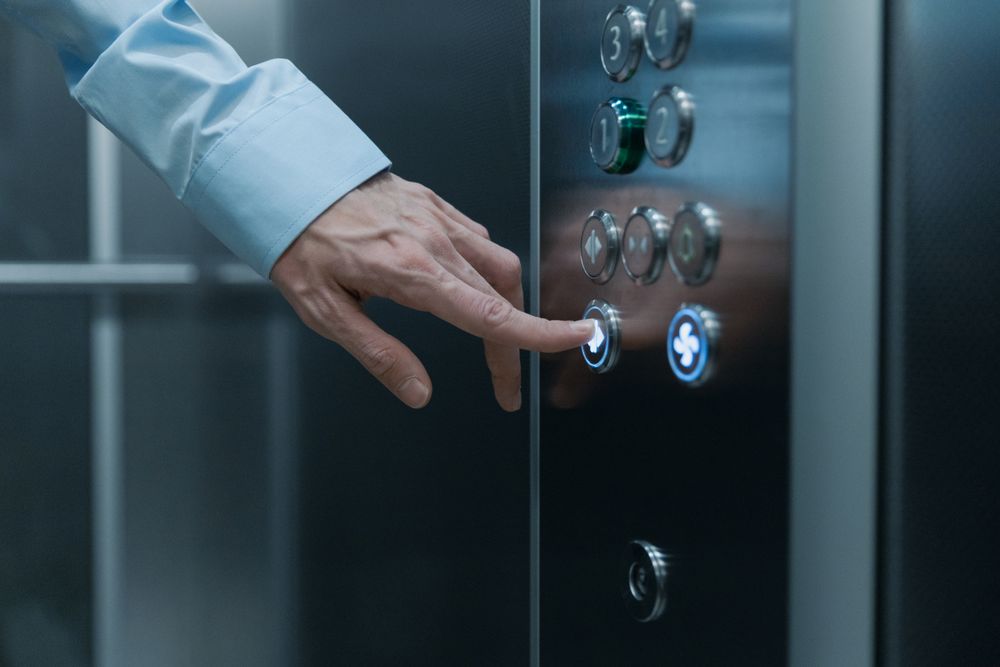
I peeled the sticker onto my sweater and thanked him and walked toward the elevator bank, clutching the lunchbox now with both hands like it was the only solid thing in the building. When the doors of the nearest car slid open, I stepped inside and reached for the button for Jeremy’s floor.
Or I tried to. Because right before the doors closed, another woman slipped in.
She was beautiful. And I don’t mean beautiful the way people say when they’re being polite about someone, that reflexive kindness we hand out. I mean she was genuinely, effortlessly, expensively beautiful, the kind of woman who looks completely put together without appearing to have tried at all, which is of course the hardest look in the world to achieve. A blazer that fit her like it had been made for her, and maybe it had. Hair that fell in a way mine had never once fallen in my life. A bag that probably cost more than my car was currently worth. Small gold hoop earrings. Nails a soft, perfect, understated nude. And a perfume that reached me a half-second after she did, something low and warm and clearly chosen from a counter where a single bottle costs more than my weekly grocery run.
We both reached for the same floor button at the same moment. Our fingers nearly brushed.
We did that small awkward laugh two strangers do when they’ve accidentally reached for the same thing, and she said, “Sorry.”
I pulled my hand back. “No, you’re fine.”
She gave me a quick polite smile, pressed the button, and the doors slid shut.
For a few seconds the elevator hummed smoothly upward and we stood in the particular silence of two strangers in a small box, each of us performing not-looking. I stared at the little numbers ticking up above the door. She looked at her phone. I tried, and failed, not to compare my stretched-out sweater to her blazer, my tired bun to her hair, my whole self to her whole self.
And then the elevator made a sound.
It was an awful grinding noise, deep and mechanical and wrong, the sound of something that is supposed to move freely suddenly refusing to. The car jerked hard. My stomach dropped as the whole thing shuddered and then stopped, suspended, between floors.
Then came the beeping. Not the soft, polite chime of a machine doing its ordinary job. This was an angry, insistent, repeating, soul-scraping beep that filled the tiny space completely until it felt like it was coming from inside my own skull.
We both went very still.
The woman recovered first. She pressed the button to open the doors. Nothing happened. I pressed the alarm button. More beeping, as if in answer, as if mocking us.
For a moment neither of us said anything. We just stood there staring at the seam where the closed doors met, as though if we looked helpless enough the doors might take pity and open.
“Okay,” she said slowly. “That’s not ideal.”
“No,” I agreed. “Not exactly.”
She hit the open-door button again, harder, with the flat of her hand. Still nothing. I looked down at the lunchbox in my grip and had the sudden absurd thought that of all the things to be trapped in a broken elevator with, I had brought chicken. I almost laughed, and then didn’t, because the air already felt thinner, which I knew was almost certainly my brain being dramatic, but knowing that did not make it feel any less true.
She found the button marked with a little telephone symbol and pressed it, and after a burst of static a man’s voice came through, tinny and far away.
“Security. Is everyone all right in there?”
“We’re stuck in elevator three,” she said, and I noticed she sounded remarkably calm, far calmer than I felt, the voice of a woman used to handling things.
“Maintenance has been notified,” the voice said. “Please remain calm, we’re working on it. Shouldn’t be long.”
The speaker crackled and went dead, and the two of us were alone again with the beeping and each other.
I shifted my weight from one foot to the other. The lunchbox handle was starting to dig a red line into my palm. After a few minutes of standing in that ringing silence, the awkwardness of it began to feel almost worse than the fact of being trapped, and apparently fear makes me socially brave, because I heard myself say, “So. Do you work here?”
She turned toward me. “Yeah. One of the upper floors.”
Her voice was smooth, but now that she’d turned to face me fully I could see something underneath it, a tiredness around her eyes that the perfect hair and the blazer had distracted me from. Up close she looked less like the effortless woman from a magazine and more like an actual person who had been holding herself together carefully all morning and was running low on whatever it took to do that.
“Oh, that’s where my husband works,” I said, with a small self-conscious laugh, lifting the lunchbox an inch as if to explain myself. “One of the upper floors. I’m just dropping off his lunch. He forgot it on the counter this morning.”
She glanced down at the lunchbox in my hand. Then she looked back up at my face.
And something moved across her expression, something quick and complicated, there and gone so fast that I told myself I had imagined it.
“Oh, really,” she said. “Who’s your husband? Maybe I know him. It’s a small building, once you’re up on those floors.”
There was no reason on earth for my heart to tighten at that. It was a completely normal question, a friendly one, the most natural thing in the world. People who work in the same building know each other. They chat by the coffee machine and complain about the same slow elevators, the very elevators, and sit through the same interminable meetings. Of course she might know him.
“Jeremy,” I said.
The effect was immediate and total.
The color left her face. Not faded, not drained slowly. Left. All at once, the way light leaves a room when someone flips a switch. Her lips parted but no sound came out. She stared at me, and I watched something happen behind her eyes, some frantic internal calculation, as though she were trying to decide in real time whether to lie, or cry, or find some way to walk backward through the solid wall of the elevator and out of this moment entirely.
The beeping went on and on.
My fingers tightened on the handle. “What?” I said, and my voice came out smaller than I meant it to. “Do you know him?”
She swallowed. Her eyes dropped, just for a second, to my left hand, to my wedding ring, and then rose slowly back to my face, and when she spoke it was barely above a whisper.
“Oh, girl.”
For a moment all I could hear was the beeping, bouncing off the metal walls, sharp and endless, while this beautiful tired stranger looked at me the way you look at someone standing in the path of something they can’t see coming.
My throat had gone completely dry. “What does that mean?”
She pressed her lips together and looked toward the doors again, as though rescue might arrive in the next second and spare her from having to answer.
“Please,” I said. “Do you know my husband?”
She let out a long, shaky breath. “Yes.”
One word, and it landed in the center of my chest like a stone dropped into still water, sending everything rippling.
“From work?” I asked. I was still reaching, you understand. I was still trying to build an innocent version of this out of the pieces in front of me.
Her eyes filled so fast that for one strange, awful second I almost felt sorry for her, before I remembered that I was the one standing there holding my husband’s lunch.
“Kind of,” she murmured.
“Kind of?” My voice cracked down the middle. “What does kind of mean?”
She wiped carefully under one eye with the pad of her thumb, an automatic gesture, protecting makeup that no longer mattered. “My name is Brielle,” she said, as if that were an answer, as if a name could soften whatever came next.
I waited. I did not offer mine. Something in me had gone very quiet and very cold, waiting.
She looked at my ring again. “I didn’t know about you,” she said. “At first.”
The elevator seemed to shrink around us, the walls easing inward.
“At first,” I repeated.
She closed her eyes for a second, gathering something. “Maya, right?”
Hearing my own name come out of her mouth was worse than anything she had said yet. It made it real in a way nothing else had. It meant I existed in her world, that I had been discussed, referred to, named, in rooms I had never been in. “How do you know my name?” I said.
“He mentioned you,” she admitted, so quietly I had to lean in over the beeping to catch it. “Later. Not in the beginning. In the beginning he didn’t mention you at all.”
I stared at her, still trying, even then, to arrange the words into some shape that couldn’t hurt me. Maybe Jeremy had simply talked about me to a coworker. Maybe this woman had a hopeless crush on my husband and was mortified to be trapped with his wife. Maybe I was about to make an enormous fool of myself over nothing, and we would laugh about it later, or never speak of it again.
But her face already held far too much grief for any harmless version of this to be true. You don’t cry like that over a coworker’s wife.
“Say it,” I told her. My voice had steadied into something I didn’t recognize. “Whatever this is. Just say it.”
She flinched.
“Whatever it is,” I said again, “say it.”
Her voice came out soft and ruined. “Jeremy and I were involved.”
I did not move. I did not scream. I did not drop the lunchbox, though later I would wonder how, because my hands had gone numb. I just stood there, perfectly still, in a broken elevator, while somewhere deep inside me my entire life quietly split into two pieces, a before and an after, cleaved right down the middle by one soft sentence from a stranger.
“Involved how,” I said, though I already knew. Of course I knew.
Her eyes lowered. “We dated.”
“You dated.” I heard the words come out flat. “My husband dated you.”
She nodded, and the tears were spilling over now, tracking down her carefully made-up face. “He told me he was separated,” she said, the words tumbling out fast now that the dam had broken, as though confession were the only thing that might make her feel less monstrous. “He told me the marriage was basically over, that the two of you were only still living together because of money, because of the house, because of the divorce being complicated. And because of your son.”
Something in my chest turned to ice. “We don’t have a son,” I said.
Her head snapped up. “What?”
“We don’t have a child. Any child.” I heard myself explaining it to her, calmly, as though the facts of my own marriage were something I needed to prove. “I’m home during the day because I used to be a nanny, before we got married, and we agreed I’d take some time away from working while we tried to start a family of our own. We haven’t been able to. That’s why I’m home, Brielle. There’s no little boy.”
Her face crumpled completely. “Oh my God,” she whispered. “He told me you had a son. A little boy. He said he did school pickup on Thursdays. He said he coached, he said, oh my God.”
A laugh broke out of me then, small and jagged and ugly, a sound I had never made before. “Of course he did,” I said. “Why stop at one lie? Why not build a whole child? Why not invent a whole little boy who needs picking up on Thursdays?”
Brielle pressed her hand over her mouth. “I’m so sorry,” she said through her fingers. “I’m so sorry, I didn’t know, I swear to you I didn’t know any of it was real, I mean, that none of it was, that you were.”
“How long,” I said.
She hesitated, and in the hesitation I already heard that it was going to be worse than I wanted.
“How long,” I said again.
“Six months.”
The number nearly took my legs out from under me, and I put a hand against the cold metal wall to steady myself. Six months. Half a year. I ran the arithmetic before I could stop myself, the way you press on a bruise. Six months of lunches. Six months of me lying awake wondering if he was working too hard, if I should be doing more, if the quiet in our marriage was the ordinary settling quiet of a couple who had found their rhythm or something else. Six months of me asking if he was tired and believing fine. Six months of him kissing the air near my ear while he read his phone. Six months of me calling his mother for a recipe, standing in my kitchen at midnight with garlic on my hands, thinking I was tending to my marriage, while he told this woman I was a cold and distant roommate he was too decent and too broke to leave.
“Is it still happening?” I asked.
“No,” she said quickly, and I could hear that this part, at least, she needed me to believe. “No. I ended it. Two weeks ago.”
“Why?”
And her expression changed then, shame giving way to something harder, older, an anger that wasn’t aimed at me. “Because I found out he was lying about something else,” she said. “Not about you. I still didn’t know about you, not really, not the truth of it. But he’d promised me he was leaving the company, that he was going to start over, that we were going to build something together somewhere new. And then I saw him at a client event, laughing, completely at ease, with another woman, touching her arm, and I watched him and I realized I had no idea which version of anything he said was true. Any of it. So I ended it. And he told me I was being dramatic. He told me I’d imagined the whole thing, that it was nothing, that I was seeing things that weren’t there.”
She wiped her eyes again. “I want you to understand something,” she said, “not to excuse myself, because there’s no excuse, but because I think you deserve to know how it happened, how a person ends up here. I’m thirty-four. I’ve spent my whole adult life in that building and buildings like it, working eighty-hour weeks, and I told myself that was why I was alone, that I just hadn’t had time. And then this charming, funny, sad man started paying attention to me, and he had a whole story ready-made, a story where he was trapped in a loveless marriage with a woman who’d stopped seeing him, staying only out of decency and money and for the sake of a child. And I ate it up, because it made me the answer to something. It made me the good thing happening to a good man who deserved better. Nobody thinks of themselves as the villain in someone else’s marriage. He didn’t offer me a villain’s role. He offered me a hero’s.”
The beeping stopped.
The sudden silence was almost worse than the noise had been, a ringing absence.
A voice crackled through the speaker. “Ladies, maintenance is working on it from the sixth floor. You may feel some movement shortly. Hang tight.”
Neither of us answered.
Brielle leaned back against the wall of the elevator and slid down slightly, drained, all the polish gone out of her posture. “I confronted him,” she went on, quieter now. “About the woman at the event. And that’s when he did the thing he does. He made me feel insane. He made me feel like the problem was my jealousy, my imagination, my inability to trust a good man. And then today.” She stopped. “Today I was in his office to drop off a file, and his phone was face up on the desk, and your name flashed across the screen. Maya. And a message. It said you were bringing his lunch.”
My message. My caring, stupid, hopeful little message.
“So you got in this elevator because of me,” I said slowly.
“I was leaving,” she said. “For the day. Maybe for good, I don’t know. I couldn’t sit up there one more minute and watch him walk around being normal, being charming, being fine, knowing what I knew. I just needed to get out of the building. I didn’t know you’d be in here. I swear I didn’t. I would never have.”
I looked down at the lunchbox in my hands. It suddenly seemed like the most absurd object in the world, almost cruel in its cheerfulness, the blue lid, his name in my careful black capitals. I had carried love into this building in a plastic container. I had driven downtown in my stretched sweater to warm the heart of a man who had invented a child to explain me away.
“What did he tell you about me?” I asked. I don’t know why I wanted to know. I think some part of me needed the whole wound at once, all of it, no more slow reveals.
Brielle’s shoulders sagged. “That you were cold,” she said gently, as though gentleness could take the edge off the words. “That you didn’t love him anymore. That you’d checked out of the marriage years ago and only cared about the house, about keeping everything nice, that living with you was like living with a very organized ghost. He said he felt invisible in his own home.”
And those words hurt more than any of the rest of it, more than dated, more than six months, because they were not entirely unfamiliar. They sounded like softened, quieter versions of things Jeremy had said to me over the years. Never accusations, nothing so direct that I could have pointed to it and argued. Just hints. Small sighs. Little comments dropped at the right angle to lodge under my skin and stay there. You’re always cleaning. You never just relax with me. Sometimes I feel like you’d rather organize the pantry than talk to me. Comments that had made me try harder, always harder, that had made me the woman standing up at midnight seasoning chicken with his mother’s paprika, trying to reach a man who had already decided, for his own convenience, that I could not be reached.
“I made his lunch,” I said, and my voice broke on it, “because I thought he needed kindness. I thought he was tired and overworked and that I could give him one small good thing in the middle of his day.”
And Brielle, this beautiful stranger crying on the floor of a broken elevator, looked at the lunchbox and cried harder. “I thought I was giving him that too,” she said. “The kindness. He made me feel like I was the only person who really saw him. Like I was rescuing him from a cold life. That was the story. I was the warmth. You were the cold.”
And that was the first moment I truly saw her. Not the blazer, not the perfect hair, not the enviable bag. I saw a woman who had been handed the exact same story I’d been living inside, told from the other direction. He had cast us both. He had written us each a role in a play about his own suffering, the cold wife and the warm rescuer, and he had performed his loneliness for both of us, and we had each, in our own way, tried to save him. She had not walked into my marriage laughing. She had walked into a lie so carefully built that she’d had no way of knowing it had a real woman standing at the center of it, a woman making him lunch.
And I understood, in that cramped humming box, something about my husband that was almost worse than the affair itself. Jeremy had not simply cheated. Cheating, at least, is a single betrayal with a clear shape. What Jeremy had done was author two entire women. He had studied each of us, found the exact story that would make each of us reach for him, and told it patiently, maintained it, updated it, for months. To me he was the tired good husband who only needed a little more warmth. To her he was the trapped good man who only needed a way out. Neither man existed. Both were performances calibrated to their audience, and the through line connecting them, the only true thing in either story, was a man who had discovered that he could get an endless supply of care by presenting himself as someone in need of rescue. Brielle and I had both signed on to save a drowning man, and there had never been any water. He had just liked the way it felt to be reached for.
I slid down the wall and sat on the floor of the elevator, the lunchbox in my lap. After a moment, Brielle shifted and sat across from me, the two of us on the floor of a stopped elevator in our completely different clothes, and something in the strange intimacy of it, the enforced closeness, made the next question possible.
“Did you love him?” I asked.
She nodded once, and looked away, humiliated by the truth of it. “I thought I did,” she said. “I really thought I did.”
I looked up at the ceiling and breathed through the deep ache spreading across my chest. “So did I,” I said.
We sat with that for a while, the two of us, saying nothing, the silence no longer awkward but something else, something almost like company.
Then the elevator lurched, and we both grabbed for the rails and pulled ourselves up. Somewhere above us metal clanged against metal, and there was a whir, and the car began, cautiously, to move. A few minutes later the doors shuddered open, only halfway at first and then the rest of the way, onto a hallway full of hard fluorescent light, two maintenance workers in coveralls, and a security guard.
“Careful stepping out,” one of the workers warned. “Mind the gap there, we’re not quite level.”
Brielle stepped out first. And then she turned back, in the doorway of that broken elevator, and held out her hand to me.
I almost didn’t take it. There was a version of me, the old version, the one who read a closed door and never knocked twice, who would have refused it out of pride, out of the sheer strangeness of being helped up by the woman my husband had been sleeping with. But I looked at her hand, and I looked at her face, and I understood that we were, in the most unlikely way, the only two people in that entire glass building who actually knew the truth, and that she was offering me the only real kindness anyone had offered me all day.
So I took it. Her palm was cold, but her grip was steady and sure, and she pulled me up, and we stepped out into the hallway together.
And there was Jeremy.
He was standing near the security desk down the corridor, his tie loosened, his phone in his hand, and the moment he saw the two of us come out of that elevator together, side by side, his whole face changed. Not into fear, not at first. Into calculation. I watched it happen. I watched my husband of three years look at his wife and his girlfriend emerging from an elevator together and immediately begin running the numbers, working out the angles, deciding which version of himself to deploy.
“Maya,” he said, and he came toward me fast, arranging his features into concern. “Oh my God, are you okay? I just got your text, I was in a meeting, I heard the elevator got stuck, are you all right?”
I looked at Brielle. She looked at me. Neither of us said anything.
Then I held up the lunchbox between us.
“You forgot this,” I said.
Jeremy’s eyes flicked from my face to Brielle’s and back again, and I saw the calculation stutter. “What,” he said carefully. “What’s going on? Why are you two.” He didn’t finish it.
Brielle’s mouth tightened. “Don’t,” she said.
His jaw hardened, and his voice dropped into something low and controlling that I had heard before, aimed at me, in smaller doses, over the years. “This isn’t the place,” he said.
“No,” I agreed quietly. “Our marriage wasn’t the place either. But you still brought someone else into it.”
His face went pale. “Maya. Let me explain. It’s not, whatever she told you, it’s not what it.”
“You told her we were separated,” I said. My voice was steady now, steadier than his. “You told her we had a son. A little boy. You told her you did school pickup on Thursdays. You told her I was cold, that I didn’t love you, that living with me was like living with a ghost. And meanwhile you let me pack your lunches and call your mother for recipes and lie awake worrying that I wasn’t doing enough for you. You played the wounded husband for her upstairs and the neglected husband for me at home, and you were the only one in the whole arrangement who knew both scripts.”
People in the hallway had begun to slow down, to glance over, the way people do when they sense something real happening in a place built for the performance of normalcy. Jeremy noticed. Of course he noticed. He was always aware of his audience.
“Lower your voice,” he said, under his breath.
And that, of everything, almost made me smile.
“For three years,” I said, and I did not lower my voice, “I lowered my voice. I made myself smaller. I made excuses for you. I waited for you to come home and I believed you when you said everything was fine. I have been lowering my voice this entire marriage, Jeremy. I’m done doing it now.”
His eyes softened in that practiced, pleading way I knew far too well, the look that had ended a hundred small disagreements in his favor. “Baby,” he said. “Please. Can we not do this here. Let’s go home and talk about this, just us, please.”
I shook my head slowly. “No,” I said. “You can talk to my lawyer.”
The words surprised even me. I had not planned them. But the instant they were out of my mouth, hanging in the fluorescent air of that hallway, they felt more true and more right than anything I had said in years.
Jeremy stepped closer, lowering his voice further, and there was an edge under the softness now. “Maya. Think about what you’re doing. Don’t make a scene you’re going to regret. You’re upset, you’re not thinking clearly.”
And Brielle moved. Not in front of me, not to speak for me. Just beside me. She shifted her weight and stood at my shoulder, quietly, and it was enough. It told him that there was no wedge to drive here, no version of the story he could tell one of us that the other wouldn’t immediately unravel. His two audiences had compared notes.
I set the lunchbox down on the security desk, gently, the blue lid catching the overhead light, his name in my own handwriting facing up.
“Enjoy your lunch,” I told him. “It’s the last thing I’m ever going to make for you.”
And then I turned and I walked out of that cold glass building, past the guard who had called me ma’am, out through the heavy doors, with my hands shaking and my heart breaking somewhere in my chest, but my spine absolutely straight.
Outside, the city was loud and bright and indifferent, and I stood on the sidewalk in the noise of it and took what felt like the first full breath I had drawn in months, maybe in years. The air was cold and sharp and real. Cars honked. People streamed past me on their way to their own lives. And I just stood there, breathing, letting the enormity of it move through me.
Brielle came out a minute later. She stopped a few feet away, uncertain, and said, “I’m sorry. For all of it. For my part in it, even the part I didn’t know.”
And I found that I believed her. “So am I,” I said.
We did not hug. We were not friends, and maybe we never would be, and it would have been strange and false to pretend otherwise. But we stood together on that sidewalk for a moment, two women who had walked into the same elevator as strangers and walked out holding the same terrible truth between us, and there was something in that, some hard clean solidarity that did not need a name.
“Are you going to be okay?” she asked.
“I don’t know,” I said honestly. “But I’m going to be better than I was an hour ago.” And that, at least, was true.
“For what it’s worth,” she said, “the woman he married, the one he described to me. She sounded awful. Cold, checked out, impossible to reach. And I met you for forty-five minutes in a broken elevator on the worst day of your life, and you are nothing like her. She doesn’t exist. He made her up. I just want you to know that, in case you ever wonder. Whatever went wrong in your marriage, you weren’t the woman he told me you were. There was no such woman.”
I hadn’t known I needed to hear that until she said it, and it undid something in me, some small tight knot I’d been carrying since he’d said the word cold in that hallway. Because that was the fear, wasn’t it, the one underneath all the others. Not that he had lied, but that the lie had contained some seed of truth, that I really had been the cold and distant ghost he’d described, that I had earned my own betrayal by being insufficient. And here was the one person in the world positioned to confirm that fear, and instead she was dismantling it, telling me the cold wife was fiction, a character, a role in his play and not a description of me.
“Thank you,” I said. It came out rough. “You have no idea.”
She nodded, like maybe she did.
By the time I reached my car, two blocks away, my phone was already buzzing in my bag, Jeremy’s name lighting up the screen, once, twice, a third time, the calls stacking up now that walking away from an audience had turned into a private crisis he needed to manage.
I sat in the driver’s seat and looked at his name flashing there, and I thought about all the times I had watched that little screen, waiting for him, hoping for a typing bubble, arranging my whole day around his availability.
Then I turned the phone off. All the way off, the screen going dark and still in my hand.
And I drove home. Not as the wife who packed his lunch. Not as the woman who called his mother for a recipe, or lay awake worrying she was too cold, or lowered her voice for three years so as not to disturb a man who was performing his loneliness for two women at once. I drove home simply as Maya, a woman with shaking hands and a straight back and her whole real life, unknown and unwritten, waiting in front of her.
And for the first time in longer than I could remember, that felt like more than enough.

Lila Hart is a dedicated Digital Archivist and Research Specialist with a keen eye for preserving and curating meaningful content. At TheArchivists, she specializes in organizing and managing digital archives, ensuring that valuable stories and historical moments are accessible for generations to come.
Lila earned her degree in History and Archival Studies from the University of Edinburgh, where she cultivated her passion for documenting the past and preserving cultural heritage. Her expertise lies in combining traditional archival techniques with modern digital tools, allowing her to create comprehensive and engaging collections that resonate with audiences worldwide.
At TheArchivists, Lila is known for her meticulous attention to detail and her ability to uncover hidden gems within extensive archives. Her work is praised for its depth, authenticity, and contribution to the preservation of knowledge in the digital age.
Driven by a commitment to preserving stories that matter, Lila is passionate about exploring the intersection of history and technology. Her goal is to ensure that every piece of content she handles reflects the richness of human experiences and remains a source of inspiration for years to come.