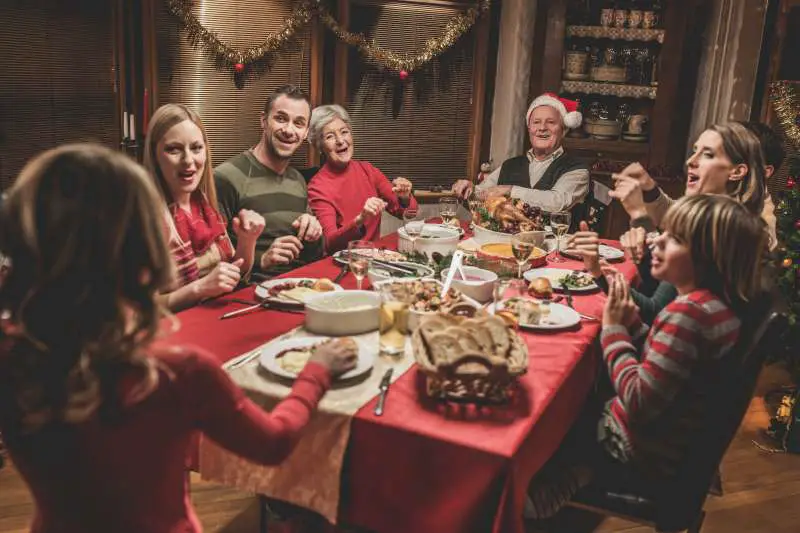
Every month for three years, I watched my daughter shrink herself around one woman. That’s the truth nobody puts in the Christmas cards. You can dress a seven-year-old in gold silk, polish her shoes twice, remind her to say please and thank you, and none of it will protect her from an adult who has decided, quietly and permanently, that she doesn’t belong.
I’m Danielle. My husband is Travis. My daughter, Zia, is his in every way that matters, though not by blood, and not yet by law when this story started. That distinction was the crack Lorraine kept working her fingers into, year after year, gathering after gathering, until she finally cracked it open in front of the whole family on a Christmas morning that none of us will forget.
I want to tell you how we got there, because the candle and the place card weren’t the beginning. They were just the moment everyone else finally saw what Zia had been living with the whole time.
Travis and I met four years ago at a diner two blocks from the elementary school where I dropped Zia off every morning. She was three at the time, and her father — my first husband — had been gone eight months, not dead, just gone, the kind of gone where the child support stops before the goodbyes ever really happen. I was tired in the specific way single mothers get tired, the kind that lives in your shoulders and doesn’t leave even when you sleep.
Travis was a regular at that diner. He noticed before I did that Zia always ordered the same thing — apple juice, no ice, and a plain waffle with the syrup on the side, never on top, because she didn’t like it touching until she was ready. One morning the waitress got it wrong, syrup all over the waffle, and Zia’s face did that thing where a three-year-old tries very hard not to cry in public and fails anyway. Travis, two booths over, a stranger, quietly asked the waitress to bring a fresh one, no charge, syrup on the side. He didn’t make a scene. He didn’t come over and introduce himself like it was a meet-cute. He just fixed the small thing that was breaking her morning, and went back to his coffee.
I found out later he did stuff like that all the time. It’s just who he is.
We started talking. Then we started dating. A year in, he proposed at that same diner, in the same booth, and when I said yes, the first thing he did — before he even hugged me — was turn to Zia, who was four by then, sitting in her booster seat with syrup on her chin, and ask her, seriously, like she was the one whose answer actually mattered most: “Is that okay with you? Can I be your dad too?”
She said yes around a mouthful of waffle. He cried. I did too.
From that day on, Travis never called her his stepdaughter. Not once, not to friends, not to coworkers, not to strangers who assumed otherwise because she didn’t share his last name yet. She was his daughter. Full stop. He packed her lunches. He learned that she needed the crusts left on, not cut off, because cutting them off felt like a sign something was wrong with the sandwich. He knew which stuffed rabbit, a gray one named Pepper, had to be positioned facing the bedroom door before she’d fall asleep. He drove forty minutes each way to the only pediatric dentist she wasn’t scared of, because the first one had hurt her and she never forgot it.
None of that meant anything to his mother.
I want to be fair to Lorraine, or at least I tried to be, for a long time, because that’s what you do with family — you give people chance after chance and call it grace. The first time I met her, before Travis and I were even engaged, she looked at Zia across her living room, looked back at me, and said, “So this one’s not his, then,” like she was confirming a fact about a piece of furniture. I remember laughing, a nervous, confused laugh, because I genuinely thought I’d misheard her. I hadn’t.
It only got worse from there, but it got worse in the specific, deniable way that’s almost impossible to describe to someone who wasn’t in the room. Lorraine never screamed at Zia. She never said anything a lawyer could call abuse. What she did was smaller and, in its way, crueler. She built an entire vocabulary out of tiny distancing words, deployed so casually that objecting to them made you sound unhinged.
Zia was never her granddaughter. She was “Travis’s girl.” Sometimes “your daughter,” aimed at me, as if Travis had nothing to do with it. On her more generous days, Lorraine called her “our little visitor,” and said it with a smile so warm that anyone watching from across the room would have thought it was a term of endearment. It wasn’t. A visitor is someone who doesn’t live there. A visitor is someone whose toothbrush isn’t supposed to be in the cup by the sink.
The first birthday party was the first real crack. Zia turned five that spring, and Lorraine hosted a joint party for her and her “real” grandchild, my sister-in-law’s son, who was turning six the same week. There were two cakes. One said Happy Birthday Marcus in blue icing script, professionally done, a bakery box, candles shaped like dinosaurs because Marcus loved dinosaurs. The other said, simply, Happy Birthday, in a hand clearly not practiced at cake writing, on a sheet cake from the grocery store, no name at all. When I asked, gently, why Zia’s cake didn’t have her name on it, Lorraine said, “Oh, I ran out of room on the order form, sweetheart, don’t read into it.” Zia was five. She read into it anyway. Five-year-olds always do.
Travis noticed. He always noticed. That night, driving home, he gripped the wheel hard enough that his knuckles went pale, and he said, low, almost to himself, “I’m not doing this again. Whatever this is, I’m not letting it keep happening to her.”
I didn’t know yet what “not letting it happen” would eventually mean. I just knew he meant it.
The pattern held for years. At the school play, when Zia had a speaking part — three whole lines, and she’d practiced them in the mirror for a week — Lorraine RSVP’d yes, then didn’t show, then later told everyone at Thanksgiving she’d “had a conflict,” while somehow making it to Marcus’s soccer championship the very same weekend, three hours away. At the hospital, when Zia broke her arm falling off the porch steps at Lorraine’s own house, Lorraine’s first words weren’t to Zia at all. She turned to Travis in the waiting room and said, “You’ll want to keep a better eye on her when she’s here. Accidents like this make people talk.” Not “is she okay.” Not “I’m sorry.” Just liability, dressed up as concern.
Every single time, Travis absorbed it first, so I wouldn’t have to watch her face fall alone, and then, later, in private, he’d hold her and tell her the only truth that mattered: that none of it was about her, that some people simply decide who they’ll love before they even meet the person, and that decision says everything about them and nothing about her. Zia nodded along every time, the way kids do when they’re trying to believe something an adult tells them. But I watched something quietly harden in her over those years too. Not bitterness, exactly. More like caution. She learned to keep a small, guarded space around herself whenever Lorraine was in the room, the emotional equivalent of standing near a door in case she needed to leave quickly.
About a year before that Christmas, Travis started disappearing into his home office some evenings after Zia went to bed. I assumed it was work. It wasn’t, not entirely. I found out later he’d been meeting with a family law attorney named Priscilla Ortega, a woman he found through a coworker whose own blended family situation had gone sideways in ways he didn’t want to repeat. He hadn’t told me at first, and when I found the folder — thick, tabbed, official — sitting on his desk one night, I felt a flash of hurt that he’d kept something from me.
“Why didn’t you say anything?” I asked him.
He sat down across from me at the kitchen table, and he had that look he gets when he’s about to say something he’s been carrying around for a while, turning it over and over until the edges are smooth. “Because I wanted it to be solid before I brought it to you,” he said. “I didn’t want to promise Zia something and then have it fall apart. I wanted it done, not almost done.”
The folder held two things. The first was a stepparent adoption petition — the legal kind, filed properly, with my consent as her biological mother and with her biological father’s parental rights already terminated years earlier due to abandonment, which made the path clear if slower than either of us wanted. Travis had been quietly building the case for over a year: gathering records, filing consent forms, doing everything by the book so that no judge, and no relative, could ever again treat his fatherhood as conditional or temporary. Legally, once finalized, Zia would be his daughter in every sense the state recognized, with his last name, with inheritance rights, with nothing “step” about any of it, not on paper and not anywhere else.
The second thing in the folder was smaller, and it was the thing that would end up inside a red velvet box on Christmas morning. It was a key to a safe deposit box at their credit union, and inside that box was a letter Travis had written to his mother, along with a copy of the adoption petition, a copy of a revised beneficiary designation that removed Lorraine from any guardianship contingency involving Zia, and a formal, notarized statement that any future estate planning on Travis’s side of the family would explicitly and permanently include Zia as an equal heir, on the same terms as any biological grandchild, with no distinctions, no asterisks, no exceptions.
He hadn’t done it to punish his mother. That part matters, and I want to be honest about it because it would be easy to tell this story as some kind of revenge plot, and it wasn’t that, not for Travis. He told me, sitting at that kitchen table, “I’m not trying to hurt her. I’m trying to make sure Zia never again has to wonder if she’s really wanted here. If Mom keeps doing what she’s doing, that’s on her. But I refuse to let Zia’s place in this family depend on my mother’s mood.”
He’d told Zia about the red box weeks before that Christmas, in an age-appropriate way, sitting on the edge of her bed one night with Pepper the rabbit between them. He hadn’t explained legal documents to a seven-year-old. He’d explained it the way you’d explain it to a child: “This box means you’re mine forever, no matter what anyone says or does. If Grandma is ever unkind to you again, and you want her to know that, you can give her this box, and she’ll understand.” He put the choice in her hands, not because he wanted to hide behind his daughter, but because he’d learned, watching her endure years of small cruelties silently, that Zia deserved, for once, to be the one who decided when enough was enough.
That’s the part people don’t understand when they hear this story secondhand. Travis wasn’t hiding behind a seven-year-old to deliver a message he was too polite to deliver himself. He was giving his daughter back a piece of power that his mother had been quietly stealing from her for years, one dismissive nickname at a time.
So that’s the family that walked into Lorraine’s house that Christmas morning. A little girl in a gold dress, freshly adopted in every way that mattered except the final court date, holding a red velvet box she hoped she’d never need to open.
You already know what happened with the candle. To Travis’s Girl, in Lorraine’s own handwriting, on a drugstore vanilla candle handed over like an afterthought while iPads and cash envelopes went to the “real” grandchildren. I watched something in Zia’s face go very still when she read that tag, the particular stillness of a child doing complicated emotional math she shouldn’t have had to do at seven years old. Is Dad’s love conditional too? Am I only allowed to belong halfway?
That night, in the guest room, when she asked me, “Mom, am I only Dad’s girl?” I felt something in my chest cave in the way a rotted floorboard gives way under your foot, that sick lurch of realizing the ground isn’t as solid as you thought. I didn’t get the chance to answer before Travis was in the doorway. He knelt down, brought himself to her eye level, and told her, “You are my daughter. No tag gets to decide that.” Then he handed her the red box and gave her the choice that had been building for a year.
“Will she be mad?” Zia asked.
“Probably,” Travis admitted.
“Will you still be my dad?”
I don’t think I’ll ever stop hearing that question. Not because it was dramatic — it wasn’t asked dramatically, it was asked quietly, almost matter-of-fact, the way kids ask things they’re afraid of the answer to, bracing themselves in advance for a “maybe.” That’s what three years of Lorraine’s careful cruelty had done. It had taught a seven-year-old to expect love to come with conditions attached.
“Always,” Travis said, and he said it in a way that left no room in the word for doubt.
Zia kept the box that night. She didn’t open it. She didn’t say anything else about it. She just held it, and eventually she fell asleep with it still curled in her hand, Pepper the rabbit tucked under her other arm, facing the door like always.
Brunch the next morning was Lorraine’s signature event, more formal in some ways than Christmas dinner itself, because it was the meal where she got to reset the narrative, smooth over whatever discomfort had crept in the day before, and remind everyone that she was, above all, a gracious hostess. White dishes. Silver napkin rings polished until they threw little coins of light across the tablecloth. Handwritten place cards in her looping cursive, because Lorraine believed a place card said “you belong here” better than words ever could.
Except, of course, for the place card that said Guest.
I want you to understand what that word does to a room full of people who’ve just spent a full day watching a seven-year-old absorb one slight after another with more grace than most adults could manage. There’s a specific kind of silence that happens when everyone in a room sees the same ugly thing at once and nobody yet knows if they’re allowed to react. I felt Travis go rigid beside me. I felt my own hands curl into fists under the table. And I watched Zia read that word — Guest — and instead of crumpling, instead of looking to us to fix it, she reached into the little purse Travis had given her for Christmas the year before, and she pulled out the red velvet box.
She stood up. The chair legs scraped against the hardwood, loud in a room that had gone almost completely silent. Her gold dress, wrinkled now from a full day of wear, still had a kind of dignity to it as she crossed the dining room, every eye at that table following her. Nobody stopped her. Nobody said a word.
She stopped beside her grandmother’s chair.
“Grandma,” she said, and her voice carried, clear and steady, all the way to the far end of the table where Marcus and his mother sat frozen mid-bite. “Dad told me to give this to you if you ever ignored me again.”
Lorraine looked at the box. Then she looked at Zia, and I watched her try to reach for that same practiced smile she always used to defuse things, the one that said, without saying it, that everyone else was simply too sensitive, too dramatic, too eager to make something out of nothing. “Well, isn’t that dramatic,” she said, reaching for the box like she was humoring a child’s game.
Travis stood. He crossed behind Zia, close enough that she could feel him there without him taking the moment away from her.
“Open it,” he said.
I have never, in the ten years I’ve known this family, seen Lorraine’s face do what it did in the next ten seconds. She lifted the lid slowly, still performing composure, still halfway convinced she was about to deliver a gentle, condescending speech about children and their imaginations. And then she saw the key.
It was ordinary. Small, brass, nothing special to look at. But Lorraine’s whole body changed the second she recognized it, and that recognition was the thing that told me — told all of us — that she knew, on some level, exactly what kind of reckoning she’d been avoiding.
The scream that came out of her wasn’t performative. It wasn’t for an audience. It was the sound of a woman realizing, all at once, in front of every person she’d spent years performing for, that she had lost the thing she never thought she’d have to fight to keep.
Her hands shook as she pulled out the folded card that had been resting beneath the key. She opened it. I watched her eyes move across the first line, and I watched the color drain slowly out of her face as she kept reading.
I know what that letter said because Travis showed it to me the week before, sitting at our kitchen table, asking if I thought the wording was fair. It began, “Mom, this key opens a box at First Meridian Credit Union. Inside, you’ll find the adoption paperwork that makes Zia my daughter under the law, not just in my heart. You’ll also find that she has been named, permanently and irrevocably, as an equal beneficiary in every part of my estate, alongside any biological grandchildren I may have. I am not asking you to love her the way you love Marcus. I can’t make you do that, and I’ve stopped hoping you will. What I am telling you is that her place in this family no longer depends on your permission. It never should have. If you want a relationship with her going forward, it will be on the same terms as your relationship with any other grandchild — full, equal, without asterisks. If that’s not something you’re willing to offer her, I understand, but I need you to understand something too: I will choose her, every single time, without hesitation, for the rest of my life.”
Lorraine read that letter twice at the table, her lips moving faintly over some of the words, the room so quiet you could hear the furnace kick on somewhere in the house. When she finally looked up, she wasn’t looking at Travis. She was looking at Zia.
“You’re really her father now,” she said, and it wasn’t quite a question.
“I have been her father since she was four years old,” Travis said. “The paperwork is just catching up to what’s already true.”
I want to tell you Lorraine apologized right then, on the spot, dramatically, the way these stories sometimes go when people tell them secondhand — that she broke down in tears and hugged Zia and everything was healed by New Year’s. That’s not what happened, and I think it’s important to say so, because real reckonings are messier and slower than that.
What actually happened was that Lorraine sat very still for a long moment, the letter trembling slightly in her hand, while eleven relatives sat around her dining table pretending very hard to look at their plates. Then she said, quietly, in a voice I’d genuinely never heard from her before, stripped of its usual polish, “I need a minute,” and she got up and walked into the kitchen, and we heard the water running at the sink for a long time, longer than anyone needed to wash their hands.
Marcus’s mother, my sister-in-law Renata, was the first to say anything. She looked at Zia, still standing beside Travis’s chair, and she said, “Zia, honey, come sit by me for the rest of brunch, okay? I want to hear about your school play.” It was such a small thing, and it meant everything, because it was the first time in three years that someone in that family had actively chosen Zia in front of everyone else instead of quietly allowing her to be sidelined.
Zia looked up at Travis, silently asking permission for something she didn’t quite have words for. He nodded, and she went and sat beside her cousin, and for the rest of that strange, charged brunch, she got the thing she’d been quietly denied for three Christmases running — an ordinary place at the table, nobody’s asterisk, nobody’s guest.
Lorraine came back out about fifteen minutes later. Her eyes were red-rimmed but dry. She didn’t make a speech. She walked over to where Zia was sitting, crouched down — something I don’t think I’d ever seen her do for Zia before, get down to her level instead of speaking down at her — and she said, “I owe you an apology. A real one, not the kind I usually give. I have not been fair to you, and I’m sorry.”
Zia, being seven, and being braver than most adults I know, looked at her steadily and said, “Okay. But you have to mean it every time, not just today.”
I don’t think Lorraine expected that. None of us did, except maybe Travis, who told me later he wasn’t surprised at all — that Zia had been quietly, carefully paying attention to every one of Lorraine’s inconsistencies for years, cataloguing them the way kids do even when adults think they’re not noticing.
“I’ll try,” Lorraine said. “That’s the honest answer. I’ll try.”
It wasn’t a fairy-tale ending, and I want to be honest about that too, because the versions of these stories that end in instant, complete transformation are lying to you a little. Lorraine didn’t become a different person overnight. There were a few more slips over the following months — an offhand comment here, a moment of forgetting to include Zia the way she automatically included Marcus there — but something had genuinely shifted. The difference now was that those slips got named immediately, by Travis, calmly and without theatrics, and Lorraine, for the first time in years, actually adjusted instead of digging in. The letter and the key had done something a hundred quiet conversations hadn’t managed: they’d made the stakes concrete. She finally understood that this wasn’t a family dynamic she got to control from the head of a dining table. It was a door that could close, and Travis had shown her, once and for all, that he was willing to close it.
The adoption was finalized in March, in a small courtroom with wood-paneled walls and a judge who smiled the entire time. Zia wore the gold dress again, a little snug on her by then, because she’d insisted. Lorraine came. She sat in the second row, next to Renata, and when the judge asked Travis if he understood he was assuming full and permanent parental rights and responsibilities, and he said, “I do, I have for years, this just makes it official,” I watched Lorraine wipe her eyes with the back of her hand, not performing for anyone this time, because nobody in that courtroom was watching her.
Afterward, at the little diner two blocks from Zia’s school — the same one, the same booth, because Travis is sentimental like that — Lorraine gave Zia a gift. Not cash. Not an iPad. A small framed photo of Travis as a baby, and beneath it, a second frame, empty, with a note tucked behind the glass that said, “Waiting for the picture I take of you today, my granddaughter.” Zia read it out loud, slowly, sounding out “granddaughter” like it was still a new word to her, and then she looked up at Lorraine and said, “You wrote it right this time.”
Lorraine nodded, and for once, she didn’t try to explain herself or soften it into a joke. She just said, “I did. I’m going to keep writing it right.”
I think about that Christmas morning a lot, the candle and the cheap tag and the place card that reduced my daughter to a stranger in her own family’s house. I think about how close we came to just swallowing it again, the way we’d swallowed every slight before it, because that’s what families do, they absorb and absorb until absorbing becomes its own kind of tradition. What changed everything wasn’t rage. It wasn’t a screaming match across a dining table. It was one quiet, prepared man who decided that his daughter’s belonging would never again be optional, and one seven-year-old girl who, when finally given the choice, chose to stop shrinking.
Zia still has the red velvet box. It’s empty now, the key long since used and the letter long since read and reread and eventually folded away in a drawer in Travis’s office, but she keeps it on her dresser next to Pepper the rabbit, and every once in a while, when she’s had a hard day at school or someone’s been unkind to her on the playground, she takes it out and just holds it for a minute, like a small reminder of the moment she learned that being chosen isn’t something you have to keep earning. It’s something that, once it’s real, nobody gets to take back — not with a candle, not with a place card, not with three years of careful, deniable cruelty.
She’s ten now. Lorraine calls her granddaughter every single time, without fail, and last Christmas, when the gifts were passed around, Zia’s card said her name in full, in Lorraine’s looping handwriting, no asterisks, no qualifiers, nothing tucked in quotation marks that meant something different than what it said. Just her name, the way it always should have been.

Adrian Hawthorne is a celebrated author and dedicated archivist who finds inspiration in the hidden stories of the past. Educated at Oxford, he now works at the National Archives, where preserving history fuels his evocative writing. Balancing archival precision with creative storytelling, Adrian founded the Hawthorne Institute of Literary Arts to mentor emerging writers and honor the timeless art of narrative.