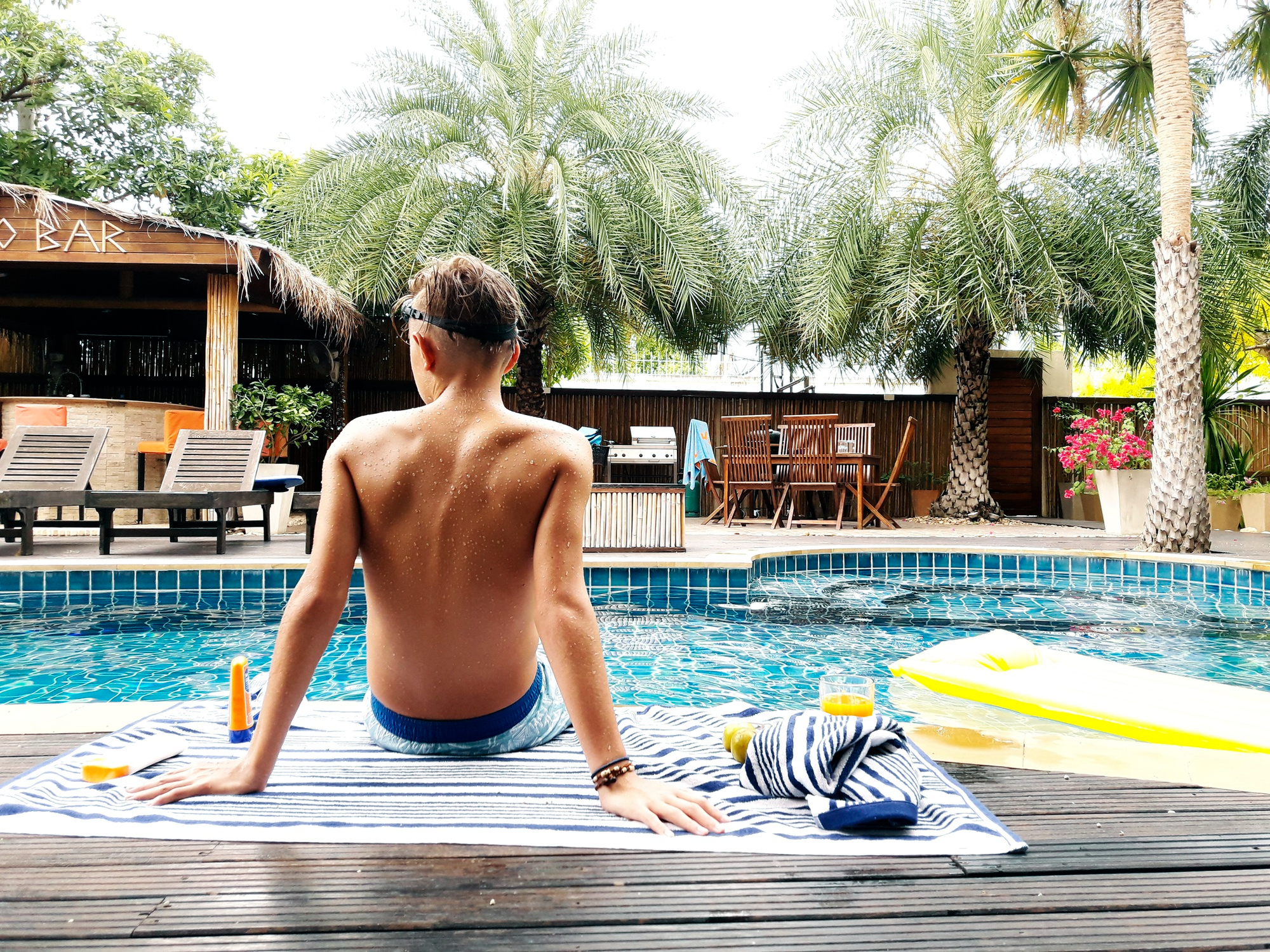
The 500th Guest
The box contained a card and a printed certificate.
The card had the resort logo and was addressed, in neat type, to Valued Guest.
The certificate said:
Congratulations on being our 500th guest check-in of the week. Please note that this certificate is provided to the registered occupant of the room from which you checked in. Our records indicate that your check-in was registered under the name of the primary account holder: Rachel Moore, Room 214. If you are not the registered occupant of this room, please see the front desk to discuss your account.
The card below the certificate said, in smaller type:
This certificate also serves as formal notice that your lounge chair assignment in this area has been logged as disputed. Our pool attendant has noted the chairs in section C-7 as pre-reserved under the room number attached to the towels removed from them. Our resort policy provides that pre-reserved seating is held for the occupying guest for up to 30 minutes from reservation time. We would like to make this right.
The woman read this.
She read it again.
Her boyfriend looked up from his phone.
The resort employee in the polo shirt, whose name tag read Marcus, was standing beside the chair with the specific patience of someone who has done this before.
She did not scream because of the certificate, exactly.
She screamed because, in opening the box, she had not looked carefully at what she was holding, and the first thing she had touched inside the box, expecting a gift card or chocolates or something commensurate with being the five hundredth guest of the week, was a large and extremely lifelike rubber frog that Marcus had placed on top of the certificate as a prop for a completely separate resort joke promotion that had nothing to do with chair disputes and that was, in retrospect, unfortunate timing.
She threw the box.
The frog went into the pool.
Two children near the pool edge found this hilarious.
The certificate and the card landed on the pool deck.
Marcus, who had seen the frog-in-the-box go wrong before this particular deployment, bent down and picked up the certificate and the card and stood with them.
He looked at me.
I was standing eight chairs away, holding my smoothie, watching.
I had not arranged any of this.
I want to be specific about this: I had not spoken to Marcus. I had not complained to resort management. I had not done anything except pull our towels out of the trash and find two different chairs and sit down with my daughter and tell her we were going to have a nice day.
Marcus had come because I had not needed to say anything, because the pool attendant who works the morning shift is a person who watches what happens in his area, and what he had watched was a woman removing tagged towels from reserved chairs and discarding them while a small bald child with a hospital bracelet on her wrist stood and watched.
He had gone to the front desk.
He had spoken to the guest services manager.
He had come back with the box and the certificate.
The frog had been his own addition.
I learned all of this later.
At this moment, I was eight chairs away, holding my smoothie, watching the woman on my chair try to explain to Marcus why the certificate did not apply to her, and listening to the specific increasingly-not-quiet conversation that was happening between her and her boyfriend and between both of them and Marcus, who remained composed.
Mia was beside me, cross-legged on her chair with her smoothie in both hands.
She looked at me.
“What’s in the box?” she said.
“A certificate and a rubber frog,” I said.
She thought about this.
“Why a frog?” she said.
“I don’t fully understand,” I said.
“Is she in trouble?” she said.
“A little,” I said.
She looked at the pool.
“The frog’s in the pool,” she said.
“Yes,” I said.
“The kids are trying to get it,” she said.
There were three children now at the pool edge, and one of them had a foam noodle extended toward the frog, and the frog was drifting away from the noodle in the specific manner of rubber frogs that are not cooperating.
Mia watched this.
She smiled.
It was the first real smile I had seen from her in eleven days.
It is a specific kind of smile, the smile of a child who finds something genuinely funny, and it involves the eyes, and it is different from the polite smiles and the brave smiles and the smiles that children produce when adults need them to look okay.
This one was real.
I held onto it.
Marcus had, by this point, made the situation at the chairs very clear.
The woman had moved.
Her boyfriend had gathered their things without looking at either of us.
They left the pool deck through the side gate that leads to the hotel lobby.
Marcus came to our chairs.
He said: “Ms. Moore. Mia. I’m sorry about the mix-up with your seating. We’d like to offer you a complimentary upgrade to the cabana section if you’re interested. It has shade and your own attendant and you’d get first pick of the spots.”
He looked at Mia when he said this.
Not in the way that adults sometimes look at sick children, which is a kind of look that contains pity so large that the child can feel it.
He looked at her the way you look at someone you’re talking to.
“What do you think?” I said to Mia.
She looked at Marcus.
“Does the cabana section have a better view of the pool?” she said.
“It has the best view,” he said. “And I can ask them to put the frog back in if you want.”
She considered this carefully.
“Yes,” she said.
The cabana section had three private spots with shade and a lounge chair for each of us and a small table and a resort attendant named Sofia who brought us menus and did not make a thing of Mia’s hospital bracelet or her bald head or the way she moved, which was still careful and slightly slow from the treatment.
Mia ordered a second smoothie.
I ordered a coffee.
We sat.
The pool was in front of us.
The frog was back in the pool, floating near the deep end, apparently at peace with its situation.
The three children were still negotiating with foam noodles.
Mia watched them.
She said: “Mom. Can I go in?”
“In the pool?” I said.
“Yeah,” she said.
I thought about this.
Her oncologist had said yes to the trip. She had said be sensible but go. She had said Mia’s counts were good enough for the pool.
“Yes,” I said.
She got up with the specific deliberateness of a child who is still learning to trust her own body again.
She walked to the pool steps.
She stood at the top of the steps.
She looked at the pool.
Then she went in.
The water was, in the afternoon, whatever temperature resort pools are: warm enough to be immediately comfortable, clear, with the specific quality of light on blue water that is one of the more reliably pleasant things in the world.
Mia stood in the pool up to her waist.
She looked up at me.
I waved from the cabana.
She waved back.
Then she looked at the frog.
Then she looked at the children with the foam noodles.
She said something to one of them.
I could not hear what she said.
The child handed her a foam noodle.
Mia positioned herself between the frog and the far end of the pool and began herding the frog toward the children with the precise patience of someone who has an actual strategy.
The frog cooperated this time.
One of the children grabbed it.
There was cheering.
Mia laughed.
I sat in the cabana with my coffee and watched my daughter laugh at a pool and I held this, the way you hold the specific things that are too large to put down.
Let me tell you some things about the past year, because the pool is not the whole story.
Mia was diagnosed fourteen months ago.
She had been complaining about her knee, which I had thought was growing pains or a sports injury, because she was seven and very active and had been doing gymnastics twice a week and the knee pain seemed like the kind of thing that happened. I took her to the GP, who referred us to a paediatrician, who ran blood tests, who referred us to an oncologist.
Acute lymphoblastic leukemia.
It is, I was told, the most common childhood cancer and one of the most treatable. I have held these two facts simultaneously for fourteen months. Common and treatable are not the same as easy. They are not the same as fast. They are not the same as watching your daughter lose her hair and spend her birthday hooked to an IV and ask a nurse quietly whether the medicine was going to make her feel sick again.
She asked quietly because she did not want me to hear her asking.
I heard.
I have heard everything for fourteen months.
She was sick and frightened and she was also, throughout, herself: methodical and funny and interested in specific things with the focused intensity of a child who has always operated this way, who since the age of four has had a sequence of consuming interests and who pursues each one with the thoroughness of a small scientist.
During the treatment, the consuming interest was space.
She read everything she could find about space and she asked everyone she encountered about their favorite planet and she established, at some point in month four, that her favorite planet was Saturn because of the rings, which she described as unnecessarily beautiful, which is the most Mia way of phrasing anything I have ever heard.
She was also, throughout, a child who did not want to be treated as a sick child when she did not have to be.
This is the thing that is hardest to explain.
She understood what was happening to her. We had talked about it honestly, with the support of the hospital’s child life team, and she knew what the treatment was and what it was for and what the statistics were, because Mia is a child who wants information and who is made more frightened by the absence of it than by the reality of it.
She knew all of this.
She also wanted, during the hours when she was not in treatment and not feeling sick, to not be a sick child.
She wanted to be a kid who was interested in Saturn.
She wanted to do gymnastics and then was not able to do gymnastics and then she wanted to do modified gymnastics and the physical therapist at the hospital was wonderful and worked with her on modified gymnastics.
She wanted to go to a pool like a regular kid.
This was not a simple request.
It was everything.
I sat in the cabana with my coffee and watched her in the pool and I thought about a word she had used: regular.
Can I go somewhere with a pool, like a regular kid?
There is nothing about the past fourteen months that has been regular.
But there was something, in the pool, that was.
She was in the water with other children.
The frog had been retrieved.
The foam noodles were being deployed for other purposes.
She was laughing.
She was regular.
Sofia came by to see if we needed anything.
I said I was fine.
She said: “She’s doing great out there.”
“Yes,” I said.
“Marcus told me a little about the morning,” she said. “I’m really glad you got the cabana.”
“Please thank him,” I said.
“He said to tell you the frog was unplanned,” she said.
“Tell him it was the best part,” I said.
Sofia laughed.
She went back to the attendant station.
I thought about the woman on the chair.
I had not thought about her much since they left.
I tried, and I am trying now, to be honest about this: there was, in that moment when she looked at Mia and said maybe go somewhere more appropriate, a rage in my body of a kind that I have not often felt. It was the rage of a parent whose child has been looked at with disgust, and it combined with the fourteen months of everything in a way that made my hands shake when I was pulling our towels from the bin.
But the rage did not consume me.
It used to be, before Mia’s diagnosis, that I was a person who would have said something. Not violently. But specifically and with the kind of precision that produces results.
After fourteen months of watching my daughter be sick and then get better and then be sick again and then, eleven days ago, hear the words we’re done for now, I had developed a different relationship to the energy required for confrontation.
The energy went to Mia.
The rage went somewhere internal.
I pulled the towels from the bin and found different chairs and ordered smoothies and told Mia we were going to have a nice day, and I meant it, and I was going to make it true.
Marcus had made it truer.
The frog had made it the truest.
After lunch, which we ate at the cabana with club sandwiches and a fruit plate that Mia ate approximately two thirds of, which was more than she had eaten in one sitting in recent memory, she asked me something.
She said: “Mom.”
“Yeah?”
“Was that lady being mean because she knew I was sick?”
I looked at her.
“I don’t think so,” I said. “I think she was being mean because she’s the kind of person who’s mean to people she thinks won’t do anything about it.”
“But we were in her chairs,” she said.
“She was in our chairs,” I said.
“Oh,” she said. She thought about this. “Why did she think we wouldn’t do anything?”
“She probably thought we’d just find different chairs,” I said. “Which is what we did.”
“But then Marcus came,” she said.
“Then Marcus came,” I said.
She ate a piece of melon.
“Is she a bad person?” she said.
“She did a bad thing,” I said. “Whether she’s a bad person is something I don’t know.”
“You always say that,” she said.
“It’s usually true,” I said.
She thought about it.
“I think she was being mean because we looked like we had problems,” she said. “And she didn’t want problems near her.”
I looked at my daughter.
Eight years old.
She had been in treatment for fourteen months and had just articulated something that takes most adults considerably longer.
“That’s probably right,” I said.
“It’s not nice,” she said.
“No,” I said.
“But also,” she said, “I got a whole cabana.”
“You got a whole cabana,” I said.
She seemed satisfied with the accounting.
She lay back on her lounger and closed her eyes.
“The sun feels really nice,” she said.
“Yes,” I said.
“On my head,” she said.
She touched the top of her head, the soft new fuzz that was starting to come back.
“It does,” I said.
She was quiet.
Then she said: “Mom. This is a good day.”
I pressed my lips together.
“Yes,” I said. “It is.”
“Can we come back?” she said.
“We can definitely come back,” I said.
“Before school starts?” she said. School had been another thing the treatment had interrupted and rearranged and that she was going back to in September.
“Before school starts,” I said.
She closed her eyes again.
The afternoon moved the way good afternoons move: slowly and with content.
We stayed at the pool until four.
Mia went in and out of the pool three more times.
She talked to the children with the foam noodles for a while, and they told her their names, which I could not hear, and she told them hers, and at some point one of them asked about her head, and she said something matter-of-fact and they said something back, and it was handled.
She handled it.
She is better at handling it than I am.
I have watched her handle it all year.
She walked us to dinner that evening with the specific posture of someone who is tired in a good way, the satisfying tired of a day that went well.
We ate at the resort restaurant, which had a children’s menu with the chicken strips and fries that Mia had requested, and I had pasta, and we sat by the window that looked out over the courtyard and talked about the day.
She told me about the children with the foam noodles.
Their names were Oliver and Priya and a smaller one whose name she couldn’t quite hear but who was very committed to the frog retrieval.
She told me about the pool temperature and how it was different in the deep end.
She told me that she wanted to learn to swim the butterfly stroke, which she had seen someone doing and which she described as the most dramatic swimming.
“It does look dramatic,” I said.
“Like you’re fighting the water,” she said.
“Yes,” I said.
“I want to do that,” she said.
“We can look into lessons,” I said.
“When I’m stronger,” she said.
“When you’re stronger,” I said.
She ate her chicken strips.
“I’m getting stronger,” she said. Not as a question. As a statement.
“Yes,” I said.
“My arms are still thin,” she said, looking at them.
“They’re going to get stronger,” I said.
“Faster than a year ago?” she said.
“Much faster,” I said. “The treatment part is done. Now it’s just your body getting back to being itself.”
She thought about this.
“Like charging a battery,” she said.
“Yes,” I said. “Exactly.”
She ate more fries.
“What percentage am I?” she said.
“What?” I said.
“Like a phone battery,” she said. “What percentage?”
I thought about it.
“After today?” I said. “At least forty.”
“That’s better than last week,” she said.
“What were you last week?” I said.
“Maybe twenty,” she said.
“And before the treatment started?” I said.
“A hundred,” she said. She looked at her chicken. “But that was a long time ago.”
“You’ll get back to a hundred,” I said.
“Probably not exactly a hundred,” she said. “Because I’ve been different. Some things changed.”
I looked at my daughter.
She is eight years old and she has been sick for fourteen months and she understands something about the irreversibility of experience that most adults do not fully accept.
“That’s true,” I said. “Some things changed. Some of them might be good changes.”
“Like what?” she said.
I thought about it.
“Like the fact that you know what it feels like to be really sick and to get better,” I said. “And that you know how to be patient in really hard situations.”
“And that I know all about Saturn,” she said.
“You knew about Saturn before,” I said.
“I knew more during,” she said. “Because I had more time to read.”
“That’s true,” I said.
“And I know what chemo smells like,” she said.
“Less useful,” I said.
“Some knowledge is just knowledge,” she said. “It’s still knowledge.”
I looked at her.
“Where did you get that?” I said.
“You say it all the time,” she said. “About things I learn that seem useless.”
“Do I?” I said.
“All the time,” she said.
She finished her chicken.
She looked out the window at the courtyard.
“Mom,” she said.
“Yes.”
“I think we should come here for my birthday,” she said.
Her birthday was in August.
She had spent the last one hooked to an IV.
“I think that’s a very good idea,” I said.
“Can we get the cabana again?” she said.
“We can ask,” I said.
“Tell them I want the frog in the pool again,” she said.
“I’ll pass that along,” I said.
She pushed back from the table.
“I’m sleepy,” she said.
“That’s the sun,” I said.
“And the swimming,” she said.
“And the swimming,” I said.
We went back to the room.
She fell asleep before eight o’clock, which had not happened in months because the treatment had done various things to her sleep, and she lay curled in the hotel bed with the light still on in the bathroom because she had always slept with some light, and she looked, in sleep, like herself.
Like the Mia before.
Not entirely. There were differences I could see, the ones she had named at dinner: things changed. But she also looked like the Mia from two summers ago, from the trampoline park birthday and the gymnastics tournaments and the specific concentrated face she made when she was thinking about something.
I sat in the chair by the window.
The resort was quiet outside.
The pool would be dark now, the water still, the cabana section unoccupied, the frog probably back in whatever drawer it lived in when it was not being deployed in milestone promotions.
I thought about Marcus.
I had looked him up before dinner: his name on the resort’s staff directory on their website, which confirmed he had been with them for six years and managed the pool area. He had seen what happened at the chairs and he had done something about it.
I was going to send a thank you to the resort the following day.
A specific one, with his name.
Not because the cabana was nice, though the cabana was nice.
Because he had looked at Mia the way you look at someone you are talking to.
Because he had made a day that could have been a very bad memory into what it had been instead.
The thank you felt insufficient.
I wrote it anyway.
I wrote it that night, on the resort’s feedback form on my phone, while Mia slept.
I said Marcus in the pool area saw what happened and handled it with compassion and professionalism and without making my daughter feel singled out. I said this matters more than I can easily express. I said please make sure his manager knows.
I submitted it.
I put the phone down.
I looked at Mia sleeping.
I thought about the past fourteen months.
I have, since the diagnosis, operated in the specific mode of someone managing a situation that cannot be fixed, only navigated. You learn to triage. You learn to identify what you can control and what you cannot. You learn to hold both the fear and the ordinary life simultaneously, because if you let the fear take everything there is nothing left for Mia.
She needed me to also be the person who found smoothies and argued for chairs and found the humor in the rubber frog.
She needed both.
I had tried to give her both.
I do not always succeed.
There are nights, when she is asleep and I am in the chair by the window, where the fear takes everything and I sit with it until it goes somewhere manageable.
This was one of those nights.
But manageable tonight was easier.
Because the day had been a good day.
She had said so.
She had been in the pool and laughed and eaten chicken strips and planned her birthday and called herself a charging battery at forty percent.
Forty percent is not a hundred.
Forty percent is also, from where we had been, an extraordinary number.
She was charging.
The doctors said she was charging.
I believed them.
I believed her.
In the morning, she woke up with the hotel pillow on top of her face, which is how she sleeps when she is deeply asleep, and she surfaced from it with her eyes still closed and said: “Is there a pool?”
“There is a pool,” I said.
“With a frog?” she said.
“Possibly,” I said.
“Okay,” she said. “I’m getting up.”
She sat up.
She looked at the room.
She looked at her arms.
She looked at me.
“Today is going to be a good day,” she said.
“How do you know?” I said.
“Because yesterday was,” she said. “And we’re still here.”
She went to the bathroom.
I sat on the edge of my bed.
The resort was starting its morning: sounds in the corridor, the hum of the ventilation, a door closing somewhere along the hall.
We were still here.
We had one more day.
I went to make coffee.
The day was exactly as good as she said it would be.
We spent four hours at the pool, the two of us and the cabana and Sofia and the children whose names I was still learning and the frog, which had been placed back at the edge of the pool for reasons I did not investigate.
Mia swam in the deep end for the first time.
Not the butterfly stroke. The regular stroke, the front crawl she had learned at the community pool two years ago and that had not changed just because everything else had.
She swam the length of the pool.
She got out and stood at the edge and dripped.
She looked at me.
“I did it,” she said.
“You did it,” I said.
“The deep end,” she said.
“The deep end,” I said.
She looked at the pool.
“I wasn’t sure I could,” she said.
“I was,” I said.
She was quiet.
“Mom,” she said.
“Yes.”
“I feel like myself again,” she said.
I held this.
“Good,” I said.
“Like actually,” she said. “For the first time in a long time. I feel like Mia.”
“You’ve been Mia the whole time,” I said.
“I know,” she said. “But I didn’t feel like it.”
She went back in the pool.
She swam another length.
We drove home in the late afternoon.
She slept in the back seat for most of it, the good sleep, and I drove with the windows open a little and the radio low and thought about the week ahead and the things to come and the doctors’ appointments and the school and the gymnastics and the butterfly stroke she was going to learn.
And the birthday in August.
Cabana section.
Frog optional.
I was going to book it when I got home.
I did.
I also, the following week, received a message from the resort.
It said:
Dear Ms. Moore,
Thank you for your kind words about our team member Marcus. He shared your feedback with us and was very touched. We want you to know that Marcus’s instinct that afternoon reflects exactly the values we try to bring to every guest’s experience.
We would like to offer Mia our special Birthday Package at no charge during her August visit, which includes the cabana, a birthday cake of her choice, and a pool-side celebration. We also want you both to know that you are welcome here, always.
Please come back.
I read this at my kitchen table.
I thought about the woman on the chair.
I thought about what she had said.
Go somewhere more appropriate.
I thought about what appropriate had turned out to mean.
A pool with a frog in it.
A child who swam the deep end.
A cabana and a birthday cake and a letter that said you are welcome here, always.
That is what appropriate was.
That is where we were going.
I wrote back and said we would be there in August.
I asked about the frog.
The reply said: we’ll have it ready.
I want to tell you about August, because August deserves its own account.
Mia’s birthday is the fourteenth.
She turned nine at the resort.
The cabana was reserved under her name this time, not mine: Mia Moore, Cabana A, Birthday Package.
She saw this when we checked in.
She said: “My name.”
“Your name,” I said.
She looked at the check-in desk.
She looked at me.
“This is fancy,” she said.
“You’re nine,” I said. “Nine is fancy.”
She considered this.
“Okay,” she said.
We went up.
The room had a birthday banner across the headboard, which is a detail I had not arranged and that the resort had apparently done on their own. It said: Happy Birthday Mia.
She stood in the doorway and looked at it.
She did not say anything.
Then she went and sat on the bed.
She sat there for a moment.
“Last birthday,” she said, “I was in the hospital.”
“Yes,” I said.
“I remember the nurse brought me a cupcake,” she said. “She put a candle in it and everything.”
“Patricia,” I said.
“Yeah,” she said. “She was nice.”
“She was very nice,” I said.
Mia looked at the banner.
“This is different,” she said.
“Yes,” I said.
“Both were nice,” she said.
“Yes,” I said.
She thought about this.
“I’m glad the cupcake year is over,” she said.
“Me too,” I said.
She got up.
“Okay,” she said. “Pool.”
We went to the pool.
Marcus was there.
He saw us from the pool desk and he came over.
He shook Mia’s hand formally and said: “Happy birthday, Mia. We’ve been expecting you.”
She looked at him.
“Did you keep the frog?” she said.
“It’s been in the pool since this morning,” he said.
She looked at the pool.
The frog was visible near the far end, floating peacefully.
“Good,” she said.
She went to get changed.
Marcus looked at me.
“How’s she doing?” he said.
“Better every week,” I said.
“Good,” he said.
“Thank you for the letter,” I said.
“Thank you for the feedback,” he said. “It went to my manager and that was—” He paused. “It was a good day.”
“For us too,” I said.
He went back to the desk.
I sat in the cabana and watched Mia come back from the changing room and walk to the pool.
She was different from June.
The difference was not dramatic. She was not dramatically stronger or dramatically faster. She was simply more herself: more the Mia from before the treatment, who had opinions about everything and who moved through spaces with a specific assured quality, the quality of someone who knows their own mind.
She went in.
She swam immediately to the frog.
She retrieved it.
She held it up toward the cabana.
“Got it,” she said.
“Very efficient,” I said.
She put it back.
She swam.
She swam for two hours with the specific absorption of someone who is doing the thing she wanted to do and who is not thinking about anything except the doing of it.
At noon, Sofia brought out the birthday cake.
It was a chocolate cake with blue icing, which Mia had specified when I had asked the resort what her choices were: chocolate cake with blue icing because blue was her favorite color and because chocolate was the correct cake.
There were nine candles.
The pool deck was quiet enough that when Sofia set the cake on the cabana table and I called Mia out of the pool, a handful of people nearby noticed and one of them started a quiet rendition of Happy Birthday that others picked up.
Mia stood at the cabana table in her wet swimsuit, dripping, with the specific wide-eyed quality of someone receiving more than they expected.
She looked at the cake.
She looked at the candles.
She looked at me.
“Mom,” she said.
“Yes,” I said.
“Make a wish,” she said. Not to me. She said it to herself. She was telling herself.
She made a wish.
She blew out the candles.
All nine.
In one breath.
People clapped.
She looked up and around at the pool deck with the slightly dazed expression of someone who is not quite used to being seen by a room full of strangers in a warm way.
Then she looked at me.
“Can I have a big piece?” she said.
“You can have whatever size you want,” I said.
“The corner one,” she said. “With the most icing.”
“The corner one,” I said.
She sat down.
She ate the corner piece.
She ate most of it.
“This is the best cake,” she said.
“Better than the cupcake?” I said.
She thought about it.
“Both are the best,” she said. “For different reasons.”
“Fair,” I said.
She went back in the pool.
She was in the pool until four.
At four, we went back to the room.
She lay on the bed with the birthday banner above her head and said she was tired.
“Good tired or bad tired?” I said.
“Good tired,” she said. “Like when you’ve done a lot of things.”
“That’s the best tired,” I said.
She was asleep in ten minutes.
She slept for two hours.
When she woke up, she was nine and it was six o’clock and the room smelled like sunscreen and hotel soap and the specific clean smell of resort air conditioning.
She sat up.
She looked at the room.
She said: “I’m nine.”
“Yes,” I said.
“I don’t feel nine yet,” she said.
“When do you think you’ll feel it?” I said.
She thought about it.
“Maybe when I go back to school,” she said. “When I see everyone.”
School was in three weeks.
She was going back.
Her teacher had been in touch throughout the treatment, sending work at the pace Mia could handle, and Mia had done more of it than I had expected because Mia is a child who likes knowing things and who found the work a form of continuity with a life that had otherwise been interrupted.
“They might ask questions,” I said.
“I know,” she said. “They’re going to ask about my hair.”
Her hair was coming back, soft and slightly different from before: the same dark color but with a different texture, fine and close to her head, not yet enough for a ponytail.
“What are you going to say?” I said.
She had thought about this.
“I’m going to say I had cancer and I’m better now and my hair is growing back and it’s actually kind of interesting what happens when your hair grows back because it’s different,” she said. “And then I’m going to ask them about their summer.”
I looked at her.
“That’s a perfect answer,” I said.
“I know,” she said. “I practiced it.”
“You practiced it?” I said.
“In the hospital,” she said. “With the counselor lady. She said it helps to have something ready so you don’t get caught off guard.”
“She was right,” I said.
“She was pretty smart,” she said.
We went to dinner.
The resort restaurant had put a little card at our table that said Happy Birthday Mia, which she read and then put in her bag, which is where she puts things she wants to keep.
She had a collection.
The card from July.
The card from tonight.
The completion of treatment paperwork that her oncologist had signed with a note in the margin that said good work, Mia.
The drawing she had made of Saturn during one of the hospital stays, the one with the rings exactly right, that the nurse had said was so good she wanted to keep it, and Mia had given it to her but made a copy first.
The copy was in the bag.
All of it, in her bag.
She was keeping the record.
I thought about documentation.
I thought about the photographs on my phone from the pool deck in June, the timestamped ones, the ones I had not needed.
Marcus had acted on what he saw.
The pool deck had done what pool decks sometimes do: contained a small moment of cruelty and then moved past it, the frog in the water, the children with the noodles, the afternoon that turned into the day that turned into the trip that turned into the birthday.
I had not needed the photographs.
I had needed to pull the towels from the bin and find different chairs and order smoothies and tell Mia we were going to have a nice day.
That had been enough.
And Marcus had done the rest.
This is the thing about resort pools: they are staffed by people who are there all day, who see what happens, who have their own judgment about what requires a response.
Marcus’s judgment had been correct.
After dinner, walking back to the room, Mia asked me something she had not asked before.
She said: “Was she a bad person? The lady from last time?”
“I’ve been thinking about that since you asked me in June,” I said.
“And?” she said.
“I think she did a bad thing,” I said. “Whether she’s bad as a person, I still don’t know.”
“But the thing she said,” she said. “About somewhere appropriate.”
“Yes,” I said.
“That was bad,” she said.
“Yes,” I said.
“Even if she didn’t know about the cancer,” she said.
“Even then,” I said.
“Because it’s bad to tell someone to go away from a place because of how they look,” she said.
“Yes,” I said.
“That’s just bad,” she said.
“It is,” I said.
She thought about it.
“I wonder if she thinks about it,” she said.
“Maybe,” I said.
“I’d think about it,” she said. “If I said something like that. I’d think about it for a long time.”
“Most people do,” I said. “Eventually.”
“How long does eventually take?” she said.
“It depends on the person,” I said.
She nodded.
We got back to the room.
She brushed her teeth and got into bed.
She lay with the birthday banner above her head.
“Mom,” she said.
“Yes.”
“This was the best birthday,” she said.
“Better than the cupcake year?” I said.
“You know the answer to that,” she said.
“Both were the best,” I said. “For different reasons.”
She smiled.
“Yeah,” she said.
She closed her eyes.
“Next year,” she said.
“What about it?” I said.
“Let’s do something like this again,” she said.
“Deal,” I said.
“With the pool,” she said.
“With the pool,” I said.
“And the frog,” she said.
“The frog is apparently now a fixture,” I said.
She was quiet for a moment.
Then she said: “I feel like myself again.”
“You said that in June,” I said.
“I know,” she said. “But now more. In June I felt like Mia. Now I feel like Mia who is nine and did a hard year and got through it.”
“That’s a better Mia?” I said.
“A different Mia,” she said. “Still the best one.”
She fell asleep.
I sat in the chair by the window.
The resort was quiet.
The pool was somewhere below and to the left, dark and still.
The frog was probably back in its drawer.
We were going home in the morning.
She had a check-up in two weeks.
Then school.
Then the butterfly stroke lessons I was going to arrange.
Then everything else.
All of it ahead.
All of it manageable.
A different Mia.
Still the best one.
I turned off the lamp.
I went to sleep.
In the morning, she woke up and said: “Is it still my birthday?”
“No,” I said. “It was yesterday.”
“Oh,” she said.
She thought about this.
“It was a good one,” she said.
“It was,” I said.
“Next year,” she said.
“Next year,” I said.
She got up.
She was nine years old.
She was Mia.
She was the best one.
That is the whole of it.
That is everything.
That is enough.
Always enough.
We were going home.
And she was going back to herself.
Both true at once.
Both good.
That is the whole of it.
One more thing.
In September, she went back to school.
I dropped her at the gate.
She stood at the gate with her backpack and her slightly different hair and her nine-year-old posture and she looked at the school.
Then she turned around.
She said: “Mom.”
“Yes,” I said.
“What if they ask?” she said.
I had expected this question.
She had prepared her answer.
But the preparation and the moment are different things, and the moment was now, and she was standing at the school gate.
“You know what to say,” I said.
She took a breath.
“I had cancer and I’m better now,” she said. Quietly. To herself. Practicing it one more time.
“Yes,” I said.
“And my hair is growing back,” she said.
“Yes,” I said.
“And it’s actually kind of interesting,” she said.
“Yes,” I said.
She looked at the school.
Then she walked through the gate.
She did not look back.
That is the whole of it.
She walked through the gate.
She did not look back.
That is the best thing I can say.
She walked through.
She knew what to say.
She said it.
She went in.
That is Mia.
That is the whole of it.
That is enough.
That has always been enough.
The morning comes.
She goes through the gate.
We are going to be all right.
We already are.
That is everything.
I want to tell you one last thing about the pool.
In October, Mia asked me what would have happened if Marcus hadn’t come.
We were at dinner, a Tuesday night, a normal dinner, the kind we now had regularly because normal was back: pasta and the homework on the table and the radio on in the background.
She said: “In June. What would have happened if Marcus didn’t come?”
“We would have stayed in the regular chairs,” I said. “We would have had a good day anyway.”
“You think so?” she said.
“Yes,” I said. “I was going to make it a good day regardless.”
She twirled pasta.
“But the cabana was better,” she said.
“The cabana was better,” I said.
“And the birthday,” she said.
“And the birthday,” I said.
She thought about it.
“Do you think Marcus knew that?” she said.
“Knew what?” I said.
“That it mattered that much,” she said. “To get the chairs back.”
I thought about this.
“I think he knew it mattered,” I said. “The details of why, maybe not.”
“He just saw something wrong and fixed it,” she said.
“Yes,” I said.
“That’s a good thing to do,” she said.
“It is,” I said.
“I want to do that,” she said. “When I’m grown up. See things that are wrong and fix them.”
“What kind of things?” I said.
She thought about it.
“I don’t know yet,” she said. “But the kind that matter to people.”
She ate her pasta.
“Also I’m going to be an astronaut,” she said.
“Also that,” I said.
“Or a doctor,” she said. “Like the ones who fixed me.”
“You could do both,” I said.
She thought about this seriously.
“Probably not at the same time,” she said.
“Probably not,” I said.
She finished her pasta.
She went to do homework.
I sat at the table.
The radio played.
She was nine years old.
She was at forty percent in June and was higher now and climbing.
She wanted to see things that were wrong and fix them.
She was going to be an astronaut or a doctor or both not at the same time.
She had cancer and she was better now and her hair was growing back.
She had told her whole class.
She had asked them about their summer.
They had told her.
She had listened.
She is Mia.
She has always been Mia.
She will keep being Mia.
The morning comes.
She goes through the gate.
The pool has a frog in it.
The cabana section has her name.
The battery is charging.
The birthday was the best one.
Both were the best, for different reasons.
That is the whole of it.
That is everything.
That is enough.
That has always been enough.
The morning comes.
She is going to be all right.
She already is.
That is Mia.
That is enough.
I want to say one more thing about Mia, specifically.
She is the child who, when her hair started falling out during the treatment, asked the nurse whether it would grow back curly.
The nurse said it sometimes did.
Mia said: “I hope so. Curly would be interesting.”
Her hair grew back straight, the same as before, just finer.
She was slightly disappointed about this.
She said: “I was hoping for curly.”
“We can always curl it,” I said.
“It’s not the same,” she said.
“No,” I said.
“Real curly comes from inside,” she said.
I am not entirely sure what this means.
She seemed to know what it meant.
She is a child who has thoughts that make sense to her and that she offers to you with the calm assumption that you will follow.
I usually do.
She is the child who, at the point in treatment when she was most sick, three months in, on a Tuesday afternoon when everything was hardest, said to me: “Mom. Don’t be scared.”
She knew I was scared.
She had never told me to not be scared before.
She said it the way you say something that you mean as a gift: simply and directly and without making it a big thing.
I said: “Okay.”
She said: “You don’t have to pretend not to be scared. Just don’t let it be the main thing.”
Eight years old.
I wrote this down that night.
I have looked at it sometimes since.
Don’t let it be the main thing.
It is not the main thing.
She is the main thing.
She is nine years old and she wants to see things that are wrong and fix them, and she wants to be an astronaut or a doctor or both not at the same time, and she wants to swim the butterfly stroke, and she wants to go back to the resort next August.
She is going back next August.
The frog will be ready.
The cabana will have her name.
The pool will be there.
She will be there.
All of it, there.
That is the whole of it.
That is everything.
That is enough.
The main thing.
Always the main thing.
That is Mia.
She told me once, in the hospital, that Saturn was her favorite because the rings were unnecessarily beautiful.
I have thought about this phrase constantly since.
Unnecessarily beautiful.
Something that did not need to be beautiful but was anyway.
That is the rings.
That is also, I think, the frog in the pool.
That is the birthday banner.
That is Marcus’s instinct to act on what he saw.
That is the letter from the resort that said you are welcome here, always.
None of it had to be there.
All of it was.
Unnecessarily beautiful.
Like the rings.
That is the whole of the whole of it.
That is enough.
That has always been enough.
The morning comes.
Mia goes through the gate.
The rings are there.
We are going to be all right.
We already are.
That is everything.
The pool at the resort is not extraordinarily beautiful.
It is a nice resort pool, the kind with the blue tile and the floats in a basket by the shallow end and the underwater lighting that turns on at dusk.
The frog is a rubber frog from a party supply store.
Marcus is a pool attendant who has worked there for six years.
None of it is remarkable.
All of it was, for us, everything.
Unnecessarily beautiful.
That is Mia’s phrase.
She gave it to me.
I am keeping it.
Along with everything else.
The morning.
The gate.
The pool.
The frog.
The rings.
All of it, ours.
All of it, here.
That is enough.
That is everything.
That is the whole of it.
Always.

Adrian Hawthorne is a celebrated author and dedicated archivist who finds inspiration in the hidden stories of the past. Educated at Oxford, he now works at the National Archives, where preserving history fuels his evocative writing. Balancing archival precision with creative storytelling, Adrian founded the Hawthorne Institute of Literary Arts to mentor emerging writers and honor the timeless art of narrative.