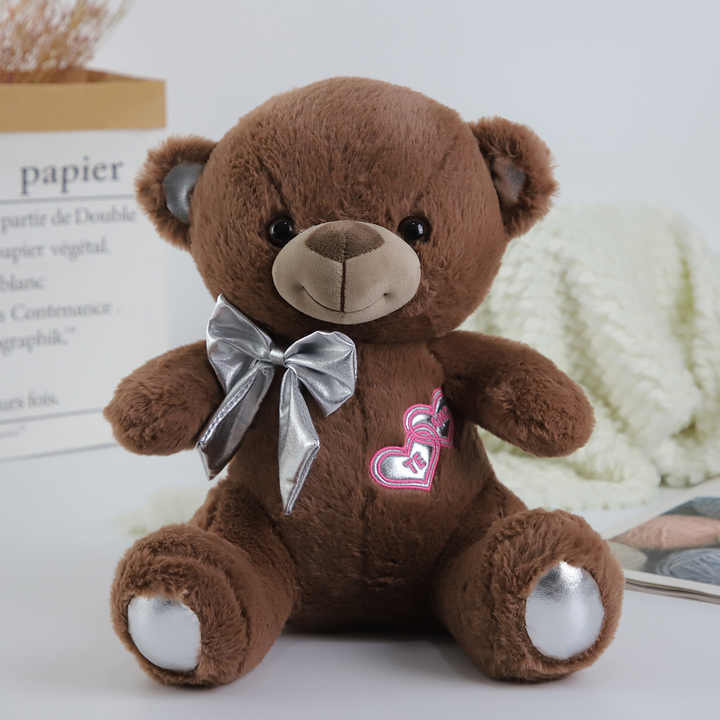
The smell reached me before I saw the fire pit.
Smoke. Charcoal. Sweet barbecue sauce drifting through the summer air. And underneath it all, something that made my six-year-old son stop walking beside me.
Lucas had always been the kind of kid who noticed small things. The color of a bird on the fence. The sound of our old garage door opening, that particular groan on the third foot of track that meant he had exactly four seconds before I’d be standing in the kitchen. The exact spot where Mr. Bamboo sat on his bed every night, propped against the second pillow, facing the door like a small sentry.
That panda was not just a stuffed animal. It was part of his childhood. He had slept with it since he was three years old. He carried it through thunderstorms, dentist appointments, and the difficult months after my divorce, when he’d wake up some nights and simply appear in my doorway holding it against his chest, not saying anything, just needing to know I was still there.
Some adults see a stuffed animal and see fabric and stuffing. Children see memories. They see safety. They see something that stayed when other things changed.
That afternoon, my parents hosted their annual family barbecue. It was supposed to be one of those simple summer gatherings where everyone pretended life was normal. The grill was hot. The cousins were running around the backyard, shrieking over a game of tag that kept shifting rules depending on who was losing. Someone had music playing from a speaker near the patio, an old classic rock station my father favored, the volume just loud enough to make conversation require leaning in.
My mother Elaine had spent hours preparing food because she believed a good family gathering could cover almost any problem. There was potato salad in her good glass bowl, corn on the cob wrapped in foil, a cooler stocked with more soda than anyone could drink in a weekend. She’d been up since seven that morning, I later learned, humming to herself in the kitchen the way she always did when she wanted the day to go smoothly.
But families have a way of revealing themselves when nobody expects it.
I walked into the backyard holding a paper cup of soda when Lucas stopped beside me. His fingers tightened around the strap of his backpack, the small blue one he insisted on bringing everywhere that summer, packed with crayons and a half-finished coloring book and, until that morning, Mr. Bamboo, though he’d left the panda at home that day, which somehow made what happened worse rather than better, because it meant someone had gone looking.
His face changed before he said anything.
“Dad,” he whispered. “That’s Mr. Bamboo.”
I looked toward the barbecue pit. At first, I didn’t understand what I was seeing. Then I saw the small pieces. The blue elephant, its trunk curled and blackened. The soft lion, reduced to a charred lump with one glass eye somehow still catching the light. The patchwork turtle Lucas’s grandmother on his mother’s side had sewn for him as an infant. And the panda, with the worn fabric around one ear from years of being held every night, half-collapsed in the coals, the white fur gone gray and curling at the edges.
My entire body went cold.
Lucas made a sound that I still hear sometimes when the house is quiet. It wasn’t loud. It was worse. It was the sound of a child realizing the people around him had made a choice.
I picked him up immediately. His arms wrapped around my neck. His tears soaked through my shirt, hot and immediate, his small body shaking against mine in a way that made every rational thought in my head narrow down to the single, animal instinct of get him away from this.
Around us, the backyard changed. The laughter disappeared. The conversations stopped mid-sentence. Forks rested on paper plates. Hands froze around cups halfway to mouths. The grill continued hissing like nothing had happened, oblivious, indifferent, the one thing in that yard that didn’t understand what it had just witnessed. Nobody moved.
My mother covered her mouth. Aunt Sophia stared at the ground, suddenly fascinated by a patch of grass. Uncle Robert looked at the fire pit like he wanted to undo what had already been done, his jaw working like he might say something and then didn’t.
Then I saw my brother Derek. He was standing near the cooler. Arms crossed. Smiling. That was the part I couldn’t understand. Not just that it happened. That he looked proud, the particular pride of a man who believes he has just delivered an important lesson and is waiting for applause.
“Who did this?” I asked. My voice was quiet. Sometimes anger is loud. Sometimes anger becomes so controlled that everyone around you understands the danger of ignoring it.
Derek shrugged. “The boys got carried away.” His sons, nine and eleven, suddenly became interested in the grass, the older one shuffling a step behind his father as though hoping to disappear into his shadow.
Then Derek said the sentence that changed the entire meaning of that afternoon. “Honestly, Virgil, it’s probably for the best. He needs to toughen up.”
My father Frank stepped beside him. “They were crutches,” he said. “A boy needs to learn to stand on his own two feet.”
I looked at my father. For years, I had tried to explain that there was a difference between teaching resilience and teaching someone to ignore pain. He never understood. He believed feelings were obstacles. He believed discomfort was a lesson. And now he was passing that same lesson to my son, three generations deep into the same cold arithmetic.
“He’s six,” I said.
Frank’s expression barely changed. “I was shooting my first rifle at six.”
“And look how warm that made this family,” I answered.
Nobody laughed. Because everyone knew the conversation was no longer about toys. It was about years of small moments that had finally connected, a lifetime of individual sparks suddenly recognizable as one continuous fire.
When Lucas wanted a kitchen playset for his birthday, my father called it embarrassing, told me over the phone that I was raising a boy who’d never learn to hunt or fix a car, as though those were the only two available futures. When Lucas cried after falling on the driveway, splitting his knee open on the gravel, Derek told him to walk it off like a man, standing over him with his arms crossed while the boy sat there bleeding, waiting for someone to actually help. When Lucas brought drawings to Grandpa, careful crayon renderings of dinosaurs and spaceships he’d worked on for an hour at the kitchen table, Frank barely looked at them, setting them aside with a distracted “very nice” before returning to whatever game was on television. When my marriage ended, they used it as proof that I was raising him wrong, that a boy needed a mother in the house and a firmer hand than mine, as though the divorce itself were evidence of some deficiency in me rather than simply two people who had grown into different lives.
Not cruelty. Not punishment. Control. That was what I finally saw, standing there in that smoke-filled yard with my son’s tears soaking through my shirt.
Some people call it tradition when they are afraid to admit it is just hurt being passed down.
I held Lucas closer. “Lucas and I are leaving.”
Derek laughed. “Over stuffed animals?”
I turned toward him. “No. Over grown men teaching boys that hurting someone smaller is strength.”
My mother stepped forward. “We can replace them.”
Lucas lifted his head from my shoulder, his face blotchy and wet. “They were my friends.”
That sentence should have stopped everything. A child had just explained his pain more clearly than every adult in that yard. But my father sighed. “It was just toys, Virgil.”
That was when I understood something important. People who minimize harm are often not confused about what happened. They are uncomfortable admitting who caused it.
I carried Lucas through the house. Past the food, the potato salad my mother had spent all morning making, the pitcher of lemonade sweating on the counter. Past the decorations, the little paper banner strung across the doorway that said FAMILY in cheerful block letters. Past the picture-perfect version of our family my mother wanted everyone to see, the framed photos lining the hallway, decades of holiday portraits where everyone smiled the same practiced smile.
At the front door, she grabbed my arm. “Virgil, please. We’re family.”
I looked back toward Derek, still standing by the cooler, still not entirely understanding what he’d lost in that moment. “Family protects children,” I said. “It doesn’t break them to prove a point.”
Then I left.
The drive home was silent except for Lucas’s occasional hiccupping sob from the back seat, the sound gradually settling into something quieter, exhausted, as the adrenaline of the afternoon burned itself out. I kept glancing at him in the rearview mirror, watching him hold his empty hands in his lap, hands that should have had a panda in them, and feeling something in my chest that I can only describe as the sound of a door closing for good.
The next day, I ignored every call. My phone kept lighting up. My father. My mother. Derek. Relatives who suddenly wanted to discuss peace instead of what caused the problem, cousins texting vague, careful messages that tried to sound neutral while clearly fishing for my side of a story they’d already half-decided didn’t need telling.
By noon, I took Lucas to a small toy store two towns over, deliberately somewhere unfamiliar, somewhere without the weight of memory attached to it. He walked through the aisles quietly, running his fingers along shelves of stuffed animals without picking any of them up, his face still carrying the particular flatness of a child processing something too large for him.
Then he found a panda. He held it for a long time, turning it over in his hands, studying its face the way you’d study something you were trying to decide whether to trust.
“Can I get this one?” he asked.
I nodded.
He looked at me. “Not to replace Mr. Bamboo.” A small pause. “Maybe just his cousin.”
That was the first time he smiled since the barbecue.
That evening, we pulled into my driveway and saw my father’s truck outside. Frank was sitting on the porch. Pressed khakis. Polo shirt. Hands in his pockets, that particular stillness he adopted whenever he was rehearsing something in his head.
For one second, I thought he had come to apologize. I sent Lucas inside, watching him disappear through the door with the new panda clutched under one arm, before I walked toward my father.
“You should’ve called first.”
Frank looked at me. “Would you have answered?”
“Probably not.”
He accepted that with a small nod. Then he said the words that told me why he was really there.
“Derek’s in trouble at work.”
I waited.
“He works at Peterson Tech.” My company, the firm I’d spent eleven years building a reputation inside. “The sales department.”
I stared at him.
“There’s been a complaint,” he continued. “Maybe two.” He hesitated, his eyes not quite meeting mine. “Your name came up.”
That was the moment everything shifted. Yesterday, my son’s comfort objects were destroyed in front of everyone, burned deliberately by grown men who thought they were teaching a lesson. Today, my father was asking me to protect the same person who had caused that pain.
“Let me understand this,” I said. “Derek humiliates my son. He shows no remorse. And now you want me to use my reputation to save him?”
Frank’s face hardened. “Family helps family.”
I stepped closer. “Did family help Lucas yesterday?”
For the first time in my life, my father had nothing to say. The porch went silent, just the sound of the neighbor’s sprinkler ticking across their lawn a few houses down, ordinary and indifferent to what was happening between us.
And in that silence, I finally understood that the fire pit had not destroyed our family. It had only revealed what was already there.
I didn’t offer him anything that night. No coffee, no invitation inside, no softening of the moment. He sat there a while longer, maybe hoping I’d change my mind, and when I didn’t move or speak, he eventually stood, brushed off his khakis with the same unhurried care he brought to everything, and walked back to his truck without another word. I watched his taillights disappear down the street before I went inside.
The next morning, I learned more about Derek’s situation, mostly from a colleague in HR who I’d known for years and who, sensing I was already tangled up in whatever this was, gave me more than she probably should have. The complaint at Peterson Tech was not a single mistake. It was a pattern. Two junior employees, both younger, both new to the department, had separately described a supervisor who mocked their questions in front of clients, who took credit for work that wasn’t his, who had once reduced a twenty-four-year-old analyst to tears in a conference room over a formatting error in a slide deck.
The same behavior that had appeared at home was appearing at work. The same belief that hurting someone weaker made him powerful. The same refusal to accept responsibility.
Frank eventually admitted, in a phone call a few days later that I only picked up because I recognized the number and had run out of ways to avoid this conversation forever, that he had known more than he’d told me. He had seen the warning signs in Derek for years, the small cruelties that had calcified into a personality nobody in the family wanted to name. He had ignored them because admitting Derek was wrong meant admitting that his own lessons had failed, that the whole philosophy he’d built his fatherhood around, the toughness, the discipline, the contempt for softness, had produced not a strong man but a fragile one who could only feel powerful by making someone else feel small.
My father spent decades teaching me that strength meant never bending. But real strength is not refusing to apologize. Real strength is being able to admit when you caused damage.
That was the lesson Lucas taught me without ever trying.
The months that followed were quieter than I expected. I didn’t cut my parents off entirely, not right away, not with the dramatic finality some people imagine when they hear this story. There were a few more calls, a few more attempts from my mother to smooth things over with vague talk of “moving past it,” a birthday card from her that arrived at Lucas’s next birthday with a check inside and no mention of the barbecue at all, as though the check itself might paper over the memory.
I sent it back.
Derek called once, about two weeks after the barbecue, his voice carrying none of the smugness from that afternoon, something closer to bewilderment. “You’re really doing this? Cutting us off over some toys?”
“They weren’t just toys to him, Derek.”
“They’re stuffed animals, Virgil. He’s six. Kids get over things.”
“Some kids get over things,” I said. “Some kids learn that the people who are supposed to protect them will hurt them instead, and they carry that for the rest of their lives, and they call it normal because nobody ever told them it wasn’t.”
He didn’t have an answer for that. The call ended a few minutes later, neither of us having actually resolved anything, and it was the last real conversation the two of us had for a long time.
Six months after the barbecue, Derek left Peterson Tech. Not fired outright — the company handled it quietly, the way companies often do when they’d rather avoid the paperwork of a formal termination — but resigned under pressure once the second complaint escalated into a documented investigation. My father called to tell me, framing it carefully as “a rough patch,” though by then I’d already heard most of it through my own channels at work.
I didn’t feel triumphant. I want to be honest about that. I felt something closer to a tired, sad recognition, the feeling you get watching a slow-motion collision you saw coming from a long way off and couldn’t stop.
Over the following year, I made the decision that would eventually take Lucas and me six hundred miles from the town where I’d grown up. It wasn’t a single dramatic choice so much as a series of smaller ones that all pointed the same direction — a job opportunity in Vermont that I might once have turned down out of obligation to stay close to family, a house with a yard big enough for the dog Lucas had been asking for, a school district with a reputation for kindness that I’d read about and then, almost impulsively, called to ask more questions about.
We moved the summer Lucas turned seven, less than a year after the fire pit. I remember standing in the empty rooms of our old house the day before the movers came, running my hand along a doorframe where I’d marked his height every few months since he was born, and feeling, for the first time in a long time, like I was choosing something rather than simply enduring it.
Years later, I still remember that barbecue. Not because of the toys. Because of the choice everyone made afterward. Some people looked away. Some people defended the person who caused harm. And one little boy stood there wondering what he had done wrong.
The answer was simple. He had done nothing wrong. He was just the first person brave enough to show everyone else what was happening.
Because family is not proven by who shares your last name. It is proven by who protects the people who need protection most.
The years did not erase the smell of woodsmoke, but they changed what it meant. It no longer meant a summer gathering. It no longer meant family. It simply meant fire.
Ten years after that afternoon in the backyard, I sat on the porch of a house six hundred miles away from the city where I grew up. The air in Vermont was colder, cleaner, and quiet. There were no unannounced visits. There were no loud, imposing trucks parked on the driveway. There was only the quiet hum of an ordinary life built on purpose.
Inside, the light from the kitchen spilled across the dark wood of the floor. Lucas was sixteen now. He had grown tall, his shoulders broad like mine, but his posture was different from the men in my family. He didn’t carry tension in his neck. He didn’t look at the floor when he walked into a room. He moved with the easy, unforced confidence of a child who had never been taught that his pain was something to hide.
On the shelf above his desk in his room, the second panda still sat. The cousin to Mr. Bamboo. Its fur was slightly worn around the left ear. Not because it had been dragged through dirt or used as a shield against a broken family, but simply because it had been loved.
My phone rang on the small table beside my chair. I didn’t need to look at the screen to know who it was. It was the same number that appeared every few months, usually late at night, usually when the silence in an empty house in Ohio became too heavy to bear.
Elaine.
I let it ring three times before I answered. “Hello, Virgil.” Her voice sounded thinner than I remembered. Older. Fragile in a way that felt calculated, as if time itself were an argument she was trying to win.
“Hello, Mom.”
“Are you coming home for the holidays this year?” she asked. She asked every year. She asked as if the distance between us were merely a matter of miles, rather than a wall built brick by brick out of ignored apologies and defended cruelty.
“No,” I said gently. “We’re staying here.”
A long pause followed. I could hear the television playing in the background of her living room. The sound of a house where nobody spoke unless they were trying to prove a point.
“Your father’s health isn’t what it used to be,” she said. It was her favorite lever. The subtle reminder that time was running out, designed to make me feel the weight of a guilt that wasn’t mine to carry.
“I’m sorry to hear that,” I replied. And I was. Not because I wanted to run back, but because it was sad to realize that a man could live an entire life without ever learning how to love the people around him without trying to break them first.
“He asks about Lucas,” she added, her voice dropping a fraction lower. “He asks if he’s doing sports. If he’s… tough.”
I looked through the window. Lucas was sitting at the kitchen island, laughing at something on his phone, reaching out to offer a slice of apple to the stray dog we had adopted two years ago, a scruffy, gray-muzzled mutt named Bear who’d shown up at the edge of our property one October and simply never left. He was kind. He was patient. He was whole.
“He’s doing well, Mom,” I said. “He’s happy.”
“He needs his grandfather, Virgil. A boy needs—”
“He has what he needs.” My voice wasn’t loud. It didn’t need to be. The boundary was firm, not out of anger, but out of absolute clarity.
She sighed, a sound heavy with the familiar frustration of a woman who could not understand why her script was no longer being followed. “Derek asks about you too, you know.”
Derek. My brother had left Peterson Tech six months after the investigation ended. He hadn’t been fired; he had resigned before the official report could be filed, moving from one middle-management job to another, always blaming the company, the culture, the managers, or the politics for his failures. He still lived twenty minutes from my parents. He still went to the Sunday dinners. He still lived in the shadow of a father whose approval he would never fully gain, trapped in the very cycle he had tried so desperately to enforce on my son.
“I hope Derek is doing well,” I said, and for the first time in ten years, I actually meant it. I felt no desire for revenge. I felt no need to see him suffer. Pity had long since replaced the anger.
“He misses his brother,” she whispered.
“He missed his brother ten years ago,” I answered. “He just didn’t realize it until I stopped standing in the yard.”
We stayed on the line for another minute, saying the polite, empty things that distant relatives say when they run out of historical scripts to rely on. When I hung up, I set the phone face down on the table.
The cool evening air brushed against my face. From inside the house, I heard the sound of footsteps coming toward the porch door. Lucas pushed the screen open and stepped outside, holding two mugs of hot tea. He handed one to me and leaned against the railing, looking out toward the dark silhouette of the trees at the edge of the yard.
“Was that Grandma?” he asked quietly.
“Yeah.”
He took a sip from his mug. He didn’t ask if we were going back. He didn’t ask what she said. He knew the story. I had never lied to him about why we left, nor had I raised him to hate the people we left behind. I had simply taught him that safety was a requirement, not a privilege, and that love did not demand that you let someone burn your things to prove your loyalty.
“How is Grandpa?” he asked after a moment.
“Getting older,” I said.
Lucas nodded slowly. He set his mug down on the railing and reached into his pocket, pulling out a small wooden horse he had spent the last three days carving in the garage, working patiently at the kitchen table some evenings too, shavings collecting in a neat pile beside him while he hummed along to whatever was playing on his headphones. The edges were smooth. The details were precise. It was delicate, thoughtful work.
He held it up to the light of the porch lamp, examining the curve of the mane.
“Do you think he would have liked this?” Lucas asked. It was a genuine question. No bitterness. No resentment. Just an honest inquiry about a man he barely remembered.
I looked at the small carving in my son’s hands. I thought of my father Frank, sitting in his armchair in Ohio, surrounded by his pristine lawn, his framed photos of old sports trophies, and the heavy silence of a house where weakness was forbidden and love was conditional.
“I think he wouldn’t have known what to do with it,” I said softly. “He would have thought it was too fragile.”
Lucas looked down at the horse, running his thumb over the polished wood. “It’s not fragile,” he said, his voice steady and calm. “It’s just made carefully.”
I looked at my son. The six-year-old boy who had stood in a smoke-filled backyard, clutching his backpack while adults laughed at his grief, was gone. In his place was a young man who understood something my father, my brother, and my mother would never grasp.
That care is not weakness. That gentleness is not fear. And that the strongest thing a man can ever do is protect the soft parts of the world from the people who only know how to break them.
“You’re right,” I said. “It’s made carefully.”
Lucas smiled, putting the carving back into his pocket. “I’m going to finish my homework,” he said, tapping the railing twice before turning back toward the door. “Night, Dad.”
“Goodnight, Lucas.”
The screen door clicked shut behind him. I sat alone on the porch for a long time, watching the fireflies drift through the tall grass at the edge of the woods, Bear stretched out at my feet with a contented sigh, the whole yard settling into the particular hush of a Vermont evening in late summer.
The toys were gone. The fire pit was cold. The family I was born into had made their choice, and I had made mine.
And as I took a sip of my tea, listening to the quiet sound of my son moving around inside a safe house, I knew without a shadow of a doubt that I had chosen right.

Adrian Hawthorne is a celebrated author and dedicated archivist who finds inspiration in the hidden stories of the past. Educated at Oxford, he now works at the National Archives, where preserving history fuels his evocative writing. Balancing archival precision with creative storytelling, Adrian founded the Hawthorne Institute of Literary Arts to mentor emerging writers and honor the timeless art of narrative.