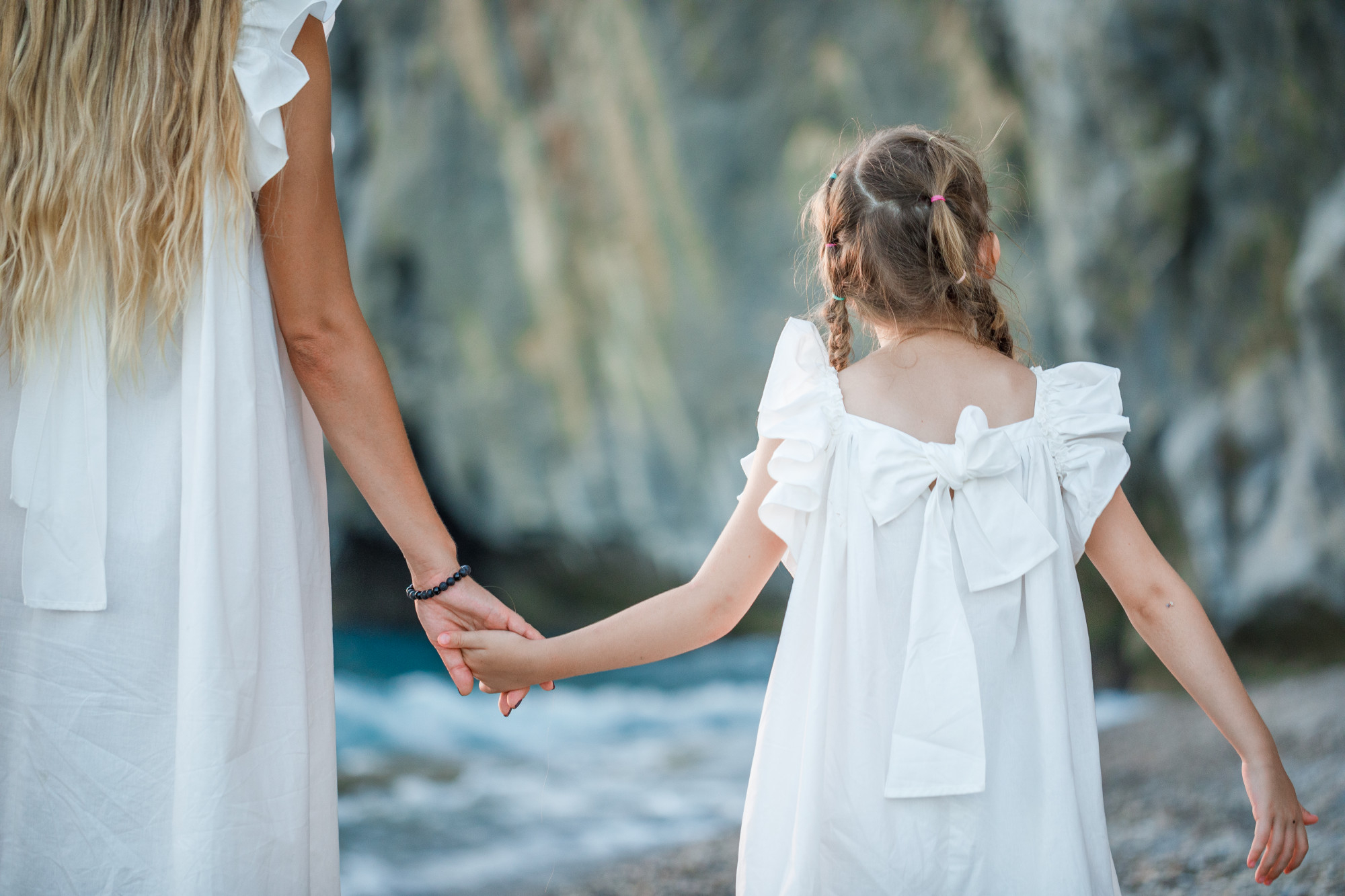
The dress had taken four months to find.
I want to start there because it is such an ordinary detail, and ordinary details are the ones that stay with you afterward, the ones that carry the texture of a day you were not fully prepared to lose the way you lose things when they become larger than you expected. Four months, six boutiques, two cities, and one afternoon in my mother’s basement looking through a box of old photographs she had kept since her own wedding in 1979, not because I wanted a vintage dress but because I wanted to understand something about what I was walking toward. What the day was supposed to feel like from the inside.
I found the dress in March at a bridal shop in Asheville that a friend had mentioned once and that I had not taken seriously until I was running out of other options. It was simple in the way things are simple when they have been made with full attention, a clean silhouette in ivory silk with buttons up the back and a train that was not so long as to be theatrical and not so short as to be ordinary. I stood in the fitting room looking at myself and felt something I had not felt in any of the other boutiques, which was that I looked like myself.
This mattered more than it might have in other circumstances.
I was forty-one. I had not expected to get married, not because I was opposed to the idea, but because the version of my life I had built in my thirties was full and satisfying and the specific quality of loneliness I sometimes felt in it was manageable in the way that managed things are when you have decided not to let them run. I had a career I found genuinely meaningful, clinical social work with children in the foster care system, work that was hard in the way that important things are hard and that left me at the end of a day both depleted and certain that the day had been worth something. I had an apartment in Greenville, South Carolina, that I had decorated with the accumulated choices of an adult who lives alone and likes it, and a group of friends that had thinned and deepened over the years into the small reliable number that actually sustains a life.
I had not planned for Graham.
But that is the nature of the things that change your life. They do not arrive on a schedule.
I met him at a benefit dinner for a child welfare organization I had done work with, one of those evenings that are obligatory in a professional sense and that you arrive at with the specific resignation of someone who already knows where the exits are. He was at the table next to mine and he laughed too loud at something someone said, not in the performative way of people trying to be noticed, but in the unguarded way of someone who found the thing genuinely funny and had not thought about how it sounded.
I noticed the laugh before I noticed him.
He was forty-three, tall, with the kind of face that records experience honestly, the lines around his eyes deep enough to tell you he had both smiled and suffered in sufficient quantity. He was there because his firm, a mid-size architectural practice, had designed a pro bono renovation of a group home the organization ran, and he looked around the room with the attentive curiosity of someone who is always calculating the relationship between spaces and the people who inhabit them.
We talked for two hours.
He told me about Millie before he told me almost anything else about himself. This is the thing I want you to understand about Graham. Not that he was a good father, though he was, but that his daughter was so central to his understanding of himself that to introduce one was to introduce the other. He told me she was six, that she had her mother’s stubbornness and his tendency to narrate her own activities aloud while doing them, that she had recently decided her life’s ambition was to be a marine biologist who also baked professionally.
He told me her mother had died.
He said this plainly, not as a bid for sympathy, but as a fact about his life that could not be omitted without distorting the picture. Her name had been Caroline. She had developed a complication during labor that moved very fast, and by the time the medical team understood what was happening, they could not reverse it. Millie had been born healthy and screaming while her mother was already gone, and Graham had held a newborn daughter in a hospital room and understood that these two things were the same event.
He had told me this on the night we met and had not dramatized it and had not asked me to respond to it in any particular way, which was how I knew he had been carrying it long enough to know how.
I met Millie six weeks later.
Graham had been careful about this. He had told me, in one of the early conversations, that Millie had not met anyone he had dated since Caroline, that this was a line he had not crossed, and that he was telling me this not as a compliment but as context. I said I understood. I did understand. I worked with children in circumstances far more difficult than Millie’s, and I knew that children read the adults in their lives with an accuracy that adults consistently underestimate.
We met at a park on a Saturday morning. Millie was wearing a yellow rain jacket despite the clear weather, which Graham later explained was a preference she maintained regardless of forecast, and she looked at me with the direct, appraising gaze of a child who has decided in advance to form her own opinion.
“Are you a friend of Daddy’s?” she said.
“I am,” I said.
“What kind of friend?”
Graham had crouched beside her. “A good kind,” he said.
Millie looked at me for another moment.
“Do you know about fish?” she said.
“Some things,” I said. “Not everything.”
“I know a lot,” she said.
“Then you can teach me,” I said.
This appeared to satisfy her in a fundamental way.
We walked through the park for two hours, and Millie told me everything she knew about marine biology with the fluency of someone who has been rehearsing expertise for a long time, and I asked questions and learned things I had not known about bioluminescent creatures and the specific social structures of octopus communities, and by the time we reached the car she had taken my hand without comment in the way children sometimes do when they have decided a person is trustworthy.
Graham looked at our joined hands and then at me with an expression I did not have a word for at the time.
I have a word for it now.
Relief.
He had been afraid, I understood later, not that Millie would reject me but that she would be indifferent, that she would go through the polite motions children go through when adults require them to be pleasant, and that he would have to choose between his daughter’s emotional reality and the thing he was beginning to feel. The possibility that she would simply take my hand had not been in his range of expectation.
The following year was the year I fell in love with both of them.
This is not a metaphor. You can fall in love with a child who is not your child in a way that is not romantic and is not parental and is something else, a third category that does not have a clean name but that is real and specific and changes you in ways you do not fully understand until you try to imagine the alternative.
Millie and I baked on Sunday afternoons. She had opinions about ratios and techniques that were sometimes correct and sometimes completely invented, and she presented both with equal confidence, which I found delightful in a way I could not entirely explain. We had a system for movie nights, which involved negotiation about genre and snack allocation, negotiation that Millie took seriously as a process and that she always approached with a prepared position.
I never tried to be her mother. I want to be precise about this. I never used that word about myself, never suggested that our relationship occupied that space. Caroline had been her mother and Caroline was gone, and the absence of Caroline was real in Millie’s life in the way that absences are real for children, a shape felt most sharply at the specific moments when the present tense required what the past had held. The first-grade mother-daughter event. The question, in the middle of a grocery store, about whether Caroline had liked strawberries.
I could not fill that shape. I was not trying to.
What I was trying to do, and I think what I was actually doing, was be present in a way that did not require Millie to pretend anything. She could miss her mother and also enjoy Sunday baking. She could love her father and also want me to read to her at night when I stayed over. These things were not in competition. Children understand this more readily than adults sometimes do.
Graham proposed in October.
He did it at the kitchen table on a Sunday afternoon while Millie was in the living room watching a documentary about whale migration, which she had requested after a previous documentary about sharks had satisfied her temporarily. He did not make it elaborate. He said that he had spent three years understanding that I was the person he wanted his life to be organized around, that he had been more himself in the past three years than he had been since before Caroline died, and that he was asking me to marry him.
He put a ring on the table.
It was not a large ring. It was a simple oval sapphire, deep blue, set in gold, that had belonged to his grandmother. He had asked his mother, who still had it, and she had given it to him without hesitation.
I looked at the ring.
Millie appeared in the kitchen doorway.
She had apparently grown tired of the whales and had been standing there long enough to understand what was happening, and her expression was the expression of a child containing an enormous feeling with imperfect success.
I looked at Graham. Then at Millie.
I put the ring on my finger.
Millie made a sound that was not a word.
Then she crossed the kitchen and wrapped her arms around me from the side, her face pressed against my arm, and she said, into the fabric of my shirt: “Does this mean you’re really going to be my family now?”
“It does,” I said.
“For real?”
“For real.”
She held on for a long time.
We planned the wedding over eight months. Small, which was what both Graham and I wanted, forty people in a garden at a property outside Greenville that a friend of mine owned and let us use for the day. We had string lights in the oak trees and round tables with white linens and a caterer who made the kind of food that does not announce itself, good without requiring acknowledgment.
Millie chose her dress herself. It was pale yellow, with small flowers at the hem, and she wore it at the fitting with the particular seriousness of a child performing an important function. Her role was flower girl and she had practiced the walk in the hallway of Graham’s house on four separate occasions, adjusting her pace each time with the professional dedication of someone who understands that repetition produces competence.
The morning of the wedding I got ready at the property with my mother and my two closest friends. My mother, who had cried with relief rather than sentimentality when I called to tell her about the proposal, helped with my hair and did not say anything that required a response, which was the version of support I needed and which she had spent enough years around me to understand.
Millie arrived an hour before the ceremony with Graham’s sister, who was her aunt and her primary caretaker on the days Graham had to work. She found me in the room I was using to get ready and stood in the doorway in her yellow dress and looked at me for a long moment.
“You look like someone important,” she said.
“You look exactly right,” I said.
She came and stood beside me in front of the mirror and we looked at ourselves together, which was an ordinary thing and was not ordinary at all.
The ceremony was everything I had wanted it to be, which is to say it was itself, not a performance of what a wedding should look like but a simple honest event between people who meant what they were saying.
Millie walked down the aisle before me, carrying flowers, with the focused expression of someone executing a plan that has been rehearsed to the standard she requires. She reached her position and turned and watched me come toward her father, and her face when she saw me in the dress was the face of someone receiving something they had been hoping for.
Graham’s face was the other face I will carry from that day.
The ceremony was twenty minutes. The vows we had written ourselves, both of us, not with the ambition of literature but with the intention of accuracy. We said what we meant. The officiant, a friend of Graham’s from graduate school who had become ordained for the occasion, cried during the exchange of rings, which broke the solemnity in the best way.
We were married.
At the reception, during the period when Graham was making his way around the room talking to relatives, doing the work of a person who has family he has not seen in too long and who came a significant distance to be here, I stood near the edge of the tent with a glass of wine and felt the specific quality of a day that has exceeded its own expectation.
Then Millie’s hand found the hem of my dress.
She was standing beside me, which I had not heard or felt, because Millie could move through a room without announcing herself when she chose to, a quality I had always found remarkable in a child whose default mode was narration.
“Can I tell you Daddy’s secret now that you’re my mommy?” she whispered.
I looked down at her.
She had the expression that children have when they are holding something they have been holding for a long time and have been waiting to set down.
I smiled. I assumed what any person would assume, what any reasonable person at their own wedding reception would assume when a nine-year-old asks about a daddy’s secret, which was that we were in the territory of something small and sweet. A planned surprise. A honeymoon destination he had not told me. A gift he had been keeping.
“What secret?” I said.
Millie glanced across the room at Graham.
“Daddy made me promise to never, ever, ever tell you,” she whispered.
Three nevers.
I had spent enough time with children to understand that the number of times a child repeats a qualifier in a sentence is directly proportional to how seriously they took the original instruction. One never was a casual request. Three nevers was a solemn promise, the kind a child makes with the full weight of whatever moral gravity they have assembled.
My smile was still on my face but something underneath it had changed.
“Then why are you telling me now?” I said.
Millie looked genuinely puzzled.
“Because you’re my mommy now,” she said. “I thought that meant I could.”
I crouched down beside her.
I was aware of the reception continuing around us, the sound of conversation and the caterer moving between tables and someone laughing at something on the far side of the tent. I was aware of my dress on the grass and the evening light coming through the oak trees and the string lights beginning to matter now that the sky was starting to darken.
“What did Daddy tell you not to tell me?” I said.
She leaned toward me.
She whispered something in my ear.
I heard it completely.
Every word.
Then I straightened up slowly.
I looked across the room at my husband.
Graham was talking to his uncle, a man named Frank who lived in Cincinnati and who Graham had mentioned with affection in various stories, and he was leaning slightly forward in the way he did when he was engaged in a conversation, his hands moving. He was wearing the navy suit he had chosen three weeks earlier and he had the look of a man who was very happy and was present in his happiness rather than performing it.
I looked at him.
And I held what Millie had told me against what I knew about him, the three years of knowing, the specific detailed knowledge that intimacy builds, and I tried to understand what I was looking at.
What Millie had told me was this.
She had told me that Daddy cried on the day we met. Not after, not later that evening when she was asleep, but when we were still in the park, walking, while she was explaining something about anglerfish to me and I was listening carefully. He had been walking slightly behind us and she had looked back to make sure he was still there and he was there and he was crying, silently, not so that anyone would notice, but she had noticed because she was nine and she watched her father the way children watch the parent they are afraid of losing.
She had asked him about it later.
He had told her, quietly, that he was crying because he was happy. That he had not been sure, for a long time, that he would feel this again, the particular feeling of watching someone you love being loved by someone else. That he had been afraid to let anyone in because the last time he had loved someone completely, she had died, and that fear was not something he had found a way through until recently, until me, and seeing Millie take my hand in the park had been the moment he understood that the fear was over.
He had made her promise not to tell me.
“He said it was embarrassing,” Millie told me, still whispering, her face tipped up to mine. “He said boys aren’t supposed to cry at parks. I told him that was stupid.”
“It is stupid,” I said.
“I told him I was going to tell you eventually,” she said, with the particular satisfaction of a child who has been correct about something. “I said when you were my mommy I could tell you because mommies and daddies don’t have secrets from each other.”
“That’s a very good rule,” I said.
“Daddy said I was too young to be making rules,” she said.
“Daddy was wrong,” I said.
She considered this with the gravity of a child filing away an instance of an adult being wrong in a category she monitors carefully.
“Are you sad?” she said.
“No,” I said.
“Your face looked sad for a second.”
“Not sad,” I said. “Something else. Something that doesn’t have a name.”
She thought about this.
“Daddy says that sometimes,” she said. “He says some feelings are bigger than their names.”
“He’s right about that,” I said.
She looked at Graham across the room.
“Are you going to tell him I told you?” she said.
“I think I have to,” I said.
She nodded, resigned. “I figured.”
“It’s a good thing,” I said. “You did the right thing.”
“Because I’m your daughter now,” she said.
“Yes,” I said. “Because you’re my daughter now.”
She went back to the table where Graham’s sister was sitting, navigating the reception with the directional confidence of someone who has memorized the layout, and I stood for a moment with my glass of wine and the evening air and the string lights and what Millie had told me.
I have spent my professional life working with children who have experienced loss and disruption and the specific damage that is done when the adults around them are not trustworthy. I have sat in offices and in cars and in the corners of foster homes with children who have learned to read adults with the precision of survival, who notice the small things because the small things have historically mattered. I have watched children carry information they should not have to carry, protect adults who should be protecting them, perform stability for the benefit of people who could not provide it.
Millie had carried this for three years.
Not because it was damaging. Not because it was a burden in the harmful sense. But because her father had asked her to keep something that she found too large for the pocket he had put it in, and she had waited, with the patience of a child who understands that some things have the right moment and the right moment was not yet.
She had decided tonight was the right moment.
She had been correct.
I set my wine glass on a nearby table and walked across the room toward Graham.
He saw me coming.
He finished his sentence to his uncle Frank and turned to face me with the open expression he always had when I was approaching him in a room, as if the sight of me coming toward him required him to recalibrate slightly upward.
“Hey,” he said.
“Hey,” I said.
His uncle Frank excused himself with the tactful awareness of a man who has been married long enough to recognize a conversation that requires privacy.
“What’s wrong?” Graham said.
“Nothing’s wrong,” I said. “I need to tell you something and I need you to know first that nothing is wrong.”
He looked at me.
“Millie told me,” I said.
He blinked.
“Told you what?”
“About the park,” I said. “The first time we met. She told me what happened when she wasn’t looking.”
Graham’s expression changed.
It went through the same stages I had watched my own face go through when Millie had first spoken, the same brief reconfiguration of understanding, and then it arrived somewhere that was a specific combination of mortification and relief in proportions that shifted while I watched.
“She promised,” he said.
“She also told me she told you she was going to tell me eventually,” I said. “And that her reasoning was sound.”
He pressed his hand over his eyes briefly.
“She’s nine,” he said.
“She’s nine and she was right,” I said. “She told me because she’s my daughter now and daughters don’t keep secrets from their mothers.”
Graham lowered his hand.
He looked at me.
“I was going to tell you,” he said. “I’ve meant to tell you about ten times. I just couldn’t find a way to say it that didn’t make me sound like a person having a breakdown in a public park.”
“You were not having a breakdown,” I said. “You were having a feeling.”
“I was crying at a park,” he said. “On a first date.”
“It was not technically a first date,” I said. “And you were crying because you were happy. There is nothing in that sentence that requires an apology.”
He was quiet for a moment.
Around us the reception continued, forty people in a garden with string lights and good food and the accumulated warmth of an evening that was going well, and in the middle of it my husband was looking at me with the expression of a man who has been found out in the best possible way and is not sure what to do with the exposure.
“I was afraid,” he said. “For a long time. I didn’t let anyone in because the last time I did, she died, and I didn’t think I was capable of surviving that again. I thought I was protecting Millie by keeping it smaller. Keeping us smaller.”
“And then,” I said.
“And then she took your hand,” he said. “And I was behind you both and I watched it happen and I understood that the thing I’d been afraid of had already happened anyway. That I’d already let you in. And instead of being afraid, I was just.” He paused. “Happy. Which I had not expected.”
“You should have told me,” I said.
“I know.”
“Not because you owed me the information. Because carrying it alone is lonelier than it has to be.”
He looked at me for a long moment.
“How are you not annoyed at me?” he said.
“I am a little annoyed at you,” I said. “Specifically about the three nevers you made Millie promise. That was a lot of nevers for a six-year-old.”
“She’s very committed when she makes a promise.”
“I know she is,” I said. “Which means she’s been walking around with three nevers for three years and it has apparently been a significant storage problem.”
Graham laughed.
It was the laugh I had first noticed across a room, the unguarded one, and it was the same on our wedding night as it had been at a benefit dinner three years ago, unchanged by the interval, which is one of the reliable signs of a genuine thing.
“What do I do now?” he said.
“You tell me things,” I said. “Not everything. Not more than fits. But the things that are too large for one person’s pocket. That’s what this is for.”
He reached out and touched the ring on my hand, the sapphire his grandmother had worn.
“I’m aware of the irony,” he said. “Making a promise about secrets on our wedding day.”
“It’s appropriate timing,” I said.
His uncle Frank reappeared at a diplomatic distance and gave Graham a look that asked without asking whether the conversation had resolved itself, and Graham gave him a small nod, and Frank went back to the buffet table with the ease of a man who has been reading rooms for a long time.
“Come find me in an hour,” Graham said. “After I’ve finished the uncle circuit.”
“I’ll be at the table,” I said. “With your daughter.”
I walked back across the reception to the table where Millie was sitting with Graham’s sister, who was named Claire and who had been a consistent and warm presence in Millie’s life since Caroline died. Claire looked at me as I approached with the knowing expression of someone who has been told the situation in advance.
“Did she tell you?” Claire said.
“You knew?” I said.
“She told me six months ago that she was waiting until you were her mommy,” Claire said. “She asked me if that was the right time and I said I thought it probably was.”
I sat down beside Millie.
“Are you in trouble?” Millie said.
“You’re not in trouble,” I said.
“Daddy’s going to say I broke my promise.”
“Daddy is also going to think about it and realize that knowing was better,” I said. “He’ll get there.”
Millie considered this with the measured skepticism of a child who has learned not to take adult reassurances at face value.
“Are you sure?” she said.
“Not entirely,” I said. “But I’m optimistic.”
She seemed to accept this as an honest answer, which it was.
We ate dinner, all three tables of us, and the food was as good as I had hoped, and the speeches were the kind that say true things without saying too many of them, and the evening moved through its own stages the way evenings do when they are good.
My mother, who gave the second speech and who had told me she was going to keep it brief and did not, said among other things that she had known I was serious about Graham the first time I had described his laugh. She said she had heard me describe people many ways over forty-one years and this was the first time I had described the way someone laughed before I described anything else about them. She said she thought that probably meant something.
She was right.
Graham’s speech was the last one, and he stood up with the same quality of composure he brought to things that mattered, the composure that is not distance but control, the kind that comes from feeling something fully and choosing how to let it be visible.
He talked about Millie first.
He talked about the version of himself he had been before she was born and the version he had become in the years of raising her, how she had changed what he understood about his own capacity for love and for patience and for the specific kind of repetitive attention that parenting requires. He said she had taught him more than he had taught her, which Millie received with a look of practiced modesty that did not entirely conceal her agreement.
Then he talked about me.
He talked about the park on a Saturday morning and a child in a yellow rain jacket deciding to take someone’s hand, and how he had watched it happen from two steps behind, and what he had understood in that moment.
He did not say he had cried.
But he looked at me while he said it, and I looked at him, and we understood each other, which is what it means to be married in the sense that actually matters.
Millie, beside me, leaned toward my ear.
“He’s telling you,” she whispered.
“I know,” I whispered back.
“Now you don’t need me to tell you.”
“I needed you to tell me first,” I said. “So I could hear it right.”
She thought about this.
“Because I’m your daughter,” she said.
“Because you’re my daughter,” I said.
She sat back in her chair with the satisfied expression of someone who has executed a plan that has come out better than expected.
After dinner, while the dancing started and the string lights became the primary light and the garden took on the quality of evenings that are complete in themselves, Graham found me at the edge of the tent.
He did not say anything about Millie telling me.
He said: “I have something to tell you.”
“I know,” I said.
“I mean something new,” he said. “Not what Millie told you.”
I waited.
“I bought the property next door to the one in North Carolina,” he said. “The one you said you’d always wanted to build something on. I bought it in February. Millie helped me pick it.”
I stared at him.
“It has a creek,” he said. “And enough flat ground for the kind of garden you described. And it faces southeast, so the mornings are.” He paused. “I talked to an architect.”
“You are an architect,” I said.
“I talked to myself,” he said. “At length. There are drawings.”
I put my hand on his face.
He put his hand over mine.
“I’ve been carrying that for six months,” he said. “It was getting heavy.”
“You should have told me,” I said.
“I know,” he said. “I’m learning.”
We stayed at the reception until the last guests left, which was a decision we made without discussing it, the natural consequence of not wanting the evening to end. Millie fell asleep in Claire’s arms around ten, still in her yellow dress, her head against Claire’s shoulder, and Claire carried her to the car with the ease of someone who has been carrying this child for nine years.
I watched them go.
Graham came to stand beside me.
“She’s going to want to hear all about the property,” he said. “In detail. With drawings.”
“She will have questions about the creek,” I said. “Ecological questions.”
“She has already asked two,” he said. “In February, when I told her.”
“You told her in February?”
“She is very good at keeping secrets,” he said. “When they’re good ones.”
I thought about Millie at six, standing in a park in a yellow rain jacket, deciding to take my hand. I thought about the three years between that afternoon and this evening, the Sunday baking and the movie nights and the negotiated snack allocations and the anglerfish documentation and the question in the grocery store about whether Caroline had liked strawberries.
I had not replaced Caroline. That was not what had happened.
What had happened was something else, something that did not fit neatly into the available categories, a third thing between stepmother and mother that Millie had named herself, in her own time, in a way that felt accurate.
She had called me her mommy.
She had decided that was the right word.
And she had been carrying a secret for three years, waiting for the moment when she had the standing to set it down, and she had identified that moment correctly, with the precise timing of a child who has learned to read rooms from a man who builds them for a living, and she had given me a gift I had not known I needed.
Not the secret itself.
The trust that came with the telling.
The wedding guests were gone. The caterers were finishing their breakdown. The string lights were still on in the oak trees and the round tables had the pleasant disarray of a party that was ending rather than the abandoned quality of one that had gone wrong.
Graham offered me his arm.
We walked out of the tent and across the grass toward the car, and the night was warm and the string lights were behind us and the dark outside the property was the particular dark of rural South Carolina in October, thick and full of sound.
“Tell me about the property,” I said.
“Now?”
“Now,” I said. “On the drive. Tell me everything.”
He talked for the entire drive.
The creek, which ran along the eastern edge and had a particular quality of light in the morning that he had noticed when he visited in February. The flat section near the center that he thought would take a garden without requiring significant grading. The way the trees were distributed, not dense, but enough to give structure without blocking the southeast exposure.
He had been thinking about the house for six months.
He described it the way he described all the buildings he thought about, from the inside out, starting with how the light would move through the spaces at different hours and working outward to the structure that would hold it. He said he wanted a porch that faced the creek. He said Millie had already requested a room with a window directly over the water, which he had told her was structurally complex, and which he was going to do anyway.
I listened to all of it.
We reached the hotel where we were staying for the night before the flight tomorrow, and he was still talking when we got to the room, sitting on the edge of the bed with his jacket off and his shoes on the floor, drawing on the hotel notepad the rough outline of what he was thinking, the shape of the rooms, the porch, the window over the creek.
I sat beside him and looked at the drawing.
It was the kind of drawing architects make when they are thinking rather than presenting, loose and specific at the same time, the proportions approximate but the intention clear.
“This window,” I said, pointing.
“That’s Millie’s,” he said.
“And this one?”
“Ours,” he said. “Southeast. Morning light.”
I looked at the drawing for a long moment.
Then I looked at my husband.
He was watching me with the expression I had learned over three years to read accurately, the one that meant he was carrying something and had decided to set it down.
“I’ve been happy before,” he said. “I want you to know that. With Caroline, for the years we had. It was real and I don’t want to.”
“I know,” I said.
“But this is different,” he said. “Not better. Just different. The way that something you build yourself is different from something you find. Both are real. Both are yours. They just feel different in your hands.”
I thought about a man I had not known yet, standing two steps behind his daughter in a park, watching something happen that he had not known was possible.
I thought about Millie in a yellow rain jacket, deciding.
I thought about three nevers.
“Tell me when things are heavy,” I said. “That’s all I need from you.”
“I will,” he said.
“And let Millie tell me things when she decides it’s time,” I said. “She has good timing.”
He looked at the notepad drawing.
“Better than mine,” he said.
“Better than most,” I said.
We stayed up late, the way you stay up on a night you are not ready to let end, and he told me things he had been carrying and I told him things I had been carrying and by the time we slept the window was beginning to lighten at its eastern edge in the way windows do when the morning is almost there but has not yet announced itself.
The way things do when they are almost what they are going to be.
The light came through the window.
In the other room of the suite, which Claire had brought Millie to late in the evening, I could hear, through the wall, the particular sound of a child sleeping, the even settled breathing of someone who has put down what she was holding and is resting in the lightness of it.
I had said I would never try to replace her mother.
This was still true.
What I had not known, on the day I said it, was that there was a third thing. Not replacement. Not absence. A thing Millie had named herself, in her own time, with better timing than anyone could have planned.
She had been waiting to tell me.
She had been waiting for the right moment.
She had found it.
So had we all.

Specialty: Legal & Financial Drama
Michael Carter covers stories where money, power, and personal history collide. His writing often explores courtroom battles, business conflicts, and the subtle strategies people use when pushed into a corner. He focuses on grounded, realistic storytelling with attention to detail and believable motivations.