“What now?”
My voice came out steadier than I felt, colder than I had ever heard it leave my own mouth. Across the table, my brother-in-law pushed his chair back without a word, the legs scraping loud against the hardwood floor my mortgage payments had polished for five straight years.
Someone asked what was going on. My mother, maybe, or one of the cousins who only surfaced at Christmas to eat off plates they never washed.
I turned toward the sound, still calm, still quiet, because I had learned a long time ago that quiet was the only weapon they never saw coming.
“This is the last time you’ll see us,” I said.
Their faces froze. Mouths half open around whatever they had been about to say. Forks stalled in the air over the good china. Nobody laughed, which told me they finally understood I was not joking, because in that house, my sincerity had always been the funniest thing in the room.
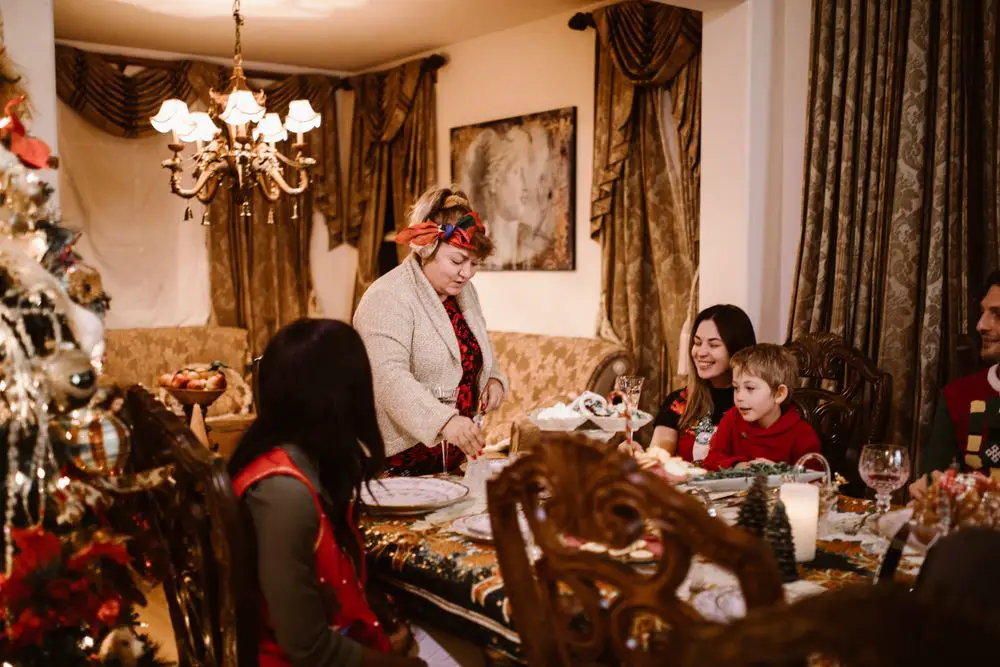
Then I took Olivia’s hand. She did not resist. She just let me draw her up out of her chair, her small fingers trembling against mine, and we walked out of that house together. Past the kitchen, past the dining room where the adults sat frozen mid-chew, past the Christmas tree blinking its cheerful lights in the corner, out into the sharp cold December air that closed behind us like a held breath finally released.
The house still hummed with the memory of their laughter. The particular kind that has an edge to it. The kind that cuts even when it is aimed at a child.
I opened the car door for Olivia and buckled her in myself, though she was eleven and perfectly capable, because I needed to do something with my hands that was gentle. She stared out the window, her lips pressed into a thin line, saying nothing. Adam slid into the driver’s seat and glanced over at me, a question forming, but he did not ask it. Not yet. My husband has always known how to read a silence, and this one was still too hot to touch.
The engine turned over. We pulled away from the curb and out of that neighborhood, and only when the house had disappeared from the mirror did I finally let myself breathe.
They thought mocking my daughter was just a game, a harmless little holiday tradition, the way they had once made a game out of mocking me. Very soon, my sister Monica was going to learn exactly how wrong they all were. Soon she would open an envelope, read one short paragraph, and understand that nothing in this family would ever be the same again.
If you have ever wondered what it feels like to grow up as the family black sheep, let me spare you the suspense. It feels like being invited to a party where everyone else is in on a joke you were never told, and somehow the punchline is always you.
I had one sister and one brother, and between the two of them, they gave my parents enough pride to last several lifetimes.
Monica was the social one. The golden girl. The daughter whose photos got framed and whose report cards got mentioned at dinner parties whether anyone had asked or not.
Daniel was the athlete. Charming, easy, the kind of son parents brag about over cocktails while the other guests nod and refill their glasses.
And then there was me. The nerd. Not the fun kind, either. Not the quirky, movie-trivia, life-of-the-party kind who gets teased affectionately and belongs anyway. I was the serious kind. Nose in a book. Taking apart the family computer and putting it back together before most people in my grade knew how to set the clock on a VCR. I built my first working program at twelve on a secondhand machine I had saved up for by mowing lawns all summer, one careful ten-dollar bill at a time, keeping the cash in a coffee can under my bed because I did not trust anyone in that house not to borrow from it.
We were not poor, exactly, but money was always tight in a way that put everyone on edge. My father sold insurance, life and auto policies mostly, and his income rose and fell with the seasons and the economy. My mother did the books for a dentist’s office. There was enough for the things that showed, the vacations Monica and Daniel got to brag about at school, the cheer uniforms and the travel-team fees, and never quite enough for the things I wanted, which were mostly books and computer parts nobody else in the family understood the point of. When I asked for a new hard drive one Christmas, my mother sighed like I had requested a car.
My siblings never let me forget a single ounce of any of it.
When I got my first pair of glasses in fifth grade, they called me Owl and hooted every time I opened my mouth. At dinner one night, Daniel pulled my chair clean out of the dining room as a prank, and everyone laughed while I stood there holding my tray, genuinely unsure whether I was supposed to sit on the floor or simply cease to exist. If I tried to join a conversation, he would sigh theatrically and announce to the table, “Shh, the encyclopedia’s talking.”
But the worst part was never really them. It was my parents.
They did not join in. I will give them that much, though it is a smaller thing than it sounds. What they did was worse in its own quiet way. They let it happen. Sometimes my father would chuckle like he could not help himself, a reflex he never bothered to suppress. My mother would pat my shoulder and deliver the line that became the soundtrack of my entire childhood.
“Don’t be so sensitive.”
Don’t be so sensitive when they hid my homework the night before it was due. Don’t be so sensitive when they mocked the way I dressed, the clothes we could afford. Don’t be so sensitive when they joked, again and again, that I must have been adopted, because how else could one family produce something so different, so wrong, so me.
I laughed along sometimes, because what else was there to do. But underneath the laughing, I understood something with total clarity. I did not belong. Not really. Not to them.
And when a child grows up knowing she does not belong, she learns to make herself useful instead. That is how I became the helper. The one who did the dishes without being asked, carried the trays, refilled the glasses, kept the peace, smoothed every edge before anyone could cut themselves on it. At family gatherings I was the one clearing plates while the others sat and laughed, the one who noticed the trash was full and quietly took it out, the one who drove my grandmother home so nobody else had to leave the party early. I told myself it made me indispensable. What it actually made me was invisible in a way that felt, from the inside, almost like safety.
If I could not be loved, I reasoned, without ever once putting it into words, then maybe I could at least earn the right to be tolerated. Maybe usefulness was a kind of currency, and if I saved up enough of it, I could eventually buy the thing everyone else in the family seemed to get for free just by existing. It never occurred to me, not for decades, that love you have to purchase is not love at all. It is rent. And the landlord can raise it any time she likes.
The irony, of course, is almost too clean. Every single thing they mocked me for turned out to be the thing that saved my life. The books. The glasses. The obsession with computers that they found so embarrassing. I built an entire career out of it. Senior software engineer at a company you have heard of, with a salary that made my parents quietly recalculate their opinion of me and good benefits, real ones, the kind with an actual health insurance plan and a retirement account I have been maxing out since my mid-twenties because I grew up watching what it looks like when nobody plans for anything.
Adam is in tech too. We met over a shared bug in a codebase, spent four hours arguing about the fix, and never really stopped talking after that. Two nerds building a small, sturdy, nerdy life together, the kind of life that does not look impressive from the outside and feels like everything from the inside. We bought a modest house in a quiet neighborhood with a fixed-rate mortgage we could comfortably afford, put a healthy emergency fund aside, and met with a financial adviser once a year the way other couples get an oil change, on schedule, without drama. We are careful people. We had to be. Careful was the only inheritance I ever got.
Our family works. Theirs, as it turned out, did not. And that is precisely how I ended up paying the mortgage on a house that was never mine to live in.
It started five years ago, when Olivia was six.
Monica came to me in tears one afternoon, and I want you to understand that I believed those tears, because I always believed her tears. Her husband, she explained, was finding himself, which is a phrase that sounds gentle until you translate it. What it actually meant was that he drifted from one community college class to one part-time gig and back again, never landing on anything resembling an income, always three weeks from a breakthrough that never came.
Monica was working part-time herself, or so she said, insisting she could not possibly juggle a real career and motherhood at the same time. Over the years she had launched a small parade of side businesses. Handmade candles. An Etsy shop full of macramé nobody bought. A fitness coaching certification she paid for on a credit card and used exactly twice. Each one ended the same way, in a fresh little pile of debt she never mentioned until it had already collapsed.
She told me all she wanted was stability for her daughter, my niece Madison. A safe home. Somewhere Madison could feel settled and grow up without moving every eleven months when another lease went sideways.
It began small. She asked if I could help with a deposit. Just a little boost, she called it, the words already softening the size of what she was asking for. But when I started asking the practical questions, the real story came out. Her credit was wrecked. Years of unpaid cards and defaulted loans had dragged her score down into a range where no lender on earth would approve her for a mortgage. She could not even qualify for a decent apartment without a cosigner.
So I did what I honestly believed at the time was the kind thing. The family thing. The thing you do when you have finally made it and someone you grew up with has not. I talked it over with Adam, who was quiet for a long time before he said the words I chose to ignore. He said, are you sure this is a loan and not a gift, because if she can’t pay it back, you need to make peace with that now. I told him it was fine. I told him she was my sister.
I got preapproved on a second mortgage, which meant a lender running my income and my debt-to-income ratio and my credit, and mine was excellent, spotless, the one thing in my life nobody could criticize. I put down a real down payment out of the savings Adam and I had built, signed a stack of closing documents at a title office on a Tuesday afternoon, and let Monica and her family move in the following weekend. I even paid the movers.
It was supposed to be temporary. Six months. A year at the outside. Just long enough for her and her husband to get their finances untangled, rebuild her credit, and eventually either qualify for their own mortgage and buy me out or take over the loan through a formal assumption. That was the plan we agreed to, out loud, at my own kitchen table, both of us nodding like reasonable adults.
That was five years ago.
In five years, they have paid the electric bill and the water bill. That is the complete and total list. I have covered every single mortgage payment, all sixty of them, plus the property taxes that the county reassessed upward twice, plus the homeowners insurance premium that climbed a little higher at every renewal, plus every major repair that came up along the way. When the water heater failed, I paid for the new one and the plumber’s emergency call-out fee. When the roof started leaking after a bad storm, that was me too, the deductible on a claim I filed on a policy I was paying for, on a house I would never sleep a single night in. I even covered the HOA dues, sixty-five dollars a month that Monica once described, to my face, as my little contribution.
And somewhere in those five years, without anyone ever saying it aloud, the house stopped being mine in their eyes. It quietly became their home. Their right. Their entitlement. My name sat on the deed and the loan documents, but in their private accounting, I was just the nerd with the money, the sister who sat at a computer all day and therefore could not possibly need it as much as they did.
“Must be nice,” Monica said to me once, when I mentioned a project I was proud of at work. “Just sitting at a computer all day. You wouldn’t even know what to do with that money if you weren’t helping us.”
I laughed it off, of course. That is what I do. It is the reflex they installed in me before I was old enough to choose otherwise.
But that night I lay awake staring at the ceiling and I thought, with a clarity that frightened me, maybe she is right. Maybe I have been buying acceptance this whole time. Maybe the mortgage payment leaving my account every month was never really about the house at all. Maybe it was a membership fee for a club that had already decided, decades ago, never to let me in.
I never said any of that out loud. It was easier to keep telling myself I was just helping. That is what family does, isn’t it. That is the story I wrapped around the whole arrangement so I would not have to look directly at what it actually was.
The truth, when I finally let myself add it up, was staggering in a way that had nothing to do with the dollar amount, though the dollar amount was staggering too. Five years of payments was more than the down payment on a second home for Adam and me. It was a college fund for Olivia several times over. It was the early retirement we sometimes talked about over coffee on Sunday mornings, a little further out of reach every year. I had been quietly rerouting my own family’s future into a house where I was treated like the hired help, and I had been calling it love because the alternative was admitting I had been buying something that was never for sale.
And for a while, the story held. Or at least I let myself believe it did.
Adam never liked it. He is too kind and too careful to have ever said out loud that I was being used, but I could read it in his face. Every month, when the automatic mortgage payment cleared and the notification lit up my phone, he would go quiet in a particular way. Every holiday, when we arrived with our arms full of gifts and Monica barely managed a thank you before setting them aside, he would glance at me with an expression I came to know well. He was waiting. Waiting for the day I finally saw it. Waiting for me to snap.
I did not snap, because deep down some small, stubborn, wounded part of me still believed that this was simply the price of belonging. That if I paid it long enough and quietly enough, one day the acceptance would finally arrive.
By then, Olivia was firmly part of our lives, and she changed everything about how I saw that house.
She and Madison were only a few months apart in age, growing up side by side, cousins who saw each other at every holiday and most Sundays in between. But where Madison was loud and quick and effortlessly liked, Olivia was quiet. Thoughtful. Happiest with a book in her lap or a Lego set spread across the living room floor, building cities only she could see. She was brilliant, genuinely brilliant, but shy, a little socially awkward, more comfortable with ideas than with crowds. In other words, she was Adam and me distilled into one small person.
Which made her, in that family, the perfect target.
At first I convinced myself it was fine. Kids tease each other. Families play favorites, everyone knows that, it is practically a law of nature. I told myself it was nothing like what I had gone through. It was softer, I insisted to myself. Ordinary.
Except it was not softer. It was the exact same machine, running the exact same program, and I had simply installed it in a new generation without noticing.
At Thanksgiving, Olivia tried to tell everyone about the science fair project she had spent three weeks building, a little model of a water filtration system that actually worked, her voice bright with a rare, unguarded excitement. Monica cut her off mid-sentence. “Let Madison finish her story first,” she said, and Madison had not actually been telling a story, but everyone at the table nodded like this was the most natural thing in the world, like a child’s excitement was a small inconvenience to be scheduled around. Olivia went quiet and pushed her food around her plate for the rest of the meal, and I watched her do it, and I remembered the exact shape of that silence because I had lived inside it for eighteen years.
Another time, at my parents’ place, Olivia brought over a robotics kit she had built from scratch, motors and sensors wired together into a little machine that could follow a line across the floor. She had worked on it for a month. She set it down on the carpet and explained how the sensors read the contrast between the dark tape and the light floor, her whole face lighting up the way mine used to before they taught me to dim it. My mother smiled, patted her head, and then turned immediately to Madison. “Sweetheart, why don’t you show everyone your new cheer routine?”
The room erupted. Clapping, whooping, phones out to record it, praise poured over Madison like warm water while my daughter quietly picked her little robot up off the floor, set it on the coffee table, and folded her hands in her lap. She pretended, with a skill no eleven-year-old should ever have to develop, that she did not care. That skill is not a gift. It is a scar that has learned to smile.
I saw it. I felt it land in my own chest like it was aimed at me. And still, God help me, I told myself it was not serious. That I was imagining things. That history was not repeating itself right in front of me at the dinner table.
But that Christmas, there was no imagining it anymore, and there was no telling myself anything.
It happened at the dinner table, over dessert, in front of everyone. Daniel started it, the way he had always started things, with that easy grin that made cruelty look like play. He asked Olivia a riddle, then answered it for her before she could think, then laughed and said, “Come on, encyclopedia’s kid, keep up.” Madison giggled. Monica joined in with something about how at least Madison knew how to talk to people. My mother, watching my daughter’s face fall, said the words I had heard ten thousand times in my own childhood, the ones that had followed me from grade school to graduation. She said, “Oh, don’t be so sensitive.”
And I watched my eleven-year-old daughter do the exact thing I had spent my whole life doing. I watched her arrange her features into a small brave smile and pretend it did not hurt, absorb it, file it away, and reach for another bite of pie so nobody would see her hands shake.
Something in me shifted in that instant, some load-bearing wall that had held for thirty years finally giving way all at once. Because I understood, with a horrible perfect clarity, that I had done this. Not on purpose. But by saying yes for five years, by writing the checks and swallowing the comments and dragging my daughter to holiday after holiday in a house that had never once been safe for a child like her, I had handed her the same inheritance my parents handed me. I had taught her that this was family. That this was the price.
I was not going to stand there, tray in hand, keeping the peace, while my daughter became their new punchline the way I had been theirs. Not for one more minute.
Not anymore. It stopped there.
The drive home was the heavy kind of silence, the kind that has nothing peaceful about it. Adam kept his eyes on the road. Olivia stared out her window, her breath fogging small clouds against the cold glass. I sat in the front with my arms folded so tightly I could feel my own fingernails pressing half-moons into my skin.
Adam tried once, about halfway down the block. “What’s going on?” he asked, his voice careful, testing the temperature of the water before he stepped in.
“Later,” I managed. My throat was too tight to say anything more without it turning into something I did not want Olivia to hear.
He nodded and let it go, though I could feel his confusion filling the car like static. No one spoke again the whole way home. By the time we pulled into our own driveway, my jaw ached from clenching it.
Inside, Adam tossed his keys into the dish by the door and turned to face me. “Okay,” he said. “What was that?”
I pulled off my coat and hung it up slowly, deliberately, because if I moved any faster I was fairly sure I would tear it in half.
“They were mocking Olivia.”
He frowned.
“Mocking her out loud, in front of everyone. It wasn’t teasing, Adam. It was organized. It was a group activity.”
His eyebrows shot up. “I didn’t hear anything like that. I honestly thought they were all just playing some silly game.”
“Exactly.” My voice came out flat and sharp. “They thought it was a game too.”
Adam looked genuinely thrown. He has always been the peacekeeper of the two of us, the one who smooths ruffled feathers at family gatherings while I carry the trays and refill the drinks. He could not quite process that we had just detonated Christmas dinner over something he had not even registered happening.
Before I could explain further, Olivia spoke for the first time since we had left that house.
Her voice was small, the kind of small that makes you lean in because it sounds like it might vanish before it finishes.
“It was just a joke.”
I turned. She was standing by the couch, still in her coat, staring down at her shoes. And her words cut deeper than anything Monica had said all night.
“If I walked away every time people made jokes about me,” she added, almost whispering, “I wouldn’t have any friends.”
That was the moment my chest cracked wide open. Because I recognized it. Word for word, thought for thought, it was me at eleven years old, swallowing every barb my family threw and calling the taste of it normal. She had already learned the lesson. She had already started paying the fee. And I had let it happen right in front of me.
Adam rubbed his forehead, still catching up. “Olivia,” he said gently, “what kind of jokes?”
She hesitated. Her lip trembled. “They said Madison’s smarter than me. Funnier. Better. They said I’m annoying.”
The word hung in the air like a blade.
She blinked hard and rushed to add, “But it’s fine. It’s probably true anyway. Madison is smarter than me.”
Her voice broke on that last word, and it very nearly finished me.
I crossed the room and crouched down in front of her, taking her cold hands in mine. “None of that is true,” I said, steady but fierce. “Not one word of it. They weren’t being honest, Olivia. They were being cruel. A joke that hurts on purpose isn’t a joke. It’s just cruelty wearing a costume.”
She shook her head, tears shining in her eyes but stubbornly refusing to fall, and even that I recognized. “But if I can’t take it,” she said, “then maybe I really am weak. Maybe they’re right about me.”
I wanted to scream. Not at her. At every single one of them, all the adults who had trained a brilliant little girl to believe that enduring cruelty was a test she had to keep passing to deserve a seat at the table.
Instead I took a breath and held it together.
“No,” I said, as calm as I could make myself. “You are not weak. You are kind, and you are brilliant, and the people who tear you down do not deserve one more minute of you. Not ever.”
Her lips wobbled. And then the tears finally came, fast and hard, like she had been holding them back for hours, for years, for a whole childhood she had not lived yet but had already started to inherit. She buried her face against my shoulder and her small body shook, and what I felt pouring off her was not just grief. It was relief. The pure, staggering relief of a child hearing, for the first time, that she did not have to take it.
I held her until her breathing slowed, until the storm inside her finally passed through and out the other side.
Later, I tucked her into bed. She was quiet, thoughtful, still turning it all over behind her eyes. I sat on the edge of her mattress longer than I needed to, smoothing the blanket, listening to her breathing settle. I thought about all the nights of my own childhood when there had been no one to sit on the edge of my bed and tell me the jokes were not my fault. I thought about how a single sentence, said with enough conviction at the right age, can rewrite a person’s whole sense of what they are worth. My mother had used hers to shrink me. I was determined to use mine to do the opposite.
Before I stood up, Olivia opened her eyes and looked at me and asked, very softly, whether we were going to have to see them again. I told her the truth. I told her I did not know yet, but that whatever happened, she would never again have to sit at a table where people were unkind to her and call it love. She nodded, closed her eyes, and something in her face let go. A small seed, planted. The beginning of an idea she would spend the next year learning to trust.
When I came back down to the kitchen, Adam was leaning against the counter with his arms crossed, caught somewhere between anger and bewilderment.
“You’ve always said yes to them,” he said slowly. “Always helped. Always kept the peace. What happened to that?”
“That was the old me.”
I pulled out a chair and sat down hard. “I kept saying yes for years, hoping that eventually it would mean something to them. That one day I’d finally be enough. It never did. It never was.”
He hesitated. “But the house. Hannah, they’re living in the house.”
“They’re done.” My voice went cold and certain. “I want them out.”
He studied my face for a long moment. “Are you sure? That’s a big step. That’s not something you can un-take.”
I met his eyes and did not look away. “I have never been more sure of anything in my life.”
For a second he looked like he might argue, like the peacekeeper in him was reaching for the usual tools. Then he saw it was pointless, and something in his shoulders dropped, and he exhaled. “Okay,” he said.
That one word was all I needed.
Before I opened the laptop, I did something I had never once done in five years. I called a friend from work whose brother is a real estate attorney, and I asked her for his number, and I made a note to schedule a consultation that week so I understood exactly where I stood legally before I made a single move. No lease existed, which cut both ways, and I wanted to know precisely what notice the law required and how to give it cleanly. I was done acting on emotion and hope. This time I was going to act on facts and paperwork, the way I should have from the very beginning.
Then I pulled my laptop onto the kitchen table, and the glow of the screen lit the room while I drafted the letter. I kept it short. Formal. Cold as I could make it, because warmth had never once been rewarded in this family and I was finished offering it for free. Monica and her family had thirty days to vacate the property. I referenced the deed. I referenced the loan in my name. I left no room for interpretation, because interpretation was the crack they had always slipped through.
Adam read it over my shoulder, his lips pressed into a thin line. He did not say a word. When it was finished, I printed a copy, and we sealed it into an envelope, and I made a note to send the formal version by certified mail so there would be a record of exactly when it was delivered. Then Adam slid the courtesy copy onto the outgoing mail pile by the front door.
I stood there and stared at it for a long moment. That envelope was so much more than paper and ink. It was the first real boundary I had drawn in thirty-one years of living. It was the line between the old me, the girl who swallowed jokes until she believed every one of them, and the woman who had just decided her daughter would never, ever live that same life.
The house was quiet after that. Almost too quiet.
No one called in the days right after Christmas. No apology, no explanation, not even an angry text. I think they assumed I was not serious. I think they assumed, the way they always had, that I would fold before it mattered, that the letter was a tantrum and not a decision.
They were wrong.
Very soon, Monica would open that envelope. And when she did, nothing in this family would ever be the same again.
The call came three days later. Monica, of course.
I knew what was coming before I even swiped to answer, and she did not disappoint me.
“You’ve lost your mind,” she spat down the line, no hello, no lead-up. “Thirty days? You think you can just throw us out on the street like we’re strangers, over one little joke? You’re pathetic, Hannah. You have always been way too sensitive.”
There it was again. The old refrain, the family anthem. Too sensitive.
I let her burn through it, all of it, the accusations and the insults and the disbelief. When she finally paused for breath, I said, steady as stone, “It’s not a joke, Monica. You have thirty days. I’m selling the house.”
“You can’t sell it,” she shrieked. “We live here.”
“My name is on the deed and the loan. Not yours. It has never once been yours.”
She swore at me then. Called me selfish, told me I was tearing the family apart over nothing, that I would regret this for the rest of my life. And then she hung up.
I stared at the phone for a moment, half expecting it to light up again immediately. It did not.
Not right away.
But later that evening, it rang again. My mother this time.
Her voice came through soft and honeyed, the voice she used to save for tucking me into bed on the rare nights she remembered to.
“Hannah, sweetheart. I think we should all just take a breath here. Don’t do anything rash. Think about Madison, honey. That little girl needs stability. You’ve always been the generous one in this family. Don’t throw all of that away over one silly night.”
I almost laughed out loud. Generous. That was a brand-new one. In thirty-one years I do not think that word had ever once been aimed at me.
“It’s not about one night,” I said, keeping my voice flat and even. “It’s about Olivia. It’s about years of the two of us being treated like we don’t count. The letter stands.”
“Hannah, listen to me.” She pressed harder now, the syrup thickening. “You’ve already helped so much. Can’t we just find a way to move past this? You don’t want to be the one who breaks this family apart.”
I leaned back in my chair and looked at the ceiling. “The family broke itself a long time ago, Mom. I just finally stopped pretending not to notice.”
I could hear her recalibrating on the other end of the line, reaching for the next tool in the kit. She tried guilt. She reminded me of everything she had supposedly done for me, a list so thin and so revised that I almost laughed. She tried fear, hinting that I would end up alone, that family was all anyone really had at the end, that I would be sorry when they were gone. She never once, in the entire call, asked how Olivia was doing. She never once acknowledged that anything had happened at Christmas at all. To her, the problem was not the cruelty. The problem was that I had finally reacted to it.
The pause on the line stretched long and thin. And then the sweetness cracked all at once, like sugar shattering under sudden heat.
“You’ll regret this,” she hissed, and the line went dead.
So much for honey.
The days after that crawled by. I understood their strategy perfectly, because I had watched them run it my whole life. Do nothing. Drag their feet. Wait for me to lose my nerve and fold the way I always folded. But I did not fold this time.
I sat down with the real estate attorney first, paid for an hour of his time, and walked out understanding my position completely. Then I called a listing agent and put the house on the market. He was kind but honest, the way the good ones are, and he warned me that Monica might make the process miserable. She could slam doors in the faces of buyers. She could refuse to let anyone in for showings. She could let the place fall into disarray out of pure spite and drag down every offer.
“She can make this ugly and drawn out if she wants to,” he said gently, as though I did not already know exactly who I was dealing with.
“Then she’ll be served, formally, through the court,” I said. “I’ve already talked to a lawyer. Either way, the house is mine. Either way, she’s out. The only thing she gets to choose is how much it costs her on the way.”
I was not bluffing. Not anymore. That was the whole difference, and I think somewhere underneath all the shouting, they could feel it.
The threats kept coming for a while. Talk of lawyers, of court, of tenants’ rights they had read about online, of how they would never leave and I could never make them. But when they finally sat down and looked at the actual legal reality, when Monica’s husband presumably spent his own money on a consultation of his own, they understood. My name was on the deed, the mortgage, the insurance policy, the tax bill, every document that mattered. There was no lease in their name because there had never been a lease at all, only my endless, unwritten goodwill. Any attorney would have told them in fifteen minutes that fighting it would cost them thousands of dollars they did not have in order to delay, by a few weeks, an outcome they could not change. Eventually the threats went quiet.
Between the letter and day thirty, the house sat on the market and, to my quiet surprise, drew an offer within the first two weeks. A young couple, pre-approved, expecting a baby in the spring, looking for exactly the kind of starter home in a decent school district that Monica had been living in for free. Their offer was fair. I accepted it. The closing was scheduled for the week after the move-out deadline, which meant the timeline was no longer just mine to enforce. It belonged to a signed contract now, to a lender, to a title company, to people whose lives were waiting on that address becoming empty. There was no folding left to do, even if I had wanted to.
Day thirty arrived cold and gray.
When I turned onto the street, the moving truck was already parked at the curb. Monica’s husband was wrestling a box down the front steps, red-faced and muttering. Monica stood in the yard barking orders, her arms folded across her chest except for the moments she flung them out to point at something he was doing wrong. My parents hovered nearby, directing the chaos like a pair of generals commanding a retreat they refused to call a retreat.
When they spotted me stepping out of my car, the looks they shot across the street could have burned holes straight through me.
I crossed slowly, unhurried, the slam of the truck’s cargo door ringing out like a bell tolling the end of something. The driveway was littered with boxes. Monica’s husband cursed under his breath as he staggered past me with another load, not meeting my eyes. My mother and father stacked things by the door, whispering to each other, sharp and low and furious.
And then we locked eyes. Me on the walkway. The three of them on the steps of the house I had paid for.
My mother dropped a box and stormed toward me, my father right on her heels. Monica followed, arms wrapped tight around herself, venom in her stare.
“How could you do this to your own sister?” my mother demanded, her voice rising. “To your family? Over nothing but a few words at Christmas?”
Monica jabbed a finger through the cold air at me. “You were always jealous. Always different. You never belonged in this family and you know it.”
The words landed exactly where they were meant to. Heavy. Familiar. An old bruise pressed by a practiced thumb.
“So that’s it,” I said quietly. “All these years. I never belonged.”
My mother’s face hardened. The honey was gone now, entirely gone, and what was left underneath was raw and bitter and, at last, honest.
“You were never like us,” she said. “You never fit in here, not once. And yes, maybe you did try to buy your way into this family with all your help and your money. But that was your choice, Hannah. Nobody asked you to.”
The world went completely still.
It was the thing I had suspected my entire life and had spent thirty-one years refusing to fully believe. And now here it was, out loud, in the cold, in the driveway, finally and undeniably said.
But instead of breaking me the way it would have broken the girl I used to be, it set me free.
I straightened up, steady as steel. “No,” I said. “That was me trying to believe I mattered to you. Trying to earn something you’d already decided I would never get. And now I finally know the truth. You never wanted me. And I am finally, completely done wanting you.”
Silence. Behind them, the moving truck roared to life. Monica’s husband shouted her name from the cab.
I stepped back and put my hand on the frame of the front door, the door I had a key to and they no longer would.
“Goodbye,” I said.
And then I closed it.
About a year later, Olivia came home from school with her backpack bouncing against her shoulder. She dropped it by the door and said, almost casually, in that offhand way kids deliver the things that have been sitting on their hearts all day, “Remember that girl at school? The one who was always making those little jokes about me?”
I nodded and braced myself.
“I don’t sit with her anymore,” she said. “I figured out she wasn’t really my friend.”
Before I could find the right thing to say, she grinned, and it was a real grin, an easy one, the kind I had almost never worn at her age. “I hang out with someone new now. She likes all the same books I do. And she doesn’t laugh at me. She laughs with me. There’s a difference.”
I do not cry easily. My family made very sure of that. But in that moment, standing in my own kitchen, I very nearly did.
Because for the first time, my daughter had learned in a single year something it had taken me three decades to understand. You do not keep the people who tear you down. You choose the ones who lift you up. And she had chosen, all on her own, without ever having to bleed for the lesson the way I did.
The rest of it, I heard about the way you hear about anything in a family like mine. Through the grapevine. Through relatives who could not resist passing along the news.
After the move-out, Monica and her husband and Madison crowded back into my parents’ house, into Monica’s childhood bedroom and the guest room across the hall. That arrangement lasted about two months before the walls started coming down. Too many adults under one roof, too many old resentments with nowhere to go, tension so thick you could have cut it and served it for dinner. Eventually they scraped together first month, last month, and a security deposit and moved into a cramped rental in a rough part of town, the kind of place Monica had once turned up her nose at when she drove past it.
The house I sold, meanwhile, went to a young couple expecting their first baby. They got a good deal, and I made back most of my down payment and walked away, and after I paid off the mortgage balance and the agent’s commission, what was left I moved straight into Olivia’s college fund, where it should have been growing all along. It felt like recovering something that had been quietly bleeding out of me for five years.
Gone were the days of side hustles and finding yourself. Monica clocked in for a full-time job she openly hated, the exact kind of nine-to-five stability she had spent years insisting she was far too creative to need. Her husband finally gave up the endless creative searching and took a steady job doing manual labor, coming home each night exhausted, bitter, and beaten down. They were tired. They were broke. And from what I heard, they were still arguing, only now the arguments were about the electric bill and the car payment instead of about who was going to chase which dream.
And my parents, the same two people who had spent my whole life telling me I was too sensitive, were the ones bailing Monica out now. Handing her cash at the end of every month. Covering her overdue bills and quietly draining the retirement savings they should have been guarding for their own old age. My father, who sold financial products for a living, who spent his career telling other people to plan ahead and protect themselves, was watching his own cushion disappear one emergency at a time into the golden child who could not stand on her own. The irony was not lost on me for a single second.
They had chosen Monica over me a long, long time ago. And now she had become the weight slowly pulling them both under.
I would be lying if I said none of it satisfied me. There is a small, honest part of me that felt the scales finally tip, that watched from a distance as the arrangement I had propped up for five years collapsed under its own weight the moment I stepped away from it. But mostly what I felt was quiet. Not triumph. Just the absence of a pressure I had carried so long I had stopped noticing it was there, the way you only feel how loud a room was after someone finally turns off the noise.
I did not gloat. I did not call anyone. I did not need to. The consequences arrived on their own schedule, without any help from me, which is exactly how consequences work when you finally stop protecting people from them.
One afternoon, not long after I heard all of that, I watched Olivia curled up on our couch with her new friend, the two of them giggling over some book they both loved, heads bent together, entirely at ease. And the sound of it filled our house with something I had not felt in years, maybe ever.
Peace. Real peace. The kind that does not cost anything and never sends a bill.
They thought mocking me was harmless. A family tradition. They thought mocking my daughter was just good clean fun. But in the end it cost them the house, the help, the money, and the one person who had been quietly holding all of it together from the outside.
And it taught me the one thing I should have known from the very beginning, the thing I spent thirty-one years and five years of mortgage payments learning the hard way.
For most of my life I believed that if I just gave enough, helped enough, paid enough, endured enough, I would eventually earn a seat at a table that had never had a chair for me. I treated belonging like a debt I could pay down, and I kept making the payments long after any reasonable person would have seen that the balance never actually moved. The interest was my dignity. The principal was my daughter’s childhood. And the whole time, the lender had no intention of ever marking the loan paid in full, because as long as I owed them, they got to keep me exactly where they wanted me.
The strange gift in all of it is Olivia. She learned in one year what took me three decades, and she learned it without having to bleed the way I did. She watched her mother draw a line and hold it, and now she draws her own without a second thought. She does not sit with people who laugh at her. She does not audition for affection. She does not believe, the way I did at her age, that cruelty is a test she has to keep passing. When I see her curled on the couch with a friend who laughs with her instead of at her, I know that whatever the last five years cost me, this is what I bought with it, and it was the only thing worth buying all along.
I never needed their acceptance to begin with.
I only needed to stop paying for it. And the day I finally cancelled that payment, for the first time in my whole life, my account came out ahead.

Lila Hart is a dedicated Digital Archivist and Research Specialist with a keen eye for preserving and curating meaningful content. At TheArchivists, she specializes in organizing and managing digital archives, ensuring that valuable stories and historical moments are accessible for generations to come.
Lila earned her degree in History and Archival Studies from the University of Edinburgh, where she cultivated her passion for documenting the past and preserving cultural heritage. Her expertise lies in combining traditional archival techniques with modern digital tools, allowing her to create comprehensive and engaging collections that resonate with audiences worldwide.
At TheArchivists, Lila is known for her meticulous attention to detail and her ability to uncover hidden gems within extensive archives. Her work is praised for its depth, authenticity, and contribution to the preservation of knowledge in the digital age.
Driven by a commitment to preserving stories that matter, Lila is passionate about exploring the intersection of history and technology. Her goal is to ensure that every piece of content she handles reflects the richness of human experiences and remains a source of inspiration for years to come.