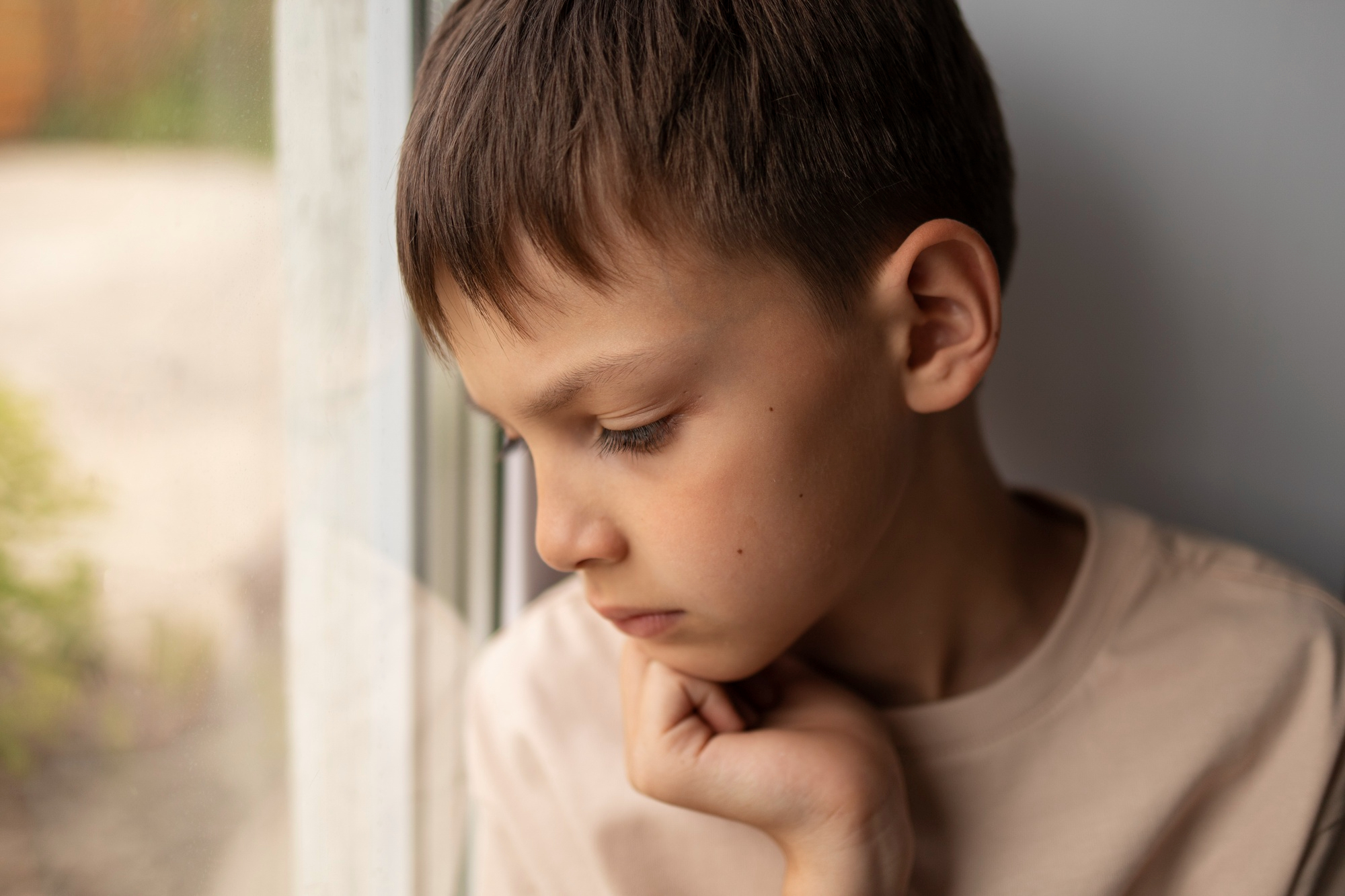
The Stroller
My husband Greg and I have a six-year-old son named Leo, and if you have ever spent any real time around him, you already know the two most important things about him. The first is that he feels everything all the way down. There is no shallow end with Leo. When he loves something, he loves it completely, with his whole small body. And the second thing is that once something catches his attention, once it settles into that busy, tender heart of his, it does not let go.
He has always been like this. As a toddler it was a particular blue dump truck that had to come everywhere, to the dinner table and the bathtub and eventually, when it finally fell apart, into a shoebox we kept because he couldn’t bear to throw it away. Then it was dinosaurs, a phase so total that he learned to pronounce words I still can’t spell. Then it was the moon, and for months every clear night ended with the two of us in the backyard while he asked me questions about craters that I answered badly and made up the rest.
Greg used to worry about it a little, the intensity. He’d say things like, he gets so attached, is that normal, and I’d tell him it was more than normal, it was a gift, that most people spend their whole adult lives trying to get back a fraction of the wholehearted way a six-year-old can love a dump truck. Greg would nod, not fully convinced, because Greg loves our son but Greg also grew up in a house where boys were taught early and often what boys were and were not supposed to feel, and some lessons go deep and take a long time to unlearn, if they ever fully do.
I’m telling you all of this because you need to understand who Leo is before I tell you what happened at the park. Because what happened at the park was, on the surface, a small thing. A two-dollar toy and some unkind words from a couple of first graders. The kind of thing that happens on playgrounds every day and gets forgotten by dinner.
But it did not get forgotten. It changed something in our family. It changed something in Greg that I had been quietly hoping would change for the entire eleven years I’d known him, and it did it in the space of about thirty seconds, and it was our six-year-old who did it, without any idea that he was doing anything at all.
It started at a yard sale.
Last weekend was one of those bright, cool Saturday mornings in early fall where the whole neighborhood seems to come outside at once. Half the street had signs stuck in their yards and folding tables set up in their driveways covered in the ordinary sediment of family life, the outgrown and the unwanted, the bread machines and the puzzles missing pieces and the baby clothes nobody needed anymore. We do this most weekends when the weather’s good, the three of us, walking the neighborhood, not really shopping for anything, just being together and seeing what there is to see.
Leo, of course, wanted to stop at every single table. He examined everything with the grave attention of a museum curator. And then, at a house about four blocks from ours, he went very still, the way he does when something has caught him, and I followed his gaze, and there it was.
A small toy stroller. The kind sized for a child to push. It was a little sun-faded, the fabric worn soft, clearly some other kid’s outgrown treasure. And sitting up in it, strapped in with a little cloth belt, was a baby doll. Not a fancy one. A plain, soft-bodied baby with a molded plastic face and a stitched-on expression of mild surprise, wearing a onesie that had gone gray with washing.
Leo walked over to it slowly, almost reverently, and he crouched down in front of the stroller and looked at the baby, and the baby looked back at him with its surprised little face, and I watched my son fall completely, instantly, and irrevocably in love.
“Mom,” he said, without looking away from the doll. “Can I have this. Please. Can I have this.”
Greg had come up beside me. I felt him hesitate. I knew what the hesitation was, and I want to be fair to him here, because in the moment it didn’t come out as anything cruel. It came out as practical.
“Bud, you’ve got a whole room full of toys at home,” Greg said. “You’ve got that castle you haven’t touched in a month. What do you need another one for?”
It was a reasonable thing to say. It was also not, I understood even then, entirely the whole of what Greg was feeling. Because I saw his eyes go to the doll, to the baby specifically, and I saw a flicker of something more complicated pass over his face, something he probably wasn’t even fully aware of. A little clench. A little unease. His son, crouched in adoration in front of a baby doll in a pink-trimmed stroller.
Greg didn’t say any of that. He just said the thing about the castle. But I’ve been married to him for nine years and I can read the things he doesn’t say as well as the things he does.
I looked at the price tag. It was written in marker on a little circle of masking tape stuck to the stroller’s handle. Two dollars.
“It’s two dollars, Greg,” I said.
He shrugged, a small surrender. “It’s your call.”
I paid the woman running the sale two crumpled dollar bills, and Leo stood up holding the stroller handle like he’d been handed the keys to a car, and his face was so purely, incandescently happy that even Greg smiled, whatever the flicker had been getting buried for the moment under the simple pleasure of watching your kid be that delighted.
“Thank you thank you thank you,” Leo said, and then, immediately, to the doll, in a completely different voice, softer, a voice I had never heard him use before, “It’s okay, baby. You’re coming home with us now. I’ve got you.”
And something in my chest went warm and strange, because that voice, that gentle, competent, reassuring voice, was my voice. It was the voice I used with Leo when he was scared or hurt. He had learned it from me, absorbed it over six years of being held and soothed, and now here it was coming back out of him, aimed at a two-dollar doll with a surprised face, and I thought, not for the first time, that children are just echoes of how they’ve been treated, and that we had, apparently, done at least one thing right.
From that moment, the stroller went everywhere.
I mean everywhere. Leo pushed it up and down the hallway of our house until Greg begged for mercy about the squeaky wheel and got out the WD-40. He pushed it down the driveway and around the block, narrating a running commentary to the baby about everything they passed. He took it to the grocery store, where he pushed it alongside our cart and got a mix of reactions from other shoppers, some of them charmed, a couple of them giving the little furrowed look that people give when a boy is doing a thing they’ve decided is a girl thing, and Leo, gloriously, obliviously, did not notice a single one of them.
He named the baby. He named it, after long and serious deliberation, “Baby.” Just Baby. He fed Baby invisible bottles. He put Baby down for naps and shushed us when we got too loud. He worried, out loud, about whether Baby was warm enough, and one cold morning he insisted on wrapping Baby in one of his own old receiving blankets that I’d kept in a drawer, and when I got that blanket out and handed it to him, I had to turn around and blink hard at the kitchen window for a second, because it was the blanket we’d brought him home from the hospital in, and now he was tucking it around his own baby with those same small hands that had once been small enough to be swallowed by it.
Greg watched all of this with a patience that I could tell cost him something. He didn’t forbid it. He wasn’t a bad father, isn’t a bad father, and he loved seeing Leo happy. But I caught the flickers. I caught them when Leo did the mommy voice. I caught them at the grocery store when a man about Greg’s age glanced at Leo pushing the stroller and then glanced at Greg with a little smirk of male solidarity, an invitation to be embarrassed together, and I watched Greg’s jaw tighten, and I watched him not smirk back, but I also watched him not quite meet the man’s eyes either, caught between two loyalties.
That night, after Leo was in bed with Baby tucked in beside him, Greg brought it up. Carefully. He’s not a confrontational man.
“I’m not saying take it away,” he said. We were doing the dishes, him washing, me drying, the way we do. “I just wonder if we should, I don’t know. Steer him toward other stuff a little. Get him back into the soccer thing. He liked soccer.”
“He liked soccer for about a week in the spring,” I said.
“You know what I mean.” He scrubbed at a pot. “I just don’t want him to get, I don’t want the other kids to be hard on him. That’s all. Kids are brutal. You know how they are. I don’t want him walking into that class pushing a baby doll and having those little animals tear him apart. I’m trying to protect him.”
And the thing is, I believed that Greg believed that. I think a lot of the flickers really were, at bottom, a father’s fear for his son, the knowledge of how cruel the world can be to a boy who colors outside the assigned lines, and a desperate wish to spare him that cruelty by keeping him inside the lines in the first place. It comes from love. It’s just love wearing the wrong clothes. Because keeping a child inside the lines to protect him from the people who enforce the lines is a way of doing the enforcers’ work for them, and I said something like that to Greg, gently, and he sighed the sigh of a man who half-agreed and half-didn’t and didn’t want to fight about it at nine o’clock on a Saturday.
“I just don’t want him to get hurt,” he said again.
“I know,” I said. “But you can’t love the tenderness out of him, Greg. And you shouldn’t want to. It’s the best thing about him.”
He didn’t answer. He handed me the last pot, and we finished the dishes in silence, and I thought that was where it would sit, unresolved, the way most of these things do, quietly negotiated over years rather than settled in a single kitchen conversation.
And then, the very next afternoon, we walked to the park.
It was a warm Sunday. The park is about six blocks from our house, a nice one, with good equipment and a big open grassy field where the neighborhood kids play. Leo brought the stroller, naturally. He pushed Baby the whole six blocks, and he pushed Baby up the little path into the park, and I carried a bag with waters and snacks and settled onto a bench near the field while Greg went to push Leo on the swings.
There were already some kids there. A cluster of boys, four or five of them, out on the grass kicking a soccer ball around, and I recognized a couple of them from Leo’s kindergarten class last year, boys who were now, like Leo, in first grade. There was a boy named Mason who I knew a little, and a boy named Cole, and a couple of others.
Leo, being Leo, wanted to say hi. After a few minutes on the swings, he hopped off, took hold of the stroller handle, and pushed Baby across the grass toward the boys with the ball, delighted, wanting to be included, having absolutely no premonition of what was about to happen.
I saw it developing before he did. I’ve been on this earth thirty-eight years and I know exactly what a cluster of six-year-old boys does when a peer approaches doing something they’ve been taught is forbidden. I set down my water bottle and I stood up.
The boys saw the stroller. And they stopped playing. The ball rolled away, ignored. All of them turned to look at Leo pushing his baby across the grass, and I watched a couple of them exchange the glance, the one that means they’d found something, and my stomach dropped.
Mason was the first. “Why are you pushing a baby around?” he called out, loud, his voice pitched to carry, pitched for an audience. “That’s for girls!”
A couple of the others laughed. Cole, emboldened, went further. “Yeah, are you a mommy now?” he said, and cackled at his own wit, and the little pack of them laughed harder, that ugly rising laughter that groups of kids get when they’ve picked a target and the cruelty is feeding on itself.
I was already moving. I was off the bench and walking fast across the grass, my whole body flooding with that specific rage a mother feels when someone hurts her child, ready to sweep in, ready to gather Leo up and shield him and say something withering to a pack of first graders which is not, I recognize, a proportionate response, but which I was absolutely prepared to do.
I expected Leo to crumple. That’s the truth. I braced for it. I expected his face to fall, expected the tears, expected him to let go of the stroller and come running to me, humiliated, and I was ready to catch him. Across the field I saw Greg turning from the swings, saw him register what was happening, saw his face go tight with the exact fear he’d talked about in the kitchen the night before, the fear that had made him want to steer Leo away from all of this. This was the thing he’d dreaded, happening in real time, and I could see him bracing for his son to be torn apart.
But Leo did not crumple.
Leo stopped pushing the stroller. He stood up a little straighter. And he looked at those boys, all of them, with an expression I can only describe as serious. Not hurt. Not scared. Serious. The way you look at someone who has said something that isn’t just mean but is actually, factually incorrect, and needs to be gently set right.
I stopped. Halfway across the grass, I stopped, because something in his face told me to wait.
Leo pointed at the baby in the stroller. And in a calm, clear, carrying voice, a voice with no wobble in it at all, he said:
“My dad takes care of me. Is your dad a girl?”
Silence.
The boys just looked at him.
Leo wasn’t finished. He pointed at Baby again, patient, explaining, as though the answer were the most obvious thing in the world and he couldn’t quite understand how they’d missed it.
“Taking care of a baby isn’t for girls. It’s for people who love the baby. My dad takes care of me because he loves me. I take care of Baby because I love him. That’s not a girl thing. That’s a dad thing too.”
I could not move. I could not speak. I stood there in the middle of the grass with my hand half-raised, completely, utterly speechless.
Because my six-year-old had just done something that I, at thirty-eight, with all my words and all my convictions, so often fumble. He had heard a lie dressed up as an insult, and instead of getting defensive, instead of getting hurt, instead of firing an insult back, he had simply, calmly, disassembled it. He had taken the whole rotten premise, that caring for a baby is a female thing and therefore shameful for a boy, and he had held it up to the light and pointed out the obvious flaw in it, which is that his own father cared for him, and his father was not a girl, and therefore the premise was nonsense, and therefore there was nothing to be ashamed of.
He hadn’t learned that from a book. He hadn’t learned it from a lesson. He had learned it from the plain evidence of his own life, from a father who did, in fact, take care of him, and a mother who told him that tenderness was the best thing about him, and he had reasoned his way from that evidence to a conclusion so clear and so correct that a pack of jeering first graders simply had no answer for it.
Mason opened his mouth. Closed it. One of the other boys said, uncertainly, “My dad makes me breakfast sometimes,” as though testing the idea out loud, and another one said, “yeah, my dad does bath time,” and just like that the whole cruel energy of the group evaporated, deflated, because Leo hadn’t fought them, he’d just quietly removed the thing they were standing on.
Cole, the mommy-now kid, looked at the stroller with new eyes and said, in the total tonal reversal that only six-year-olds can pull off, “Can I see the baby?”
And Leo, who does not hold grudges, who had already completely moved on, beamed and said, “His name is Baby. You can push him if you want but you have to be careful because he’s little.”
And that was it. That was the whole thing. Within about ninety seconds, the boys who had been laughing at my son were taking turns pushing the stroller across the grass, being careful because Baby was little, and Leo was directing the operation with great authority, and the soccer ball lay forgotten in the grass, and I stood there in the middle of the field with tears running down my face for reasons I could not have fully explained to anyone.
But the person I was really watching, in the end, was not Leo.
It was Greg.
Greg had come across the field from the swings, and he had heard it. He’d heard all of it. He was standing a few feet away from me, and he was staring at our son, and his face, my husband’s face, was doing something I had never seen it do before.
My dad takes care of me. Is your dad a girl?
Leo had built his entire beautiful argument on Greg. On the fact of Greg. On the plain, lived, undeniable evidence that his father took care of him out of love, and that this caretaking was not shameful, was not feminine, was not anything to hide, was simply what a person who loves a smaller person does. Leo had reached for the strongest example he had of love expressed through care, and the example he’d reached for was his dad.
And Greg, who had spent the previous night at the kitchen sink worrying that Leo’s tenderness would get him hurt, who had spent I don’t know how many years of his own childhood being taught that boys don’t do certain things and boys don’t feel certain ways and a real man keeps a certain distance, Greg was standing in the middle of a park watching his six-year-old son publicly, joyfully, fearlessly dismantle that entire inheritance, and cite Greg himself as the proof.
I watched it land on him. I watched something in my husband’s face just, break open. Not break down. Break open. Like a window that’s been painted shut for years finally coming free.
He didn’t say anything right away. He walked over to where the boys were, and he crouched down next to Leo, and he looked at the baby doll in the stroller, and then he looked at his son, and he said, in a slightly rough voice, “You did good, bud. That was exactly right, what you said. Every word of it.”
Leo, oblivious to the magnitude of the moment, was busy adjusting the receiving blanket. “Baby got cold,” he explained.
“Well,” Greg said. “Better tuck him in good, then.”
And my husband, Greg, who two nights before had wanted to steer his son back toward soccer to keep him safe, reached out and helped tuck the blanket around a two-dollar doll named Baby, his big hands surprisingly gentle, and Leo nodded approval at the job, and the other boys watched Leo’s dad, a grown man, carefully tuck in a baby doll, and not one of them laughed, because Leo had already made it un-laughable, had already, in ninety seconds on a grass field, changed the local weather about what dads were allowed to do.
We walked home a while later. The boys had exchanged the promise of another park meetup. Leo pushed Baby the whole six blocks, narrating the walk to the doll, and Greg and I trailed behind, and for a couple of blocks neither of us spoke.
Then Greg said, quietly, “Where did he even learn to think like that.”
“From us,” I said. “From you, mostly, apparently.”
Greg was quiet again. Then he said, and his voice was not quite steady, “My dad never once made me breakfast. Never gave me a bath. Never pushed me on a swing that I can remember. He worked, and he came home, and he sat in his chair, and that was being a dad, that was the whole job as he understood it. And I used to tell myself I was different, that I was a hands-on father, I make the breakfasts, I do the bath time, I’m nothing like him.” He watched Leo up ahead. “But I stood at that sink last night and I wanted to take a baby doll away from my little boy because I was afraid of what other people would think. Because some part of me still thinks caring is the girl part and providing is the man part, even though I know it’s garbage, even though I hate that it’s in there. And Leo just, he doesn’t have that in him at all. It never got put in him. He just loves things and takes care of things and it doesn’t occur to him that there’s anything to be ashamed of, because there isn’t, and it took a six-year-old to say it out loud to make me actually hear it.”
I took his hand. Up ahead, Leo told Baby they were almost home.
“You can keep unlearning it,” I said. “That’s the whole point. You’re not your dad. The fact that it’s in there and you hate it, that’s the difference. Your dad never hated it. He just passed it on. You’re breaking it. You broke it a little more today, right there at the park, tucking in that blanket in front of those kids. Leo won’t remember that consciously. But he’ll have it. The picture of his dad doing that. It’ll be in him, the way you make the breakfasts is in him. That’s how it goes. We just keep handing down slightly better versions of ourselves and hoping it adds up.”
Greg squeezed my hand. He didn’t say anything else. He didn’t need to.
That was a few weeks ago now. The stroller is still going strong, though Baby has been joined by a second doll that Leo negotiated for at a different yard sale, so now it’s a whole operation, two babies, elaborate logistics, a lot of tucking in. The squeaky wheel came back and Greg fixed it again without complaint. When they play together now, and they play together more than they used to, it’s often Greg on the floor being assigned a baby to hold while Leo runs the show, and Greg holds the baby, and it doesn’t cost him anything anymore, or if it does, it costs him less every time.
Last weekend at the grocery store, a man about Greg’s age glanced at Leo pushing his stroller of babies and gave Greg the little smirk, the invitation to be embarrassed together, man to man.
And Greg looked right at him, and instead of not-quite-meeting his eyes the way he used to, he smiled, a real smile, and said, “He’s a great little dad, isn’t he,” and put his hand on Leo’s head, and the man didn’t know what to do with that at all, and Greg didn’t care, and we pushed our cart and our stroller down the cereal aisle together, all four of us if you count the babies, which in our house you do.
I think about that moment at the park all the time. The moment I stopped halfway across the grass, expecting to have to rescue my son, and realized he didn’t need rescuing. That he had, in fact, come equipped with something I hadn’t given him on purpose and couldn’t have taught him if I’d tried, some clear uncomplicated knowledge that love is love and care is care and none of it belongs to one kind of person, and that anyone who says otherwise is simply, factually, wrong, and can be gently corrected and then invited to push the stroller.
People ask me sometimes, when I tell this story, what the lesson is. And I never quite know how to answer, because I don’t think Leo was teaching a lesson. Leo was just being Leo, all the way down, the way he loves everything all the way down. He wasn’t making a point about gender. He was defending his baby and telling the truth about his dad. The lesson was something the rest of us took from it, something Greg took from it standing in that field, something I’m still taking from it now.
I expected his friends’ laughter to break my son. Instead my son’s answer broke something open in his father that had been painted shut for forty years. And he did it without knowing, without trying, with a two-dollar doll named Baby and one clear question that nobody in that whole park could answer.
Is your dad a girl?
No. His dad is a man who takes care of him because he loves him. Just like Leo takes care of Baby. Just like, it turns out, we’re all capable of taking care of each other, if nobody manages to talk us out of it first.
And nobody’s going to talk Leo out of it. I’m sure of that now. I watched him at the park, calm and certain and kind, and I understood that whatever we did or didn’t do right as parents, we somehow raised a boy who knows the thing it takes most people a lifetime to learn, if they learn it at all.
He’s got it. He’s had it the whole time.
I’ve got you, he told that doll at the yard sale, in my own voice handed back to me. I’ve got you.
He does. And watching him, I think maybe the rest of us are going to be okay too.

Specialty: Emotional Turning Points
Rachel Monroe writes character-driven stories about betrayal, second chances, and unexpected resilience. Her work highlights the emotional side of family conflict — the silences, the misunderstandings, and the moments when someone quietly decides they’ve had enough.