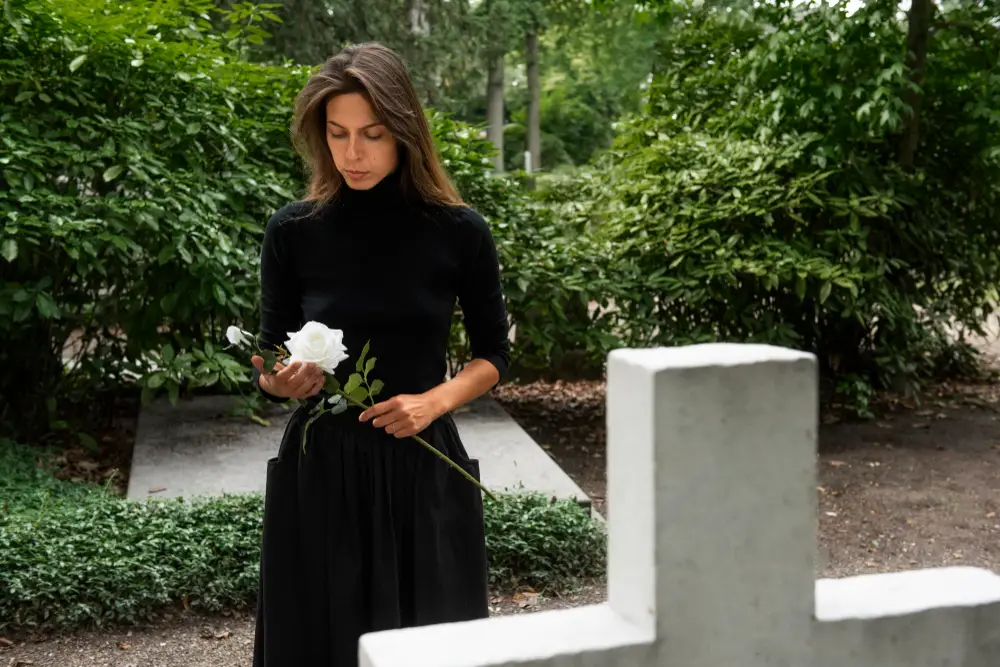
My mother died on a Tuesday in March, which is the kind of detail that lodges itself in your memory not because Tuesday has any particular significance but because the ordinary weekday quality of it made the whole thing feel surreal. People die on Tuesdays. Of course they do. The world does not pause for grief, does not arrange itself around the magnitude of what’s been lost. The garbage trucks still came that morning. My neighbor’s dog still barked at the mail carrier. The day kept moving the way days do, indifferent and relentless, and by the time the hospital called I had already been awake for two hours drinking coffee and reading the news, and the news was about things that seemed important until they suddenly weren’t.
She had been sick for fourteen months. Ovarian cancer, diagnosed late the way it so often is, in the stage where the options narrow and the conversations with doctors shift from treatment to management to a different kind of honesty that nobody in a white coat enjoys delivering. We had known, in the abstract way you know things you are not yet willing to fully hold, that we were working toward this outcome. And then the outcome arrived on a Tuesday in March and the knowing turned out to have prepared me for nothing at all.
My father had died six years before her.
Heart attack, sudden, the kind that gives no warning and asks for no permission. He was sixty-one and healthy by every measure his annual physical had recorded and then one evening he was gone, and my mother and I had spent six years learning how to be a family of two after spending our whole lives as three.
I was an only child. My parents had wanted more children, had tried for more, and the trying had not resulted in more, and eventually they had redirected that energy into the single child they had, which meant that I grew up in a house where I was the entire focus of two people’s considerable love and attention, which is both a gift and a pressure I am still working out how to carry.
After my father died, my mother and I spoke every Sunday. After she was diagnosed, I drove the two hours to her house every weekend, and then every few days, and then near the end I was staying there most of the week and driving back to the city on Wednesdays to handle what could not be handled remotely and returning Thursday evenings. I slept in my childhood bedroom and helped her to the bathroom in the night and made soup she couldn’t finish and sat beside her watching the television programs she liked, the British mystery series and the nature documentaries and the old films she had seen twenty times and still found surprising.
She died on a Tuesday in March and I arranged the funeral and handled the paperwork and called the people who needed to be called and thanked everyone who came and said all the appropriate things in the appropriate order, and then about three weeks later I sat down on my kitchen floor and cried for an hour and a half without interruption, which was the first time I had fully stopped moving since the hospital called.
I started visiting the cemetery every two weeks after that.
It was not something I had planned or decided. It was something I began doing the way you begin doing things that serve a need you haven’t yet articulated to yourself. I would bring flowers, two bunches, one for each grave, and I would spend some time with each of them, and then I would drive home and feel, not better exactly, but less untethered than I had felt before I went.
The cemetery was a forty-minute drive from my apartment. A large, well-maintained place on the eastern edge of the county, with old oaks along the main path and newer sections that opened into more open ground. My parents were buried in the older section, on a slight rise, their stones side by side the way they had always been side by side in everything.
I had been doing this for about four months when I noticed the flowers were disappearing.
The first time I assumed an explanation that didn’t require anyone’s involvement.
Wind, maybe. Or the groundskeeping staff removing them as part of routine maintenance. Some cemeteries had policies about floral arrangements that I wasn’t aware of. I put fresh flowers on both graves and didn’t think about it again until the next visit, when my father’s arrangement was exactly where I had left it, slightly wilted but present, and my mother’s was gone.
Every trace of it. No loose petals, no stems. Gone as completely as if I had never placed them.
I told myself it was coincidence. That the timing was random, that the two graves simply happened to have different groundskeeping schedules, that I was looking for patterns because grief inclines you toward pattern-finding, toward the imposition of meaning on things that are simply things.
This is a reasonable explanation and I held onto it for approximately three more visits.
By the fourth visit with the same result, my father’s flowers wilting steadily in place and my mother’s vanishing between weeks, I had stopped believing it was coincidence.
By the sixth, I was certain someone was removing them deliberately.
The certainty produced a feeling I hadn’t expected, which was not quite anger and not quite grief but something between them. A kind of violation. My mother’s grave was the one place where I felt I could still do something for her, could still perform the small act of bringing her flowers the way she had always loved flowers in life, and someone was undoing that act, removing the evidence of it, and I didn’t understand why and the not understanding made it worse.
I told my friend Daniel about it over dinner one evening.
He suggested I contact the cemetery’s administration office and ask about their policy.
I had already done this. The woman I spoke with was polite and thorough and told me that their groundskeeping staff removed floral arrangements only when they had become visibly decomposed, that fresh flowers would not be disturbed, and that if I had concerns I could speak with the superintendent.
I spoke with the superintendent. He was equally polite and equally unhelpful, not from unwillingness but from genuine ignorance. He had no explanation. He suggested it might be wildlife, though the wildlife explanation seemed improbable given the complete absence of any evidence of animal activity.
“Then go earlier,” Daniel said. “Go before whoever it is gets there.”
So I did.
I set my alarm for five-fifteen on a Saturday morning in late October.
I drove to the cemetery in the grey pre-dawn dark, arriving before the main gates were fully open, and walked the familiar path to the older section in the cool morning air. The cemetery was quiet in a way it wasn’t later in the day, a different quality of quiet from ordinary silence, the specific stillness of a place that has been given over to a particular kind of attention.
I came around the curve in the path where the oak trees thickened and the older stones became visible, and I stopped.
A woman was standing at my mother’s grave.
Her back was to me. She was wearing a dark coat, her hair pulled back, and she was standing with the posture of someone who has stood in this spot before and knows how to be in it.
For one moment I thought she had come to grieve, that she was someone I didn’t know who had loved my mother, a former colleague or neighbor or friend from a chapter of my mother’s life I hadn’t been present for.
Then she bent down, lifted the flowers I had left the previous week, and dropped them into the waste bin beside the path without hesitation or ceremony. A clean, practiced motion. The motion of someone who has done this before and intends to do it again.
The anger arrived before the thought did.
“Excuse me.” My voice came out louder than I intended. “What are you doing?”
She turned.
She was older than I had expected from the way she stood, somewhere in her late sixties, with a face that had a quality I can only describe as having been through things and arrived on the other side of them. She looked at me without the startled guilt I had expected to see.
She looked at me the way someone looks when they have been waiting for a conversation to begin.
“I’m sorry,” she said. “I’ve been wondering when you’d come.”
Her name was Patricia.
She had been coming to my mother’s grave every week for three years.
She told me this standing beside the headstone on a cold October morning, with the discarded flowers in the waste bin and my hands not entirely steady, and she told it to me in the direct, unhurried way of someone who has spent a long time deciding how to say something and has finally been given the occasion to say it.
Three years. She had been visiting my mother’s grave since shortly after my father died.
“I don’t understand,” I said. “Did you know her?”
“In a manner of speaking,” Patricia said.
She looked at the headstone. My mother’s name, her dates, the phrase we had chosen: Beloved always.
“I knew her the way a person knows someone they’ve watched from a distance for a long time,” Patricia said. “Someone they owe something to.”
“You owe my mother something.”
“Yes.”
“What?”
She was quiet for a moment.
“May I show you something? There’s a bench near the chapel. I’d rather not stand while I explain.”
We sat on the stone bench near the chapel with the morning light coming slowly up over the tree line and the cemetery quiet around us, and Patricia told me a story that rearranged everything I thought I knew about my parents.
She had known my father.
Not casually. Not professionally. She had known my father the way you know someone when you are both young and certain that what you feel is the most important thing that has ever happened to anyone.
They had met when my father was twenty-four and she was twenty-three, in the city, at a time before he had met my mother. They had been together for almost two years. She had believed, she said with the matter-of-fact steadiness of someone recounting ancient history, that they would get married.
Then my father had gone home for Christmas to the town he’d grown up in and had met my mother at a party his sister organized, and three months later he had ended things with Patricia in a letter that she still had somewhere in a box, and eight months after that he had married my mother.
“I was not graceful about it,” Patricia said. “I want you to know that. I was young and I was hurt and I was not graceful.”
“What does that mean?”
“It means I said things I shouldn’t have said. Did things I shouldn’t have done.” She looked at her hands. “I contacted your mother. More than once. I told her things about my relationship with your father that were designed to cause harm. I told myself I was being honest, but I was being cruel. There’s a difference and I knew it even then.”
I was very still on the bench.
“Did my mother know? About you and my father, before that?”
“She knew he’d had a relationship before her. Whether he told her the details I don’t know. What I do know is that I went out of my way to make sure she understood the depth of what we had been to each other, in a way that was intended to wound her.” Patricia paused. “I succeeded.”
“You’re telling me you tried to destroy my parents’ marriage.”
“I tried to create doubt in your mother’s mind about the man she had just married. Whether I came close to destroying anything I can’t say. Your parents stayed together. Clearly they managed to move past it.”
“Did they?” I asked. Because I didn’t know. I had been born two years after my parents married, and nothing in my childhood had suggested damage, but children are not always reliable witnesses to the interior lives of their parents.
“I believe so,” Patricia said. “I watched from the outside for a while. The way you do when you’re young and haven’t learned to stop. Then eventually I stopped, and I built my own life, and I told myself the chapter was closed.”
She was quiet for a moment.
“But the chapter wasn’t closed,” she said. “It just went quiet.”
Patricia had been married herself, for thirty-one years, to a man named Gerald who had died four years ago.
She had children, two sons and a daughter, who were grown and scattered across the country. She had worked as a librarian for most of her career, had retired eight years earlier, had a house in a neighborhood twenty minutes from the cemetery that she had lived in for more than two decades.
She described this life to me not as a defense but as context, the way you provide context when you want someone to understand that you are a full person and not only the worst thing you once did.
Gerald’s death had done something to her.
“When someone dies,” she said, “and you have loved them for a long time, you find yourself doing a kind of accounting. Looking back over everything. And the things that don’t add up become harder to ignore.”
Gerald had known about my father, had known about what she’d done to my mother. He was the person she had told, years later, in the way you eventually tell the person you trust most the things you are least proud of. He had listened and had not judged and had said, simply, that she should find a way to make it right.
She had not known how.
“I thought about writing to your mother,” Patricia said. “But I didn’t know if she was even still alive, and I didn’t know what I would say, and part of me was afraid that reopening it would cause more harm than leaving it alone.”
Then Gerald died, and she found herself in the particular state of grief that examines everything, and she started thinking about it again, and she looked up my mother’s name.
And found the obituary.
For my father, not my mother. He had died three months earlier.
“I went to the funeral home’s webpage,” Patricia said. “There was a notice. And a photograph of him.”
She stopped.
“I had not seen his face in over forty years,” she said quietly. “I had carried a young man’s face in my memory and had not thought about what time would do to it.”
She had not attended the funeral. She had not felt she had the right.
But she had found the cemetery, found the graves, and had started coming.
Not to grieve my father exactly. Or not only that.
“I came because of your mother,” she said. “Because the debt I owed was to her. Because I had come between her and her husband in the earliest days of their marriage, had tried to introduce doubt into something that deserved to be left in peace, and I had never made that right, and by the time I understood I needed to she was gone.”
“So you removed the flowers,” I said.
“Yes.”
“Why?”
Patricia looked at me steadily.
“Because I was bringing her flowers,” she said. “My own. Every week. And I didn’t want mine to be beside yours without you knowing why I was here. It felt dishonest. Like I was pretending to be something I wasn’t, someone who had a right to grieve beside your family.”
I sat with this.
“So you removed mine.”
“I know,” she said. “I know how that looks. I knew at the time it was wrong. But I couldn’t stop coming and I couldn’t leave my flowers beside yours without an explanation and I couldn’t find a way to give the explanation.” She paused. “Until now.”
“Until I came and caught you.”
“Yes.”
The morning light was fully up now, the October sun low and flat across the cemetery grounds. A bird was doing something persistent in the oak above us.
“You said you owe my mother something,” I said. “What did you think you were paying, by coming here?”
Patricia considered this for a long moment.
“I don’t think I can pay it,” she said finally. “I don’t think that’s how this works. I think I came because I needed to be honest somewhere, with someone, even if that someone couldn’t hear me anymore.” She looked toward my mother’s grave. “I talked to her. When I visited. I said what I should have said forty years ago, which is that I was sorry, that what I did was cowardly and cruel, that she deserved better than to have someone try to undermine her marriage out of injured pride.”
“Did it help?” I asked.
“No,” she said. “Not really. It helped me in the small way that saying true things out loud helps. But it didn’t fix anything. It’s too late to fix it.”
“Then why keep coming?”
She looked at me.
“Because showing up is all I have left to offer,” she said. “And because your mother deserved someone to show up, even late. Even when it doesn’t fix anything.”
I drove home without going back to the graves.
I sat in my car in the cemetery parking lot for a while first, with the engine off and the morning cold working its way through the windows, and I thought about what Patricia had told me and tried to figure out what I felt about it.
Anger was still present. The sight of those flowers going into the trash bin had produced something in me that didn’t dissolve quickly. The violation of it, the removal of what I had brought, the gesture that was supposed to be mine to make on my mother’s behalf, intercepted and discarded.
But underneath the anger was something harder to name.
My mother had been a practical woman, precise and unsentimental in her expressions of love, the kind of person who showed up rather than said things. She had opinions about everything and shared them without ceremony and was usually right and occasionally infuriatingly wrong. She had loved my father with the uncomplicated permanence of someone who had made a decision and did not revisit it.
I had believed I knew the outline of her life.
Now there was a detail I hadn’t known, a chapter from the first year of her marriage when a young woman named Patricia had written letters designed to cause doubt, and my mother had received those letters and had decided, apparently, to absorb them and move forward and never mention them to the child she raised in a house full of love.
She had not told me.
I didn’t know what to do with that.
I called Daniel on the drive home.
He listened to the whole thing without interrupting, which was one of his better qualities.
“Are you going to see her again?” he asked.
“I don’t know.”
“What do you want?”
I thought about this.
“I want to understand more,” I said. “What she did. What my mother knew. What my father was like before I existed.”
“You can’t get all of that from her.”
“I know. But she’s the only person left who was there.”
I called Patricia three days later.
She had given me her number before we left the cemetery, written on a small card she produced from her coat pocket with the preparedness of someone who had been carrying it in case this day arrived.
She answered on the second ring.
“I’d like to meet again,” I said. “Not at the cemetery. Somewhere we can talk properly.”
“Yes,” she said. “I hoped you’d call.”
We met at a coffee shop on a Wednesday afternoon, a quiet place in her neighborhood that she knew, and we sat across from each other with coffee between us and I asked her to tell me more about my father when he was young.
This was not what I had expected to ask her. I had arrived with questions about what she had done, wanting to understand the shape of the harm and why, wanting to be angry in a more informed way. But sitting across from her I found that what I actually wanted was something else.
My father had died when I was thirty-two. I had known him well, as adults know their parents, through the specific and partial lens of the parent-child relationship, which shows you certain things clearly and obscures others entirely. I had not known him at twenty-four. I had not known the person he was before he became someone’s husband and then someone’s father.
Patricia had known that person.
She talked for almost two hours.
He had been quieter than I would have expected, she said. Thoughtful in a way that occasionally made people think he was distant, but he wasn’t distant, he was listening. He had a specific kind of laugh, she said, and then she described it, and I recognized it completely, the laugh that started slowly and gathered into something genuine, the laugh I had grown up with.
He had been terrible at cooking and enthusiastic about it despite the evidence. He had read voraciously and remembered everything he read and had opinions about what he read that he was willing to defend at length. He had been, she said, one of the most honest people she had ever known.
“Is that hard?” I asked. “To say that, given what happened?”
“A little,” she said. “But it’s true. He was honest with me, at the end. The letter he sent was kind but it was clear, and he didn’t pretend to feel something he didn’t feel anymore. That’s one of the things I was most angry about. It’s easier to stay angry at someone who lies to you than at someone who tells you the truth cleanly.”
“What truth did he tell you?”
She looked at the table.
“That he had met someone who felt like home to him. That he hadn’t expected it. That he was sorry for the hurt it caused but he couldn’t pretend otherwise.”
She was quiet for a moment.
“Your mother felt like home to him,” she said. “He said it in a letter to me and I received it and I was furious at the phrase because it implied everything I was not.” She paused. “But it was honest. And all these years later it’s the part of the letter I keep returning to, because it was true, and I think your mother must have known it too.”
I started visiting Patricia occasionally after that.
Not often. Not as a regular arrangement. But sometimes, on a Sunday afternoon when the apartment felt too quiet and the weight of my parents’ absence was particular and specific, I would call her and we would have coffee, and she would tell me things about my father when he was young, and I would tell her things about my parents in the years she hadn’t been present for.
It was a strange arrangement and I was aware of its strangeness.
She had done something harmful to my mother. That remained true. She had been a young woman in pain who had weaponized her pain, and the weapon had landed, and the harm had been absorbed by a woman who had not deserved to absorb it. I was not going to rewrite that history into something it wasn’t.
But she was also the only person left who had known my father before he was my father, who carried memories of him that no one else carried, and those memories felt to me like something I didn’t want to lose simply because the person holding them had once behaved badly.
I told my therapist about it, because I had started seeing a therapist four months after my mother died, when it became clear that the floor-crying was becoming a pattern rather than a single event.
My therapist asked me what I was getting from the relationship.
I thought about it.
“I’m getting him back a little,” I said. “A version of him I never had access to.”
“And her?”
“I think she’s getting to make good on something she can’t otherwise make good on. She can’t apologize to my mother. My mother is gone. But she can know me, and knowing me is the closest she can get.”
“How do you feel about being a proxy for your mother’s absolution?”
“I’m not giving her absolution,” I said. “I’m having coffee with her on Sundays.”
“Is there a difference?”
I thought about this.
“I think there is,” I said. “Absolution would mean telling her it was okay. I’m not telling her it was okay. I’m just not requiring her to only be the worst thing she did.”
I went back to my mother’s grave alone on the following Saturday.
I brought two bunches of flowers as usual, one for each grave, and I placed them and stood there in the November cold and said the quiet things you say when there is no one to hear them and you say them anyway.
Then I told my mother about Patricia.
I don’t know why I did this exactly. She couldn’t hear me. The conversation was with myself as much as anything, a way of saying things out loud that needed to be said somewhere.
I told her that I had found out about the letters. That I understood something had happened in the first year of her marriage that she had absorbed and carried and never mentioned. That I wished she had told me, not because I would have done anything about it, but because I would have liked to know her more fully, to know the parts of her life she had decided to protect me from.
I told her that Patricia was old and sorry and coming to her grave every week was the only form of repair available to her, and that I thought my mother, who had been the most practically compassionate person I had ever known, would have found a way to understand that even if she couldn’t fully forgive it.
I told her I missed her in ways that surprised me daily, in the small specific ways that nobody warns you about, the reflex to call her when something funny happened, the pause before I remembered she wouldn’t answer.
I told her the flowers were staying this time.
I had spoken with Patricia about this.
“Come when you want to come,” I had told her. “But leave the flowers.”
She had agreed, after a moment, with the expression of someone who has been carrying something heavy and has just been told they can set it down, not that the weight goes away but that they are no longer required to carry it alone.
“And if I bring my own?” she had asked.
“Then we’ll both have brought flowers,” I said. “Which is what happens when more than one person loved someone.”
She had looked at me for a moment.
“You are very like your mother,” she said.
“You never knew my mother.”
“No,” she said. “But your father described her. And I’ve seen the way you love her, from a distance, for three years.” She paused. “She raised someone who can be angry and still be kind. That’s not nothing.”
I had not known how to answer that so I hadn’t.
The winter passed.
I visited the graves through November and December and into the new year, and sometimes when I arrived Patricia’s flowers were already there, a different bunch from mine, different color, smaller arrangement, and I would stand and look at both bunches together and feel something I still don’t have a clean word for.
Not forgiveness. Not reconciliation. Not the tidy resolution of a story that wraps into something comfortable.
Something more like: this is the full picture, including the parts that are hard, and I am choosing to see it rather than protect myself from it.
My mother had been a person with a history I hadn’t fully known. My father had been a young man before he was my father, with a life that preceded me and contained things I would never have access to. Patricia had been a young woman in pain who had done a harmful thing and spent forty years with the residue of it, and was now an old woman trying to show up somewhere because showing up was all that was left.
And I was someone who had come to a cemetery at five-fifteen in the morning to catch a flower thief and had instead found a piece of my parents’ history waiting beside a waste bin.
None of these people were only one thing.
That was the lesson I was still learning.
In February, Patricia’s daughter came to visit from out of state.
Patricia called me a few days before to mention it, in the way she now called to mention things, with the slightly tentative quality of someone who is still calibrating how much access they are permitted.
“She wants to understand why I come to the cemetery every week,” Patricia said. “I’ve never explained it to her properly.”
“Are you going to?”
“I think so. Yes.” A pause. “I’ll have to tell her about your father. About what I did.”
“How do you feel about that?”
“Frightened,” she said immediately. “She has a certain image of who I am. Most children do, I think. The version of their parent that doesn’t include the worst thing that parent has done.”
I thought about my mother, who had decided not to tell me about Patricia’s letters, who had carried that chapter silently for forty years, who had given me an image of her marriage that was whole and uncomplicated.
I thought about whether I was grateful for that protection or would have preferred to know.
I was still working out the answer.
“She’ll adjust her image,” I said. “If you tell her the whole truth and not just the version that makes you look better, she’ll adjust it.”
“You sound certain.”
“Children are more resilient about their parents’ histories than their parents usually think,” I said. “We spend so much time being protected from who you were before us that when we finally find out it’s usually a relief. You existed before we did. You made mistakes. You were a whole person, not just our parent.”
Patricia was quiet for a moment.
“I’ll tell her,” she said. “All of it.”
“Good.”
“Will you tell me how it goes? After?”
“Yes,” I said.
She called me the following Sunday evening.
The conversation with her daughter had been, she said, long and difficult and ultimately better than she had feared.
Her daughter had cried. Had asked questions Patricia hadn’t expected and hadn’t had good answers to. Had been angry for a while in a way that was uncomfortable to sit with.
And then had said, roughly and imperfectly, that she loved her mother and was glad she had finally said it out loud.
“She said it sounded lonely,” Patricia told me. “Carrying it for forty years.”
“Was it?”
“Yes,” Patricia said. “The things we don’t say to protect people end up being the loneliest things about us.”
I thought about my mother’s kitchen doorway, the height marks she had measured every year with a pencil and a ruler. The Sunday phone calls. The end-of-life conversations when we said what needed to be said while we still could.
The things we had said.
The things she had kept from me, to protect me, and which had been the loneliest part of her history even after she was gone.
“I want to bring her,” Patricia said. “My daughter. To the cemetery. I want her to know where I’ve been going.”
“Of course,” I said.
“Would that be all right? I know it’s your family’s—”
“It’s a cemetery,” I said. “It belongs to everyone who needs it.”
The following Saturday was cold but clear, the kind of February day that offers pale sun as compensation for its temperatures.
Patricia and her daughter, whose name was Ellen and who had her mother’s eyes and a warmer and more immediately readable face, met me at the cemetery gate.
We walked to the graves together, the three of us.
I placed my flowers. Patricia placed hers. Ellen stood slightly behind her mother with her hands in her coat pockets and looked at the two headstones and at the two bunches of flowers that now stood beside each other without apology.
“Which one is your mother?” Ellen asked me.
I pointed.
She stepped forward and looked at the headstone for a moment.
“She sounds like she was remarkable,” Ellen said. “From what my mother has told me.”
“She was,” I said. “She was difficult and opinionated and practical and very funny and she loved people without making a performance of it.” I paused. “I don’t think she ever stopped missing my dad. Even six years was not enough time to stop missing him.”
Ellen glanced at her mother.
Patricia was looking at my father’s headstone with the expression of someone encountering something they have a long and complicated history with.
“I’m sorry,” Patricia said. Not to me. To the headstone. To my father. “I’m sorry I made it harder than it needed to be.”
The cemetery was very quiet.
Then she looked at my mother’s headstone.
“And I’m sorry to you,” she said. “For the things I said that were intended to wound. You deserved none of it and you handled it with more grace than I deserved.”
Ellen put her arm around her mother’s shoulders.
I stood there on the cold February grass with the pale sun coming down through the bare oak branches and thought about how the story of any two people is always larger than either of them knows while they are living it, how the edges of a life extend into other lives in ways that only become visible later, often much later, sometimes only after everyone who was there has gone.
My mother had not known, in those first difficult months of her marriage, that the young woman writing painful letters to her would one day stand at her grave and apologize sincerely.
She had not known that the daughter she would eventually raise would be the one standing there to hear it.
She had not known any of this.
But she had stayed. She had absorbed what she was given and had built something lasting from it anyway. She had spent forty years in a marriage that her husband had described, in a letter to someone else, as feeling like home.
She had been home to him.
He had been home to her.
I had grown up inside that, warmed by it, shaped by it, and had not known its full history, which meant I had not known its full price, the things they had each paid to make it what it became.
Now I knew.
And the knowing did not make it less. It made it more.
It made it the story of two real people, imperfect and human and specific, who had chosen each other across the complications of other people’s pain and had kept choosing for forty years.
Which was, I thought, standing beside their graves on a cold February morning with a strange woman’s arm around her daughter’s shoulders, exactly what love actually looks like when you see the whole of it.
Not the simplified version.
The real one.
With all its history left in.
I still bring flowers every two weeks.
Patricia still comes every week. We have overlapped a handful of times since that first October morning, arriving at the same hour by coincidence or perhaps by something else, the unspoken coordination of people who have become accustomed to the same geography.
When we arrive together we walk to the graves together and stand for a while and then sometimes we go for coffee and sometimes we don’t, depending on what the day calls for.
Ellen visits when she comes to see her mother, which is more often now than it used to be.
My therapist says I have made an unconventional peace with a complicated situation.
I told her the situation was only complicated if you required it to resolve into something comfortable.
“What would you call what it’s resolved into?” she asked.
I thought about it.
“True,” I said.
She nodded.
“That’s usually the best you can get,” she said.
I think she was right.
My mother raised me to believe that showing up was the fundamental act, that presence was the beginning of everything else, that you could not love anyone properly from a safe distance.
She was right about that, as she was right about most things.
I showed up early one morning to a cemetery to catch a stranger removing flowers.
What I found instead was a piece of my parents’ life I hadn’t known existed, held in the memory of an old woman who had been carrying it for forty years and had not known what to do with it except return, week after week, to the place where the debt had been incurred.
We bring flowers now, both of us.
They stand beside each other without explanation.
My mother would have had opinions about this.
She had opinions about everything.
I like to think she would have found a way, eventually, to understand it.
She usually did.

Adrian Hawthorne is a celebrated author and dedicated archivist who finds inspiration in the hidden stories of the past. Educated at Oxford, he now works at the National Archives, where preserving history fuels his evocative writing. Balancing archival precision with creative storytelling, Adrian founded the Hawthorne Institute of Literary Arts to mentor emerging writers and honor the timeless art of narrative.