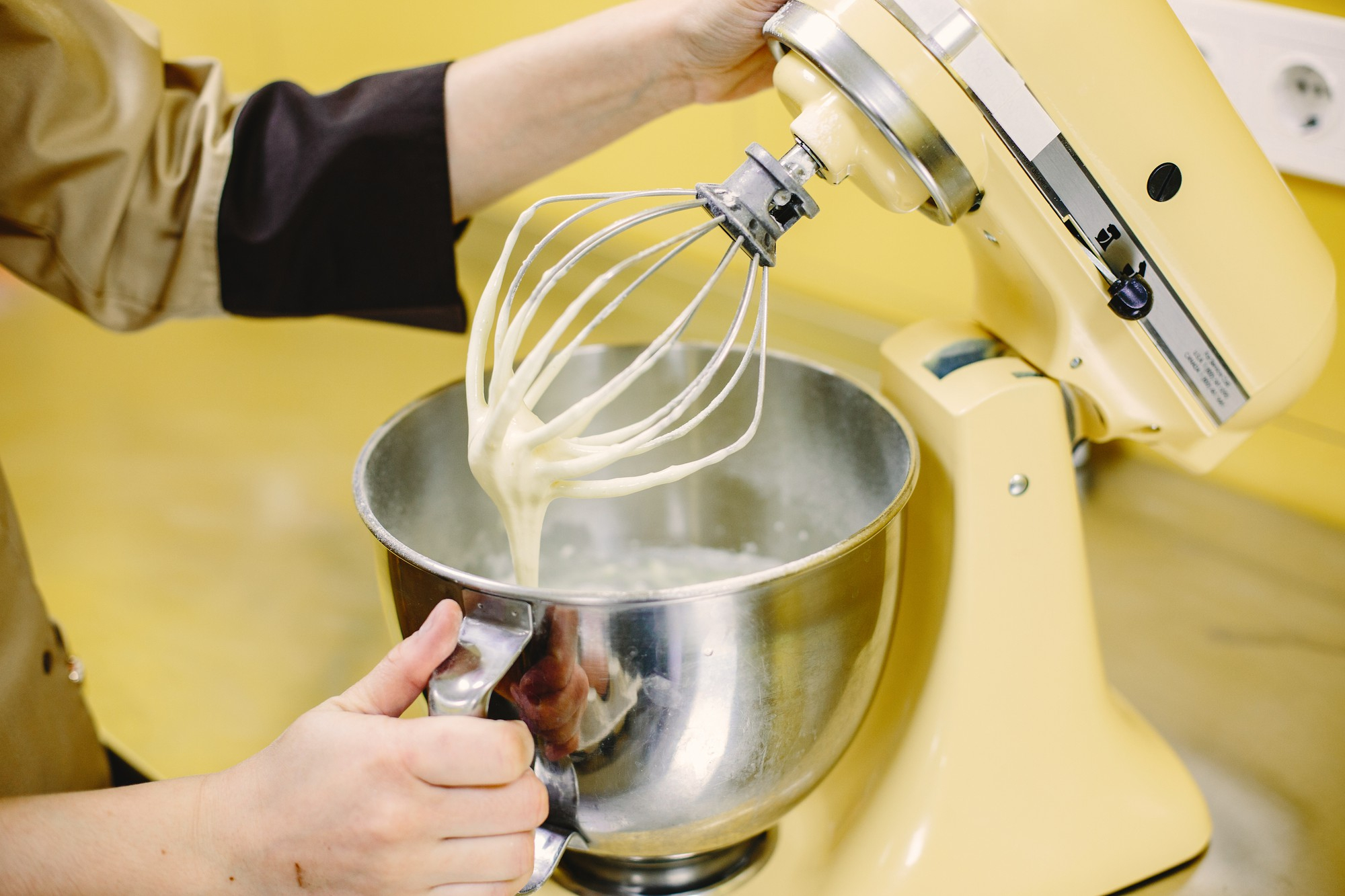
My mother was not a sentimental person.
She would tell you this herself, in the same direct way she told you most things, without apology and without the softening that some people offer before blunt truths. She kept no jewelry from her own mother, had given away her wedding china within two years of my father’s death because she said it had been his choice and she had never liked the pattern, and when my sister and I helped her downsize into the apartment in 2018, she gave away furniture and photographs and accumulated objects with the systematic efficiency of someone who understood that things were not people and that the distinction mattered.
The mixer she kept.
This requires some explanation because it runs against her general philosophy. She had bought it in 1989 with money she had saved from teaching summer school, which she had done every summer for six years specifically to build up the fund for the kitchen equipment she wanted. She had not wanted many things in her life, not in the material sense, but she had wanted a real stand mixer and a real set of cast iron pans and the cast iron she had acquired in the 1970s and the mixer she had waited for until she could pay cash.
She used it every Sunday.
I mean this literally. Every Sunday morning for the years I was growing up and the years after I left home and for as long as she was physically able to stand at the counter, which was longer than most people gave her credit for because she was stubborn about it in the specific way she was stubborn about most things, which was quietly and without announcement and past the point that other people would have stopped.
After she moved to the apartment she gave me the mixer.
She drove it over herself, which was unusual because she generally had things delivered, and she carried it inside and put it on my counter and stood back and looked at it.
“You bake,” she said.
“I do,” I said.
“It needs the ceramic bowl for bread,” she said. “I’ll mail you the catalog page.”
“I know about the attachments, Mom,” I said.
“The catalog page will have the part number,” she said.
She mailed me the page.
I use the mixer every week, or close to it. I make bread and I make pie crust and in the fall I make the apple cake that my mother made every autumn from a recipe she had clipped from a magazine in 1974 and that I have made from a photocopy of that clipping because I was not willing to use the original until the photocopy degraded beyond use. I make the things she made and some things she never made, and the mixer is present for all of it, the cream color and the weight of it and the particular sound of the motor that I have known for thirty-six years.
She died in March of last year.
I will not spend more time on this than is necessary for you to understand the context of everything that followed, which is that the mixer became, after March, something it had not been before March, in the way that objects become different things when the person associated with them is no longer alive. This is not mysticism. It is just the ordinary way that objects acquire meaning from the people who used them and that meaning intensifies rather than fades when the person is gone.
The mixer was the last thing of my mother’s that I still used.
My name is Carol. I live in a house in a suburb of Columbus in a neighborhood where the houses are close enough together to make borrowing natural and the people are varied enough in their sense of what borrowing entails that the naturalness is sometimes a problem. I have two daughters, one who lives with me and one who lives in Atlanta, and I work three days a week as a medical billing specialist from my home office, and I have been in this house for eleven years and I know my neighbors with the mixed knowledge that eleven years of proximity produces, the genuine warmth in some directions and the managed relationship in others.
Denise moved in four years ago.
I want to try to describe Denise accurately because she is the kind of person who is difficult to describe fairly, who exists in the gap between what she presents and what she does, and who has developed a talent for making the gap feel like your misunderstanding rather than her inconsistency.
She is friendly in the immediate sense. She waves. She asks after your health and your children. She has the particular social ease of someone who has learned to make a good first impression and who relies on that impression to sustain relationships longer than it technically should. She is attractive in a polished way that she maintains with clear effort, and she knows how to be charming in the specific moments that charm is useful.
What she is not is honest about what she takes.
The borrowing had started in spring of last year, three months after my mother died, which I note not because I believe the timing was calculated but because it was my most vulnerable period and perhaps my least attentive.
The ladder was first. She needed it to hang something in the guest room and brought it back two weeks later without explanation for the delay. The pressure washer came next, which returned without the soap attachment, which she said must have gotten left somewhere she couldn’t find it. Then she moved into the kitchen, which was a different kind of crossing.
The crock pot she borrowed in September and returned in November with a hairline crack in the interior ceramic that she did not mention, which I discovered when I used it for Thanksgiving and it was not the same as it had been. The steamer she returned dented. The cooler she returned without the drain plug. The good roasting pan she returned clean but with one handle loose in a way it had not been before, the screw stripped in some way that the dishwasher or the oven or something had produced.
Every item came back slightly worse.
Never with an acknowledgment.
Never with an offer to replace.
I had said things. Not confrontational things, because I am not a confrontational person by nature and because the size of each individual offense had always been small enough that the confrontation felt disproportionate. I had said the crock pot has a crack now and she had said these things just happen. I had said the cooler needs the drain plug and she had said I’ll look for it and never mentioned it again. I had said the roasting pan handle seems loose and she had looked at it briefly and said it seems fine to me.
She had the particular skill of the person who takes things from you without being accountable for the taking, the skill of deflection wrapped in friendliness, and I had been managing it imperfectly for six months when she asked for the mixer.
I said no.
I said the actual word, which I had not said to any previous request, and I said the reason, which was that it was my mother’s and I didn’t lend it.
She laughed.
Not unkindly, exactly, but dismissively, the laugh of someone who has heard an objection and has decided it is not serious. She said she would be careful. She said it was one cake. She was still standing there.
My daughter Sophie was on the porch steps.
I heard myself say fine.
This is the thing I have come to understand about that moment, which is that my no had been real but my fine was not courage, it was the specific capitulation of someone who has been managed many times and whose resistance has been worn down by the pattern. I said fine and I went inside and I spent Saturday morning being angry at myself, which was not productive but was where I was.
Saturday was when she returned it.
Not brought to the door. Not handed over with any acknowledgment of its presence or its condition. Left on the porch like a delivery, which I found when I went out to get the newspaper, sitting on the boards by the mat with the dried cream in the seam, yellow and cracking in the way of something that had been left for days without cleaning.
I stood on the porch with the mixer in my hands and I looked at it.
I brought it inside.
I plugged it in.
The motor made a sound.
I have known the sound of that motor for thirty-six years, from childhood Sunday mornings when it ran in the background of the particular domestic warmth of my mother’s kitchen, and the sound it made when I plugged it in on that Saturday morning was not the right sound. It was the sound of something straining, something damaged, the sound of a motor that had been overloaded or run wrong in some way that had changed it permanently.
I unplugged it.
I stood there with my hand on the switch.
Then I walked across the grass and knocked on her door.
I was not angry yet. I was in the state that precedes anger, the state of someone trying to find the benign explanation before the real one arrives. I thought she had been embarrassed. I thought she had left it on the porch because she couldn’t face me, which would have been cowardly but would have been a form of acknowledgment.
She opened the door holding her coffee with the ease of someone who does not expect to be confronted.
“Oh, yeah,” she said. She said it the way you say something that had been sitting at the back of your mind and has now been reminded into existence. “Honestly, you should buy a new one. That thing is ancient. It quit halfway through my cream and I had eleven people sitting in my dining room with no cake.”
She took a sip of her coffee.
“So thanks for that ruined night, I guess.”
I looked at her.
She was not embarrassed. She was not calculating. She was simply a person who had broken a piece of equipment she had borrowed without permission over my objection, left it uncleaned on the porch, and was now, in some register of her self-understanding, the victim of the situation.
I said something. I don’t remember exactly what. Something neutral. Something that ended the conversation without giving her what she wanted, which was either my apology or my capitulation. I walked back across the grass.
I went inside.
I sat at the kitchen table.
Sophie found me there ten minutes later and looked at my face and said what happened.
I told her.
She sat down.
“Okay,” she said. “What are you going to do?”
This is my daughter’s primary mode with me, the direct practical question, which she has always been better at than I have and which I have always appreciated.
“I’m not sure yet,” I said.
“But you’re going to do something,” she said.
“Yes,” I said.
She nodded.
“Good,” she said. “Tell me when you know.”
I spent Sunday thinking.
Not in the agitated way, pacing and planning, but in the settled way, the way I approach problems that require a correct solution rather than an emotional one. I thought about what had actually happened, which was a layered thing, and about what I wanted to accomplish, which was also a layered thing.
At the surface level, the mixer was broken and needed repair or replacement and the responsible party was Denise.
Below that was the pattern, which was six months of borrowed things returned in worse condition without acknowledgment.
Below that was something harder to name, which was the quality of what Denise had done when she said thanks for that ruined night, which was the inversion of accountability, the transformation of herself from the person who had broken something into the person who had been wronged by the breaking.
This was the thing I was most interested in addressing.
Not because I am a person who seeks out conflict. I am not. But because I understood by Sunday morning that the only way Denise’s behavior would change was if the cost of it became real to her, and the cost had not been real because I had been absorbing it.
I was going to stop absorbing it.
But I was also going to be precise about how.
The mixer, I discovered on Sunday after taking it to the appliance repair shop two blocks from the supermarket, had a burned motor bearing. The repair technician, a man named Phil who had been fixing appliances since before I was born and who had the specific authority of someone whose competence is unmistakable, held it and ran it briefly and turned it off and told me what was wrong.
“Whoever used this ran it at high speed for too long without the bowl seated properly,” he said. “The bearing is toast.”
“Can it be fixed?” I said.
“Yes,” he said. “It’ll take two weeks. I need to order the part.”
He told me what it would cost.
The cost was considerable but not impossible, and I told him to order the part and said I would call to confirm pickup.
Then I went home and I typed a letter.
I am an accountant by training, though I work now in billing rather than general accounting, and I have an accountant’s relationship with documentation and specificity, and the letter I typed was specific in the way that documents produced by people with this training tend to be. It was not aggressive. It was not emotional. It was a statement of facts in chronological order, beginning with the spring and the ladder and proceeding through each borrowed item and the condition in which each had been returned, concluding with the mixer and the repair estimate.
At the end of the letter I noted that I would appreciate reimbursement for the repair cost and that if the repair was not successful I would appreciate replacement of the item, which I had researched and which could not be replaced identically because the model was discontinued but could be replaced with a current equivalent whose price I included.
I printed three copies.
I put one in an envelope and put the envelope in my kitchen drawer.
I kept one on my desk.
The third I set aside for a purpose I had decided on during the morning’s thinking.
On Monday, I called three people.
The first was my neighbor Margaret, who lived on the other side of Denise and who had her own history with Denise’s borrowing that I was aware of in the general way of neighbors who talk. Margaret had an affable quality that made her good company and an honest quality that made her useful.
I asked if she had ever been reimbursed for the leaf blower she had lent Denise in October that had come back with the motor running rough.
There was a pause.
“No,” Margaret said.
“Would you like to be?” I said.
Another pause.
“What are you thinking?” she said.
I told her.
The second call was to my neighbor Pete, who lived across the street and who had lent Denise his pressure nozzle after she had returned mine without the soap attachment, and whose nozzle had been returned cracked.
Pete’s response was more immediate.
“I’ve been waiting for someone to do something about this,” he said.
The third call was to our neighborhood’s community Facebook group administrator, whose name was Kevin and who ran the group with the earnest efficiency of someone who took the responsibility seriously. I asked Kevin about the group’s policy on posting warnings about borrowed items and damage, and Kevin told me that this kind of post was within the group’s guidelines as long as it was factual and not harassing.
I said it would be factual.
I went back to Denise’s door on Monday afternoon.
She opened it with the ease of someone who does not yet know that things have changed.
“Denise,” I said, “I took the mixer to the repair shop. The motor bearing is burned out. The repair cost is going to be ninety-four dollars. I’d like you to reimburse me for that.”
She blinked.
“That thing was already ancient,” she said.
“It was in perfect working order when you borrowed it,” I said. “The repair technician identified a specific cause, which was running it at high speed with the bowl improperly seated. That’s not age. That’s misuse.”
“I didn’t misuse it,” she said.
“You ran it incorrectly,” I said. “I’m not interested in the debate about whether it was intentional. I’m interested in the repair cost.”
She made a face.
“I’m not paying ninety-four dollars for something that was already old,” she said.
“Then let me tell you what I’m going to do,” I said.
She waited.
“I’m going to post to the neighborhood Facebook group,” I said. “A factual accounting of the items I and two other neighbors have lent you this year and the condition in which they were returned. Not angry. Not editorial. Just the facts.”
She stared at me.
“You can’t do that,” she said.
“It’s within the group’s guidelines,” I said. “I’ve confirmed this.”
“I’ll be humiliated,” she said.
“I understand that,” I said. “That’s not my goal. My goal is the repair cost. If you’d prefer to pay the ninety-four dollars, I won’t post anything.”
She was looking at me with an expression I had not seen from her before, the expression of someone who has encountered resistance they did not expect.
“This is ridiculous,” she said.
“Ninety-four dollars,” I said. “Or the Facebook post. Those are your options.”
I walked back across the grass.
I did not hear from her that day.
I put up the Facebook post the next morning.
I want to describe exactly what I wrote because this is the part that some people might expect to be a scathing public condemnation and it was not that. It was written the way the letter had been written, in the factual mode, the accountant’s mode.
It said: A note for neighbors who may be considering lending items to a neighbor. I have shared tools and kitchen equipment with my neighbor at number fourteen this year and have experienced consistent issues with items being returned late, in worse condition than when lent, or with components missing. A partial list: ladder (returned two weeks late with no explanation), pressure washer (returned without soap attachment), crock pot (returned with interior crack), cooler (returned without drain plug), roasting pan (returned with stripped handle screw), stand mixer (returned uncleaned with burned motor bearing, repair estimate ninety-four dollars). Two other neighbors have had similar experiences. I have asked for reimbursement for the mixer repair and have not received it. I am sharing this so others can make informed decisions about lending. Happy to discuss with anyone who has questions.
The post went up at nine in the morning.
By noon it had forty-seven comments.
The comments ranged from people who had similar experiences with Denise that I had not known about, a casserole dish, a tent, a portable fan, to people who were simply expressing solidarity, to a few people who thought the post was too public and should have been resolved privately. I responded to the latter group to note that I had attempted private resolution and would immediately remove the post if Denise paid the repair cost.
Margaret commented to add her own experience with the leaf blower.
Pete commented to add the cracked pressure nozzle.
By two in the afternoon Denise had called me twice and I had not answered.
By four in the afternoon she knocked on my door.
She was not holding her coffee this time.
She was holding cash.
I am not going to pretend that the sight of her at my door with cash in her hand was not satisfying, because it was, but I want to be accurate about what kind of satisfying it was, which was not triumphant and not cruel. It was the satisfaction of a correction made, of a thing brought into alignment that had been misaligned for too long.
“Ninety-four dollars,” she said. She held it out.
I counted it.
It was ninety-four dollars.
“Thank you,” I said.
She looked at me with the specific quality of someone who wants to say something and has decided not to.
“The post will come down today,” I said.
“I’d appreciate that,” she said.
“I’d also appreciate,” I said, “if you had something you needed borrowed in the future that you asked someone else.”
She said nothing.
She went back across the grass.
I took the post down thirty minutes later, with a note that said the matter had been resolved to my satisfaction.
The resolution, in the form of comments, was another thirty-four. Several of them from people who said they were glad to hear it.
I drove to the repair shop on Wednesday and told Phil I had the money and asked him to go ahead with the repair.
He looked at me with the expression of someone who has seen many things.
“Did you get reimbursed?” he said.
“I did,” I said.
“Good,” he said. “People break things and act like it’s your fault for having things to break. It’s a pattern.”
“Yes,” I said. “It is.”
“The part comes in Friday,” he said. “Come back Monday and I’ll have it done.”
I came back Monday.
I carried the mixer home and put it on the counter and plugged it in and turned it on.
It ran the way it had always run.
I stood in my kitchen and listened to the motor and I thought about my mother, which I do often and which no longer has the sharp edge of early grief but still has weight, the particular weight of things that have settled into you rather than sitting on top of you.
She had bought this machine with money from six years of summer school teaching.
She had used it every Sunday.
She had carried it to my house herself rather than having it delivered.
She had mailed me the catalog page with the part number.
Sophie appeared in the kitchen doorway.
“It works?” she said.
“It works,” I said.
“Good,” she said. She came in and stood beside me looking at it. “How does it feel?”
“Like it always felt,” I said. “Like it’s supposed to.”
“Did Denise say anything else?” she said.
“No,” I said. “She’s avoiding me. Which is fine.”
Sophie was quiet for a moment.
“Do you feel bad about the Facebook post?” she said.
I considered this honestly, because Sophie had always deserved my honest consideration.
“No,” I said. “I feel like I did the right thing in the wrong order, which is to say I should have set clearer limits six months ago and I didn’t and the post was the correction for that. But the post itself was fair.”
“It was very factual,” Sophie said.
“I am a very factual person,” I said.
“I know,” she said. “It’s one of your better qualities.”
I plugged in the mixer and ran it for a few minutes without anything in the bowl, just to hear it, and then I turned it off and covered it with the cloth cover I kept for it, the same cover it had always had, flour-stained at the edges from years of Sunday mornings.
I thought about what I would make first. Something that required the mixer properly, something that would use it the way it was meant to be used.
The apple cake, I decided.
The apple cake from the clipping my mother had photographed in 1974 from a magazine she had since given away, the clipping I kept in the recipe box in the same condition it had always been in, slightly soft with age and with my mother’s handwriting in the margins noting the adjustments she made the second year, which were the adjustments I made now.
I got the apples from the counter. I got the recipe box from the shelf. I put my mother’s clipping on the stand and I stood at the counter and I made the apple cake, and the mixer ran the way it had always run, and the kitchen had the particular smell of autumn baking that I had known since childhood, and the afternoon settled into itself around the work.
Sophie came through later and looked at the batter.
“Mom’s cake?” she said.
“Grandma’s cake,” I said.
“Same thing,” she said.
“Close enough,” I said.
She stole a bit of batter and left.
I put the cake in the oven and I cleaned up and I set the timer and I thought about my mother, who had been a practical woman rather than a sentimental one, who had kept the mixer through the downsizing because she knew I used it.
She would have had opinions about the situation with Denise.
She would not have been sympathetic to Denise, which was not in question.
But she might have said something to me about the six months before the post, about the pattern of lending things to someone who did not treat them with care, about the accommodation that produces the conditions for what followed.
She would have been right about that.
She was usually right about things she had opinions on, which was most things.
I had always inherited her practicality unevenly, applying it to some areas of my life with precision and failing to apply it in others, specifically in the area of managing difficult relationships where the practical course was the harder one.
The situation with Denise had clarified something for me, which was that the accommodation I had been practicing was not kindness. It was avoidance dressed as kindness, and the cost of it was absorbed by me in the form of a burned motor bearing on the last thing of my mother’s that I still used.
That was not a cost I was going to continue paying.
The timer went off.
I took the cake out of the oven.
It was the right color, the specific brown of caramelized apple and cinnamon and butter that I had known all my life, and it smelled the way it always smelled, which was like the Sundays of my childhood.
I put it on the rack to cool.
I covered the mixer with its cloth cover.
Outside, the October afternoon was doing what October afternoons did, going gold and then going early dark, and the neighborhood was quiet with the particular quiet of a weekday, and next door Denise was presumably in her house doing whatever she did, and I had the specific feeling of a settled situation, not entirely resolved in the sense that people say resolved when they mean everyone is happy, but settled in the sense that things were correctly positioned.
The mixer was repaired.
The repair was paid for.
The post had come down.
The pattern had been named publicly, which would have consequences in the neighborhood that were not my responsibility to manage.
And the apple cake was cooling on the rack, made with the machine that my mother had used every Sunday for more than thirty years, that she had carried to my house herself and set on my counter and stepped back to look at before driving home.
Sophie came back into the kitchen.
She looked at the cake.
“That smells incredible,” she said.
“It always does,” I said.
“Can we have it tonight?” she said.
“It needs to cool another hour,” I said.
“Then after dinner,” she said.
“After dinner,” I said.
She sat at the kitchen table.
“Tell me something about Grandma,” she said. “I feel like you haven’t talked about her in a while.”
Sophie had always done this, asked for stories about her grandmother, not because she hadn’t known her but because she wanted the stories I had, the ones from before Sophie existed.
“She bought that mixer with summer school money,” I said. “She taught summer school for six years specifically to save up for it.”
“Six years,” Sophie said.
“She wanted to pay cash,” I said. “She didn’t buy things she couldn’t pay for.”
“Is that where you got that?” Sophie said.
“Partially,” I said. “She was more disciplined than I am.”
“Was she sentimental about it?” Sophie said.
“Not outwardly,” I said. “She would have said it was just a machine. But she kept it for thirty-six years and she drove it to my house herself.”
“That’s sentimental,” Sophie said.
“In her way,” I said.
Sophie looked at the cloth-covered mixer on the counter.
“I’m glad it works,” she said.
“So am I,” I said.
The apple cake cooled for its hour and we had it after dinner, Sophie and me, at the kitchen table, with the particular pleasure of something homemade and right, and I thought about my mother and about the summer school money and the Sunday mornings and the catalog page with the part number.
I thought about Denise, briefly, not with anger.
With the satisfaction of a thing corrected.
The mixer was on the counter under its cloth cover, repaired and ready, in the kitchen where it had always belonged.
My mother would not have called this sentimental.
She would have called it practical.
She would have been right.

Specialty: Emotional Turning Points
Rachel Monroe writes character-driven stories about betrayal, second chances, and unexpected resilience. Her work highlights the emotional side of family conflict — the silences, the misunderstandings, and the moments when someone quietly decides they’ve had enough.