I drove nine hours straight without telling a single person where I was going. Not my husband, not my best friend, not even the coworker who usually covered for me when I needed to disappear for a day. I just got in my car at five in the morning with a half-empty coffee thermos and a knot in my stomach that had been tightening for weeks, and I drove.
My name is Sophia Langford, and this is the story of how I found my eighty-nine-year-old grandmother sitting alone by a window in a hospital gown, unwashed and forgotten, while my father called the place a five-star facility. This is the story of how a nurse looked at me with genuine confusion and said, “We thought she had no family,” and how those six words rearranged everything I thought I understood about the people who raised me.
My grandmother, Elmar, was more of a mother to me than my own mother ever managed to be, even before things fell apart. When my mother passed away, I was twelve years old, too young to understand grief and too old to be spared from it. My father worked long hours and dealt with his own loss in ways that left very little room for a grieving daughter. It was my grandmother who stepped into that gap without anyone asking her to. She moved into a small apartment three blocks from our house so she could walk over every morning before school and every evening after. She braided my hair when I couldn’t manage it myself. She sat through parent-teacher conferences my father forgot to attend. She was the one who taught me to drive, sitting in the passenger seat of her old sedan with her hands folded calmly in her lap even when I nearly took out a mailbox on my first attempt at parallel parking.
She was, in every way that mattered, my real family.
Two years before that nine-hour drive, my father made a decision that changed everything. He announced, almost casually, over a Sunday dinner that had otherwise been unremarkable, that my grandmother needed to move into a nursing home. He said it was for her own good. He said the facility he’d chosen was five-star, that it had a beautiful courtyard and a full-time medical staff and activities every afternoon. He said all the things people say when they’ve already made a decision and are simply looking for permission they don’t actually need.
I pushed back immediately. I told him I could take her in myself, that I had a spare room and a flexible enough schedule to manage her care, that she didn’t need to be handed off to strangers when she had family willing to step up. My father shook his head before I’d even finished making my case.
“You’re too busy with your job,” he said. “A professional facility will do a better job than either of us could. They have nurses on staff. They have doctors who check in regularly. This is the responsible choice, Sophia.”
I didn’t have the standing to fight him on it back then. I wasn’t her legal guardian. I wasn’t the one paying her bills. I was just her granddaughter, watching decisions get made about her life in a conversation she wasn’t even present for. So I agreed, reluctantly, telling myself that if the place really was as good as he claimed, she’d be safe there, cared for, maybe even happier with people her own age and activities to fill her days.
For the first few months, I visited every other weekend without fail. I’d drive up on Saturday mornings with a bag of her favorite butterscotch candies and sit with her in the little garden they had out back, listening to her tell the same three stories about my mother that she always told, stories I never got tired of hearing even though I could have recited them myself by then. She seemed to be adjusting. Not thriving, exactly, but managing. Getting by.
Then, slowly, almost too gradually to notice at first, my father started making excuses on my behalf.
“She’s settling in,” he’d say when I mentioned planning a visit. “Too many visitors right now might confuse her, unsettle her routine. Give her some space to adjust.”
“The facility recommended limiting visits during this transition period,” he told me another time, though he could never quite explain which facility staff member had supposedly said this, or when.
I trusted him. That was my mistake, though I didn’t see it as a mistake at the time. He was her son. He was the one paying for her care, the one who’d made all the arrangements, the one who presumably had a direct line to the staff and a clearer picture of what she actually needed. I had no reason to doubt him, and every reason, given how exhausting it already was to balance my job with everything else in my life, to simply accept what he told me and let my visits taper off.
I was wrong. I was so wrong that even now, months later, thinking about how easily I let those months slip by without questioning anything, I feel something close to nausea.
The call that changed everything came on a Tuesday evening in early spring. I was making dinner, half-listening to a podcast, when my phone rang with a number I recognized but hadn’t seen in years. Carol Whitfield had been friends with my grandmother for over three decades, the kind of friendship built on decades of shared holidays and phone calls that stretched for hours over nothing in particular. She’d finally gotten around to visiting the nursing home, she told me, after hearing through a mutual acquaintance that Elmar had moved there.
Her voice on the phone was different from how I remembered it. Careful. Hesitant, in a way that made my stomach drop before she’d even finished her first sentence.
“Sophia, honey, I don’t want to alarm you,” she said, “but something felt very wrong when I visited your grandmother yesterday.”
I set down the wooden spoon I’d been holding. “Wrong how?”
“She looked so thin,” Carol said. “Thinner than I’ve ever seen her. Her clothes were dirty, Sophia. Not just wrinkled, actually dirty, like they hadn’t been changed in days. And when I tried to talk to her, she seemed so confused. She didn’t recognize me at first. It took her almost ten minutes before she remembered who I was, and even then she seemed foggy, like she was looking at me from underwater.”
I gripped the edge of the counter. “Did you ask the staff about it?”
“I tried,” Carol said. “They were vague. Said she’d been having a difficult week. But Sophia, I’ve known that woman for thirty-five years. I know what she looks like when she’s having a difficult week, and this wasn’t that. This was something worse.”
I thanked Carol, hung up the phone, and stood in my kitchen for a long time without moving. The dinner I’d been cooking eventually burned on the stove, and I didn’t notice until the smoke alarm went off.
I didn’t call my father that night. Some instinct told me not to give him the chance to explain it away, to offer some reasonable-sounding story that would talk me back down into complacency the way he had so many times before. Instead, I called my supervisor first thing the next morning, told her I had a family emergency, and got in my car.
Nine hours is a long time to drive alone with nothing but your own thoughts for company. Somewhere around hour four, crossing through a stretch of flat highway with nothing but fields on either side, I started running through every excuse my father had given me over the past eight months, laying them out mentally like evidence on a table. Too many visitors might confuse her. She’s settling in. The facility recommended limiting visits. Each individual excuse had sounded reasonable in the moment. Strung together now, in sequence, they sounded like something else entirely. They sounded like someone building a wall, brick by careful brick, between me and whatever was actually happening behind it.
By hour seven, I was gripping the steering wheel hard enough that my knuckles had gone white, and I had to consciously remind myself to breathe, to keep my speed reasonable, to not let the growing dread in my chest translate into reckless driving. I thought about all the Sunday dinners where my father had updated the family on how well Grandma was doing at her new place, how she’d made friends with another resident, how she seemed happy with the activities program. I thought about how easily I had believed him, how easily we all had, and how none of us had ever once asked to see her directly instead of simply taking his word for it.
I arrived at the nursing home a little after four in the afternoon, road-weary and running on nothing but coffee and adrenaline. The building itself looked exactly like the brochures had promised, manicured hedges out front, a tasteful sign with gold lettering, a lobby with comfortable chairs and fresh flowers on a side table. It looked, in every visible way, like the five-star facility my father had described.
I walked up to the front desk and asked to see Elmar Langford. The young woman behind the counter checked something on her computer, then looked up at me with an expression I couldn’t quite read.
“And you are?” she asked.
“Her granddaughter,” I said. “Sophia.”
She blinked, glanced back at her screen, then stood up. “Let me get someone to take you back.”
The wait that followed felt endless, though it was probably only a few minutes. A nurse eventually appeared, a woman in her forties with tired eyes and a kind but guarded expression, and led me down a long hallway that smelled faintly of disinfectant and something underneath it that I didn’t want to identify. We passed several open doors, residents sitting in wheelchairs or lying in beds, some with the television on, some staring at nothing in particular. When we reached room 214, the nurse paused outside the door for a moment before pushing it open.
What I saw inside broke something in me that I don’t think has ever fully healed since.
My grandmother was sitting in a chair by the window, wearing nothing but a thin hospital gown that had slipped off one shoulder. Her hair, which she had always kept neatly styled even into her eighties, hung in tangled, greasy strands around her face. She had lost weight, a lot of it, enough that her collarbone jutted sharply against skin that looked almost translucent in the afternoon light. Her hands rested in her lap, trembling slightly, and her eyes, when she finally turned them toward the door, were clouded with something that looked less like confusion and more like resignation, like a woman who had stopped expecting anyone to walk through that door at all.
When she saw me, something flickered across her face. Recognition, I think, though it took a long moment to surface. Her eyes filled with tears, and her mouth moved like she was trying to say my name, but no sound came out, as if her voice had simply given up along with everything else.
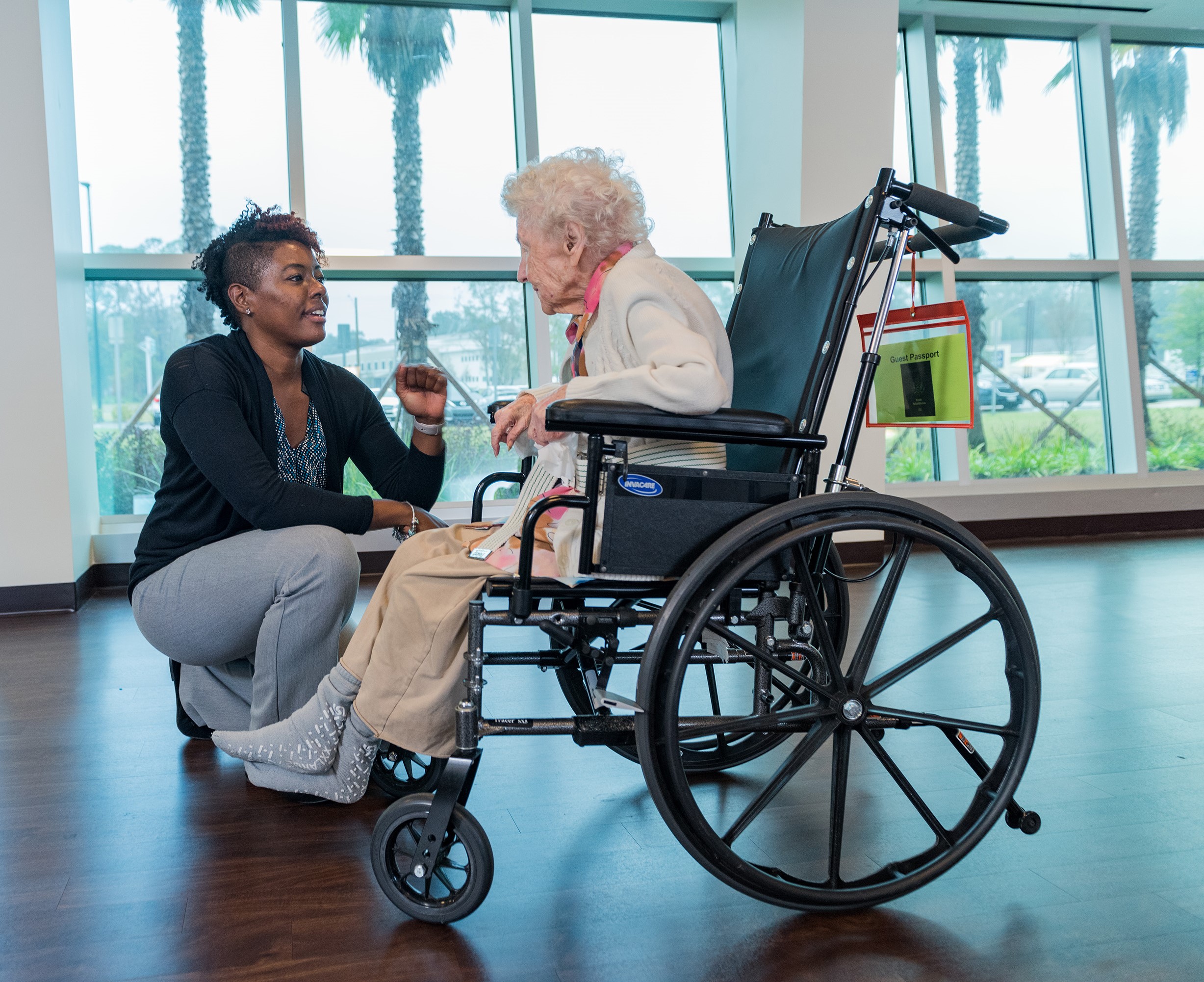
I crossed the room in three steps and knelt down in front of her chair, taking her cold, papery hand in both of mine.
“Grandma,” I said softly, my own voice cracking. “How long have you been like this?”
She just looked at me. Her eyes were wet, but they had that same clouded, distant quality Carol had described on the phone, like she was looking at me from somewhere far away and struggling to bridge the distance.
A few minutes later, the nurse who had walked me back stepped into the room, presumably checking on a routine visit. When she saw me kneeling beside my grandmother, holding her hand, her whole expression shifted into something close to alarm.
“We… we thought she had no family,” the nurse said, her voice low, almost apologetic. “No one ever visits her. We didn’t even know she had a granddaughter.”
Those words landed on me like a physical blow. I felt the air leave my lungs.
“What do you mean, no one visits her?” I asked, my voice sharper than I intended. “My father pays for this place. He told me he comes to see her.”
The nurse hesitated, glancing toward the door as if checking whether anyone else could hear this conversation. “Ma’am, in the last eight months, no one from her family has come here even once.”
I felt my blood run cold, a physical sensation, like ice water spreading through my chest.
I looked back at my grandmother, sitting there in her thin gown, staring out the window like she’d already accepted that this was simply how the rest of her life would look. Abandoned. Forgotten. Left to fade quietly in a room that strangers had to explain to her own family didn’t seem to exist.
That was the moment I made my decision. I wasn’t going to leave her there. And I wasn’t going to let my family walk away from what they had done to her.
I turned to the nurse, keeping my voice as level as I could manage despite the fury building underneath it. “How long has she been like this? Specifically.”
The nurse glanced at the door again before answering, lowering her voice further. “Miss Langford, your grandmother has been a resident here for almost ten months. In the beginning, your father did visit, maybe once or twice a month. But after about the first two months, the visits stopped completely. We tried calling the emergency contact number on file several times. No one ever answered. We sent letters as well, following our standard protocol for family notification. We never received a response to any of them.”
My chest tightened until it was difficult to draw a full breath. “What about her medications? She looks heavily sedated. Her eyes, the way she’s responding, something isn’t right.”
The nurse’s hesitation this time was longer, and when she finally spoke, she chose her words carefully, the way people do when they know they’re saying something that could get them in trouble. “She’s currently on high doses of benzodiazepines and anticholinergics. Those medications are typically prescribed for anxiety or sleep difficulties, but the dosage she’s receiving is significantly higher than what we’d normally consider appropriate for someone her age. That level of medication can cause severe confusion, memory problems, and considerable physical weakness in elderly patients. We raised concerns about the dosage with the family on more than one occasion. We were told it was the prescribing doctor’s decision and to continue as directed.”
I looked back at my grandmother. She had returned to staring out the window, her expression blank, as though the conversation happening a few feet away from her wasn’t quite registering, or perhaps had simply stopped mattering to her a long time ago.
I turned back to the nurse, and something in my voice must have changed, because she seemed to brace herself before I even spoke.
“I want to see her medical and financial records,” I said. “All of them. Right now.”
“Those are confidential,” the nurse said, though without much conviction behind it.
“I’m her granddaughter, and right now I appear to be the only living relative who actually cares whether she’s alive or dead,” I said, my voice steady but hard. “If you don’t produce those records, I will have a lawyer standing in this room within the hour, and I promise you this facility will not enjoy the scrutiny that follows.”
The nurse studied my face for a long moment, then nodded and left the room without another word. I sat down on the edge of my grandmother’s bed, still holding her hand, and waited.
Ten minutes later, the nurse returned carrying a thick file folder.
I opened it right there in the room, my grandmother beside me, and began reading. Within the first few pages, I felt something inside me shift from grief into a colder, harder kind of anger, the kind that doesn’t shout but instead settles into your bones and stays there.
For the past eight months, substantial sums of money had been withdrawn from my grandmother’s pension account and savings, all authorized by my father and my mother. Thousands of dollars, spread across a series of transactions that, once I started cross-referencing dates, matched up almost perfectly with a family trip to the coast, a weekend getaway to a luxury resort two states over, and what appeared to be an entire new wardrobe purchased at a department store my mother had always favored but claimed she could never afford.
Meanwhile, page after page of the nursing home’s own internal notes documented my grandmother’s steady decline. Missed hygiene checks. Delayed changes of soiled clothing. Weight loss flagged repeatedly by staff without any response from the family. And scattered throughout the file, entries logging scheduled family visits that, according to the sign-in records I cross-checked against the visitor log, had simply never happened. Someone, at some point, had been filling in a calendar with visits that existed only on paper.
I closed the file and looked up at the nurse, who was watching me with an expression somewhere between sympathy and unease.
“I’m taking her with me. Right now,” I said.
The nurse’s face tightened with concern. “Miss Langford, we can’t simply release her without proper authorization from the family or documentation of guardianship.”
“I don’t care what your paperwork says,” I told her. “I am not leaving her in this building for one more night. Prepare her discharge documents. I will take full legal responsibility for whatever happens after she leaves this room.”
While the nurse went to sort out the paperwork, I sat beside my grandmother and gently squeezed her hand.
“Grandma, I’m here now,” I told her softly. “I’m taking you home with me.”
She turned her head slowly toward me, and for the first time since I’d walked into that room, I saw something flicker behind her eyes that looked genuinely like her, like the woman who used to sit with me at the kitchen table helping me with algebra homework, the woman who never once in my entire childhood made me feel like I was a burden. A single tear slid down her cheek.
It took almost an hour to get her ready to leave. I helped the aides bathe her properly, change her into clothes that actually fit and belonged to her rather than the thin institutional gown she’d been wearing, and comb the tangles out of her hair as gently as I could manage. She was so weak by that point that she could barely stand without support, and I had to hold her up with both arms as we made our slow, careful way down the hallway toward the exit, past rooms full of other residents I couldn’t stop to think about, though the guilt of leaving them behind followed me anyway.
Just as we reached the reception area near the front doors, my phone began ringing in my pocket. I glanced at the screen. My father.
I answered, keeping one arm braced under my grandmother’s shoulder to steady her.
“Sophia, what the hell do you think you’re doing?” His voice came through sharp and immediate, no greeting, no preamble. “The nursing home just called me. They said you’re taking her out of there. You have no right to do that.”
I kept my own voice level, though every word cost me something to keep steady. “I have every right. She’s my grandmother. And after seeing the condition you left her in, I am not letting her spend another minute in that place.”
“You’re making a huge mistake,” he snapped. “Do you have any idea how much we’re paying for her care there? That facility isn’t cheap.”
I let out a short, cold laugh that surprised even me with how little warmth was left in it. “Care? Is that what you’re calling this? You left her sedated, unwashed, and completely alone for eight months while you and Mom used her pension money to fund vacations. I have the records, Dad. I’ve seen every withdrawal.”
There was a pause on the other end of the line, several seconds of silence that told me more than any words could have.
Then his voice returned, lower now, edged with something that sounded almost like a warning. “Sophia, don’t do anything stupid. Bring her back here. We can sit down and talk about this like a family.”
I looked down at my grandmother, still weakly gripping my arm for support, her eyes fixed on some point in the middle distance as if she was afraid to hope too much that any of this was real.
“We stopped being a family,” I said quietly, “the day you decided to abandon her in that building.”
I ended the call before he could respond and slid the phone back into my pocket.
As I settled my grandmother into the passenger seat of my car, adjusting the seatbelt carefully around her frail frame and making sure she was comfortable for the long drive ahead, I made myself a promise that I intended to keep no matter what it cost me. I wasn’t only going to take her away from that place. I was going to make certain that everyone responsible for what had happened to her would answer for it, fully and without exception.
The drive back was quieter than the one that had brought me there. My grandmother slept for most of it, her head resting against the window, occasionally stirring when the road hit a rougher patch. I kept glancing over at her throughout the night, half expecting to wake up from what felt like some kind of fever dream, but each time I looked, she was still there, still real, still finally out of that room.
I got her back to my house well past midnight. She was exhausted in a way that went far beyond ordinary tiredness, the kind of exhaustion that comes from months of neglect finally catching up all at once now that there was somewhere safe to collapse into. I settled her into the guest room I’d hastily prepared before leaving that morning, made sure she had something warm to eat, even if it was only a small bowl of soup she could barely finish, and sat with her until her breathing evened out into sleep. I stayed in the chair beside her bed for a long while after that, watching her chest rise and fall, terrified that if I looked away even for a moment, I might discover that none of this had actually happened.
The next morning, before I had even had coffee, I called my lawyer.
Daniel Reyes had handled a few small matters for me over the years, nothing dramatic, mostly contract reviews for my freelance work. But when I explained what I’d found at the nursing home, laying out the medical records, the medication dosages, the pattern of financial withdrawals, his tone shifted almost immediately into something more focused, more serious.
“Bring everything you have to my office this afternoon,” he said. “Don’t wait.”
I spent the morning organizing the documents I’d taken, photographing every page in case the originals were somehow needed elsewhere, and arranging for a neighbor to check in on my grandmother while I made the trip downtown. By the time I sat across from Daniel’s desk that afternoon, spreading the files out in front of him, my hands had finally stopped shaking, replaced by a grim, focused determination.
Daniel went through the paperwork methodically, occasionally pausing to ask clarifying questions, occasionally making notes in the margins of a legal pad. When he finally looked up at me, his expression was serious.
“Sophia, this is a clear case of financial exploitation combined with elder abuse and neglect,” he said. “The pattern of withdrawals from your grandmother’s pension and savings accounts, timed against the nursing home’s documented decline in her care, along with the sedation levels you’ve described, this is about as textbook as these cases come. We can file a civil suit against your father and mother for misappropriation of funds. We should also file a formal complaint against the nursing home itself for failure to provide adequate care and failure to properly notify authorities when family contact broke down. And given the severity of what you’re describing, I strongly recommend we involve Adult Protective Services immediately, both for your grandmother’s ongoing protection and to trigger a formal investigation.”
I didn’t hesitate. “Do it. All of it. I want them to answer for every single thing they did to her.”
Over the following weeks, the machinery of that decision began turning in ways I couldn’t have fully anticipated. Daniel filed the formal complaints. Adult Protective Services opened an investigation, which meant caseworkers coming to interview me, interview my grandmother when she was well enough to speak coherently, and eventually interview my parents directly. I learned, through documents Daniel obtained during discovery, details I hadn’t known even after reading the nursing home’s file myself.
My father, it turned out, had stopped paying the full monthly fee for my grandmother’s care roughly six months into her stay, quietly negotiating the facility down to a reduced rate that covered only the most basic level of custodial care, no additional therapies, no enhanced nursing attention, nothing beyond the minimum required to keep a resident technically housed and fed. That reduction in payment, timed almost exactly with the point where her care had begun visibly deteriorating according to staff notes, told its own story about where priorities had shifted.
The larger sums withdrawn from her accounts, the ones that had made my stomach turn when I first saw them in that nursing home office, traced back through bank records to a coastal vacation my parents had taken with my brother, several thousand dollars in charges at a resort with an ocean view my father had posted photos of on social media, captioned with something about finally getting a well-deserved break. My mother, it turned out, had also used a significant portion of my grandmother’s savings on herself directly, jewelry purchases and a new wardrobe that Daniel found itemized in credit card statements linked back to an account my grandmother had never personally authorized anyone to access beyond basic bill payments.
When investigators eventually sat my father down for formal questioning, he apparently tried, at first, to construct an explanation that made the withdrawals sound reasonable, framing them as loans against future inheritance, temporary borrowing he fully intended to repay once his own finances stabilized. But the evidence didn’t leave much room for that story to hold together. The bank statements were too specific, too clearly timed against luxury purchases with no connection whatsoever to my grandmother’s actual care needs. The nursing home’s internal records, documenting exactly when the family stopped visiting and exactly when the reduced payment plan began, closed whatever gaps might have remained.
My mother, when questioned, apparently tried a different approach entirely, positioning herself as overwhelmed and stressed by the burden of managing an aging parent’s care, suggesting that the withdrawals had felt justified given how much emotional labor she claimed to have put into the situation, despite the fact that she hadn’t visited even once in the better part of a year. When investigators presented her with the specific spending records, the jewelry, the clothing, the resort charges, she reportedly had no coherent response left to offer.
My brother, who I later learned had benefited substantially from the withdrawn funds through gifts and covered expenses my parents had extended to him during that period, simply stopped answering calls once word of the investigation reached him. I hadn’t been particularly close with him even before all of this, but the silence still stung in a way I hadn’t expected.
Three months after that nine-hour drive, the court delivered its verdict.
My father was found guilty of financial exploitation of a vulnerable adult, a felony charge given the scale of the misappropriated funds and the documented pattern of neglect that had accompanied it. He was sentenced to three years in prison. I sat in that courtroom when the sentence was read, and I felt none of the satisfaction I might have expected to feel. Mostly I just felt tired, and sad in a way that didn’t have a clean edge to it, grief for the father I’d once believed he was, layered over the anger at the father he’d actually turned out to be.
My mother was ordered to return every dollar she had misappropriated from my grandmother’s accounts, along with substantial fines on top of the restitution. She avoided prison time but was placed under supervised probation for a period of two years, with regular check-ins and financial monitoring built into the terms. She sent me one letter after the sentencing, which I read once and never responded to.
The nursing home itself faced its own consequences. State regulators, alerted by the Adult Protective Services investigation, conducted a broader review of the facility’s practices and found additional cases of neglect beyond just my grandmother’s, patterns of understaffing and inadequate oversight that had apparently been building for years before I ever walked through their doors. The facility was fined and placed under a corrective action plan, required to improve staffing ratios and implement stricter protocols for flagging and escalating cases where family contact broke down entirely.
As for me, the court granted me full legal guardianship over my grandmother, along with control over what remained of her financial accounts, which Daniel helped me secure and protect going forward specifically for her ongoing care and wellbeing.
Today, months after that drive, my grandmother lives with me full time. Taking her off the heavy sedatives she’d been prescribed took weeks of careful adjustment under a new doctor’s supervision, weeks where I watched her slowly, gradually return to herself, like watching color seep back into a photograph that had faded almost entirely to gray. She’s regained a good portion of the weight she’d lost. Her hands have steadied. She laughs now, sometimes at things I say, sometimes at nothing in particular, just the simple pleasure of being somewhere she feels safe.
Every morning, she sits by the window in my kitchen with a cup of tea, and I sit with her before I start my workday, the two of us talking through old memories the way we used to when I was a child sitting at her own kitchen table. Sometimes, without any particular prompting, she’ll reach over and take my hand, and she’ll say, quietly, “You came back for me.”
I never contacted my father or my mother again after the court proceedings concluded. My brother tried reaching out once, through a distant cousin who apparently agreed to serve as an intermediary, saying he wanted to talk things through, to explain his side. I declined. Some relationships, I’ve come to understand, are too damaged to be worth repairing, particularly when the damage stemmed from people choosing greed and convenience over the basic dignity of someone who had spent her entire life caring for them without asking for anything in return.
What I learned through all of this, more than anything else, is that silence has a cost, and that cost compounds the longer it’s allowed to accumulate. When you stay quiet for too long, when you accept explanations without pushing for proof, people learn that they can get away with almost anything, because no one is watching closely enough to stop them. But the moment you finally decide to speak up, to show up unannounced, to demand records instead of accepting reassurances, everything can change, sometimes all at once, sometimes in ways you never fully anticipated when you first got in the car.
Protecting the people you love sometimes means standing directly against the very people who were supposed to protect you in the first place. It means understanding that family isn’t a word that automatically excuses cruelty, and that love, real love, shows up in the room, checks the records, asks the hard questions, and refuses to look away no matter how uncomfortable the answers turn out to be.
My grandmother is eighty-nine years old. She spent nearly a year of her life forgotten by a window, sedated into silence while the people who owed her everything spent her money on vacations she was never invited to take. But she’s here now. She’s warm, and fed, and surrounded by someone who actually shows up. And every morning, when she reaches for my hand across the kitchen table and tells me that I came back for her, I think about that nine-hour drive, and I know without any doubt at all that it was the most important decision I have ever made.

Laura Bennett writes about complicated family dynamics, difficult conversations, and the quiet moments that change everything. Her stories focus on real-life tensions — inheritance disputes, strained marriages, loyalty tests — and the strength people find when they finally speak up. She believes the smallest decisions often carry the biggest consequences.