Most mornings, the biggest decision I had to make was whether the tomatoes needed watering before breakfast.
At sixty-four, I liked it that way. I’d had enough surprises for one lifetime, and after thirty-two years in the same little suburban house, there wasn’t much left in it that could catch me off guard.
That morning, I found out I was wrong.
I poured my coffee, sat down at the kitchen table with the stack of mail, and slit open the electric bill with my thumb the way I always did. Then I looked at the number at the bottom.
I blinked. Then I blinked again.
“That can’t be right,” I said out loud, to nobody but the cat.
The cat, whose name is Biscuit and who has never once been helpful in a crisis, blinked back at me and went on washing his paw.
The number was nearly double. Not a few dollars off. Not some little seasonal bump. Double. As in twice what I’d paid the month before, and the month before that, and just about every month for as long as I could remember.
I checked the account number to make sure it was even my bill. It was. I checked the meter reading printed on the statement. I got up, walked out to the little gray box on the side of my garage, and squinted at the digits ticking away in there, half expecting them to notice me watching and correct themselves out of embarrassment.
They didn’t.
I came back inside, sat back down, and did what widows do when something doesn’t add up. I called my daughter and pretended I just wanted to chat.
“Hi, sweetheart. How are the kids?”
“Mom. It’s nine in the morning. What’s wrong?”
Diane knows me too well. Always has.
“Nothing’s wrong exactly. My electric bill’s a little high, that’s all.”
“How high?”
“It doubled.”
There was a pause while she did the math on what that meant for a woman living on a fixed income. “Did you maybe leave the AC running with a window open again? Like in the spring?”
“I did not,” I said, a touch offended. “I haven’t so much as touched that thermostat since April. I’ve been opening windows like a pioneer woman.”
“Okay, okay. Maybe it’s the fridge. Old fridges eat power, you know. They just guzzle it.”
“That fridge is younger than you are, honey. I bought it three years ago at the Presidents’ Day sale. You helped me pick it out.”
She laughed. I did not laugh, because two hundred and twenty-seven dollars is not a laughing matter when your whole monthly grocery budget is a hundred and eighty.
After we hung up, I stood at the kitchen window with my cooling coffee and stared out across the low fence at my neighbor’s yard.
Monica.
Let me tell you a little about Monica, because you can’t understand the rest without understanding her.
She was somewhere in her thirties, with three kids and a husband who traveled for work so much I sometimes wondered if he actually existed or was just a story she told. And she had a shiny white Tesla that she parked crooked in her driveway every single day, always nosed up close to the fence we shared, right near the corner of my property, as if the mulch beds and the little solar lights I’d put in were just decoration that didn’t apply to her.
Monica had trouble, and I mean real trouble, understanding where her property ended and everybody else’s began.
I’d known that for a while. I just didn’t know yet how far she’d taken it.
Six months back, my garden gnome disappeared. Now, I know how that sounds. A gnome. But it wasn’t nothing to me. My husband, Walt, had bought me that gnome at a flea market the last summer before he passed. He’d pressed it into my hands with that big grin of his and said, “For the garden, El. Every yard needs a little nonsense in it.”
Two days after it went missing, I spotted it sitting cheerful as you please by Monica’s front steps. She’d slapped a fresh coat of blue paint over it, like a burglar giving a stolen car a new paint job, but I’d have known that gnome anywhere. I could see the chip on his nose right through the blue.
I never said a word.
I told myself it was just a gnome. I told myself maybe her kids had wandered over and taken it and she didn’t even know. I told myself a lot of things.
Then my lawn mower went missing from the garage. That one came back on its own about a week later, tank bone dry, blade dull as a butter knife, sitting in my garage like it had never left. No note. No thank-you. Nothing.
I told myself she was busy. Three kids. Give the woman some grace.
And I wasn’t even the only one. Frank, across the street, had grumbled to me once about a ladder Monica had “borrowed” and forgotten to give back for three whole months. At the time I’d waved it off. That was just Monica. She borrowed first and asked later, if she asked at all.
Looking back now, I understand something I didn’t understand then. People like Monica don’t stop when nobody stops them. Why would they? Every time somebody swallows it and stays quiet to keep the peace, they hear the same thing. Yes. Take more. There won’t be any trouble.
“Keep the peace, Eleanor,” I muttered at the window, the way I’d been muttering it to myself for the better part of ten years.
I looked down at the bill still in my hand. Two hundred and twenty-seven dollars. For a woman who watches PBS in the evenings and boils exactly one kettle of tea a day.
Something in my life was drinking electricity like a thirsty horse, and I meant to find out what.
It took me a few more days to find out, and I found out by accident, in the middle of the night.
I couldn’t sleep. That happens to me more since Walt died. I’d taken my pill and it hadn’t done a thing, and I was sitting up in bed staring at the ceiling like it might have something interesting to say, when I heard it.
A hum. Faint. The kind of low sound you’d never notice in the daytime, buried under birds and traffic and the general noise of living. But at midnight, with the whole street asleep, it came drifting in through my open window plain as anything.
I got up and pulled the blinds back about an inch and squinted out toward the driveway.
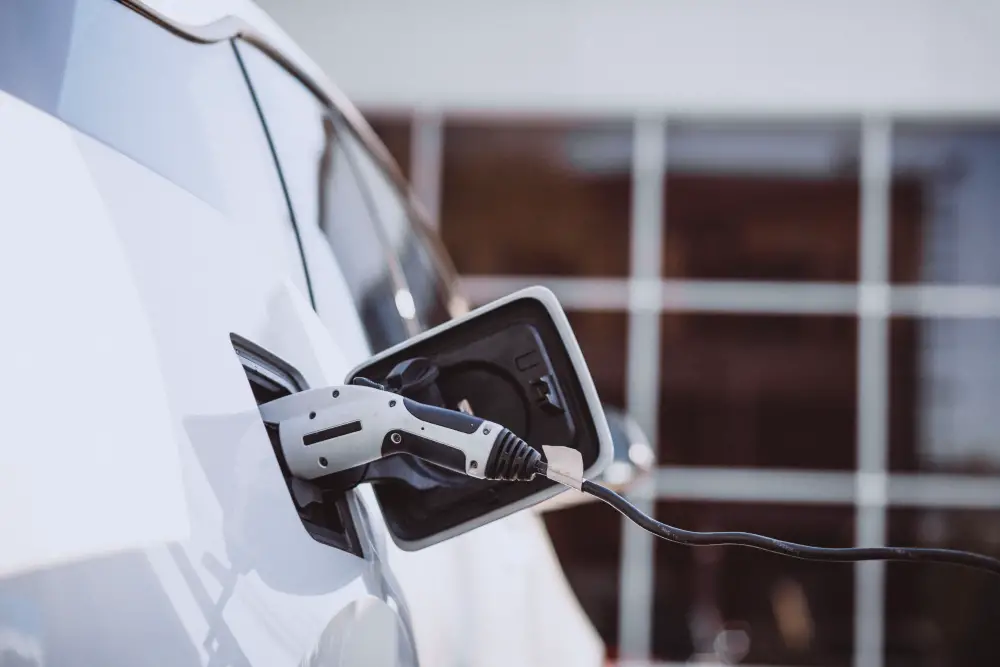
For a second, I honestly thought my old eyes were playing tricks on me. There was Monica’s white Tesla, pulled up close against my property line, closer than usual. And running from a little door on the side of that car was a thick black cable.
I followed it with my eyes.
It ran across the strip of grass. It ran right up to my garage.
And it was plugged into the outdoor outlet on my garage wall.
I sat back on the edge of the bed for a moment, my heart going harder than it had in months. And then, before I could talk myself out of it the way I’d talked myself out of everything for years, I threw on my robe and my slippers and I walked out into the cool night air.
Monica was leaning against her car, scrolling on her phone, calm as a Sunday morning. Like she owned the place. Like she owned my garage and my outlet and the whole quiet street.
“Monica,” I said, and my voice came out tighter than I meant it to. “What exactly are you doing?”
She looked up. And here’s the thing I’ll never forget. There wasn’t one flicker of shame on her face. Not one.
“Charging my car,” she said. “What’s the big deal?”
“The big deal,” I said, folding my arms across my robe, “is that that cable is plugged into my house.”
She rolled her eyes, actually rolled them, and slid her phone into her back pocket like I was interrupting something important.
“Eleanor, come on. You live alone. How much electricity could you possibly need?”
“That is not the point.”
“It kind of is, though,” she said, and she waved a hand at my dark little house like it was proof of something. “I’ve got three kids. I’m running around all day, errands, school pickups, the whole thing. You’re retired. You just sit inside.”
I felt the heat climb right up the back of my neck.
“My bill doubled last month, Monica,” I said. “Doubled. And now I know why. Because of this.”
She gave a little irritated laugh, the kind you’d give a slow child.
“Fine. God. I’ll give you ten bucks if it matters that much to you.” She shook her head. “Don’t be greedy, Eleanor. It’s just a little electricity.”
Greedy.
That word landed somewhere deep and it landed hard. I had spent forty years being the woman who baked casseroles for grieving families and dropped them on porches without ringing the bell. I’d watered half the plants on this street while their owners were off on vacation. I’d sat with Frank’s wife in the hospital the night she passed so he wouldn’t have to be alone. Greedy. From a woman stealing power out of my wall at midnight.
“Please unplug the cable,” I said quietly.
“I’m almost done. Ten more minutes.”
“Now, Monica.”
She sighed like I’d asked her for a kidney, and then she made a big slow show of tugging the cable out of my outlet and coiling it up in her hands, taking her sweet time about it. And as she turned to go, she tossed one more thing over her shoulder.
“You know,” she said, “this is exactly why I didn’t ask. I knew you’d make a whole big thing out of it.”
I didn’t answer. I forced my mouth into the smallest, tightest little smile I could find, turned on my heel, and walked back inside.
The door clicked shut behind me and I stood in the dark hallway for a long moment, just listening to myself breathe.
Then I went to the kitchen, sat down at the table, and looked at that electric bill still sitting there under the fruit bowl where I’d left it.
Two hundred and twenty-seven dollars.
And do you know, I was almost smiling.
Because something had shifted. I could feel it, sitting there in the dark kitchen. For years I’d let it all slide. The gnome. The mower. The crooked car against my fence. I’d let it slide because I was tired, and because I was alone, and because being the nice one, the quiet one, was so much easier than the alternative.
But this is exactly why I didn’t ask. I knew you’d make a whole big thing out of it.
That was the sentence that did it. Because underneath it was the truth of how Monica saw me. Not as a neighbor. Not even as a person, really. As an obstacle so small and so harmless that the only inconvenience I posed was that I might, on occasion, object to being robbed.
I picked up my phone and texted Diane.
Mystery solved. I know why my electric bill doubled. And I have a plan.
My phone rang before ten seconds had passed. Diane’s name lit up the screen.
I looked at it, and I smiled, and I did not answer. Instead I typed:
I’ll tell you tomorrow. Love u ❤️
Because I knew my daughter. She loves me and she is sensible to a fault, and if she got me on the phone she’d talk me right back into keeping the peace. And I was done keeping the peace. I’d kept it so long and so well that a grown woman felt entitled to plug her sixty-thousand-dollar car into my wall and call me greedy for minding.
By the time I climbed back into bed, I really was smiling.
I didn’t know exactly how Monica would react to what I had in mind. But I knew her well enough by now to know one thing for certain. She wouldn’t be able to leave that gnome alone.
Tomorrow, Monica was going to learn something about the quiet widow next door.
The next morning I woke up with a clarity I hadn’t felt in years. I made my coffee. I sat at the kitchen table. And I let the plan take shape as easy and natural as breathing.
First things first.
I walked across the lawn in broad daylight, right up to Monica’s flower bed, and I bent down and picked up my garden gnome.
There he was. The chipped nose showing through, the faint red outline of his little hat bleeding up through that sloppy blue paint where she’d been too lazy to prime him first. Six months he’d been sitting there, decorating the yard of the woman who’d taken him.
Nobody stopped me. Monica’s Tesla was gone, off running errands somewhere on a battery full of my electricity, I had no doubt.
I carried Walt’s gnome home, and I set him down right beside the outdoor outlet on the side of my garage. Then I spent the better part of an hour getting the rest of it ready. I won’t bore you with every detail, but I will say that I’d raised a daughter and buried a husband and kept a house running alone for eighteen months, and a person who can do all that can certainly figure out how to rig up a little surprise with some fishing line, a bracket, and a full can of the brightest paint the hardware store sells.
When I finally stepped back and looked, that gnome sat there beside the outlet looking perfectly innocent. Perfectly harmless. Just a silly little lawn ornament.
Which was exactly the point.
Around lunchtime, Diane called again, and this time I picked up because I was in too good a mood not to.
“Mom, you sound too cheerful,” she said immediately. “What are you doing?”
“Just tidying up the yard, sweetheart.”
“You’re plotting something. I can hear it in your voice. You’ve got the voice.”
“I don’t have any voice.”
“You’ve absolutely got the voice. Mom. What are you going to do to that woman?”
“Nothing at all,” I said. “Only if Monica gives me a reason to.”
“Mom.”
I laughed, and I told her I loved her, and I hung up before she could talk me out of a single thing.
I’ll be honest with you. For one small moment, standing there watering my tomatoes with a booby-trapped gnome by the garage, I did wonder if I had finally lost my mind. Sixty-four years old and rigging up a lawn ornament like something out of a Saturday morning cartoon.
Was I being petty? Or was I finally, after all these years, just refusing to be invisible?
Walt used to tease me about it, gentle, the way he did everything. I’d send back the wrong order at a restaurant if it was his. I once argued a mechanic down to nothing when he tried to overcharge Diane for a brake job. I would stand up, loud and fierce, for anyone in the world who needed somebody in their corner.
Anyone except myself.
Somewhere along the way, keeping the peace had quietly turned into an excuse. An excuse for letting other people decide what I would put up with. And Monica had decided I’d put up with just about anything.
I looked over at the gnome sitting by the garage, sweet and blue and waiting.
“Not tonight,” I told him.
The sun went down. I turned off the porch light so the front of the house sat dark. I poured myself a tall glass of iced tea, and I settled into the shadows behind the big pots of geraniums on my porch, and I waited. I felt like a woman a third my age on a stakeout, and I won’t pretend I didn’t enjoy it a little.
I want to be fair here. All Monica had to do was leave my property alone. That’s all. If she’d pulled in and gone inside her own house, that gnome would have sat there harmless till morning and I’d have quietly taken it apart and none of the rest would have happened. She had every chance in the world to simply not steal from me again.
Around eleven-thirty, the Tesla drifted in with its headlights already off. Sneaking. She knew exactly what she was doing, and she knew it was wrong, or she wouldn’t have come in dark.
Monica got out in her yoga pants and slippers, the charging cable already in her hand, humming a little tune under her breath. She looked so comfortable. So at home. Like my garage was just another one of her amenities.
Then she stopped.
“What in the world,” she muttered.
She was staring down at the gnome, sitting right in the spot where she needed to plug in. My gnome. Her own sloppy blue paint job staring back up at her, that chipped nose, that bleeding-through red hat, like a tiny witness who’d been waiting all night just for her.
“Ugly little thing,” she said. “Move.”
She nudged him with the toe of her slipper. He didn’t budge, because I’d made sure he wouldn’t. So she braced herself and gave him a good hard shove with her foot.
Something thin snapped tight behind him.
Monica frowned and looked up.
Too late.
I already had my phone out, and I started recording.
The can tipped off its bracket above the garage door, wobbled once, and emptied itself in one long glorious splash right onto the top of Monica’s head. Bright pink paint. Cotton-candy pink. It poured down over her hair, down her shoulders, down the back of those yoga pants, down into her slippers.
She stood there frozen for one full second. Pink from the crown of her head to the toes of her feet.
And then the scream came.
It wasn’t really a scream. It was a shriek, the kind of sound that could crack good porcelain, and it went straight up into the night.
Lights snapped on up and down the street. Doors started opening. Somewhere a dog started barking like the end of the world had arrived, and honestly, for Monica, I suppose it had.
She stood in the middle of my driveway dripping pink onto the concrete, still clutching that charging cable in her fist like a leash on a dog that wasn’t there, her mouth opening and closing with no words coming out.
I stepped out from behind the geraniums with my phone held steady in front of me.
And that was when the whole neighborhood came running.
Doors flew open all the way down the block. Neighbors spilled out onto the sidewalk in their robes and slippers, half of them already with their own phones up, because that’s the world we live in now, and for once I was glad of it.
“YOU DID THIS ON PURPOSE!” Monica shrieked, whirling toward me, flinging little droplets of pink as she turned.
I lifted my phone a bit higher and kept my voice as calm and steady as I could manage.
“Monica,” I said, “you’re stealing electricity at midnight and arguing with a garden gnome. I’m honestly not sure I’m the problem here.”
Somebody behind me actually snorted. I think it was Frank.
Monica spun in the driveway and jabbed a shaking pink finger down at the gnome.
“AND YOU STOLE MY GNOME!”
“Your gnome?” I said. “The one you took out of my yard six months ago? The one you painted blue so I wouldn’t recognize my own dead husband’s gift to me?”
Monica went quiet. Her whole face changed. Because for the first time all night, standing there dripping under the streetlight, she seemed to notice just how many phones were pointed at her.
“Turn those off,” she snapped at the neighbors. Then she turned back to me, and her voice went wheedling, sweet, awful. “Eleanor. Tell them. Tell them this was an accident.”
“Which part?” I asked. “The paint? Or you plugging your car into my house after I stood right there and told you not to?”
Her mouth tightened up.
“I wasn’t stealing anything.”
“Then why,” I said, “were you doing it after midnight with your headlights off?”
She opened her mouth. But she didn’t get the chance to answer, because somebody else answered for her.
“Same reason she borrowed my ladder while I was at work, probably.”
Frank. Standing across the driveway in his plaid pajama pants, arms folded across his chest, looking grimly satisfied.
Monica spun toward him. “I gave that back!”
“Three months later,” Frank said. “Empty of the paint that was in the tray, too.”
Somebody laughed. And then somebody else did.
Monica turned in a slow circle in the middle of my driveway, and I watched the anger drain right out of her and something else creep in to take its place. She looked less furious now. She looked trapped.
“This is ridiculous,” she said, and her voice cracked. “You’re all ganging up on me. Over nothing.”
“No,” I said. And I said it clear, so everybody could hear it. “We’re not ganging up on you. We’re finally saying something. There’s a difference, though I understand how you might get the two confused, since nobody’s said anything for so long.”
The laughter that broke out then, up and down that dark street, was the sweetest sound I’d heard in a year and a half.
Monica grabbed her cable and stormed back to her pink-spattered car and slammed the door and sat there for a minute in the dark before she finally pulled into her own driveway, where she belonged.
I thought that was the end of it. The whole story, start to finish. An old woman, a gnome, a can of pink paint, and one deeply satisfying night.
As it turned out, the paint was the very least of Monica’s problems.
After everyone finally drifted back to their houses, I stood alone in my driveway looking at the pink streaks drying on the concrete. And I noticed my hands were shaking.
Not from fear. I want to be clear about that. My hands were shaking from something I could hardly name. From the sheer strange wonder of it. Monica had yelled at me. She’d threatened me, and pointed at me, and tried to twist it all around, and turn the whole street against me. And the world had not ended. The sky had not fallen. Nothing bad at all had happened to me for finally, finally refusing to back down.
I’d spent ten years afraid of exactly that moment. And it turned out there had been nothing to be afraid of the whole time.
Two weeks later, there was a knock at my door, and I opened it to find Mr. Alvarez standing on my porch. Monica’s landlord. I’d known him for years, back before he moved out of state. He’d been a good friend of Walt’s, the two of them used to go fishing together every fall.
“Eleanor,” he said. “It’s good to see you. I thought you deserved to hear this from me, in person.”
“Hear what?”
“I saw the video.” He gave a little rueful smile. “Half the county’s seen the video by now, I think.”
I felt my cheeks go warm. “Ah. That.”
“That.” He nodded. “Her lease is up next month. And I’ve decided I won’t be renewing it.”
I blinked at him. “Because of the video?”
“No,” he said. “Not really. The video just made me decide to take a closer look at everything. And once I started looking.” He shook his head. “She’s behind on several of the utility payments that were her responsibility. I went and inspected the house myself, first time in a while, and there’s damage she never reported to me. And a few repairs she went and made herself, without ever asking permission, that I’ll now have to pay somebody to undo.”
I glanced across the way toward Monica’s house.
“So the pink paint,” I said slowly, “wasn’t her only dose of it.”
“No, ma’am,” Mr. Alvarez said. “It surely was not. Sometimes when you turn over one rock, you find out there’s a whole lot more underneath than you expected.”
A month after that, I sat out on my front porch with a tall glass of iced tea and watched Monica load the last of her boxes into a moving truck.
She never once looked my way. Not one single time. I think she couldn’t.
My gnome sat proudly out by the mailbox where he belonged, his blue paint mostly scrubbed off now, that chipped red hat showing through again, right where Walt would have wanted him.
I sat there and I watched the truck pull away down the street and around the corner and gone. And I thought about all those years I’d kept quiet. All those casseroles and watered plants and swallowed grievances. All the times I’d told myself that keeping my mouth shut and my head down was the same thing as being a good person. A good neighbor. A good woman.
It wasn’t. I understood that now, at sixty-four, sitting on my own porch in the afternoon sun.
I could almost hear Walt’s voice, the way he used to say it when he’d catch me letting somebody walk all over me and doing nothing about it.
Kindness isn’t the same as silence, El.
He’d say it and shake his head and smile at me, that big grin of his, because he knew. He always knew. He knew I had it in me the whole time. He just wished I’d point some of it at the people who’d earned it, instead of spending it all on everybody else.
I lifted my iced tea toward the empty spot in the driveway next door.
“You were right, Walt,” I said. “You were right all along.”
Because I’d finally learned the difference. Kindness is a gift you give to people. Silence is just a door you leave open, and some folks will walk right through it and help themselves to everything you’ve got, and call you greedy for noticing.
Not anymore. Not this old woman.
This time, I hadn’t mistaken keeping quiet for keeping the peace. And do you know, the peace I’ve got now, the real kind, the kind that comes from a neighbor who knows exactly where her property ends and mine begins, is quieter and sweeter than any peace I ever bought with my silence.
I finished my tea. The sun was warm. The tomatoes needed watering.
And that, at last, was the biggest decision I had left to make.

Laura Bennett writes about complicated family dynamics, difficult conversations, and the quiet moments that change everything. Her stories focus on real-life tensions — inheritance disputes, strained marriages, loyalty tests — and the strength people find when they finally speak up. She believes the smallest decisions often carry the biggest consequences.