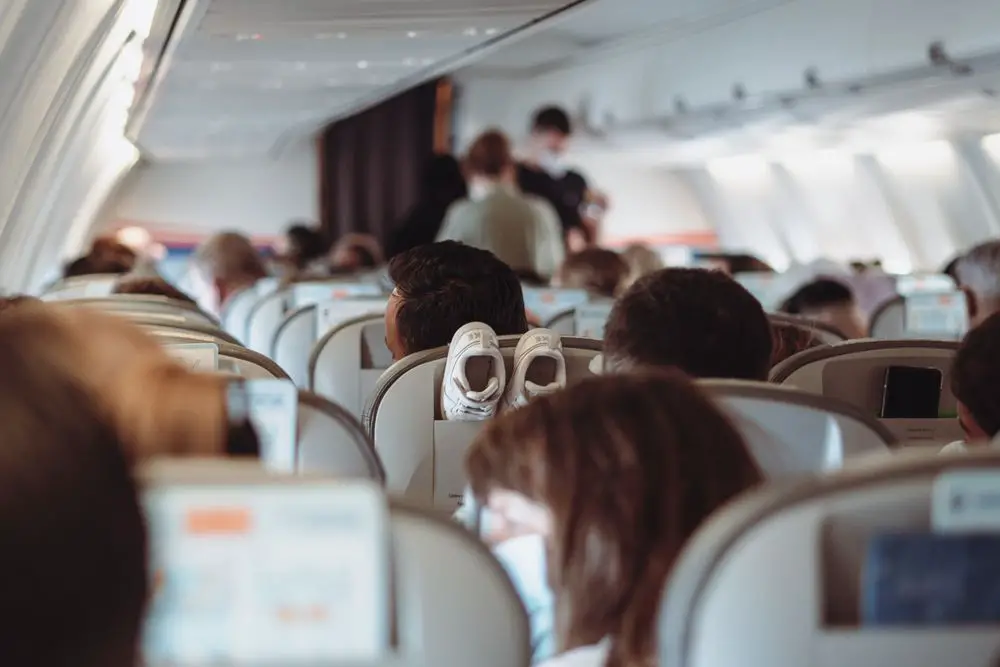
For twelve years, my wife and I built a marriage around departures.
Departures from plans we’d sworn we’d keep and then had to move because the weather over Denver turned ugly. Or a crew got reassigned. Or a connection in Chicago fell apart and took the whole weekend with it.
When you marry a flight attendant, you learn fast that time together is never simple. You take what you can get, and you stop treating the calendar like it owes you anything.
Laura used to joke that our marriage had more layovers than most flight plans.
But the truth is, it had romance too. We just had to fight harder than most people to keep the fire going. We’d celebrated birthdays over video calls with terrible airport Wi-Fi, her face freezing mid-sentence while I sang. We’d eaten anniversary dinners at ten at night because her flight got delayed by three hours and I refused to eat without her. One year we did Christmas morning with her still in full uniform, kissing me at the door before turning right back around and heading out to the airport.
None of that ever made me love her less. If anything, it made me love her more, because I could see how hard she worked to come home to me at all.
But there was one thing all the miles and all the strange hours couldn’t soften.
We wanted a child.
That ache sat quietly in our marriage for years, and then it sat loudly, and then, toward the end, it got brutal. It touched everything. It got into the walls of the house.
First it was just hope. Easy and bright, the kind of hope you don’t even question. We’d talk about names on long drives. Laura had opinions about nursery colors before there was any nursery.
Then it became calendars on the fridge with little circles drawn on certain days. Ovulation kits in the bathroom drawer. Specialist appointments squeezed between her rotations. Blood tests. Procedures. Hormones that made her cry at commercials and then apologize for crying. Long, silent car rides home from doctors’ offices where neither of us knew what to say.
And then it became a kind of grief nobody knows how to comfort, because nobody has actually died, and yet something keeps dying anyway, month after month.
We did IVF twice.
The first time, Laura bought a tiny pair of white socks before the transfer. She held them up in the store and said she wanted to believe early, that maybe if she believed hard enough it would take. She kept them in her nightstand drawer.
The second time, she didn’t buy anything at all.
Both times, it failed.
After that came more testing. More specialists. More of those expensive conversations where people in white coats sat across a desk and told us odds and percentages, as if a decimal point could make heartbreak sound like science instead of the most personal thing in the world.
Eventually the doctors told us the thing they’d been circling for years. Conceiving naturally was highly unlikely. The exact wording shifted from office to office, but the meaning never did.
I watched Laura take that news the way a person stands still in freezing rain. She didn’t collapse. She didn’t scream. She thanked the doctors, actually thanked them, shook their hands, and walked out to the car with her back straight, and it wasn’t until we were on the highway that I saw her jaw shaking.
A few months before what would have been our tenth anniversary, she told me she was ready to stop.
We were in bed. She was staring up at the ceiling in the dark.
“I’m tired, Richard,” she said. “I’m so tired. I’m tired of building my whole future around the thing that never happens. Every month is a test I’ve already failed before it starts.”
I reached over and found her hand under the blanket.
“Then we stop,” I said. “We just stop. Okay?”
“Okay,” she whispered.
And we did. We put the calendars away. We threw out the kits. And slowly, painfully, we started learning how to be just the two of us again, which turned out to be its own kind of grief, letting go of a person who’d never gotten to exist.
Here’s the thing I have to tell you now, because everything that came later grew straight out of it.
Somewhere in the middle of all that testing, I got tested too.
I went quietly. I didn’t tell Laura. I told myself it was because I wanted to absorb any bad news first, before it reached her, so I could protect her from it. That’s the story I told myself, and it even sounded noble in my own head.
The results said I couldn’t father a biological child.
Not impossible in some cosmic sense, the doctor said, but so unlikely I shouldn’t treat it as realistic hope. He said it kindly. He said it the way you tell someone their favorite restaurant has closed.
And I took that piece of paper, that catastrophic little piece of paper, and I buried it.
Because by the time I got those results, Laura was already drowning. Another failed cycle, more hormones, more disappointment stacked on disappointment. I looked at her sitting at our kitchen table with her head in her hands, and I could not make myself walk over and say, by the way, it’s me, it was me all along, this is my fault.
I told myself there was no point. The doctors had already said natural conception was unlikely for us as a couple. Naming myself as the specific reason wouldn’t lower her grief, I reasoned. It would just move it. It would just give her a face to put on the loss, and that face would be mine.
So I said nothing.
Cowardice can look an awful lot like protection when you’re desperate enough to squint.
I kept that result buried for years. I honestly thought I’d take it to my grave, one more quiet ache folded into a marriage already full of them.
I had no idea it was a bomb with a very long fuse, and that I’d lit it myself.
Two years after we stopped trying, Laura came to me with something that genuinely surprised me.
“I think I want to leave the airline.”
My wife had been in the sky so long I couldn’t picture her fully on the ground. She was a creature of altitude to me. But she smiled this soft, tired smile and said, “I want a quieter life. With you. Maybe that’s enough for us now. I’ll figure out the rest later.”
Her retirement paperwork went through faster than either of us expected. One final rotation. One final flight. And then she’d be done. Done with jump seats and jet lag and living by rosters printed three weeks out. Done missing anniversaries.
And that last part was the cruel little joke of it, because her very last flight was scheduled to land on our twelfth anniversary.
She kept apologizing for it, which was ridiculous and completely her.
“I’m sorry,” she said the night before, hanging her uniform in the closet for what she thought was the last time. She smoothed the shoulders of it with her hand. “Twelve years married, and somehow I still managed to spend the actual day up in the air.”
I came up behind her and kissed the back of her neck.
“You come home the next day,” I said. “We’ll celebrate then. Dinner, somewhere nice.”
She turned around and smiled. “Okay. Dinner tomorrow.”
I said yes. But a different idea had already taken shape in my head, and I was quietly, foolishly proud of it.
Because think about it. This was her last flight. Our anniversary. The end of an entire chapter of both our lives. I wanted to give her something she’d remember forever.
For twelve years, Laura had been the one who surprised other people. She was the flight attendant who quietly upgraded honeymooners when she could swing it. Who found birthday cupcakes for nervous kids flying alone. Who remembered names, who could make a terrified first-time flyer feel held together at thirty thousand feet with nothing but her voice and a warm hand on their shoulder. She spent her whole career being the one who made moments for strangers.
I wanted, just once, for her to be the one who got surprised.
So I did something a little crazy. I secretly booked a seat on the exact flight she was working. Her final flight.
I pictured it a hundred times in the days leading up to it. I imagined her spotting me halfway through boarding, doing a double-take, her hand flying to her mouth. I imagined taking her hand after we landed and saying, “See? I made it to one of your anniversaries too. I finally made it.”
Maybe she’d cry. Maybe she’d call me an idiot. Probably both. Either way, I thought, it’ll be worth every cent.
I had no idea. I truly had no idea what I was walking into.
When I boarded, I spotted her almost immediately.
She was near the front, helping a big man wrestle an oversized carry-on into the overhead bin, laughing at something he’d said. Her hair was pinned up neat, her lipstick understated, her posture perfect in that way crew carry themselves after years of moving through narrow spaces with grace.
Even after twelve years, seeing her in uniform still did something to me. She was beautiful and capable and completely, entirely herself.
She hadn’t noticed me yet.
I ducked my head and slipped into my seat wearing what must have been the world’s most ridiculous grin. I felt like a kid hiding behind a couch waiting to jump out.
After everyone had boarded and the cabin doors thunked shut, I finally looked up, and my timing was perfect.
She turned, scanning the cabin the way crew do, and our eyes met.
For half a second she looked genuinely, completely shocked. Then her whole face lit up like sunrise.
She mouthed, “You idiot.”
I grinned like a fool.
One of the other flight attendants caught the whole exchange, glanced between us, put it together, and hid a smile behind her hand. Laura shook her head at me, once, like she absolutely could not believe I’d done this, but the warmth was all over her face, and I thought, right then, that this was going to be the best decision I ever made.
For that one moment alone, I told myself, the ticket had been worth it.
A few minutes later the plane pushed back from the gate. The engines woke up under us. The safety demo started, and Laura stepped into the aisle to do it, the seatbelt, the oxygen mask, all of it, and I barely listened because I couldn’t stop watching her. All these ordinary motions she’d done thousands of times, now touched with the strange light of being the last time. I found myself wondering how many times she’d stood in an aisle exactly like this and pointed at the exits. Tens of thousands, probably. And here I was, finally, for the last one.
Then the captain’s voice came over the speaker, and at first it was the usual thing. Welcome aboard, cruising altitude, weather at our destination. The voice people half-hear and half-ignore.
Then he paused. And his tone changed.
“Before we depart today,” he said, “I’d like to take a moment to recognize someone very special who’s working this flight.”
Several passengers looked up. Laura stopped in the aisle. She turned, slowly, toward the front of the plane, toward the cockpit.
And the whole cabin went quiet in that curious, collective way strangers do when they can feel that something real is about to happen.
I smiled to myself. A retirement tribute. Of course. The crew must have set it up. Maybe there’d be flowers waiting at the gate, champagne after landing. My heart swelled. My surprise and their surprise, all in one flight. Perfect.
Then the captain kept going.
“Today marks the final flight of a crew member who has spent years keeping passengers like you safe, all while quietly carrying a burden that almost no one on this aircraft knows about.”
Laura went pale. She hated being the center of attention, always had.
The other flight attendants exchanged quick, nervous little glances with each other, and something about that started a low tightening in my stomach.
“But today,” the captain said, “we’re celebrating more than just her retirement.”
My smile started to slip.
Only a few hours earlier, he explained, the airline’s medical department had received the results of the routine medical tests she’d completed before this flight.
And I swear, in the two seconds before he said the next words, some animal part of me already knew, and was already bracing.
“And I am delighted to share,” the captain said, warm as anything, “that our wonderful Laura is expecting a baby.”
The cabin erupted.
Applause. Gasps. A woman in the row across from me actually clasped her hands together and said, out loud, “Oh my God, that’s wonderful.” Someone farther back whooped. It was exactly the kind of announcement strangers love, intimate enough to feel like magic, public enough to bond a whole plane full of people for ten glowing seconds.
I sat completely, perfectly still.
Laura was crying now, her hand pressed over her mouth, looking absolutely stunned, overwhelmed, blindsided in the best possible way. She looked like a woman who had just been handed the one thing she’d stopped letting herself want.
But I couldn’t hear the applause anymore. All I could hear was one sentence, playing over and over, clear as if someone were leaning into my ear and saying it directly.
You cannot father a biological child.
The doctor’s voice. From years ago. The buried result. The secret I’d carried so carefully, so nobly, so I could protect her.
And here I sat, on my wife’s last flight, surrounded by cheering strangers celebrating a pregnancy that, according to everything I knew, could not possibly be mine.
The math did itself in my head, cold and fast and merciless. I couldn’t father a child. Laura was pregnant. Therefore.
Therefore.
I want to tell you I stayed calm. I want to tell you I thought it through like a reasonable man. I didn’t. I sat frozen in seat 14C while my whole life quietly detonated, and I said nothing.
Laura came by my row once after we reached altitude. Her eyes were still wet, her smile trembling with joy, and she reached down and squeezed my shoulder.
“Can you believe this?” she whispered.
I looked at her hand on my shoulder. And God forgive me, the thought that went through my head was: Who are you?
It makes me sick to remember. But that’s the truth of it, and I promised myself I’d tell this honestly or not at all.
When we landed, the crew had a little celebration waiting at the gate. Flowers. Hugs. Someone taking photos on their phone. Laura stood in the middle of it, dazed and radiant, glowing in a way I’d never seen in twelve years.
I must have looked like a dead man standing among them. She kept catching my eye through the crowd, confused, her smile faltering a little each time, silently asking me why I wasn’t happy, why I wasn’t crying with joy, why I was just standing there gray-faced while the best news of our lives got passed around a jet bridge.
We didn’t talk on the way to the car. We couldn’t, with the crew around. It wasn’t until we were finally alone in the concrete quiet of the parking garage that she turned to me.
“Richard, what is wrong with you?” Her voice cracked. “Are you not happy? We’ve been trying for more than ten years. Ten years. And you’re looking at me like this?”
And that’s when the poison came out. I didn’t decide to say it. It just came.
“Who’s the father?”
I watched the joy leave her face so fast it was almost violent. Like watching a light get switched off in a house.
For a second she didn’t understand the words at all. Then she did.
“What?”
I said it again. “Who’s the father, Laura?”
She just stared at me. Her mouth opened and nothing came out.
“Are you serious right now,” she finally said. Not even a question. A kind of horror.
I was past serious. I was rigid with humiliation and panic and grief and that terrible false certainty that feels like being locked inside your own worst thought with no door out.
“The child can’t be mine,” I said.
She stepped back like I’d hit her. She actually flinched away from me, put her hand out against her own car to steady herself.
“I am not lying to you,” she said.
“Then explain it. Explain to me how this is possible.”
“I don’t even know how to answer this.” Her face had gone white as paper. “Richard, I don’t even know what you’re accusing me of.”
But I was too far down inside myself to read her right. Everything she did, I ran through the filter of my own certainty. Her shock looked like guilt to me. Her confusion looked like a woman scrambling for a story. I had a secret piece of paper in my past that told me I couldn’t be a father, and I trusted that piece of paper more than I trusted twelve years of the woman standing in front of me.
We drove home in a silence I can still feel if I let myself.
The days after were worse. So much worse.
I asked her questions no one should ever ask a person they love, unless they’re truly ready to hear something unbearable. Was there someone from the airline? A pilot, a coworker, someone on a layover? Had there ever been anyone, in all those nights away? Was that the real reason she wanted to retire, to cover something up?
Every accusation made her a little quieter. A little grayer.
And she denied it. Every single time. Never once did she waver, never once did the story change, because there was no story, only the truth, and I couldn’t hear it.
“You either believe me or you don’t,” she said on the third day. She was standing in our kitchen with both hands braced flat on the counter, because the pregnancy had already started to exhaust her, and here I was making the most exhausting weeks of her life into a trial. “And if you don’t believe me, Richard, I can’t force you to. That’s not something I can make you do.”
And here’s the part I have the hardest time saying.
I never asked for a DNA test.
Think about that. There was a simple, available way to know the truth for certain, and I never asked for it. Because some part of me didn’t want the truth. I wanted my certainty. I was so sure, based on that old secret test, that I skipped right past finding out and went straight from fear to betrayal without stopping anywhere in between.
A week later, I moved out.
Laura didn’t chase me. She didn’t beg. She was too worn down by the accusations to fight for a man who’d already decided who she was. She just watched me carry my bags to the car, and she let me go.
The months after that were a blur I wouldn’t wish on my worst enemy.
I went back to my hometown, a few hours away, because I couldn’t stand our town without her in it, and I couldn’t stand myself in it either. I rented a room over a hardware store from an old man who asked me no questions, which was the only kindness I felt I could tolerate.
I drank too much some nights. I slept badly every single night. I replayed that announcement on the plane over and over until it felt carved into the bone behind my eyes. Our wonderful Laura is expecting a baby. The applause. Her hand over her mouth.
Laura never reached out. And neither did I.
She never filed for divorce. And neither did I.
Our whole life just hung there in the air, suspended, not alive and not properly dead. Two people frozen in a holding pattern, circling something neither one would land.
Around the seventh month, I found myself driving past the clinic. The one from my hometown where I’d taken that first fertility test all those years ago. I hadn’t planned it. I just looked up and there it was, and my foot came off the gas.
Something ugly and restless in me said: Go ask them again.
I don’t fully know why I went in. Not because I really believed anything would change. Maybe because, underneath all my certainty, there was a small starving part of me that wanted, desperately, to be told my wife hadn’t betrayed me. That wanted a reason to go home.
So I went in. I paid for the testing again. I sat in the same sterile waiting room with the same terrible magazines fanned out on the same table, feeling like the saddest joke in the world, a man retesting a heartbreak he’d already built his whole ruin on.
When the results came back, I was sure there’d been a mistake.
Because they said I had normal fertility. Completely normal indicators. No sign at all of the catastrophic problem I’d carried around for years like a stone in my chest.
I drove back to that clinic shaking with anger. I demanded to know how the old records and the new records could possibly disagree. I demanded they pull the files. I wanted an explanation and I wanted it right then.
A senior administrator sat down with me. Then a doctor. And after an hour that stretched out like a punishment, someone finally found what had gone wrong all those years ago.
The administrator explained it to me in a low, careful voice. Years earlier, my lab results had been switched with another patient’s. A man with a nearly identical name, whose samples had been processed the very same day mine were. His results had gone into my file. My name, his numbers.
They apologized. They said if they’d caught the error, they’d have reached out immediately.
I sat there and stared at the doctor while he told me this as calmly as if he were explaining that my dry cleaning had been sent to the wrong address.
“So,” I said, and my mouth had gone completely numb, “it’s possible. It’s possible that I could be a biological father.”
He swallowed. “Based on our review of the past and current results, yes. It’s not just possible. Your indicators are normal.”
And the only thought in my head, the only one, filling every inch of me, was this:
Laura had not betrayed me.
She hadn’t lied. She hadn’t cheated. She had gotten the exact miracle we’d spent ten years grieving over, the child we begged for, and I had answered that miracle by looking at her like she was filth and walking out the door.
I had believed the worst possible thing about the woman I loved faster than I had trusted her. Based on a piece of paper that was never even mine.
I sat in my car in that parking lot for almost a full hour, gripping the steering wheel, understanding piece by piece what I’d done. Every accusation I’d thrown at her came back to me in her voice. I don’t even know how to answer this. You either believe me or you don’t.
I told the administrator on my way out that they would be hearing from me, that a mistake like this doesn’t just confuse a chart, it detonates a family. But even that felt hollow. Because the clinic had made an error. What I’d done with that error was all mine.
I called Laura three times that day. She didn’t answer any of them.
I drove to our house twice and lost my nerve both times, sitting at the end of the street looking at the porch light before turning around.
I wrote texts and deleted them. Every single one looked pathetic the second it turned into a blue bubble. Sorry I accused you of adultery, turns out a clinic mixed up my sperm count with another man’s looked insane on a screen, because it was insane, even though it was true.
By the end of that week I knew only one thing for certain. I had to tell her in person. She deserved that much. She deserved a lot more than that, but at the very least, in person.
I still had an old calendar reminder on my phone, from back when we did everything together, that told me roughly when her prenatal appointments tended to be. I felt like a stalker using it. I used it anyway. I parked outside her obstetrician’s office and I waited.
She came out holding a folder in one hand, the other palm pressed protectively against the underside of her belly, in that unconscious way pregnant women hold themselves.
She stopped cold when she saw me leaning against her car.
I’d imagined this reunion a hundred different ways in that parking lot. Not one of them had prepared me for the look on her face. She looked exhausted. And she looked furious.
“What are you doing here?” she said.
“Please. Please just hear me out.”
“No.”
“Laura.”
She moved past me to unlock her car. “You don’t get to vanish for seven months and then ambush me in a hospital parking lot. You don’t get to do that.”
I pulled the envelope from inside my jacket. “I know. I know I don’t. But I have proof.”
She froze, and her expression sharpened. “Proof of what, Richard?”
“That I was wrong.”
She let out a small, cold laugh and shook her head. “I knew that from the very first second. If that’s what you drove all this way to tell me, you can go back to wherever it is you’ve been hiding.”
I begged her. I stood in that parking lot and I begged her for ten minutes to just listen. She said no twice more. And then, finally, without a word, she got into the driver’s seat and reached over and unlocked the passenger door.
We sat in her car, neither of us facing the other, both of us looking straight out the windshield at nothing.
And I told her everything.
I told her about the old test, the one from years ago. The result I’d gotten in secret and never shared. The shame that made me bury it, and the lie I told myself that burying it was somehow kindness. I told her how the announcement on the plane had landed on top of that buried secret like a match on gasoline. How I’d gone back to the hometown clinic, half out of my mind, and retested. The switched files. The near-identical name. The samples run on the same day. My name, another man’s numbers, sitting in my chart for years, quietly poisoning everything.
I put the documents in her lap.
By the time I finished, her face was hard to read.
“So let me make sure I understand this,” she said slowly. “You thought I cheated on you. Because of a medical result. That you kept secret from me. For years.”
“Yes.”
“And when I told you I hadn’t. Over and over. When I stood in our kitchen and swore to you. You still walked away.”
I could barely get the word out. “Yes.”
She laughed again, that same joyless sound. “You didn’t even ask me for a DNA test, Richard. There was a way to know for sure, and you didn’t even ask. You just decided. You just decided I was a liar and a cheat and you left.”
I had no defense. There is no defense.
“I know,” I said.
“No.” Her voice was suddenly steel. “Say it properly. Say the real thing.”
I looked at her belly, round under her coat, and then at her hands twisted together in her lap.
“I didn’t trust you,” I said. “I didn’t trust you. That’s what it was. Not the clinic, not the test. I didn’t trust my own wife.”
Tears filled her eyes, but her voice stayed level and clear.
“I was pregnant,” she said, “with the baby we wanted more than anything in this world. I was terrified and sick and exhausted, and the one person who was supposed to be beside me looked at me like I was a filthy liar. Do you understand that? In the single happiest moment of my whole life, my husband made me feel like garbage.”
I closed my eyes.
“You left me, Richard,” she said. “That’s the part that matters. Not the test. Not the clinic mixing up files. Those don’t matter to me at all. What matters is that when it got hard, you left.”
And there it was. The whole shape of what I’d done, with every excuse stripped off it, laid out plain in the front seat of her car. It hit me full in the face.
“I’m so sorry,” I said. “Laura, I’m so sorry.”
She cried quietly for a minute. Then she wiped her face hard with the heel of her hand, the way she did when she was done letting herself cry.
“I believe you,” she said. “The documents are too specific not to be real. I believe every word of it.” She looked at me. “But my forgiveness is not something I’m sure I’ll ever be able to give you. I need you to understand that.”
“I know.”
“I don’t want you back in our house.”
“I know.”
I kept saying it because it was the only true thing I had left.
And then, after a long silence, she said the thing that saved me, though I didn’t deserve saving.
“But this is your baby,” she said. “And even though you ran away when it counted, I will not keep you out of your child’s life. I won’t punish the baby for what the father did.” She drew a shaky breath. “You can be as involved as you want to be. In the baby’s life. Not mine. The baby’s.”
It was more mercy than I had any right to.
So I rented an apartment ten minutes from her house. And every single day, I showed up.
She let me have that. The daily visits. And I didn’t waste them. I didn’t show up to talk or to plead or to try to win her back. I showed up to do things. I babyproofed cabinets. I built the crib, on my knees on the nursery floor, my hands shaking the whole time from the size of what I’d nearly thrown away. I painted the nursery the pale yellow and deep blue she’d picked out years ago, back when picking nursery colors was still just hoping.
I carried her groceries in. I rubbed her swollen feet on the evenings she let me. I sat at her kitchen table assembling bottles and reading the instructions on everything twice. I went to every appointment she’d allow me into. I learned how to install a car seat, really learned it, watched the videos, had the fire station check my work. I stocked her freezer with meals for the nights she was too tired to cook.
Some days she’d talk to me gently, almost like before. Some days she’d barely speak at all. I accepted both without complaint. I had earned the silence, and I knew it, and by the time her due date came near, I had learned the exact shape of her quiet and how to honor it.
She called me at 2:14 in the morning.
“My water broke.”
I was at her house in ten minutes flat.
At the hospital she was fierce and exhausted and magnificent. She crushed my hand through every contraction and I let her, glad of the pain, glad to be useful, glad to be there at all.
And when our daughter finally came into the world, everything in that room changed at once. The nurse lifted her up, pink and furious and perfect and screaming, and I was crying before I even understood I’d started.
“A girl,” Laura whispered, worn out and shining. “Amanda. Her name’s Amanda.”
We’d picked names years earlier, a whole list of them from back in the hopeful days. Amanda had been near the top.
The nurse handed the baby to me first, just for a second, while they got Laura settled. And I stood there holding my daughter, this impossible child I’d been told for years I could never have, this child I’d nearly abandoned before she drew a breath. Then I turned and I laid her into my wife’s arms.
I don’t think I’ll ever be part of a more sacred moment than that one as long as I live. Laura looked down at Amanda, and the whole world seemed to go quiet and gather itself gently around the two of them.
Before we left the hospital, while Amanda slept in the little bassinet between our chairs, Laura turned to me.
“You disappointed me,” she said, “in a way I don’t think I’ll ever completely forget.”
I nodded. Anything else would have been an insult.
Then she said, “But I have forgiven you.”
I think my knees would have gone out from under me if I hadn’t already been sitting down.
She wasn’t looking at me. She was looking at Amanda. “You can move back in,” she said. “But you were right about one thing that day, even though you were wrong about everything else. Trust has to be rebuilt. From nothing. From the ground up.”
“I will spend the rest of my life rebuilding it,” I said.
She finally turned and looked at me then, really looked at me, the way she had on the plane a lifetime ago.
“See that you do,” she said.
I have tried. Every day since, I have tried.
A few months later, once the fog of newborn nights had lifted enough for us to think straight, we filed a lawsuit against the clinic. Not because any amount of money could give us back those seven months, or undo the look on her face in that parking garage. But because what happened to us should never happen to anyone. A lab error doesn’t just confuse a chart. It went into our home and it detonated our family, and someone needed to answer for it.
The case settled quietly, and the money changed things for us in ways neither of us could pretend it didn’t.
Laura never went back to the airline. Instead she finally did the thing she’d talked about since she was twenty-six and always waved off as impractical. She opened the little pastry shop she’d been dreaming about her whole life. A small storefront with warm light and good coffee and glass cases full of sweet things, and little fruit tarts that people now line up for on Saturday mornings.
Sometimes I stand behind the counter holding Amanda while Laura ices a cake, and I look at the two of them, and I think about how close I came. How I almost gave all of this up, this exact ordinary miracle, over a piece of paper with the wrong name on it and my own refusal to trust the truest person I’ve ever known.
Our next anniversary was the first one in twelve years that we spent fully at home. No flight. No delay. No dinner at ten o’clock at night. Just our house, and a baby monitor humming softly from the next room, and takeout on the table because neither of us had the energy for anything fancier.
Amanda was asleep. Laura lit a single candle in the middle of a cake she’d baked herself, and we sat at the kitchen table looking at each other over that ridiculous little flame.
“Twelve years,” she said.
“Thirteen,” I corrected her.
She smiled. “You’re right. Thirteen.”
Then she reached across the table and took my hand.
It wasn’t the easy, weightless love we’d started with all those years ago. That love was gone, and I was the one who’d broken it. This was something else. Something scarred and awake and rebuilt board by board, with full knowledge of exactly how badly it could be lost.
And in some strange way that made it more precious to me, not less. Because I knew, better than anyone alive, exactly how close I’d come to throwing it all away. And because upstairs, asleep in a crib I had built with my own two shaking hands, was Amanda. The child we had begged for, and grieved for, and somehow, after everything, after all of it, been given anyway.
On our first anniversary as a family of three, my wife didn’t have to work a flight.
She was home.
And so were our daughter and I.

Specialty: Legal & Financial Drama
Michael Carter covers stories where money, power, and personal history collide. His writing often explores courtroom battles, business conflicts, and the subtle strategies people use when pushed into a corner. He focuses on grounded, realistic storytelling with attention to detail and believable motivations.