For a second, standing in that driveway with my biological father holding out the keys to a brand-new car, I wanted to embarrass him. I wanted to say something sharp enough to wipe that proud smile clean off his face, right there in front of everyone.
But then I thought of something better. Something my whole family would remember for the rest of their lives.
Let me back up, though. Because to understand what I did, and why it mattered, you have to understand the fourteen years that came before that driveway. You have to understand what it costs to grow up counting every dollar. And most of all, you have to understand Ray.
—
My biological father left when I was three years old.
I don’t remember it. I have no memory of him at all from back then, no memory of a goodbye or a fight or a car pulling out of a driveway. He just wasn’t there, and by the time I was old enough to notice other kids had dads and I didn’t, he was already a blank space where a person was supposed to be. I asked about him a few times when I was little, the way kids do, and my mom always answered carefully, never cruel about him, never trashing him, just quiet.
“He wasn’t ready to be a dad,” she’d say. “That’s not your fault. That’s never your fault.”
For the next fourteen years, it was mostly just Mom and me.
And money was always tight. I mean always. Not poor exactly, not going-hungry poor, but the kind of tight where every single decision has a price tag hanging off it and you both know it. We never really sat down and had big serious talks about money. We just lived inside it, all the time, in a hundred small ways.
“Which bill can wait till next week?” Mom would say, spreading envelopes out on the kitchen table.
“Do we actually need this, or do we just want it?” That was the question that governed my entire childhood. I could answer it in my sleep by the time I was ten.
“You think the car’s got one more repair in it, or is this the one?” The car was a constant source of low-grade terror. That old sedan wheezed and rattled and Mom would pat the dashboard at red lights like she was soothing a sick animal, whispering come on, come on, not today.
I learned, growing up like that, not to want things. That sounds sad, maybe, but it wasn’t, not really. When you understand exactly what everything costs, when you’ve watched your mom skip her own lunch so you could have new cleats, you stop wanting every shiny thing you see. You get a kind of clear-eyed calm about it. Other kids would beg their parents for stuff in stores and I’d just stand there, genuinely not wanting it, because I’d already done the math and the math said no.
I never held it against my mom. Not once. She worked herself to the bone for me. Two jobs at some points. She was tired all the time in a way I didn’t fully understand until I was older, that bone-deep tired that comes from carrying a whole household by yourself with no one to hand it to at the end of the day.
Then, when I was sixteen, she met Ray.
—
I was braced to hate him. I want to be honest about that. I’d had my mom to myself for thirteen years, and here was this guy, and every instinct I had was to keep him at arm’s length. I’d seen enough movies and heard enough stories from kids at school with stepparents to know how these things were supposed to go. The new guy resents the kid. The kid resents the new guy. Somebody’s always the extra person, the burden, the thing making it all harder.
Ray had two kids of his own. Danny, who was eleven, and Cara, who was nine. They stayed with us every other weekend. So all of a sudden our quiet little two-person household ballooned into five people, at least half the time, and it was loud and chaotic and there were toys everywhere and the bathroom was always occupied.
And here’s the thing. Money got tighter, not looser. I did the math, because I always did the math. Five people. Two more kids to feed on weekends. Ray was paying child support for Danny and Cara on top of everything. Whatever I’d feared about being the extra mouth, the extra expense, it was suddenly true for the whole household. There genuinely was not enough to go around. Life did not get easier when Ray showed up. In a lot of ways, it got harder.
But here’s the part I didn’t expect. Not once, not one single time, did Ray ever make me feel like I was the problem. Like I was the extra one. Like I was the kid he’d gotten stuck with as part of the deal for being with my mom.
I watched for it. Believe me, I watched. I was sixteen and suspicious and I was waiting for the moment he’d show his real face, the moment he’d favor his own kids over me, the moment I’d catch him wishing I wasn’t there.
It never came.
—
Let me tell you about the games.
I played baseball. I wasn’t great. I want to be clear about that, because it makes what Ray did mean more. I wasn’t the star. I wasn’t even really a starter, most of the time. There was a whole season, my junior year, where I barely left the bench. I’d suit up and warm up and then sit there inning after inning, and maybe I’d get one at-bat if we were way ahead or way behind, and mostly I just watched.
Ray came to every game.
Every single one. Home games, away games, games two towns over on a Tuesday night when he’d had to leave work early and would clearly be making the time up later. He’d sit in the bleachers, and when I’d finally get put in for that one meaningless at-bat in the bottom of the seventh, he’d stand up and cheer like I’d just come up in the World Series. It was almost embarrassing. It was completely embarrassing, actually. This grown man on his feet yelling my name because I’d fouled off a pitch in a game we were losing by nine.
One time I asked him why he bothered. We were driving home from a game where I hadn’t played at all. Not one pitch.
“Why do you come to these?” I said. “I don’t even play. You’re wasting your whole evening watching me sit on a bench.”
Ray thought about it for a second, eyes on the road. “I’m not watching you play,” he said. “I’m watching you. There’s a difference. You could be sitting on that bench or standing at that plate, and either way you’re my—” He stopped. He’d been about to say something, and he caught himself, and he changed it. “Either way, you’re worth the drive.”
I noticed the catch. My kid, he’d almost said. Or my son. And he’d stopped himself, because he was careful like that, careful never to push, never to claim something that hadn’t been offered to him. He never once tried to be my dad. He just quietly did every single thing a dad was supposed to do, and left it up to me what to call it.
—
Let me tell you about the chemistry.
I was failing chemistry junior year. Truly failing. I had no idea what was happening in that class, and the more lost I got the more I stopped trying, the way you do when something feels hopeless. And Ray, who I would later learn understood chemistry no better than I did, decided we were going to fix it together.
He’d sit across from me at the kitchen table at night, after his long day, with my textbook open between us, and he’d try to work through the problems with me. He didn’t get it either. He’d squint at the periodic table like it had personally wronged him. But he refused to let me quit.
One night, close to eleven o’clock, both of us exhausted, I shoved the book away across the table.
“I’m done,” I said. “I’m dropping the class. I can’t do this.”
Ray pushed the book right back toward me. “Read the question again.”
“Ray, come on—”
“Again.” He tapped the page with one finger. “Out loud. Read it again.”
“I’m so tired, it’s almost eleven—”
“I know what time it is. Read the question.” And then he said the thing I’ve carried with me ever since. “We’re not quitting tonight. I don’t care if we don’t get the answer. We’re not going to be people who quit at eleven o’clock because it got hard. Read it again.”
So I read it again. And we didn’t get it that night, not really. But I didn’t drop the class. And somewhere in all those late nights of two people being confused together at a kitchen table, something shifted, and I started to get it, and I passed. Barely. But I passed.
We’re not quitting tonight. That was Ray, all the way down. He wasn’t the smartest guy in the world. He couldn’t do my chemistry homework. But he had this bedrock thing in him, this refusal to give up on something he’d decided mattered. And somewhere in there, I’d become one of the things he’d decided mattered, and he was not going to quit on me.
—
And then there was the thing I wasn’t even supposed to know about.
That fall, Ray and my mom quietly opened a college savings account. For me. Not for Danny, not for Cara, though I’m sure they meant to do the same for them in time. For me. And every month, whatever was left after all the bills and the groceries and the child support and the endless expenses of a five-person household, they put it in that account.
Sometimes it was a little bit. Twenty dollars. Fifty on a good month. And sometimes, I found out later, there was nothing left at all, and those months they’d put in nothing and feel bad about it and try to make it up the next month.
Ray never told me about it. Never mentioned it once. Never used it to make me grateful, never held it over my head, never said do you know what I’m sacrificing for you. Nothing. It was a completely secret gift, given quietly, for a future he wouldn’t get any credit for.
My mom was the one who told me, eventually. Almost by accident, months later. She mentioned it offhand and then realized she’d let it slip and looked a little panicked, like she’d broken a promise.
“Don’t tell Ray I told you,” she said. “He didn’t want you to feel like you owed anybody anything. He just wanted you to have a shot.”
I sat with that for a long time after she told me. This man, who wasn’t my father, who had two kids of his own to worry about and child support to pay and never enough money to go around, was taking the scraps left at the end of every month and quietly stacking them up so that I, the extra kid, the one who made it all more expensive, could go to college someday.
He wasn’t my father. He was just the guy my mom married. And he was doing the most fatherly thing I’d ever heard of, in complete secret, expecting nothing back.
—
Around that time, it felt like every kid at school was getting a car.
That’s how it goes junior and senior year. Suddenly the parking lot fills up. Most of the cars were junk, honestly. Old beaters, hand-me-downs, things held together with duct tape and prayers. A few of them barely ran. But they were cars, and to a seventeen-year-old, a car that barely runs is still freedom, still a thing that makes you a person in the world instead of a kid waiting for a ride.
I knew there was no way Mom and Ray could get me a car. I knew it the way I knew all the money facts of my life, instantly, without having to be told. There was no room in our budget for a car. There wasn’t room in our budget for the budget. And I want you to understand, I wasn’t bitter about it. I’d grown up knowing what things cost. I didn’t expect a car. I didn’t even really want one, or I’d trained myself not to, the way I’d trained myself out of wanting things my whole life.
If anything, I felt a little guilty that Ray was putting money into a savings account for my future when he could barely keep the present running. I’d have told him to stop if I was supposed to know about it. I’d have told him to spend it on Danny and Cara. But I wasn’t supposed to know, so I just carried it quietly, this knowledge that somewhere out there was a little account with my name on it, growing twenty and fifty dollars at a time, built out of a man’s refusal to give up on me.
That was my life the day I turned seventeen. Not easy. Not rich. But solid, in the way that actually matters. I had a mom who’d carried me my whole life and a stepdad who’d walked into the middle of a stretched-thin household and chosen, quietly, over and over, to make me one of his own.
And then, on my seventeenth birthday, after fourteen years of total silence, my biological father showed up.
—
We were having a little party. Nothing fancy. We couldn’t afford fancy. Just family, a cake my mom had made herself, some balloons, Danny and Cara running around because it was one of their weekends. It was warm and small and good.
And then there was a knock at the door, and my mom went to answer it, and I heard her go completely still. That kind of silence that means something’s wrong. I came around the corner and there he was, standing in the doorway.
My father. I recognized him from the handful of old photos my mom had kept, older now, gray coming in, but unmistakably him. Fourteen years, gone, and he was just standing in our doorway like he’d stepped out for cigarettes and come right back.
I found out later he’d never remarried. Never had any other kids. All those years he could have come back, could have called, could have sent a birthday card, and he hadn’t, and he’d also never built another family in the meantime. He’d just been out there, somewhere, being nobody’s father, while Ray quietly became mine.
He walked in like he owned the place. He walked right up to me and put a hand on my shoulder, this big warm gesture, like the hand on the shoulder by itself erased fourteen years of nothing.
“Come outside,” he said. “I’ve got something for you.”
I looked at my mom. Her face was unreadable, tight. I looked at Ray, who had gone quiet over by the wall, watching. And I don’t know why, but I followed my father out the door and down toward the driveway.
And there it was.
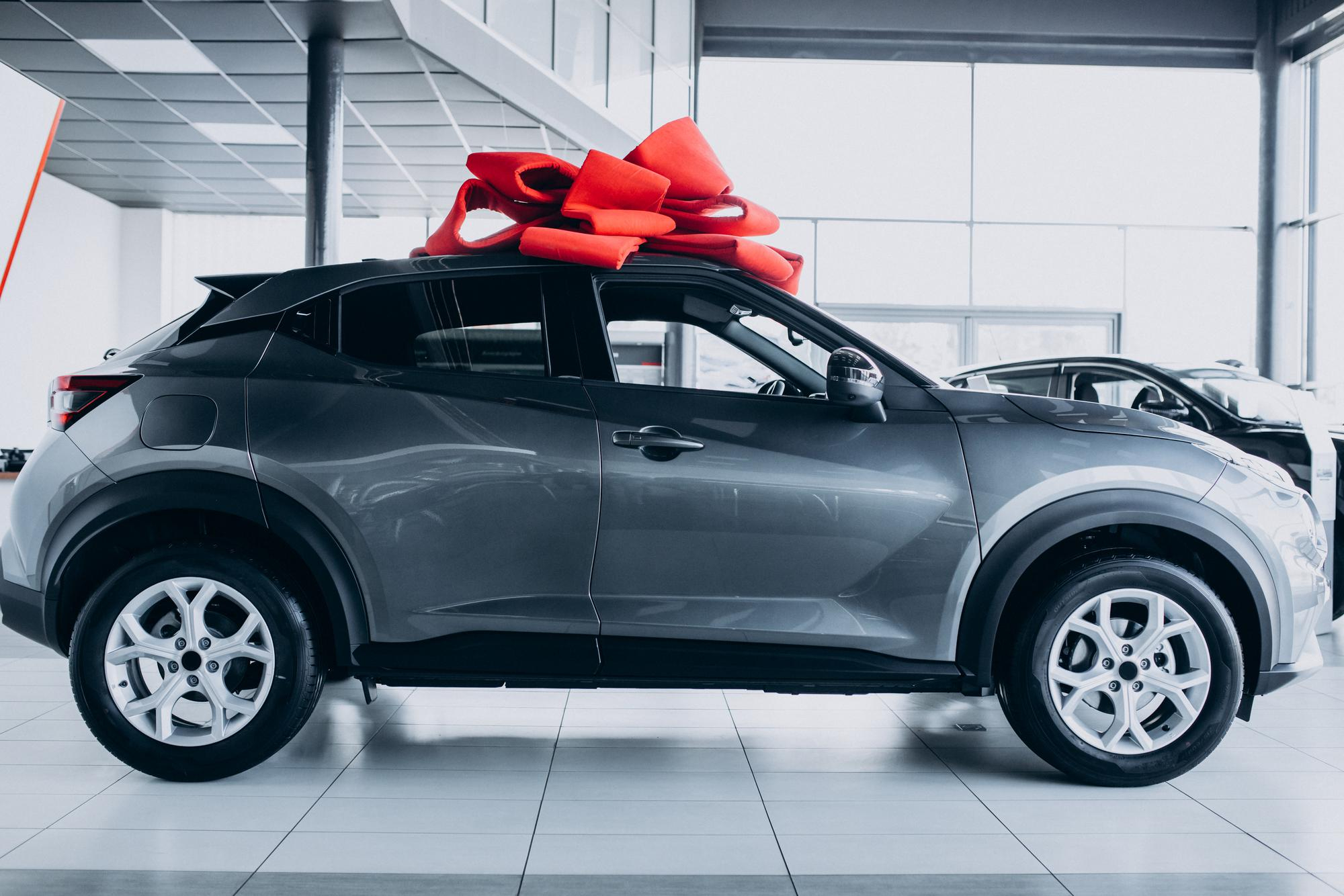
A brand-new car. Not a beater. Not a hand-me-down. Brand new, gleaming, a bow stuck on the hood like something out of a commercial. The kind of car not one single kid at my school had. The kind of car that cost more than my mom made in a lot of months.
I just stared at it.
My father grinned, soaking up my reaction, misreading it completely. “Happy birthday, son,” he said.
Son. The word landed strange. He hadn’t earned the word. He’d been gone for the word.
My mom had come out onto the porch behind us. She said nothing. Ray had come out too, and he was standing a little back, near the porch railing, both his hands tucked into his pockets, and he was looking at the car with an expression I couldn’t quite read, but that I understood later. He was looking at a brand-new car that he could never in a million years have bought me, and he was doing the same math I always did, and the math was breaking his heart.
My father was still grinning at me, holding out the keys, waiting for the explosion of gratitude he was sure was coming. But then he did the thing that changed everything. He turned, slightly, just enough, toward Ray. And he said, loud enough for everyone on that porch to hear:
“Now he knows who his real father is.”
—
The driveway went silent.
I watched Ray. I watched him lower his eyes. I watched this good man, this man who’d come to every game, who’d pushed the chemistry book back across the table at eleven at night, who’d emptied his last twenty dollars into a secret account for my future, I watched him drop his gaze to the ground because a man who’d done nothing for fourteen years had just claimed me with a checkbook and dismissed him in the same breath.
My father extended his hand further, the keys resting in his open palm, glinting in the sun. Proud. Certain. Waiting for the thank-you he was positive he’d bought and paid for.
And I had fourteen years of things I could have said.
I could have humiliated him right there in that driveway. I could have listed it all out, cold and sharp, every single thing. I could have said, my real father came to every baseball game even when I never left the bench. I could have said, my real father sat up with me until midnight over chemistry he didn’t understand because he refused to let me quit. I could have said, my real father has been putting his last dollars into a college fund for me every month, in secret, expecting nothing, while you were off being nobody’s father at all. I could have said, you don’t get to buy fourteen years back with a car. You don’t get to show up with a bow on a hood and call yourself real. Real isn’t a thing you purchase. Real is a thing you do, over and over, on the boring Tuesday nights when nobody’s watching and there’s no credit in it.
Every word of it was sitting right there on the tip of my tongue. I could have wiped that smile off his face and left it on the driveway.
But I didn’t say any of it. Because I realized, standing there, that humiliating him would make the moment about him. And I didn’t want this moment to be about him. He’d already taken enough. I wasn’t going to give him the main role in the story of my seventeenth birthday, even as the villain.
I wanted the moment to be about Ray.
So I turned away from my father, away from the keys, away from the shiny new car, and I looked toward the porch.
“Ray,” I said.
He looked up, surprised.
“Come here for a second.”
—
Ray hesitated. He glanced at my mom, then at my father, then back at me, like he wasn’t sure he was allowed. Like he thought maybe I was calling him over to receive some kind of blow. He unhooked his hands from his pockets and came down off the porch, slow, uncertain, and crossed the driveway to where I stood.
And when he got to me, I did something I’d never done in the whole time I’d known him. I put my arm around his shoulders, and I turned both of us to face my biological father, and I said, clear and steady, loud enough for everyone to hear:
“This is my real father.”
The grin froze on my father’s face.
“This is him,” I said, and my voice didn’t shake at all, which surprised me. “This is the guy. Ray. He’s been here for one year, and he’s been more of a father to me in that one year than you’ve been in my whole life. He comes to every game. Every one. Even when I don’t play. He stayed up till midnight helping me pass chemistry when I wanted to quit. He’s been putting money away for my college out of a budget that doesn’t have any room in it, and he did it in secret, and he never once told me, because he didn’t want me to feel like I owed him anything.” I felt Ray go rigid beside me, felt him realize I knew about the account. “So you can keep the car.”
My father’s hand, still holding the keys, dropped a few inches.
“You can keep the car,” I said again. “Because a real father isn’t the guy who shows up once with something expensive and expects it to erase everything he skipped. A real father is the guy who shows up a thousand times for nothing. For no credit. For no thank-you. Just because he decided you’re worth it.” I looked right at him. “You didn’t decide I was worth it. Ray did. So he’s my real father. Not you. Money doesn’t make it. Showing up makes it. And you never showed up.”
—
You could have heard a pin drop in that driveway.
My father stood there, and I watched his whole face change, watched the certainty crumble off of it, watched him understand that the grand gesture he’d been so proud of had blown up in his hands. He’d walked in expecting to be crowned. He’d expected me to take those keys and turn to Ray with a smug new-car glow and let him feel replaced. He’d built the whole moment around that. And instead I’d taken his one big move and used it to say, out loud, in front of everyone, exactly whose son I actually was.
“I—” he started. “I bought you a car. A brand-new car. Do you know what that cost?”
And there it was. Do you know what that cost. As if cost was the measure. As if the size of the check was the size of the love. He didn’t understand. He genuinely didn’t understand, and I realized in that moment that he never would, that this was the whole problem with him, that he thought fatherhood was a transaction and you could settle the account with one big enough payment.
“I know exactly what it cost,” I said quietly. “I’ve known what everything costs my whole life. That’s the thing you never had to learn, because you weren’t here. I can tell you what a car costs, and I can tell you what fourteen years of birthdays cost, and I can tell you they’re not the same thing, and you can’t pay one with the other.”
My father looked at my mom. She met his eyes and didn’t say a word, but she didn’t have to; her face said everything, said this is his choice and he’s made it and I’m proud of him. He looked at Ray, who was standing there under my arm with tears now running openly down his face, this big quiet man just crying in a driveway. And my father seemed to finally understand that there was no room for him here. That the spot he’d come to reclaim had been filled, thoroughly, permanently, by a better man, and that no car on earth was going to un-fill it.
He set the keys down. Not in my hand. On the hood of the car, next to the bow. And he said, “I’ll go.”
And he went. He got in some other car parked at the curb, one I hadn’t even noticed, and he drove away, leaving the brand-new one sitting in our driveway with a bow on it and the keys on the hood.
We never really heard from him again after that. A card, once, a year or so later, that I didn’t open for a long time and don’t fully remember the contents of. He drifted back out of my life the same way he’d drifted in, and this time I didn’t wonder about him the way I had as a little kid. Because the blank space where a father was supposed to be wasn’t blank anymore. It had Ray in it.
—
Here’s what happened with the car, since I know you’re wondering.
We didn’t keep it. Not the way you might think. I couldn’t stand it sitting in the driveway, honestly, this glittering monument to the wrong idea of love. And Ray, being Ray, wouldn’t hear of just giving it back or selling it and pocketing the money like it was some kind of prize we’d won.
In the end, it was my mom who figured it out. We sold the car. And the money from it, all of it, went into that college account. The secret one. The one Ray had been filling twenty and fifty dollars at a time. My biological father’s one grand gesture, the thing he’d meant to prove he was the real father, ended up funding the future that my real father had been quietly building all along. There was something perfect about that. His money, poured into Ray’s dream for me. The car he bought to erase Ray instead became the biggest single deposit Ray’s account ever got.
I told Ray about it, after, when it was just the two of us. I told him I knew about the account. That Mom had let it slip months ago and I’d been carrying it around, this knowledge of what he’d been doing for me in secret.
He got embarrassed. He waved it off. “It’s not much,” he said. “It’s whatever’s left over. It’s not—it’s nothing, really.”
“Ray,” I said. “It’s not nothing. It’s the opposite of nothing. It’s everything.”
And then I said the thing I’d never said to him in the whole year I’d known him, the thing I’d been careful about the same way he’d been careful, both of us tiptoeing around a word neither of us wanted to force.
“Can I call you Dad?” I asked. “I’d like to. If that’s okay.”
Ray, this grown man, this quiet man who never made a big deal out of anything, put his hand over his face and cried for the second time in one day. And when he could talk again, he said, “Yeah. Yeah, I’d—yeah. I’d like that. I’d like that a lot.”
—
That was a while ago now.
I did go to college, in the end. That account, the one built out of leftover twenties and fifties and one guilty brand-new car, got me there. Not all the way, I worked jobs and took some loans like everybody does, but it got me started, it gave me the shot Ray wanted me to have, the shot he’d said he just wanted me to get.
Ray, my dad, still comes to things. He came to my college graduation and stood up and cheered too loud, exactly like he used to at the baseball games where I never played, and it was exactly as embarrassing and exactly as wonderful. Danny and Cara are basically my brother and sister now, no half about it, and I’d walk through fire for either of them. My mom and Ray are still together, still stretching money that’s always been too stretched, still the happiest household of not-quite-enough that I’ve ever seen.
People hear this story and they focus on the car. On the dramatic moment, my biological father’s face falling, the keys on the hood. And I get it, that’s the part with the punch. But that’s not the part that matters to me. The part that matters to me happened over a whole year of ordinary days that nobody would make a story out of. The bleachers. The chemistry book pushed back across the table. The secret account, twenty dollars at a time.
Because that’s the whole meaning of it, the thing I understood in that driveway with fourteen years of angry words sitting on my tongue. Anybody can make a grand gesture. Anybody with a big enough checkbook can buy a bow and stick it on a hood and call themselves a father. The grand gesture is easy. It’s cheap, actually, no matter what it costs, because it asks nothing of you but money and a single afternoon.
What’s hard is the thousand small gestures. Showing up to the game where your kid rides the bench. Sitting up past midnight over homework you don’t understand. Putting your last twenty dollars toward a future you’ll never take credit for. That’s not cheap. That costs you something real, and it costs you again and again, on the boring days when there’s no audience and no thank-you and no dramatic music. That’s what love actually is. Not the one big moment. The ten thousand small ones nobody’s watching.
My biological father thought he could buy his way back into fatherhood with one shining afternoon. And he found out, standing in my driveway, that fatherhood isn’t for sale. It’s not a thing you purchase. It’s a thing you build, quietly, over years, out of showing up, and Ray had built it while my father wasn’t looking, one baseball game and one chemistry problem and one leftover twenty-dollar bill at a time.
He asked, that day, if I knew who my real father was. And I did.
I’d known for about a year.
His name was Ray. And the day I got to call him Dad was worth more than any car ever built.

Specialty: Legal & Financial Drama
Michael Carter covers stories where money, power, and personal history collide. His writing often explores courtroom battles, business conflicts, and the subtle strategies people use when pushed into a corner. He focuses on grounded, realistic storytelling with attention to detail and believable motivations.