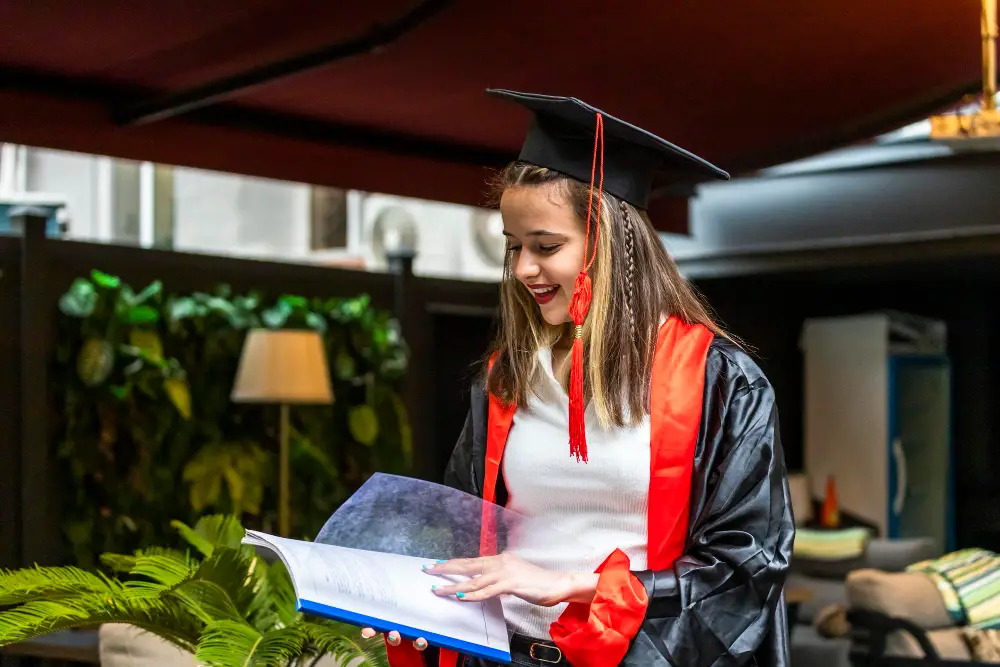
Everyone at graduation had someone cheering for them.
Everyone except me.
I could hear them from the stage. A woman in the fifth row screaming “THAT’S MY BABY!” so loud the principal paused. A whole family in matching purple T-shirts with a boy’s face printed on the front. Somebody’s little brother blowing an air horn until a teacher took it away. A grandpa standing on his folding chair, waving a cowboy hat.
Every name got its own noise.
Madison Albright. Screaming.
Tyler Banks. Air horn.
Jasmine Bell. A whole section of the bleachers on its feet.
And then the principal leaned into the microphone.
“Callie Brooks.”
And the gym gave me the same polite clapping it gives to a name nobody knows. The kind of clapping people do while they’re checking their phones. The kind that’s already fading before you’re halfway across the stage.
I walked anyway.
Black gown. Black cap. My father’s watch on my wrist, too big, sliding up and down every time I moved. I’d had a jeweler take out two links, and it still didn’t fit. I wore it anyway.
Mr. Delgado handed me my diploma. He shook my hand. He leaned in close and said, “Proud of you, Callie,” in a quiet voice, because he knew. All the teachers knew.
I said thank you. I turned toward the photographer at the edge of the stage. I made myself smile for the camera.
And that was when two hands came up from behind me and covered my eyes.
Warm. Rough. A little bit of a callus on the side of one finger.
And a deep voice, right next to my ear, said:
“Guess who finally made it?”
I need to go back.
To November.
My parents died on a Tuesday night in November. The week before Thanksgiving.
They were driving home from a dinner party at my dad’s boss’s house. It was raining. A pickup truck coming the other way crossed the center line on Route 40, right by the old grain elevator. The police officer who came to our door said they didn’t suffer. He said it was very fast.
I don’t know if that’s true. I think it’s something police officers say.
I was home alone that night. Doing calculus homework at the kitchen table. When the doorbell rang at 11:40, I thought it was my parents. I thought they’d forgotten their keys.
I opened the door, and it was a police officer and a woman from the county with a clipboard. The woman had very kind eyes. She asked if there was an adult in the house.
I said no.
She asked if there was somebody she could call.
I said, “My grandma.”
My grandmother’s name is Beatrice. Everybody calls her Bea.
She’s eighty-one. She lives in a little white house on Sycamore Street, about two miles from where I grew up. She has a porch swing and a garden full of tomatoes and a cat named Biscuit who hates everybody but me.
She raised my dad by herself after my grandfather died. And when I was little, before I started school, she raised me too. My parents both worked, and Grandma Bea watched me every single day. She taught me how to read. How to make biscuits. How to swear in Italian, which she learned from her own mother and which my parents did not appreciate.
That night in November, she drove over in her old Buick at midnight. In her nightgown with a raincoat over it. She didn’t even put shoes on. She came up the porch steps in her slippers, and she pulled me into her arms, and she held on.
We stood there in the doorway for a long time. In the cold. Neither of us said anything.
Then she said, “Get your things, sweetheart. You’re coming home with me.”
I’ve lived with her ever since.
She tried so hard.
I want to say that first. Before anything else. She tried harder than anybody has ever tried at anything.
She learned how to use the school’s parent portal so she could check my grades. It took her three weeks and four phone calls to the front office. She learned how to text. She sent me messages every afternoon at 2:45, right when school let out. Drive safe. Love you. There’s soup. Every single day.
She came to my two cross-country meets in the fall, before. She stood at the finish line in her red coat and cheered louder than anybody.
She tried to be my parent and my best friend and my grandmother all at the same time.
But she was eighty-one. And something was changing.
I started noticing in January.
Her hands shook when she poured tea. Just a little at first. A little tremor in the pot. A few drops on the table.
By March, it was more. She’d fill the cup halfway and stop. Hold the pot with both hands. Breathe. Then finish.
She got out of breath walking to the mailbox. It’s at the end of her driveway. Maybe fifty feet. She’d stop halfway. She’d put her hand on the fence post. She’d pretend she was looking at the tulips.
“They’re coming up nice this year,” she’d say. Breathing hard.
“Grandma. Are you okay?”
“I’m eighty-one, Callie. Nobody’s okay at eighty-one. We’re just here.”
She went to the doctor in April. She wouldn’t let me come in with her. She said it was her heart. She said it was “old-lady stuff” and the doctor gave her new pills and she was fine.
She wasn’t fine. I could tell. She slept more. She didn’t garden. She stopped walking Biscuit around the block. She stopped driving the Buick after dark.
And I knew, long before she said it, that she wasn’t going to make it to my graduation.
The ceremony was in the high school gym. Two hours on metal bleachers. In June. With no air conditioning and four hundred and twelve names.
I knew.
At school, people noticed.
Not in a mean way. Nobody was mean. That’s what’s strange about grief. Everybody’s so nice to you that it’s almost worse.
They just didn’t know what to do with me.
My friends sent flowers in November. They came to the funeral. They hugged me. They cried. They said, “Let me know if you need anything.”
And then, after a while, they stopped knowing what to say. So they didn’t say anything.
They’d see me in the hallway and smile too hard. They’d invite me to things and then look relieved when I said no. They’d be laughing about something at lunch, and I’d sit down, and the laughing would stop, and somebody would say, “Hey, Callie,” in a soft, careful voice. Like I was something that might break.
So I stopped sitting down.
I ate lunch alone. In my car, mostly. In the student parking lot. With the radio on. A peanut butter sandwich and an apple Grandma packed for me in a brown paper bag with my name on it in her shaky handwriting.
I walked to my car alone. Every day.
And when other kids took family pictures after pep rallies and awards nights, their parents screaming their names, everybody swapping hugs, I’d stand a few feet away. Looking at my phone. Like I had somewhere else to be.
I never had anywhere else to be.
There was one person I could have called.
I didn’t.
My brother’s name is Danny. He’s six years older than me. Twenty-four.
When I was little, he was my whole world. He taught me to ride a bike in the church parking lot. He let me sleep in his room during thunderstorms. He walked me to the bus stop every morning until he got his driver’s license, and then he drove me to school in his crappy old Honda with the broken heater, and we’d sing along to the radio so loud people at stoplights stared at us.
He had this thing he used to do. When I was little. He’d sneak up behind me and cover my eyes with his hands and say, “Guess who?”
And I’d always say, “Danny.”
And he’d say, “Wrong! It’s the Tooth Fairy!” Or the mailman. Or Abraham Lincoln.
I’d laugh so hard I couldn’t breathe.
Danny enlisted in the Army when he was nineteen. Right after his freshman year of college. He didn’t tell anybody he was going to do it. He just did it.
My dad was furious. They had a huge fight in our kitchen. I was thirteen. I sat on the stairs and listened to them yell. My dad said he was throwing his life away. Danny said it was his life to throw.
They didn’t speak for almost a year after that.
They made up eventually. Sort of. Danny came home at Christmas, and my dad shook his hand at the door, and that was that. That’s how it works with men in my family. A handshake at the door, and nobody ever talks about it again.
But Danny was gone. Most of the time. Training in Georgia. Then stationed in Texas. Then overseas.
And the year before my parents died, the summer before my senior year, Danny and I had a fight of our own.
He’d come home on leave for two weeks in July.
I was seventeen. I was so excited. I’d been counting down the days for a month. I had a whole list of stuff we were going to do. The lake. The county fair. The drive-in movie theater out on Route 9.
He came home, and he was different.
Quiet. Tired. He slept until noon. He didn’t want to go to the lake. He didn’t want to go to the fair. He sat on the back porch at night by himself, staring at the yard, drinking beer. He jumped when car doors slammed.
And at the end of the first week, he told me he was leaving early.
“I got called back,” he said. “I have to go.”
I found out later that he hadn’t been called back. He’d volunteered to go back early. He’d asked to.
I didn’t know that then. All I knew was that my big brother had come home for two weeks and spent one of them sleeping and the other one leaving.
We were standing in the driveway. He was putting his duffel bag in the back of the rental car.
“You always do this,” I said.
“Do what?”
“Leave. You always leave. You left for college. You left for the Army. You left when Dad yelled at you. Now you’re leaving again. Early. You don’t even want to be here.”
“Callie, that’s not—”
“You know what, just go,” I said. “Just go. It’s what you’re good at.”
He looked at me for a long time.
Then he got in the car and drove away.
And I didn’t answer his calls after that.
Not one. He called on my birthday in September. I let it ring. He texted. I didn’t text back. He sent a card at Halloween, a stupid one with a cartoon ghost, and I threw it in a drawer without opening it.
I was seventeen and I was angry and I thought I had all the time in the world to stop being angry.
Then November happened.
Danny was deployed when my parents died. Overseas. In a place with no cell service and a satellite phone that worked one day a week.
The Army notified him. It took them two days to reach him.
It took him five more days to get home. Planes and layovers and paperwork. He kept calling Grandma from airports. Germany. Then Maryland. Then Chicago.
The funeral was on a Saturday. One week after the accident. We couldn’t wait any longer. Grandma talked to the funeral home. She talked to the pastor. They couldn’t wait.
Danny’s plane landed in Indianapolis at 2:15 that afternoon.
The funeral started at one.
By the time he got to the church, it was over. Everybody was standing outside in the parking lot. In the cold. In their black coats.
I saw him get out of a cab. In his uniform. Running across the parking lot.
He was too late.
He stopped in front of me. He was out of breath. His face was gray.
“Callie,” he said. “Callie, I’m so—”
I turned around and walked away.
I didn’t say a word to him.
I got in Grandma’s Buick and sat in the passenger seat and stared straight ahead. Grandma stood in the parking lot with him for a long time. Talking. Holding his arm. I watched them through the windshield.
He stayed for four days. At Grandma’s house. Sleeping on the couch. He tried to talk to me. Every day. He knocked on my bedroom door.
I didn’t open it.
On the fifth day, he had to go back. His unit was still deployed. He’d only been granted emergency leave.
He stood outside my bedroom door that last morning.
“Callie,” he said through the door. “I have to go. I’m sorry. I’m so sorry. I tried. I tried so hard to get here.”
I didn’t answer.
“I’ll call,” he said. “I’ll call every week.”
He did.
I never picked up.
That was seven months ago.
Seven months of my phone buzzing every Sunday at 4:00 p.m. Danny. Seven months of letting it ring. Seven months of voicemails I didn’t listen to. Forty-one of them, by June. I counted once. I never pressed play.
Grandma talked to him. Every Sunday. On the kitchen phone. I’d hear her in there with the door half-closed. Talking quietly. Laughing sometimes. Crying sometimes.
She never pushed me. Not once. She never said You should call your brother. She never said He misses you. She never said You’re being unfair.
She just left the kitchen door open a little. Every single Sunday.
The morning of graduation, I almost didn’t go.
I was sitting on the edge of my bed in my bathrobe. My gown was hanging on the back of the closet door. Black. Still in the plastic from the dry cleaner.
I was staring at it.
Grandma came to the doorway. Slowly. Holding onto the frame.
“You’re not dressed,” she said.
“I’m not going.”
She didn’t say anything for a moment.
“What’s the point?” I said. “Seriously, Grandma. What’s the point? I’ll walk across a stage. Everybody will clap for two seconds. Nobody’s going to be there. I’ll get a piece of paper I could just get in the mail. And I’ll stand there afterward watching everybody else hug their families.”
My voice cracked.
“If no one’s going to be there,” I said, “what’s the point?”
Grandma walked across the room.
Very slowly. One hand on the dresser. One hand on the bedpost. It took her a long time.
She sat down next to me on the edge of the bed. It took her a while to get settled. She was breathing hard.
Then she reached over and took both of my hands in hers.
Her hands were cold. And thin. I could feel every bone. And they were shaking.
“Just get your diploma, sweetheart,” she said.
“Grandma—”
“One last day,” she said. “Just one. Your mother wanted to see you walk across that stage more than anything in the world. She talked about it when you were in kindergarten. She said, Bea, I’m going to scream so loud at that girl’s graduation they’re going to kick me out.“
I laughed. A wet, broken laugh.
“She would have,” I said.
“She absolutely would have,” Grandma said. “Your father would’ve been embarrassed. He’d have pretended he didn’t know her.”
She squeezed my hands.
“I can’t sit on those bleachers, Callie,” she said. “My heart won’t let me. You know that. I’m sorry. I’m so sorry I can’t be there.”
“I know, Grandma. It’s not your fault.”
“But I want you to go,” she said. “Do it for me. Please. One last day. Walk across that stage for your mother. And your father. And for me.”
I looked at her. At her thin face. At her white hair, which she’d curled that morning, even though she wasn’t going anywhere.
“Okay,” I said. “For you.”
She smiled.
“That’s my girl,” she said.
What I didn’t know, sitting there on the edge of my bed in my bathrobe, was that three weeks earlier, Grandma had sat down at her kitchen table with a pad of lined paper and a ballpoint pen.
And she’d spent three days writing one single letter.
It took her three days because her hands shook so badly. She’d write a few lines and then have to stop. Rest her hands. Start again. She tore up the first two drafts because she said the handwriting was too messy.
She addressed it to somebody I hadn’t spoken to in over a year.
She mailed it to an Army post office address in New York, which forwarded it to a base on the other side of the world.
And I didn’t know that it had already been answered.
So I put on my gown.
Grandma helped me with my cap. She pinned it into my hair with bobby pins. Her hands were shaking so badly it took her ten minutes.
“There,” she said finally. “Beautiful. You look just like your mother.”
At the front door, she hugged me for a long time.
“Callie,” she said into my shoulder. “Promise me something.”
“What?”
“When they call your name,” she said, “don’t look at the floor. Okay? Don’t look down. Look up. Look out at the crowd. Promise me.”
“Why?”
She pulled back. She looked at me with her bright, watery eyes.
“Just promise me,” she said.
“Okay. I promise.”
She patted my cheek.
“Go on,” she said. “You’ll be late.”
I drove to school by myself. In my dad’s old truck. With the windows down.
I parked in the student lot. I sat there for a minute. With my hands on the steering wheel.
Then I got out and walked into the gym.
The ceremony was long.
Four hundred and twelve names. Alphabetical. Speeches by the principal and the superintendent and the valedictorian, a boy named Jordan Kim who talked for twenty minutes about the future and used the word journey nine times. I counted.
I sat in my folding chair on the gym floor, in the second section, between Brianna Briggs and Marcus Brown. I looked up at the bleachers.
They were packed. Every seat. Families waving signs. CONGRATS MADISON! WE LOVE YOU TYLER! Balloons. Flowers wrapped in cellophane. Grandmas fanning themselves with programs.
I didn’t look for anybody.
There was nobody to look for.
And then they got to the B’s.
I stood up with my row. We walked to the side of the stage. We lined up.
Madison Albright. Screaming. Tyler Banks. Air horn. Jasmine Bell. The whole section standing up.
I was fourth in line. Then third. Then second.
Brianna Briggs. Her mom crying and yelling at the same time.
Then it was me.
“Callie Brooks.”
I walked up the three steps onto the stage.
I heard the polite clapping. The soft, scattered sound of four hundred strangers being nice.
And I remembered what I promised Grandma.
Don’t look at the floor. Look up.
So I looked up.
I looked out at the bleachers. At the sea of faces. At the signs and the balloons and the flowers.
I didn’t see anybody. Of course I didn’t.
Mr. Delgado shook my hand. “Proud of you, Callie.”
I turned toward the photographer.
And two hands covered my eyes.
“Guess who finally made it?”
I froze.
Right there. In the middle of the stage. With my diploma in one hand and two warm hands over my eyes.
Everything in me went still. My heart. My breath. My whole body.
I knew that voice.
I knew those hands. The callus on the side of the finger from years of holding a pencil wrong. From years of holding a rifle.
I knew that game.
Guess who.
I didn’t say Danny.
I couldn’t say anything. My throat had closed up completely.
I just reached up with my free hand and grabbed his wrist. And held on. So hard my fingers hurt.
He took his hands away from my eyes.
And I turned around.
He was standing right behind me. On the stage.
In his dress uniform. Dark green. With all his ribbons and badges on the chest. His cap tucked under his arm. His hair cut so short I could see his scalp.
He looked older. So much older than seven months ago. There were lines around his eyes that weren’t there before. He was thinner.
He was crying.
My big brother. Standing on the stage in the high school gym. In front of four hundred and twelve graduates and two thousand people in the bleachers. Crying.
“Hey, Cal,” he said.
I don’t remember deciding to do it.
I just dropped my diploma. Right on the stage. It hit the floor and rolled away.
And I threw my arms around my brother’s neck.
He caught me. He lifted me right off my feet. Like he used to when I was little. He held on. I could feel him shaking.
“I’m sorry,” I said into his shoulder. Over and over. “I’m sorry. I’m sorry. I’m so sorry, Danny.”
“Don’t,” he said into my hair. “Don’t. You don’t have to be sorry. I’m the one who’s sorry.”
“I didn’t answer. I never answered. Seven months.”
“I know.”
“Forty-one voicemails.”
He laughed. A wet, shaky laugh.
“You counted?”
“I counted. I never listened to them. I counted.”
“Some of them were pretty good,” he said. “One of them was just me singing the Pizza Hut jingle.”
I laughed into his uniform. Snot and tears all over his ribbons.
And then I heard it.
The gym.
It had gone completely silent. For a few seconds. Two thousand people. Holding their breath. Watching a soldier hold a girl on a stage.
And then somebody started clapping.
Not polite clapping. Real clapping. Loud.
Then somebody else. And somebody else. Then the whole first section of bleachers stood up. Then the second section. Then everybody.
Two thousand people. On their feet. Clapping and cheering and whistling.
The woman who screamed THAT’S MY BABY was screaming again. The family in the purple T-shirts was cheering. The grandpa on the folding chair was waving his cowboy hat over his head.
Mr. Delgado had his hand over his mouth.
I looked out at all of them over Danny’s shoulder. And I couldn’t believe it.
For me.
They were cheering for me.
Danny set me down. He picked up my diploma off the floor. He brushed it off and handed it back to me.
“You dropped this,” he said.
“I know.”
“Kind of important.”
“I know, Danny.”
He wiped his eyes with the back of his hand.
“Okay,” he said. “We’re holding up the line. There are like three hundred more kids. Let’s go.”
“Wait,” I said. “How did you—when did you—how are you here?”
He smiled. That crooked smile. The one from the Honda with the broken heater.
“Ask her,” he said.
And he pointed.
Out into the gym. Past the stage. Past the graduates in their folding chairs.
To the very end of the front row. Where there’s a little open space for wheelchairs.
My grandmother was sitting there.
In a wheelchair. In her best blue dress. The one she wore to my parents’ wedding. With her white hair curled. With a corsage of white roses pinned to her chest.
She was crying too.
And she was waving at me.
With both hands. Over her head. Like she was at a football game.
I don’t remember walking off the stage.
I know I did, because the next thing I remember, I was kneeling on the gym floor in front of her wheelchair. With my gown spread out around me. With my face in her lap.
“You said you couldn’t come,” I said. “You said your heart—”
“My heart couldn’t do the bleachers,” Grandma said. She stroked my hair. Very gently. Around the bobby pins. “Your brother fixed that. He called the school. He arranged the wheelchair spot. He came and picked me up an hour after you left.”
“You knew? This morning? When you made me promise?”
“I knew,” Grandma said.
“You made me promise to look up.”
“I wanted you to see him coming,” she said. “But he snuck around the back. I told him not to. He never listens.”
“I never listen,” Danny agreed. He was standing behind her wheelchair now. With his hands on her shoulders. “It’s a family trait.”
The principal had moved on. The names were going again. Marcus Brown. Tiffany Bryant. Kevin Bui. But I didn’t hear any of them.
I knelt there on the gym floor between my grandmother and my brother. And for the first time in seven months, I didn’t feel like I was standing a few feet away from everybody else.
After the ceremony, we went outside.
It was a beautiful evening. Warm. The sky was turning orange and pink over the football field. Families everywhere on the front lawn. Taking pictures. Hugging. Kids throwing their caps in the air.
Danny pushed Grandma’s wheelchair across the grass. I walked next to them.
And for the first time all year, I didn’t have to stand a few feet away, pretending to look at my phone.
A woman I didn’t know came up to us. Somebody’s mom. She had tears in her eyes.
“I’m sorry,” she said. “I just—I had to say something. That was the most beautiful thing I’ve ever seen. Thank you for your service,” she said to Danny. “And congratulations, honey,” she said to me.
Then another woman. Then a man. Then a teacher. Then a whole group of kids from my calculus class. People I barely talked to all year.
Brianna Briggs hugged me so hard she knocked my cap off.
“Why didn’t you tell anybody you had a brother?” she said. “He’s hot.”
“Brianna.“
“I’m just saying.”
Danny turned bright red. Grandma laughed so hard she started coughing.
Mr. Delgado found us by the flagpole.
He shook Danny’s hand. He held it for a long time.
“Thank you,” he said quietly. “For getting here.”
“I almost didn’t,” Danny said. “My flight got delayed in Atlanta. I landed at noon. I drove straight from the airport.”
“You made it,” Mr. Delgado said. “That’s what matters.”
He looked at me.
“Take the picture,” he said. “The one you didn’t get to take onstage. Take it now.”
A photographer from the school was walking around the lawn. Mr. Delgado waved him over.
I stood in front of the flagpole. In my black gown. Holding my diploma.
Danny stood on one side of me. In his uniform.
Grandma sat in front of us. In her wheelchair. In her blue dress.
My dad’s watch slid down my wrist.
“Okay,” the photographer said. “Everybody smile.”
Danny put his arm around my shoulders. Grandma reached up and held my hand.
I didn’t have to make myself smile this time.
Click.
That night, we went to the Chinese restaurant on Main Street. The Golden Dragon. It was my dad’s favorite. We used to go there every Friday when I was little. All four of us. Then all three of us, after Danny left. I hadn’t been back since November.
The owner, Mrs. Liu, recognized us the second we walked in. She’d known my parents for twenty years.
She came over to our table. She looked at me in my gown. She looked at Danny in his uniform. She looked at Grandma in her wheelchair.
She put her hand on her heart.
“Your mother would be so proud,” she said to me. “So proud. She talked about you all the time. Every Friday.”
She brought us a whole bunch of food we didn’t order. Egg rolls. Crab rangoon. A plate of orange chicken with a little paper umbrella stuck in it.
“On the house,” Mrs. Liu said. “Graduation dinner. Your father always ordered the orange chicken. Every single time. Twenty years.”
We ate. We laughed. Grandma told stories about Danny when he was a baby. How he used to eat dirt out of her garden. How he once flushed her car keys down the toilet.
“I was two,” Danny said.
“You were four,” Grandma said. “And you did it on purpose. You told me you wanted to see where they went.”
I laughed so hard orange chicken came out of my nose.
It was the first time I’d laughed like that in seven months. The kind of laugh that hurts your stomach.
After dinner, Grandma got tired. Danny drove us home in his rental car. He carried her up the porch steps. Actually carried her. Like a bride. She told him to put her down. He didn’t listen.
He put her to bed. Biscuit jumped up on the bed and curled up by her feet. Biscuit hates everybody. He let Danny scratch his ears.
Then Danny came out to the back porch, where I was sitting on the porch swing.
He sat down next to me.
For a long time, neither of us said anything. The swing creaked. Crickets were singing in the grass. Fireflies were starting to come out over Grandma’s garden.
“How long do you have?” I asked finally.
“Ten days,” Danny said. “Emergency family leave. My commanding officer signed off on it after he read Grandma’s letter.”
“What letter?”
He looked at me.
“She didn’t tell you?”
“Tell me what?”
He reached into the inside pocket of his uniform jacket. He pulled out an envelope. Worn soft. Folded and unfolded so many times the edges were fuzzy.
He handed it to me.
The handwriting on the front was Grandma’s. Shaky. Uneven. The letters going uphill and downhill.
Sgt. Daniel Brooks. And a long military address with a lot of numbers.
I opened it.
It was three pages. On yellow lined paper. In the shakiest handwriting I’ve ever seen. Some words were hard to read. She’d crossed some things out and started over.
Dear Danny,
It took me three days to write this so you better read it.
My hands are bad now. My heart is bad too. The doctor says I need to take it easy. I’m taking it easy. I’m sitting at the kitchen table. That’s as easy as it gets.
I need to tell you something and I need you to listen.
Your sister graduates on June 8th. At the high school. In the gym. At 6 o’clock.
I can’t sit on those bleachers. I’ve tried to tell myself I can. I can’t. I get winded going to the mailbox.
So she’s going to walk across that stage alone. And nobody is going to be there. Not her mother. Not her father. Not me.
Danny, I know she hasn’t answered your calls. I know she said some things. I know she walked away from you in the parking lot. I was there.
But I also know my granddaughter. She’s not angry at you, honey. She’s angry at the world. And you were the only one she could reach.
She thinks everybody leaves. Her parents left. You left. She thinks I’m going to leave too. She watches me pour my tea every morning like she’s waiting for me to drop the pot.
She’s seventeen and she’s alone and she’s so scared, Danny.
I can’t fix it. I’m too old and my heart’s too tired.
But you can.
You missed the funeral. I know you did everything you could to get there. I know it wasn’t your fault. I know it eats you alive.
Don’t miss this.
Please. I’m asking you. As your grandmother. As the woman who changed your diapers and fished your father’s car keys out of the toilet.
Just once. Show her that somebody comes back.
All my love,
Grandma Bea
P.S. Don’t tell her. Let it be a surprise. That girl hasn’t had a good surprise in seven months.
I read it twice.
Then I folded it up very carefully and held it in both hands. In my lap.
I couldn’t talk. For a long time.
The fireflies were blinking all over the garden now. Hundreds of them. Little green-gold lights.
“She wrote me back too,” Danny said quietly. “When I got the letter, I called her. On the satellite phone. I said, Grandma, I’ll be there. I don’t care what it takes. I’ll be there.“
“What did she say?”
He almost smiled.
“She said, You’d better be. Because if you miss this one too, I’m going to come over there and kill you myself. Heart or no heart.“
I laughed. Through the tears.
“That sounds like her.”
“It sounds exactly like her,” Danny said.
We sat on the swing for a while.
“Callie,” Danny said finally. “I need to tell you something. About the funeral.”
I looked at him.
“I tried,” he said. His voice was shaking. “I tried so hard. I want you to know that. When they told me, I was at a base with no airfield. They had to drive me six hours to the nearest one. In a truck. At night. Then I sat in an airport in Germany for fourteen hours because of a storm. I begged the guy at the desk. I begged him. I offered him every dollar I had. There were no seats.”
He put his face in his hands.
“I landed in Indianapolis at 2:15,” he said. “I took a cab. I told the driver to go as fast as he could. I told him I’d pay any ticket. I got to the church at 2:50.”
He looked up at me.
“And you were standing in the parking lot,” he said. “In your black dress. And Mom and Dad were already gone. And you looked at me like I was a stranger. And you turned around and walked away.”
“Danny—”
“And I deserved it,” he said. “I deserved it. Because you were right. In July. In the driveway. You were right. I do always leave. I left that summer early because I couldn’t stand being home. I couldn’t stand being around people who were happy and normal. After what I’d seen over there. I couldn’t sit at the lake and pretend everything was fine. So I left. I left you.”
He wiped his face.
“And then the one time I really, really needed to be there,” he said, “I couldn’t. And you were alone.”
I didn’t say anything for a long time.
Then I reached over and took his hand. The one with the callus.
“I wasn’t angry at you,” I said slowly. “In the parking lot. I mean—I was. But not really at you.”
He looked at me.
“Grandma’s right,” I said. “I was angry at everything. At the truck driver. At the rain. At Route 40. At God. At Dad, for taking the back road. At Mom, for making him go to that stupid dinner party. At myself, for not going with them.”
“Callie—”
“I was supposed to go,” I said. My voice broke. “Did you know that? I was supposed to go to that dinner party. Mom wanted me to come. I said no. I said I had calculus homework. I didn’t even have that much. I just didn’t want to go to a boring party with Dad’s boss.”
I was crying now. Hard.
“And if I’d gone,” I said, “maybe we’d have left at a different time. Maybe we’d have taken the highway. Maybe—”
“Stop,” Danny said. He squeezed my hand. “Stop. Cal. Look at me.”
I looked at him.
“If you’d gone,” Danny said, very quietly, “you’d have been in that car.”
I stared at him.
“And Grandma would have buried three people that day,” he said. “Not two. And I’d have gotten to that church at 2:50 and there would have been nobody in that parking lot. Nobody.”
He put his arm around me.
“You were supposed to be at that kitchen table, Callie,” he said. “Doing calculus. You were supposed to be here. You were supposed to walk across that stage today.”
We sat on that porch swing until almost two o’clock in the morning.
We talked about everything.
About Mom. How she sang off-key to the radio in the car and refused to admit it. How she cut the crusts off our sandwiches until Danny was twelve and he begged her to stop.
About Dad. How he wouldn’t let anybody else touch the grill. How he cried at every single Pixar movie and pretended it was allergies. How he and Danny shook hands at the door that Christmas and never talked about the fight again.
“He was proud of you,” I told Danny. “He never said it. But he was. He had a picture of you in your uniform on his desk at work. His boss told me at the funeral. He said Dad showed it to everybody.”
Danny didn’t say anything for a long time. He just stared at the fireflies.
“I didn’t know that,” he said finally.
“I know you didn’t. He was bad at saying stuff.”
“We all are,” Danny said. “It’s a family trait.”
I told him about the year.
About eating lunch in my car. About walking to the parking lot alone every day. About standing at the edge of every family picture, looking at my phone.
About Grandma’s hands shaking. About her stopping halfway to the mailbox. About lying awake at night listening to her breathe through the wall.
“I’m scared all the time,” I said. “That she’s going to—that I’m going to wake up and she’s going to be—”
“I know,” Danny said.
“I’m scared she’s going to leave too.”
He held my hand tighter.
“She’s not going anywhere yet,” Danny said. “I talked to her doctor today. Before the ceremony. She signed something so he could talk to me.”
“What did he say?”
“He said her heart’s tired. He said she needs to rest more. He said she shouldn’t be alone so much. But he said she’s tough. He said she might surprise everybody.”
“She surprised me today,” I said.
Danny laughed.
“She surprises everybody,” he said.
Danny stayed for ten days.
He slept on Grandma’s couch with Biscuit on his chest. He fixed the leaky faucet in the bathroom. He mowed the lawn. He took Grandma to her doctor’s appointment and sat in the waiting room for two hours. He weeded her whole garden on his hands and knees while she sat on the porch in her wheelchair and told him he was doing it wrong.
He took me to the lake. Finally. The one he didn’t want to go to last summer.
We sat on the dock with our feet in the water. We didn’t talk much. We didn’t need to.
He took me to the drive-in on Route 9. We watched a terrible horror movie and threw popcorn at the screen. We sang along to the radio on the way home. Loud. With the windows down. People at stoplights stared at us.
On the eighth day, he took me to the cemetery.
I hadn’t been since the funeral. Seven months. I couldn’t go. I’d drive past and keep driving.
We stood in front of the gray stone together. Both of their names. Side by side.
Danny took off his cap. He stood there at attention for a long time.
“I’m sorry I was late, Dad,” he said quietly. “I’m sorry I was late, Mom.”
Then he reached into his pocket. He pulled out a little folded piece of paper. He set it at the bottom of the stone. Under a rock, so it wouldn’t blow away.
“What’s that?” I asked.
“Your graduation program,” Danny said. “I took two. So they’d know.”
I stood there and held my brother’s hand and cried in the cemetery. And for the first time since November, it didn’t feel like drowning.
It felt like letting something go.
On the tenth day, he had to leave.
He stood in Grandma’s driveway in his uniform with his duffel bag. Next to the rental car. In almost the exact same spot where I yelled at him a year ago.
Grandma was on the porch in her wheelchair. Waving.
I stood in front of him. I didn’t know what to say.
“I’ll call,” he said. “Every Sunday. Four o’clock. Like always.”
“I’ll pick up,” I said.
He smiled.
“You’d better,” he said. “Or Grandma will kill both of us.”
“Heart or no heart,” I said.
He laughed. Then he stopped laughing.
“I get out in eighteen months,” he said. “My contract’s up. I’m not reenlisting. I already told my CO.”
I stared at him.
“I’m coming home, Cal,” he said. “For real this time. I’m going to find a job around here. Help with Grandma. I’m done leaving.”
I threw my arms around his neck.
I start college in the fall. At the state school, forty minutes away. I’m going to live at home with Grandma. Commute. She told me not to. She said I should go away. Live in a dorm. Have fun.
“I’ll have fun,” I told her. “From here.”
She pretended to be annoyed about it. She wasn’t.
Danny calls every Sunday at four o’clock.
I pick up every single time.
The photo from the flagpole is in a frame on Grandma’s mantel now. Right next to my parents’ wedding picture.
Me in my black gown. Danny in his uniform. Grandma in her wheelchair, in her blue dress, holding my hand.
All three of us smiling. Real smiles.
Every morning, when Grandma pours her tea, with her shaking hands, she looks at it. And she smiles.
And every morning, I don’t watch her pour the tea anymore. Waiting for her to drop the pot.
I watch her look at the picture instead.
I spent a whole year thinking nobody would be there for me.
That I’d walk across that stage alone. That I’d stand a few feet away from everybody, forever. That everybody leaves.
I was wrong.
Sometimes the people who love you can’t get there on time. Storms ground the planes. Hearts get tired. Trucks cross the center line on rainy nights.
But sometimes, an eighty-one-year-old woman sits at her kitchen table for three days with shaking hands, writing one letter.
And sometimes, a soldier on the other side of the world reads it. And crosses an ocean. And sneaks up behind his little sister on a stage, the way he used to when she was six.
Guess who finally made it?
He did.
They both did.
And this time, so did I.

Ethan Blake is a skilled Creative Content Specialist with a talent for crafting engaging and thought-provoking narratives. With a strong background in storytelling and digital content creation, Ethan brings a unique perspective to his role at TheArchivists, where he curates and produces captivating content for a global audience.
Ethan holds a degree in Communications from Zurich University, where he developed his expertise in storytelling, media strategy, and audience engagement. Known for his ability to blend creativity with analytical precision, he excels at creating content that not only entertains but also connects deeply with readers.
At TheArchivists, Ethan specializes in uncovering compelling stories that reflect a wide range of human experiences. His work is celebrated for its authenticity, creativity, and ability to spark meaningful conversations, earning him recognition among peers and readers alike.
Passionate about the art of storytelling, Ethan enjoys exploring themes of culture, history, and personal growth, aiming to inspire and inform with every piece he creates. Dedicated to making a lasting impact, Ethan continues to push boundaries in the ever-evolving world of digital content.