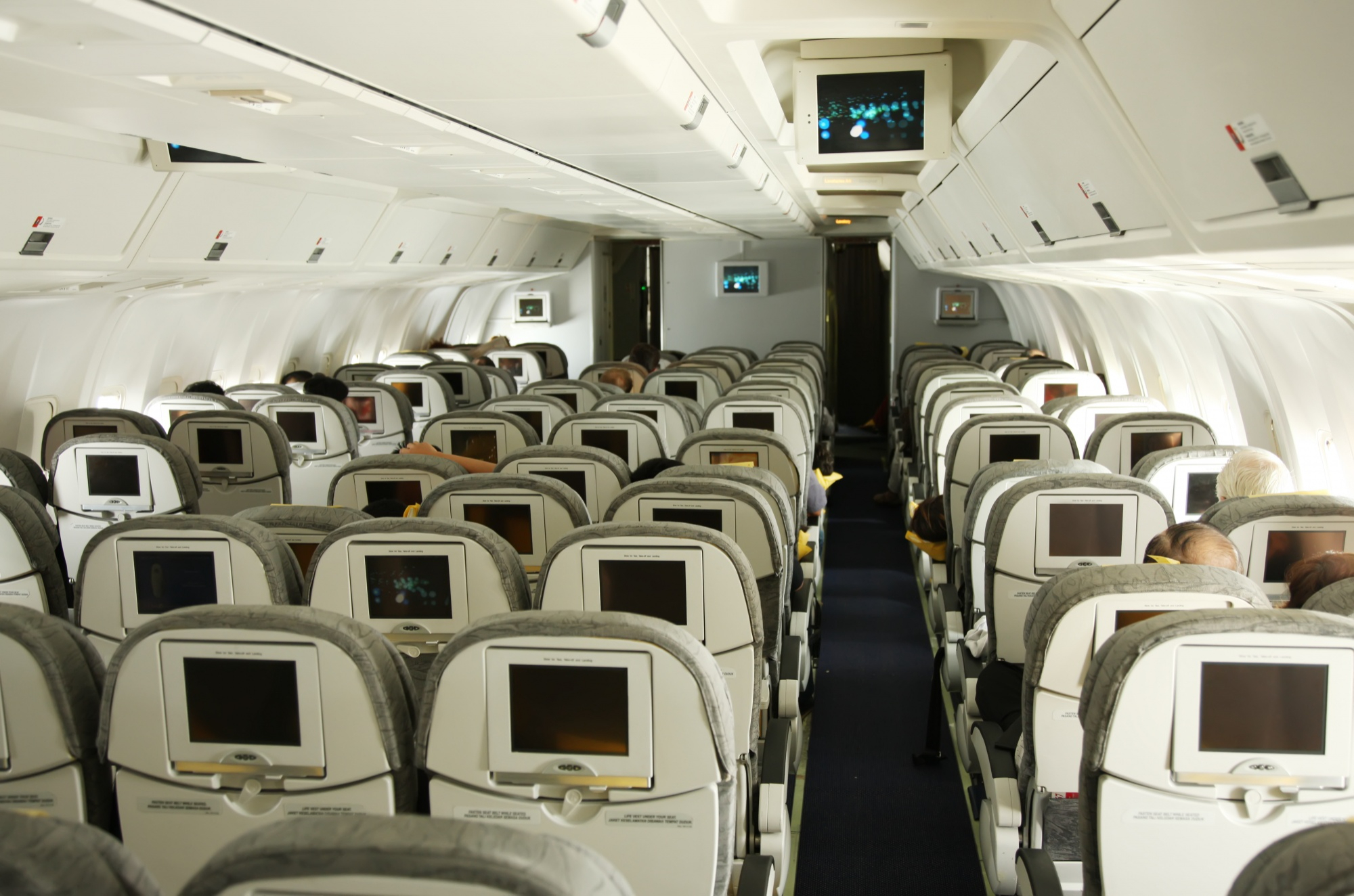
The landing was perfect.
I don’t know much about flying, but even I could tell. The wheels kissed the runway so softly I barely felt it. Beside me, Dad let out a low whistle.
“Beautiful,” he murmured. “Look at that. He greased it.”
“Greased it?”
“Smooth landing. Hardest thing in the world to do.” He shook his head, smiling. “That boy. That little boy in the blue sweater.”
We taxied to the gate. The seatbelt sign went off. Everyone stood up at once and started pulling down bags.
Dad didn’t move. He sat with his hands in his lap, holding the wings.
“You okay?” I asked.
“I don’t know if I can go up there, Lauren.”
“Why not?”
“It’s been fifty years since I walked into a cockpit.” He looked at me. “The last time, I walked right back out.”
I took his hand. “Then I’ll walk with you.”
We waited until most of the passengers had gone. Grant was standing near the front, by the door. He’d let everyone in first class pass him. He was waiting.
When we reached the front of the plane, the cockpit door was open.
Michael was sitting in the captain’s seat. His first officer, a young woman with a tight ponytail, was finishing some paperwork. When she saw us, she stood up and smiled.
“Mr. Hayes,” she said. “It’s an honor, sir. The captain’s told me about you since my first week on the line.”
Dad looked flustered. “Oh. Well. Thank you, young lady.”
Michael stood up and came out. He hugged Dad again, gentler this time.
“Will you sit with me?” he asked.
Dad stared at the cockpit. At the dials and screens and switches. It looked nothing like the old pictures I’d seen. Everything was digital now. But I watched his eyes move across the panels anyway, and I could see him reading them, understanding them, the way he used to read his newspaper.
His hands started to shake.
“I don’t know, Michael.”
“It’s on the ground, Walt. Parking brake’s set. Engines are off. Nothing can happen.” Michael put a hand on his back. “Just sit. That’s all.”
The first officer stepped out to give him room.
Dad took one step. Then another. He put his hand on the back of the right-hand seat, the co-pilot’s seat. The seat he used to sit in.
Then, very slowly, he lowered himself into it.
I stood in the doorway and held my breath.
Dad put his hands on his knees. He stared out the windshield at the airport, at the bright October sky, at the planes lined up at their gates. His breathing was quick at first. Then, little by little, it slowed down.
“Huh,” he said quietly.
“What?” Michael asked.
“I thought it would feel different.” Dad reached out and touched the yoke, the control column, very lightly. Just his fingertips. “I thought I’d see her again. Ruth. I always saw her when I closed my eyes in a cockpit.”
“And now?”
Dad closed his eyes.
He was quiet for a long moment.
“Now I see a field full of people walking home,” he said.
Michael sat down in the captain’s seat beside him. He reached into the breast pocket of his uniform and pulled out something small. He held it out.
It was a pair of wings. Not silver. Plastic. Cheap and faded, the gold paint mostly worn off, one tip chipped.
Dad stared at them.
“Ruth gave me these when I got on the plane,” Michael said. “I was holding them when you found me under the seat. I’ve carried them on every flight I’ve ever flown. Thirty-one years. Every single one.”
He put them in Dad’s palm, right beside the silver ones.
“I always thought you should have the silver wings,” Michael said. “For what you did. But I think you should have these too. Because you were Ruth’s crew. And she’d want you to know that you finished the job. You got her passengers home.”
Dad held both pairs of wings in his open hand. Silver and plastic. His and Ruth’s.
He didn’t say anything. He couldn’t.
He just sat there in the co-pilot’s seat with his eyes closed and his hand open, and he cried. Not loud. Just quiet tears, running down his face and dripping off his chin onto his good brown jacket.
Michael put his hand on Dad’s shoulder and left it there.
I stood in the doorway and cried with them.
When we finally walked off the plane, Grant was standing at the end of the jet bridge.
I figured he’d be gone. He had his big meeting. His deck. The biggest account in five years. He couldn’t afford delays.
But there he was, holding his phone, waiting.
“I called my boss,” he said, before I could ask. “Told him to push the meeting to tomorrow.”
“Can you do that?” I asked.
“Probably not.” He shrugged. “Patterson’s going to present my numbers and take all the credit. I might lose the account. Maybe even my job.” He smiled a little. “Turns out there are things more important than that.”
He reached for Dad’s carry-on bag. “Can I take this for you, sir?”
Dad looked at him. Then he handed over the bag.
“Thank you, Grant.”
“Walter,” Grant said. “Grant Walter Whitaker. I think I like my middle name now.”
He walked beside us all the way through the airport. He slowed his pace to match Dad’s. When a crowd came around a corner, he put himself between Dad and the rushing people, like a shield. At baggage claim, he lifted Dad’s suitcase off the carousel before I could reach it.
Then he turned his phone around and held it out.
“She wants to see you,” he said. “My mom. Just for a second.”
On the screen was a woman with silver hair and a blue cardigan. She was crying before she even said a word.
“Mr. Hayes,” she said. “It’s Carol. Carol from 6C. Do you remember me?”
Dad took the phone with both hands. He held it close to his face, the way old people do.
“Blue coat,” he said softly. “You had a blue coat.”
She laughed and sobbed at the same time.
“I still have it,” she said. “I never wore it again. But I still have it.”
They talked for ten minutes. I didn’t listen to most of it. It felt private. I stood back with Grant, and the two of us watched my father smile in a way I hadn’t seen since Mom died.
“I’m sorry,” Grant said to me quietly. “For this morning. For pushing him. For what I said.”
I looked at him for a long time.
“He forgave you,” I said. “I’m still working on it.”
He nodded. “That’s fair.”
“But you stayed,” I said. “You didn’t have to stay.”
“I think,” he said slowly, “I spent a long time being the kind of man who never stays. I’d like to try being a different kind.”

Adrian Hawthorne is a celebrated author and dedicated archivist who finds inspiration in the hidden stories of the past. Educated at Oxford, he now works at the National Archives, where preserving history fuels his evocative writing. Balancing archival precision with creative storytelling, Adrian founded the Hawthorne Institute of Literary Arts to mentor emerging writers and honor the timeless art of narrative.