When my father slid the paper across the dinner table like it was a warrant, I almost laughed. Not because it was funny. Because some small, stupid part of me still thought this family had a bottom they wouldn’t hit. I was wrong. There was no bottom. Just floors I hadn’t fallen through yet.
“Sign it,” he said.
My fork froze over the mashed potatoes. Mom kept smiling at the roast chicken because, in our house, denial was practically a side dish. Brandon leaned back in his chair, one ankle on his knee, wearing the same lazy golden boy grin that had gotten him out of every wrecked car, bounced check, and screaming ex-girlfriend since tenth grade.
The paper said I was voluntarily deferring my fall semester at Ellison University. Voluntarily. I had worked three jobs for that acceptance letter. I cleaned offices at night, tutored rich kids who called me “the scholarship girl” to my face like it was a compliment, and saved every diner tip in a coffee can under my bed. Ellison was supposed to be my exit door. Instead, my father was standing in front of it with a pen.
“Why would I sign this?” I asked.
His jaw ticked. “Because family comes first.” He meant Brandon came first. He always had.
My name is Ava Whitfield. I was twenty years old, a sophomore, and until that night, I thought my biggest problem was affording textbooks.
I want you to understand something before I tell you the rest. I wasn’t the dramatic one. I wasn’t the one who called the police on ex-boyfriends or posted crying videos online. I was the one who got good grades quietly and kept receipts. Literally, I kept every receipt, every pay stub, every text message, because I’d learned a long time ago that in my family, memory was a battlefield, and whoever controlled the narrative won.
Brandon was two years older than me and had never worked a job longer than four months. He’d totaled two cars, dropped out of a business program my parents paid thirty thousand dollars for, and once got caught selling counterfeit concert tickets on a resale app. Every time, my parents called it a rough patch. When I got a B+ in AP chemistry, my mother asked what happened.
Our grandmother, Evelyn Whitfield, was the only person in that house who ever looked at me like I wasn’t a disappointment waiting to happen. She died fourteen months before that dinner. Pancreatic cancer, fast and cruel, the kind that doesn’t give you time to say the things you meant to say. At her funeral, my father cried so hard two ushers had to help him to a seat. I remember thinking at the time that it was the most human I’d ever seen him. I didn’t know yet that grief and guilt can look identical from across a funeral home.
The first red flag came six months before the dinner, in February. Brandon asked to borrow my social security card to help with insurance paperwork for a car he was buying. I gave it to him because that’s what you do when you’ve spent your whole life being told that saying no makes you difficult. Two weeks later, I noticed a hard inquiry on my credit report. I didn’t recognize the student loan company. I told myself it was probably a mistake, some clerical error, nothing to lose sleep over. That was the first time I lied to myself. It would not be the last.
In March, I started checking my credit report obsessively, the way you check a bruise to see if it still hurts. It still hurt. There were now two loans in my name from a company called Meridian Student Funding, totaling almost eleven thousand dollars, disbursed to an account I didn’t recognize. My hands were cold when I called the number on the statement. A recorded voice told me the account was in good standing and to contact my loan servicer with questions. I told myself identity theft happens to strangers, not to people whose brother has the same middle name as the account holder listed.
I tried to fix it quietly. I called Meridian’s fraud line and sat on hold for fifty-one minutes, my phone sweating against my palm, before a representative told me I’d need notarized documentation and a police report to dispute the loans. A police report meant naming someone. I hung up without saying who I suspected. I wasn’t ready yet.
In April, Brandon showed up to Easter dinner in a Ford F-150. He said he’d bought it with hard work and a good used car guy. It had temp tags. I did the math in the driveway while everyone else went inside. A truck like that doesn’t come from used car guy money. It comes from real money. Sudden money. I told myself, people finance trucks all the time. Everyone finances everything. It’s normal.
Then I found the pawn slips in the glove box while looking for a phone charger. Not for tools. Not for a guitar. My laptop. My camera. Both pawned the same week the loans hit my credit report, both at a shop forty minutes from our house, nowhere near where Brandon lived. My stomach dropped so fast I had to sit down on the driveway curb with my head between my knees. Easter ham smell drifting out the open front door like nothing in the world was wrong.
I confronted him that night in the kitchen, voice shaking, holding up the pawn slip like evidence in a trial only I knew was happening. He looked at it, looked at me, and said, “You’re being paranoid.” And walked away like I’d accused him of stealing a cookie. I didn’t call the police. I told myself I needed more before anyone would believe me over Brandon. I was right about that. I was wrong about everything else.
In May, I started going through Dad’s home office when nobody was around, which sounds cold now, but at the time felt like the only sane response left to me. Most of the file cabinet was locked. One drawer wasn’t. Inside were refinance documents for the house. A house I’d grown up believing my parents owned outright, paid off years ago from Grandma’s side of the family. There were two refinances. One eighteen months before Grandma died, one four months after. I told myself refinancing wasn’t a crime. People refinance for all kinds of reasons. Renovations, medical bills, retirement planning. I photographed the documents anyway because some instinct in me, some tired, distrustful animal instinct, said, keep a record.
In June, my mother left the family iPad open on the kitchen counter while she showered. I wasn’t snooping. I was looking for a grocery list app. Instead, I found an email thread between her and a woman named Carol Denny, a notary my mother used to work with at her old real estate office. The subject line said, “Re: signature deed correction. Keep between us.” I read four lines before my hands started shaking so badly I had to set the tablet down. A deed correction on a house. My grandmother’s house. The one she used to say, half joking, half not, “This place is going to Ava someday when the truth becomes necessary.” I’d always assumed she meant sentimentally. I’d never once imagined she meant legally.
I told myself I was misreading it. I told myself for eleven days, because the alternative was accepting that my parents had forged something. Then I drove forty minutes to the county recorder’s office on my lunch break. Paid four dollars for a certified copy of the current deed and sat in my car in the parking lot reading language I barely understood, except for one part I understood completely. Grantor: estate of Evelyn Whitfield. Grantee: Michael D. Whitfield. My father’s name. Not mine. Nowhere in that document was mine.
By July, I’d stopped confronting anyone. Confronting people had never once worked in this family. It only warned them. Instead, I built a folder. I am by nature an organized person, the kind who color codes, and I turned that instinct into the only weapon I had. I scanned everything. The pawn slips, the Meridian loan disclosures, the two refinance documents, the deed, screenshots of the email between my mother and Carol Denny, a photo of the fireproof box in my father’s office that I’d noticed had a brand new lock. I also did something I’m not proud of and would do again in a heartbeat. I called my grandmother’s estate attorney’s office and asked, as vaguely as I could manage, whether beneficiaries were always notified of asset distributions. The paralegal who answered, a kind, tired-sounding woman, told me that if I had reason to believe I was a named beneficiary who hadn’t received required notice, I should speak with an attorney immediately, because Georgia law required it.
I didn’t have a lawyer. I had a coffee can of diner tips and a folder of evidence I was terrified to use. So I did the only thing that felt survivable. I waited, and I got ready, and I told no one. Not even Aunt Renee, my mother’s sister, the one adult in this story who had never once made me feel like a disappointment. I loved her too much to hand her a grenade before I knew how to pull the pin safely.
I was still waiting the night my father slid that paper across the dinner table.
“He sold my laptop,” I said at that dinner, the folder already sitting untouched in my email drafts, three timed sends already scheduled and waiting like sleeper agents. “And my camera. I found the pawn slips in his truck.”
Brandon laughed, soft and easy. “There she goes again. Always dramatic.”
Dad’s palm hit the table hard enough to jump the water glasses. “You will apologize to your brother tonight or we cut off your education. No tuition, no co-signed housing, no car, nothing.”
They still thought I needed them. That was the last mistake they’d get to make comfortably.
I folded the deferral form in half, then in half again. My heartbeat loud enough I was sure they could hear it.
“Ava, don’t make this harder,” my mother whispered, not looking at me, looking at the roast chicken like it might rescue her.
“Say you lied,” Brandon said. “Then we can all eat.”
I stood up. My knees were shaking so badly I had to lock them. My voice came out flat and calm, the calmest I have ever sounded in my life, which felt in the moment like some kind of miracle.
“All right,” I said.
My father smiled, victorious, already reaching for his fork like the matter was closed. Brandon actually winked at me. Neither of them noticed me open my phone under the table and hit send on the first email, the one addressed to a name I’d found three weeks earlier on the county financial crimes division’s website. Detective M. Voss.
By sunrise, my room was two trash bags and an old rolling suitcase with a broken wheel. I hadn’t slept more than twenty minutes. At 5:48 a.m., Brandon burst into my doorway barefoot, pale as milk, holding his phone like it had bitten him.
“Please tell me you didn’t send it,” he said.
My father appeared behind him in his robe, annoyed at being woken. “Send what?”
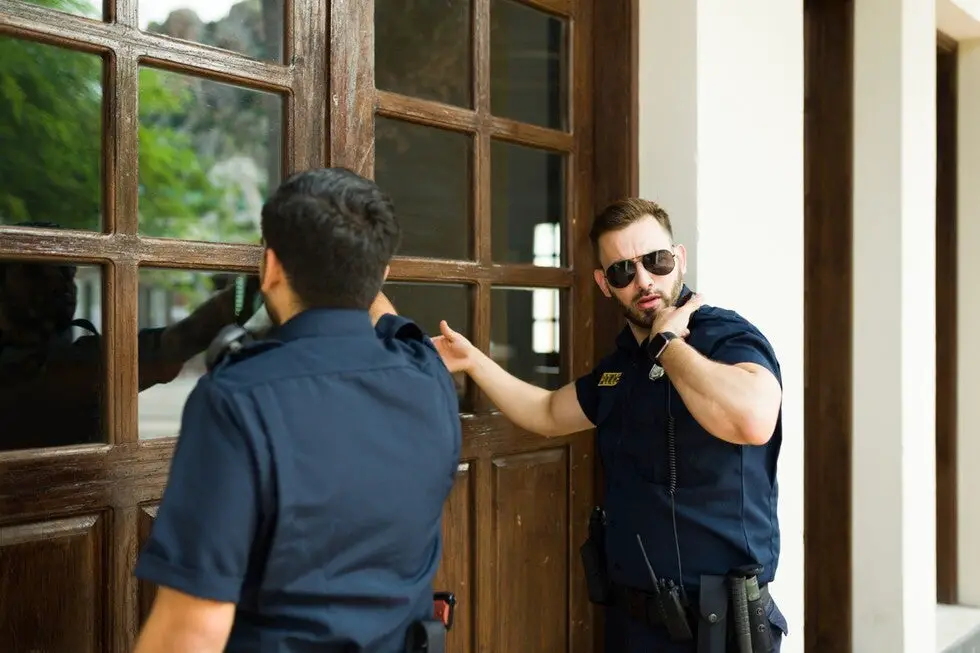
Then my mother screamed from downstairs, a sound so sharp it made every argument in that house stop breathing at once. We ran down together, an ugly little parade. She stood in the foyer in her nightgown, staring through the front window. A black sedan sat at the curb. Behind it, Aunt Renee’s silver SUV. Behind that, a marked police cruiser. Its light bar dark but present, which somehow felt worse than if it had been flashing.
My father looked at me slowly, the way you look at something you’re only now realizing might be dangerous. “Ava, what did you do?”
I gripped my suitcase handle so hard my knuckles went white. “I protected myself.”
He stepped in front of the door, blocking it with his shoulder. And for the first time in my life, I understood physically, in my body, that he was bigger than me and had always known it.
“You are not leaving until you explain.”
That was when my phone started buzzing. Then buzzed again. Then didn’t stop. The kitchen counter behind me humming like a struck wasp nest. Emails, texts, missed calls. My aunt. My university’s financial aid office. A number I’d saved three weeks earlier under “estate attorney, Paya.” A woman from a student loan fraud investigations unit whose name, Priya Shaw, I had memorized at three in the morning weeks ago, because terror makes you organized in ways nothing else ever has.
Brandon’s face went the color of wet cement. “You sent the folder.”
“What folder?” Dad snapped.
“The one with the forged loan applications,” I said. And for the first time in my life, I watched my voice make my father flinch. “The pawn slips, Grandma’s trust statements, the fake medical reimbursement claims you used to drain it, the deed.”
My mother’s hand flew to her mouth. Her eyes weren’t shocked. They were tired. Tired in a way that told me she’d known this moment was coming for a long time and had simply been hoping it would happen to someone else’s family. That scared me more than my father ever had.
Aunt Renee pounded on the door hard enough to rattle the glass. “Michael, open this door before I break the window.”
My father grabbed my arm. Not hard enough to bruise. Hard enough to remind me one last time who used to be in charge. “Undo it,” he said.
“I can’t.”
“You can.”
“No,” I said. “I scheduled three sends. The first already went to the people who can actually investigate. The second goes at noon to every relative and every donor who ever gave Brandon money for a fresh start. The third goes tonight to a reporter at the Ledger who covers financial crimes.”
Brandon made a sound I’d never heard a grown man make. Something between a laugh and a sob. “You psycho.”
“Ava, please,” my mother said, eyes wet now. “You don’t understand what happens if this gets out.”
“Then tell me,” I said. “Tell me right now, or let the woman with the badge tell me instead.”
The refrigerator hummed in the silence that followed. It is a strange thing to remember the sound of a refrigerator during the worst five minutes of your life. But I do. I remember it exactly.
“Diane.”
“Don’t,” my father warned.
My mother looked at me anyway and said the sentence that split my entire childhood cleanly in half, the way a bone splits when it breaks the wrong way. “Your grandmother didn’t leave that trust only to you. She left you this house, too, in your name, effective the day you turned eighteen.”
For a second, none of the words connected to anything real. The house I had scrubbed after Brandon’s parties. The house where my father told me I was ungrateful for wanting a locked bedroom door. The house they had just threatened forty minutes earlier to make sure I never returned to. It had been mine since I was eighteen years old. And every single one of them had known it.
The doorbell rang through the glass. I saw a woman in a navy blazer holding up a badge, calm in a way that made everyone else in the foyer look unhinged by comparison. Beside her stood Aunt Renee, crying and furious in equal measure.
My father looked at Brandon. Brandon looked at the stairs. Then he bolted straight for my father’s office and the fireproof box only he had ever had a key to.
Detective Mara Voss had been with the county’s financial crimes division for twelve years, the last four of them specializing in elder fraud and estate theft. I would learn all of this later, in a sterile little interview room with bad coffee. But even in the doorway of my childhood home, she had the specific calm of someone who has stood in a hundred foyers exactly like ours and never once been surprised by what was behind the doors people slammed.
She knocked once. Aunt Renee pushed past her the second my mother turned the lock. “Ava,” Aunt Renee said, taking my face in both hands like she was checking I was still whole. “Did he touch you?”
“I’m fine,” I said, though my arms still burned where my father’s fingers had been.
Detective Voss introduced herself with the kind of clean procedural calm that made my father look even more frantic by comparison. A uniformed officer, Deputy Ruiz, stood in the hallway, not touching anything, just watching, which somehow felt more threatening than if he’d had his hand on his belt.
From the office came the sound of drawers slamming. Then Brandon cursing.
“He’s destroying evidence,” I said.
“No one is destroying anything,” my father barked, already moving toward the hallway like he could physically undo the last five minutes.
Detective Voss looked at him with something close to boredom. “Then step aside, Mr. Whitfield.”
For once in his life, my father did not control a room simply by raising his voice. Deputy Ruiz moved past him. Aunt Renee followed. So did I. Because I was finished obeying a man in a bathrobe who’d spent a year stealing from his own dead mother-in-law and calling it love.
Brandon was on his knees beside the fireproof box, hands shaking so badly he could barely fit the brass key into the lock. When he saw us, he tried to shove a stack of papers under the desk with his foot, which is exactly as smooth as it sounds, meaning not at all.
“Hands where I can see them,” Detective Voss said.
He froze. “This is a family matter.”
Aunt Renee laughed once, bitter as burnt coffee. “So was our mother’s funeral. You still stole from it.”
Detective Voss opened the box with gloved hands. Inside, envelopes, notarized certificates, bank statements, and a folded deed with my grandmother’s looping handwriting across the front in blue ballpoint pen. “For Ava, when the truth becomes necessary.”
My throat closed up so fast I had to remind myself to breathe. My father stared at it like it had risen out of the ground. Detective Voss handed me the envelope with gloved fingers. “You can read it now, or your attorney can review it with you later.”
“I want to read it now,” I said.
My grandmother’s letter was short. She wrote the way she talked. Warm. Blunt. No patience whatsoever for nonsense. She wrote that she’d watched my parents call my quiet a flaw and Brandon’s recklessness potential for twenty years, and that she was done pretending not to notice. She’d put the house and the education trust in my name because she believed I would build a life with it, not gamble one away, the way she’d already watched Brandon gamble away three separate fresh starts funded by money that was never his either. Then came the line that broke me in the middle of my childhood foyer, in front of a detective and a deputy and the family that raised me like a debt to be collected.
“If they ever make you feel homeless in a house I left to you, remember this. Love does not require you to stay where you are being used.”
I cried the ugly, humiliating way. The kind that breaks your breathing apart, not the graceful movie kind. Aunt Renee pulled me against her shoulder, and for the first time all morning, I had someone standing next to me who wasn’t trying to sell off pieces of me to keep the peace.
My father tried one last angle, voice climbing toward the register he used to use to end arguments. “That letter proves nothing. Evelyn was confused near the end. The cancer, the medication—”
Detective Voss pulled another document from the box without looking up. “The notarized deed transfer dated fourteen months before your mother-in-law’s death and witnessed by two people, neither of whom appear to be medically compromised, says otherwise, Mr. Whitfield.”
My mother sank into the reading chair by the bookcase like her legs had simply stopped agreeing to hold her.
Here is the ugly machine laid out fully in daylight, the way I eventually understood it across weeks of interviews, documents, and one very long civil deposition. My grandmother had deeded the house to me and funded a separate education trust worth just over two hundred thousand dollars two years before she died. My father learned of it after her funeral and panicked because he and my mother had quietly refinanced their own home twice to keep pace with Brandon’s disasters. The business program he quit after one semester. The gambling losses he called bad luck at cards. The private attorney fees after he was caught reselling counterfeit tickets. The truck. And an engagement ring for a fiancée who, it would turn out, had already left him twice before.
They couldn’t touch a house that wasn’t theirs. They couldn’t drain a trust with records attached to it. So my father forged what he called, in his own defense later, a “correction deed,” claiming my grandmother had meant to leave everything to him and had simply run out of time to fix the paperwork. My mother notarized one signature through her old colleague, Carol Denny, who would later lose her notary license and face her own charges for it. Brandon, who was somehow simultaneously too irresponsible to hold a job and fully capable of executing loan fraud, opened two student loans in my name using my social security card and an old expired school ID and funneled the disbursements into an account my father controlled, which then bled out piece by piece to cover Brandon’s messes.
My education had never actually been threatened at that dinner table. It had already been stolen years earlier and then dangled back in front of me like a leash, so I’d stay small enough not to notice the collar.
The detail that finally silenced the whole foyer came from Aunt Renee. And it was the twist none of us saw coming, including me, and I’d spent six months preparing for this exact morning. She pulled a small thumb drive from her purse and held it out to Detective Voss.
“What is that?” my father asked. And for the first time all morning, his voice actually cracked.
“Mom’s kitchen camera,” Aunt Renee said. “You remember, we put it up after she started falling, so someone could check on her remotely. It recorded audio too, Michael. All of it, including the afternoon you went to her house three days before she died and screamed at her for forty minutes about the trust.”
My father went the color of the wall behind him.
Aunt Renee’s voice shook, but she didn’t look away from him. “You told her Ava would never survive without you managing everything for her. She told you Ava would survive the exact minute she got away from you.”
Brandon dropped his head into his hands. For one strange second, I wondered if he’d ever actually believed his own golden boy performance, or if some part of him had always known exactly what he was. Then he looked up at me with something close to hatred. And whatever sympathy I had left for him packed its bags and walked out the same door I was about to.
“You ruined my life,” he said.
“No,” I said. “I just stopped letting you use mine.”
Deputy Ruiz led him into the hallway after Detective Voss found three unsigned loan approval notices tucked into his backpack, still in the front pocket where he’d apparently planned to grab them and run. He hadn’t been trying to protect our father. He’d been trying to protect himself. His name was on one of the transfer requests, too. Even his panic, in the end, was selfish. That tracked.
My father wasn’t handcuffed that morning. Investigations move slower than rage. Detective Voss made that very clear. But he was told in front of all of us not to remove any further documents from the property, not to contact the notary or the estate attorney’s office, and not to threaten me again in any form, in writing or otherwise. Watching a stranger explain consequences calmly to the man who had ruled every dinner table I’d ever sat at did not feel like victory yet. It felt like the floor tilting back toward level for the first time in my life.
My mother followed me out onto the porch when I finally carried my suitcase outside into a morning that had somehow unbelievably turned into an ordinary July day. Birds. A neighbor’s sprinkler. The smell of cut grass.
“Ava,” she said. “I was afraid. Your father said we’d lose everything.”
I looked back at the brick house glowing in the early light. From the sidewalk, it looked like every other safe, ordinary family home on the block. That was, I realized, exactly the point. It always had been.
“You did lose everything,” I said. “You just lost it protecting the wrong person.”
Aunt Renee took me back to her apartment, made coffee strong enough to strip paint, and let me sleep on her couch under a quilt that smelled like lavender detergent and safety, which are apparently the same smell if you’ve never had either.
When I woke up seven hours later, my phone had ninety-one new messages. Some relatives called me cruel for airing family business. More of them, quietly, in separate texts, admitted they’d always suspected something was wrong and hadn’t known how to say it. My university’s financial aid coordinator, Denise Okafor, wrote that my enrollment would remain fully secure while the fraud claim was under formal review. Full stop. No conditions. The student loan fraud unit under Priya Shaw froze both accounts within forty-eight hours pending investigation. The estate attorney, Mr. Aldrich Paya, confirmed by email that the original 2024 deed would stand unless my father could produce evidence of fraud on my grandmother’s part, which, given the audio recording now in the district attorney’s possession, was not a battle he was likely to win.
At noon, exactly as scheduled, the second email went out. To relatives, to two of Brandon’s former investors, to a family friend who’d once co-signed a loan for him. I let it send. It wasn’t revenge. It was a record. Dates, transfers, scanned documents, a timeline built plainly enough that even my uncle Mark, who once lost an entire parked car at a county fair and didn’t notice for six hours, could follow it start to finish. I pulled anything that was simply embarrassing and left only what was evidence. I wanted the truth on the table. I didn’t need a bonfire.
By evening, Brandon’s fiancée mailed back the engagement ring. It had been purchased with trust money too, a detail that came out during discovery months later. She sent me exactly one message. “I’m sorry I believed them over you.”
The months that followed did not look like a montage. Real justice, it turns out, mostly looks like paperwork. I worked breakfast shifts at the diner between classes and filled out affidavits on my lunch breaks. I sat through meetings where men in gray suits said words like “misappropriation” while I bit down the urge to say the actual word out loud. Theft. I moved into a dorm room the size of a large closet and loved it more than I’d loved any room in that brick house. I bought a used laptop with money Aunt Renee insisted was a loan and then flatly refused to let me repay. I froze my credit at all three bureaus and learned more about escrow accounts than any twenty-year-old should reasonably have to know.
I testified at a civil hearing in the only blazer I owned. And when my father’s attorney suggested with a straight face that I was simply an angry daughter exaggerating a family conflict, I looked directly at the judge and said, “Being angry doesn’t make the documents fake.” The judge did not smile exactly, but something in her face agreed with me.
The house was placed under court protection while the estate matter was resolved. My father eventually accepted a settlement that restored the trust through the forced sale of assets he had, weeks earlier, sworn under oath did not exist. Brandon took a plea deal on the loan fraud charges because his fingerprints were on the evidence, literally and digitally, down to the metadata on the scanned loan applications.
My mother avoided criminal charges by cooperating fully with Detective Voss’s investigation, which hurt in a way I hadn’t expected. Cooperation, I learned, is not the same thing as an apology. She called once months later to say she was proud of me.
“I hope someday,” I told her, “you mean that when it actually costs you something.”
Then I hung up. And I did not cry. And that surprised me more than anything else that whole year.
A year later, almost to the week, I stood outside the Ellison University library after my last final of sophomore year. The sun was warm. My backpack was too heavy, the way it always is at the end of a semester. My coffee was burnt, the way diner coffee always is. My life was still messy, still expensive, still nothing like the glossy brochures had promised it would be. But it was mine. All of it. Finally, actually mine.
That morning, Aunt Renee had texted me a photo. The old house had sold. The money went exactly where my grandmother had intended it to go, fourteen months before she died, and years before any of us understood why. My education. My credit repair. And a small scholarship fund carrying her name, set aside for students whose families treated opportunity like a bargaining chip instead of a birthright.
I sat down on the library steps and cried again. But this time I laughed too, right in the middle of it, which is a strange and specific kind of relief nobody warns you about. Somewhere, I could almost hear her voice, dry as ever, completely unimpressed with how long it had taken me.
People ask me sometimes why I only said one word at that dinner table, why I didn’t scream, why I didn’t stand up and defend myself right there in front of all of them the way people do in movies. Because “all right” was never surrender. It was the sound of a door unlocking quietly, while everyone in the room was still looking the wrong way.

Sophia Rivers is an experienced News Content Editor with a sharp eye for detail and a passion for delivering accurate and engaging news stories. At TheArchivists, she specializes in curating, editing, and presenting news content that informs and resonates with a global audience.
Sophia holds a degree in Journalism from the University of Toronto, where she developed her skills in news reporting, media ethics, and digital journalism. Her expertise lies in identifying key stories, crafting compelling narratives, and ensuring journalistic integrity in every piece she edits.
Known for her precision and dedication to the truth, Sophia thrives in the fast-paced world of news editing. At TheArchivists, she focuses on producing high-quality news content that keeps readers informed while maintaining a balanced and insightful perspective.
With a commitment to delivering impactful journalism, Sophia is passionate about bringing clarity to complex issues and amplifying voices that matter. Her work reflects her belief in the power of news to shape conversations and inspire change.