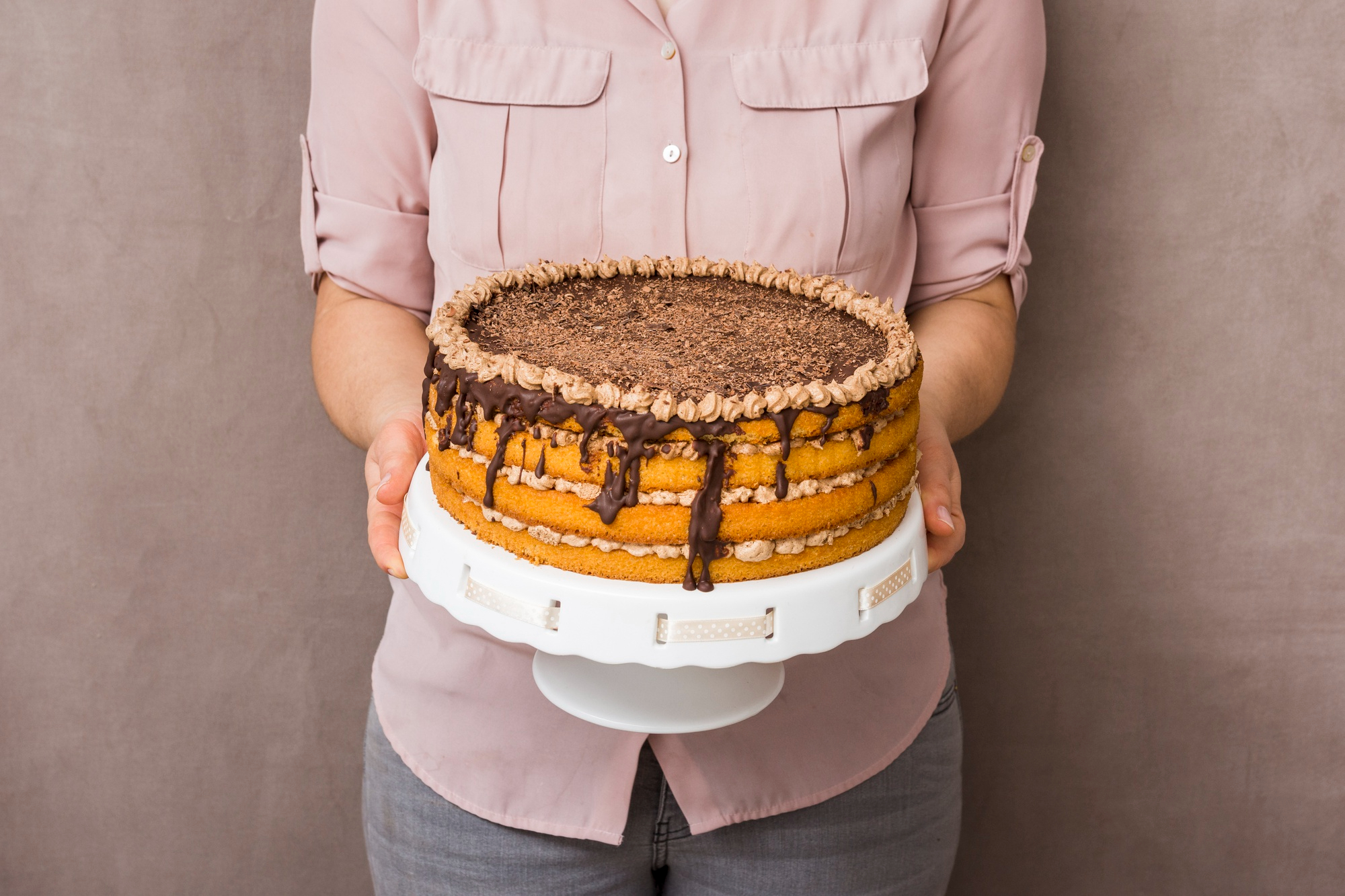
Grandma said yes.
She started with one cake a week. Her mother’s vanilla sponge with raspberry filling. Marisol sold it by the slice at The Daily Grind for six dollars a piece. It sold out by eleven in the morning every Tuesday.
Then Marisol asked for two cakes a week. Then three. Then she asked if Grandma could do cupcakes. Then cookies. Then the lemon meringue pie, which Grandma made with lemons from Grandpa’s tree in the backyard.
By spring, people were lining up outside The Daily Grind on Tuesday mornings before it opened. Somebody wrote about it in the local paper. 73-Year-Old Grandmother’s Cakes Are the Best-Kept Secret in Town.
Then the wedding orders started coming.
It turned out a lot of people had seen that video. And a lot of them weren’t just angry at Ashley. They were amazed by the cake.
The first call came from a nurse in a nearby town. She was getting married in June. She’d watched the clip eleven times, she said.
“I don’t want a bakery,” she told Grandma on the phone. “I want you. I want someone who bakes with love. And I want to pay you properly. Up front. Whatever you think is fair.”
Grandma didn’t know what was fair. She’d never charged anyone for anything in her life.
So I sat down at her kitchen table with my laptop, and we figured it out together. Ingredients. Hours. A fair rate for her skill. I designed her a simple price list on cream-colored paper, with the little sugar rose logo I’d made for the invoice. Rose’s Kitchen — Est. 1971.
“Is this too much?” she asked, looking at the numbers. “This seems like so much money for cake.”
“Grandma,” I said. “It’s less than what the bakery quoted Ashley. And your cakes are better.”
She looked at the price list for a long time.
“Fifty-two years,” she said quietly. “I’ve been baking for fifty-two years. And nobody ever paid me for it.”
“Well,” I said. “Now they will.”
She made eleven wedding cakes that year. She could have made fifty. People called from all over the state. But she said eleven was enough. She wanted to make each one by hand, with every sugar flower placed just right, and she couldn’t do that if she rushed.
“Bake it with love,” she said, “or don’t bake it at all.”
Every single bride paid her up front. In full. Before she bought a single egg.
Some of them paid her more than she asked. One bride, a kindergarten teacher, cried when she picked up her cake and slipped an extra hundred dollars into the envelope. Grandma tried to give it back. The bride wouldn’t take it.
“My grandmother made my mother’s wedding cake,” she said. “She died before I got married. When I saw you in that video, standing up in your blue dress, I saw her. Please. Let me.”
Grandma kept it.
She put every dollar into a savings account at the credit union. The first savings account she’d had since Grandpa died. She keeps the passbook in her green spiral notebook. Sometimes I catch her looking at it.
She enrolled in the drug company’s assistance program, the one Daniel found. Her heart medication costs ninety dollars now instead of a hundred and eighty. She has never missed a single pill.
And every Sunday, she still bakes for free.
Pies for the church potluck. Cookies for the mailman. Banana bread for the new family down the street. Birthday cakes for the neighbors’ kids.
“Paid work is paid work,” she told me once. “And love is love. I just had to learn the difference.”
I never heard from Ashley again.
Not directly, anyway. A few months after the annulment, a mutual friend told me she’d moved to Arizona. Started over. New city, new job, new Instagram account with a different name.
I hope she’s okay. I really do. Grandma says she prays for her sometimes.
“She’s somebody’s granddaughter too,” Grandma said. “Somebody must have taught her that taking was the same as winning. That’s a sad way to grow up.”
I’m not as kind as my grandmother. I’m still working on it.
But I’ll say this much. I hope that somewhere in Arizona, every time Ashley sees a wedding cake, she thinks of a little sugar rose with a crack in one petal.
And I hope she remembers that it took forty-five minutes to make.
A year after the wedding, Daniel met someone new.
Her name is Priya. She’s a pediatric nurse. She’s quiet and funny and kind, and the first time Daniel brought her to Sunday dinner at Grandma’s house, she brought a homemade lasagna and a bottle of wine and a bouquet of flowers from her own garden.
After dinner, she got up and started washing the dishes before anyone could stop her.
“You don’t have to do that, honey,” Grandma said. “You’re a guest.”
“I know,” Priya said, scrubbing a pot. “But you cooked. So I clean. That’s how it works in my family.”
Grandma looked at me across the kitchen.
She didn’t say anything. She just raised her eyebrows a little and smiled.
They got engaged eight months later.
A few weeks after that, Priya came to Grandma’s house by herself. On a Tuesday afternoon. She sat at the kitchen table, nervous, holding her purse in her lap.
“Grandma Rose,” she said. “I know it’s a lot to ask. And I know about what happened before. Daniel told me everything.” She took a breath. “But would you consider making our wedding cake?”
Grandma was quiet for a moment.
Then Priya reached into her purse and pulled out an envelope. She set it on the table and slid it across.
“This is a deposit,” she said. “It’s half of your full price. I looked it up on your price list. The other half will be in your hands a week before the wedding. And if it’s more than that, if it takes more time or more ingredients than you expect, you just tell me. And I’ll pay it. No questions.”
Grandma looked at the envelope. She didn’t pick it up.
“Honey,” she said. “You don’t have to pay me. You’re going to be family.”
Priya shook her head.
“That’s exactly why I’m paying you,” she said. “Because you’re going to be family. And family doesn’t take advantage of each other. Family takes care of each other.”
My grandmother picked up the envelope.
She held it for a long moment. Then she put her other hand on top of Priya’s and squeezed.
“Five tiers?” she asked.
Priya laughed through her tears. “Just three. We’re having a small wedding. Forty people. In my parents’ backyard.”
“Three tiers,” Grandma said. “Vanilla sponge. Raspberry filling. My mother’s recipe from 1971.”
“That sounds perfect.”
“And flowers?”
“Whatever kind you want,” Priya said. “Whatever you think is beautiful.”
Grandma smiled. “Jasmine,” she said. “Lots of little jasmine. I’ve gotten very good at jasmine.”
She made that cake in May. It took her two days instead of three. I helped. Daniel helped too, if you can call licking the beaters helping.
At the wedding, in Priya’s parents’ backyard, under a big oak tree strung with lights, Grandma’s cake sat on a little wooden table covered in a lace cloth.
Three tiers. Pure white. Covered in hundreds of tiny jasmine blossoms, trailing down the sides like a waterfall.
And on the very top, in the center, a single sugar rose.
It wasn’t perfect. The petals were a little thick. One edge was slightly cracked.
It was the first one. Number one. The rose from the jewelry box. Ashley had left it behind on the head table at the barn when she ran out of the reception. Brianna, the maid of honor, found it after everyone left. She mailed it back to Grandma two weeks later in a padded envelope, with a note that said I think this belongs to you. I’m so sorry.
Grandma kept it on her windowsill for a year. Then she put it on Daniel’s wedding cake.
“Why that one?” I asked her, the night before the wedding, watching her carefully set it in place on the top tier with a dab of buttercream.
She stepped back and looked at it.
“Because it’s the one that taught me something,” she said. “I spent fifty-two years thinking that love meant giving everything away. That if I asked for anything back, I was being selfish.” She smoothed a tiny spot of frosting with her fingertip. “That little rose taught me that it’s okay to know what you’re worth. Even when you’re giving something with love. Especially then.”
She took off her apron.
“And besides,” she said, with her teakettle laugh, “it’s a very nice rose. It just needed the right cake.”
Daniel and Priya cut that cake under the oak tree while forty people cheered. Daniel fed Priya the first bite and smeared buttercream on her nose. She smeared some on his cheek. They laughed so hard they had to hold onto each other.
Grandma watched from her chair at the front, in her blue church dress, with tears running down her face.
After the cake was cut, Priya walked over to her. She knelt down beside her chair. She took Grandma’s hand.
“Thank you,” Priya said. “For the most beautiful cake I’ve ever seen. And for my husband. You raised him right.”
“Oh, honey,” Grandma said. “I just fed him.”
“Same thing,” said Priya.
People ask me sometimes if I regret what I did at that first wedding. If I went too far. If I should have just let it go, the way Grandma would have wanted.
I think about it a lot.
And here’s what I always come back to.
My grandmother spent seventy-three years giving. Her time. Her money. Her love. Her cakes. She gave and gave and gave, and she never asked for anything back. And for most of her life, the people around her were good people, so it didn’t matter.
But one day, she met someone who saw her kindness as a weakness. Someone who looked at a seventy-three-year-old woman in her slippers and saw an easy mark. Someone who laughed at her for asking for what she’d been promised.
And in that moment, my grandmother didn’t know how to stand up for herself. Because nobody had ever taught her that she was allowed to.
So I stood up for her.
Not to humiliate Ashley. Not really. I did it so a hundred and fifty people would look at that cake and see what it actually cost. Not in dollars. In love. In time. In heart medicine. In fifty-two hours of an old woman’s hands shaping sugar into flowers.
I did it so my grandmother would know that somebody saw her.
And so would everyone else.
Grandma is seventy-five now. She still bakes every day. She still wears an apron over everything. Her kitchen still smells like vanilla and butter and lavender lotion.
There’s a framed piece of paper on the wall above her oven now.
It’s not a diploma or an award. It’s a price list. Cream-colored paper. A little sugar rose logo at the top. Rose’s Kitchen — Est. 1971.
Underneath, in my grandmother’s shaky handwriting, she added three lines of her own.
Rule One: Wash your hands.
Rule Two: Measure twice, pour once.
Rule Three: Bake it with love. And never, ever let anyone tell you that love is free.

Specialty: Legal & Financial Drama
Michael Carter covers stories where money, power, and personal history collide. His writing often explores courtroom battles, business conflicts, and the subtle strategies people use when pushed into a corner. He focuses on grounded, realistic storytelling with attention to detail and believable motivations.