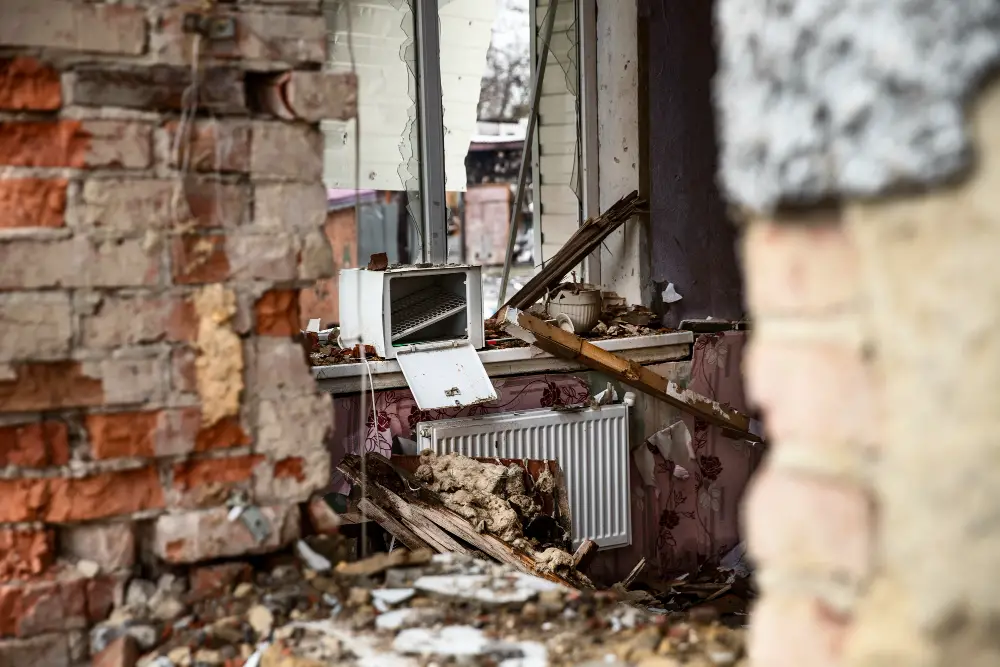
The water was already running when I opened the front door.
Not dripping.
Running.
I stood on the porch with my key still in the lock, listening to it rush somewhere inside the house. A steady, heavy hiss, like a shower left on in an empty hotel room.
Before I took another step, I knew Brian had left me something to find.
“Brian?” I called.
Silence.
Just the water.
I should tell you that I almost didn’t come that day. I sat in my car at the end of the driveway for twenty minutes first, with the engine running and both hands on the wheel, looking at the house.
It was a pale yellow two-story with white shutters and a red front door. I picked that door color. Brian said red was “a lot.” I said a house should look like somebody happy lives there. He rolled his eyes, but he painted it anyway, one Saturday in April, eight years ago, while I held the ladder and handed him things and we argued about whether the radio should play country or classic rock.
We’d bought that house together when we were twenty-nine. We’d been married for two years. We’d been so proud of it that we took a picture of ourselves on the front steps holding the keys up to the camera like a trophy.
That picture was in a box somewhere now. Or in a landfill. I didn’t know which. I’d stopped asking about the boxes months ago.
My divorce from Brian had dragged through the courts for almost eight months before the judge finally awarded me the house.
Brian had two weeks to move out.
His deadline had expired the day before. I’d waited an extra day on purpose. I didn’t want to risk pulling into the driveway and seeing his truck still there. I didn’t want to watch him carry out the last of his things and look at me the way he’d been looking at me for a year. Like I was a stain he couldn’t scrub off.
So I gave it one more day.
Then I drove over, sat in my car for twenty minutes, walked up to my red front door, and turned the key.
And heard the water.
<!–nextpage–>
I stepped inside and closed the door behind me.
The front hall looked strange. Empty. Brian had taken the bench and the coat rack and the little table where we used to drop our keys. There were pale rectangles on the wall where pictures had hung. I’d expected that. I’d prepared myself for that.
What I hadn’t prepared for was the smell. Damp. Like a basement after a storm.
I walked into the living room.
There was a hole punched clean through the drywall beside the fireplace.
It was about the size of a fist. Maybe a little bigger. The edges were jagged and torn, and the paper backing hung down in little flaps. White plaster dust covered the floor beneath it in a fan shape, like someone had sprinkled flour.
I stood there staring at it.
I tried to convince myself that something heavy had fallen. A shelf. A picture frame. Something the movers dropped. Movers drop things all the time.
Then I saw another hole, near the hallway.
Same size. Same jagged edges. About shoulder height.
Shoulder height on Brian. Brian is six feet tall.
I walked down the hallway with my heart starting to pound. I pushed open the door to the guest bedroom, the room we’d painted pale green four years ago when we were trying for a baby that never came.
There was a third hole in the wall beside the window.
My stomach tightened.
The sound of the water suddenly seemed louder. I’d been hearing it the whole time, like background music, but now it filled my whole head.
I hurried into the kitchen.
The faucet was running at full force. Hot water. Steam was curling up out of the sink, and the window above it had fogged over completely.
I shut it off. My hand slipped on the wet handle.
In the sudden quiet, I heard more water. Upstairs.
I ran.
The upstairs bathroom sink was running too. So was the bathtub, the drain wide open, water pounding down onto the porcelain. The mirror over the sink was completely fogged. The bathmat was soaked through.
I turned them both off.
Then I heard it again, down the hall. The second bathroom. The one off the master bedroom.
Another faucet, left wide open.
“What the hell?” I whispered.
I turned them off one after another, my hands shaking harder each time. By the last one, my fingers were trembling so badly that I had to use both hands on the knob.
Then I stood in the doorway of that bathroom and listened.
Nothing. The house was finally quiet.
I had no idea how long the faucets had been running. A day? Since yesterday morning when his deadline ran out? Longer? I didn’t know, and I didn’t want to think about it, because I knew the water bill could be catastrophic.
I leaned against the doorframe and closed my eyes.
Okay, I told myself. Okay. Holes in the walls. Faucets. It’s bad. But it’s fixable. Walls can be patched. Water bills can be paid. It’s just stuff. It’s just a house.
I took a deep breath.
Then I went back downstairs.
And that’s when I saw something glittering on the living room floor.
<!–nextpage–>
For one confused second, I thought a window had broken.
Little pieces of light were scattered across the hardwood near the far wall, catching the afternoon sun coming in through the blinds. Sparkling. Almost pretty.
Then I got closer, and I stopped.
My grandmother’s antique mirror lay smashed across the floor.
“No.”
I dropped to my knees beside it.
The dark wooden frame had split at one corner, right where two of the carved pieces met. The glass had shattered into dozens of pieces, some as big as my hand, some as small as grains of sugar. They were spread out in a wide circle, like it hadn’t fallen.
Like it had been thrown.
“No, no, no.”
I reached out and touched the edge of the frame. The wood was cool and smooth under my fingers, the way it had always been. The carved roses on the top corners were still there. One of them had a chip out of a petal.
That mirror had hung in my grandmother’s bedroom for as long as I could remember.
Her name was Lena. She was my father’s mother. She lived in a little white farmhouse an hour north of town with a porch that sagged in the middle and a kitchen that always smelled like cinnamon and coffee. Every summer, from the time I was five until I was fourteen, my parents dropped me off there for two weeks.
The mirror hung over her dresser. It was tall and oval, in a dark walnut frame with carved roses at the top. The glass was old and a little wavy, so your reflection looked like it was standing underwater.
Every morning, I’d stand in front of it and brush my hair before breakfast. And every morning, Grandma Lena would come stand behind me and watch.
“You’re pulling too hard,” she’d say. “Gentle, Nicky. Your hair didn’t do anything to you.”
Then she’d take the brush out of my hand and do it herself. Long, slow strokes. A hundred of them. She counted out loud. I’d stand there watching her face in the wavy glass behind mine, and I’d feel like the safest person in the whole world.
When my mother died, the year I turned fifteen, I spent the whole summer at Grandma Lena’s. I barely spoke. I barely ate.
But every morning, I stood in front of that mirror. And every morning, she brushed my hair.
She never told me it would be okay. She never told me it was God’s plan. She just brushed my hair and counted to a hundred and let me cry when I needed to.
After she died, eleven years ago, my father gave the mirror to me.
“She’d want you to have it,” he said. “You’re the one who stood in front of it.”
It was one of the few things of hers I owned. A quilt. A recipe box. A pair of reading glasses. And the mirror.
And for reasons I had never understood, it was also the one thing from the entire divorce settlement that Brian had fought hardest not to give me.
<!–nextpage–>
Brian didn’t care about the mirror. That was the thing. In the nine years we were married, I don’t think he ever once looked at it.
When I first hung it in our living room, he said, “It’s kind of old-ladyish, isn’t it?”
When we hosted his parents for Christmas, he asked if I could take it down “just for the week” because his mother thought it looked “dated.”
When I asked him to help me rehang it after we painted the living room, he said, “Can’t we just get a new one from Target?”
So when the divorce started, I assumed the mirror would be the easiest part.
It wasn’t.
First, he argued that it belonged with the house. That it was a “fixture,” like a light switch.
“It’s on a nail,” I said, in mediation. “It’s hanging on a nail.”
“It’s been on that wall for eight years,” Brian said. “It’s part of the house.”
Then, when that didn’t work, he claimed it had been a marital gift. That my grandmother had given it to both of us, as a couple, after we got married.
“She died three years before we got married,” I said.
“Your father gave it to us,” Brian said. “After the wedding. As a gift.”
“He gave it to me. Two years before I met you.”
“That’s not how I remember it.”
He even suggested selling it. Getting it appraised and splitting the money.
“It’s worth maybe four hundred dollars,” I told the mediator. I’d had it appraised once, for insurance. “I’ll pay him two hundred dollars right now. Today. Cash.”
“I don’t want two hundred dollars,” Brian said.
“Then what do you want?”
He just looked at me. And he smiled. A little smile. A smile I’d started seeing a lot in that last year.
Anything except letting me have it.
The mediator gave up. It went to the judge. And three weeks before Brian’s move-out deadline, the judge finally ruled that the mirror was mine. My separate property, inherited from my family, given to me before the marriage. Clear as day.
I cried in the parking lot when Claire told me. Not because of the money. Because I’d started to believe that Brian might actually win this one. That I’d lose the last piece of Grandma Lena just because he’d decided I should.
I remember thinking, It’s over. He can’t touch it now.
Now it was in pieces on my living room floor.
I reached toward the broken frame again. I wanted to pick it up. Gather the glass. Hold it the way you’d hold something that was hurt.
Then I stopped.
My lawyer’s voice came back to me. Claire had said it to me at least fifty times over eight months, so often it had started to feel like a prayer.
Photograph everything.
So I did.
I sat back on my heels, and I took out my phone, and I photographed everything.
The holes in the walls. All three of them. Close up, and from across the room, so you could see where they were. I put my hand beside one for scale.
The faucets. The water pooled around the bathroom sinks. The soaked bathmat. The fogged kitchen window. The water stains already spreading on the bathroom floor.
And every single piece of the broken mirror. The split corner of the frame. The chipped rose. The glass, scattered in its circle.
My hands were shaking so badly that half the photos came out blurry. I took them again.
Then I called my lawyer.
<!–nextpage–>
Claire picked up on the second ring.
“Nicole?”
“He destroyed the house.”
“What do you mean?”
“Holes in the walls. Faucets left running. Every faucet. Upstairs and down.” My voice cracked. “The mirror is smashed.”
There was a short pause on the line. Then her tone changed immediately. Claire has two voices. The warm one she uses when she’s asking how you’re sleeping. And the sharp one she uses when she’s about to go to war. This was the sharp one.
“Do not clean anything yet. Take photographs.”
“I already did.”
“Video too. Walk through the whole house with your phone. Narrate it. Say the date and time out loud.”
“Okay.”
“Check the water meter if you can find it. Take a picture of the numbers.”
“Okay.”
“And Nicole?”
“Yes?”
“Do not call Brian.”
That was exactly what I wanted to do.
I wanted to call him so badly my thumb was already hovering over his name. I wanted to hear him explain how three walls had somehow punched themselves. How every faucet in the house had turned itself on. I wanted to hear him try.
Mostly, I wanted him to explain the mirror.
I wanted to ask him, Why? Why that? Why the one thing?
Instead, I said, “I won’t.”
“Promise me.”
“I promise.”
“Good. Send me everything. By coincidence, we already have the final hearing on the remaining assets this Thursday. This is going to matter.”
After we hung up, I did what she said. I walked through the whole house with my phone held out in front of me, recording. My voice sounded strange on the video. Thin and far away. This is Nicole Harmon. It’s Monday, October fourteenth, at 2:47 p.m. This is the living room. This is the hole by the fireplace.
I narrated every room.
When I got to the mirror, I couldn’t talk. I just held the phone over it for a long time. You can hear me breathing on the recording. That’s all.
For months, the house had felt less like a home and more like another box on a legal spreadsheet. Line 14: Marital Residence. Line 15: Vehicles. Line 16: Household Furnishings.
Brian wanted it sold. Split down the middle. Done.
I wanted to keep it.
Not because it was worth so much. It wasn’t a fancy house. But I’d planted the hydrangeas out front. I’d picked the red door. I’d cried in the pale green guest room after our second miscarriage, sitting on the floor with my back against the wall, and I’d gotten up again. It was where I’d become a grown-up. I didn’t want to lose that too.
He called me emotional. He said it in mediation, in the courthouse hallway, in emails his lawyer forwarded to mine. Nicole is being emotional about the property. Nicole’s emotional attachment to the residence is not a legal argument.
I believed he wanted to erase every part of the life we’d built. Sell it, split it, scatter it. Like none of it had ever happened.
Still, I’d never expected this.
Never. Not in a million years.
Brian could be cold. He could be cruel with his words, especially in that last year. But he’d never broken anything. He’d never thrown things or punched things. He was the kind of man who got quieter when he was angry, not louder.
I didn’t know the man who’d done this.
Or maybe I did. Maybe I just hadn’t wanted to.
<!–nextpage–>
My father arrived before I finished documenting the damage.
I hadn’t called him.
Claire had.
I heard his old truck in the driveway, that rattle it makes when it idles. I heard the front door open. I heard his footsteps in the hall, slow and heavy.
He came in without speaking.
My father is sixty-eight. He’s a retired electrician, tall and a little stooped now, with big hands covered in old scars from forty years of wires and fuse boxes. He wears the same tan canvas jacket every fall. My mother used to say he was the quietest man in three counties and she’d married him to have someone to talk at.
He stopped in the doorway of the living room.
His eyes went to the hole by the fireplace. Then the one by the hallway. Then, slowly, down to the floor.
To the mirror.
For several seconds, neither of us spoke.
“I know,” I said quietly.
He walked over and crouched down beside it. His knees cracked. He stayed there for a long time.
My father had barely said a word through eight months of proceedings.
He’d helped when I needed him. He’d driven me to the courthouse when I was too upset to drive. He’d let me sleep in my old bedroom for the first two months, after I couldn’t stand being in the same house as Brian anymore. He made me grilled cheese sandwiches at eleven at night and sat with me at the kitchen table while I cried, and he never once said, I told you so, even though he’d never really liked Brian.
He listened when I was upset. But he rarely offered an opinion.
“It’s your life, Nicky,” he’d say. “You’ll figure out what’s right.”
Now, he reached out and touched the broken wooden frame. Very gently. With one finger. The same way he used to touch my forehead when I was sick, checking for fever.
He ran his finger over the chipped rose.
“He knew what this meant to you,” he said.
It was the first judgmental thing I’d heard him say about Brian since the divorce began.
“Yes,” I said.
Dad stood up. His knees cracked again.
“Did you photograph this?”
“Yes.”
“The faucets? The walls? Everything he ruined in this house?”
“Everything. Claire made me take a video too.”
He nodded slowly.
“Good.”
Something about his expression made me uneasy. He was looking past me, at the hole by the fireplace, and his jaw was set in a way I didn’t recognize. Like he’d made up his mind about something.
“What?” I said.
“Nothing.”
“Dad.”
He looked at me.
“Do exactly what Claire tells you,” he said. “Don’t worry about me.”
“Why would I worry about you?”
But he didn’t answer. He just went out to his truck and came back with a broom, a dustpan, and a cardboard box. He set them by the door.
“For when Claire says you can clean up,” he said.
That was all he said.
He stayed until the sun went down. He helped me find the water meter in the basement and photograph it. He checked the bathroom floors for soft spots. He walked through every room with a flashlight, looking at the ceilings for water stains.
He didn’t say another word about Brian.
<!–nextpage–>
I slept at Dad’s house that night. I couldn’t stay in that house with the holes in the walls and the broken mirror on the floor. It felt like sleeping next to something that had died.
I lay in my old bedroom, under the same flowered comforter I’d had since high school, and I stared at the ceiling.
Down the hall, I could hear Dad moving around in his room. Long after I thought he’d be asleep.
At one point, I heard his voice. Low. Like he was talking to someone on the phone. I couldn’t make out the words.
I thought maybe he was talking to Claire. Or my aunt, his sister.
I fell asleep before I could wonder about it.
Over the next few days, Claire collected repair estimates and contacted Brian’s lawyer.
A drywall contractor came out on Tuesday and looked at the holes and whistled through his teeth.
“Somebody was mad,” he said.
“Somebody was,” I said.
A plumber came on Wednesday and checked every pipe and drain. The good news, he said, was that the drains were all open, so nothing had overflowed. The bad news was that there was some water damage under the upstairs bathroom floor from the bathmat being soaked for so long, and the water heater had been running nonstop and needed to be inspected.
“Whoever did this,” he said, “knew exactly what he was doing. If he’d plugged the drains, it would have flooded and been obvious. This way, it’s just—expensive. Slow. Quiet.”
That stayed with me. Quiet. It sounded exactly like Brian.
On Wednesday afternoon, Claire called me into her office.
Claire Delgado was forty-five, with short dark hair and a habit of tapping her pen against her teeth when she was thinking. Her office was on the third floor of an old brick building downtown, and it always smelled like burnt coffee and the lemon hand lotion she kept on her desk.
“Brian’s lawyer responded,” she said.
“And?”
She slid a printed email across the desk.
Brian denied intentionally causing any damage.
The email said the damage was “the result of normal wear and tear during the moving process,” that the faucets were “inadvertently left on” by “persons unknown,” and that Brian “had no knowledge” of the condition of the mirror.
I read it twice.
“Seriously?” I said.
Claire gave me a tired look.
“Don’t react to it.”
“Persons unknown? Who else was living there, Claire? Did the faucets become depressed and decide to ruin my week?”
She almost smiled. I saw the corner of her mouth twitch.
“Save that line for me,” she said. “Not the judge.”
“Normal wear and tear? He punched three holes in the wall! At shoulder height! Normal wear and tear is a scuff on the baseboard!”
“I know.”
“And he doesn’t know what happened to the mirror? It was the only thing he cared about for eight months!”
“I know, Nicole.”
I sat back in the chair and pressed my hands over my face.
When I took them away, Claire was holding up another document. Her expression had changed.
“There’s more,” she said.
<!–nextpage–>
It was a motion. Filed by Brian’s lawyer two days before I’d walked into the house and heard the water.
Brian was asking the court to reduce what I would receive in the remaining settlement. The retirement accounts. The savings. The money from the second car. He wanted my share cut by almost a third.
The reason he gave was “financial hardship.”
“He’s asking for sympathy?” I said.
“He’s asking for money,” Claire said.
“After doing this?”
“He filed it before you found the damage. He was planning on the court never knowing. Or on you being too upset to make it an issue.” She tapped her pen against her teeth. “That’s why the timing may matter.”
“What does that mean?”
“It means he’s going to stand up in that courtroom on Thursday and tell the judge he’s broke and struggling and needs the court’s help. And we’re going to show her pictures of what he did to your house three days later.”
I stared at the motion.
Financial hardship.
Brian made more money than I did. He always had. He was a regional sales manager for a medical supply company. He drove a new truck. He’d just put down a deposit on a two-bedroom condo by the lake. I’d seen the listing. It had a hot tub.
“He’s not broke,” I said.
“Probably not,” Claire said. “But that’s not what matters on Thursday. What matters is whether the judge believes him.”
That night, I went back to the house with Dad.
Claire had finally said I could start cleaning up, now that everything was photographed and the estimates were in.
Dad brought the broom and the cardboard box he’d left by the door. And a pair of thick work gloves.
“Let me do the glass,” he said.
“I can do it.”
“I know you can. Let me.”
So I let him.
I sat on the bottom step of the staircase and watched my father kneel on the living room floor and pick up my grandmother’s mirror, one piece at a time. He did it slowly. Carefully. He didn’t sweep the big pieces. He picked each one up by hand, in his gloves, and laid it in the box like it was something alive.
When he got to the frame, he lifted it with both hands and turned it over.
On the back, there was writing. Old pencil, faded almost to nothing. I’d seen it before, but I’d never been able to read it.
Dad held it up to the light.
“L.M. — from Mama — 1952,” he read.
“What does that mean?”
“Your grandmother’s maiden name was Moretti. Lena Moretti.” He touched the writing. “Her mother gave her this mirror on her wedding day. My grandmother. She bought it from a furniture maker in the old neighborhood. Paid it off a quarter a week for two years.”
I didn’t know that. In all those years, nobody had ever told me that.
“Your grandmother brushed her hair in front of it every morning for sixty years,” Dad said. “She brushed my hair in front of it. And yours.”
He laid the frame very carefully on top of the glass in the box.
“Brian knew that?” I asked quietly.
“Some of it. You told him.”
I remembered. Our first Christmas together, I’d told him the whole story. The hairbrush and the hundred strokes and the summer after Mom died. I’d cried a little. He’d held my hand and said, That’s beautiful, babe.
He’d used it.
Eight years later, he’d used it.
<!–nextpage–>
On the morning of our final court date, Dad arrived at my apartment before I was ready.
I’d been staying in a small rented apartment since I moved out of Dad’s spare room. I still had my hair in a towel and one shoe on when I heard his truck in the parking lot.
He was wearing a suit.
I hadn’t seen my father in a suit since my mother’s funeral. It was dark gray and a little too big for him now, and he’d clearly ironed his shirt himself, because one side of the collar was crisp and the other side was crooked.
“Dad,” I said. “What are you doing?”
“Driving you to court.”
“You don’t have to come. You’ve sat through enough of this.”
He’d come to every hearing. Every single one. Eight months of sitting in the back row of courtrooms, listening to lawyers argue about retirement accounts and couches.
“Dad, really. It’s just the asset stuff today. It’s boring. Claire’s got it.”
He opened the passenger door of his truck.
“I’m coming.”
There was something unusually final in his voice. Something that made me stop arguing.
I put on my other shoe.
The drive downtown took twenty minutes. Dad didn’t turn on the radio. He drove with both hands on the wheel, the way he’d taught me, at ten and two.
“Are you okay?” I asked.
“Fine.”
“You’re wearing a suit.”
“It’s a courthouse.”
“You wore jeans to the last four hearings.”
He didn’t answer.
I looked at him. His jaw was set the way it had been in my living room, staring at the hole by the fireplace.
“Dad. What’s going on?”
He kept his eyes on the road.
“Nicole, let Claire handle today,” he said. “Whatever happens. Okay?”
My stomach tightened.
At the courthouse, Brian was already seated beside his lawyer.
He looked good. That was the first thing I noticed, and I hated that it was the first thing I noticed. He’d gotten a haircut. He was wearing a navy suit I’d never seen before. He had the relaxed, easy posture of a man who believed he’d already won.
His lawyer was a heavy man named Pruitt with a red face and a gold watch who liked to say “with all due respect” right before he said something with no respect at all.
Brian glanced up when we came in. He looked at me first. Cool. Blank. The way he’d looked at me for the last year.
Then he looked at my father.
His face changed.
It was small. Just for a second. But I saw it. His shoulders stiffened. His mouth went tight. He looked at my father the way you’d look at a dog you weren’t sure was friendly.
And then he quickly looked away.
He stared down at the table in front of him. He didn’t look up again.
I turned to Dad as we sat down behind Claire.
“Brian looked strange when he saw you.”
Dad was looking straight ahead at the empty judge’s bench.
“Nicole,” he said quietly. “Let Claire handle today.”
<!–nextpage–>
The judge came in. We all stood. We all sat.
Judge Alvarez was in her sixties, with short gray hair and glasses she wore low on her nose. She’d been our judge for the whole case. She had a way of looking at people over the top of those glasses that made them stop talking in the middle of their sentences.
The hearing began.
Claire stood first. She presented the photographs one by one on a screen at the front of the courtroom. The hole by the fireplace. The hole by the hallway. The hole in the pale green guest room. The faucets. The soaked bathmat. The water meter readings.
And then the repair estimates. Drywall. Plumbing. Water heater inspection. Subfloor repair in the upstairs bathroom. She read the total out loud.
The judge wrote something down.
Then Mr. Pruitt stood up.
“With all due respect, Your Honor,” he said, “my client vacated the property under significant emotional strain. Moving is chaotic. Things happen. It’s entirely possible that some of the damage depicted here may have existed before my client left the residence. Pre-existing conditions. Wear and tear.”
I felt Claire’s hand touch my arm under the table. Stay still.
“As for the faucets,” Pruitt went on, “my client has no recollection of leaving any water running and cannot account for it.”
Then he moved on, smooth as butter, to the remaining asset division.
He spoke about Brian’s expenses. His legal costs, which had been “extraordinary.” His new monthly rent. His car payment. His “reduced financial position.” He made Brian sound like a man barely holding on. A man who’d lost his home and his marriage and was struggling to rebuild.
He never mentioned the condo by the lake. Or the hot tub.
“Accordingly, Your Honor,” Pruitt said, “we respectfully request a reduction in the respondent’s share of the remaining assets on the grounds of financial hardship.”
He sat down.
My father shifted beside me.
I felt it. The bench creaked. He sat forward, his big hands on his knees.
Then he leaned toward Claire and whispered something in her ear.
I couldn’t hear it. But I saw Claire’s face. Her expression sharpened. Her eyes went wide for just a second, and then narrowed.
She turned and looked at my father.
“Dad?” I murmured.
He didn’t answer.
Across the room, Brian had gone pale.
He wasn’t looking at the table anymore. He was looking at my father. And his face was the color of skim milk.
My father raised his hand slightly. The way you’d raise it in a classroom.
“Your Honor?”
The judge looked up, surprised. In eight months of hearings, my father had never said one word in that courtroom. I don’t think she knew what his voice sounded like.
“Yes?”
“If the court permits,” Dad said, “I’d like to address something directly.”
Mr. Pruitt was on his feet in a second.
“Your Honor, I object. This man is not a party to these proceedings. He’s not on the witness list. He—”
The judge lifted one hand. Pruitt stopped talking.
“I’ll determine whether it’s relevant,” she said.
Then she looked over the top of her glasses at my father.
“You may speak.”
<!–nextpage–>
My father stood up slowly.
He buttoned his jacket. The middle button. His fingers were steady.
Then he turned toward Brian.
Brian wouldn’t look at him. He stared down at the table again, at a legal pad covered in his lawyer’s notes, like the notes might save him.
That frightened me more than anger would have.
My father was the calmest person I knew. In my whole life, I had never once heard him raise his voice. Not when I crashed his truck at seventeen. Not when my mother died. Not when the furnace exploded in our basement and he had to put out the fire with a garden hose. He didn’t threaten people. He didn’t make scenes.
Yet Brian suddenly looked like a man who wished with his whole heart that my father had stayed home.
Dad turned and faced the judge.
“Your Honor,” he said, “there’s something Nicole doesn’t know.”
I stared at him.
“Dad?”
He didn’t look at me.
“It’s about the condition of the house,” he continued.
The judge glanced at Claire.
“Counsel, do you know what he’s referring to?”
Claire stood.
“Not entirely, Your Honor.”
That surprised me. I’d thought Claire and Dad had worked this out together. That’s what the phone call at night must have been. That’s what the suit was for.
But Claire looked just as surprised as I was.
The judge studied my father for a long moment.
“Go on,” she said. “Stick to the relevant facts.”
Dad reached into his jacket and took out his phone. It was an old phone, with a cracked corner. He’d had it for six years and refused to replace it because “it still makes calls.”
“Three days before Brian’s deadline to leave the house,” Dad said, “he called me. I didn’t answer. So he left a voicemail.”
My mouth went dry.
Pruitt shot to his feet again.
“Objection, Your Honor. We have not been provided with any such recording. This is completely improper. We have no way of—”
The judge listened. Then she held up her hand again.
“Mr. Harmon, you may describe the circumstances of the call. Counsel will address how, or whether, the recording itself can be considered.”
Dad nodded.
“The voicemail is forty-seven seconds long,” he said. “Brian wanted me to convince Nicole to stop fighting him over the remaining settlement. He said she’d listen to me. He said she always listened to me.”
I turned and looked at my father.
“You never told me,” I whispered.
He looked down at me for the first time.
“I was going to.”
“Why didn’t you?”
“Because there was more.”
He turned back to the judge.
“Brian said Nicole was going to regret making him leave the house.”
The courtroom went very quiet.
Across the room, Brian’s head came up.
“That’s not what I said.”
“Brian,” his lawyer warned, grabbing his arm.
Brian shook him off. He was half out of his chair.
“No. That’s not what I said. That’s not what I meant!”
The judge looked at him over her glasses.
“Mr. Lawson. You will speak through counsel.”
Brian sat back down. Slowly. His hands were shaking on the table.
Dad continued, in the same calm, even voice.
“He also said that if Nicole wanted the house so badly, she could have it exactly the way he decided to leave it.”
<!–nextpage–>
A chill moved through me. It started at the back of my neck and went all the way down to my feet.
Exactly the way he decided to leave it.
The holes.
The running water.
The mirror.
Suddenly, none of it looked impulsive. None of it looked like a man who got angry on moving day and lost his temper. It looked planned. Deliberate. Like a list he’d made and checked off, one by one.
Hole by the fireplace. Check.
Hole in the hallway. Check.
Hole in the guest room. The room where we’d tried for a baby. Check.
Every faucet in the house. Check.
The mirror. Check.
“I saved the voicemail,” Dad said.
Then he sat down.
The attorneys started arguing immediately. Pruitt said it was hearsay, it was ambush, it was improper. Claire said it went directly to the question of intent and to the credibility of the hardship claim. They went back and forth for several minutes, using words I didn’t understand.
The judge listened to all of it with her hands folded.
Finally, she said the voicemail should be preserved, and that she would consider the issue alongside the other evidence and testimony.
Then she called a fifteen-minute recess.
I leaned toward Dad before the judge was even out of the room.
“You knew he might do something?”
“No.”
“Dad.”
“No,” he said again. “I thought he’d leave the place dirty. Or take something petty. The lightbulbs. The shower curtain. That kind of thing. I didn’t think he’d destroy things.”
“Why didn’t you warn me?”
“Because I didn’t want you going there before his deadline.”
I stopped.
He looked at me. His eyes were very tired.
“If I’d told you Brian said you’d regret it,” he said, “what would you have done?”
I knew the answer.
I would have driven straight over there and confronted him. That same day. I would have walked right up to that red front door and pounded on it and demanded to know what he meant.
Probably alone.
Probably while he was still there, with three days left on his deadline and his whole temper boiling over.
I didn’t say anything.
Dad nodded slowly, like I’d answered.
<!–nextpage–>
We went out into the hallway. It was long and gray with linoleum floors and a row of wooden benches. Claire had gone off somewhere with her phone.
I turned on Dad.
“You should have told me.”
“I know.”
“You don’t get to decide what I can handle.”
“I know.”
“I’m thirty-seven years old, Dad. I’m not fifteen anymore. You don’t get to protect me by keeping secrets.”
“I know, Nicky.”
“Then why didn’t you tell me he called you?”
He looked at me for a long moment. Then he sat down on one of the benches and patted the spot beside him.
I didn’t sit.
His expression softened anyway.
“Because you’re my daughter,” he said. “And sometimes knowing that you can handle things doesn’t stop a father from making the wrong choice for the right reason.”
I stood there with my arms crossed.
I wanted to stay mad at him. I really did. But it’s hard to stay mad at someone who looks at you like that.
I sat down beside him.
“What else is there?” I asked.
He hesitated.
“Dad.”
“There was a second call.”
I stared at him.
“What did he say?”
Dad looked toward the courtroom doors. Through the little glass window, I could see Brian sitting at his table with his head in his hands, and Pruitt leaning over him, talking fast.
“He asked me to lie,” Dad said.
“About what?”
“The mirror.”
My chest tightened.
Brian knew my grandmother had given the mirror to my father first. That it had passed to Dad when she died, and then Dad had given it to me. Brian knew that, because I’d told him. That Christmas. The night he held my hand and said it was beautiful.
During the divorce, Brian had claimed it was given to both of us after we married. As a wedding gift. From my family to the two of us, together.
It wasn’t. And my father knew that better than anyone alive.
“He wanted me to say your grandmother intended it for both of you,” Dad explained. “That she’d told me before she died. That it was meant to be a wedding present.”
“Why would you ever say that?”
“He thought I might,” Dad said quietly, “if there was something in it for you.”
“What does that mean?”
Dad rubbed his big scarred hands together.
“He said if I backed his story, he’d stop fighting you over several household assets. The furniture. The car. Some of the savings. He said he’d let you have them without a fight. All I had to do was say the mirror belonged to both of you. Then he’d have a reason to keep fighting for it, and you’d get everything else.”
I stared through the glass panel in the courtroom door. At the back of Brian’s head.
“He tried to bargain with you,” I said slowly. “Using my things?”
“Yes.”
“And when you refused?”
Dad’s jaw tightened. The muscle in his cheek jumped.
“That’s when he said, ‘Then maybe nobody gets the mirror.'”
<!–nextpage–>
Everything suddenly made sense.
The mirror hadn’t been broken during a random fit of anger. It hadn’t fallen off the wall while he was moving furniture. It hadn’t been an accident.
He’d thrown it. He’d planned to throw it the moment my father said no.
Brian had destroyed the one thing he knew I could never replace. Not because he wanted it. Because he knew I did.
That was what he’d been fighting for all those months. Not the mirror. The power to take it away from me.
I sat on that bench and I couldn’t speak.
Dad put his hand on my back. Just rested it there, between my shoulder blades, the way he used to when I was a little girl and had a nightmare.
“I’m sorry, Nicky,” he said.
“For what?”
“For not telling you. For not getting over there before he did it. I keep thinking, if I’d just gone over that last day. Knocked on the door. Taken it down off the wall myself and carried it out to my truck—”
“He’d have called the police on you.”
“Maybe.” He shook his head. “Maybe it would’ve been worth it.”
When we returned to the courtroom, Claire asked my father to come up and answer some questions about the second conversation.
Pruitt objected repeatedly. He objected to almost every question. The judge sustained some objections and overruled others and limited Dad’s testimony to what she considered relevant.
Through all of it, Dad remained calm.
He didn’t exaggerate. He didn’t call Brian names. He didn’t look at Brian once. He just answered each question, simply and plainly, the same way he used to explain wiring to me when I was a kid. This goes here. This connects to that. Here’s what happened.
He explained the first call. The second call. The offer. His refusal. Then maybe nobody gets the mirror.
Then Claire put one last photograph up on the screen at the front of the room.
My grandmother’s shattered mirror. The split frame. The chipped rose. The glass spread across my living room floor in its wide, glittering circle.
The judge’s expression changed.
I saw it. She looked at that photo for a long time. Then she took off her glasses, cleaned them on her robe, put them back on, and looked again.
Mr. Pruitt stood and returned to his argument about financial hardship. His voice was a little less smooth now. He talked about Brian’s rent and his legal bills and his reduced circumstances.
When he finished, Claire stood up.
“Your Honor,” she said, “deliberately damaging property before surrendering possession is not evidence of hardship.”
She paused.
“It’s a choice.”
She pointed to the photographs, one after another. The holes. The faucets. The repair estimates, which added up to more than what Brian claimed he couldn’t afford. Then she returned to the circumstances surrounding my father’s voicemail. She can have it exactly the way I decided to leave it.
“Mr. Lawson isn’t asking this court for help because he’s struggling,” Claire said. “He’s asking this court to help him finish what he started in that house.”
<!–nextpage–>
Pruitt was on his feet again before Claire had even sat down.
“With all due respect, Your Honor, nobody has conclusively proved my client caused this damage. There’s no video. There are no witnesses. There’s a voicemail that hasn’t been admitted and a father who, understandably, wants to help his daughter.”
The judge looked at him for a long moment over her glasses.
“Mr. Pruitt,” she said. “Your client remained in possession of the residence until the turnover deadline. Correct?”
“Yes, Your Honor.”
“He had the only other set of keys.”
“Yes, Your Honor.”
“And there is no allegation that Ms. Harmon caused this damage herself?”
Pruitt hesitated.
“No, Your Honor.”
“Has your client offered any alternative explanation,” the judge said, very slowly, “for the running faucets, the damaged walls, and the destruction of an item that was specifically disputed during these proceedings? An item this court ruled on just three weeks before it was destroyed?”
Pruitt paused.
The courtroom was so quiet I could hear the clock on the wall ticking.
“No, Your Honor,” he said finally.
Brian leaned over and whispered something urgent into his ear.
Pruitt shook his head. A small, tired shake.
Brian sat back in his chair. He looked at the ceiling.
The judge denied Brian’s request for a reduction.
She didn’t make a speech. She just read her decision in a flat, even voice, looking down at her papers.
The documented damage became part of the financial accounting used to resolve the remaining asset division. Every repair estimate. Every bill. The water. The drywall. The subfloor. The water heater. All of it came out of Brian’s share.
The house remained mine. Free and clear.
And the financial consequences of what he’d done were placed exactly where they belonged.
Several other disputes that Brian had dragged out for months, the couch, the second car, the savings account, the pension split, finally ended that afternoon. The judge went down the list and ruled on every one of them, one after another, like she was clearing off a desk.
There was no dramatic moment. No gavel banging. No speech about justice or karma or getting what you deserve.
The judge made her decisions. She signed her name. She said, “We’re adjourned.”
That was enough.
<!–nextpage–>
When we walked out into the hallway, Brian followed us.
“Nicole, wait.”
I stopped. I don’t know why. Habit, maybe. Nine years of stopping when he said my name.
Claire turned around before I could.
“Brian,” she said. “Communicate through counsel.”
He ignored her. He stepped around her and stood in front of me. His face was red now. Blotchy. His new navy suit didn’t look so good anymore.
“You made this look like I destroyed the whole house,” he said.
I stopped and faced him.
Eight months earlier, I might have argued. I would have cried, probably. I would have raised my voice and listed every single thing he’d ever done wrong, and he would have looked at me with that cool little smile and said, You’re being emotional, Nicole, and I would have felt crazy.
Now, I didn’t need to.
I just looked at him.
“You punched holes in the walls,” I said.
“You don’t know that.”
“You left every faucet running.”
“You can’t prove—”
“And you smashed my grandmother’s mirror.”
I didn’t raise my voice. I didn’t cry. I just said it. The way my father had said it in the courtroom. Plainly. Like a fact. Like wiring. This goes here.
His expression changed.
For just a second, I saw something in his face I hadn’t seen in a long time. Something almost like shame. Then it was gone, and he lowered his voice, like he was letting me in on a secret.
“It was just a mirror, Nic.”
My father stepped beside me.
He didn’t touch Brian. He didn’t get in his face. He just stood next to me, close enough that our shoulders touched.
“No,” Dad said calmly. “It was the one thing you knew you couldn’t replace.”
Brian looked at him.
He opened his mouth.
Then he closed it again.
He had nothing to say.
I turned away first.
I walked down that long gray hallway with my father on one side and Claire on the other, and I didn’t look back. Not once. I heard Pruitt saying something to Brian behind us in a low, angry voice. I didn’t listen.
Outside, the sun was out. It had been raining when we went in that morning. Now everything was wet and shining.
Claire hugged me on the courthouse steps.
“You did good,” she said. “Both of you.”
Then she looked at my father.
“Next time,” she said, “you tell your lawyer about the voicemail before the hearing.”
“Yes, ma’am,” Dad said.
She shook her head and laughed and walked to her car.
<!–nextpage–>
Weeks later, the walls were repaired.
The drywall contractor came back and cut out the damaged sections and patched them and sanded them smooth. I painted them myself. I didn’t hire anyone. I bought the paint at the hardware store, a warm cream color called Morning Light, and I spent a whole weekend with a roller and a radio playing classic rock.
I painted the guest room too. I painted over the pale green. I painted it the same cream as everything else, and when I was done, I stood in the doorway and it just looked like a room. Not a room where I’d cried. Just a room. Waiting to see what I’d do with it.
The plumbing was checked. The subfloor in the upstairs bathroom was replaced. The water heater, thankfully, was fine.
The water bill came at the end of the month.
It was awful. It really was. I sat at the kitchen table and stared at it for a long time.
But it wasn’t as catastrophic as I’d feared. And per the judge’s order, I forwarded it straight to Claire, who forwarded it straight to Pruitt, who paid it out of Brian’s share without a single word of argument.
I framed the receipt. I’m not proud of that. But I did.
The mirror couldn’t be completely restored.
Dad found a man two towns over who restored antique furniture. An old man named Abe, with a workshop in a converted barn and sawdust in his eyebrows. Dad drove the box out there himself.
Abe called a week later.
“Most of the frame I can save,” he said. “The corner joint I can rebuild. I can match the wood. The rose with the chip, I can carve a new petal. You’ll never know.”
“And the glass?” I asked.
There was a pause.
“The glass is gone, honey. It was old mercury-backed glass. They don’t make it like that anymore. I can put in new glass. Good glass. But it won’t be the same.”
“It won’t be wavy,” I said.
“No. It’ll be clear.”
I sat with that for a while.
“Okay,” I said finally. “Put in the new glass.”
Abe kept it for almost two months. Dad called him every week to check on it. I think Abe started to dread the phone ringing.
Then, on a Sunday afternoon in December, I heard Dad’s truck in my driveway.
The rattle. The idle. The door slamming.
I looked out the front window, and there he was, wrestling something big and flat and wrapped in moving blankets out of the truck bed.
<!–nextpage–>
He carried it into the living room and set it down against the couch. Then he stepped back.
“Go on,” he said.
I knelt down and pulled off the blankets.
The frame was whole again. Dark walnut, polished so it glowed. The corner where it had split was seamless. I ran my finger over it and couldn’t feel the join. The carved roses were at the top, just like always. And the one with the chip had a new petal, carved so carefully that I had to look three times to find it. It was just a tiny bit lighter than the rest.
And inside the frame was the new glass.
Clear. Perfectly clear. Not a ripple in it.
I looked into it, and for the first time in my life, my reflection didn’t look like it was standing underwater. It was just me. Thirty-seven years old, in a sweatshirt with paint on the sleeve, with my hair in a messy bun and tears running down my face.
“He saved this,” Dad said quietly.
He reached into his jacket pocket and took out something wrapped in a handkerchief. He unfolded it.
It was a piece of the old glass. One piece, about the size of my palm, the edges sanded smooth so it wouldn’t cut. It was wavy and old and a little cloudy, and when I held it up, my eye in it looked like it was swimming.
“Abe thought you might want to keep a piece,” Dad said.
I held it in my hand for a long time.
Then I turned it over. On the back, Abe had stuck a tiny piece of tape, and on the tape, in careful pencil, he’d written: L.M. — 1952.
We hung the mirror in the same living room where Brian had shattered it. In the same spot. Over the same nail.
Dad held it up. I stood back and told him where to put it.
“Left,” I said. “No. Your left. Up a little. Down. Okay. There.”
He stepped back.
We both looked at it.
“Your grandmother would complain it’s crooked,” Dad said.
I tilted my head.
“It is crooked.”
“I knew you’d say that.”
We adjusted it together. He held one side, and I held the other, and we nudged it a quarter inch at a time until it was perfectly straight.
Then he went into the kitchen to make coffee, the way he always does after a job is finished.
And I stood in front of the mirror alone.
<!–nextpage–>
I looked at my reflection for a long time.
Clear glass. No waves. No water. Just me.
I thought about Grandma Lena standing behind me in that little farmhouse bedroom. You’re pulling too hard, Nicky. Gentle. Your hair didn’t do anything to you.
I went upstairs and got my hairbrush.
I came back down, and I stood in front of the mirror, and I took my hair out of its bun. And I brushed it. Slowly. Gently. I counted out loud, the way she used to.
One. Two. Three.
By twenty, I was crying. By fifty, I was laughing at myself for crying. By a hundred, I was just standing there, breathing, with my hair smooth and shining over my shoulders.
Dad was leaning in the kitchen doorway holding two cups of coffee. I don’t know how long he’d been there.
“She’d be proud of you,” he said.
“For what? Brushing my hair?”
“For counting to a hundred.” He handed me a cup. “She always said you’d quit at thirty.”
I laughed.
We sat on the couch together and drank our coffee and looked at the mirror. The afternoon sun came in through the blinds and caught the new glass, and for a second it threw a little rainbow across the wall. Right across the spot where the hole by the fireplace used to be.
For almost eight months, I’d thought winning meant keeping the house. Or getting the right number on the settlement. Or making the judge see who Brian really was.
I’d lie awake at night running numbers in my head. Making lists. Planning what I’d say if he said this, or if his lawyer did that. Every hearing felt like a war, and every war felt like it would decide whether I was going to be okay.
I was wrong.
I got the house. I got the number. The judge saw exactly who Brian was.
And none of that was the part that mattered.
Brian had broken something I loved because he wanted to hurt me one last time. He’d thought about it. He’d planned it. He’d tried to use my own father to do it, and when that didn’t work, he’d done it with his own hands.
He wanted me to walk into that house and fall apart. He wanted me to kneel on that floor and feel like everything I loved could be taken away by him whenever he decided.
And for one afternoon, it worked.
But only for one afternoon.
Because he hadn’t broken my ability to move forward. He couldn’t. That wasn’t his to break. It never had been.
I keep the piece of old glass in my jewelry box now, next to Grandma Lena’s reading glasses and my mother’s wedding ring. Some mornings I take it out and hold it up to the light and look at my wavy, underwater eye in it. And then I put it back, and I go stand in front of the clear glass on the living room wall, and I brush my hair.
The mirror wasn’t the same.
Neither was I.
And for the first time, I was glad.
Brian moved into his condo by the lake. I heard he sold it six months later. I heard he moved out of state for a new job. I don’t know if any of it is true. I don’t ask anymore.
My father comes over every Sunday now. He fixes things that aren’t broken. He sits in the kitchen and drinks his coffee and tells me stories about Grandma Lena that I’ve never heard before. How she drove a tractor at twelve. How she slapped a priest once for being rude to her sister. How she paid off that mirror’s twin, a little round one, a quarter a week, for her own daughter, my aunt, who still has it hanging in her hallway in Ohio.
Last Sunday, I asked him something I’d been wondering since the courthouse.
“Dad. Why did you wear the suit?”
He looked down at his coffee.
“Because,” he said, “your mother told me once that if I ever had to stand up for you in front of the whole world, I’d better look like I meant it.”
I didn’t say anything. I couldn’t.
He finished his coffee. He kissed the top of my head on the way out, and he stopped in front of the mirror in the living room and straightened it a quarter of an inch.
“Crooked,” he said.
“It wasn’t crooked.”
“It’s always a little crooked,” he said. “That’s how you know somebody lives here.”
<!–nextpage–>
I’ve thought a lot about what happened since then. About Brian, and that day in the courtroom, and the long silence before he said It was just a mirror.
I don’t hate him. I thought I would. For a long time, I wanted to. But hate takes a lot of energy, and I’ve found I’d rather spend mine painting walls and brushing my hair and listening to my father tell stories in my kitchen.
What I feel now, mostly, is something closer to distance. Like Brian is a picture I used to keep on the wall, and I took it down, and now there’s just a pale rectangle where it hung. And someday I’ll paint over that too.
The judge made him pay for what he broke. Every dollar. Every drywall patch. Every gallon of water.
And I was glad she did. I’m not going to pretend I wasn’t. There’s something important about being told, in a courtroom, by a stranger in a black robe, Yes. This happened. It was wrong. And it’s his to pay for, not yours.
But the money wasn’t what healed me.
What healed me was kneeling on that living room floor and watching my quiet father pick up the pieces of my grandmother’s mirror one at a time, with his big scarred hands, like they were alive. What healed me was him standing up in a too-big suit and telling the truth when nobody asked him to. What healed me was a carpenter named Abe in a barn two towns over, carving a single new petal on a wooden rose so carefully that I had to look three times to find it.
What healed me was standing in front of clear glass and counting to a hundred.
Brian broke something that day. That’s true. I’ll never get the wavy glass back. I’ll never see my reflection the way I saw it at fifteen, standing in my grandmother’s bedroom, with her face behind mine.
But I see something else now.
I see a woman who walked into a flooded house alone and turned off every faucet with shaking hands. Who took the pictures. Who didn’t make the phone call. Who stood in a courthouse hallway and said, plainly, You smashed my grandmother’s mirror, without raising her voice.
I like her.
I didn’t know her eight months ago. I’m glad I know her now.
So here is the question I keep coming back to, sitting on my couch on Sunday afternoons with my father’s coffee cup still warm on the table, looking at that crooked mirror on the wall:
When someone deliberately destroys what you love just to hurt you, is winning about making them pay for the damage?
Or is it about reaching the point where they no longer have the power to break you?
I think, for me, it was both.
But only one of them let me stand in front of the mirror again.

Adrian Hawthorne is a celebrated author and dedicated archivist who finds inspiration in the hidden stories of the past. Educated at Oxford, he now works at the National Archives, where preserving history fuels his evocative writing. Balancing archival precision with creative storytelling, Adrian founded the Hawthorne Institute of Literary Arts to mentor emerging writers and honor the timeless art of narrative.