The Walk Home
“Come outside. You need to see what your son did.”
Ivy’s voice was shaking so hard I barely recognized it.
I didn’t put on shoes. I didn’t grab my keys. I just dropped the dish towel I was holding and ran out the front door in my socks.
The October air hit my face, cold and sharp. Leaves were blowing across the street, red and yellow, scraping along the pavement.
Ivy was standing near the curb in front of her house, three doors down, wiping tears from her face with both hands.
And farther down the sidewalk was Joel.
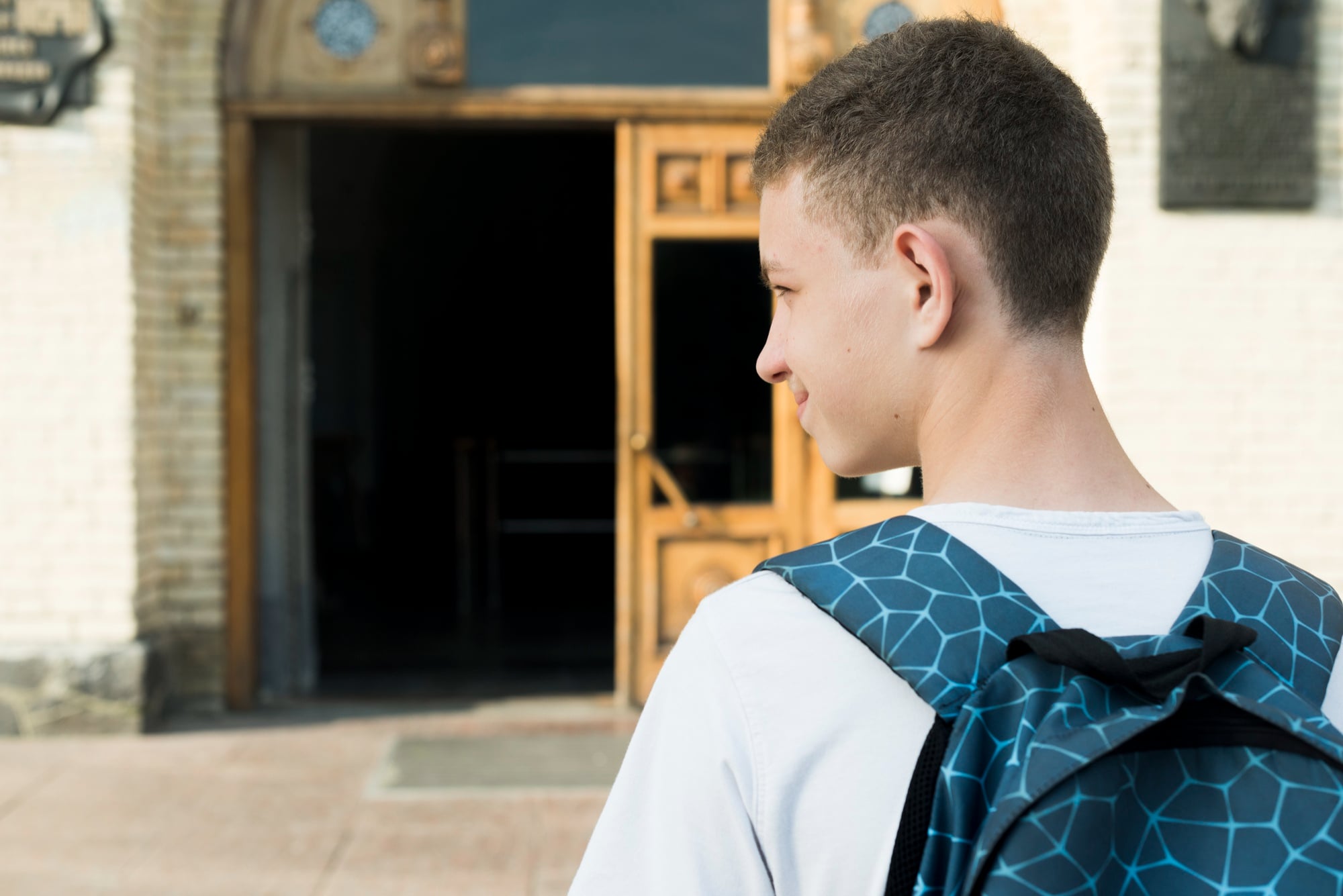
My son. Eleven years old. His blue backpack still on his shoulders.
I walked closer.
Then I stopped.
His jeans were torn open at both knees. Blood was running down his shins into his socks. His palms were scraped raw and black with gravel. There was a scratch across his cheek.
A delivery truck was parked crooked in the middle of the road with its door hanging open. A man in a brown uniform was sitting on the curb beside it with his head in his hands.
And in my son’s arms, clinging to his neck and screaming, was a little girl in pink pajamas. She couldn’t have been more than two.
“Joel,” I whispered. “What have you done?”
But to understand what happened that afternoon, you have to go back three weeks.
To the night Joel started asking.
“Mom. It’s ten minutes. I’m eleven. I can walk home by myself.”
We were sitting at the kitchen table eating spaghetti. Joel had sauce on his chin and that look on his face. The one where he’d been practicing a speech in his head all day.
“No,” I said.
“You didn’t even think about it.”
“I thought about it. The answer’s no.”
“Mom.” He put down his fork. “Tyler walks home. Ava walks home. Marcus walks home, and he lives way farther than us. He has to cross Jefferson.”
“Marcus’s mom isn’t me.”
“That’s not a reason.”
“It’s the only reason I need.”
He slumped back in his chair and stared at his plate.
I knew I was being unfair. I knew it even while I said it. But I’d been picking Joel up from Lincoln Elementary every single day since kindergarten. Rain or shine. Snow. Even the week I had the flu and could barely stand, I sat in the pickup line with a box of tissues and a fever of a hundred and two.
It wasn’t just habit. It was something else.
His father left when Joel was four. Packed up and moved to Arizona with a woman from his office. He calls on birthdays. Sometimes on Christmas. Not always.
After that, it was just Joel and me. Two of us against the world. And when it’s just two of you, you hold on tight. Maybe too tight.
“I’m not a baby,” Joel said quietly.
“I know you’re not.”
“Then why do you treat me like one?”
That one stung. I didn’t have an answer for it.
He asked again the next night. And the next.
He didn’t whine. That’s the thing about Joel. He never whined. He just kept coming back, calm and patient, with new arguments every time. Like a little lawyer.
On Tuesday, he brought me a map. He’d drawn it himself on a piece of printer paper, with our house and the school and every street in between. He’d marked the crosswalks with red X’s.
“See?” he said, laying it on the counter while I was chopping onions. “Straight down Maple. Left on Birch. Cross at the light on Oak. Then straight to school. There’s a crossing guard at Oak. Mrs. Delgado. She knows me.”
“I know the route, Joel. We walk it all the time.”
“Exactly. So I know it too.”
On Wednesday, he brought me statistics. He’d looked them up on the school computer. Something about how kids are statistically safer now than they were in the eighties, when I was a kid and walked everywhere by myself.
“You walked to school alone when you were seven,” he said. “Grandma told me.”
“Grandma talks too much.”
“She said you walked a mile. Uphill.”
“Both ways,” I said. “In the snow.”
He grinned. “Is that true?”
“No.”
On Thursday, he didn’t bring me anything. He just sat at the table while I paid bills and said, very seriously, “Mom. I need to do this. Please.”
There was something in the way he said it. Need. Not want. Need.
I looked up from the checkbook.
“Why do you need to?”
He looked away. He picked at a scab on his elbow.
“I just do,” he said.
Here’s something I should tell you about our street.
We live on Maple Street, in a little brick house with a crooked porch swing. It’s a quiet street. Old trees. Old houses. Old people, mostly. The kind of street where everybody knows whose dog is barking and whose car is parked where it shouldn’t be.
Three doors down lives Ivy Hale.
Ivy is sixty-eight. She has white hair that she wears in a long braid down her back and a garden full of roses that she talks to every morning. She taught third grade for thirty-four years. She’s the kind of woman who brings you soup when you’re sick without asking if you want soup.
When Joel was a baby and his dad had just left, and I was working double shifts at the dental office and falling apart, Ivy took care of him three afternoons a week. She wouldn’t take a dime for it.
“I like the company,” she said.
Joel loves her. He calls her Miss Ivy. When he was little, he used to sit on her kitchen floor and play with an old set of wooden blocks she kept in a basket by the stove. Blocks with letters painted on them, faded from years of little hands.
I never asked whose blocks they were.
I knew.
Every afternoon, when Joel and I walk home from school, we pass Ivy’s house.
And every afternoon, at about 3:15, Ivy is sitting in her front window.
Not reading. Not watching TV. Just sitting there. Looking out at the street.
Joel always waves. She always waves back.
When he was little, he thought it was a game. “Miss Ivy is waiting for us!” he’d say, and run ahead to wave at her.
He’s older now. He’s started noticing things.
About two months ago, in August, we were walking home from the library, and we passed the corner of Maple and Birch. There’s an old lamppost on that corner. Green paint, peeling. And screwed into the lamppost, at about the height of a grown-up’s chest, is a small metal plaque.
It’s so faded you can barely read it. Rust has eaten the corners. Someone’s put a sticker over half of it, a sticker for a pizza place that closed years ago.
Joel stopped in front of it. He scraped at the sticker with his thumbnail until it peeled away.
“Danny Hale,” he read slowly. “Nineteen ninety-six to two thousand seven. Walk safe, little man.”
He turned to me.
“Hale,” he said. “Like Miss Ivy?”
I didn’t want to tell him. I’d been hoping he’d never ask.
But he was looking at me with those serious brown eyes, and I’ve never been able to lie to that face.
“Yes,” I said. “Like Miss Ivy.”
“Who was Danny?”
I took a breath.
“Danny was her son.”
I told him the story that night. On the porch swing, with the crickets going.
I told it the way Ivy had told it to me, years ago, in her kitchen, when Joel was asleep on her couch and the coffee had gone cold.
Danny Hale was eleven years old. He was funny and loud and had freckles and a cowlick that stuck straight up no matter how much water Ivy put on it. He loved baseball and chocolate milk and a cartoon about a talking dog.
For weeks, he begged his mom to let him walk home from school by himself.
Ivy said yes.
On October thirteenth, two thousand seven, Danny left Lincoln Elementary at 3:10. He was walking up Birch toward Maple. He was almost home. He was three hundred feet from his own front door.
A man who’d been drinking since lunch ran a stop sign at the corner.
Danny was gone before the ambulance got there.
Ivy was standing at her front window. Waiting for him. She heard the sound. She didn’t know what it was. Not at first.
She found out a few minutes later, when a neighbor came running up her front steps.
Joel didn’t say anything while I told him. He just sat very still on the porch swing with his knees pulled up to his chest.
“That’s why she sits in the window,” he said finally. Quietly. “Isn’t it? Every day at three-fifteen.”
“I think so,” I said.
“She’s still waiting for him.”
“I don’t know, honey. Maybe. Maybe she’s just remembering him.”
Joel was quiet for a long time.
“That’s the saddest thing I’ve ever heard,” he said.
“I know.”
“Was it her fault? For letting him walk?”
“No,” I said firmly. “No. It was the fault of the man who was driving drunk. Not Miss Ivy. Not Danny. Never them.”
“Does she know that?”
I opened my mouth. Then I closed it.
“I don’t know,” I said.
He went to bed early that night. I heard his light on until almost eleven. When I checked on him, he was asleep with a pencil still in his hand and a notebook open on his chest.
I closed the notebook without looking at it. I put the pencil on his nightstand. I turned off his light.
I didn’t think anything of it.
I should have.
A week after Joel started asking to walk home alone, I was out in the front yard raking leaves when Ivy came down the sidewalk with a pie.
She did that sometimes. Showed up with pie. Apple, this time. Still warm.
“For you and the little man,” she said, holding it out.
“Ivy, you’ve got to stop. I’m going to have to buy bigger jeans.”
“Nonsense. You’re too skinny. Single moms always forget to eat.”
I took the pie. We stood there in the yard together while the leaves blew around our feet.
“Joel tells me he wants to walk home on his own,” Ivy said.
I nearly dropped the pie.
“He told you that?”
“He mentioned it.” She smiled a little. “He asked me what I thought.”
My face went hot. I felt embarrassed, and something else. Something close to guilty. Of all the people for Joel to ask. Of all the people.
“Ivy, I’m sorry. He shouldn’t have bothered you with that. I know it’s… I know what that must…”
“Megan.” She put her hand on my arm. “It’s all right. It’s been nineteen years.”
“Still.”
She looked down the street toward the corner. Toward the green lamppost with the faded plaque.
“Do you know what people expect me to say?” she asked. “They expect me to say never let him go. Keep him close. Don’t make my mistake.” She shook her head slowly. “But I don’t think that’s true. I don’t think letting Danny walk home was a mistake.”
I didn’t know what to say.
“He was so proud,” Ivy said softly. “That first day, he called me from the school office. Just to tell me he was leaving. ‘I’m on my way, Mom.’ Like he was a grown man heading off to war.” She smiled, and her eyes filled up. “He walked home by himself every day for three weeks. Every single day, he came up those front steps with this look on his face. Like he’d climbed a mountain. Those three weeks were some of the happiest of his life.”
“Ivy…”
“It wasn’t the walking that took him,” she said. “It was a man who made a terrible choice. If I’d kept Danny in a bubble, maybe he’d still be here. Or maybe that man would have run the stop sign while I was driving Danny home in the car. You can’t know. You can never know.” She squeezed my arm. “But I know Danny was happy. And I know he felt big. And I’m glad he got to feel big, Megan. Even if it was only for three weeks.”
I stood there holding the warm pie, and I didn’t trust myself to talk.
“I’m not telling you what to do,” Ivy said. “You’re his mother. But don’t say no because of me. Don’t let my story be the reason.”
She patted my arm and walked back down the sidewalk toward her house.
Halfway there, she stopped and turned around.
“He’s a good boy, your Joel,” she said. “He’s got a big heart. Bigger than he lets on.”
“I know.”
“No,” Ivy said. “I don’t think you know how big.”
The next week, I made Joel a deal.
“Friday,” I said. “One time. A trial run.”
His face lit up like a Christmas tree.
“Seriously?”
“Seriously. But there are rules.”
“Anything.”
“Straight home. No shortcuts. No stopping anywhere. Not at the gas station. Not at Tyler’s house. Not to look at a cool bug.”
“I don’t stop for bugs.”
“You stopped for a bug last Tuesday. For five minutes.”
“It was a praying mantis, Mom. That’s different.”
“No stopping. Even for mantises.”
“Fine.”
“And you text me the second you walk out of the school building.”
“Yes.”
“And if anything feels weird, anything at all, if anyone talks to you, if you get scared, you call me. I don’t care if it’s nothing. Call me.”
“Mom. Yes. I know.”
He hugged me so hard I almost fell over.
“Which Friday?” he asked, muffled against my shoulder.
“This one. The thirteenth.”
He went completely still.
“The thirteenth,” he repeated.
“Is that bad luck? I can make it next week if you’re superstitious.”
He pulled back. There was a strange look on his face. Something serious and far away.
“No,” he said. “The thirteenth is perfect.”
That week, Joel was different.
He stayed after school two days in a row for art club. He’d never been in art club in his life. He couldn’t draw a stick figure without the head coming out shaped like a potato.
“Since when do you like art?” I asked him in the car on Wednesday.
“Since now,” he said.
“What are you making?”
“Just a project.”
“What kind of project?”
“Mom.” He rolled his eyes. “It’s a surprise. Mr. Okafor’s helping me.”
On Thursday, he came out of the school with his backpack bulging. Something flat and hard was inside it, pushing against the fabric. He wouldn’t let me touch it. When I reached for the bag to put it in the back seat, he snatched it away and held it on his lap the whole ride home.
That night, I heard him in his room with the door closed. I heard the sound of sandpaper. Scritch, scritch, scritch. Then a small paintbrush clinking against a jar.
I knocked.
“Don’t come in!” he yelled.
“Joel, what are you doing?”
“Nothing! Homework!”
“Since when does homework smell like varnish?”
A pause.
“It’s an art project, Mom. Please. Just trust me.”
I stood outside his door for a while. Then I went back downstairs.
Trust me.
That’s the whole thing, isn’t it? That’s what this entire week had been about. He was asking me to trust him. And I was standing there in the hallway trying to decide if I could.
Friday morning, I made him repeat the rules.
He stood by the front door with his backpack on. The flat hard thing was still in there. I could see the corner of it pushing out against the zipper.
“Straight home,” I said.
“Straight home.”
“No shortcuts.”
“No shortcuts.”
“No stopping anywhere.”
He hesitated. Just for a second. Just a flicker.
“Joel.”
“No stopping,” he said. He wasn’t looking at me.
“And text me when you leave school.”
He sighed the biggest, most dramatic sigh an eleven-year-old has ever sighed. “I know.”
“Say it.”
“I’ll text you when I leave school.”
I fixed his collar. I tried to fix his hair, which never stays down, and he ducked away.
“Mom.”
“Okay, okay.” I put my hands up. “Go. You’re going to be late.”
He opened the door. Then he turned around.
“Mom?”
“Yeah?”
“Thanks. For trusting me.”
Then he was gone, running down the steps two at a time, his backpack bouncing.
I stood in the doorway and watched him go. Down Maple. Past Ivy’s house. She was out in her garden in her robe, talking to her roses. Joel waved at her. She waved back.
At the corner, by the green lamppost, he stopped.
Just for a second. He put his hand flat against the old faded plaque. Like he was saying hello to someone.
Then he turned left onto Birch and disappeared.
I took the day off work. I told myself it was because I had errands. That wasn’t true. I wanted to be home. I wanted to be standing at the window when he came up the street.
I cleaned the whole house. I cleaned things that didn’t need cleaning. I scrubbed the grout in the bathroom with a toothbrush. I reorganized the spice rack alphabetically.
At two o’clock, I made his favorite snack. Apple slices with peanut butter. I put it on the counter. Then I worried it would go brown, so I put lemon juice on it. Then I worried he wouldn’t like the lemon juice, so I made another plate without it.
At three o’clock, I sat on the couch with my phone in my lap and stared at it.
At 3:11, it buzzed.
On my way.
Three little words. With a thumbs-up emoji.
I smiled so hard my cheeks hurt.
I almost texted back. Be careful! Look both ways! Love you! Call me if anything happens! I typed it out. My thumb hovered over send.
Then I deleted it.
He’d been so excited about doing something on his own. I didn’t want to hover. Not today. Not on his big day.
So I just sent back a heart.
Then I sat on the couch and waited.
Ten minutes passed.
That was fine. Ten minutes was normal. He’d be passing the gas station on Oak. Then Mrs. Delgado at the crosswalk.
Fifteen minutes.
Still fine. He was walking up Birch now. Probably kicking a rock. He always kicked rocks.
I got up and went to the front window.
Maple Street was empty. Leaves blowing. A squirrel running along the power line.
Eighteen minutes.
Nineteen.
At twenty, my heart started to pound.
He should have been here by now. Even if he walked slow. Even if he kicked every rock on Birch Street. Twenty minutes was too long.
No stopping.
I picked up my phone to text him.
Before I could type a single letter, it rang.
IVY.
“Hey, Ivy.”
For a second, all I could hear was breathing. Ragged. Uneven.
Then I realized she was crying.
“Are you home?” she said.
My stomach tightened into a knot.
“Yeah. What happened?”
“Come outside. It’s about Joel.”
Every drop of blood in my body went cold.
“Ivy, what happened?”
“He’s here. He’s okay.”
“Then why are you crying?”
She took a shaky breath. I could hear her trying to steady herself.
“You need to see what your son did,” she said.
I was already moving toward the door.
I don’t remember the steps. I don’t remember opening the door. I just remember the cold October air on my face, and the leaves, and my socks on the wet sidewalk.
And Ivy. Standing at the curb in front of her house, wiping tears from her face with both hands.
And Joel. Farther down the sidewalk, near the corner. Near the green lamppost.
His jeans torn open at both knees. Blood running down his shins. His palms raw and black. A scratch across his cheek.
The delivery truck, crooked in the street, its door hanging open. The driver on the curb with his head in his hands.
And in my son’s arms, screaming and clinging to his neck, a little girl in pink pajamas with bare feet.
“Joel,” I whispered. “What have you done?”
I didn’t wait for an answer. I ran.
I fell on my knees in front of him on the sidewalk and grabbed his face in both my hands.
“Are you hurt? Where are you hurt? Joel, look at me. Where does it hurt?”
“I’m okay, Mom.” His voice was shaking. “I’m okay. It’s just my knees.”
“Your knees are bleeding! Your hands! What happened? Did that truck hit you? Did that truck hit you?”
“No. No, Mom. It didn’t hit me.”
“Then what—”
The little girl in his arms screamed louder. She buried her face in Joel’s neck. Her tiny bare feet were filthy. Her pajamas had little cartoon strawberries on them.
“Whose baby is that?” I said. “Joel, whose baby is that?”
“I don’t know her name,” Joel said. “She lives over there. In the yellow house.”
He pointed across the street. The yellow house on the corner of Maple and Birch had been empty for almost a year. A new family had moved in a month ago. I’d seen a moving truck. I’d seen a young woman carrying boxes and a man hanging a tire swing in the big oak tree. I’d meant to bring them cookies. I never had.
The front door of the yellow house was wide open.
The little white gate at the end of their front walk was swinging back and forth in the wind.
I looked at the gate. I looked at the truck, stopped crooked in the street. I looked at the long black skid marks on the pavement, right in front of the yellow house.
I looked at my son’s bleeding knees.
And I understood.
“Oh my God,” I said. “Oh my God, Joel.”
Behind me, a woman screamed.
“Rosie! ROSIE!”
The young woman from the yellow house came flying out her front door. She was barefoot too. Her hair was wet, like she’d just gotten out of the shower. She was wearing a bathrobe and holding a towel, and she was screaming her daughter’s name over and over.
She saw the truck. She saw the skid marks.
She made a sound I will never forget for the rest of my life. A sound that wasn’t even a word.
Then she saw Joel. Holding her daughter.
She ran across her yard, through the swinging gate, across the street. She didn’t look for traffic. She didn’t look at anything. She just ran.
Joel held the little girl out to her. His arms were shaking.
“She’s okay,” he said. “She’s okay. She’s not hurt. I checked.”
The mother grabbed her daughter out of Joel’s arms and crushed her against her chest. She sank down onto the sidewalk with her. She was sobbing so hard she couldn’t breathe.
“Rosie,” she kept saying. “Rosie, Rosie, Rosie, baby, baby, Rosie.”
The little girl stopped screaming the second she was in her mother’s arms. She just hiccuped and clung.
The truck driver had stood up. He walked over slowly. He was a big man, maybe fifty, with a gray mustache and a name tag on his uniform that said GARY. His face was the color of paper. His hands were trembling.
“I didn’t see her,” he said. His voice cracked. “I swear to God, I didn’t see her. I was backing up to turn around. I checked my mirrors. She’s so small. She was right behind the truck. I didn’t see her until…”
He stopped. He looked at Joel.
“Until this kid came out of nowhere,” Gary said. “Out of nowhere. Running. I saw him in the mirror. Running full speed. He grabbed her right out from behind my back wheel. He threw himself down on the pavement with her. Rolled right out of the way.” He shook his head slowly. “If he’d been one second later. One second…”
He couldn’t finish.
He sat down hard on the curb again and put his face in his hands.
Ivy was beside me now.
I hadn’t even heard her come up. She stood next to me on the sidewalk with her arms wrapped around herself. Her braid had come half undone. Tears were still running down her face.
“I saw it,” she said quietly. “I saw the whole thing.”
I turned to her.
“I was sitting in my window,” Ivy said. “Like always. Three-fifteen. And I saw the gate. I saw that little girl come out. I saw her toddle right off the curb and into the street. Right behind that truck while it was backing up.” Her voice shook. “And I couldn’t do anything. I’m sixty-eight years old, Megan. I got up out of my chair, and I knew I’d never get there. I knew it. I was standing at my window screaming, and nobody could hear me through the glass.”
She pressed her hand against her mouth.
“And then Joel came around the corner,” she whispered. “From Birch. And he saw her. And he didn’t even stop. He didn’t even take his backpack off. He dropped something on the ground and he just ran. Straight into the street. Straight behind that truck.”
She looked at me with her eyes full of tears.
“On this corner,” she said. “Today. Of all the days in the world.”
And that’s when it hit me.
October thirteenth.
Nineteen years to the day.
The corner of Maple and Birch.
An eleven-year-old boy walking home from school.
The green lamppost with the faded plaque was right behind us. Right there. Twenty feet away.
Walk safe, little man.
I looked at Ivy. She looked at me.
Neither of us could say anything.
The little girl’s name was Rosie Moreno. She was two years and three months old.
Her mother’s name was Ana. Ana had put Rosie down for a nap and gone to take a five-minute shower. Just five minutes. Rosie had climbed out of her toddler bed, wandered downstairs, and pushed open the front door. The latch was loose. Ana’s husband had been meaning to fix it for weeks.
The little white gate didn’t latch either. It was an old gate. It came with the house.
Ana told me all of this sitting on the sidewalk, rocking Rosie in her arms, saying it over and over like she was confessing to a priest.
“Five minutes,” she said. “Five minutes. I was only gone five minutes. Oh God. Oh God. What kind of mother…”
“Hey.” I sat down next to her on the cold cement. I put my hand on her back. “Hey. Listen to me. Every mother on earth has turned her back for five minutes. Every single one of us.”
“But she could have…”
“She didn’t,” I said. “She’s right here. She’s okay. Look at her.”
Rosie had stopped crying. She was sucking her thumb and staring at Joel with big dark eyes.
Joel was standing a few feet away. He looked smaller than I’d ever seen him look. His shoulders were hunched up. His bloody hands were hanging at his sides. He was shaking all over.
Shock. I knew it from somewhere. Some first aid class. The adrenaline was wearing off.
“Joel,” I said. “Come here, baby.”
He came. He sat down on my other side on the curb. I put my arm around him, and he leaned his whole body against me.
Rosie took her thumb out of her mouth.
She reached across her mother. She put her tiny dirty hand on Joel’s arm.
“Boo-boo,” she said, looking at his knee.
Joel let out a sound. Half laugh, half sob.
“Yeah,” he said. “Boo-boo.”
“Kiss it,” Rosie ordered.
Ana laughed. A wet, broken laugh. She lifted her daughter’s hand and kissed it and then pressed it, very gently, against Joel’s shoulder.
“There,” Ana said through her tears. “That’s from both of us.”
Somebody had called 911. A police car pulled up a few minutes later, and then an ambulance, with no siren.
The paramedics checked Rosie first. Not a scratch. Not one single scratch on her. Joel had held her against his chest when he fell and taken the whole landing on his own knees and elbows and hands.
Then they checked Joel.
A young paramedic with a ponytail knelt in front of him on the sidewalk and cleaned his knees with something that stung. Joel gritted his teeth and didn’t make a sound.
“You’re a tough guy, huh?” she said.
“It hurts,” Joel admitted.
“Of course it hurts. You skidded across asphalt.” She smiled at him. “You’ve got some road rash. Nothing broken. No stitches. You’ll be sore for a while, though. These knees are going to look pretty gross for a week or two.”
“Cool,” Joel said weakly.
She laughed.
The police officer took statements. From Gary. From Ivy. From Ana. From Joel, who told the story so simply it broke my heart.
“I came around the corner and I saw her in the street. Behind the truck. And the truck was backing up. And I just ran.”
“Did you think about it?” the officer asked. “Before you ran?”
Joel shook his head.
“No,” he said. “There wasn’t time to think.”
The officer wrote something down in his notebook. Then he closed it and looked at Joel for a long moment.
“Son,” he said. “I’ve been doing this job for twenty-two years. Most grown men I know would have frozen. Most grown men would have stood right there on that sidewalk and yelled.”
Joel looked at his ruined jeans.
“I didn’t want to just yell,” he said.
Gary the truck driver came over before he left. He was still pale. He had to sit in his truck for twenty minutes before the police let him drive.
He crouched down in front of Joel. His knees cracked.
“Kid,” he said. “What’s your name?”
“Joel.”
“Joel.” Gary held out his hand. It was huge, calloused, still trembling a little. “My name’s Gary Pruitt. I’ve been driving this route for eleven years. I’ve got three grandkids. One of them’s about your age.”
Joel shook his hand. His scraped palm was wrapped in gauze now. Gary held it very carefully.
“You saved her life,” Gary said. “And you know what else? You saved mine too. Because if I’d hit that baby…” He shook his head. “I couldn’t have lived with that. I don’t know how anybody lives with that.”
He let go of Joel’s hand. He stood up slowly. Then he looked at me.
“You raised a good one, ma’am,” he said.
I couldn’t speak. I just nodded.
As Gary walked back to his truck, I saw Ivy watching him go. There was a look on her face I’d never seen before. Something cracked open. Something very old and very deep.
I don’t know how anybody lives with that.
The man who killed Danny had lived with it. For a while. He went to prison for six years. Ivy told me once that he wrote her a letter every year on October thirteenth. She’d never opened a single one. She kept them in a shoebox on the top shelf of her closet. Nineteen letters now. Maybe twenty.
She never said what she was going to do with them.
It was almost five o’clock by the time the police and the ambulance left. The sun was getting low. The light turned everything orange and gold.
Ana took Rosie inside. Before she went, she grabbed Joel and hugged him so hard he squeaked.
“I’ll never be able to thank you,” she said into his hair. “Never. You hear me? Never in my whole life.”
“It’s okay,” Joel said, embarrassed. “You don’t have to.”
“Yes, I do.” She pulled back and held his face. “My husband’s going to want to meet you. He’s going to want to hug you too. Fair warning. He’s a big hugger.”
“Okay.”
Then she went inside with Rosie on her hip and closed the door. I heard the deadbolt click. I heard it click again, like she was checking it.
And then it was just the three of us. Me and Joel and Ivy. Standing on the corner of Maple and Birch, under the green lamppost.
“Let’s get you inside,” Ivy said to Joel. “My house is closer. I’ve got a first aid kit and hot chocolate. Real hot chocolate. Not the powder.”
Joel didn’t move.
He was looking at the sidewalk. At something lying in the grass between the sidewalk and the street, right at the base of the lamppost.
“My stuff,” he said.
He limped over and bent down, wincing. He picked something up out of the grass.
It was a flat piece of wood. About the size of a dinner plate. Rectangular, with rounded corners. Sanded smooth and varnished so it shined.
That was the thing in his backpack. The flat, hard thing he’d been guarding all week.
He’d dropped it when he ran.
Ivy said he’d dropped something on the ground and just ran. This was it.
He turned it over. There was a long scratch across the varnish where it had hit the sidewalk.
“Oh no,” he said quietly. “Oh no. It’s scratched.”
“What is it, honey?” I asked.
Joel looked at me. Then he looked at Ivy.
His face went red. He looked like he wanted to disappear into the ground.
“It was supposed to be a surprise,” he said. “It was supposed to be perfect.”
He held it out to Ivy with both hands.
She took it.
I came around to stand beside her so I could see.
It was a plaque. Hand-carved, the letters cut into the wood with a little knife and then filled in with dark blue paint. Some of the letters were crooked. The D was a little too big. The y had a wobble in its tail.
It said:
DANNY HALE
1996 – 2007
He walked home brave.
We’ll walk the rest of the way for him.
Underneath the words, painted in careful colors, was a baseball. And a little cartoon dog.
Ivy made no sound at all.
She just stood there holding the piece of wood in both hands, staring down at it.
Then her knees gave out.
I caught her. Joel caught her too, on the other side, even with his scraped-up hands. We held her between us, and she sank slowly down onto the curb, still clutching the plaque against her chest.
“How,” she whispered. “How did you know? The baseball. The dog. How did you…”
“I asked Mr. Okafor,” Joel said. His voice was wobbling. “He’s my art teacher. He’s been at Lincoln for like thirty years. He was Danny’s art teacher too. He remembered him. He said Danny drew baseballs on everything and he loved this cartoon about a dog named Rocket. He said Danny drew Rocket on every single assignment, even math.”
Ivy laughed. A broken, gasping laugh with tears running down her face.
“He did,” she said. “He did. He drew Rocket on his spelling tests. His teacher sent a note home.”
“Mr. Okafor showed me how to carve the letters,” Joel said. “I did it myself, though. He just helped me with the router for the edges. He wouldn’t let me use the router alone. He said I’d lose a finger.”
“Smart man,” I managed.
“I saw the old one,” Joel said, looking up at the lamppost. At the rusty, faded little plaque that nobody could read anymore. “In August. When Mom told me about Danny. It’s all rusty and somebody put a pizza sticker on it. And I thought…” He swallowed. “I thought that’s not fair. He shouldn’t be covered up by a pizza sticker. Somebody should fix it.”
Ivy pressed the plaque against her heart.
“I wanted to bring it on today,” Joel said. “Because Mom told me what day it was. When it happened. October thirteenth. And I wanted to walk the same way he walked. Down Birch. To the corner. By myself. Like he did.” His voice cracked. “Because he didn’t get to finish. He didn’t get to come home. So I thought… I thought maybe I could finish it for him. And then I’d come to your door and give it to you, Miss Ivy. And you wouldn’t have to sit in the window alone today.”
The street was so quiet. A leaf blew past my feet.
“That’s why you wanted to walk alone,” I said.
Joel nodded.
“If you drove me, you’d make it a whole thing,” he said. “You’d cry in the car. And then I’d cry. And it wouldn’t be the same. I wanted to walk it. The way he did.”
“And no stopping,” I said softly. “That’s why you hesitated this morning. When I said no stopping.”
“I was going to stop at Miss Ivy’s,” Joel admitted. “I’m sorry, Mom. I broke the rule. I was always going to break that one.”
“You broke more than one rule today,” I said. “You ran into the street.”
He looked at me.
“Are you mad?”
I looked at my son. My eleven-year-old son. With his bloody knees and his gauze-wrapped hands and the scratch on his cheek. With the plaque he’d carved by hand for a boy he never met. Walking a road nobody asked him to walk, so a grieving woman wouldn’t have to sit alone in her window.
And then running into the street. Without thinking. Without stopping. To catch somebody else’s little girl.
“No, baby,” I said. “I’m not mad.”
I pulled him into my arms and held him so tight he complained.
“Mom. My knees.”
“I don’t care about your knees.”
“I care about my knees.”
I laughed. I laughed and I cried, and I didn’t let go.
Ivy was still sitting on the curb with the plaque in her lap. She was running her fingers over the carved letters. Over the crooked D. Over the little cartoon dog.
“He walked home brave,” she read out loud. Very softly. “We’ll walk the rest of the way for him.”
She looked up at Joel.
“Where did you get those words?”
Joel shrugged. His face went red again.
“I made them up,” he said. “It took me like a week. I had a bunch of other ones, but they were dumb.”
“They’re not dumb,” Ivy said. “They’re perfect.”
She looked down the street. Toward her own house. Toward the front window where she’d sat every afternoon at 3:15 for nineteen years.
“Do you know,” she said slowly, “what I was doing when I saw that baby in the street?”
We waited.
“I was waiting for you,” she said to Joel. “Your mom told me this morning you were walking home alone today. And I sat down in my window at three o’clock. And I thought, he’s walking up Birch right now. Just like Danny did. On this day. And I was so scared. My heart was pounding so hard. I kept thinking, God, please, not again. Not on this street. Not on this day. Please let this boy come home.”
She stopped. She pressed her lips together hard.
“And then I saw that little girl in the street,” she said. “And I knew I couldn’t save her. I was too far away. I was too old. I was too slow. Just like before. Just like I couldn’t save…”
Her face crumpled.
“And then you came around the corner,” she whispered. “And you didn’t even stop. You just ran.”
She reached up and took Joel’s bandaged hand in both of hers.
“You did what I couldn’t do,” she said. “For nineteen years, I’ve been sitting in that window wishing someone had been there. Wishing someone had been on that corner when my Danny came around it. Just one person. Just one person who could have run.”
Tears were sliding down her face, one after another.
“And today, someone was,” she said. “Today, someone was there.”
Joel knelt down on the sidewalk in front of her, wincing at his knees. He put his arms around her neck.
Ivy held him and cried into his shoulder. Big, deep, shaking sobs. The kind that have been waiting a very long time to come out.
I stood over them in the orange light under the old green lamppost.
And I cried too.
We cleaned Joel up in Ivy’s kitchen.
She had a first aid kit the size of a toolbox. “Thirty-four years of third graders,” she said, pulling out bandages and ointment. “You learn to be prepared.”
Joel sat on her kitchen counter while she cleaned the gravel out of his palms with tweezers. I held his other hand.
The wooden blocks were still in their basket by the stove. Faded letters. A, B, C. Joel looked at them.
“Were those Danny’s?” he asked.
Ivy didn’t look up from his palm.
“Yes,” she said.
“I used to play with them.”
“I know you did.” She smiled a little. “You used to spell out ‘JOEL’ and then knock it down and laugh like a maniac.”
“I don’t remember that.”
“You were three.” She dabbed ointment onto his hand. “Danny used to do the exact same thing. Spell his name and knock it over. Every single time. I never told you that.”
Joel was quiet.
“Is that why you let me play with them?” he asked.
Ivy finally looked up. Her eyes were soft.
“I let you play with them because blocks are for playing with,” she said. “They were sitting in a closet for twelve years. That’s no life for a block.”
She finished wrapping his hand and patted it gently.
Then she made hot chocolate. Real hot chocolate, in a pot on the stove, with milk and cocoa and sugar and a pinch of cinnamon. She poured it into three mismatched mugs. Joel’s mug had a faded cartoon dog on it. Rocket. The dog from Danny’s show.
He didn’t ask whose mug it was. He already knew.
We sat at her kitchen table while the sun went down, drinking hot chocolate, not saying much.
At one point, Ivy got up and went to her bedroom. She came back holding a shoebox.
She set it on the table in front of her. She didn’t open it.
“Do you know what this is?” she asked me.
I did. I nodded.
“Nineteen letters,” Ivy said. “One every year. On this day. From the man who killed my son.”
Joel looked at the box. Then at Ivy. His eyes went wide.
“I’ve never opened one,” Ivy said. “Not one. I couldn’t. I thought if I opened them, I’d be letting him off the hook. Saying it was okay. And it was never okay. It’ll never be okay.”
She put her hand flat on the lid.
“But today,” she said, “I watched that truck driver. Gary. I watched him sitting on the curb with his head in his hands. Shaking. Because he almost did the same thing. Because he almost lived the worst moment of his life. And I thought…” She stopped. She took a breath. “I thought, I wonder if that’s what it’s like for him. The other man. Every October. Every year.”
“You don’t have to open them, Ivy,” I said gently. “Nobody expects you to.”
“I know,” she said. “I’m not going to. Not tonight.”
She lifted her hand off the lid.
“But maybe someday,” she said. “Maybe. I don’t know. For the first time in nineteen years, I think maybe.”
Joel’s dad called that night.
I’d texted him a picture of Joel’s bandaged hands and a short explanation. I didn’t expect an answer. He hadn’t answered my last three texts.
But my phone rang at nine-thirty. Joel was already in bed, half asleep, his knees wrapped up like mummies.
“Is he okay?” Kyle asked. No hello. Just that.
“He’s okay. He’s sore. He’s asleep.”
There was a long silence on the line.
“He ran in front of a truck,” Kyle said. “For some kid he didn’t even know.”
“Behind a truck. But yes.”
“Jesus, Megan.”
“I know.”
Another long silence.
“Can I talk to him?” Kyle asked. “Tomorrow? When he wakes up?”
I almost said something sharp. Something about how he hadn’t asked to talk to Joel since July. Something about birthdays, and Christmas, and a soccer tournament in September that Joel had saved him a seat at.
But I thought about Ivy. About the shoebox. About maybe someday.
“Yeah,” I said. “Call him in the morning. He’d like that.”
“Okay.” Kyle’s voice was thick. “Tell him… tell him I’m proud of him. Tonight. In case he wakes up.”
“I will.”
I hung up. I went upstairs and stood in Joel’s doorway.
He was asleep. One bandaged hand was hanging off the side of the bed. His face looked so young. Younger than eleven.
I went in and sat on the edge of his bed.
“Your dad says he’s proud of you,” I whispered.
Joel didn’t wake up. But he smiled in his sleep. Just a little.
I sat there for a long time, watching him breathe.
On Saturday morning, there was a knock on our door at nine o’clock.
It was the Morenos. All three of them. Ana, holding Rosie on her hip. And a very large man with a beard and tattoos up both arms who was already crying before I even got the door all the way open.
“Is he here?” the man said. “Is the boy here?”
“Joel,” I called up the stairs. “You have visitors.”
Joel came down the stairs very slowly, holding the railing. His knees had stiffened up overnight. He was walking like a ninety-year-old man.
The big man took one look at him and made a sound like a wounded bear.
“Come here,” he said. “Come here, kid.”
He wrapped Joel up in a hug that lifted him clean off his feet.
“OW,” Joel said. “Knees! Knees!”
“Sorry! Sorry, sorry.” The man put him down very carefully. He wiped his face with the back of his tattooed hand. “I’m Luis. I’m Rosie’s dad. I’m the idiot who didn’t fix the latch on the front door. Or the gate. I’ve been meaning to do it for a month.”
“It’s okay,” Joel said.
“It’s not okay. It’s not okay at all. I fixed them both last night. Three o’clock in the morning. Ana thought I’d lost my mind.” He laughed, wet and shaky. “I put new locks on everything. I put a lock on the refrigerator. I’m thinking about putting a lock on the dog.”
“You don’t have a dog,” Ana said.
“I’m going to get a dog just so I can lock it.”
Rosie reached out from her mother’s arms toward Joel.
“Joe,” she said. “Joe!”
“She’s been saying your name all morning,” Ana said, smiling. “Well. Half of it.”
Joel took Rosie’s tiny hand. She grabbed his finger and squeezed.
“Boo-boo,” she said, pointing at his knee.
“Still got the boo-boo,” Joel agreed.
They’d brought food. So much food. Enchiladas and rice and a whole tray of homemade tamales and a chocolate cake with THANK YOU JOEL written on it in blue frosting. Luis carried it all in from their car in three trips.
“I didn’t know what you liked,” Ana said. “So I made everything.”
“I like everything,” Joel said.
That afternoon, we hung the plaque.
Ivy asked Joel if he’d do it himself. He said only if Mr. Okafor could come and help him with the drill. So I called the school, and the school called Mr. Okafor, and he showed up on Maple Street at two o’clock on a Saturday in paint-stained overalls with a toolbox.
He was older than I expected. Seventy, maybe. Bald, with gray in his beard and reading glasses pushed up on his head.
When he saw Ivy standing on the corner, he stopped.
“Mrs. Hale,” he said.
“Mr. Okafor.” Ivy smiled. “It’s been a long time.”
“Nineteen years,” he said. “I came to the funeral. I don’t know if you remember.”
“I remember. You brought a drawing. One of Danny’s. The one of Rocket playing baseball.”
Mr. Okafor nodded slowly.
“I kept a few of his drawings,” he said. “I don’t know why. I never kept anyone else’s. But I kept his.” He reached into the front pocket of his overalls and took out a folded piece of paper. Yellowed. Soft at the edges. He held it out to her. “I thought maybe you should have this one.”
Ivy unfolded it.
It was a drawing in crayon. A little cartoon dog with a baseball bat. And underneath, in big, wobbly, nine-year-old letters: ROCKET HITS A HOME RUN AND GOES HOME.
Ivy laughed out loud. Then she pressed the paper against her chest and closed her eyes.
“Thank you,” she whispered.
“Thank this young man,” Mr. Okafor said, putting his hand on Joel’s shoulder. “He came to me with a picture he’d drawn on a napkin and said, ‘I need to make a sign for a boy who died.’ I said, why? He said, ‘Because his old sign has a pizza sticker on it, and he deserves better than that.’” Mr. Okafor shook his head. “In forty years of teaching, nobody’s ever said anything better to me.”
Word had gotten around the street. You know how it is on a street like ours.
By the time Joel and Mr. Okafor had the drill out, there were maybe twenty people standing on the corner. Old Mr. Lindqvist from across the street, leaning on his cane. The Pattersons with their twins. Mrs. Delgado, the crossing guard, still in her bright orange vest even though it was Saturday. The Morenos, with Rosie on Luis’s shoulders.
Gary the truck driver showed up. I don’t know how he heard. He parked his own car, a beat-up blue sedan, and stood at the back of the crowd in a flannel shirt with his hands in his pockets. When Joel saw him, he waved. Gary waved back.
Mr. Okafor carefully unscrewed the old, rusty plaque. He handed it to Ivy. She held it in her palm and looked at it for a long time. The faded words. The rusted corners. The sticky patch where the pizza sticker had been.
“His father picked this one out,” she said quietly. “Frank. He went to the hardware store the week after and had it made. He screwed it onto the lamppost himself. He cried the whole time.”
“Do you want to keep it?” Joel asked.
“Yes,” Ivy said. “I think I do. I’ll put it next to Frank’s picture.”
Ivy’s husband, Frank, had died five years ago. Heart attack. She told me once that he never really recovered from Danny. She said grief sat on his chest like a stone for fourteen years until one day his heart just stopped trying.
She put the old plaque in her coat pocket. She kept her hand on it.
Then Joel held the new plaque up against the lamppost. His bandaged hands were shaking a little. Mr. Okafor held the drill steady and guided Joel’s hands, and together they drove in the screws. One. Two. Three. Four.
Joel stepped back.
The new plaque shone in the afternoon sun. The scratch from the sidewalk ran right across the bottom corner.
“I wish it wasn’t scratched,” Joel said quietly.
Ivy put her hand on his shoulder.
“I’m glad it is,” she said.
“Why?”
“Because now it tells the whole story,” Ivy said. “Every time I walk past it, I’ll see that scratch. And I’ll know what you dropped it for.”
Then something happened that I’ll never forget.
Ivy looked down Birch Street.
Toward the school. The way Danny had walked. The way Joel had walked.
“Nineteen years,” she said, almost to herself. “Nineteen years, and I’ve never once walked down Birch Street.”
I stared at her.
“Never?”
“Never. I drive around. I go down Elm and cut over on Fifth. It adds ten minutes to everything. Ten minutes every single time I leave the house. For nineteen years.” She laughed a little. “Frank used to say I’d spent two whole years of my life driving around one street.”
Joel looked up at her.
“Do you want to walk it?” he asked. “Now?”
Ivy didn’t answer. She just stood there looking down the street. At the sidewalk. At the old trees. At the leaves blowing across the pavement.
“I don’t know if I can,” she said.
Joel took her hand. His bandaged hand. Very gently.
“We can walk it together,” he said. “The rest of the way. Like it says on the sign.”
Ivy looked down at him.
I watched her face. I watched nineteen years of grief move across it like weather.
And then she nodded.
They walked down Birch Street together. Ivy and Joel. Hand in hand. Slowly, because of his knees and because of her age, and because some walks aren’t meant to be fast.
Nobody followed them at first. We all just stood on the corner and watched them go.
Then Mr. Okafor started walking. A few steps behind.
Then Mrs. Delgado in her orange vest.
Then Luis Moreno with Rosie on his shoulders, and Ana beside him.
Then the Pattersons and their twins. And old Mr. Lindqvist with his cane, very slowly, at the back.
And Gary. The truck driver. With his hands in his pockets.
And me.
We walked all the way down Birch Street to Lincoln Elementary. A whole crowd of us. Strangers and neighbors. Nobody talking. Just walking.
At the school, Ivy stopped at the front steps. She looked up at the building. At the old brick and the big double doors. The doors that her son had walked out of at 3:10 on October thirteenth, two thousand seven, so proud, so big, on his way home.
She stood there a long time.
Then she turned around.
“Okay,” she said. Her voice was steady now. “Now let’s walk him home.”
And we did.
All of us. Back up Birch Street. The whole way. Past the stop sign where the drunk driver ran through nineteen years ago. Past the corner. Past the green lamppost with the shining new plaque.
Up Maple Street. To Ivy’s front walk. To her front steps.
Ivy stopped at the bottom of the steps. She looked up at her front door.
“He was three hundred feet away,” she said quietly. “That’s all. Three hundred feet.”
Joel squeezed her hand.
“Well,” he said. “He’s home now.”
Ivy closed her eyes.
Then she walked up the steps, one at a time. And she opened her front door. And she turned around and looked at all of us standing on her lawn. Twenty people who’d walked a mile on a Saturday afternoon for a boy most of them had never met.
“Thank you,” she said. “All of you. Thank you for bringing my boy home.”
That was a year ago.
Joel walks home from school by himself every day now. Rain or shine. He texts me when he leaves. On my way. Every single day. Even though I don’t make him anymore.
We changed the rules, Joel and me.
Straight home. No shortcuts. One stop allowed.
He always takes it at the same place.
Every afternoon at 3:15, Ivy is sitting in her front window. But she’s not looking at the corner anymore. She’s not waiting for a boy who’ll never come.
She’s waiting for Joel.
He comes up her front steps, and she opens the door before he can knock. And there’s always something. A cookie. A piece of pie. Hot chocolate in the mug with the cartoon dog on it. He sits at her kitchen table and tells her about his day for exactly fifteen minutes. Then he walks the three doors home to me.
Sometimes Rosie Moreno toddles over from the yellow house with her mother, and the four of them sit on Ivy’s porch together. Rosie is three now. She calls Joel “Joe-Joe” and follows him around like a duckling. Luis put a new gate on their front walk. It latches with a click you can hear from three houses away. Every time I hear that click, I say a little thank-you in my head.
Joel’s dad calls on Sundays now. Every Sunday. They talk about baseball, mostly. Kyle came to visit in August, for the first time in two years. He walked Joel to the corner of Maple and Birch and read the plaque on the lamppost and had to sit down on the curb.
I don’t know what they talked about there. Joel says it was private. That’s fair.
Gary Pruitt still drives the delivery route. Every time he comes down Maple Street, he honks twice when he passes our house. Joel waves from the window.
Mr. Okafor retired in June. Joel gave him a card he made himself, with a drawing of a cartoon dog holding a paintbrush. Mr. Okafor said he’s going to frame it.
And Ivy opened the shoebox.
Not all at once. She told me she opened one letter in January. Just one. The first one. From the first year. She said it was only three lines long, and the handwriting was so shaky she could barely read it.
She didn’t tell me what it said. She said that was between her and him.
She opened another in March. And another in May.
She hasn’t written back. She says she doesn’t know if she ever will. She says forgiveness isn’t a door you walk through. It’s a street you walk down. Slow. One step at a time. And sometimes you have to stop and rest.
“But I’m walking,” she said. “For the first time, I’m walking.”
Today is October thirteenth again.
At 3:11, my phone buzzed.
On my way.
I didn’t text back. I just went outside and stood on the porch and waited.
At 3:20, I saw him come around the corner from Birch. He was taller than last year. His jeans actually fit him, for once. His knees had healed, but there were two faint pale scars on them, shiny in the sunlight, that will probably never go away.
He stopped at the green lamppost.
He put his hand flat against the plaque. Over the crooked D. Over the little cartoon dog. Over the long scratch across the bottom corner.
He stood there for a second. Just a second.
Then he walked on up Maple Street.
Ivy was standing in her front doorway. Not in her window. In the doorway, with the door wide open, waiting. She had something in her hands. A plate covered with a dish towel.
Joel walked up her front steps. She put her arms around him.
They stood there together for a long time.
Then Ivy looked up and saw me on my porch, three doors down. She lifted her hand and waved.
I waved back.
I used to think the hardest part of being a mother was keeping your child safe. Holding on. Picking them up every afternoon in the pickup line, even with a fever of a hundred and two. Never letting them out of your sight.
I was wrong.
The hardest part is letting go.
Opening your hand. Watching them walk down the street alone, getting smaller and smaller. Trusting the world with the most precious thing you’ve got. Knowing you can’t protect them from everything. Knowing you never could.
But here’s what I learned on that cold October afternoon, standing on a sidewalk in my socks.
When you let go, you don’t just find out who your child is.
You find out who they were all along.
I spent eleven years trying to keep Joel safe. And he spent one week, in secret, carving a sign for a boy he never met, because he couldn’t stand the idea of a grieving woman sitting alone in her window.
And when the moment came, when a little girl wandered into the street behind a backing truck, he didn’t stop to think. He didn’t stand on the sidewalk and yell.
He ran.
Not because I taught him to. I spent his whole life teaching him the opposite. Look both ways. Stay on the sidewalk. Don’t take chances.
He ran because of who he is.
And I never would have known that, if I’d kept picking him up.
Joel came down Ivy’s front steps with the plate in his hands. He walked the three doors home and came up our steps. He held the plate out to me and pulled off the dish towel.
Apple pie. Still warm.
“Miss Ivy says you’re too skinny,” he said.
“Miss Ivy says that every week.”
“She says single moms always forget to eat.”
I laughed. I took the pie. And then I put it down on the porch swing, and I pulled my son into my arms, right there on the porch, in front of the whole street.
“Mom,” he groaned. “People can see.”
“I don’t care.”
“I’m twelve now.”
“I know.”
“Twelve-year-olds don’t get hugged on porches.”
“This one does,” I said. “Today, this one does.”
He sighed. That big, dramatic, eleven-year-old sigh he still hasn’t grown out of.
But he didn’t pull away.
He put his arms around me and hugged me back.
Down the street, the leaves were blowing across the corner of Maple and Birch, red and yellow, scraping along the pavement. The new plaque on the green lamppost caught the afternoon sun and shone.
He walked home brave.
We’ll walk the rest of the way for him.
And we do. Every single day.
All of us.
Together.

Adrian Hawthorne is a celebrated author and dedicated archivist who finds inspiration in the hidden stories of the past. Educated at Oxford, he now works at the National Archives, where preserving history fuels his evocative writing. Balancing archival precision with creative storytelling, Adrian founded the Hawthorne Institute of Literary Arts to mentor emerging writers and honor the timeless art of narrative.