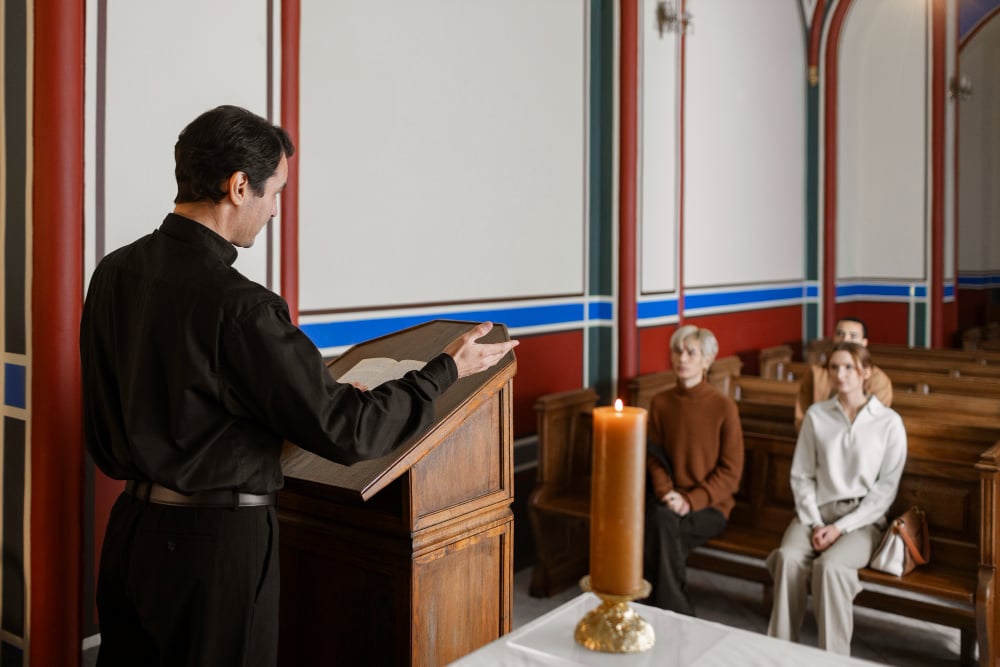
“I know half of you want me out of here right now.”
Theo stopped. His voice had cracked on the last word.
For a moment, he just stood at the microphone in that red dress while people whispered behind me. The church was so full that some people were standing along the back wall. Every one of them was staring at him.
My husband, Daniel, was half-standing beside me. One hand on the pew in front of us. His jaw tight.
I had one hand wrapped around his sleeve. I wasn’t sure anymore whether I was holding him back or holding on.
Theo looked down at himself.
“And I know how this looks,” he said. “It isn’t even mine. I borrowed it from my sister.”
A few people shifted in their seats. Somebody coughed. An old man near the front shook his head slowly, the way you’d shake your head at a car accident.
Theo swallowed hard.
“The reason I’m standing here in it is very simple.”
He turned and looked at my son’s coffin.
“And it’s the saddest thing I know.”
The room went quiet.
And I want to tell you the truth about that moment, because the whole story depends on it. Ten minutes earlier, I had seriously considered asking the funeral director to take that boy outside.
My son Jack died seventeen days after his eighteenth birthday.
Cancer. A kind with a long name that I learned to spell without looking, the way you learn the name of a street you never wanted to live on.
Fourteen months from diagnosis to funeral.
It still feels obscene to reduce his whole life to those facts. They fit on an index card. He didn’t.
Jack loved old horror movies, the cheaper the better. The ones where you can see the zipper on the monster’s back.
He burned grilled cheese every single time because he refused to cook it on low heat. “Low heat is for cowards, Mom.” Then he’d scrape the black off with a butter knife over the sink and eat it anyway.
He hated tomatoes. But he put ketchup on everything. Eggs. Rice. Once, to my horror, a slice of pizza.
“Ketchup is made of tomatoes,” I told him.
“Ketchup is made of ketchup,” he said, like I was the one who didn’t make sense.
He could name almost every capital city in the world. Ouagadougou. Ulaanbaatar. Tegucigalpa. He’d rattle them off at dinner if you gave him a country. But he could not, for the life of him, remember to bring his laundry downstairs. His hamper would overflow until it looked like a small mountain of hoodies, and I’d stand in his doorway and say, “Burkina Faso,” and he’d say, “Ouagadougou,” and I’d say, “Laundry,” and he’d say, “I don’t know that one.”
And Theo had been beside him for most of it.
The boys met when they were seven.
Theo’s family moved into the yellow house four doors down from us the summer before second grade. I remember the moving truck. I remember a skinny little boy with enormous ears standing in the driveway, holding a plastic dinosaur, watching his parents argue about where the couch should go.
Jack watched him from our front steps for about ten minutes.
Then he walked down the sidewalk with his own plastic dinosaur.
I watched from the kitchen window. I couldn’t hear what they said. I just saw Jack hold up his T. rex, and Theo hold up his triceratops, and then the two of them sat down on the curb and started fighting with the dinosaurs.
An hour later, Jack came back inside.
“His name is Theo,” he announced. “He doesn’t know any capitals. I’m going to teach him.”
By the time they were ten, Theo practically lived at our house.
He came over after school. He stayed for dinner. He knew which drawer the good spoons were in and which cabinet had the cereal we pretended was for guests. He called me Mrs. Harris for the first year, then Laura for about a week, until Daniel told him it was weird, and then he went back to Mrs. Harris and never changed it again.
He slept in our spare room so often that I eventually stopped calling it the spare room.
It became “Theo’s room.”
I bought sheets with rocket ships on them. Theo kept a toothbrush in our bathroom, a green one, in the cup next to Jack’s blue one. When he was eleven, he taped a poster of a band I’d never heard of to the wall in there, and I didn’t take it down for six years.
His home life wasn’t easy.
I learned that slowly. Not from Theo. Theo never complained. I learned it from the things he didn’t say.
His parents separated when he was nine. Then they got back together. Then they separated again when he was eleven. Then they got back together again. Then, when he was thirteen, they finally divorced with enough bitterness to poison every holiday that came after.
I’d hear about it in pieces. His dad had a new apartment across town. His mom had changed the locks. His sister, Emma, who was four years older, had stopped speaking to their father for a whole year.
There were years when Theo spent Christmas with us because neither parent could agree whose house he was supposed to be at. They’d each assume he was with the other one. Or they’d fight about it on the phone until nobody wanted to be anywhere.
The first time, Theo was twelve.
It was Christmas Eve. Snowing. We were about to sit down to dinner when the doorbell rang. Theo was on the porch with a backpack and snow in his hair.
“Hi, Mrs. Harris,” he said. “Sorry. Is it okay if I— I don’t have to stay for dinner. I can just—”
Jack came up behind me in his socks.
“Mom,” he said. “Theo’s staying.”
Not asking.
Informing.
I always said yes.
That night, Theo opened a present under our tree. Jack had bought it with his own allowance. It was a cheap paperback atlas.
“So you can finally learn the capitals,” Jack said.
Theo laughed so hard he fell off the couch.
Jack never made a big deal about any of it. Not once. He never asked Theo questions about his parents. He never acted sorry for him.
He just made room.
Later, I’d think about that a lot. About how a twelve-year-old boy knew exactly how to love somebody without making them feel like a charity case. I’m not sure I’ve ever learned it as well as he did.
Jack got sick the spring of his junior year.
It started with him being tired. Then bruises he couldn’t explain. Then a cough that wouldn’t go away, and a lump on his neck that he showed me one morning in the kitchen like it was a funny bug bite.
“Is this weird?” he asked. “It feels weird.”
I touched it with two fingers.
It felt weird.
Two weeks later, a doctor in a gray office told us what it was. She said it gently. She said it clearly. She said the words “very treatable” three times, and I held on to those words like a rope.
Daniel drove us home. Nobody turned on the radio. Halfway there, Jack, in the backseat, said, “Well. That’s annoying.”
And Daniel laughed. A horrible laugh, a laugh that was half something else. And then I laughed too. And Jack grinned at us in the rearview mirror like he’d done it on purpose.
He probably had.
When Jack got sick, Theo returned every favor we’d ever done him, in a way I still don’t know how to describe.
He came over after school. Every day. Without being asked.
He did his homework on the floor of Jack’s bedroom, sitting cross-legged on the rug with his back against the bed, while Jack slept or read or stared at the ceiling.
He watched bad movies with him. Horrible ones. Attack of the Killer Tomatoes. Jack insisted it was a documentary about his greatest enemy.
He was there for the hair loss. When Jack’s hair started coming out in clumps on his pillow, it was Theo who showed up with Daniel’s electric clippers and said, “Okay. Let’s just get it over with.” He shaved Jack’s whole head in the bathroom while Jack sat on the closed toilet lid making a list of famous bald people.
Then Theo handed Jack the clippers.
“Your turn.”
“What?”
“Do mine.”
“Theo, no. You have good hair. You have, like, shampoo commercial hair.”
“Do it, or I’ll do it myself and it’ll look terrible.”
Jack did it. It looked terrible anyway. They came downstairs together, two bald teenage boys, and Daniel stood in the kitchen with a dish towel in his hands and couldn’t speak.
Theo was there for the steroids. The weeks Jack’s face swelled and he was hungry all the time and angry all the time and threw a lamp once, not at anyone, just at the wall. Theo picked up the pieces and said, “That lamp was ugly anyway, man.”
He was there for the days Jack didn’t want to speak. He’d sit in the room in silence for two, three hours, just doing his calculus, and leave without saying goodbye, and come back the next day.
And he was there for the days Jack couldn’t stop speaking. The days he talked and talked and talked. Capital cities. Movie plots. Long, rambling theories about whether a duck could beat a goose in a fight. I understood later that he talked like that because he was terrified that if he went quiet, everyone else would get scared.
There were weeks Theo saw more of my son than I did.
Daniel and I were working opposite shifts. I was a nurse at the county clinic. Daniel managed the hardware store on Route 9. We were trying to keep our jobs, and our insurance, while practically living at the hospital. One of us was always somewhere else.
Theo was always there.
He never complained. Not once in fourteen months.
I’d come home at eleven at night and find him asleep in the armchair in Jack’s room with a textbook open on his chest. I’d put a blanket over him and turn off the light.
He was seventeen. Just a kid. His own life was falling apart in a yellow house four doors down.
And he gave my son every afternoon he had.
So when he walked into the funeral wearing a red dress, I didn’t understand.
It was bright red. Knee-length. Short sleeves. Simple, but impossible to miss in a room full of black and navy and gray.
He came in late, through the side door, just as the organ started. He walked fast, with his head down, the way you walk into a classroom when you’re late and hope nobody notices.
Everybody noticed.
People turned. Some openly stared. A woman two rows in front of us actually stood up halfway to get a better look, then sat back down.
He was wearing black dress shoes and black socks. His hair, which had grown back thick after he shaved it for Jack, was combed neatly. He had a white shirt collar showing at the neck, like he’d tried to wear the dress over a dress shirt and given up halfway.
His face was pale. His hands were empty.
One of Daniel’s brothers, Rick, leaned forward from the pew behind us.
“What the hell?” he whispered.
Not quietly enough.
My first thought embarrasses me now.
I thought Theo was trying to make the funeral about himself.
That’s what I thought. About that boy. About the boy who shaved his own head in my bathroom.
I thought, Not today. Not Jack’s day. How could you?
Then I thought maybe he and Jack had fought before Jack died. Something I didn’t know about. Something secret. Something ugly. Maybe this was some kind of revenge.
It didn’t make any sense. I knew it didn’t make sense. But grief doesn’t care about sense.
I leaned across the aisle toward two of Jack’s school friends. Marcus and Devin. They’d come to the hospital almost every week those last two months.
“Did something happen between them?” I whispered.
Both boys shook their heads immediately.
“No, Mrs. Harris,” Marcus whispered back. His eyes were wide. “Nothing. I swear.”
Devin looked over at Theo. Then back at me. Then down at his hands.
I don’t think he knew either.
Theo sat alone, near the aisle, about four rows behind us.
Nobody sat next to him. The pew was half-empty, and the people on the other end slid a little further away.
He didn’t look up. His hands were clenched together in his lap so tightly that his knuckles had gone white against the red fabric.
Daniel saw him a few minutes later.
I felt him go stiff beside me. I felt it through his whole body.
“What is he doing?” he whispered.
“I don’t know.”
“This is Jack’s funeral.”
“I know.”
He started to stand.
I grabbed his sleeve.
“Don’t.”
“He’s wearing a dress, Laura.”
“I can see that.”
“Why?”
“I don’t know.”
Daniel looked at me.
His face was raw from seventeen days of barely sleeping. His eyes were red. He’d cut himself shaving that morning and there was still a tiny piece of tissue stuck to his jaw. I hadn’t had the heart to tell him.
Mine probably looked the same.
Grief makes you less patient with mystery. Everything feels like one more insult. You don’t have any room left inside you to absorb one more strange thing. Not one.
Daniel sat back down. But his hand was gripping the edge of the pew so hard I thought the wood might crack.
I need to tell you about those seventeen days. Because they explain Daniel’s face, and mine.
Jack turned eighteen in the hospital. We brought a cake to his room. Chocolate, with blue frosting. Theo brought eighteen candles and a lighter, and a nurse named Glenda pretended not to see.
Jack was too tired to blow them all out. He got about six. Theo and I did the rest.
“Make a wish,” Daniel said.
Jack closed his eyes for a long time.
“Done,” he said.
“What’d you wish for?”
“If I tell you, it won’t come true,” Jack said. “Everyone knows that. Honestly, Dad.”
Three days later, he couldn’t sit up without help.
Ten days later, the doctors stopped talking about next steps.
On the seventeenth day, early in the morning, with the sky going gray outside the window and Daniel asleep in the chair and my hand on his chest, my son stopped breathing.
It was very quiet.
I always thought it would be louder.
Then Theo’s name was announced for the eulogy.
I’d forgotten.
I’d completely forgotten he was supposed to speak. Months ago, during one of the good weeks, Jack had told us. “If, you know. If. Theo’s doing the speech. Not Uncle Rick. Uncle Rick will talk about fishing for an hour.”
I’d said, “Don’t talk like that.”
And Jack had said, “Okay,” and changed the subject. And I’d let him. And I’d written Theo’s name down on the funeral director’s form last week without even thinking about it.
Now the pastor said it out loud.
“Jack’s best friend, Theo Moreno, will now share a few words.”
Theo stood up.
The whispers followed him all the way down the aisle to the front of the church. I heard them. What is he wearing? Is this a joke? Somebody should say something. His poor mother.
His poor mother.
They meant me.
Daniel started to rise again. Half up off the pew. I don’t know what he was going to do. I don’t think he knew either.
I held on to his sleeve.
And Theo reached the microphone, and turned around, and saw all of us looking at him.
And that’s when he said it.
I know half of you want me out of here right now.
Now he was staring at the coffin.
It was a simple wooden one. Pine. Jack had wanted it that way, though I didn’t know at the time how much he’d wanted it.
Theo pulled the microphone closer. His hand was shaking.
“About six months ago,” he said, “Jack and I were watching this terrible movie in his room.”
A tiny smile appeared on his face. Just a flicker.
“He said it was a classic.” Theo shook his head. “It was not.”
A few of Jack’s friends laughed softly. Marcus wiped his eyes.
Theo kept going.
“He’d just gotten back from another scan. His parents weren’t home yet.”
I looked at Daniel.
I remembered that scan.
I remembered the day exactly. A Tuesday in March. Daniel had driven Jack to the hospital and back because I had a shift I couldn’t miss. He’d dropped Jack off at home and gone straight to the store.
The results came that evening, by phone.
They were bad.
Not hopeless. Not officially. Nobody used that word.
But bad enough that the oncologist had started using new phrases. Phrases like next-line treatment. Phrases like managing expectations.
I remember standing in the kitchen with the phone against my ear, staring at a burned pan Jack had left in the sink, nodding at things she said.
I remember thinking, We just won’t tell him how bad it is yet. Not until we know more.
Jack had been upstairs. With Theo. Watching a terrible movie.
“Jack asked me if I’d speak at his funeral,” Theo said.
The air left my chest.
Daniel sat down. Hard. Like his legs had stopped working.
Theo looked straight at us.
“I told him to shut up.”
His eyes filled.
“I was mad at him. For even saying it. I threw a pillow at his head.”
Then, somehow, he laughed through his tears.
“So then he kept going. Because he was Jack. And I said, ‘Fine. I’ll speak at your funeral when you show up to mine wearing a dress.’”
Several people smiled. Somebody near the back actually chuckled.
I didn’t.
I already knew where this was going. I could feel it, the way you feel a wave coming before it reaches you.
Theo went on.
“And Jack said, ‘Fine. Then you have to wear one to mine.’”
Theo looked down at the red fabric.
“I told him absolutely not.”
He paused.
“Then he said, ‘Red.’”
My hands began to shake.
“Specifically red,” Theo said. “Because he said black makes me look like an undertaker.”
Someone behind me laughed out loud. And then, in the same breath, started crying. I heard the two sounds come out of the same throat, one right after the other.
Theo’s voice weakened.
“I told him there wasn’t going to be a funeral.”
He stopped again. He looked down at the podium for a long time.
This time he couldn’t hide the tears. They just came. He didn’t wipe them.
“I said he was going to get better.”
The church was completely silent. I could hear the old radiator clanking along the wall. I could hear a car pass by outside.
“He said, ‘Probably.’”
Theo wiped his face with the back of his hand.
“But then he made me promise.”
I couldn’t breathe.
Jack had never told us. Not once. Not in fourteen months.
He had asked us whether his hair would grow back. “Will it come back curly? Sometimes it comes back curly. I read that. I’d be okay with curly.”
He had asked whether he could still go to college. He’d been accepted to the state university, early decision, in the middle of his treatment. He’d opened the email in a hospital bed with an IV in his arm and yelled so loud that Glenda came running.
He’d asked whether we’d let him travel if the treatment worked. He wanted to go to Mongolia. He wanted to see Ulaanbaatar, just because he liked how it sounded. “I want to stand in the middle of it and say it out loud, and have nobody look at me weird.”
He talked about the future so constantly that I’d assumed he believed in it as strongly as I needed to.
And six months before his death, on the same night I stood in my kitchen deciding not to tell him how bad that scan was, my son had been upstairs making his best friend promise what to wear to his funeral.
He knew.
He’d known the whole time. Or at least he’d known it was possible.
And he’d protected me from knowing that he knew.
“I thought if I didn’t promise,” Theo said, “he’d think I was scared.”
He looked at Jack’s coffin.
“I was scared.”
Then he reached into the pocket of the dress.
Yes.
The stupid thing had pockets.
Jack would have appreciated that. Jack had very strong opinions about pockets. He once wrote a letter to a clothing company complaining that his mother’s jeans had fake pockets. I never asked him to. He was fourteen.
Theo pulled out a piece of paper. Lined notebook paper, folded into a small square, soft and worn at the creases, like it had been opened and folded back up a hundred times.
“This is why I didn’t just ignore him,” Theo said.
He held it up.
“Jack wrote it down.”
My head snapped up.
Theo looked right at me.
“Mrs. Harris, I’m sorry,” he said. “I should’ve told you before today. I just—” His voice broke. “I couldn’t.”
He unfolded the paper slowly.
I recognized the handwriting from across the room. Jack’s handwriting was terrible. Slanted and cramped, half print and half cursive, with little circles over the i’s that he did as a joke in fourth grade and then could never stop doing.
Theo cleared his throat.
“It says, ‘Theo. If you’re reading this because I died, first of all, that’s embarrassing for me.’”
A ripple of laughter went through the church.
Real laughter. Painful. But real.
That sounded exactly like Jack. It sounded so much like Jack that for a second I could almost hear him saying it. That flat, deadpan voice he used for jokes. The way he’d raise one eyebrow.
Theo kept reading.
“‘Second, you promised. Red dress. Don’t chicken out just because my relatives are judgmental.’”
Daniel made a sound beside me. Half sob, half laugh. He pressed his fist against his mouth.
Theo looked up from the paper.
He looked, very deliberately, at the pew behind us. At Daniel’s brother Rick. The one who’d whispered What the hell?
Rick turned red from his collar to his hairline.
A few people laughed harder.
Then Theo’s face changed.
He looked back down at the paper. And when he read the next part, his voice went very quiet.
“‘Third. Don’t let my funeral be the first time you lie to me just because I’m not there to call you out.’”
Theo lowered the paper.
He stood there for a long moment, holding the edge of the podium.
“I almost didn’t come,” he said.
I looked at him.
“My dad told me not to wear it,” Theo said. “He said I’d embarrass myself. He said I’d embarrass your family.” He looked at me. “My mom said people would misunderstand. That they’d think I was making fun of Jack. My sister told me I was insane.”
Then he glanced down at himself.
“But she gave me the dress anyway.”
A young woman near the back covered her mouth with both hands.
Theo’s sister. Emma.
I’d barely noticed her. She was sitting alone in the last pew, in a black coat, with red-rimmed eyes. She must have come in right behind him.
She was twenty-two now. I remembered her at eleven, standing in the driveway of the yellow house, glaring at her parents while they argued about the couch.
Theo looked back at me.
“I didn’t want to upset you,” he said.
That broke me.
Because he’d been sitting there. Four rows behind me. Ten feet away. In his sister’s dress, with his hands clenched white in his lap, terrified of hurting us.
While I’d been sitting in the front row wondering whether to have him removed.
I stood up.
I didn’t decide to. My body just did it.
Daniel looked up at me. He didn’t grab my sleeve. He just let me go.
I walked to the front of the church. My heels clicked on the floor. Every eye in the room followed me.
Theo froze at the microphone.
For one horrible second, I think he thought I was coming to take him away. To make him stop. To ask him to leave. I saw it in his face. I saw him brace for it. Like a kid who’s been yelled at by adults his whole life and knows exactly what it looks like when it’s coming.
Instead, I hugged him.
He was taller than me now.
When had that happened? I’d known this boy since he had missing teeth. Since he was a skinny little thing with enormous ears and a plastic triceratops. I’d put a blanket over him a hundred times.
Now I had to reach up to get my arms around his neck.
He folded into me. All of him. His whole body just gave way, and he started sobbing into my shoulder. Big, wrenching sobs. The kind that come from the bottom of your lungs.
“I’m sorry,” he whispered.
“No.”
“I should’ve told you.”
“No.”
“I didn’t mean to make today worse.”
“You didn’t.”
I held the back of his head with one hand, the way I used to hold Jack’s when he was little.
“Theo,” I said into his ear. “Finish it.”
He pulled away. He looked at me. His face was a mess.
“Are you sure?”
“Finish what Jack asked you to say.”
I squeezed his arm once. Then I walked back to my seat.
Daniel was crying openly now. Not hiding it at all. He reached for my hand as soon as I sat down and held it so tight it hurt.
Theo stood at the microphone again.
He looked at the note for a moment. Then he folded it carefully and put it back in the pocket.
“I actually wrote a eulogy,” he said.
He lifted a thick stack of papers from the podium. Typed. Stapled at the corner.
“Seven pages.”
A voice from the row of Jack’s school friends said, “Jeez, Theo.”
Devin. Of course it was Devin.
Theo laughed. A real laugh, wet and surprised.
“Exactly,” he said. “Jack would’ve hated it. He’d have fallen asleep on page two.”
He set the pages aside on the edge of the podium.
“So I’m not reading it.”
And instead, he just talked.
He didn’t talk about cancer. Not mostly.
He talked about the summer they were twelve, when they were practicing hockey shots in our driveway and accidentally broke the garage window with a puck.
“We spent three hours,” Theo said, “coming up with explanations. Increasingly stupid explanations. We had a list. A written list. Jack wanted to say it was a meteor. I wanted to blame a neighbor kid we didn’t like. Jack said that was unethical.”
People were smiling now. Real smiles.
“We finally decided to blame a bird.”
Daniel laughed out loud beside me. He remembered. I remembered.
“Mr. Harris came home,” Theo said, “and looked at the window, and looked at us, and asked, ‘What kind of bird carries a hockey puck?’”
He paused.
“And Jack said, ‘A strong one.’”
The whole church laughed. Even the old man at the front who’d been shaking his head.
Daniel was laughing and crying at the same time, with his head bowed. “A strong one,” he repeated under his breath. “God. A strong one.”
He’d grounded them both for a week. Theo too. Theo’s parents had been in the middle of separation number two at the time, and nobody else was going to ground him, so Daniel did. Theo told me years later it was the first time he’d felt like somebody was paying attention.
Theo told everyone about Jack cheating at Monopoly. Every single game. He’d steal money from the bank when he thought nobody was looking.
“And when you caught him,” Theo said, “he’d say it wasn’t cheating. Because—and I quote—‘The bank has insurance.’”
More laughter.
Then Theo got a little quieter.
He told them about the first day of high school. Freshman year.
“I had a panic attack,” he said. “In the bathroom. Second floor, by the science wing. I couldn’t breathe. I thought I was dying. I locked myself in a stall and sat on the floor.”
The church was very quiet again.
“Jack found me. I don’t know how. He just showed up. And he didn’t make a big deal of it. He didn’t call a teacher. He sat down on the floor outside the stall door and started talking. Really loudly. About how this was great, actually, because we’d both decided to skip second period on purpose, and wasn’t it amazing, our first day and already we were rebels.”
Theo looked at the coffin.
“He sat on that bathroom floor with me for the whole period. Telling me capital cities. Until I could breathe again.”
I hadn’t known that.
There was so much I hadn’t known.
Then Theo’s voice changed again. Lower.
“When Jack got sick,” he said, “everybody started calling him brave.”
He looked down at the podium.
“He hated that.”
I knew that.
Jack once told me, after a particularly bad day with a new nurse, “Mom, if one more adult tells me I’m brave while putting a needle in me, I’m going to become violent.”
I’d laughed. He hadn’t.
“He said being sick wasn’t brave,” Theo said. “It was just happening to him. He didn’t choose it. You can’t be brave about something you didn’t choose. That’s just being stuck.”
Theo’s hands tightened around the edges of the podium.
“But I think there was one thing he was brave about.”
He looked at Daniel and me.
“He knew,” Theo said. “Before most of us were willing to know.”
I closed my eyes.
“He knew he might die.”
The words hurt. Even then. Even though we’d already buried him in every way except the last one. Even though his body was lying right there in a pine box.
They still hurt.
“And somehow,” Theo said, “he still spent half his time trying to make everybody else less afraid.”
Theo touched the skirt of the dress. Smoothed it with his palm.
“This wasn’t Jack making fun of me,” he said.
Then he smiled.
“Okay. It was partly Jack making fun of me.”
More laughter. Softer now.
“But mostly,” Theo said, “I think he wanted one last thing he could control.”
That landed harder than anything else he said that day.
Cancer had taken control away from Jack piece by piece. I’d watched it happen.
His school. He missed most of junior year and all of senior year. He did his finals from a hospital bed.
His hair. Twice.
His appetite. He’d lost thirty pounds by the end.
His privacy. Nurses and doctors and machines, all day and all night. Strangers looking at his body. Strangers deciding when he slept and when he ate.
His plans. Mongolia. College. Ulaanbaatar.
Eventually, his ability to walk without help.
But he’d chosen this.
A red dress.
A promise.
A joke that waited six months for its punch line.
“So,” Theo said. “This is for Jack.”
He looked down at himself. At the red dress and the black socks and the dress shoes.
“I hate it,” he said.
And from the very back of the church, his sister Emma called out, loud and clear, “You look great!”
The room erupted.
People laughed so hard the pews creaked. Marcus put his face in his hands. An old woman in a feathered hat had to dab her eyes with a handkerchief. Rick, behind me, laughed so loudly that his wife elbowed him.
Even I laughed.
At my son’s funeral. With his coffin six feet in front of me. I laughed.
Theo shook his head and pointed at the back of the church.
“Thank you, Emma.”
Then he turned and looked at the coffin one last time.
He looked at it for a long moment. Long enough that the laughter died down and the church went still again.
“You win, idiot,” he said softly.
And he stepped away from the microphone.
After the service, everyone wanted to talk to Theo.
That was almost funny, considering how many of them had stared at him when he walked in.
People lined up. Literally lined up. In the aisle, while the pallbearers waited.
Rick was the first one.
Daniel’s younger brother. Big man. Fishing hat. Not a bad person, really. Just a man who said the first thing that came into his head and thought about it later, if ever.
He walked over to Theo awkwardly, with his hands in his suit pockets.
“Theo.”
Theo looked nervous. He took a small step back.
Rick cleared his throat.
“I owe you an apology.”
“For what?”
“I was judging you,” Rick said, “before you even sat down.”
Theo shrugged. He looked at the floor.
“It’s okay.”
“No,” Rick said.
He looked toward Jack’s coffin.
“It isn’t.”
Then he took his hand out of his pocket and held it out.
Theo looked at it for a second. Then he shook it.
Rick held on for a moment longer than he needed to.
“He was right about me,” Rick said quietly. “Your speech is better than mine would’ve been. I’d have talked about fishing.”
Theo almost smiled.
“He said you’d talk about fishing for an hour.”
Rick laughed. Then his face crumpled, and he walked away fast before anybody could see.
Others followed.
Some hugged him. Jack’s chemistry teacher. Glenda, the nurse who’d pretended not to see the candles. Mrs. Okafor from next door, who’d brought us casseroles three times a week for fourteen months.
Some told him Jack would have loved it.
“He would’ve been so smug,” Marcus said, hugging him. “Unbearable. He’d have been unbearable about this.”
One elderly aunt of Daniel’s, Aunt Ruth, who was eighty-seven and had opinions about everything, took Theo’s hand in both of hers and looked him up and down.
“Young man,” she said. “I still don’t understand boys today. But your speech was beautiful.”
Theo nodded seriously.
“Honestly,” he said, “that’s fair.”
And for the first time all day, I saw something close to the Theo I knew. The kid with the enormous ears. The one who fell off the couch laughing at a cheap atlas.
Theo’s parents weren’t there.
I noticed that later. I looked for them at the reception. His mother had texted me the night before that she “wasn’t feeling up to it.” His father didn’t send anything.
Emma was there. She stood by the coffee urn the whole reception, not talking to anybody, watching her little brother get hugged by strangers.
I went over to her.
“Thank you,” I said. “For the dress.”
She looked at me. She had the same eyes as Theo. Big and dark and wary.
“He was up all night,” she said. “Trying it on. Taking it off. He called me at three in the morning and said he couldn’t do it. Then he called me at five and said he had to.” She shook her head. “He made me promise not to tell anybody. Even you. He said Jack had to be the one to tell you. Through the letter.”
I looked over at Theo.
“I’m so glad he came,” I said.
“Me too.” Emma’s voice wobbled. “My parents are idiots. You know that, right? Everybody knows that.”
I didn’t answer.
“Your family,” Emma said. “You were his real— You know.” She looked down at her coffee. “Thank you. For Christmas. For the room with the rocket ships. He told me about the rocket ships.”
I hugged her. She was stiff for a second. Then she wasn’t.
Later, after most people had drifted off to the reception hall, I went back to the front of the church alone.
We’d set up a table of photographs near the entrance. Pictures of Jack from every age. Baby pictures. School pictures. Halloween costumes. Jack at the beach, Jack in his soccer uniform, Jack bald in a hospital bed giving a thumbs-up.
Theo found me there.
I was looking at one picture in particular. The two boys at eight years old, in our backyard, after a rainstorm. Covered in mud from head to toe. Both of them missing their shoes. Grinning like criminals.
I’d taken it myself. I remembered yelling at them for twenty minutes afterward. I remembered hosing them off on the lawn like dogs while they screamed and laughed.
Theo stood beside me. He was still in the dress. He’d put his suit jacket on over it at some point.
We looked at the picture together for a while.
“I need to tell you something,” he said.
I looked at him.
“What?”
“Jack didn’t want you to know.”
My stomach tightened.
“Know what?”
“That he thought he was going to die.”
I stared at the photograph. At my son’s muddy, gap-toothed grin.
Theo rushed on.
“Not because he didn’t trust you. It wasn’t that.”
“I know.”
“He said you and Mr. Harris needed hope. He said you needed it more than he did.”
That hurt. That hurt more than almost anything.
“He was the sick one,” I said.
“I told him that.”
“What did he say?”
Theo smiled sadly.
“He said, ‘Yeah. But Mom’s dramatic.’”
I laughed. Through the tears. A wet, broken laugh.
“That little jerk.”
“He loved you,” Theo said.
“I know.”
“He wasn’t pretending, though,” Theo said. “To be hopeful. I need you to know that. He wasn’t faking it for you.”
That mattered. That mattered more than I can say. I’d been terrified, all day, that the whole fourteen months had been a performance. That every conversation about Mongolia and curly hair and college had been my son lying to make me feel better.
I looked at Theo.
“He wanted college,” Theo said. “He wanted to travel. He really thought the treatment might work. He’d get excited about it. We looked up flights to Mongolia. He made a whole spreadsheet.”
Then he added, more quietly, “He just knew it might not.”
Both things.
Hope and fear. At the same time. In the same body.
My eighteen-year-old son had somehow learned that they could exist together long before I did. I’d thought you had to pick one. I’d thought if I let the fear in, even a little, the hope would drain out of me like water from a cracked glass.
Jack knew better.
“Did he talk about dying often?” I asked.
“No.”
“Really?”
“Maybe three times,” Theo said. “The night of the scan. Once in the summer, at like two in the morning. And once in the hospital. Near the end.”
I nodded slowly.
Then I made myself ask the question I was most afraid of.
“Was he scared?”
Theo didn’t answer right away.
That was answer enough.
“Yes,” he said finally.
I started crying again. Properly, this time. Standing in the church entryway in front of a table of photographs, with my hand over my mouth.
Theo put his arm around my shoulders.
“He wasn’t scared all the time,” he said. “I promise. Most of the time he was just Jack. Annoying. Cheating at Monopoly. Making me watch tomato movies.”
I leaned into him.
“Thank you,” I said. “For not lying to me.”
He nodded.
“I promised him that too.”
That night, Daniel and I sat on the edge of our bed in our funeral clothes for a long time.
Neither of us had the energy to change.
“I almost dragged that kid out of the church,” Daniel said finally.
“I know.”
“I was standing up. I was halfway there. If you hadn’t grabbed my sleeve—” He shook his head. “I’d have done it, Laura. I’d have walked over and taken him by the arm in front of everyone.”
“So would I,” I said. “I was thinking about it. Before you even saw him.”
He looked at me.
“Really?”
“I asked Jack’s friends if they’d had a fight. I thought maybe he was doing it to hurt us.”
Daniel stared at the carpet.
“Jack knew we’d do that,” he said slowly. “Didn’t he. That’s why he wrote the note. He knew we’d see the dress and think the worst.”
“I think so.”
Daniel laughed. A small, tired, broken laugh.
“Our son,” he said, “planned a prank on his own funeral six months in advance, and the target was us.”
“And Uncle Rick.”
“And Uncle Rick.” Daniel wiped his eyes. “He got Rick. He got Rick so good.”
We laughed until we cried. And then we just cried.
And then we went to sleep in our clothes, holding on to each other on top of the covers.
The red dress became one of the things people remembered about Jack’s funeral.
For a while, that bothered me.
People would come up to me at the grocery store, or at church, or at the clinic. “I heard about the boy in the red dress.” Like it was a funny anecdote. A strange story you’d tell at a party.
I didn’t want my son’s whole life reduced to that. Some odd story about a teenager in a dress. He was so much more than that. He was capital cities and burned grilled cheese and a hamper full of hoodies. He was a boy who sat on a bathroom floor for a whole class period so his friend could breathe.
But eventually, I understood why people remembered it.
The dress wasn’t really about Theo.
It wasn’t even really about the joke.
It was proof. Proof that Jack had still been Jack, right up until the end. When death was close enough for him to see it coming, he was still sarcastic. Still controlling. Still funny. Still annoying.
Still thinking six months ahead about how to make his best friend uncomfortable.
He was still entirely himself.
That’s what people remembered. They just didn’t have the words for it.
Theo tried to give the dress back to Emma the next day.
She refused.
“Absolutely not,” she told him, according to Theo. “It has funeral energy now. I can’t wear that to a party.”
So he kept it.
He told me once, a year later, that it hangs in the back of his closet in a dry cleaning bag. He never takes it out. But he never gets rid of it either.
“Sometimes I open the closet and it’s just there,” he said. “Being red. Judging me.”
“Do you want it to go away?”
He thought about it.
“No,” he said. “I like knowing where it is.”
For a while after the funeral, Theo didn’t come around.
I understood. Our house was full of Jack. Every room. His burned pans. His hoodies. His terrible handwriting on the grocery list on the fridge. KETCHUP (2!!!)
I think it was too much for Theo. I think it was too much for all of us.
But six weeks later, on a Tuesday, the doorbell rang.
It was Theo. On the porch. Holding a DVD case.
Attack of the Killer Tomatoes.
“I don’t know if this is weird,” he said. “I can go.”
I opened the door wider.
“Theo,” I said. “You’re staying.”
Not asking.
Informing.
Daniel came downstairs, saw the DVD, and groaned. Then he went and made popcorn. We watched the whole terrible thing on the couch, the three of us, in the living room where Jack used to lie with his feet in my lap.
Nobody laughed at the movie.
But we laughed at each other for not laughing.
That became a thing. Once a month. Theo would come over with a horrible old horror movie. Daniel would make popcorn. I’d make grilled cheese, on high heat, and burn it.
“Low heat is for cowards,” Theo would say, every time.
Theo went to college that fall. The state university. The same one Jack had been accepted to.
He studied geography.
When he told us, Daniel looked up from his plate.
“Geography?”
“Yeah.”
“Why?”
Theo shrugged, but his ears went a little pink.
“Somebody had to learn the capitals,” he said.
Years have passed.
Theo is twenty-three now.
He graduated from college last spring.
Daniel and I went. We drove three hours. We sat in the bleachers of a football stadium in the hot sun, next to Theo’s mother.
She’d gotten older. Softer, maybe. She’d remarried. She and I had never been close, and that afternoon was the first time we’d really talked.
“He talks about you,” she said, while they read the names. “All the time. You and Daniel and Jack.” She looked down at her program. “I wasn’t always— I know I wasn’t there. Back then. I know he was at your house more than mine.”
I didn’t know what to say.
“Thank you,” she said. “For being there when I wasn’t.”
“He was there for us too,” I said. “When we needed him most.”
She nodded. She squeezed my hand.
When they called Theo’s name, all three of us stood up and yelled. Emma, two rows down, whistled through her fingers.
Afterward, Theo came over to us in his cap and gown. He hugged his mother. He hugged Emma. Then he hugged Daniel and me, both at once, his arms around both our necks.
Then he leaned in close and whispered, “I considered wearing red.”
Daniel pulled back and looked at him sternly.
“Don’t push your luck.”
Theo laughed. A big, free laugh. The laugh of a kid who’d made it.
For his graduation present, we gave him one of Jack’s watches.
Nothing expensive. A black plastic digital watch with a cracked strap that Daniel had replaced. Jack wore it almost every day of high school, until treatment made his wrists too thin and it kept sliding off.
It still had his alarm set. 7:15 a.m. Every day. Neither of us had been able to change it.
I handed it to Theo in a small box, after dinner at a restaurant near the campus.
Theo opened it. He knew what it was right away.
He stared at it for a long time. He didn’t touch it.
“I can’t take this,” he said.
I reached across the table and closed his hand around it.
“Yes, you can.”
He put it on. It fit him better than it ever fit Jack.
He cried.
So did I.
So did Daniel, who pretended he had something in his eye, and then gave up pretending.
We do that less now. The crying.
But grief doesn’t leave. It just changes shape. It gets quieter. It learns to sit in the corner of the room without taking up all the space.
There are days when Jack feels eighteen years away. Like a story I heard about someone else’s son.
Then I hear one of his stupid phrases in my head. The bank has insurance. A strong one. Low heat is for cowards. And he’s right beside me again. Right there, at my elbow, raising one eyebrow.
I still think about the moment Theo walked into that funeral.
The staring. The whispers. My own suspicion. Daniel half-standing, gripping the pew.
For several minutes, almost every adult in that room thought we understood exactly what we were looking at.
We didn’t.
We saw a teenager in a red dress at his best friend’s funeral, and we invented reasons. Ugly ones. Before he’d said a single word.
Theo knew that would happen.
Jack knew it too.
He’d predicted it six months earlier, lying in his bed after a bad scan with a terrible movie playing on his laptop.
That might be the most Jack thing about the whole story.
The last line of the note wasn’t read at the funeral.
Theo showed it to me later. About a year after. We were sitting on my front steps on a summer night. He took the note out of his wallet, where he kept it, folded small.
“There’s one more part,” he said. “I didn’t read it out loud. It was for you, I think. I didn’t want to do it in front of everyone.”
He handed it to me.
I unfolded it under the porch light.
Under the part about judgmental relatives, in that terrible slanted handwriting with the little circles over the i’s, Jack had written one more line.
If Mom looks mad, give her thirty seconds. She’s nice when she has all the information.
I stared at it for a long time.
The crickets were loud. A car went by. Theo sat beside me and didn’t say anything.
“He gave me far too much credit,” I said finally.
Theo smiled.
“No,” he said.
He took the note back and folded it carefully along the old creases. He put it back in his wallet.
“He knew you.”
Maybe he did.
Maybe that’s what I remember most now. Not the dress. Not the whispers. Not even the funeral.
My son was dying. He knew he was dying. He was eighteen, and scared, and tired, and he’d lost his hair and his school and his plans and his ability to walk on his own.
And he still believed that if people had enough time, and enough truth, they might become kinder than their first reaction.
He believed it about Uncle Rick.
He believed it about me.
That day, because of Theo, we did.

Lila Hart is a dedicated Digital Archivist and Research Specialist with a keen eye for preserving and curating meaningful content. At TheArchivists, she specializes in organizing and managing digital archives, ensuring that valuable stories and historical moments are accessible for generations to come.
Lila earned her degree in History and Archival Studies from the University of Edinburgh, where she cultivated her passion for documenting the past and preserving cultural heritage. Her expertise lies in combining traditional archival techniques with modern digital tools, allowing her to create comprehensive and engaging collections that resonate with audiences worldwide.
At TheArchivists, Lila is known for her meticulous attention to detail and her ability to uncover hidden gems within extensive archives. Her work is praised for its depth, authenticity, and contribution to the preservation of knowledge in the digital age.
Driven by a commitment to preserving stories that matter, Lila is passionate about exploring the intersection of history and technology. Her goal is to ensure that every piece of content she handles reflects the richness of human experiences and remains a source of inspiration for years to come.