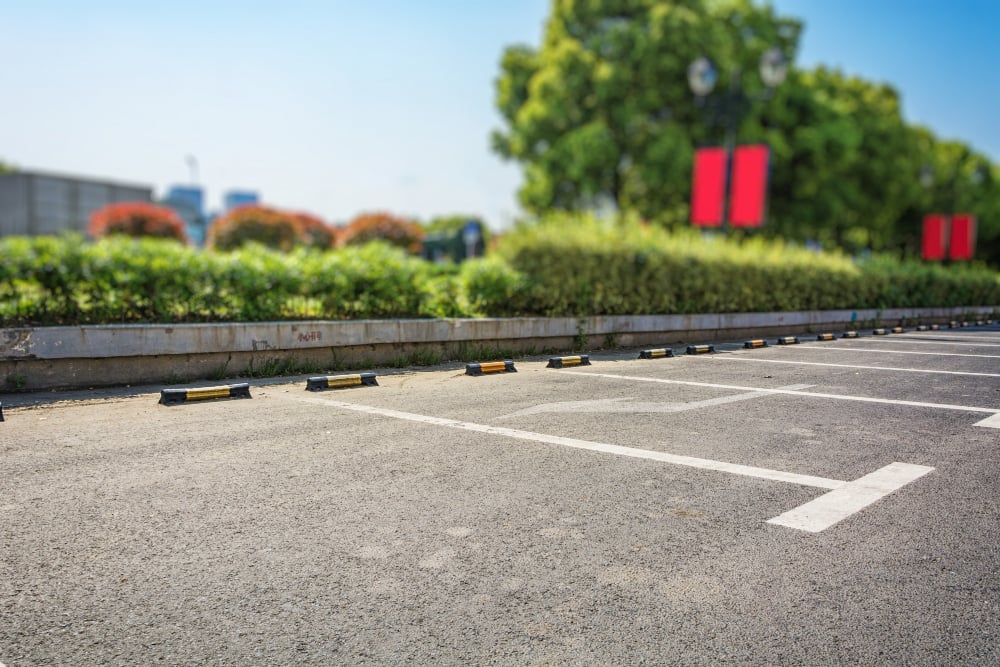
Forty minutes after I parked, the sign for row B4 was still standing exactly where I’d left it.
My car wasn’t.
I stood beside the cart return with a bag of groceries in each hand and my phone held up in front of my face. On the screen was the picture I’d taken when I arrived. My blue SUV. The B4 sign right behind it. The same dented cart return. The same crack in the asphalt, shaped like a lightning bolt.
I looked at the picture.
I looked at the empty space.
I looked at the picture again.
There was a little silver hatchback parked there now, with a stuffed bear suction-cupped to the back window. The bear was waving at me.
My hand tightened around the cart handle until my knuckles went white.
For six weeks, every time this happened, I’d told myself I’d made a mistake. Wrong row. Wrong section. Wrong entrance. I was tired. I was distracted. I was getting older.
But this time I had a photograph.
There was no wrong row to blame.
I have always been a person who loses things.
My phone. My keys. My reading glasses, which are usually on top of my head. My train of thought, halfway up the stairs. I’ll walk into a room with total purpose and stand there in the middle of it wondering what on earth I came in for.
My mother used to say I’d lose my head if it wasn’t screwed on. My third-grade teacher wrote on my report card, Emma is bright and creative but needs to keep better track of her belongings. I lost that report card, too.
My husband, Tristan, is the opposite.
He knows which drawer has the batteries. He knows where the passports are, and the spare house key, and the warranty for the dishwasher. He keeps the kids’ vaccination records in a blue folder labeled VACCINATION RECORDS. He can tell you, without looking, how much milk is left in the fridge.
When I couldn’t find my phone, he’d walk over and check the pocket of my blue coat before I’d even thought of it.
And there it would be.
“How do you do that?” I’d ask.
He’d just grin and hand it to me, and I’d kiss him.
For fourteen years, that was one of the things I loved most about him. I was the scattered one. He was the steady one. I lost things, and he found them. It worked.
Then I started losing my car at the supermarket.
And I began to worry that something might be seriously wrong with me.
The first time was in early February.
I came out of FreshWay with a full cart, walked straight to where I was sure I’d parked, and found a minivan there instead.
I stood there for a second, confused. Then I laughed at myself. Typical Em. I’d probably parked one row over.
I found the SUV three rows away. Three whole rows. Facing the other direction.
I stared at it. I could have sworn I’d parked near the front, by the pharmacy doors. I remembered it clearly. I remembered a woman with a golden retriever in her car, and the dog had barked at me.
But there was my car. Three rows back.
I shrugged it off. I loaded the groceries and drove home and didn’t think about it again.
The second time was about a week and a half later.
I came out of the store with a gallon of milk, two rotisserie chickens, and a tub of mint chocolate chip ice cream for our son Noah’s eighth birthday party the next day.
I walked to where I’d parked.
It wasn’t there.
I walked up and down the row. Then the next row. Then the one after that. I pressed the button on my key fob over and over, listening for the little beep, watching for the flash of headlights.
Nothing.
I wandered that parking lot for fifteen minutes, pushing my cart in a slow, stupid circle. The ice cream started to sweat through its cardboard. By the time I found the SUV, all the way over by the garden center on the far side of the lot, the ice cream was soft enough to drink.
I stood beside the car and looked back at the store entrance.
The garden center. I never parked by the garden center. It was the farthest point from the door. I hated parking by the garden center.
I sat in the driver’s seat for a minute before starting the engine.
You were tired, I told myself. You were thinking about the party. You weren’t paying attention.
I drove home and put the ice cream in the freezer and didn’t tell anybody.
The third time, I told Tristan.
It was over dinner. The kids were arguing about whose turn it was to feed the hamster. I said, half laughing, “I lost the car again today at FreshWay. Took me ten minutes to find it.”
Tristan looked up from his plate.
“Again?”
“Third time.”
He smiled and shook his head.
“Of course you did, love. You lost your car keys inside your car last month.”
“That was different. They fell between the seats.”
“They were in the ignition.”
Our daughter, Pippa, who was five, giggled into her mashed potatoes. Noah rolled his eyes and said, “Mom, you’d lose your own head.”
“Your grandmother used to say that,” I said.
And I laughed along. Because it was funny. Because I am like that. Because Tristan was smiling at me across the table with so much affection, and I loved him, and it was just a car.
But that night, I lay awake for a long time staring at the ceiling.
I should tell you about my grandmother.
My mother’s mother. Nan. She lived with us when I was a teenager, after my grandfather died. She was the funniest woman I ever knew. She taught me poker and swear words in Welsh and how to make a proper Yorkshire pudding.
And when I was fourteen, she started losing things.
Her glasses. Her purse. Then the names of the neighbors. Then the way home from the post office, a walk she’d made every day for forty years. One afternoon the police brought her back to our house in a squad car. She’d been found standing at a bus stop two miles away, crying, because she didn’t know which bus went to her house. She’d been looking for the house she grew up in. It was torn down in 1971.
The doctors called it early-onset Alzheimer’s. She was sixty-one.
I watched my mother take care of her for six years. I watched Nan forget my name. Then my mother’s name. Then her own.
I was forty-one now.
And I was losing my car in a supermarket parking lot.
Tristan knew all of this. I’d told him about Nan on our third date. He’d held my hand across the table and said, “That must have been terrifying.”
It was.
It still is.
The fourth time was in March.
I’ll never forget that afternoon.
It was a Thursday. I’d taken a half day from work to do the grocery run and get home before the kids got out of school at 3:15. I parked, I shopped, I came out at quarter past two.
And the car was gone.
I knew where I’d parked. I knew it. I’d parked in the second row, right in front of the pharmacy, because I remembered thinking how lucky I was to get such a good spot.
It wasn’t there.
I walked the second row. I walked the third. I walked every single row in that lot, once and then twice, pressing my key fob like a madwoman.
By quarter to three, I was standing beside a cart return in the middle of the parking lot, with my heart pounding and my hands shaking.
The kids were getting out in thirty minutes.
I couldn’t find my car.
I couldn’t remember where I’d parked my car.
Nan at the bus stop. Crying. Looking for a house that didn’t exist anymore.
I pulled out my phone and called Tristan.
I was trying very hard not to cry. Not there. Not where strangers could see.
He answered on the second ring.
“Hey, love.”
“Tristan,” I said, and my voice broke right down the middle. “I’m scared. I can’t find the car again. I’ve looked everywhere. Everywhere. What if— What if something’s wrong with me? What if it’s early dementia? Or something worse? What if it’s like Nan?”
There was a short silence on the line.
Then his voice came, low and warm and steady.
“Breathe,” he said. “Just breathe. You’ll find it. Retrace your steps.”
“I have retraced my steps. Five times.”
“Then do it again. Slowly. I’m right here. I’m not going anywhere.”
I stayed on the phone with him until I could speak normally. He talked to me the whole time. About nothing. About the hamster. About whether we should paint the downstairs bathroom yellow or green.
And then I walked around the end of the fourth row and there it was. My SUV. Parked near the pharmacy doors. Two rows over from where I’d been looking.
“I found it,” I said. “Oh my God. I found it.”
“See?” Tristan said. “I told you.”
I thanked him. I said it three times. I told him I loved him.
Then I hung up and sat behind the wheel and wiped my face with a fast-food napkin from the glovebox before I drove to the school.
I got there at 3:21. Pippa was standing by the gate with her teacher, holding her backpack straps, looking worried.
“You’re late, Mommy.”
“I know, baby. I’m sorry. I couldn’t find the car.”
She looked at me very seriously.
“Again?”
After that, I started leaving early for every shopping trip. Half an hour early, so I’d have time to search afterward if I had to.
I started making notes in my phone. Parked row C, by the cart thing. Then I’d come out and stare at the note and wonder if I’d written it down wrong.
I started getting anxious in the car on the way to the store. My stomach would knot up when I pulled into the lot. I’d sit for a full minute after I turned off the engine, staring at the signs, trying to burn them into my memory like I was studying for a test.
I started noticing other things. Or thought I did. Did I leave the stove on? Did I lock the back door? What was the name of Noah’s soccer coach? It was right on the tip of my tongue. Was that normal? Did everybody forget things like that?
I googled early signs of dementia in your 40s at two in the morning with the screen turned all the way down so Tristan wouldn’t see the light.
One evening in late March, after the kids were in bed, I finally said it out loud.
Tristan was on the couch watching a football match. I sat down next to him and muted the TV.
“I need to talk to you about something.”
He looked over. “What’s up?”
“The car thing,” I said. “It’s really worrying me. It’s happened four times now. And I keep forgetting other stuff. I couldn’t remember Coach Harris’s name on Saturday. I stood there like an idiot.”
“Everybody forgets names, Em.”
“I know. But with Nan—” I swallowed. “I think maybe I should see a doctor. Just in case. Just to rule things out.”
He laughed softly. Not mean. Gentle. Like I’d said something sweet.
“You’re fine, love,” he said. “You’ve always been like this. You lost your keys in the freezer once, remember? On our honeymoon.”
“That was different.”
“It wasn’t, though.” He reached over and squeezed my knee. “You’re scatterbrained. It’s one of the cute things about you. Just take a picture of where you park next time. Problem solved.”
Then he pulled me into a hug.
I leaned against him. He smelled like his deodorant and the laundry soap we’d used for fourteen years. He wasn’t worried. He’d known me since I was twenty-seven. If something was really wrong, surely he’d see it. Surely he’d say so.
A photograph. That sounded like something I could do. That sounded so much easier than sitting in a doctor’s office waiting for news I wasn’t ready to hear.
“Okay,” I said into his shoulder. “I’ll take a picture.”
“That’s my girl.”
He unmuted the TV.
I sat beside him for the rest of the match, his arm around me, watching men in red shirts run back and forth, not seeing any of it.
So that Saturday, the first week of April, I did exactly what he said.
I parked beside the B4 cart return at FreshWay. I got out. I stepped back about ten feet. I took a clear photograph of my SUV with the B4 sign right behind it. I even zoomed in to make sure the sign was readable.
Then I went in and did my shopping.
And forty minutes later, I came out and found that silver hatchback with the waving bear in my space.
I checked the photograph twice. Three times. I held my phone up and matched the cart return in the picture to the one in front of me. Same dent. Same faded paint. Same lightning-bolt crack in the asphalt.
It was the right spot.
My car was not in it.
For one second, I felt relief. Wild, dizzy relief. I hadn’t forgotten. I hadn’t. I had a picture.
Then the relief turned into something much colder.
If I hadn’t forgotten where I parked, then where was my car?
I started walking through the lot, pressing my key fob, looking for a flash of blue between the parked vehicles. My heart was pounding. Had it been stolen? Towed? Was I in the wrong lot somehow? Was there another FreshWay with another B4?
That was when a security guard started walking toward me.
He was in his fifties, heavyset, with a gray mustache and a FreshWay jacket that was a size too small. He’d been standing by the store entrance. I’d seen him watching me.
“Ma’am,” he said. “Are you looking for a blue SUV?”
I stopped.
“Yes.”
His expression changed. Something flickered across it. Not quite worry. Something more careful than that.
“You need to come with me.”
“Have you found it? Is it stolen?”
“Ma’am,” he said. “You need to see this.”
The security office was a tiny room behind the customer service desk. It smelled like burned coffee. There was a bank of six monitors on the wall, each one showing a different grainy black-and-white view of the parking lot.
The guard’s name tag said WALT. He pulled out a rolling chair for me. I didn’t sit down.
“I’ve noticed you a few times,” he said, a little awkwardly. “Walking around the lot. Looking for your car. You seemed pretty upset last month.”
My face went hot.
“I’m not crazy,” I said.
“No, ma’am,” Walt said. “I don’t think you are.”
He sat down at the keyboard and typed something. One of the screens flickered. Then it went back in time. Forty minutes. An hour.
There I was. Tiny and gray on the screen. Pulling into the space by B4. Getting out of the car. Stepping back. Holding up my phone to take the picture. Walking toward the store.
I watched myself disappear through the automatic doors.
A few minutes later, a man walked into the frame.
He went straight to my car.
“Wait,” I whispered. “Zoom in.”
Walt zoomed in.
It was Tristan.
For a moment, I could breathe again.
That was the strangest part. My first feeling, watching my husband open the driver’s door of my car, was relief.
I hadn’t imagined where I’d parked. I wasn’t Nan. I wasn’t standing at the wrong bus stop. There was nothing wrong with my brain.
There he was. Tristan. In his gray hoodie. Opening my car door with his spare key.
Then the relief cracked, and something else came through.
Why was he here? Why hadn’t he called me? He’d told me that morning he was going to the hardware store.
I pulled out my phone and checked it for a missed message. A text. Anything. Hey, borrowing the car for a sec!
Nothing.
I looked back at the monitor.
That’s when I saw the other man.
He was standing at the edge of the frame, by a pickup truck. He was holding up a phone. Sideways. Pointed at my car. As Tristan opened the door, he took a couple of steps to the side to keep him in view.
I knew that man.
Dale. Tristan’s oldest friend. His best man at our wedding. The godfather of our son.
On the screen, Tristan got into my car. Before he pulled out, he looked over at Dale’s phone. He grinned and gave a little thumbs-up.
Then he backed out of the space and drove off.
Dale followed on foot, still filming.
Walt followed them through the footage, switching from camera to camera.
Tristan drove slowly through the lot. Past the pharmacy. Past the garden center. All the way to the far side, where the lot backs up against a row of trees.
He parked in a spot in the very last row. He got out. He locked the car.
Then he jogged over to Dale. Dale said something, and Tristan threw back his head and laughed. Dale clapped him on the shoulder.
They both walked out of the frame together.
Walt stopped the video. He didn’t say anything for a minute.
“That’s the third time I’ve seen this,” he said finally. Quietly. “I didn’t know it was your husband until just now. I thought it was somebody messing with you. I was going to call the police if it happened again.”
I didn’t say anything.
I couldn’t.
I’d gone home that day in March and told the man on that screen that I was frightened. I’d cried to him about Nan. He’d held me on the couch while I wondered what was wrong with my brain.
And he’d known. The whole time. He’d known exactly where my car was.
Why?
Why would he do this? When he knew how much it had frightened me?
I thanked Walt. I don’t remember what I said. Something polite. I walked out of that little office and across the lot to the last row by the trees.
My SUV was sitting there, quiet and blue and ordinary.
I got in. I put my grocery bags on the passenger seat. I put my hands on the steering wheel.
And I sat there for a long time.
I’d been right about B4.
How many of the other times had I been right too?
The pharmacy. The second row. The woman with the golden retriever. I’d been right. Every single time, I’d been right, and I’d stood in this parking lot doubting my own mind.
I picked up my phone. I pulled up Tristan’s number. My thumb hovered over the call button.
I couldn’t press it.
Terrible thoughts started cycling through my head. Thoughts I’d never had about my husband in fourteen years.
Did he want me to stop driving?
Did he want me to start relying on him for everything?
Did he want me to believe I was losing my mind?
Why would anyone want that?
I hated having those thoughts. I hated it. This was Tristan. Tristan who kept the vaccination records in a blue folder. Tristan who checked my coat pocket for my phone. Tristan who’d cried when Pippa was born.
But I couldn’t make his hand on that car door mean anything else. Not yet.
I put my phone away.
I needed to hear his explanation standing in front of him. I needed to see his face when he said it.
I started the engine and drove home.
He was in the garage when I got back, hanging a new shelf. He looked up and smiled.
“Hey, love. How was FreshWay?”
“Fine,” I said.
“Find the car okay?” He winked. “Did you take a picture like I said?”
I stood there in the garage doorway with the grocery bags.
“Yes,” I said. “I took a picture.”
“See? Told you.”
He turned back to his shelf.
I went inside and put away the groceries. I made dinner. I helped Noah with his spelling words. I gave Pippa her bath and read her two chapters of a book about a mouse who wanted to be a knight.
I did all of it on autopilot. Like a woman underwater.
Tristan didn’t notice a thing.
That evening, after the kids were finally asleep, I asked him to sit down at the kitchen table.
He pulled out a chair, still holding a cup of tea.
“Everything all right?”
“Did you move my car today?”
He glanced up. “What?”
“At the supermarket. Did you move it?”
I watched his face very carefully.
He looked startled. Just for a second. His eyebrows jumped.
Then a smile appeared. Slowly. Spreading across his face like he couldn’t stop it.
“How did you find out?”
“The security guard showed me. On the cameras.”
“Oh, Em.” He leaned back in his chair and laughed. Shook his head. “You should’ve called me. It was a prank.”
I stared at him.
A prank?
All that fear. All those sleepless nights. All that googling at two in the morning. All those terrible thoughts in the car about what awful reason he could possibly have for hurting me like this.
And that was his answer?
“You’re telling me,” I said slowly, “all those times…”
“Oh, don’t get upset. It was all in good fun.”
He took out his phone.
“Look,” he said. “You’ll see. It’s actually hilarious.”
There were five recordings.
Five. In a folder on his phone. The folder was called CAR WARS.
I stared at the dates while he scrolled. February 3rd. February 14th. February 27th. March 18th. And today.
He picked the second one and pressed play.
On the screen, there I was. Pushing my cart down the aisle of the parking lot, slowly, looking left and right. I passed the same row twice. My face was tight. In the cart, I could see the tub of mint chocolate chip ice cream for Noah’s birthday.
Tristan gave a little laugh.
“Look,” he said, pointing. “You walked right past it there. Right past it! It was literally two cars away.”
I remembered that afternoon. I remembered trying to get home before the ice cream melted. I remembered fighting back tears as I got more and more desperate.
In the video, I stopped in the middle of the row and pressed my fingers to my forehead.
That was the moment. I remembered it exactly. That was the first time I’d thought the word dementia.
Tristan glanced over at me. Waiting for me to smile.
I didn’t smile.
I reached over and took the phone from his hand.
My stomach was sinking. I already knew. But I opened the video from March anyway.
Surely. Surely it wasn’t what I thought it was.
The video started.
It was filmed from a distance. Dale’s phone, I guessed. In the frame, Tristan was standing near the pharmacy entrance, in the same gray hoodie, holding his phone to his ear.
Behind him, about thirty feet away, clearly visible, was my blue SUV.
His voice came out of the speaker. Low and warm and steady.
“Breathe. Just breathe. You’ll find it. Retrace your steps.”
I paused it.
My eyes filled with tears so fast I couldn’t see the screen.
“I called you for help,” I said. My voice was barely a whisper. “I was crying. I was standing in that parking lot crying about my grandmother. And you were right there. You were standing next to my car.”
He looked down at the screen.
“You knew exactly where it was,” I said. “And instead of telling me, you reassured me? You told me to breathe?”
I’d come home that day and thanked him. I’d kissed him in the kitchen and told him he was the most patient man in the world.
And now he was looking at the recording like the funny part just hadn’t happened yet.
“I thought something was happening to me,” I said. “I thought I was going to end up like Nan.”
He rubbed the back of his neck.
“I’m sorry it upset you,” he said. “I am. But Em, it was just a joke…”
And that’s when I got angry.
I looked down at the phone. At the frozen frame of him standing beside my car, phone to his ear, half-smiling.
If watching it himself hadn’t made him understand, maybe hearing other people say it would.
“Fine,” I said. “Let’s ask the family what they think of your joke.”
His hand closed over the phone.
“Why do we need to drag them into this?”
His resistance only made me more sure. He didn’t want them to see it. Maybe some part of him already knew what they’d say.
“Because you refuse to understand that this was not funny.”
“We don’t need everybody getting involved in an argument between us.”
“Then let them see,” I said. “Let them decide.”
I pulled the phone away from him. I opened our family group chat. Twenty-two people. His parents. My sister. His sister. Cousins, aunts, uncles. My best friend, Beth, who’d been added years ago for a surprise party and never left.
I selected the first clip, the one from February where I walked past my own car, and I shared it before he could say anything else.
Then I typed underneath:
This is Em, using Tristan’s phone. He moved my car five times without telling me, while Dale filmed it. I thought my memory was going. I thought I was getting what Nan had. He says it’s a funny prank. Do you agree?
I hit send.
I put the phone face-up on the table between us.
And I pictured it. I pictured him reading their replies. All of them telling him how wrong it was. And then finally, finally turning to me and asking what he could do to make it right.
The phone buzzed.
The first reply made my jaw drop.
It was a laughing emoji.
Just one. From Tristan’s Uncle Roy.
I stared at it.
It’s only one person, I told myself. Roy laughs at everything. Roy laughed at his own wife’s gallbladder surgery.
The phone buzzed again. Someone else was typing.
My cousin Kyle wrote:
HAHAHA this is gold
Then another laughing face. From Tristan’s dad.
Then Beth’s name appeared at the top of the screen.
I leaned closer. Beth had been my best friend since university. She knew about Nan. She’d sat with me in the hospital waiting room the night Nan died. She knew me better than almost anyone.
Surely she would bring some sense back to this conversation.
Beth wrote:
Oh Em, I would’ve been so frustrated too.
I let out a breath and looked over at Tristan, ready for him to read it.
Then another message from Beth appeared right underneath.
…but I have to admit, this is a really good prank
My face went hot. All the way up to my hairline.
Then my sister-in-law, Nora, Tristan’s younger sister, replied.
That’s not okay, Tris. She was scared.
I let out a breath I didn’t know I’d been holding.
“Read that,” I said, pointing. “Read what Nora wrote.”
He glanced at it.
Right as he did, another laughing face popped up underneath Nora’s message. From his mother.
Tristan chuckled.
“See?” he said. “Even Beth says it’s a good prank. Everybody thinks it’s funny except Nora, and Nora’s never had a sense of humor.” He picked up his tea. “So it looks like I was right. Now please, love. Stop trying to turn this into a thing.”
I sat there looking at that screen.
I’d thought bringing them into it would make him see me.
Instead, he’d just found more people to laugh with.
I picked up the phone. I started typing. About March. About the phone call. About standing beside a cart return trying not to cry in front of strangers. About how I’d almost gone to the doctor to get tested.
I typed half of it.
Then I stopped.
Was I really going to send them that? My frightened voice? The worst moment of my whole year?
And if they laughed at that, too? What would I do then?
I held down the delete button and watched the words disappear one letter at a time.
Then I set the phone back down on the table and stood up.
“I’m going to bed,” I said.
“Em. Come on. Don’t be like this.”
I didn’t answer him.
I lay in bed in the dark with my back to the door. When he came up an hour later, he climbed in and put his hand on my shoulder.
“I really am sorry it upset you,” he whispered.
I didn’t move. I pretended to be asleep.
After a while, he took his hand away.
And somewhere in that long, dark, sleepless night, I made a decision.
If Tristan wouldn’t listen to me, then I’d stop explaining.
I’d show him instead.
The next week was strange.
Tristan acted like nothing had happened. That was the worst part. He made pancakes on Sunday. He kissed me goodbye on Monday. He asked how my day was on Tuesday. He seemed to think that because the family had laughed, the whole thing was settled.
I was polite. I was quiet. I did the school runs and went to work and cooked dinner.
On Wednesday, Pippa asked me why I was sad.
“I’m not sad, baby.”
“Your face is sad.”
“It’s just my thinking face.”
She looked at me doubtfully. Then she climbed into my lap and put her arms around my neck and didn’t say anything else.
On Thursday, Beth called.
“Em. Hey. Listen. About the group chat.” She sounded uncomfortable. “I think I said the wrong thing.”
“You think?”
“I didn’t— I watched the video, and you just looked so confused, and it was kind of funny in the moment, like a hidden camera show. I didn’t think about the Nan thing until afterward. Then I felt sick about it.”
I didn’t say anything.
“I’m sorry,” Beth said. “Really. I should’ve thought before I typed.”
“Thank you,” I said.
And I meant it. But I didn’t tell her what I was planning. I didn’t tell anyone.
My nephew Leo’s seventh birthday lunch was the following Sunday. My sister Rachel had rented the hall at St. Anne’s Church, the one with the big kitchen and the folding tables and the bouncy castle the kids loved.
Several relatives from the group chat would be there. Uncle Roy. Kyle. Tristan’s parents. Beth and her husband. Nora.
And Dale.
On Wednesday night, after Tristan was asleep, I went out to the car and called Dale.
He picked up on the fourth ring. There was music in the background.
“Em? Hey! What’s up?”
“I know about the car,” I said.
There was a pause. Then he laughed. A big, delighted laugh.
“Did Tristan finally show you the videos?”
“Yes.”
“Oh man. Aren’t they great? The one where you walk past it twice. I’ve watched that like fifty times.”
He sounded genuinely pleased. Like he’d been waiting months for me to see his masterpiece.
Part of me wanted to tell him exactly what I thought of him. That I’d been crying in parking lots while he stood behind a pickup truck filming me. That I’d lain awake googling dementia symptoms. That I’d almost booked a brain scan.
But that wasn’t why I’d called.
“I need your help,” I said. “I want to return the favor. I want to prank Tristan.”
He laughed immediately.
“Oh, pranking the prankster! Em, I love this. He’s going to love this.”
I wasn’t so sure about that.
“It’s at Leo’s birthday on Sunday,” I said. “I’ll give you the spare key.”
“I’m in,” he said. “Totally in. I’ll bring the good phone.”
“Dale,” I said.
“Yeah?”
“Don’t tell him. Not a word. Not a hint.”
“Em,” he said, offended. “I’ve been doing this to him since 2004. I know how to keep a secret.”
I hung up and sat in the dark car in my driveway for a while.
Was this the right thing to do?
I honestly didn’t know. Part of me thought it was petty. Childish. Revenge dressed up as a lesson.
But I’d tried telling him. I’d tried showing him. I’d tried letting the family show him.
None of it had worked.
Maybe the only way Tristan would ever understand what he’d done was to stand where I’d been standing.
On Sunday, the church hall was loud and bright and full of balloons.
Leo was wearing a paper crown that said BIRTHDAY KING. The bouncy castle was already full of shrieking kids. My sister was running around with a clipboard, as usual, because Rachel cannot throw a party without a clipboard.
Tristan was wonderful.
That’s the thing. He was so wonderful that day.
He carried Leo on his shoulders through the hall so Leo could touch the balloons on the ceiling. He helped Rachel carry out the trays of sandwiches without being asked. He spent twenty minutes fixing the wobbly leg on the dessert table with a matchbook folded in half.
At one point, I watched him crouch down beside the bouncy castle so Leo could climb down safely onto his back.
Later, while I was standing by the coffee urn talking to Beth, he came up behind me and tucked a loose curl behind my ear. Absently. Tenderly. The way he’d done a thousand times.
“Love you,” he said, and went off to refill the punch bowl.
Beth watched him go. Then she looked at me.
“Are you two okay?”
“We will be,” I said.
I hoped that was true.
It seemed impossible to me that a man could be so kind and so attentive and so gentle, and still be so completely blind to how badly he’d hurt me.
If things went the way I thought they would, that was about to change.
About an hour into the party, Tristan found me by the dessert table.
He bumped my hip with his.
“We’ll laugh about the parking thing someday,” he said, smiling. “You’ll see.”
He picked up a plate and a slice of Leo’s dinosaur cake before I could answer.
I watched him walk away.
A little later, I told Rachel I was stepping out for some air. I walked out the front doors and down the steps.
Dale was waiting around the side of the building, by the recycling bins, smoking a cigarette he swore to his wife he’d quit.
I handed him the spare key to our car. The silver Volvo we’d driven to the party. Tristan’s car, really. He was the one who always drove it.
“Back lot,” I said. “Behind the church. By the old shed. Where he can’t see it from the front.”
“Ten-four,” Dale said, grinning. He dropped the cigarette and stamped it out.
I went back inside.
Ten minutes later, Dale came back in through the side door. He caught my eye across the hall.
And he nodded.
The front entrance of the church hall faced the main parking lot. Six wide stone steps led down to it.
At the end of the party, around three o’clock, I stood at the top of those steps with Pippa’s hand in mine and Noah carrying a bag of party favors, while Tristan went to get our car.
I watched him walk across the lot with his keys in his hand, whistling.
He reached our parking space.
It was empty.
He stopped.
He stood there for a second. Then he turned around toward me, and he laughed. A short, knowing laugh.
“Very funny,” he called up the steps. “Where is it?”
“Where’s what?” I said.
“The car, Em.”
“Where did you park it?”
He pointed at the empty space at his feet.
“Right here. Come on.”
Behind me, Dale came out the front doors and down the steps, his phone already in his hand.
“Everything okay?” he asked innocently.
“She’s moved my car,” Tristan said.
I shook my head.
“I’ve been inside this whole time,” I said. “You saw me.”
Tristan looked at Dale.
“You’re in on it, right?”
Dale looked completely blank.
“In on what?”
Tristan waited. He looked from me to Dale and back again.
Neither of us smiled.
He turned and walked past the first row of cars, looking between them.
I let go of Pippa’s hand and handed her to Noah. “Stay right here on the step.” I followed Tristan down.
“Maybe you parked farther over,” I said.
“No,” he said. “I know where I left it.”
He checked the next row anyway. Then the next. He pressed his key fob. Nothing beeped. He walked faster.
When he came back, he’d stopped smiling.
“Did anyone see somebody driving out of here?” he asked. His voice had changed. It was tighter.
Dale shook his head.
Tristan looked toward the road. He looked up and down the street. He walked back to the empty space and stood in it, like the car might reappear if he stood there long enough.
He ran a hand through his hair.
“It was right here,” he said. “I know it was right here. I parked next to that blue van. I remember the van.”
The blue van was still there.
Our car was not.
I stood beside him.
“Maybe next time,” I said quietly, “you could take a picture.”
He turned and stared at me.
And I saw it happen. I saw it land.
The hurt in his eyes. The sick, sinking, disoriented feeling of knowing you did something one way and the world telling you that you didn’t. That flash of what if it’s me.
He finally understood.
“I’m being serious, Em,” he said quietly.
“I know,” I said. “I was being serious, too.”
I looked over my shoulder and gave Dale a small signal.
Dale burst out laughing. He lowered his phone.
“Gotcha, buddy!” he crowed. “Oh, man. Oh, your face. That was perfect.”
A few relatives had wandered out the front doors to see what all the fuss was about. Uncle Roy. Kyle. Beth and her husband. Tristan’s mother.
Beth gave a surprised laugh. Kyle started laughing too. Then a couple of the other cousins.
Tristan’s face went red. All the way up his neck.
He turned to Dale.
“You filmed this?”
Dale grinned and held up his phone.
“Just like all the others, mate.”
Tristan bit his lip. He looked down at the empty parking space for a long moment.
Then he looked at me.
“This wasn’t funny,” he said. His voice was low. “I thought somebody stole my car. I was about to call the police.” He stared at me. “You said you’d been inside. You said it wasn’t a prank. You could’ve just told me where it was.”
“I asked you for help in March,” I said.
“That was different…”
“How?”
He stopped.
He opened his mouth. Then closed it.
I waited.
If he finished that sentence, I honestly didn’t know what else I could do. I’d tried explaining. I’d tried showing him. I’d tried his family. I’d tried this.
I couldn’t keep setting up opportunities for my husband to care that he’d hurt me.
The silence stretched out over the parking lot. Somewhere inside the hall, the kids were still shrieking in the bouncy castle.
Then Uncle Roy came down the steps, chuckling.
“Come on, Tristan,” he said, clapping his hands. “She got you with your own prank! Be a good sport about it.”
“Don’t,” Tristan said.
It came out sharp. Sharper than I’d ever heard him speak to his uncle.
Roy stopped on the bottom step. His smile faded.
Tristan didn’t look at him. He kept his eyes on me.
“I get it now,” he said quietly.
His voice was shaking a little.
“And you were right. This wasn’t funny. None of it was. I just stood here for three minutes thinking I was losing my mind, and I knew it was probably a prank, and I still felt sick.” He swallowed. “You didn’t know. You didn’t know it was a prank. You thought it was Nan. For two months.”
I didn’t say anything. My throat was too tight.
“I shouldn’t have done this to you,” he said. “Any of it. And I shouldn’t have taken so long to see how much it hurt you. I’m so sorry, Em.”
He pulled his phone out of his pocket.
“I’m deleting all of the clips,” he said, tapping at the screen. I watched him open the CAR WARS folder. I watched him select all five videos and press delete. Then he went into the recently deleted folder and deleted them again.
He looked up at Dale.
“Dale. Please delete the originals.”
Dale’s grin had faded. He looked from Tristan to me. For the first time, I think he actually saw my face.
“And the one from today,” I added. “Of Tristan.”
Dale nodded slowly. He opened his phone.
Tristan stood right beside him while he deleted the recordings. All of them. Including the one he’d just made.
“Gone,” Dale said quietly. “All gone. I swear.”
Then Tristan opened the family group chat.
He stood there in the parking lot, typing for a long time.
When he finished, he walked over and held the screen out to me.
I moved Em’s car five times. Dale filmed it. She called me crying and scared, and I let her think she’d forgotten where she parked, while I was standing right next to the car. She asked me to stop treating it like a joke, and I didn’t listen. It wasn’t a prank. It was cruel. I’m sorry, Em. Please, everyone delete the video she sent.
“Is that okay?” he asked.
I read it twice.
“Yes,” I said.
He sent it.
Within a minute, the phones started buzzing in pockets all around the parking lot. I watched Beth read it. I watched Kyle read it. I watched Tristan’s mother read it, and put her hand over her mouth.
Uncle Roy read it and looked down at his shoes.
Nobody was laughing anymore.
When Tristan finally looked up from his phone, his eyes were wet.
“I’m sorry,” he said again. “I knew you were frightened. I knew. I kept doing it anyway. Because Dale thought it was funny. Because I thought it would make a great big reveal at the end. I don’t even know what I was thinking.”
I nodded.
But I wasn’t ready to hug him. Not yet.
“The car’s behind the church,” I said. “By the old shed.”
The drive home was quiet.
The kids fell asleep in the back seat, worn out from the bouncy castle, Pippa with frosting still on her cheek.
Tristan drove. He kept both hands on the wheel. He didn’t turn on the radio.
When we got home, he carried the kids up to bed one at a time. I heard him tuck them in. I heard him sit with Pippa for a minute when she woke up and asked for water.
Then he came back downstairs into the kitchen.
He took his car keys out of his pocket. Then he took my spare set off the hook by the door. He laid both sets side by side on the kitchen table.
“I won’t move yours again,” he said. “Ever.”
I looked at the keys.
“I need more than that,” I said.
“I know.”
“Tristan. For two months, every time you told me everything was fine, you were lying to me. Every time you said breathe, every time you said you’ve always been like this.” I sat down across from him. “When you tell me something’s fine now, I need to believe you’re actually helping me. Right now, I don’t.”
He sat down slowly.
He looked at the keys on the table for a long time.
“Okay,” he said quietly. “I understand why.”
He didn’t argue. He didn’t explain. He didn’t say but.
He just sat with it.
The next morning, I called our doctor’s office.
Not because I thought something was wrong with me anymore. Because I’d spent two months believing it, and I couldn’t make the fear go all the way away just because I’d seen a video. It had dug itself in too deep.
I booked an appointment for the following week. A full checkup. Memory tests, too.
When I told Tristan, he went pale.
“Because of me,” he said.
“Because I need to know,” I said. “For me.”
“Can I come with you?”
I thought about it.
“You can drive me,” I said. “You can wait in the waiting room.”
He did. He sat in that waiting room for an hour and a half, in a plastic chair under a poster about flu shots. When I came out, he stood up so fast he knocked over a magazine rack.
“Well?”
“Everything’s normal,” I said. “Everything. The doctor said my memory’s actually above average for my age. She said I’m just disorganized.”
He let out a breath that seemed to go on forever. Then he sat back down in the plastic chair and put his face in his hands.
“I’m so sorry, Em,” he said into his palms. “I’m so, so sorry.”
I sat down beside him.
After a minute, I put my hand on his back.
It was the first time I’d touched him on purpose in two weeks.
Over the next six weeks, he followed up with every relative who’d gotten the clip in the family chat.
He called them himself. One at a time. I heard some of the calls through the door of his office.
“Uncle Roy, it’s Tristan. I need you to delete that video. And I need you to understand it wasn’t funny. Em thought she had dementia.”
“Kyle. Yeah. Delete it. No, I’m serious. I’m not mad at you. I’m mad at me.”
Beth confirmed she’d deleted it the same day. She sent me flowers with a card that said I’m an idiot. Love you. B.
Kyle confirmed. Roy confirmed, eventually, after Tristan called him twice.
Dale came over on a Saturday morning, alone. He stood on our front porch with his hands in his jacket pockets and wouldn’t come inside.
“I never sent the videos to anybody else,” he said. “I want you to know that. I only showed Tris.” He looked at his shoes. “And I’m sorry. I didn’t know about your gran. He never told me about your gran. I thought you were just, you know. Scatty. I thought it was harmless.” He swallowed. “It wasn’t harmless.”
“No,” I said. “It wasn’t.”
He nodded. Then he turned and went back to his truck.
He and Tristan didn’t talk for almost a month after that. When they finally did, Tristan told me, it was mostly Dale apologizing and Tristan saying, “Me too, mate. Me too.”
Healing didn’t happen all at once.
For weeks, I still caught myself checking Tristan’s face whenever I misplaced something. My keys. My phone. A permission slip. I’d look up at him, waiting to see if there was a smile at the corner of his mouth. A secret.
There never was.
He stopped making jokes about my forgetfulness. All of them. Even the gentle ones, even when it was just the two of us. No more you’d lose your head. No more of course you did, love.
When I lost something now, he just helped me look. Quietly. Seriously.
And when I found it, he didn’t say see? He didn’t say told you.
He just let the moment end.
Last week, I couldn’t find my sunglasses.
I’d been looking for ten minutes. In my purse. On my head. In the bathroom. In the pocket of my blue coat. I was getting that old, familiar tightness in my chest.
Tristan was at the kitchen counter, making coffee.
He didn’t laugh. He didn’t tease. He didn’t say of course you did.
He thought about it for a second.
“Check the car?” he suggested.
I went out to the driveway.
They were on the passenger seat. Right where I’d left them after the school run that morning.
I stood there in the driveway, holding them, and let out a long breath.
When I came back inside, Tristan didn’t ask if I’d found them. He didn’t need to. He just looked up from the counter and saw them in my hand, and nodded once.
Then he handed me my coffee.
Two sugars. A splash of milk. In my favorite mug, the chipped green one.
He’d remembered exactly how I like it.
He always does.
And this time, I didn’t look for a smile at the corner of his mouth.
I didn’t have to.

Adrian Hawthorne is a celebrated author and dedicated archivist who finds inspiration in the hidden stories of the past. Educated at Oxford, he now works at the National Archives, where preserving history fuels his evocative writing. Balancing archival precision with creative storytelling, Adrian founded the Hawthorne Institute of Literary Arts to mentor emerging writers and honor the timeless art of narrative.