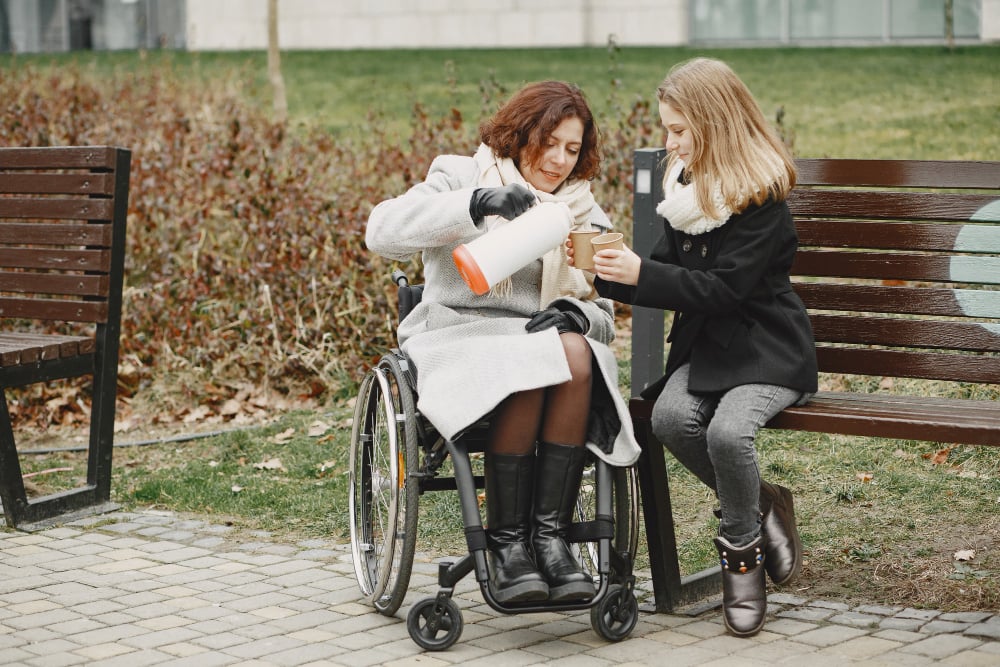
The woman had been following us through the department store for almost ten minutes.
I noticed her first in Housewares. Late fifties, maybe. A tan raincoat buttoned all the way to the neck. A plastic shopping basket hooked over one arm with a jar of fancy olives and a box of candles inside. She’d been standing behind us at the display of crystal bowls, close enough that I could smell her perfume.
“Some people,” she said to nobody in particular, “will do anything for special treatment.”
I didn’t think she meant us. Not at first.
Then she followed us to Women’s Accessories. Then to the escalators, which we didn’t take. Then to the elevator, which we did. She took the stairs and was waiting at the top when the doors opened.
And when we finally got in line at the accessible checkout on the second floor, she got in line right behind us.
“Unbelievable,” she said loudly. “Look at this. She just rolls right up to the front.”
My mother didn’t turn around.
“I watched her in Housewares,” the woman went on, to the cashier now, to the people in the next line, to anyone who would listen. “She was reaching for things on the top shelf. Leaning forward. Twisting. People who really can’t walk don’t move like that.”
Mom kept her eyes on the cashier. She had a silk scarf in her lap, pale blue, that she’d decided not to buy after all. She folded it neatly into a square.
That seemed to make the woman angrier.
“You’re not fooling anybody,” she snapped.
When Mom still didn’t answer, the woman stepped forward and kicked the back of her wheelchair. Hard. Hard enough to make the front wheels jump off the floor.
For one terrible second, I thought Mom was going to tip forward out of the chair.
She grabbed both armrests and steadied herself.
The woman pointed at her, triumphant.
“See? See? She can move when she wants to.”
I stepped between them so fast I nearly knocked over a rack of reading glasses.
“Don’t touch her again.”
My voice came out so low and sharp that I didn’t recognize it.
The woman folded her arms across her raincoat.
“Then stop pretending she needs special treatment.”
My mother was eighty years old.
She had not walked in six years.
And we had come to Halbrook’s Department Store on a Saturday morning in October for one simple reason.
My daughter, Mia, was turning twelve the next weekend.
And her grandmother wanted to choose her birthday present herself.
That was all. That was the whole reason. A birthday present.
I’d already tried to steer her toward three different displays on the way in. The jewelry counter, which was close to the elevator. The toy section, which had wide aisles. A table of scented candles right by the front doors, so we’d have a short trip.
Each time, she’d said, “Rebecca. I can find my own way.”
And each time, I’d let go of the handles of her chair and walked beside her, and within two minutes my hands had drifted back to the handles again without my even noticing.
Now half the store seemed to be watching us.
A security guard was coming across the floor. Big man, gray at the temples, with a radio clipped to his shoulder.
“Ma’am,” he said to the woman in the raincoat. “Please lower your voice.”
“Ask her to stand up,” the woman demanded, pointing at Mom again. “Go on. Ask her. Then you’ll see.”
My hands were shaking.
Mom’s weren’t.
She set the blue scarf down on the counter. Then she slipped two fingers into the pocket of her cardigan. The gray one with wooden buttons that Mia called “Grandma’s cloud sweater.”
She pulled out a worn brown leather case.
“Perhaps,” she said quietly, “this will settle it.”
I knew the case.
I’d given it to her. The first Christmas after.
It held her medical information. Her list of medications. Her emergency contacts, which were me, my husband Sam, and her neighbor Doris. Her disability identification card. The doctor’s letter she sometimes needed when she traveled, because airport security never knew what to do with her chair.
She opened it now with the same steady hands that used to braid Mia’s hair every Sunday before church.
Something folded slid out from behind the plastic ID card.
A small piece of paper. Yellowed at the edges. Soft from being handled.
It fluttered down and landed against the toe of my shoe.
I bent to pick it up.
On the front, under a faded drawing of musical notes, someone had printed in big cheerful letters:
MAPLEWOOD ELEMENTARY — SPRING CONCERT.
And the year.
Six years ago.
My breath caught in my throat.
I recognized the school emblem. A little green maple leaf. And I recognized the crooked purple circle drawn around one name, about halfway down the list of first graders.
Mia Callahan.
She’d been six years old when she drew that circle.
Three days before that concert, Mia had brought the program to Grandma’s house. She’d marched up to Mom’s front door with it held in both hands like a treasure map.
“I circled me,” she’d announced. “So you can find me. There’s going to be a lot of kids up there, Grandma. Like a hundred. You have to look for the purple.”
Mom had taken it very seriously. She’d put on her reading glasses and studied it.
“I’ll keep it safe,” she promised. “And I’ll look for the purple.”
I hadn’t known she still had it.
I hadn’t known she carried it everywhere. Every doctor’s appointment. Every trip to the pharmacy. Every Sunday at church. Tucked in a leather case behind her disability card.
I turned the paper over.
There was writing on the back.
Mom’s handwriting. Small and careful. A little shaky, the way it had been for those first few months.
I saw the first three words.
I never got—
And my stomach dropped right through the floor.
I never got.
I knew what came next. I’d been waiting six years for her to say it. I’d been waiting six years for someone, anyone, to say it.
I never got to walk again because of you.
I never got my life back.
I never got—
Before I could read another word, somebody grabbed the back of my sweater so hard that I stumbled backward and nearly fell against Mom’s wheelchair.
I twisted around.
It was the woman in the raincoat.
She’d gone completely white. Her lips were gray. Her shopping basket slipped out of her fingers and hit the floor. The jar of olives shattered. Brine and green olives spread across the tile.
She wasn’t looking at Mom anymore.
She wasn’t looking at me.
She was staring past us. Over our shoulders. Toward the front of the store, where the big glass doors opened onto the street.
“Oh my God,” she whispered.
Then her knees buckled.
As she fell, she lifted one trembling hand and pointed.
Straight at a man standing beside the front doors.
The security guard lunged and caught her under the arms before her head could hit the floor.
I followed her finger.
The man was standing just inside the entrance, near the display of umbrellas. He was maybe forty. Thin. A baseball cap pulled low. He wore a loose gray button-up shirt, untucked.
As I watched, he shifted his weight. And the bottom of his shirt pulled tight for an instant against his waist.
Underneath the fabric, something dark and hard and angular showed. Just for a second.
The shape of it was unmistakable.
A gun.
The security guard saw it too. He was kneeling on the floor with the fainted woman’s head in his lap, and I watched his face change. All the color went out of it, and then all the expression. His face went flat and calm and very, very careful.
He reached up and touched the radio on his shoulder.
He spoke into it so quietly I couldn’t hear a word.
Across the store, the man in gray glanced toward the checkout counters. Toward us.
I folded the concert program without reading another word and pushed it deep into my pocket.
The guard spoke into his radio again. A crackle answered.
Then the speakers in the ceiling came alive.
“Attention, all employees. Code Silver. Lock the front doors immediately. Attention, all employees—”
The man near the entrance looked up at the ceiling.
For a moment, nobody moved. The whole store held its breath. A woman by the perfume counter was frozen with a little glass bottle in her hand.
Then someone screamed.
The man in gray reached up under his shirt.
“Down!” somebody shouted. “Get down!”
Everything happened at once.
People dropped behind counters. A display of scarves toppled over, and a rainbow of silk spilled across the aisle. A child started crying. Somewhere, glass broke.
The checkout line scattered. People crouched behind the counter, behind the racks, behind each other.
And my mother’s wheelchair stood completely exposed in the middle of the aisle.
She couldn’t get down. She couldn’t hide behind a counter. She couldn’t do anything but sit there.
I grabbed the handles.
“Mom. We have to go.”
“I can move myself,” she said.
“Please,” I said. “Not now. Please.”
I swung the chair around and started pushing toward the nearest gap between the displays.
The woman in the raincoat had come back to her senses. She scrambled up off the floor and shoved past a cashier who was trying to help her.
“Get out of my way!”
She tried to squeeze past us, between Mom’s chair and a rack of coats. There wasn’t room. She pushed against the side of the chair.
I put my arm out and blocked her.
“There’s room on the other side,” I said.
She glared at me. Then she turned and hurried away the other direction, slipping on an olive.
Mom reached back over her shoulder and touched my wrist.
“Slow down,” she said.
I didn’t.
I couldn’t.
Six years earlier, I had watched an ambulance take my mother away.
I’d stood beside the crumpled wreckage of her little blue sedan at the corner of Fifth and Garland, in my good concert dress, with my car keys digging into my palm. I’d watched the paramedics cut the door off with a machine that screamed like an animal. I’d watched them lift her out onto a stretcher, her neck in a brace, her eyes closed.
And I’d stood there, completely unable to do one useful thing.
I had promised myself, in the hospital waiting room that night, that I would never stand there helpless again.
Ahead of us, at the end of the aisle, a green EXIT sign glowed above a corridor.
I aimed straight for it.
“Not that way,” Mom said.
I kept pushing.
“Please, Mom. We’re almost there.”
The corridor was narrow and short. It curved, and then it opened out near the front of the store.
I saw the glass front doors. I saw a metal security shutter rattling down over them from the ceiling.
And I saw the man in gray, walking across the entrance with his hand under his shirt.
We were heading straight toward him.
“Stop,” Mom said.
I tried to turn the chair hard, to swing it around a display table of folded sweaters. One wheel hit the table’s metal leg with a loud clang.
The chair jolted sideways.
Mom gasped. Her shoulder hit the armrest.
I froze. For half a second, I couldn’t move at all.
Then I yanked the chair backward.
And my mother said, very clearly:
“YOU’RE NOT LISTENING TO ME.”
Her voice wasn’t loud.
It didn’t need to be.
My hands tightened on the rubber grips of her chair.
And for an instant, the department store disappeared.
I heard another voice. My own voice. Six years younger. On the phone, in my kitchen, on a Thursday morning in April.
Mom, please. It’s just one little trip.
Rebecca, I’m so tired. I didn’t sleep.
She’s been practicing for weeks. She circled her name for you.
I know, honey. But my head is pounding.
She’ll be heartbroken. Please. Just come for an hour.
I swallowed hard.
The store came back. The shouting. The rattle of the metal shutter. The man in gray, twenty yards away, with his back to us.
I took a breath.
“Okay, Mom,” I said. “Which way do we go?”
She pointed. Not toward the exit sign. Across the aisle, back toward the middle of the store.
“That employee,” she said. “She’s opening the staff passage. Look.”
I looked.
A young cashier in a red Halbrook’s vest, no older than twenty, was standing beside a narrow door marked STAFF ONLY. She was holding it open and waving people through in small, quiet groups. Two at a time. Three at a time. Calm as anything.
Beyond her, I could see a long hallway and another illuminated exit sign.
From where the man in gray was standing, by the front doors, he couldn’t see that passage at all. A tall column and a display of handbags blocked his view.
Mom had seen it. While I was panicking and pushing her toward a gunman, she’d been looking around. She’d been paying attention.
I let go of the handles.
Mom put her hands on her wheels and turned them.
“Stay beside me,” she said.
Not behind.
Beside.
We moved toward the cashier.
I wanted to push again. Every single part of me wanted to grab those handles and run.
But Mom knew exactly where she was going. She rolled steadily, without hurrying, steering around a fallen mannequin and a puddle of spilled coffee like she’d been doing it her whole life.
At the staff door, a stack of cardboard boxes narrowed the opening. It couldn’t have been more than an inch wider than her chair on either side.
Mom angled the chair and rolled through without touching either wall.
I followed her.
And I realized, walking down that long staff hallway beside her, that for the first time all day I wasn’t deciding where she went.
I was trusting her.
A security employee was waiting at the far end of the hallway. Young, with a shaved head and a very calm face.
“Keep moving,” he said. “Emergency exit’s open. Right through there.”
Behind us, back in the store, came a sharp crash.
Then shouting. Men’s voices. Someone yelling, “Drop it! Drop it now!”
I flinched so hard I almost tripped.
Mom kept rolling.
The cashier from the staff door had run ahead of us. She held the emergency exit open while Mom rolled down a short concrete ramp and out into the service yard behind the store.
It was bright outside. Cold. The October sun hit my face, and I almost started crying right there.
Employees in red vests were guiding customers behind a long concrete wall at the edge of the loading area, away from the building. People were huddled together. Some were on their phones. A little boy was clinging to his father’s leg.
Someone was shouting for an ambulance for the woman in the raincoat, who’d fainted again by the loading dock.
Mom rolled to a stop beside a loading bay, out of the wind.
I crouched in front of her chair.
“Are you hurt?”
“No.”
“Your shoulder? When the chair hit the table? I heard it, Mom. I heard you hit.”
“I’m all right.”
“Are you sure? Let me look.”
She looked at me for a long moment.
“Darling,” she said. “I’m frightened. That doesn’t mean I’m broken.”
I lowered my eyes.
A police siren sounded nearby. Then another. Then a third.
An officer in a dark uniform came around the corner of the building and told everyone to stay behind the wall while police secured the entrance.
So we waited.
I kept checking Mom’s face. Her color. Her breathing. Whether she was cold.
She kept checking mine.
At one point, she reached over and took my hand.
It was warm. Alive. Her skin was soft and papery, with the little brown spots she called her “freckles of wisdom.”
I held on to it too tightly.
She let me, for a while. Then she squeezed once. Gently.
“You’re hurting my fingers,” she said.
I loosened my grip.
“Sorry.”
“I know,” she said.
We sat there for almost forty minutes.
I’m going to tell you about the morning of the concert now. Because I thought about nothing else the whole time we waited behind that concrete wall.
It was a Thursday in April. Six years ago. Mia’s spring concert at Maplewood Elementary was at ten in the morning. All the first graders were singing two songs. Mia had been practicing for three weeks. In the bath. In the car. At the dinner table, until Sam begged her to sing something else, anything else, just for one meal.
She’d circled her name in purple and brought the program to Grandma’s house so Grandma could find her on the stage.
Mom had been a music teacher. Thirty-four years at Lincoln Middle School. She’d taught choir and band and general music to about ten thousand kids. She’d been to more school concerts than anyone alive. She’d sat through ten thousand off-key recorders and never once winced.
She wouldn’t have missed Mia’s first concert for anything.
Except that morning, she called me at 7:30.
“Becca, honey,” she said. Her voice was thin. “I don’t think I can make it today.”
I was in the kitchen in my bathrobe, packing Mia’s lunch. Mia was upstairs, putting on the yellow dress she’d picked out a month before.
“What? Why?”
“I have a terrible headache. I didn’t sleep at all last night. I’ve been up since three. I think I need to stay home and lie down.”
“Mom, it’s at ten. It’s a few hours from now. Take some aspirin.”
“I took some. It’s not helping.”
“She’s going to be so disappointed.”
There was a pause.
“I know,” Mom said quietly. “I’ll call her. I’ll explain. I’ll come to the next one.”
“There isn’t a next one. Not for months.” I was getting frustrated. I remember that. I remember the knife in my hand, spreading peanut butter way too hard. “She made you that program. She circled her name for you.”
“I know, honey.”
“Please, Mom. It’s just one little trip. You don’t even have to stay for the whole thing. Just come for her songs. She sings second. Fifteen minutes. That’s all.”
“Becca, I’m so tired.”
“She’ll be heartbroken. You know she will. She talks about it every single day. Grandma’s going to find the purple.”
A long silence.
Then Mom sighed.
“All right,” she said. “All right. I’ll come.”
“Really?”
“I’ll be there. Save me a seat.”
I hung up feeling good. I remember that most of all. I remember feeling proud of myself. Like I’d fixed something.
She never made it to the school.
At 9:41, at the corner of Fifth and Garland, two miles from Maplewood Elementary, a nineteen-year-old in a pickup truck ran a red light while looking down at his phone. He hit the driver’s side of Mom’s little blue sedan at forty-three miles an hour.
I didn’t know any of this at the time.
I was sitting in the third row of the Maplewood auditorium with my phone on silent and an empty seat beside me with my coat on it. Saving it for her.
The first graders came out. Mia was in the second row of risers, right in the middle, in her yellow dress. She scanned the audience. She found me. She waved.
Then she looked at the empty seat beside me.
And I watched her face fall.
She sang anyway. Both songs. She sang loud and slightly off-key and completely without fear, the way six-year-olds do. Every few lines, her eyes went back to the empty seat.
I remember being annoyed. That’s the worst part. I remember sitting there thinking, She promised. She said she’d come.
When the concert ended and I turned my phone back on, there were eleven missed calls.
The police officer who answered Mom’s phone had been trying to reach me for forty minutes.
I left Mia with her teacher. I don’t remember the drive. I remember pulling up at the corner of Fifth and Garland and seeing the blue sedan. The whole driver’s side was crushed inward, folded like a piece of paper. The windshield was a spiderweb.
The fire department was still there. They’d just finished cutting her out.
I stood on the sidewalk in my concert dress and watched them lift her onto a stretcher with a brace on her neck and her eyes closed.
I couldn’t do anything. I couldn’t help. I couldn’t even get close.
I just stood there.
The doctors called it a spinal cord injury. A fracture at the T-10 vertebra. They used words I had to look up later. Incomplete. Complete. Prognosis.
Mom was in surgery for seven hours. Then in intensive care for nine days. Then on the rehab floor for two months.
On the fourth day, the neurosurgeon took Sam and me into a small room and told us she would most likely never walk again.
She was seventy-four years old.
I went into the hospital bathroom afterward and threw up.
Then I washed my face and went back to her room and smiled at her.
That was six years ago. I’ve been smiling at her ever since.
Here’s the part I never told anyone.
The other driver ran that red light. The police report said so. The insurance company said so. The judge said so, eventually, when the boy was charged.
Everyone said it wasn’t my fault.
But I knew something none of them knew.
My mother had told me she didn’t want to go. She’d told me she was tired, she had a headache, she hadn’t slept.
And I’d pushed her. I’d guilted her. I’d used my own six-year-old daughter’s purple circle to make her feel bad enough to get in the car.
If I’d just said okay, Mom, feel better, I’ll record it for you, she would have been home in bed at 9:41 that morning.
She’d still be walking.
I never told Sam. I never told my therapist, the one I saw for exactly three sessions before I quit because she kept asking me how I felt about the accident. I never told Mom.
I just carried it.
Every single day. For six years.
After the accident, I took over.
That’s the only way I know how to describe it. I took over my mother’s life.
I found her a new apartment. Ground floor, wheelchair accessible, eight minutes from my house instead of twenty-five. I sold her old house, the one with the garden she’d planted herself, the one where I grew up.
She didn’t want to sell it. I told her it wasn’t safe anymore. Too many stairs. Too far away.
I organized her medications into a big plastic pill box with the days of the week on it. I set up her grocery deliveries. I installed grab bars in her bathroom and a ramp at her front door.
I called her every single night at nine o’clock. Without fail. Even when we were on vacation. Even when I was sick.
“Did you take your evening pills?”
“Yes, Becca.”
“Did you lock the door?”
“Yes, Becca.”
“Is your phone charged? Is it next to your bed?”
“Yes, Becca. I’ve made myself a cup of tea. I’m going to bed. I’m fine.”
I’d hang up and lie awake anyway.
I put a camera in her living room. A little one, with an app on my phone.
“It’s for emergencies,” I told her. “In case you fall.”
“I can’t fall, honey. I’m sitting down.”
“Out of the chair. In case you fall out of the chair.”
She let me put it in. She didn’t argue.
But I noticed, after a few months, that she’d started keeping a dish towel draped over it most of the time. I’d check the app and see nothing but white terrycloth.
When I mentioned it, she just said, “Oh, I must have been drying something.”
Sam tried to talk to me about it once.
We were lying in bed. I’d just hung up from the nine o’clock call, and I was scrolling through the camera app, staring at the dish towel.
“Becca,” he said. “You know she’s okay, right?”
“She’s in a wheelchair, Sam.”
“I know. But she’s okay. She’s sharp. She’s tough. She’s got Doris next door. She does her physical therapy. She goes to church. She’s teaching piano to the Hendersons’ kid on Tuesdays.”
“What if she falls?”
“Then she has her phone, and she calls you, and you go over.” He turned on his side to look at me. “You can’t be there every second. You’re going to wear yourself out. You’re going to wear her out.”
“I don’t want to talk about this.”
“Becca—”
“I said I don’t want to talk about it.”
I turned off the light.
He didn’t bring it up again. Not for years.
I went with Mom everywhere. Doctor’s appointments. The pharmacy. The grocery store, even though her groceries were delivered. The hair salon. Church.
I pushed her chair everywhere we went. Even when she said she could do it herself. Even when she said it three times.
I checked every curb before she went over it. I checked every doorway. I watched every stranger who reached for her chair to help, like they might be about to steal her.
I called it love.
And it was. Mostly. I think.
But it was something else, too.
I just didn’t know what to call it yet.
Back behind the concrete wall at Halbrook’s, a police officer finally walked around the corner of the building and came over to our group.
He was young. He had a little notebook in his hand.
“The man has been arrested,” he said. “Nobody was hurt. You’re all safe here now.”
A ripple of relief went through the crowd. A woman started crying. The man with the little boy picked him up and hugged him.
I looked at my mother.
And only then did I realize that I was crying. Tears were running down my face, and I hadn’t even noticed them start.
Mom reached up and brushed one off my cheek with her thumb.
“You always do this,” she said softly.
“Do what?”
“Look at me like I might disappear.”
I tried to laugh.
It came out wrong. Like a hiccup.
Mom’s eyes dropped to my coat. To the pocket.
“You picked up my paper,” she said.
I touched the folded program through the fabric.
“Yes.”
“Thank you.” She let out a breath. “I thought I’d lost it in there. With all the shouting.”
“Mom,” I said. “Why do you still have this?”
She looked surprised. Like I’d asked her why she still had a heart.
“Because Mia gave it to me.”
“That was six years ago.”
“I remember.”
On the back of that program, in her small careful handwriting, those three words were waiting for me. I never got.
I looked at her.
“May I read it?”
She hesitated. For a long moment. Her fingers moved on the leather case in her lap.
Then she nodded.
I took the program out of my pocket. I unfolded it carefully, the way you’d unfold an old map.
The purple circle around Mia’s name had faded to a soft lavender.
I turned it over.
At the top was a date. Three weeks after the accident. While she was still on the rehab floor.
Under the date were five lines.
I never got to hear her sing that day.
For a while, I thought only about everything I’d lost.
Then she came to see me and sang the whole song beside my hospital bed.
I nearly missed a lifetime of moments like that.
I’m so grateful I didn’t.
The words blurred and swam.
I never got to hear her sing that day.
That was all it was. That was what I never got meant. Not I never got to walk again. Not I never got my life back because of you.
I never got to hear her sing.
And I remembered.
I remembered it suddenly, all at once, like a door blowing open in the wind.
Mia standing beside Mom’s hospital bed, three weeks after the accident. Wearing her yellow concert dress, because she’d insisted on it. “It’s my singing dress, Mommy. I have to wear it to sing.”
She’d been so frightened of all the machines. The tubes. The beeping. The bruises on Grandma’s face. She’d been too scared to touch Grandma’s bandaged hand.
So instead, she’d folded her own little hands in front of her, the way her teacher had taught them on the risers.
And she sang.
Very softly at first. Barely a whisper. Her voice shaking.
Then a little louder.
Then louder still, when Grandma opened her eyes and turned her head on the pillow and smiled at her.
I’d been standing near the door. I remember the cold metal of the doorframe against my back.
But I didn’t remember the smile.
Until this moment, standing behind a concrete wall in a department store loading yard, I had completely forgotten my mother’s smile.
For six years, whenever I thought about that day, I saw only the wreckage.
The blue sedan, folded like paper at the corner of Fifth and Garland. A hospital corridor that smelled like bleach. A wheelchair. A list of all the things Mom couldn’t do anymore.
Walk in her garden. Drive her car. Climb the stairs to her old bedroom. Stand at her piano.
I’d never once thought about what she still had.
Or what she’d chosen to keep.
“You wrote this in the hospital?” I asked.
Mom nodded.
“After Mia visited. That same night. I asked the nurse for a pen.”
“Why do you keep it in your medical case?”
She ran her thumb slowly along the worn brown leather.
“Because I was afraid I’d forget.”
“Forget what?”
She looked up at me.
“That losing something,” she said, “isn’t the same as losing everything.”
My throat closed up tight.
I stared down at the program in my hands.
Six years.
Six years of checking every doorway. Every curb. Every stranger who reached for her chair. Six years of nine o’clock phone calls. Six years of watching a dish towel on a camera app.
And all that time, she’d been carrying this. Every single day. In her pocket, behind her disability card.
Not a reminder of what I had done to her.
A reminder of what she still loved.
“Mom,” I said.
She looked up.
“I need to tell you something.”
She waited.
I could have stopped right there. I’d stopped right there a hundred times before. On a hundred nights, when she called to tell me she’d made her tea and was going to bed, and I opened my mouth to say it, and then said goodnight, Mom instead.
But the program was shaking in my hands.
And I was so tired of carrying it.
“That morning,” I said. “The concert.”
Her face softened.
“What about it?”
“You told me you didn’t want to go.”
“I had a headache.”
“And you hadn’t slept.”
“That’s right.”
I pressed my lips together. Hard.
“You called me,” I said. “At seven-thirty. You told me you were going to stay home. But I kept asking.”
Mom watched me.
“I told you Mia would be heartbroken.”
“She was very excited,” Mom said gently.
“I told you it was just one little trip.”
My voice broke on the last word.
“You said you were so tired,” I said. “I wouldn’t leave it alone. I kept pushing. I used her purple circle against you.”
Mom’s smile disappeared.
“I remember you asking,” she said slowly.
“I didn’t just ask.”
I could barely breathe.
“I made you feel guilty. Until you said yes. And then you got in your car.”
I waited for her to say something.
She didn’t.
“The other driver ran that light,” I whispered. “I know that. Everyone keeps telling me that. But if I had just let you stay home, you wouldn’t have been there. At 9:41. At that corner.”
I covered my mouth with my hand.
“I’ve thought about it every single day.”
Mom’s eyes filled with tears.
“Every day?”
I nodded.
“Six years,” I said through my fingers.
She stared at me.
She stared at me like I’d just told her I’d been carrying a stone in my chest for six years. A big, heavy stone, sitting right on top of my heart.
Which, in a way, I had.
“Oh, sweetheart,” she said.
I shook my head fast.
“Please don’t tell me it doesn’t matter, Mom. Please. Everyone tells me that. It does matter.”
“Of course it matters,” she said.
She reached over and took my hand again. Carefully, this time.
“What happened that day changed my whole life.”
The words hurt. They hurt so much I almost pulled away.
Then she kept going.
“But you didn’t drive through that red light, Rebecca.”
“I pushed you to go.”
“You wanted your mother to hear her granddaughter sing.”
“You said no.”
“And then,” Mom said, “I said yes.”
I looked at her.
She held my gaze. She didn’t look away.
“I was tired,” she said. “That’s true. My head hurt. That’s true. And I was disappointed to miss it. More disappointed than I told you. I hung up the phone and sat there in my kitchen and thought about that little purple circle. And I changed my mind. Because I loved that little girl. Because I wanted to find her on that stage.”
She squeezed my hand.
“You didn’t steal my choice, honey. I made it. I’m eighty years old. I’ve been making my own choices since before your father was born. I made that one too.”
“But you lost so much,” I whispered.
“I did.”
She didn’t soften it. She didn’t pretend.
“I miss walking out into my garden in the morning with a cup of coffee. I miss my roses. I miss dancing in the kitchen with the radio on. I miss standing at my piano. Some mornings, I wake up and forget, just for a second, and I go to swing my legs out of bed—” She stopped. “And then I remember.”
Tears were sliding down her cheeks now. She didn’t wipe them away.
“I’m allowed to miss those things,” she said.
“I know.”
“And I’m also allowed to love the life I have.”
I couldn’t answer. I couldn’t say anything at all.
She reached over and tapped the program in my hand. Right on the purple circle.
“That little girl,” Mom said, “came to my hospital bed and sang every verse of that song. She was shaking like a leaf. Her little knees were knocking together. She thought if she got all the notes exactly right, it would make me better.”
Mom laughed. Through her tears. A soft, cracked laugh.
“Thirty-four years I taught music, Becca. Thirty-four years. And she was flat on half the notes.”
I laughed too. I couldn’t help it.
“I didn’t care about the notes,” Mom said. “Not one bit. It was the most beautiful thing I ever heard.”
I remembered it now. Mia’s yellow dress. Her tiny hands clasped in front of her. The way her voice got stronger, verse by verse, as she realized Grandma was listening.
And Mom’s smile.
The one I’d forgotten.
“I thought I’d lost everything that day,” Mom whispered. “I really did. For three weeks I lay in that bed and thought, that’s it. My life is over.”
She looked at the program.
“Then she started singing.”
I bowed my head.
For six years, I’d treated every ordinary risk as one more chance to fail her. Every curb. Every crowd. Every doorway.
I’d called it love.
And maybe some of it was.
But some of it, a lot of it, was fear.
Fear and guilt, dressed up as love.
“When you grabbed my chair in there,” Mom said quietly, “I knew you were scared.”
“I nearly pushed you straight toward him. Toward a man with a gun.”
“Yes,” she said.
She didn’t pretend I hadn’t.
“I’m so sorry, Mom.”
“I know you were trying to help.”
She paused.
“But sometimes, honey, I need you to ask me first.”
I looked down at her hands resting on the wheels of her chair.
The same hands that had taught me to tie my shoes. That had played Für Elise for me every night when I was little, until I fell asleep on the living room rug. That had held Mia when she was a brand-new baby, wrinkled and screaming.
The same hands that had opened a leather case without trembling while a stranger shouted at her in a crowded store.
“When you said I wasn’t listening,” I said, “in there. I remembered that morning. On the phone. You told me you didn’t want to go, and I didn’t listen.” I swallowed. “And I was doing it again. Six years later. I was doing exactly the same thing.”
Mom squeezed my hand.
“I keep thinking I can stop something terrible from happening again,” I admitted. “If I just watch closely enough. If I just check everything. If I just hold on tight enough.”
“You can’t promise me that, honey.”
“I know.”
“Neither can I,” Mom said.
She squeezed my hand one more time.
“But we can stop being afraid of every ordinary day.”
Behind us, the store’s front doors reopened. Police officers were standing on either side of them. A manager in a dark suit began escorting customers back inside, one group at a time, to collect their bags and coats and cars.
Then I heard a familiar voice. Shrill and loud.
“This is ridiculous! I haven’t done anything wrong!”
The woman in the tan raincoat was standing near the entrance with a paramedic’s blanket around her shoulders. She was arguing with the big security guard who’d caught her when she fainted.
She spotted Mom across the yard. She pointed.
“There she is! Ask her! Ask her what she was doing!”
The manager in the dark suit stepped between them.
“Ma’am,” he said firmly. “We’ve already reviewed the security footage. All of it. You followed this customer through three departments. And you kicked her wheelchair.”
“Because she was pretending! She was reaching for things! I saw her!”
“That’s enough,” the manager said.
His voice was very calm and very cold.
“You are no longer welcome in this store. Not today and not in the future.”
The woman opened her mouth again.
The security guard put a hand gently on her elbow and guided her toward the parking lot. She went, still talking, still pointing over her shoulder.
Halfway to her car, she looked back at us one more time.
For just a moment, her face changed. She didn’t look angry anymore. She looked old and frightened and embarrassed, standing alone in a parking lot in a paramedic’s blanket.
Then she turned away and got into her car.
I turned to Mom.
“Do you want to report her? To the police? She kicked you. That’s assault, Mom.”
Mom watched the woman’s car pull out of the parking lot.
“Maybe,” she said. “Later. I’ll think about it.”
She turned her chair to face me.
“But right now, I’d rather go buy my granddaughter a birthday present.”
I let out a startled laugh.
“After all this? Mom. There was a man with a gun.”
“Especially after all this,” Mom said.
I stood up. My knees cracked from crouching for so long.
I moved behind her chair, the way I always did.
My hands rose toward the handles.
And stopped.
Right there, an inch away from the grips. In midair.
Mom noticed. I saw her notice. She didn’t say anything.
She just waited.
“Would you like me to push?” I asked.
The words felt strange in my mouth. Foreign. Like a language I’d forgotten I knew.
Mom smiled.
“Not yet,” she said.
She put her hands on her wheels and turned them.
“There’s a little music shop across the street,” she said. “Brightman’s. I saw it on the way in. I’d like to look there.”
I walked beside her across the parking lot.
Not behind.
Beside.
At the crosswalk, we stopped and waited for the signal.
I watched the traffic. The cars rushing past. A delivery truck. A bus.
Mom watched it too. I saw her eyes go left, then right, then left again. Careful. Paying attention.
The light changed. The little white walking man appeared.
Mom moved first.
I stayed at her side.
My hand was in my pocket, resting on the folded concert program.
Brightman’s Music was a tiny shop with a bell over the door and a wooden floor that creaked. Guitars hung on one wall. Sheet music filled a whole bookshelf. A gray-haired man behind the counter was restringing a violin.
He looked up when the bell rang. He saw the wheelchair. He started to get up to help with the door.
“I’ve got it, thank you,” Mom said, and rolled right in.
He sat back down and smiled.
“Let me know if you need anything.”
Mom rolled slowly through the shop. She looked at everything. She ran her fingers along the guitars. She stopped in front of a glass case of harmonicas and studied them for a long time.
I stood back and let her.
I didn’t suggest anything. I didn’t steer. I didn’t say what about this? or that one’s close to the door.
It was the hardest twenty minutes I’d had in six years.
Finally, she rolled to a stop in front of a shelf near the back.
A row of ukuleles. Small, bright, in different colors. Red. Blue. Natural wood.
And one in the middle that was painted a soft, pale purple.
Mom looked at it for a long time.
“That one,” she said.
The man came over and took it down for her. Mom held it in her lap. She tuned it by ear, quickly, without even thinking about it. Then she strummed a few chords.
The sound was bright and sweet and a little bit silly. The man behind the counter grinned.
“You play?” he asked.
“I taught music for thirty-four years,” Mom said.
“Then you don’t need my help,” he said.
She played a little melody. Just a few notes. I didn’t recognize it at first.
Then I did.
It was the song. The second song from Mia’s spring concert six years ago. The one she’d sung beside the hospital bed.
Mom looked up at me.
“Do you think she’ll like it?”
I couldn’t speak. I just nodded.
She paid for it herself. With her own credit card. The man wrapped it in brown paper and tied it with a purple ribbon from a spool under the counter, without either of us asking.
“For a birthday?” he guessed.
“For my granddaughter,” Mom said. “She’s turning twelve. She’s a singer.”
“Lucky girl,” he said.
“No,” Mom said. “Lucky grandmother.”
Mia’s birthday party was the following Saturday, in our backyard.
Twelve girls. Pizza. A cake shaped like a guitar that Sam had spent four hours decorating and was absurdly proud of. A karaoke machine that Mia had begged for, that we’d regret buying by the second hour.
Mom came over at noon. Doris drove her, in her big old van with the wheelchair lift.
I didn’t go outside to meet them.
I made myself stay in the kitchen. I made myself put candles in the cake while I listened to the lift whir and the chair roll up the ramp Sam built at our back door.
Mom came into the kitchen on her own.
“Hello, darling,” she said.
“Hi, Mom.”
She looked at me. Then she looked at the window, where she could see me watching the driveway a minute before.
She smiled a little. She didn’t say anything.
Mia opened Grandma’s present last. She always saved Grandma’s for last.
She tore off the brown paper and the purple ribbon. She held up the ukulele.
She went completely still.
“Grandma,” she breathed. “It’s purple.”
“So I can always find you,” Mom said.
Mia looked at her. For a second, I didn’t think she understood. Then I saw it reach her face.
She was twelve now. She didn’t remember much about being six. But she remembered the purple circle. She remembered the hospital. Some things you never forget.
“Will you teach me?” Mia asked.
“Every Tuesday,” Mom said. “After the Henderson boy. He’s hopeless. You’ll be much better.”
Later, after the cake and the karaoke and the girls screaming in the bouncy house, the party wound down. Parents came to pick up their kids. Sam started folding chairs.
Mia went over to her grandmother’s wheelchair with the purple ukulele.
“Grandma,” she said, a little shyly. “Do you want to hear something?”
“Always.”
Mia sat down cross-legged on the grass in front of her. She’d already figured out three chords from a video on her phone.
She strummed them. Badly. Off-tempo.
And she started to sing.
The same song. The concert song. The hospital song.
Her voice was older now. Stronger. A little lower. Still a little flat on the high notes.
I was standing by the back door, with a stack of paper plates in my hands.
And this time, I didn’t watch the chair. I didn’t watch the grass for bumps or the slope of the yard or whether Mom was too cold.
I watched my mother’s face.
I watched her smile.
The same smile from that hospital bed six years ago. The one I’d forgotten.
I didn’t forget it this time.
Something changed after that day at Halbrook’s.
Not all at once. I’d be lying if I said that. Six years of fear doesn’t disappear in one afternoon.
But I stopped calling Mom every night at nine o’clock. I call her three nights a week now. She calls me the other nights. Sometimes she forgets, and I don’t panic. I go to bed.
I took the camera out of her living room. I asked her first.
“Do you want me to take this down?”
“Oh, honey,” she said. “I’ve wanted you to take that down for five and a half years.”
“You could have told me.”
“I put a dish towel on it,” she said. “I thought that was telling you.”
I laughed so hard I had to sit down.
I told Sam everything.
About the phone call that morning. About the guilt. About six years of carrying it.
We sat at the kitchen table until two in the morning. He held my hand the whole time.
“I wish you’d told me,” he said. “I would’ve carried some of it.”
“I know,” I said. “I didn’t know how to put it down.”
“Did you put it down now?”
I thought about it.
“Some of it,” I said.
I went back to see a therapist. A different one. One who didn’t ask me how I felt about the accident.
Instead, on the first day, she asked, “What do you want your relationship with your mother to look like?”
I thought about it for a long time.
“I want to walk beside her,” I said. “Not behind.”
She wrote that down.
“That’s a good place to start,” she said.
Mom never did report the woman in the raincoat.
“I thought about it,” she told me, a week later. “And I decided she probably has enough trouble. Anyone who follows an old woman around a department store for ten minutes isn’t having a very good life.”
“She kicked your chair, Mom.”
“She did,” Mom agreed. “And then she fainted into a pile of olives. I think the universe handled it.”
We found out later, from the local news, that the man in the gray shirt had come into Halbrook’s that morning to rob the jewelry counter. The woman in the raincoat had recognized him from a wanted poster at the post office. That’s why she fainted.
So in a strange way, the woman who kicked my mother’s wheelchair may have saved everyone in that store.
I still don’t know how I feel about that.
Mom says that’s all right. She says most things in life are more than one thing at once.
In April, Maplewood Middle School had its spring concert.
Mia was in the seventh-grade choir. She had a solo. Eight bars, in the middle of the second song.
She’d been practicing for three weeks. In the bath. In the car. At the dinner table, until Sam begged her to sing something else, anything else, just for one meal.
Three days before the concert, she brought a program over to Grandma’s apartment.
She’d circled her name. In purple.
“So you can find me,” she said. “There’s like two hundred kids up there.”
Mom put on her reading glasses and studied it very seriously.
“I’ll keep it safe,” she said. “And I’ll look for the purple.”
The morning of the concert, my phone rang at 7:30.
My heart stopped when I saw her name.
“Becca,” Mom said. “I didn’t sleep very well last night.”
I stood in my kitchen in my bathrobe, holding the phone, and I didn’t say anything for a long time.
Every part of me wanted to say please come. She’ll be so disappointed.
Every part of me also wanted to say stay home. Stay in bed. Don’t get in the car. Don’t go anywhere. Stay safe.
I didn’t say either one.
“Okay,” I said instead. “What would you like to do?”
There was a pause on the line. A surprised one, I think.
“I’d like to go,” Mom said. “I just wanted you to know I’m a bit tired. In case I need to leave early.”
“Okay,” I said. “Do you want me to pick you up?”
“No,” she said. “Doris is driving me. I’ve already arranged it.”
“Okay.”
“Becca?”
“Yes, Mom?”
“Thank you for asking.”
She was in the front row, at the end, in the space they leave for wheelchairs.
I sat in the third row, beside Sam. I didn’t save her a seat.
When the seventh graders filed out onto the risers, Mia scanned the audience. She found Sam and me. She smiled.
Then she looked at the front row.
She found Grandma.
And her whole face lit up like a Christmas tree.
When Mia’s solo came, she stepped forward. Her voice shook just a little on the first note. Then it steadied.
She sang all eight bars straight to the front row.
I didn’t watch Mia.
I watched my mother.
She was holding the program in her lap. Her thumb was resting on the purple circle. And she was smiling that smile.
The one from the hospital. The one from the birthday party. The one I’d spent six years forgetting.
That night, after everyone was asleep, I took the old program out of my jewelry box, where Mom had let me keep it after Halbrook’s.
The yellowed one. The first-grade one.
I unfolded it and read the back again.
I never got to hear her sing that day.
For six years, I’d remembered that morning as the day I lost my mother. The phone call. The empty seat. The blue sedan at the corner of Fifth and Garland. The ambulance. The hospital corridor.
I’d forgotten everything else.
But Mom never did. She’d carried the rest of it for me, in a brown leather case, behind her disability card. Until I was ready.
Six years ago, a six-year-old girl had circled her name in purple, because she wanted her grandmother to find her on a crowded stage.
Grandma never reached that stage.
But Mia found her anyway.
In a hospital room, in a yellow dress, with her hands clasped and her knees knocking together.
And now, for the first time in six years, when I think about that spring, I don’t start with the crash.
I start with the singing.

Specialty: Quiet Comebacks & Personal Justice
David Reynolds focuses on stories where underestimated individuals regain control of their lives. His writing centers on measured decisions rather than dramatic outbursts — emphasizing preparation, patience, and the long game. His characters don’t shout; they act.