“Well, congratulations, Layla. You’ve officially found the dumbest way to waste money.”
My husband, Declan, said it standing in our kitchen with his car keys still in his hand. He hadn’t even taken off his jacket. I’d told him the second he walked through the door, because I’d been holding it in all day and I couldn’t hold it any longer.
I’d bought my grandma’s old house with the money she left me.
I’d signed the papers that afternoon. I had the keys in my pocket. I’d been touching them all evening, the way you touch a lucky coin.
Declan set his keys down on the counter, very carefully. Like if he set them down too hard, he’d throw them.
“Tell me you’re joking,” he said.
“I’m not joking.”
“The house in Harlow Creek.”
“Yes.”
“The one with the roof.”
“It has a roof.”
“It has half a roof, Layla. I’ve seen the pictures. There’s a tree growing out of the gutter.”
“It’s a small tree.”
He stared at me. Then he laughed. Not a happy laugh. The kind of laugh people make when they can’t believe what they’re hearing.
“Do you have any idea how much the repairs will cost?” he snapped.
“I know it’ll take time,” I said. “But I have savings. My own savings. I’m not asking you to pay for anything.”
“That’s not the point.”
“Then what’s the point?”
“The point is that was our future. That money could have been a down payment on something real. A bigger place. Retirement. Anything. And you threw it into a hole in the ground three hours away without even talking to me.”
“It was my grandmother’s money.”
“And now it’s a pile of rotten wood.”
I didn’t say anything. I just stood there with my hand in my pocket, holding the keys.
He shook his head slowly and laughed again.
“That’s the worst decision you’ve ever made,” he said. “Don’t come crying to me when you realize it.”
Then he walked out of the kitchen and turned on the TV in the living room, loud.
I stood there for a long time.
Eleven years of marriage. Eleven years. And I’d honestly thought, somewhere deep down, that he’d understand.
I should explain about the house.
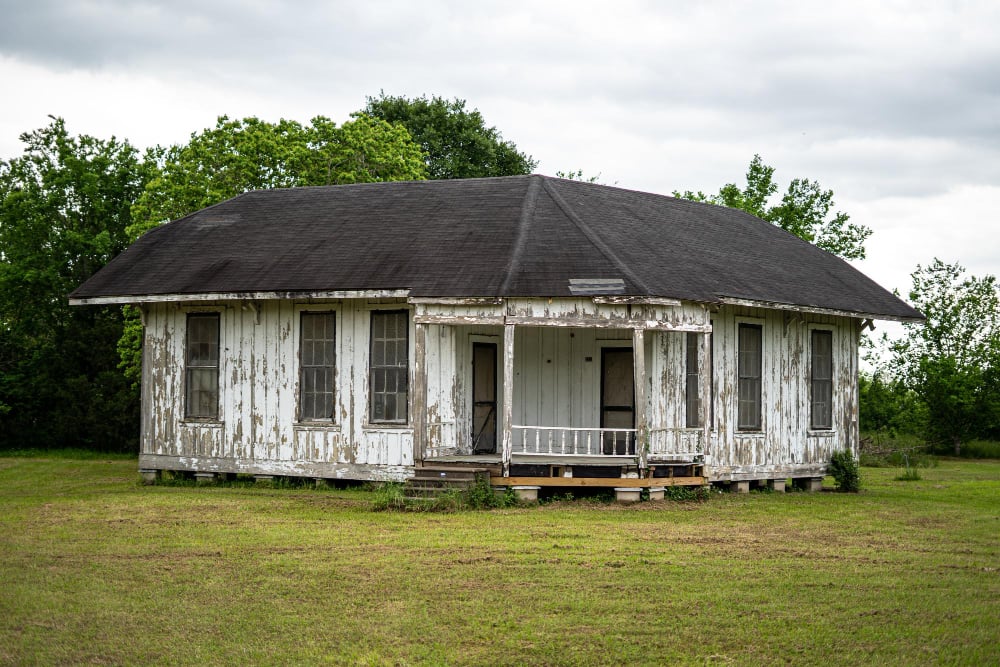
It’s a small white farmhouse at the end of a gravel road in Harlow Creek, a town of about two thousand people and one stoplight. It has a wraparound porch, a kitchen the size of a closet, two bedrooms upstairs with slanted ceilings, and a pantry that smells like cinnamon even now, even after all these years.
Or it did, when it was hers.
My grandmother, Rose Abernathy, lived in that house for fifty-three years. My grandfather died when I was two, so I never knew him. To me, the house was always just Grandma’s. Her house. Her porch. Her kitchen.
My parents both worked, and every summer from the time I was six until I was seventeen, they drove me out to Harlow Creek on the last day of school and picked me up the week before it started again.
Those were the best months of my life. I’m not exaggerating. I’m thirty-eight years old now, and I still haven’t been happier than I was on that porch.
Grandma taught me to bake in that tiny kitchen. I’d stand on a step stool beside her, wearing one of her aprons tied twice around my waist, and she’d let me crack the eggs.
“Gently,” she’d say. “An egg is like a secret. If you’re rough with it, it goes everywhere.”
I’d get shells in the bowl every time. She’d fish them out with a spoon and never once got mad.
She taught me biscuits first. Then pie crust. Then her famous cinnamon rolls, the ones the church ladies tried to get the recipe for every Christmas. She never told them.
“Some things you only give to family,” she said, and winked at me.
In the evenings, we’d sit on the porch swing for hours.
We talked about everything. Boys. School. Books. Whether there was life on other planets. Why my mother and I fought so much. Why people were mean sometimes. What happened to you when you died.
“Do you think about dying, Grandma?” I asked her once. I was eleven.
She pushed the swing with one foot and thought about it.
“Not much,” she said. “I think about this porch. I think about you eating too many biscuits. Mostly I think about whether the tomatoes are going to come in.” She looked over at me. “Dying is just one day, honey. Living is all the rest of them.”
I’ve never forgotten that.
Some of my happiest memories in the world are from that house. Catching fireflies in mason jars in the backyard. Falling asleep upstairs to the sound of rain on the tin roof over the back porch. Grandma singing hymns off-key while she washed dishes.
And the pencil marks on the pantry doorframe, where she measured me every first day of summer. LAYLA — 6. LAYLA — 7. LAYLA — 8. All the way up to seventeen.
When I was older, I visited less. College. Then work. Then Declan.
I met Declan at twenty-six, at a friend’s birthday party. He was standing by the snack table, eating the pretzels out of the mix and leaving all the cereal pieces behind, and I told him that was a terrible thing to do to a snack mix.
“Somebody has to take a stand,” he said.
He was serious and funny at the same time. Careful with money. Careful with everything, really. He was an accountant at a small firm. He made spreadsheets for fun. He paid every bill the day it arrived.
I liked that about him. I liked that he was steady. My parents had divorced when I was nine, and my childhood outside of those summers had been all slammed doors and money fights. Declan felt like solid ground.
I brought him to Harlow Creek once, the summer before our wedding. Grandma was eighty-four by then.
She looked him up and down on the porch. Then she handed him a cinnamon roll and said, “Well. Let’s see what you’re made of.”
He ate the whole thing standing up and asked for a second.
She liked him after that. I could tell.
Grandma passed away eight years ago, at eighty-seven.
She’d moved into an assisted living home for her last year. Her heart was failing, and she couldn’t do the stairs anymore. She hated it there. She said the food tasted like “cardboard that had been lied to.”
After she died, my mother was the executor. My mother and Grandma had never gotten along well. And my mother needed money. She sold the house within two months to a man who said he was going to fix it up and flip it.
I begged her to wait.
“Wait for what, Layla?” she said. “You can’t afford it. You and Declan just bought the condo. Nobody’s going to live out in the middle of nowhere. It’s a house. It’s not her.”
So the house was sold.
I drove by it once, a year later. The flipper had put a For Sale sign in the yard. Then he must have run out of money, because the sign stayed there, fading, and nothing else changed.
After that, I stopped driving by. It hurt too much.
Then, two months ago, I was scrolling on my phone at midnight, unable to sleep, and I saw it.
The listing.
Fixer-upper. Sold as-is. Great bones. Needs TLC.
And there it was. The white farmhouse. The wraparound porch. The swing was gone. The paint was peeling off in long strips. Two upstairs windows were boarded up. Weeds grew as high as the porch railing. A small tree really was growing out of the gutter.
But it was hers.
I sat up in bed and stared at the screen until my eyes burned.
Declan rolled over beside me.
“What are you doing?” he mumbled.
“Nothing,” I said. “Go back to sleep.”
I couldn’t bear losing that house twice.
What I hadn’t told Declan yet was that Grandma had left me money.
Not a fortune. But enough.
It had come as a surprise, eight years ago. A small savings account she’d been putting money into for decades. My mother got the house. I got the account. The lawyer handed me a little card with it, in Grandma’s shaky handwriting.
For when you need something foolish. Love, G.
I’d put the money in the bank and never touched it. Eight years. I didn’t know what “something foolish” was supposed to be.
Until I saw the listing.
The asking price was almost exactly what she’d left me. Within a few hundred dollars.
I don’t believe in signs. Not really.
But I sat in my car in the bank parking lot that morning, holding that little card, and I cried for twenty minutes.
Then I went in and made the withdrawal.
I did tell Declan about the money, eventually. Years ago. He knew it existed. He’d mentioned it a few times. “We should put your grandma’s money into an index fund. It’s just sitting there doing nothing.”
I always said I’d think about it.
What I didn’t tell him was that I’d made an offer on the house. Or that the offer had been accepted. Or that I’d driven three hours each way on my day off to sign the papers.
I know. I should have told him first.
I know that now. I knew it then, too, if I’m honest. I didn’t tell him because I knew exactly what he’d say.
And I was right.
For the next two days, Declan reminded me constantly what a terrible investment I’d made.
He didn’t yell. Declan doesn’t yell. He’s worse than a yeller. He’s a sigher. An eye-roller. A man who leaves real estate articles open on the laptop for you to find.
The next morning at breakfast, I mentioned I’d need a new back door.
He didn’t look up from his coffee.
“You’ll need a new everything.”
That evening, I said I’d found a guy in Harlow Creek who could look at the roof.
Declan put down his fork.
“Do you know what a roof costs? Do you actually know? Because I looked it up. Eighteen thousand dollars. Minimum. For a small house. And that’s if the beams aren’t rotten. Which they are.”
“You don’t know that.”
“There’s a tree growing out of it, Layla.”
He called his brother Sean on speaker that night while I was in the bathroom. I don’t think he meant for me to hear. But our condo isn’t big.
“She bought a house,” he was saying. “A falling-down house. In the middle of nowhere. Three hours away.”
Sean said something I couldn’t make out.
“No, I’m serious. With her grandmother’s money. All of it.” A pause. “I know. I know. You remember what happened with Dad.”
I stood at the sink with the water running.
You remember what happened with Dad.
I didn’t know what that meant. Declan had told me his father died when Declan was nineteen. He’d told me his parents had “money problems.” He’d never told me much more than that. He didn’t like to talk about it, and I’d never pushed.
I turned off the water and went back into the living room.
Declan hung up fast.
“What happened with your dad?” I asked.
“Nothing.” He picked up the remote. “Forget it.”
Every time I mentioned fixing something, he’d roll his eyes.
I’d say, “I think I can refinish the floors myself.”
He’d say, “Sure you can.”
I’d say, “Grandma’s old stove might still work.”
He’d say, “It probably has a family of raccoons in it.”
I’d say, “I think I could have the kitchen done by Christmas.”
He’d laugh. Just laugh. Like I’d told the funniest joke he’d heard all year.
By the third day, I’d had enough.
It was a Thursday. I’d taken the day off from work to make calls. Plumbers. Electricians. A roofer named Hank who sounded about ninety years old and told me he’d “known Rose Abernathy since she was sweet on the milkman.”
Declan came home for lunch, which he never did. I think he wanted to see what I was doing.
He found me at the kitchen table with a notebook full of phone numbers and prices.
He picked up the notebook. He read it. He set it down.
“This is insane,” he said quietly.
I stood up.
“I’m going out there this weekend,” I said. “I’m going to start cleaning it up. Saturday morning. With or without your help.”
He looked at me for a long moment. His jaw was tight.
“Fine,” he said. “But don’t expect me to get involved.”
Then he grabbed a sandwich from the fridge and went back to work.
I sat down at the table and put my face in my hands.
I wasn’t crying. I was too tired to cry. I was just sitting there, thinking about Grandma on the porch swing, pushing it with one foot.
Dying is just one day, honey. Living is all the rest of them.
I wondered what she’d think of Declan right now.
I wondered what she’d think of me.
Later that afternoon, my phone rang.
It was Declan.
I almost didn’t answer. I figured he was calling to send me another article about roofing costs.
But I picked up anyway.
And something about his voice immediately worried me.
“Layla,” he said. “I’m at your grandma’s house.”
I sat straight up.
“Wait. What? Why did you go there?”
He didn’t answer the question.
“I found something,” he said. His voice sounded strange. Thin. Like he was talking from very far away. “I don’t even know what to say.”
My stomach dropped.
“Declan, what’s going on? What did you find? Are you hurt? Is it the roof? Did something fall?”
There was a long pause.
So long I thought the call had dropped.
Then he said, “Get in the car. You need to see this.”
“Declan—”
“Just come,” he said. “Please.”
He’d never said please like that before. Not in eleven years.
I tried calling him back twice from the road. He didn’t answer. I sent him three texts. What is it? Are you okay? Talk to me.
Nothing.
It’s a three-hour drive to Harlow Creek. I made it in two and a half.
The whole way there, my mind ran in circles. Maybe someone was living there. Squatters. Maybe there’d been a fire. Maybe the flipper had left something terrible behind. Maybe the whole back of the house had collapsed and Declan was standing in the rubble, ready to say, See? I told you.
But that wasn’t how he’d sounded.
He hadn’t sounded angry.
He’d sounded scared.
I turned onto the gravel road just after six. The sun was low and orange over the cornfields.
The house came into view at the end of the road.
It looked exactly like the pictures. Worse, maybe. The paint peeling off in long gray curls. The boarded-up windows upstairs. Weeds up to my knees in the front yard. The little tree in the gutter, waving in the breeze.
Declan’s car was parked in the driveway.
And Declan was standing outside, at the bottom of the porch steps, with his hands hanging at his sides.
He looked pale. Not just tired. Pale like someone who’d seen something he couldn’t explain.
I parked behind his car and got out.
“Declan.”
He looked at me. He opened his mouth. Closed it.
“What happened?”
He barely said a word. He just turned and walked up the porch steps, and I followed him. The third step creaked under my foot. It always had. When I was a kid, I used to skip it at night so Grandma wouldn’t hear me sneaking down for a cookie.
She always heard anyway.
Declan pushed the front door open.
And the second I stepped through the doorway, I froze.
I grabbed the doorframe to steady myself.
The living room walls were covered in handwriting.
All of them.
From the floor up to about the height of my shoulders, every wall in that small living room was covered in writing. Pencil and pen and marker. Some of it faded, some of it dark. Lines and lines of it, running across the plaster, around the window frames, up the side of the fireplace.
I knew that handwriting.
I’d know it anywhere.
It was Grandma’s.
Long strips of old wallpaper were lying on the floor in curls. The pink wallpaper with the little roses on it. I remembered that wallpaper. It had gone up the last summer I visited before she moved out, the summer I was twenty-nine, when Declan and I came out for her eighty-sixth birthday.
Declan had torn about half of it down.
And underneath it, my grandmother had been writing to me.
I didn’t move. I couldn’t. My hand was gripping the doorframe so hard my fingers hurt.
Declan stood in the middle of the room, among the curls of wallpaper.
“I came out here to take pictures,” he said quietly. “Of the damage. For a contractor. I was going to get a real estimate. Show you the numbers on paper. I thought if you saw it written down, you’d—” He stopped. “I thought you’d sell it.”
He looked down at the wallpaper at his feet.
“There was a loose corner by the window. It was water-damaged. I pulled it to see how bad the plaster was underneath. And I saw your name.”
He pointed.
There, low on the wall beside the front window, right at the height of a child’s eyes, my grandmother had written in big, careful letters:
LAYLA. IF YOU’RE READING THIS, YOU CAME HOME.
I let go of the doorframe. My legs felt like water. I walked across the room and knelt down in front of that line.
I touched it with my fingertips. The pencil was smudged a little at the edges, like she’d pressed hard.
“I kept pulling,” Declan said behind me. “I couldn’t stop. I’ve been here since two o’clock. Layla, it’s everywhere. It’s the whole room. I haven’t even gone into the kitchen yet.”
I looked up at the wall.
And I started reading.
June. The tomatoes are a disaster this year. Blight. I’m blaming the Henderson boy’s chickens. Layla would laugh at me.
Layla called today. She sounds tired. That job is eating her alive. I wish she’d come for a week. I wish I could still drive to her.
Biscuits. 2 cups flour. 1 tbsp baking powder. ½ tsp salt. 6 tbsp COLD butter, Layla, COLD, I mean it. ¾ cup buttermilk. Don’t overwork it. Treat it like you’re mad at it but you still love it.
I laughed out loud. A broken, startled sound. I covered my mouth with my hand.
That’s exactly what she used to say. Treat it like you’re mad at it but you still love it.
I moved along the wall on my knees.
Pie crust. Same rules. Butter cold. Hands cold. Heart warm.
Cinnamon rolls. The REAL recipe. Not the one I gave Margaret Pruitt at church. She’s been making them wrong for 30 years and I’ve never had the heart to tell her.
And then the recipe, the whole thing. Every measurement. Every step. The secret ingredient I’d never been able to figure out, the one I’d been trying to guess for eight years.
A pinch of cardamom. Don’t tell ANYONE.
I was crying now. I didn’t even notice when it started.
Declan came and knelt beside me on the floor.
He didn’t touch me. He just knelt there.
“Keep reading,” he said quietly. “There’s more. By the fireplace.”
I moved over to the fireplace.
The writing there was different. Shakier. Like it had been written later. Her hands had been getting bad those last years. Arthritis. She could barely hold a coffee cup some mornings.
I know what Linda will do with this house when I go. She’ll sell it. She needs the money, and she’s never loved it. I don’t blame her. Not every house is for everyone.
Linda was my mother.
But I want Layla to know some things. And I’m too stubborn to say them out loud. So I’m putting them here, where only the house can hear me. And if she ever finds them, then she was meant to.
If she doesn’t, the house will keep them. Houses are good at keeping things.
I sat back on my heels.
I remembered now.
That last summer, when Declan and I came for her eighty-sixth birthday, the new wallpaper had just gone up in the living room. The little pink roses. I’d asked her about it. I’d been surprised, because she’d always hated wallpaper. She said it made a room “look like it was wearing a girdle.”
“Why’d you change it?” I asked.
She’d been sitting in her armchair by the window, with a quilt over her knees even though it was July.
“Some things,” she said, “are better found than given.”
I’d thought she was being strange. She’d been getting a little strange that last year. Forgetting names. Telling the same stories twice.
I’d laughed and kissed her cheek and gone to make lemonade.
She hadn’t been strange at all.
She’d been hiding something for me.
I kept reading. I couldn’t stop.
There were lines about my childhood that I’d completely forgotten.
Layla, age 8, tried to dig to China in the backyard. Got about two feet down. Found a doll’s head. Screamed for an hour. I still have the doll head. It’s in the pantry. Don’t ask.
Layla, age 12, cried all night because Billy Ferris said she had a nose like a potato. Billy Ferris works at the feed store now and has a nose like a turnip. God has a sense of humor.
Layla, age 15, asked me if I was ever afraid of being alone. I lied and said no. I’m sorry I lied, honey. Yes. Every night since your grandfather died. Being afraid isn’t the same as being unhappy. You can be both afraid and happy at once. I was.
There were lines about my mother.
Linda and I never understood each other. That’s my fault more than hers. I was too hard on her when she was young. I tried to make it right with Layla. Don’t tell Linda I said so. Or do. Maybe it would help.
There were lines about my grandfather, who I never knew.
Walter built this porch himself the year Linda was born. He hammered his thumb so many times he said he was going to name the baby Ouch. I wouldn’t let him.
And there were lines about the house itself.
The third step creaks. Always has. Don’t ever fix it. That’s how I knew when Layla was sneaking down for cookies.
I looked back over my shoulder at the front door. At the porch beyond it, glowing orange in the sunset.
I laughed and cried at the same time.
Then Declan said, very quietly, “There’s one about me.”
I turned and looked at him.
He was still kneeling on the floor. His face was gray. He had his hands pressed flat against his thighs like he was trying to hold himself still.
“Where?”
He pointed to the corner by the bookshelf. The wallpaper there had been torn back in a jagged strip.
I crawled over.
The writing was very shaky here. One of the last things she wrote, I think.
Layla brought her young man for my birthday. Declan. Serious face. Eats like a farmhand. Holds the door for me. Checked the batteries in my smoke detector without being asked, which I liked.
He’s afraid of something. I don’t know what. I can see it on him, the way you can see weather coming. He counts things. Money. Minutes. He counted the steps on the porch when he came up.
Fear makes people careful. Careful is good, until it isn’t.
I asked him to promise me something on the porch. I don’t know if he’ll remember. Men usually don’t.
I turned and looked at Declan.
He was staring at the wall. His eyes were full.
“I remember,” he said.
“What did she make you promise?” I asked.
He didn’t answer right away. He sat down on the dusty floor and pulled his knees up, like a kid.
“It was the second night,” he said. “You were inside doing the dishes. She asked me to come sit with her on the swing. I thought she was going to ask about my job. Or whether I was going to take care of you. That’s what grandparents ask.”
He wiped his face with his sleeve.
“She didn’t. She sat there for a long time. Pushing the swing with one foot. And then she said, ‘Someday, Layla’s going to want to do something that doesn’t make sense on paper. Something foolish. Promise me you’ll let her.’”
I couldn’t breathe.
“I laughed,” Declan said. “I thought she was being sweet. I said sure, of course, I promise. I didn’t think about it again. Not once. In eleven years.”
He looked around the room. At the writing. At the curls of pink wallpaper.
“Then I pulled that wallpaper down today,” he said. “And I saw it. And I remembered. Every word. And I thought about everything I’ve said to you this week.”
He put his face in his hands.
“I called it the worst decision you’ve ever made,” he said through his fingers. “I made fun of you. For three days. And the whole time, she knew. She knew I’d do this. She knew eleven years ago.”
There was more. In the kitchen.
We found it together, after the sun went down. Declan had a flashlight in his car. We stood in Grandma’s tiny kitchen, the same kitchen where I’d cracked eggs on a step stool, and shone the light on the wall beside the old stove.
The flipper hadn’t touched the kitchen wallpaper. Yellow, with little teapots. Grandma must have hung it the same time as the living room.
Declan found the loose edge and pulled. Gently this time.
Underneath was one more message. The handwriting was so shaky I could barely read it.
Look under the pantry floor. Third board from the left. The one that wobbles.
I knew the board.
When I was a kid, I used to step on it on purpose to make it go thunk. Grandma would yell, “Layla! You’ll wake the dead!” and I’d say, “Grandpa’s not in the pantry,” and she’d laugh.
I knelt down in the pantry doorway. My pencil marks were still on the doorframe beside me. LAYLA — 6. LAYLA — 7. All of them, all the way up. The flipper hadn’t painted over them.
I pressed on the third board from the left. It wobbled. Declan handed me a screwdriver from his car. I pried it up.
Underneath, in the dust, was a cookie tin.
A blue one. Danish butter cookies. The kind every grandmother in the world keeps sewing supplies in.
I lifted it out. It was heavier than I expected.
I sat down on the pantry floor and opened it.
Inside, on top, was a small cloth bundle.
I unwrapped it. It was her wedding ring. Thin gold band, worn almost flat on one side from fifty-three years of washing dishes and kneading dough.
Under the ring was an envelope with my name on it.
Under that was a second envelope.
It said DECLAN.
Declan stared at it.
“That’s—” He swallowed. “She wrote me a letter?”
“Open it.”
“You open yours first.”
I opened mine.
It was short. Her handwriting wobbled across the page.
My Layla,
If you found this, then you came back. I knew you would. You’re stubborn. You get it from me.
I don’t know how long it’s been. I don’t know if the house is still standing. I hope somebody’s been kind to it. I hope there’s not a tree growing out of the gutter. Walter always said the gutters were the weak point.
I laughed so hard I had to put the letter down.
The money I left you was for something foolish. I hope you spent it on something foolish. I hope you spent it on something that people told you was a mistake.
Here is what I learned in 87 years: almost everything worth having looks like a mistake to somebody. Your grandfather looked like a mistake to my father. This house looked like a mistake to everybody in town. You looked like a mistake to your mother’s friends when she had you at nineteen.
None of you were mistakes.
Bake something in that kitchen. Sit on the porch. Don’t fix the third step.
I love you more than biscuits.
G.
I sat on the pantry floor holding that letter for a long time.
Declan sat beside me with his envelope in his lap. He hadn’t opened it yet.
“Your turn,” I said finally.
His hands were shaking. He tore the envelope open slowly.
He read it silently first. I watched his face. I watched it crumple, a little at a time, like paper getting wet.
Then he handed it to me.
Declan,
If you’re reading this, you either kept your promise, or you broke it and found out. I suspect the second one. That’s all right. Most of us break our promises before we learn to keep them.
I don’t know what you’re afraid of. But I know that look. Walter had it after the war. My father had it after the bank took his farm in ‘38. It’s the look of a man who’s been told the floor can fall out from under you at any minute.
Sometimes it does. I won’t lie to you.
But son, if you spend your whole life standing very still, waiting for the floor to fall, you’ll never dance with anybody on it.
Let her be foolish. And then, if you can, be foolish with her.
Rose
I looked up from the letter.
Declan was crying. Not quietly. The way men cry when they haven’t done it in twenty years and don’t remember how to do it gracefully.
I put my arms around him. We sat on Grandma’s pantry floor in the dark, with the flashlight rolling slowly across the boards, and he cried into my shoulder.
“My dad,” he said finally. His voice was muffled. “I never told you. Not really.”
“Tell me now.”
He pulled back. He wiped his face with both hands.
“When I was sixteen,” he said, “my dad bought a house. A falling-down house. Out in the country, like this one. He said he was going to fix it up and flip it. Make us rich. He took out a second mortgage on our house to pay for it. Didn’t tell my mom until after.”
I didn’t say anything.
“He couldn’t fix it. He didn’t know how. He ran out of money in six months. Then he started borrowing from people. Then the bank took the house. Both houses. Ours and the one he bought.” Declan stared at the flashlight beam on the floor. “We moved into my aunt’s basement. My mom stopped talking to him. He started drinking. He died two years later. Heart attack, they said. Fifty-one years old.”
He looked at me.
“I was standing in our kitchen on Monday,” he said, “and you said you’d bought a falling-down house with all your money and didn’t tell me first. And I was sixteen again. I was standing in my parents’ kitchen watching my mom cry.”
“Declan,” I said. “Why didn’t you ever tell me?”
“Because I didn’t want you to look at me like that.” He gestured at my face. “Like you’re looking at me now.”
“How am I looking at you?”
“Like I’m broken.”
I took his face in both my hands.
“I’m looking at you like I finally understand you,” I said. “That’s different.”
We didn’t drive home that night.
Neither of us could. We were too wrung out. We found an old mattress in one of the upstairs bedrooms, in the room with the slanted ceiling where I used to sleep every summer. It was dusty and smelled like mothballs. We dragged it downstairs into the living room and laid it on the floor in the middle of Grandma’s walls.
Declan went out and got sandwiches and a flashlight lantern from the gas station in town. We ate on the mattress, cross-legged, by lantern light, surrounded by her handwriting.
“Read me one,” Declan said.
I picked one at random.
Layla, age 10, asked me why I talk to Walter’s picture. I told her it’s because he’s a better listener now than he ever was alive.
Declan laughed.
“Another one.”
Today I made 4 dozen cinnamon rolls for the church sale. Margaret Pruitt brought her own, made with MY fake recipe. Hers sold out first. I am not a jealous woman. But I went home and had a long talk with Walter’s picture.
Declan was laughing so hard he had to lie back on the mattress.
“I like her,” he said, staring at the ceiling. “God. I really, really like her.”
“She liked you too.”
He was quiet for a minute.
“She said I counted the porch steps.”
“Did you?”
“Yes.” He laughed softly. “Eleven. There are eleven steps if you count the top one.”
We drove home the next morning.
Neither of us said much on the drive. But somewhere around the halfway point, at a rest stop where we’d pulled over for coffee, Declan pulled out his phone.
He was making a spreadsheet.
Of course he was.
“What’s that?” I asked.
He turned the phone around so I could see.
The heading at the top said ROSE’S HOUSE.
Under it, he’d made columns. Roof. Windows. Plumbing. Electrical. Porch. Kitchen. Floors. Paint. Each with a little estimate beside it. A timeline. A budget. A list of people to call, with Hank the roofer at the top.
“I’m not saying it’s a good investment,” he said. “On paper it’s still a terrible investment.”
“I know.”
“But if we’re going to be foolish,” he said, “we’re going to be foolish properly. With a spreadsheet.”
I laughed so hard I spilled my coffee.
The next Saturday, we drove back to Harlow Creek together.
Declan had bought work gloves. Two pairs. And a crowbar. And three kinds of sandpaper. And a book called Old House Restoration for Beginners, which he’d already read halfway through and annotated with little sticky notes.
We started with the yard.
It took us the whole first day just to pull the weeds out of the front. Declan cut his hand on a thistle and swore so creatively that an old man walking his dog down the road stopped to listen.
“You must be Rose’s granddaughter,” the old man said to me, leaning on our fence.
“I am.”
“Thought so. You’ve got her look.” He nodded at Declan. “He swears like Walter used to.”
He introduced himself as Earl. He’d lived on the next farm over for sixty years. He told us he’d been watching the house rot for eight years and it about broke his heart.
“Rose would’ve skinned that flipper alive,” he said. “Glad somebody finally came back for it.”
He came back the next morning with his own tools and a thermos of coffee and didn’t leave until sundown.
It took us all summer.
Every weekend. Friday night to Sunday night. We’d drive out after work on Friday, sleep on the mattress in the living room, and work until we couldn’t stand up.
Hank the roofer turned out to be eighty-three years old and as strong as a bull. He came with his grandsons, two quiet teenagers, and they redid the whole roof in a week. The beams weren’t rotten after all. Declan made Hank show him three separate times.
“Good bones,” Hank said, patting a rafter. “Walter built it right. Rose kept it right. That flipper just let it sit.”
Hank took out the little tree in the gutter last. He handed it to me in a coffee can.
“Seems a shame to throw it out,” he said. “It worked hard to grow up there.”
I planted it in the backyard, by where the tomatoes used to be.
We fought, sometimes.
I won’t pretend we didn’t. Declan wanted to replace the old windows with new energy-efficient ones. I wanted to keep the old glass, the wavy kind that made the yard look like it was underwater.
“They’re not efficient, Layla.”
“They’re hers.”
“They leak heat like a sieve.”
“Then we’ll wear sweaters.”
We compromised. New windows upstairs. Old glass downstairs, with storm windows on the outside.
He wanted to sand the living room floors. I wanted to leave the scuff marks by the armchair where Grandma’s slippers had worn the finish off.
“Those are just scratches.”
“Those are her feet, Declan.”
He looked at the scuffs for a long time. Then he put down the sander and walked out to the porch. When he came back, he said, “Okay. We sand around them.”
We sanded around them.
The hardest decision was the walls.
The plaster was cracked in places. Water-damaged near the front window. A contractor in town told us we’d need to tear it out and put up new drywall.
“No,” I said.
The contractor looked at me like I’d lost my mind.
“Ma’am, it’s crumbling.”
“Then we fix it. We don’t tear it out.”
He shook his head and left. He didn’t come back.
Declan sat with me on the porch steps that night. The creaky one under us.
“We can’t keep all of it,” he said gently. “Some of that plaster is going to fall apart no matter what we do.”
“I know.”
“So we choose.”
We spent the next two weekends photographing every inch of those walls. Every word. Declan rented a good camera. He took over a thousand pictures, and he labeled every one of them in a folder on his laptop. Living room, north wall, section 4. Recipe: biscuits.
Then we chose.
We kept the wall by the front window, where it said LAYLA. IF YOU’RE READING THIS, YOU CAME HOME. We kept the fireplace wall. We kept the corner by the bookshelf, the one about Declan. We kept the kitchen wall with the note about the pantry board.
A restoration woman from the city came and sealed them under a clear coat. Then she put them behind glass, in simple wooden frames, right on the wall where they’d always been.
The rest, we patched and painted.
Pale yellow. The color of butter.
“Cold butter,” Declan said, when we finished the first coat. “COLD, Layla. She means it.”
My mother came out in August.
I hadn’t told her about the house for a while. I didn’t know how she’d take it. When I finally called, she was quiet for a long time.
“I’d like to see it,” she said.
She drove out on a Sunday. She stood on the porch for five minutes before she came inside. When she walked into the living room and saw the walls, she stopped exactly where I had.
She read every framed section. Slowly.
When she got to the one by the fireplace, she stopped.
Linda and I never understood each other. That’s my fault more than hers. I was too hard on her when she was young. I tried to make it right with Layla. Don’t tell Linda I said so. Or do. Maybe it would help.
My mother stood in front of that glass for a long time.
Then she sat down in the old armchair by the window. Grandma’s chair. The one Earl had found in his barn, where he’d been storing it since the flipper threw it on the curb.
She put her face in her hands.
I sat on the arm of the chair and put my hand on her back. I didn’t say anything. I’d learned from Grandma that sometimes the best thing you can do is sit next to someone and push the swing with one foot.
“I sold it in two months,” my mother said finally. “I couldn’t stand to be in it. Every room was her, telling me what I was doing wrong.”
“I know, Mom.”
“I didn’t know she felt that way.” She looked up at the wall. “She never said it. Not once.”
“She said it here,” I said. “She was too stubborn to say it out loud.”
My mother laughed. Wet and cracked.
“That,” she said, “is the most Rose thing I’ve ever heard.”
By late September, the house was done.
Not perfect. It’ll never be perfect. The floors still slope a little toward the kitchen. The upstairs bathroom faucet drips no matter what Declan does to it. The third porch step still creaks.
We didn’t fix it.
But the roof is solid. The windows close. The paint is fresh and white on the outside, butter yellow on the inside. The porch has a new swing, hung from the same hooks Walter screwed into the ceiling in 1971.
And the kitchen works.
The first Saturday after we finished, I baked in it.
Cinnamon rolls. The real recipe. The one from the wall.
I stood at the tiny counter in one of Grandma’s aprons. I’d found three of them folded in the cookie tin under the ring, which I hadn’t even noticed the first night. I tied it twice around my waist, the way I did when I was six.
Declan sat at the little table and watched me.
“Can I help?” he asked.
I looked at him.
“Crack the eggs,” I said. “Gently. An egg is like a secret. If you’re rough with it, it goes everywhere.”
He got shell in the bowl. Every single time.
I fished it out with a spoon and never once got mad.
When I got to the cardamom, I held the little jar up and looked at him seriously.
“You can never tell anyone about this,” I said.
He put his hand on his heart.
“Not even Margaret Pruitt?”
“Especially not Margaret Pruitt.”
We ate them on the porch swing, warm, with our fingers sticky.
Declan pushed the swing with one foot. The way she used to.
The sun was going down over the cornfields. Earl was walking his dog down the road. He waved. We waved back. Somewhere out in the backyard, the little tree from the gutter was putting out new leaves.
“I was wrong,” Declan said quietly.
“About what?”
“Everything. All of it. It wasn’t the worst decision you’ve ever made.” He looked over at the house. At the yellow light glowing through the wavy old window glass. “It might be the best one either of us has ever made.”
“On paper, it’s still a terrible investment.”
“On paper,” he agreed. He licked icing off his thumb. “Thank God we don’t live on paper.”
I leaned my head on his shoulder.
We don’t live in Harlow Creek full-time. Not yet.
We still have the condo in the city. Our jobs. Our lives. But we come out every weekend we can, and two weeks every summer, and Christmas.
Declan keeps a spreadsheet for the house. Of course he does. Every repair, every expense, every receipt. At the top, in bold, he typed one line before the columns start.
Some things don’t make sense on paper. Do them anyway. — R.A.
Last month, I was standing in the pantry, putting away flour, when I noticed something on the doorframe.
My pencil marks were there, the way they’d always been. LAYLA — 6. LAYLA — 7. All the way up to seventeen.
But beside them, there was a new one. Fresh pencil. Higher up than mine, about six feet off the floor.
DECLAN — 41. Came home.
I stood there with a bag of flour in my arms and looked at it for a long time.
Then I went and found a pencil in the kitchen drawer.
And under it, in my own handwriting, I wrote one more line.
Kept his promise.

Laura Bennett writes about complicated family dynamics, difficult conversations, and the quiet moments that change everything. Her stories focus on real-life tensions — inheritance disputes, strained marriages, loyalty tests — and the strength people find when they finally speak up. She believes the smallest decisions often carry the biggest consequences.