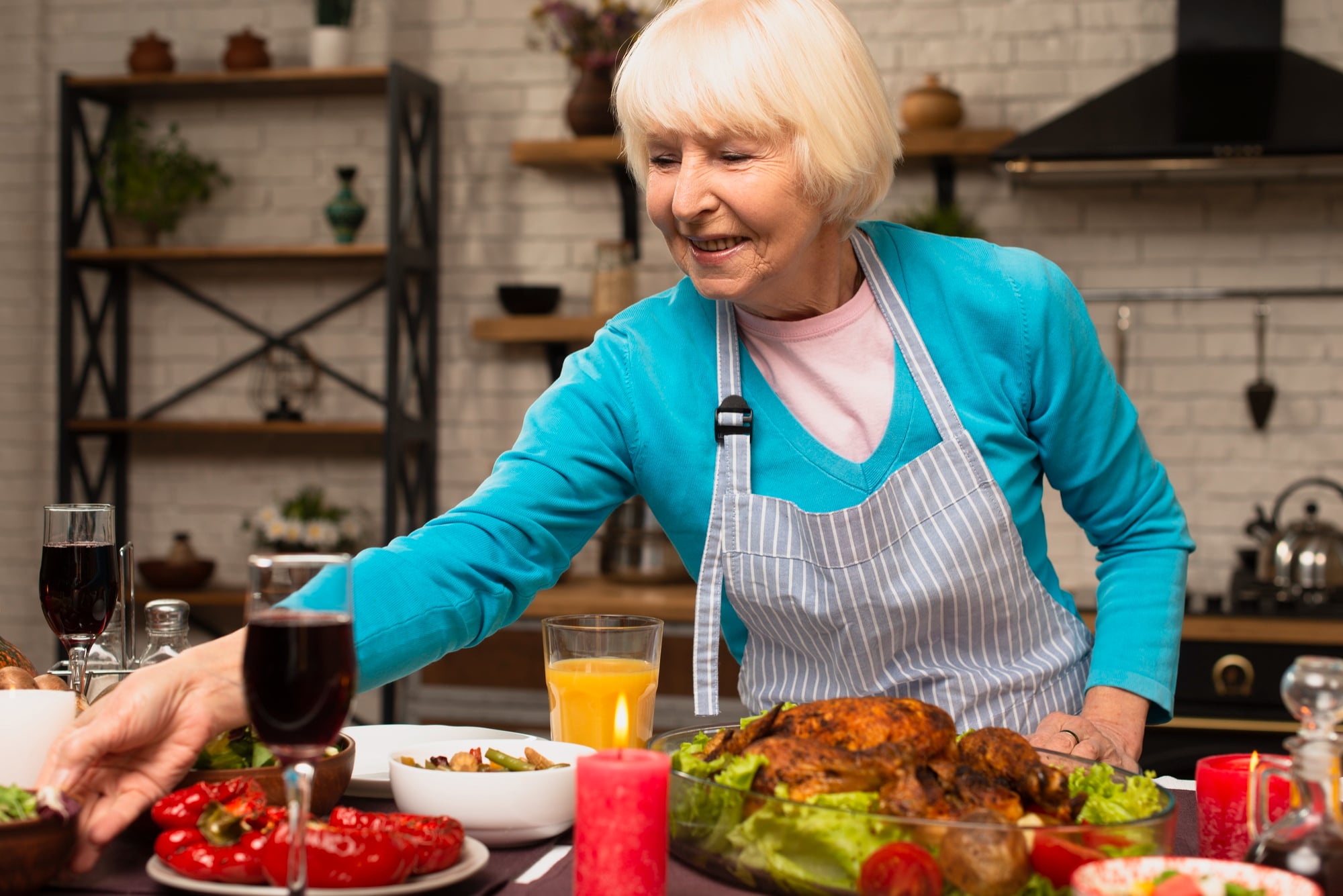
The Second Half of My Life
Part One: The Turkey on the Passenger Floor
My name is Diane Mercer. I’m sixty-three years old, and until last Thanksgiving, I had confused being useful to my family with being valued by them.
They are not the same thing. It took me forty years, one sentence at a dinner table, and a small house in Portugal to understand the difference.
I left my home in Raleigh a little after eight on Thanksgiving morning. A roasted turkey sat in a cooler wedged behind the driver’s seat. Two pies, pumpkin and pecan, rode on the passenger-side floor, held steady by a folded beach towel.
The back seat was crowded with green bean casserole, sweet potato casserole topped with marshmallows, cornbread stuffing, and a jar of cranberry sauce I’d made from scratch. I’d been cooking since Tuesday afternoon. My feet ached before I even started the car.
Holiday traffic stretched the drive to Charlotte to nearly three hours. I spent most of it worrying about whether the sweet potatoes were getting cold and whether the pecan pie would slide when I braked.
My son Derek lives in a two-story house in a Charlotte neighborhood called Ballantyne, where every lawn looks like it was trimmed with scissors. When I pulled into the driveway, the porch was decorated with matching wreaths and dozens of small golden pumpkins arranged on the steps.
Even the walkway was spotless. Not a single leaf.
His wife, Cassandra, opened the door before I could knock. She was wearing a cream sweater and gold earrings, and her hair was perfect.
She glanced at the food I was carrying, then called over her shoulder into the house.
“Derek, your mother’s here,” she said. “We can stop worrying about dinner now.”
She gave me an air kiss somewhere near my cheek and stepped aside. She didn’t offer to take anything.
I was balancing the turkey roaster against my hip while trying to keep my handbag from sliding off my shoulder. A pie tin was pressed against my ribs.
Derek appeared a moment later. He hugged me with one arm and took the roasting pan with the other.
“You’re a lifesaver, Mom,” he said. He was already walking toward the kitchen.
There was a time when hearing those words made me happy.
My husband, Leonard, died of a heart attack in 1998. He was forty-four. Derek was fourteen. His sister, Joanna, was eleven.
One morning Leonard kissed me goodbye at the kitchen door and said he’d pick up milk on the way home. That afternoon, a nurse from Rex Hospital called and asked me to come right away.
He never picked up the milk.
After that, taking care of everyone became my second job.
I worked full-time as an office manager at a dental practice on Six Forks Road. I paid the mortgage. I sat at the kitchen table with a calculator every Sunday night, stretching one income over two growing children and a house that always needed something.
Some evenings I sat in my car in the parking lot of the Harris Teeter, doing math on the back of a receipt. Could I afford both Derek’s new baseball cleats and Joanna’s winter coat? Which bill could wait two weeks?
Somehow, I always found a way.
Leonard had been a good husband. Patient. Funny. He sang off-key in the shower and left notes in my lunch bag.
When I lost him, I also lost the one person who used to remind me that I didn’t have to carry everything alone.
For years, I made myself a quiet promise.
When the kids are grown, I told myself, I’ll do the things I want to do. Just for joy. I’ll travel. I’ll see old towns with cobblestone streets. I’ll take a painting class. I’ll read books on a porch in the afternoon without a single dish waiting in the sink.
I worked hard. I saved carefully. When I retired two years ago, I had enough to live comfortably, if I was sensible.
But retirement didn’t turn out the way I’d imagined.
Derek and Cassandra had been married eight years. They always seemed to need something. Could I watch the dog this weekend? Could I pick up a dresser from a seller in Durham? Could I help with the car insurance just this once, until Derek’s bonus came through?
I loved them. I liked being part of their lives.
What I didn’t notice was how quietly their needs slid my own plans off the calendar, one weekend at a time.
Part Two: Cooking and Cleaning
That Thanksgiving, Cassandra had invited her mother, Renee, her sister’s family, and several friends from the neighborhood. Sixteen people.
The dining room looked like a magazine spread. Eucalyptus branches ran down the center of the table. Linen napkins were folded into shapes beside gold-rimmed glasses. Every seat had a handwritten place card in elegant script.
“Cassandra, this is beautiful,” I said. I meant it.
She smiled and adjusted a candle by a quarter inch.
“I’m thinking about starting an event-planning business,” she said. “Presentation is everything.”
Then she pointed toward the kitchen.
“Can you get the casseroles warming?” she said. “People will be hungry soon.”
For the next three hours, I moved between the oven, the refrigerator, and the sink.
I found serving dishes in cabinets I’d never opened. I warmed the stuffing and sweet potatoes. I made gravy from the turkey drippings. I carved the turkey on a cutting board balanced over the sink because Cassandra didn’t want the mess on her counter.
I washed pans as soon as I used them. Cassandra had said she didn’t want dirty cookware visible when guests walked through the kitchen.
Derek came in twice to ask if I needed help.
Both times, before I could answer, someone called his name from the living room and he disappeared.
At one point, Cassandra’s mother, Renee, wandered in looking for a corkscrew. She was a tall woman with silver hair and a voice like warm honey.
She saw me at the sink scrubbing a cast-iron skillet. She smiled.
“Oh, Diane, sweetheart,” she said. “You’re always happiest when you’re busy.”
I smiled back. That smile had become automatic over the years.
The truth was, I would have loved to sit down with a glass of wine. I had just finished a wonderful novel about a retired schoolteacher who sells her house and travels alone through Europe. I’d been looking forward to talking about it with someone.
Instead, I dried the skillet and hung it on its hook.
Dinner finally started a little after four.
Everyone praised the turkey. Cassandra accepted compliments on the beautiful meal without mentioning who cooked it. At first, I didn’t mind. I liked watching people enjoy the food. I’d always believed holiday dinners should bring people together, not become contests over who deserved credit.
Then one of Cassandra’s friends noticed a framed photograph on the sideboard.
It was a picture of me.
I was standing on a windswept hillside in New Zealand in a bright blue raincoat. The wind was blowing my gray hair across my face, and I was laughing so hard my eyes had almost disappeared.
I took that trip alone two years earlier, right after I retired. It was the first big trip I’d ever taken in my life. I’d given Derek the photo in a frame the Christmas after, and I was touched that it was still on display.
“Is that you, Diane?” the woman asked. “What a gorgeous place!”
My face lit up.
“It is,” I said. “That was just outside Queenstown. The scenery was unbelievable.”
She asked what my favorite part had been. So I started telling her about the ferry through Milford Sound.
I described the mountains rising straight out of the black water. The waterfalls pouring down from cliffs so high you had to tip your head all the way back. The way the whole boat went silent when the captain steered us close under one of the falls, and the mist soaked everyone, and nobody minded.
I’d barely gotten three sentences out when Cassandra laughed.
“Oh, don’t get her started,” she said. She waved her fork in my direction.
“Cooking and cleaning,” she said. “That’s your whole personality, Diane.”
She smiled at the table.
“Traveling is just what she does in between family dinners,” she said.
A few guests exchanged awkward smiles.
I looked at Cassandra, waiting for her to realize how that had sounded. Instead, she reached for her wineglass and took a sip, clearly pleased with herself.
Across the table, Derek kept his eyes on his stuffing.
He didn’t say anything.
He didn’t mention the thirty years I’d managed a dental office. He didn’t mention that I’d raised two children on my own after their father died. He didn’t mention that I’d flown halfway around the world by myself at sixty-one, simply because I wanted to see something beyond my own neighborhood.
He kept eating.
One of the guests tried to rescue the moment.
“So,” she said brightly, “what’s everyone doing for Christmas?”
Cassandra leaned forward, delighted.
“I’ve already started thinking about the menu,” she said. “Diane will handle the cooking again, of course. Nobody does Christmas like she does.”
She said it without looking at me.
As though I’d already agreed.
As though spending another holiday in someone else’s kitchen was the only thing I could possibly want.
I set down my fork.
“Derek,” I said quietly. “Could you pass the water?”
He handed me the pitcher without lifting his eyes.
His silence hurt more than Cassandra’s joke.
Because it wasn’t the first time. Over the years, Derek had apologized to me privately for a dozen of her remarks. She’s under a lot of stress, Mom. She didn’t mean it like that. You know how she is.
And then, at the next gathering, he would expect me to act as if nothing had happened.
Part Three: Family Is Everything
After dinner, I went into the downstairs bathroom to wash my hands.
Above the towel rack hung a framed sign in fancy script. Family Is Everything.
I stood there and looked at it for a long time.
I thought about the money I’d sent when Derek needed a down payment on his truck. The apartment lease I’d co-signed when he was twenty-three. The monthly transfers I’d been making quietly for two years, whenever he mentioned that money was tight.
I’d never done any of it for thanks. I did it because he was my son.
But standing in front of that sign, I couldn’t remember the last time he’d asked me what I wanted.
I helped serve the pumpkin pie. I packed up leftovers in containers I’d brought from home. I wiped down the counters.
When I finally picked up my coat, Cassandra was in the dining room talking about her Christmas guest list.
“I’ll text you the head count tomorrow, Diane,” she called over her shoulder.
I didn’t answer.
I hugged my grandchildren. Maddie is ten and loves horses. Jack is seven and has never once sat still. Maddie whispered that my pecan pie was the best one in the world. Jack asked if I could make it again at Christmas.
I kissed Derek on the cheek. I reminded him to be careful driving the kids to the skating rink in the morning.
Then I went home.
By the time I got back to Raleigh, it was dark. I drove past house after house glowing with Christmas lights, even though it was only Thanksgiving.
I kept thinking about that photograph in New Zealand.
I remembered standing on that hillside with the cold wind on my face. I remembered thinking, for the first time in decades, Nobody needs me to be anywhere else right now.
At home, I put my bag down, filled the kettle, and opened my laptop at the kitchen table.
I started with my bank statements.
There were recurring charges I’d stopped seeing. Three streaming services I never watched. A monthly fee for a storage unit in Charlotte where Derek kept furniture from his old apartment. A regular transfer of four hundred dollars to his account. Small purchases I’d made because someone had asked me to pick something up.
On their own, none of them were much.
Together, they added up to more than seven hundred dollars a month.
Then I opened the savings account where I’d put the money from selling the house Leonard and I had shared.
I had guarded that money for years. I’d told myself I might need it someday for a crisis I couldn’t predict.
But I was sixty-three. I had already lived through the crisis that changed everything. More than most people, I knew that tomorrow doesn’t promise us the years we think we have.
On my desktop was a folder called Places to Go.
Inside were photographs of Italian hill towns, Irish cottages, apartments by the sea in Greece. But one listing had always stayed with me.
A small furnished house in Óbidos, Portugal. Whitewashed walls. Blue shutters. A tiny courtyard with a lemon tree, tucked behind a narrow stone street inside a medieval town wall.
I’d bookmarked it eleven months earlier. I’d looked at it more times than I wanted to admit.
I clicked on the listing and checked the calendar.
Eight weeks were open, starting December twelfth.
My heart started pounding.
I read the cancellation policy. I compared the cost to the travel budget I’d set for myself and never touched. I looked at the photographs one more time. The lemon tree. The blue shutters. A little wooden table under a window.
Then I entered my credit card number.
When the confirmation appeared on the screen, I sat very still and stared at it.
I had just booked eight weeks in Portugal.
Not for Derek. Not for Cassandra. Not because anyone needed me to fill a role.
For me.
I found a flight to Lisbon on December eleventh. I booked a one-way ticket, so I could decide for myself when to come home, though I expected to stay the full eight weeks.
I printed the itinerary and set it next to my coffee cup.
A little before midnight, my phone lit up.
It was a text from Derek.
Cassie says we should start planning Christmas before everything gets booked.
I looked at my flight confirmation. Then I read his message again.
For the first time in years, I felt no urge to rearrange my life around his.
I typed my answer slowly.
You should make whatever plans work best for your family. I won’t be cooking Christmas dinner this year.
Then I set the phone down next to my ticket to Portugal and went to bed.
Part Four: The Questions
Derek called the next morning at seven-forty.
“Mom?” he said. “What did you mean last night? About Christmas?”
“I meant I won’t be cooking,” I said.
“Are you feeling okay? Is this about something Cassie said?”
I thought about how to answer.
For years, my first instinct in a moment like this was to make it easy for everyone. To say, Oh, I’m just tired, honey, never mind. To smooth it over so nobody had to feel uncomfortable.
“I’m going to Portugal,” I said. “For eight weeks. I leave December eleventh.”
There was a long silence.
“Portugal,” Derek said.
“Yes.”
“For Christmas?”
“For Christmas,” I said. “And New Year’s. And most of January.”
“Mom,” he said slowly, “that’s kind of sudden.”
“It’s not sudden,” I said. “I’ve been looking at that house for eleven months.”
“But Christmas,” he said. “The kids. Cassie already told her family you’re cooking.”
“Cassie didn’t ask me,” I said.
He didn’t answer that.
Cassandra called that afternoon.
She didn’t bother with hello.
“Derek says you’re going to Europe for Christmas?”
“Portugal,” I said. “Yes.”
“Diane, I’ve already invited twenty people. I told everyone about your sweet potatoes. My mother’s bringing her sister from Atlanta.”
“Then I hope you have a wonderful dinner,” I said.
“Who’s supposed to cook it?”
I took a breath.
“Cassandra,” I said, “you’re a grown woman with a beautiful kitchen. You’ll figure it out. Or you’ll order from a caterer. Either way, it’ll be lovely. Presentation is everything, remember?”
She was quiet for a moment.
“This is about what I said at Thanksgiving,” she said. “Isn’t it? It was a joke, Diane. Everyone knew it was a joke.”
“I know,” I said. “That’s what made it hard to hear.”
She hung up.
Over the next week, I took care of practical things.
I canceled the three streaming services. I sent Derek a short, kind email letting him know I’d be stopping the monthly transfers and that the storage unit lease would end on December thirty-first. I gave him the facility’s phone number so he could move his things or take over the payments.
I told him I loved him. I told him I’d still be there for real emergencies. I told him I was going to start spending my retirement on my retirement.
He didn’t answer the email.
My daughter Joanna called from Seattle on Sunday.
Joanna is thirty-seven. She’s a physical therapist, and she has her father’s laugh. She lives on the other side of the country, and she’s always been the one in our family who says exactly what she thinks.
“Derek called me,” she said. “He says you’re having some kind of crisis.”
“Is that what he said?”
“His words were Mom’s acting really weird,” Joanna said. “Are you?”
I told her everything. Thanksgiving. The photograph. Cooking and cleaning, that’s your whole personality. Derek staring at his stuffing. The sign in the bathroom.
When I finished, she didn’t say anything for a while.
Then she laughed. Not at me. With relief.
“Mom,” she said, “I’ve been waiting ten years for you to do something like this.”
“You have?”
“Do you know what I remember about being a kid?” Joanna said. “After Dad died?”
“Tell me.”
“I remember you in the car in the Harris Teeter parking lot,” she said. “Doing math on a receipt. I used to watch you through the window when you thought we were asleep in the back seat.”
My throat tightened.
“You never bought anything for yourself,” she said. “Not once. For years. I used to think, someday when I grow up, I’m going to make sure she gets to do something just for her.”
“Go to Portugal, Mom,” Joanna said. “Stay as long as you want. And send me a picture of that lemon tree.”
Part Five: Óbidos
I landed in Lisbon on a gray December morning. I took a train north through green hills and small villages, and then a taxi up a winding road to Óbidos.
The town sits on a hill, completely surrounded by a medieval stone wall. Inside the wall are narrow streets paved with cobblestones, white houses with blue and yellow trim, and bougainvillea climbing every doorway. Cars can barely fit. Most people walk.
My taxi driver stopped at the main gate and pointed.
“You walk from here, senhora,” he said. “Is better.”
I pulled my suitcase up the cobblestone street. The wheels clattered so loudly that a cat on a windowsill opened one eye to stare at me.
The house was exactly like the photographs. White walls. Blue shutters. A heavy wooden door with an iron knocker shaped like a hand.
The owner, a cheerful woman named Inês, met me at the door with the key and a basket containing bread, cheese, olives, a bottle of local cherry liqueur called ginjinha, and three lemons from the tree in the courtyard.
“Welcome to your house,” she said in careful English. “For eight weeks, it belongs to you.”
When she left, I walked through every room.
A small kitchen with blue and white tiles. A living room with a fireplace and a reading chair by the window. Upstairs, a bedroom with a slanted ceiling and a quilt the color of the sea.
And the courtyard. Small and quiet, with a stone bench, a pot of rosemary, and the lemon tree, heavy with fruit even in December.
I sat down on the stone bench.
I didn’t unpack. I didn’t make a list. I didn’t check my phone.
I just sat there and listened.
Church bells in the distance. Someone laughing down the street. A pigeon on the roof. The wind moving through the lemon leaves.
Nobody needed me for anything.
I cried for a little while. I’m not ashamed of that.
They weren’t sad tears. They felt like something that had been locked in a closet for twenty-five years finally getting some air.
Part Six: Learning to Be Diane
The first week, I didn’t do much.
I slept late. I walked along the top of the town wall every morning, all the way around, which takes about an hour if you stop to look at everything. I drank coffee at a tiny café near the main gate run by a man named Rui, who decided on my second visit that I was his favorite American.
I read three novels. I ate pastries for breakfast. I let the dishes sit in the sink overnight just to see what it felt like.
It felt wonderful.
Óbidos is famous for its bookstores. There’s one inside an old church, with shelves built where the pews used to be. There’s another in a former market, where you can buy fresh vegetables and secondhand books from the same stall.
I spent hours in them.
On my fourth day, the woman who ran the church bookstore noticed me reading in a corner. She was in her late sixties, with silver hair cut short and reading glasses pushed up on her head.
“You’ve been here three times this week,” she said in perfect English. “You must be a serious reader.”
“I’m a retired reader,” I said. “Which means I finally have time to be a serious one.”
She laughed.
Her name was Fernanda. She’d taught literature at a university in Coimbra for thirty-five years. When her husband died, she moved to Óbidos and opened the bookstore with her retirement savings.
“My children thought I was crazy,” she said. “Selling books in a church in a tiny town. They wanted me to move in with them in Lisbon and watch the grandchildren.”
“What did you tell them?”
Fernanda smiled.
“I told them I’d spent forty years being useful,” she said. “Now I wanted to be happy.”
I stared at her.
“I’m sorry,” she said. “Did I say something wrong?”
“No,” I said. “You just said the thing I’ve been trying to say for a month.”
Fernanda invited me to a book club that met in the back of the bookstore every Thursday evening. There were seven members. A retired British couple. A German widow. A Brazilian painter. Two Portuguese sisters who argued about everything. And Fernanda.
The first week, I was nervous. I didn’t think I’d have anything interesting to say.
By the end of the evening, I’d talked for twenty minutes about the novel we were reading. Somebody refilled my wine glass without my asking. When I described the ferry ride through Milford Sound, the whole group leaned in to listen.
Nobody interrupted me.
The Brazilian painter’s name was Lúcia. She taught a watercolor class on Tuesday mornings in a little studio near the town square.
“You should come,” she said. “You have a painter’s eyes. You notice light.”
“I’ve never painted anything except a bathroom,” I said.
“Perfect,” Lúcia said. “You have nothing to unlearn.”
Part Seven: Christmas Eve
The second week, I started painting.
I was terrible at first. My lemon tree looked like a green blob with yellow measles. My first attempt at the town wall came out looking like a pile of wet sandbags.
Lúcia didn’t care. She stood behind me with her coffee and said things like, “Good. Now make it worse on purpose, and see what happens.”
By the third week, my lemon tree looked like a lemon tree. By the fourth, people in the class were asking me how I got the light right on the cobblestones.
As Christmas got closer, the whole town transformed.
Óbidos hosts a Christmas village every December. There’s an ice rink in the square, a carousel, wooden stalls selling roasted chestnuts and handmade ornaments, and lights strung across every narrow street. Children run everywhere. The smell of cinnamon and wood smoke drifts over the walls.
I walked through it every evening. I bought ornaments I had no tree for. I ate chestnuts out of paper cones and burned my fingers.
On December twentieth, Fernanda asked what I was doing for Christmas Eve.
In Portugal, Christmas Eve is the big night. Families gather for a dinner called consoada. Salt cod, potatoes, cabbage, olive oil, and sweets until midnight.
“Nothing,” I said. “I suppose I’ll have dinner here at the house.”
“Alone?”
“Alone is all right,” I said. And I realized I meant it.
Fernanda shook her head.
“No,” she said. “Come to my house. My children aren’t coming this year. The book club will be there. Lúcia, the sisters, the British couple. Everyone brings one dish.”
She looked at me.
“Only one,” she said firmly. “You bring one dish. You do not cook for everyone. You do not wash anything. That is the rule.”
I laughed so hard I had to sit down.
“What’s funny?” Fernanda asked.
“I’ll tell you on Christmas Eve,” I said.
I brought a pecan pie.
The only one I’d made since Thanksgiving. I found pecans at a market in Caldas da Rainha and spent an afternoon in the little tiled kitchen making it exactly the way my mother taught me.
I made it because I wanted to. That was the difference. Nobody expected it. Nobody had assigned it to me.
Fernanda’s house was full of candles and books and noise. Lúcia brought salt cod fritters. The sisters brought a sweet bread called bolo rei, shaped like a crown and covered in candied fruit. The British couple brought mince pies. The German widow brought a stollen and too much wine.
Nobody sent me to the kitchen.
When I tried to clear plates after the main course, Fernanda took them out of my hands.
“Sit,” she said. “You’re a guest.”
After dinner, they asked me to tell the Thanksgiving story.
I hesitated. It felt petty to complain about family in front of new friends. But they kept asking, so I told them. The turkey on the passenger floor. Three hours in the kitchen. The photograph. Cooking and cleaning, that’s your whole personality.
When I finished, nobody laughed.
The older of the two sisters, Graça, put down her wine glass.
“My mother-in-law said something like that to me in 1974,” she said. “I didn’t speak to her for eleven years.”
“What changed?” I asked.
Graça shrugged.
“She apologized,” she said. “Eventually. People can learn. Even the stubborn ones.”
At midnight, the church bells rang all over town. Everyone hugged. Lúcia kissed me on both cheeks. Fernanda handed me a small wrapped package.
Inside was a used copy of the novel I’d been reading at Thanksgiving, the one about the retired schoolteacher traveling through Europe. The Portuguese translation.
On the first page, she’d written:
For Diane, who is not a cook. Who is a reader, a painter, a traveler, and my friend.
Part Eight: The Christmas Message
On Christmas morning, I sat in the courtyard under the lemon tree with a cup of coffee and my laptop.
I’d been thinking about what to say to Derek for two weeks. I’d written and deleted it six times.
I didn’t want to send something angry. I didn’t want to send something guilt-inducing. I didn’t want to write the kind of email mothers write that’s really a list of sacrifices disguised as love.
I just wanted to tell him the truth.
Finally, I opened my phone and recorded a video.
I sat on the stone bench with the lemon tree behind me and the morning sun on the white wall. I didn’t fix my hair. I didn’t use a script.
I just talked.
“Merry Christmas, Derek,” I said. “Merry Christmas, Maddie and Jack. And Cassandra.”
I held up the phone so he could see the courtyard.
“This is where I’m living for a while,” I said. “That’s a lemon tree. It has fruit in December, which still amazes me.”
“I want to tell you something,” I said. “And I want you to know I’m not angry. I’ve thought about this for a long time, and I’m not angry anymore.”
I took a breath.
“When your father died, you were fourteen,” I said. “And I made a decision without really knowing I was making it. I decided I’d hold everything together. Every bill. Every meal. Every holiday. Every problem. So you and Joanna would never feel like your world had fallen apart.”
“I think I did a pretty good job,” I said. “But somewhere along the way, I disappeared. I became the person who brings the turkey. And I let you think that’s all I was.”
I looked at the camera.
“That’s not your fault, Derek,” I said. “I taught you that. I made it look easy. I never let you see me tired.”
“At Thanksgiving,” I said, “when Cassandra said that cooking and cleaning was my whole personality, I waited for you to say something. Anything. I didn’t need you to make a scene. I just needed you to say, That’s not true. My mom is more than that.”
My voice wobbled. I let it.
“You didn’t,” I said. “And I’ve been thinking about why. And I think maybe it’s because you didn’t know what else to say. I don’t think you know very much about me that isn’t food.”
“So here’s my Christmas wish,” I said. “It’s a small one.”
I held up the old photograph from New Zealand. I’d brought a printed copy with me.
“Next time we talk,” I said, “ask me about this. Ask me about the waterfall. Ask me what I’m reading. Ask me what I’m painting. Ask me something I can answer that doesn’t involve a casserole dish.”
“I love you,” I said. “I always will. I’ll still be your mother when I come home. But I’m also going to be Diane. And I’d really like you to meet her.”
I smiled.
“Merry Christmas, sweetheart,” I said. “Tell the kids I’m painting a picture for each of them.”
I watched the video once. Then I sent it before I could change my mind.
Then I put my phone face down on the stone bench and went inside to make a second cup of coffee.
Part Nine: Christmas in Charlotte
I didn’t hear from Derek on Christmas Day.
I heard from Joanna, who sent a photo of herself in pajamas holding a mug that said World’s Okayest Physical Therapist. I heard from my neighbor in Raleigh, who was watering my plants. I heard from Rui at the café, who stopped by with a plate of cookies his mother had made.
But nothing from Derek.
I found out later what happened.
Joanna told me some of it. Derek told me the rest, weeks later, sitting across from me at a small table in a Portuguese café.
Cassandra had tried to cook Christmas dinner herself. She’d watched videos. She’d made lists. She’d ordered everything from a fancy grocery delivery service.
At two o’clock on Christmas afternoon, with twenty guests arriving at four, the turkey was still half frozen in the middle. The sweet potatoes had burned on the bottom. The gravy had separated into something that looked like dishwater.
Cassandra locked herself in the downstairs bathroom and cried.
Derek stood alone in the kitchen with a half-raw turkey and no idea what to do.
He told me he picked up his phone to call me. Out of habit. Mom will know.
Then he remembered I was in Portugal.
He told me it was the first time in his adult life that he’d faced a problem without calling me first.
He watched my video standing at the kitchen counter, next to the half-frozen turkey.
He watched it twice.
Then Maddie came into the kitchen. She’s ten, and she notices everything.
“Is that Grandma?” she asked. “Where is she?”
“Portugal,” Derek said.
“Why?”
Derek told me he didn’t know how to answer her.
So Maddie took his phone and watched the video herself. She watched the part about the waterfall. She watched the part about the lemon tree. She watched the part where I said, I don’t think you know very much about me that isn’t food.
Then she looked up at her father.
“Dad,” she said. “Did you know Grandma went to New Zealand by herself?”
“Yes.”
“Did you ever ask her about it?”
Derek stood in his kitchen with a raw turkey and his ten-year-old daughter looking at him.
“No,” he said.
He ordered pizza for twenty people. Cassandra’s mother, Renee, was horrified. Her sister brought a store-bought pie. Everyone ate pepperoni on Cassandra’s gold-rimmed plates under the eucalyptus branches.
Derek said it was the best Christmas dinner he’d had in years. Nobody had to spend three hours in the kitchen. Everybody sat at the table the whole time.
That night, after the guests left, Derek found Cassandra sitting on the bathroom floor, still in her cream sweater, holding a dish towel.
“I can’t do it,” she said. “I don’t know how she does it. Every year. Every holiday. I didn’t know it was this hard.”
Derek sat down next to her.
“Neither did I,” he said.
They talked for a long time on that bathroom floor, under the sign that said Family Is Everything.
Cassandra told him something she’d never told him before. Her mother had never cooked a single holiday meal. Renee had always hired help, and she’d taught Cassandra that a woman’s worth was how beautiful she made things look. Not how much work she put into them.
“When your mom showed up with all that food,” Cassandra said, “every single year, I felt like she was showing me up. Like she was better at being a mother than I’d ever be. So I made her into the help. Because if she was the help, I didn’t have to compare myself to her.”
Derek told her something too.
He told her that when his father died, he’d been so scared that he never let himself grieve. He’d decided the safest thing was to let his mother handle everything, because she seemed so strong. And then he’d never stopped.
“I’ve been leaning on her for twenty-five years,” he said. “And I never once asked if she was tired.”
Part Ten: The Visitor
On January ninth, there was a knock on my door in Óbidos.
I opened it expecting Fernanda. She’d promised to bring me a book about Portuguese tile painting.
Instead, Derek was standing on the cobblestones.
He was holding a small suitcase and looking very out of place in a puffy American winter jacket.
“Hi, Mom,” he said.
I stared at him.
“How did you find me?”
“Joanna,” he said. “She had the address. She made me promise not to tell you I was coming. She said if I called first, you’d tell me not to waste the money.”
I almost laughed. That was exactly what I would have said.
“Can I come in?” Derek asked.
I made coffee. He sat at the little wooden table under the kitchen window. He looked around at the tiles, the copper pots, my watercolors drying on a string across the corner.
“Did you paint these?” he asked.
“I did.”
He got up and looked at them closely. The lemon tree. The town wall at sunset. Fernanda’s bookstore with candlelight in the windows.
“Mom,” he said quietly. “These are really good.”
“Thank you,” I said.
He sat back down.
“I came to ask you something,” he said.
“All right.”
He took a breath.
“Tell me about the waterfall,” he said. “In New Zealand. In Milford Sound. I want to hear the whole thing.”
I didn’t answer right away. I couldn’t.
Then I sat down across from my son, and I told him.
I told him about flying sixteen hours alone to Auckland and being so scared at the airport that I almost turned around. About renting a car and driving on the wrong side of the road. About the ferry through the fjord, and the black water, and the cliffs that went straight up into the clouds.
I told him about the moment the captain steered us under the waterfall, and the mist soaked everybody, and I stood at the rail laughing with tears running down my face because I couldn’t believe I was really there.
Derek listened to every word. He didn’t look at his phone once.
When I finished, he was quiet for a long time.
“I’m sorry,” he said. “For Thanksgiving. For staring at my plate. For every time I let Cassie say something like that and didn’t stop her. For every time I apologized to you in private and then let it happen again.”
He looked down at the table.
“I’m sorry I never asked,” he said.
“Why didn’t you?” I asked gently.
He thought about it.
“Because if I asked what you wanted,” he said, “I might have found out you wanted something other than us. And I didn’t know who I’d be if you weren’t taking care of me.”
He wiped his eyes with the back of his hand.
“That’s a pretty pathetic thing for a forty-year-old man to admit,” he said.
“It’s an honest thing,” I said. “That’s not the same as pathetic.”
Part Eleven: The Wall
Derek stayed for five days.
I showed him everything. We walked the town wall at sunrise. We ate pastries at Rui’s café, and Rui told Derek in very loud Portuguese that his mother was the best customer in Óbidos. We spent an afternoon in Fernanda’s church bookstore, and Fernanda gave Derek a long, appraising look over her glasses.
“So you’re the son,” she said.
“I’m the son,” Derek said.
“Your mother is a remarkable woman,” Fernanda said. “I hope you know that.”
“I’m learning,” Derek said.
I took him to Lúcia’s watercolor class on Tuesday morning. He was even worse than I’d been. His lemon tree looked like a fried egg.
Lúcia patted him on the shoulder and said, “Good. Very bad. Now we can begin.”
Derek laughed so hard he had to put down his brush.
On his last night, we sat in the courtyard under the lemon tree with two small glasses of ginjinha. The air was cold, and I’d wrapped myself in the quilt from upstairs.
“Cassie wanted to come,” Derek said. “She didn’t think you’d want her here.”
“Probably not yet,” I said honestly.
He nodded.
“She sent something,” he said.
He took an envelope out of his jacket and handed it to me.
Inside was a handwritten card. Cassandra’s elegant script, but shakier than usual.
Diane, I’m sorry for what I said at Thanksgiving. It wasn’t a joke. It was something I said because I felt small next to you, and making you small felt easier than admitting that. I tried to cook Christmas dinner. It was a disaster. We had pizza. I finally understood how much work you’d been doing for eight years without anyone saying thank you. So thank you. I hope you’re happy in Portugal. I hope you paint something beautiful. — Cassandra
Tucked into the card was a photograph.
It showed a pie on Cassandra’s kitchen counter. A lopsided, slightly burned pecan pie with the crust collapsed on one side.
On the back, she’d written: My first one. It took three tries. Will you teach me when you come home? Only if you want to.
I looked at it for a long time.
“She made that?” I asked.
“Last weekend,” Derek said. “She burned two of them. She wouldn’t let me help.”
I laughed. I couldn’t stop.
“It’s terrible,” I said.
“It’s really terrible,” Derek agreed.
“I’ll teach her,” I said. “If she asks me again. In person.”
“She will,” Derek said.
Part Twelve: Coming Home
I flew home on February fifth.
I stayed the full eight weeks. On my last morning in Óbidos, I walked the town wall one more time at sunrise. Fernanda met me at the main gate with a bag of pastries and a hug that lasted a long time.
“You’ll come back,” she said. It wasn’t a question.
“Next December,” I said. “I’ve already booked it.”
Fernanda smiled.
“Good,” she said. “The book club will save your chair.”
When I came through the arrivals gate at Raleigh-Durham, Derek was waiting.
Maddie and Jack were with him, holding a poster board sign they’d made with markers. Maddie had drawn a lemon tree. Jack had drawn something that might have been a waterfall or might have been a very tall dog.
The sign said: WELCOME HOME GRANDMA DIANE THE PAINTER.
Cassandra was there too.
She stood a little behind the others, holding a paper bag. She looked nervous.
When I walked up, she held out the bag.
“I made something,” she said. “It’s probably bad.”
Inside was a pecan pie. Still lopsided. But the crust was golden, and the filling had set.
“It’s my fifth one,” she said. “I think I’m getting better.”
I looked at her. At this woman who had called my whole personality cooking and cleaning in front of a table of strangers. Who had locked herself in a bathroom on Christmas Day. Who had burned four pies before she got one right.
“Cassandra,” I said. “This looks wonderful.”
She started crying. Right there in the airport.
I hugged her. A real hug, not an air kiss.
“I’m sorry,” she whispered.
“I know,” I said. “Thank you for the pie.”
Part Thirteen: The Next Thanksgiving
The next Thanksgiving, everything was different.
Derek called me in October to ask what I wanted to do for the holiday. Not what I’d be bringing. What I wanted.
“I’d like to sit at the table,” I said. “For the whole meal. And I’d like someone else to wash the dishes.”
“Done,” Derek said.
We did it potluck style at Derek’s house. Everyone brought one dish. Renee brought a store-bought cheese platter and apologized for it. Cassandra’s sister brought green beans. Derek made the turkey himself, after watching me do it over a video call. It was dry. Nobody cared.
I brought one pecan pie. Cassandra brought another. Hers was better than mine that year. I told her so in front of everyone, and her face turned bright pink.
During dinner, one of Cassandra’s friends noticed two framed pictures on the sideboard.
One was the old photograph from New Zealand. Me on the windswept hillside in my blue raincoat.
Next to it was a watercolor. A small white house with blue shutters and a lemon tree in the courtyard, painted in careful, slightly uneven brushstrokes. It was signed in the corner. D. Mercer, Óbidos.
“Did somebody paint that?” the friend asked.
Cassandra set down her fork.
“Diane did,” she said. “She lived in Portugal last winter. She paints now. She’s in a book club with a retired professor who runs a bookstore in a church.”
She looked at me.
“Diane,” she said. “Tell everyone about the waterfall in New Zealand. It’s an amazing story.”
The whole table turned toward me.
And this time, nobody interrupted.
After dinner, Derek and Cassandra washed the dishes together. Maddie and Jack dried. I sat in the living room with a glass of wine and listened to them arguing about who was supposed to put away the gravy boat.
Renee sat down beside me on the couch.
“Diane,” she said. “I owe you an apology too. I said you were always happiest when you were busy.”
“You did,” I said.
“I think I said it because I’ve never been busy a day in my life,” she said. “And I couldn’t imagine anyone choosing it.”
She looked toward the kitchen.
“You didn’t choose it, did you?” she said.
“Not for a long time,” I said. “But I’m choosing now.”
Before I left that night, I went into the downstairs bathroom to wash my hands.
The sign was gone. The one that said Family Is Everything.
In its place was a small framed watercolor I recognized. It was one of my practice paintings from Lúcia’s class, a lemon tree I’d given to Maddie for Christmas. She’d asked to hang it in the bathroom, where everybody would see it.
Underneath it, in Maddie’s careful ten-year-old handwriting, was a new sign on a strip of paper.
Family is everybody getting to sit down.
I stood there looking at it for a long time.
Then I dried my hands, put on my coat, and drove home to Raleigh in the dark. All along the highway, houses glowed with Christmas lights.
When I got home, I made a cup of tea and opened my laptop. I checked my flight to Lisbon. December tenth. Eight weeks. The same little house with blue shutters.
Then I opened a new folder and named it Places to Go Next.
It’s getting full.

Specialty: Quiet Comebacks & Personal Justice
David Reynolds focuses on stories where underestimated individuals regain control of their lives. His writing centers on measured decisions rather than dramatic outbursts — emphasizing preparation, patience, and the long game. His characters don’t shout; they act.