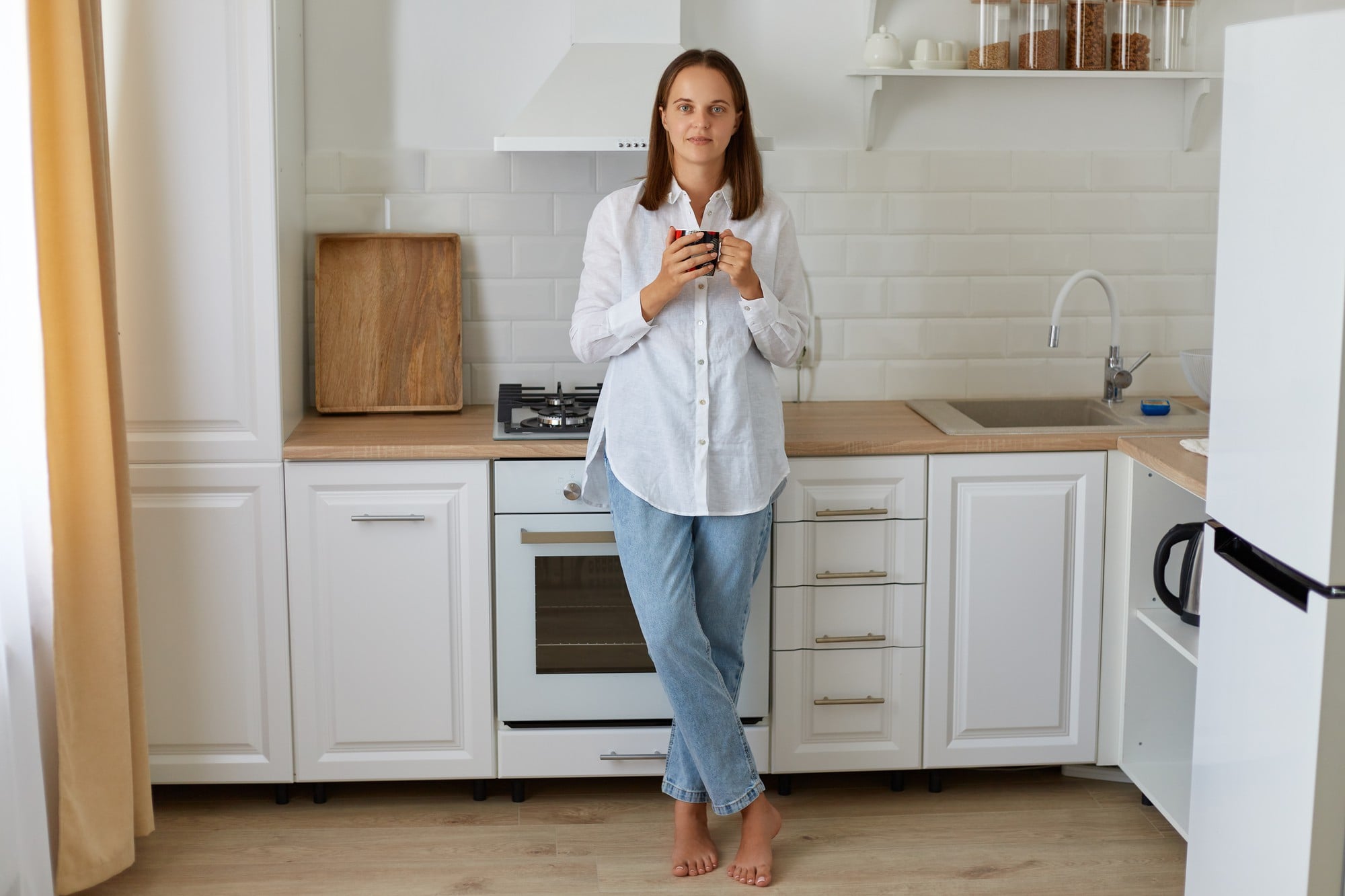
The Kitchen Is Closed
Part One: The Invitation
My son moved in with his girlfriend two months ago.
His name is Sam. He’s twenty-six, tall and lanky like his father, with my dark hair and a laugh that fills a room. He works as a project coordinator for a construction company in Columbus, Ohio. He’s kind, a little shy with new people, and he still calls me every Sunday night, even when he has nothing to say.
At least, he used to.
I’d never met his girlfriend in person. Her name was Madison, and I knew three things about her. She was twenty-five. She worked in social media for a boutique fitness studio. And Sam’s voice changed when he said her name, softer and more careful, like he was carrying something fragile.
I’d seen pictures on his phone. She was pretty, with long honey-colored hair and a bright smile. In every picture, she was the one holding the camera.
I wanted to meet her. Of course I did. But I didn’t want to be one of those mothers.
You know the kind. The ones who drop by unannounced with a casserole and rearrange the spice rack. The ones who ask too many questions at Thanksgiving. The ones whose sons stop calling because every conversation turns into an interrogation.
I’d raised Sam mostly on my own since he was eleven. I’d spent fifteen years being the only adult in his life who showed up for everything. I knew that letting go would be harder for me than for most.
So I gave them time to settle in.
The Sunday calls got shorter that first month. Five minutes instead of twenty. Then three.
“How’s the new place?” I’d ask.
“Good, Mom. Really good.”
“How’s Madison?”
“She’s great.”
“Are you eating okay?”
There’d be a pause. A short one. Then he’d say, “Yeah, we’re fine,” and change the subject.
I noticed the pause. Mothers always notice the pause.
But I told myself I was overthinking it. He was twenty-six. He was in love. He was learning how to share a life with someone. He didn’t need his mother asking about vegetables.
So I didn’t push.
Then, last Thursday, he called on a weeknight. That alone was unusual.
“Mom,” he said, “do you want to come over Saturday? Madison and I want you to see the apartment. We’ll have dinner.”
I almost dropped the phone.
“I’d love to,” I said. “What can I bring?”
“Nothing,” he said quickly. “Just come.”
“I’m bringing a pie,” I said.
He laughed. It sounded a little tired.
“Of course you are,” he said.
Part Two: The Apple Pie
My name is Donna Whitley. I’m fifty-four years old, and I’ve been making the same apple pie for thirty years.
It was my mother’s recipe. Granny Smiths and a little Honeycrisp for sweetness. Brown sugar, cinnamon, a pinch of nutmeg, and a spoonful of lemon juice. An all-butter crust that I make by hand, cold, with a pastry cutter that belonged to my grandmother.
Sam used to beg for it on his birthday instead of cake. When he was nine, he told his whole class it was the best pie in the world. When he went off to Ohio State, I mailed him one in a padded box every October.
I made it Saturday morning.
I peeled the apples at the kitchen table while the radio played old country songs. I rolled the dough on the same floured counter where I’d taught Sam to cut out sugar cookies when he was five. I crimped the edges with my thumb the way my mother did.
When it came out of the oven, golden and bubbling, the whole house smelled like autumn.
I wrapped it in a clean dish towel and set it on the passenger seat. I buckled it in like a child. I laughed at myself, but I did it anyway.
Their apartment was in a renovated brick building in Grandview, a trendy neighborhood just west of downtown. It had a buzzer at the front door and a little elevator with brass buttons. The hallway smelled like fresh paint and someone else’s coffee.
Sam opened the door before I could knock.
“Mom,” he said, and he hugged me. A long hug. Longer than usual.
He looked thinner. Not dramatically. Just enough that a mother would notice. His cheekbones were sharper, and his shirt hung looser on his shoulders.
“You look good, honey,” I said.
It wasn’t exactly true. But it wasn’t the moment.
The apartment was small but lovely. Exposed brick on one wall. Big windows that let in the afternoon light. A gray sectional couch with throw pillows in coordinating shades of cream and sage. A ring light in the corner.
Everything was very clean. Very organized. It looked like a photograph.
Sam showed me around proudly. The bedroom with the white comforter. The tiny bathroom with matching towels. The little balcony with two folding chairs and a potted fern.
“It’s beautiful, honey,” I said. And I meant it.
Madison came out of the bedroom a moment later.
In person, she was even prettier than her pictures. Long honey hair pulled into a perfect ponytail. Leggings and a fitted cream sweater. Gold hoop earrings. She smiled warmly and hugged me.
“Mrs. Whitley,” she said. “It’s so nice to finally meet you. Sam talks about you all the time.”
“Please, call me Donna,” I said.
“Donna,” she said. “I love that.”
We sat on the gray couch. Madison offered me sparkling water in a tall glass with a slice of cucumber. She asked about my drive and my job and my garden. She laughed at my stories about Sam as a little boy.
She seemed perfectly nice.
Sam sat beside her, holding her hand. He smiled when she smiled. He laughed when she laughed. But every few minutes, his eyes flicked toward the kitchen, then back to her.
I noticed. I didn’t say anything.
After about half an hour, I stood up.
“Let me put this pie in the fridge,” I said. “So it doesn’t get too soft before dinner.”
“Oh, you don’t have to,” Madison said. “I can do it.”
“It’s no trouble,” I said. “I know my way around a kitchen.”
Part Three: The Empty Fridge
The kitchen was small and spotless.
White cabinets. Quartz countertops with nothing on them. Not a toaster, not a coffee maker, not a single piece of mail. A matching set of canisters labeled FLOUR, SUGAR, COFFEE, TEA lined up perfectly by the backsplash.
I opened the refrigerator.
And I stopped.
There was almost nothing inside.
A half-empty bottle of ketchup. A carton of oat milk with maybe an inch left. Three cans of sparkling water. A small container of Greek yogurt, the expensive kind. A bag of baby carrots, mostly empty.
That was it.
On the top shelf, pushed to the back, there was one more thing. A clear glass meal-prep container with a lid. Inside was a neatly portioned salad with grilled chicken and a little cup of dressing.
A piece of tape on the lid said, in neat handwriting: M — DO NOT TOUCH.
I stood there with the refrigerator door open and my pie in my hands.
I know that moving into a new place can be expensive. I know young people sometimes live on takeout. I’m not the kind of mother who judges anyone for an empty fridge. Heaven knows mine was empty more than once when Sam was little and money was tight.
But I couldn’t help wondering what they’d been eating.
What Sam had been eating.
I opened the freezer. A bag of ice. A box of frozen protein waffles. That was it.
I opened one of the cabinets. Matching white plates, perfectly stacked. Wine glasses. A box of herbal tea.
I opened another. A jar of almond butter. A bag of rice cakes. Two cans of soup. A box of instant oatmeal.
Madison walked into the kitchen while I was still standing in front of the open fridge.
She saw my face. She saw the pie in my hands.
“Oh,” she said lightly. “Did you find room?”
“Oh, honey,” I said gently, “where’s all your food?”
I tried to keep my voice soft. I didn’t want to embarrass anyone.
“Are you two doing okay?” I asked. “If money’s tight right now, I’d be happy to help with groceries. It’s no trouble at all.”
She gave me a strange look. Not offended. Almost amused.
“Oh, no,” she said. “It’s not that. We’re fine. It’s just the end of the month, and his paycheck’s already gone.”
“Well, I understand,” I said. “Things are expensive these days. Rent alone in this neighborhood must be—”
She shrugged and leaned against the counter.
“Besides,” she said, “he still owes me for cooking.”
I thought I’d misunderstood.
“I’m sorry?” I said.
“For cooking,” she repeated, like it was the most normal thing in the world. “Normally, he pays me for every meal I cook. But he’s out of money right now. So the kitchen’s closed until payday.”
I stood there holding the pie.
“Wait,” I said slowly. “He pays you? For cooking?”
“Of course!” she said. She almost laughed. “If he wants a homemade dinner, he pays for it. Simple.”
She looked down at the pie in my hands. Her eyes brightened.
“Actually,” she said, “it’s good you brought that. At least he’ll have something to eat tonight.”
I stood there with my mother’s apple pie in my hands, wondering if she could possibly hear herself.
Now, I want to be clear about something. I wasn’t expecting her to cook three meals a day for my son. He’s a grown man. He’s perfectly capable of feeding himself. I raised him to be capable. Or at least I thought I had.
But charging him for every plate of food in their own home? Closing the kitchen until payday?
I was trying to think of something polite to say, something that wouldn’t start a war in the first hour of meeting her, when my son appeared in the doorway.
Part Four: The Paper
“Mom,” Sam said. “Everything okay?”
He looked from me to Madison. He looked at the open refrigerator. He looked at the pie.
His face went very still.
Before I could answer, Madison smiled at him. A bright, easy smile.
“Oh, we’re just talking about your little payment problem,” she said.
Sam looked at her for a long moment.
Then he looked at me.
I’d seen that look before. When he was nine and his father missed his school play. When he was thirteen and came home from a sleepover early and wouldn’t tell me why. When he was eighteen and his acceptance letter came, and he was so happy and so scared at the same time he couldn’t speak.
It was the look of a boy deciding whether to tell the truth.
“Actually, Mom,” he said quietly, “since she brought it up, there’s something you should see.”
He walked past Madison to the drawer beside the stove. He opened it. Inside were takeout menus, a roll of tape, and a few rubber bands.
He reached under them and pulled out a folded sheet of paper.
Madison’s smile disappeared.
“Sam,” she said sharply. “Don’t you dare show her that.”
He stopped. He held the paper in both hands. For a second, I thought he’d put it back.
Then he looked at me again.
“I have to, Maddie,” he said quietly. “I can’t keep doing this.”
He held it out to me.
I set the pie on the counter. I took the paper. It was a single sheet, printed on a laser printer, folded into thirds. It had been folded and unfolded so many times the creases had gone soft.
At the top, in a pretty script font, it said:
HOUSEHOLD AGREEMENT
I read it.
Then I read it again.
1. Sam’s paycheck will be deposited into the shared household account, managed by Madison.
2. Sam will pay 100% of rent ($1,750/month), utilities, and internet.
3. Sam will pay Madison’s car payment ($412/month) and phone bill ($95/month), as Madison is contributing more to the household in other ways.
4. Meals prepared by Madison will be billed as follows: Breakfast — $8. Lunch — $12. Dinner — $18. Special occasion dinners — $30.
5. Laundry service (Sam’s clothing) — $15/load.
6. Emotional labor and household management — $200/month flat fee.
7. Payments not received by the 25th will result in suspension of services until the next payday.
8. Sam receives a personal allowance of $40/week for lunches and personal expenses.
Signed: Madison Kerr. Sam Whitley.
At the bottom, in Sam’s handwriting, was his signature. It was dated five weeks earlier.
I looked up from the paper.
Madison had her arms crossed. Her face had gone pink.
“It’s a fair arrangement,” she said. “We agreed on it. Both of us. He signed it.”
I looked at my son.
“Sam,” I said quietly. “Your whole paycheck goes into her account?”
He nodded. He didn’t look at me.
“And you get forty dollars a week?”
He nodded again.
“For lunch,” I said. “And everything else.”
“Gas comes out of it too,” he said, very quietly. “And my phone.”
I looked at the refrigerator. At the salad with the tape on it. M — DO NOT TOUCH.
“When did you last eat dinner, honey?” I asked.
He was quiet for a long time.
“Wednesday,” he said finally. “I had a granola bar at work on Thursday. And I ate some of the rice cakes last night.”
Part Five: Madison
The kitchen was very quiet.
I could hear the refrigerator humming. I could hear a car honking somewhere on the street outside. I could hear my own heartbeat in my ears.
I didn’t yell. I want to be clear about that. I’ve raised my voice maybe a dozen times in my life, and I’ve regretted most of them.
But I didn’t trust myself to speak yet.
Madison spoke first.
“You don’t understand,” she said. “Women have done unpaid labor for centuries. Cooking. Cleaning. Taking care of men who don’t even say thank you. I’m not going to do that. I’m not going to be my mother.”
She uncrossed her arms and pointed at the paper.
“That’s fair,” she said. “That’s what my time is worth. If he wants a wife, he can pay for one. And if he can’t afford it, then he can make his own food.”
“He can’t,” Sam said quietly.
Madison turned to him. “What?”
“I can’t make my own food,” Sam said. “I don’t know how.”
He was looking at me when he said it. Not at her.
“I can make toast,” he said. “And cereal. And scrambled eggs, if they’re not too hard. That’s it, Mom. I don’t know how to cook anything.”
His voice cracked.
“You always did it,” he said. “Every night. I never learned.”
I felt something drop through the middle of my chest.
He was right. I had always done it.
Every dinner. Every lunch. Every birthday cake. Every Thanksgiving. When his father left, I decided that whatever else happened, my son would never come home to an empty kitchen.
I cooked for him every single day for fifteen years. I never once asked him to help. I never once taught him how to make a meal.
I thought that was love.
“Then you learn,” Madison said to Sam. “That’s on you. Not me.”
“I tried,” Sam said. “I tried to make pasta the first week, and you said I was wasting groceries. You said if I wanted to eat, I should pay you, because you’d do it right.”
He swallowed.
“And then you said the groceries were yours,” he said, “because they came out of the household account. Which is my paycheck.”
Madison’s face went from pink to red.
“I said you could cook if you bought your own groceries,” she said.
“With forty dollars a week?” Sam said. “After gas?”
She opened her mouth. Then she closed it.
“Madison,” I said finally.
My voice came out calmer than I felt. It was the voice I’d used for twenty-six years as an elementary school secretary, talking to parents who were shouting at the front desk.
“Can I ask you something?”
She looked at me warily.
“What happened with your mother?” I said.
She didn’t answer right away.
Her eyes got bright. She looked down at the floor.
“She cooked for my dad for twenty-two years,” Madison said. “Every meal. Every day. She cleaned the house and did his laundry and raised three kids. She never worked outside the house because he said she didn’t need to.”
She wiped her eye with the back of her hand.
“When I was sixteen, he left her for someone from his office,” she said. “He kept the house. He kept the savings. She had nothing. No job. No credit. No retirement. Twenty-two years of cooking dinner, and she walked out of that house with two suitcases.”
The kitchen was quiet again.
“She works at a grocery store now,” Madison said. “Stocking shelves at night. She’s fifty-three. Her knees are shot. And every single thing she ever did for him was free.”
She looked up at me. Her eyes were wet, but her chin was lifted.
“I swore I’d never be her,” she said. “I swore no man would ever eat a meal I cooked without paying for it.”
Part Six: What I Said
I didn’t say anything for a long moment.
Because here’s the thing. I understood her.
I understood her more than she knew.
“Madison,” I said quietly. “I was married to Sam’s father for fourteen years. I cooked every meal. I did every load of laundry. I worked full-time at the school and came home and did everything else.”
Sam looked at me. He’d never heard me say this out loud.
“When Sam was eleven,” I said, “his father left. He took the good car and half the savings, and he moved to Phoenix with a woman he met on a business trip. He sent child support for about a year. Then he stopped.”
“So I know,” I said. “I know exactly what your mother lost. I know what it feels like to look back on years of work that nobody ever counted.”
Madison stared at me.
“You’re right that it wasn’t fair,” I said. “You’re right that a lot of women do work that nobody ever pays for, and nobody ever thanks them for. You’re right to be angry about that.”
She blinked.
“But Madison,” I said gently. “This isn’t fixing what happened to your mother.”
I held up the paper.
“This is doing it to him,” I said.
She shook her head. “It’s not the same.”
“His whole paycheck goes into an account he can’t touch,” I said. “He gets forty dollars a week. He can’t eat unless you decide he’s paid enough. If he can’t pay, the kitchen’s closed.”
I set the paper down on the counter.
“That’s not a partnership,” I said. “That’s what your father did to your mother. Just with the roles switched.”
Madison’s face crumpled.
“That’s not true,” she said. Her voice cracked. “That’s not what this is.”
“Then what is it?” I asked.
She didn’t answer.
She turned around and walked out of the kitchen. A moment later, we heard the bedroom door close. Not slammed. Just closed.
Sam stood in the middle of the kitchen with his hands at his sides. He looked like he was nine years old again.
“Mom,” he said. “I’m sorry.”
“For what, honey?”
“For not telling you,” he said. “For letting it get this bad. For being so stupid.”
Part Seven: How It Happened
I sat down at their little kitchen table. I pulled out the chair beside me.
“Sit down,” I said. “And tell me how it happened. All of it.”
He sat. For a minute, he didn’t say anything.
Then it came out slowly, the way hard things come out.
They’d met nine months earlier at a friend’s birthday party. She was funny and confident and seemed to know exactly what she wanted. He liked that. He’d always been the kind of person who second-guessed everything.
The first few months were wonderful, he said. She was affectionate. She was fun. She’d come over to his old apartment and they’d order takeout and watch movies.
When they decided to move in together, she found the apartment. She said she’d handle the lease and the setup because she was better at organizing.
The first week, she cooked dinner every night.
“It was amazing, Mom,” he said. “Chicken and roasted vegetables. Pasta from scratch. She made this salmon thing with lemon. I kept telling her how great it was.”
He swallowed.
“On the second Sunday, she sat me down,” he said. “She had the paper printed out already. She said she’d been thinking about how much work cooking was. How women always get stuck with it. How she wasn’t going to do it for free.”
“She said it was only fair,” Sam said. “She said I’d been raised by a woman who did everything for free, and I needed to learn that labor has value.”
He looked at me.
“And Mom,” he said, “she was right about that part. You did do everything for free. I never helped. Not once. I didn’t even realize until she said it.”
“So I felt guilty,” he said. “Like maybe I was just like Dad. Like maybe I’d grown up thinking women were supposed to take care of me. So I signed it.”
He put his face in his hands.
“I thought I was being a good boyfriend,” he said. “I thought I was proving I wasn’t like him.”
“And then the money,” I said gently.
He nodded.
“She said it’d be easier if everything went into one account,” he said. “So she could budget. She’s really good with budgets. She has a spreadsheet.”
He laughed, but it wasn’t a happy laugh.
“By the third week,” he said, “I’d stopped being able to buy anything. Every time I asked for money, she’d pull up the spreadsheet and show me everything I owed for meals and laundry and the management fee. And there was never anything left.”
“What about your car payment?” I asked. “Your student loans?”
He didn’t answer right away.
“I’m two months behind on the loan,” he said quietly. “The car’s paid off, thank God. But I didn’t have enough for insurance last month. I’ve been driving it anyway.”
I closed my eyes.
“Sam,” I said. “Why didn’t you call me?”
He was quiet for a long time.
“Because I was ashamed,” he said. “I’m twenty-six. I have a good job. I’m supposed to be an adult. And I couldn’t even afford to eat in my own apartment.”
He wiped his eyes.
“And because every time I thought about calling,” he said, “I thought you’d say I told you so. About moving in with someone so fast. About not knowing her long enough.”
“I never said that,” I said.
“You didn’t have to,” he said. “I could hear you thinking it.”
I reached across the table and took his hand.
His fingers were thin. Thinner than I remembered.
“Listen to me,” I said. “Asking for help isn’t a failure. Not knowing how to cook isn’t a failure. Trusting someone you love isn’t a failure.”
I squeezed his hand.
“Staying quiet when you’re hungry,” I said, “that’s the only part I want you to stop doing.”
Part Eight: The Pie
We didn’t stay for dinner.
There wasn’t any dinner. The kitchen was closed.
After a while, Sam went to the bedroom door and knocked softly. He talked to Madison through it for a few minutes. I couldn’t hear what they said. I didn’t try to.
When he came back to the kitchen, his eyes were red.
“She wants some space,” he said. “She said she needs to think.”
“What do you want?” I asked.
He looked at the pie on the counter. Still wrapped in my dish towel.
“I want to eat something,” he said. “And I want to go somewhere I don’t have to pay for it.”
I drove him home to my house in Westerville.
He packed a duffel bag first. Work clothes. His laptop. His toothbrush. A framed photograph of the two of us at his college graduation that had been sitting on their bookshelf.
He left the paper on the counter. He didn’t take it with him.
The drive took twenty-five minutes. Sam held the pie on his lap the whole way, still wrapped in the dish towel. He didn’t say much.
When we turned onto my street, he looked out the window at the houses.
“Mom,” he said. “Can we eat the pie for dinner? Like, actual dinner? Just the pie?”
I laughed for the first time all day.
“Yes,” I said. “Yes, we absolutely can.”
We sat at my kitchen table. The same table where he did his homework for twelve years. The same table where I’d served him every meal I could think of.
I cut two big slices. I didn’t bother with plates. I just gave him a fork and slid the whole pie between us.
He ate three slices. Then he put his fork down and started crying.
I didn’t say anything. I just moved my chair next to his and put my arm around him, the way I did when he was little and had a nightmare.
“I’m so sorry, Mom,” he said into my shoulder.
“You don’t have anything to be sorry for,” I said.
“I let her treat me like that,” he said. “I let her make me feel like I owed her for being fed.”
“Honey,” I said, “can I tell you something?”
He nodded.
“She wasn’t completely wrong,” I said. “About the unpaid work. About women doing too much. About how you grew up.”
He pulled back and looked at me.
“I did everything for you,” I said. “Every meal. Every load of laundry. Every dish. I never let you help. Because after your dad left, I wanted you to feel like nothing was missing. Like you’d always have a hot dinner and a clean shirt, no matter what.”
“And that was love,” I said. “But it was also a mistake.”
He stared at me.
“I didn’t teach you how to take care of yourself,” I said. “I didn’t teach you that a home is something two people build together. I just did it all. So when you moved out, you didn’t know how. And someone who was hurting found a way to use that.”
“That’s not your fault, Mom,” Sam said.
“Part of it is,” I said gently. “And I’m going to fix that part.”
“How?”
I smiled.
“Starting tomorrow,” I said, “you’re going to learn how to cook.”
Part Nine: The Lessons
Sam stayed with me for three weeks.
The first thing we did was go to his bank. He opened a new checking account in his name only. He called his company’s payroll department and changed his direct deposit. He called his student loan servicer and set up a payment plan to catch up on what he’d missed. He called his car insurance company and paid the overdue bill.
By the time we walked out of the bank, his shoulders were a full inch higher.
The second thing we did was go to the grocery store.
I gave him a cart and a list. I didn’t pick anything off the shelves myself. I made him find every item. I made him compare prices. I made him read the labels.
“Why does this pasta cost three dollars and this one costs a dollar ten?” he asked, holding up two boxes.
“Look at the ingredients,” I said.
He looked. “They’re the same.”
“They are,” I said. “One just has a nicer box.”
He laughed. He put the expensive one back.
The third thing we did was cook.
We started with scrambled eggs, done right. Low heat. Butter. A splash of milk. Stir slowly with a rubber spatula. Take them off the heat before you think they’re done.
His first batch was rubbery. His second batch was runny. His third batch was perfect.
He stood over the pan staring at them like he’d discovered fire.
“Mom,” he said. “I made these.”
“You did,” I said.
He ate them standing up at the stove.
Then we moved on. Spaghetti with meat sauce. Grilled cheese and tomato soup. Roasted chicken thighs with potatoes and carrots. Chili. Tacos. Stir-fry. Pancakes from scratch, which he burned three times before he got the heat right.
Every night, he cooked dinner for both of us. I sat at the kitchen table and watched. Sometimes I gave advice. Mostly I didn’t.
In the second week, he made my mother’s apple pie.
I stood beside him the whole time. I showed him how to cut the butter into the flour with my grandmother’s pastry cutter until it looked like coarse sand. How to add ice water a little at a time. How to roll the dough without overworking it.
His first crust tore. His second one was too thick. His third one was beautiful.
When the pie came out of the oven, golden and bubbling, he stood in front of it for a long time.
“It smells like your house,” he said quietly.
“It smells like your house too,” I said. “It always has.”
Part Ten: Madison Calls
Madison called on the eighteenth day.
Sam was in the kitchen making chicken parmesan when his phone buzzed on the counter. He looked at the screen. He looked at me.
“It’s her,” he said.
“You don’t have to answer,” I said.
“I know,” he said.
He answered.
I went into the living room to give him privacy. But my house is small, and I could hear some of it.
He didn’t raise his voice. Neither did she, as far as I could tell. They talked for almost forty minutes. At one point, I heard him say, “I’m not angry. I’m just done.” At another point, I heard him say, “I hope you talk to someone. I really do.”
When he came into the living room, he sat down beside me on the couch.
“She’s moving back in with her mom,” he said. “In Dayton. The lease on the apartment ends in August. She’s going to find a roommate to take over my half, and I’ll keep paying my share until then.”
“How do you feel?” I asked.
He thought about it.
“Sad,” he said. “And relieved. And kind of guilty for feeling relieved.”
“All three are allowed,” I said.
“She apologized,” he said. “Sort of. She said she didn’t mean for it to get so bad. She said she started with the meal thing because she was scared, and then every time I didn’t push back, she pushed a little further. And she didn’t know how to stop.”
He looked at his hands.
“She said she saw her mom’s face when you talked about Dad,” he said. “When you said you understood. She said nobody had ever told her that before. That it was okay to be angry about what happened to her mom, but that she didn’t have to make someone else pay for it.”
“Do you think she’ll be okay?” I asked.
“I think so,” he said. “She said she’s going to start seeing a counselor. Her mom’s been asking her to for years.”
He paused.
“She also asked me to tell you something,” he said.
“What?”
“She said thank you for the pie,” he said.
Part Eleven: The Apartment
Sam went back to the apartment once, in late July, to get the rest of his things.
He asked me to come with him. Not because he needed help carrying boxes, but because he didn’t want to walk in alone.
Madison was there. She’d already packed most of her own things. The gray sectional was gone. So were the throw pillows and the ring light. The exposed brick wall looked bare and a little lonely without the decorations.
She met us at the door.
She looked different. No makeup. Hair in a messy bun. An oversized Ohio State sweatshirt that I was fairly certain had once been Sam’s.
“Hi, Donna,” she said quietly.
“Hi, Madison,” I said.
She stepped aside to let us in. Sam went to the bedroom to pack his clothes. I stood in the empty living room, not sure what to do with my hands.
Madison went into the kitchen. After a moment, she came back holding something.
It was my dish towel. The one I’d wrapped the pie in. Washed and neatly folded.
“You left this,” she said. “The night you came over.”
I took it from her. “Thank you.”
She didn’t move away. She stood there with her arms crossed, looking at the floor.
“I talked to my mom,” she said. “About everything. About the paper. About what you said in the kitchen.”
“What did she say?” I asked.
Madison was quiet for a moment.
“She cried,” she said. “She said she never wanted me to turn into my dad. She said the whole reason she told me what happened to her was so I’d protect myself. Not so I’d hurt someone else.”
Her voice wavered.
“She said the worst part of her marriage wasn’t the cooking,” Madison said. “It was that my dad decided she didn’t get a say in anything. Not money. Not food. Not her own life.”
She looked up at me.
“And that’s exactly what I did to Sam,” she said.
I didn’t know what to say. So I said the only true thing I could think of.
“You’re twenty-five,” I said. “You have a whole life to do better. Most people don’t figure this out until they’re much older than you. Some never do.”
She nodded slowly.
“I’m seeing a counselor now,” she said. “Every Tuesday. In Dayton. My mom drives me.”
“I’m glad,” I said. And I was.
Before we left, Madison stood in the kitchen doorway while Sam carried the last box to the car.
“Sam,” she said. “Can I ask you something?”
He turned around.
“Did you learn how to cook?” she asked.
He smiled. It was a real smile. The first one I’d seen him give her.
“Yeah,” he said. “Mom’s been teaching me. I can make chicken parm now. And pancakes. And her apple pie.”
Madison laughed. It was small and a little sad, but it was real.
“I’m glad,” she said. “I’m really glad, Sam.”
Part Twelve: His Own Kitchen
Sam moved into his own apartment in September.
A one-bedroom in Clintonville, near the park. It’s older than the place in Grandview. The kitchen is tiny, with a gas stove that’s probably from the 1980s and a refrigerator that hums too loud.
He loves it.
The first Saturday after he moved in, he invited me to dinner.
“Don’t bring anything,” he said on the phone.
“I’m bringing a pie,” I said.
“No, you’re not,” he said. “Not this time. I mean it, Mom.”
I didn’t bring a pie. It was one of the hardest things I’ve ever done.
When I knocked on his door, it smelled like garlic and tomatoes.
He opened the door wearing an apron. A real apron. Navy blue with white stripes. He’d bought it himself.
“Come in,” he said. “Dinner’s almost ready.”
He’d set his little kitchen table with two plates, two glasses, and a candle in a jar. There was a vase with grocery store flowers in it. Yellow daisies.
He made spaghetti with meat sauce from scratch. Garlic bread. A green salad with a dressing he’d made himself in a jar.
It was good. It was really good.
I told him so. He turned pink.
After dinner, he went to the refrigerator.
I looked past him as he opened the door. It was full. Eggs. Milk. Butter. Cheese. Vegetables in the crisper drawer. Leftovers in glass containers with handwritten labels. A carton of orange juice. Chicken thawing on a plate for tomorrow.
No tape that said DO NOT TOUCH.
He came back to the table holding a pie.
My mother’s apple pie. Golden crust. Crimped edges. Steam still rising through the slits in the top.
“You said not to bring a pie,” I said.
“I said you couldn’t bring a pie,” he said, grinning. “I didn’t say anything about me.”
He cut two big slices and put them on our plates.
I took a bite. Granny Smiths and a little Honeycrisp. Brown sugar. Cinnamon. A pinch of nutmeg. A spoonful of lemon juice. All-butter crust, cold, made by hand.
It was exactly like my mother’s.
I put my fork down. I couldn’t speak.
“Is it okay?” Sam asked nervously.
I nodded. I still couldn’t speak.
“It’s perfect, honey,” I finally managed. “It’s perfect.”
When I tried to help with the dishes afterward, he wouldn’t let me.
“Sit down, Mom,” he said. “You’ve washed enough dishes for one lifetime.”
So I sat at his little kitchen table and watched my son wash the dishes. He hummed while he did it. An old country song I used to play on the radio while I peeled apples on Saturday mornings.
When he was done, he dried his hands and sat down across from me.
“Mom,” he said. “Can I tell you something?”
“Of course.”
“When Madison showed you that paper,” he said, “I was so scared. I thought you’d be angry at me. For letting it happen.”
“I wasn’t angry,” I said.
“I know,” he said. “You weren’t angry at anybody. Not even her.”
He reached across the table and took my hand.
“You know what I figured out?” he said. “While you were teaching me to cook?”
“What?”
“She was right that it’s work,” he said. “Cooking. Cleaning. Taking care of people. It’s real work. It deserves to be valued.”
He looked at the pie plate.
“But you don’t value it by sending someone a bill,” he said. “You value it by learning how to do it yourself. And then doing it for each other.”
I looked at my son. Twenty-six years old, in a navy apron, with flour still on his sleeve.
“Where did you learn that?” I asked.
He smiled.
“From a woman who made me apple pie every birthday for twenty-six years,” he said. “And never once sent me the bill.”
I drove home that night with an empty pie plate on the passenger seat.
He’d insisted I take it. He said it was mine. My grandmother’s, actually, the old glass one with the fluted edge.
At a red light, I looked over at it. There was a sticky note on the bottom, in Sam’s handwriting.
Your turn next Saturday. Kitchen’s always open.

Lila Hart is a dedicated Digital Archivist and Research Specialist with a keen eye for preserving and curating meaningful content. At TheArchivists, she specializes in organizing and managing digital archives, ensuring that valuable stories and historical moments are accessible for generations to come.
Lila earned her degree in History and Archival Studies from the University of Edinburgh, where she cultivated her passion for documenting the past and preserving cultural heritage. Her expertise lies in combining traditional archival techniques with modern digital tools, allowing her to create comprehensive and engaging collections that resonate with audiences worldwide.
At TheArchivists, Lila is known for her meticulous attention to detail and her ability to uncover hidden gems within extensive archives. Her work is praised for its depth, authenticity, and contribution to the preservation of knowledge in the digital age.
Driven by a commitment to preserving stories that matter, Lila is passionate about exploring the intersection of history and technology. Her goal is to ensure that every piece of content she handles reflects the richness of human experiences and remains a source of inspiration for years to come.