The road home was quiet that evening.
I had the windows cracked open about two inches. One hand rested loose on the steering wheel, and I was humming along to some old pop song on the radio that I didn’t even like. The air coming through the gap smelled like dust and cut wheat.
I’d just left a meeting on the other side of town that ran an hour and ten minutes over schedule. It was the kind of meeting where six people say the same thing in six different ways and nobody decides anything. My shoulders were up around my ears. My neck hurt.
All I wanted was my apartment, a hot shower, and silence.
That was it. That was the whole plan for my evening.
The countryside opened up around me in long gold fields on both sides of the road. It was late August, and the wheat was tall and almost ready. The sun was low, turning everything orange. There weren’t many cars on this stretch. I’d passed maybe three in the last ten minutes.
I kept to the speed limit. Ninety exactly. Not ninety-one.
I always do. Not because I’m especially careful. In my line of work, you learn to. You learn how small things turn into big things. You learn that a broken taillight or five kilometers over the limit is all some people need.
I checked my mirrors. I watched the signs. I wasn’t thinking about anything except the shower.
That was when the lights showed up behind me.
Blue and red, flashing steadily in my rearview mirror.
A patrol car was closing the distance fast. It must have been parked behind the old bus shelter I’d passed a minute before. I hadn’t even noticed it.
I felt the jolt of adrenaline everyone feels when they see those lights. It doesn’t matter if you’ve done nothing wrong. It doesn’t matter who you are or what you do for a living. Some old animal part of your brain still flinches.
I eased off the gas. I flicked on my turn signal. I pulled onto the gravel shoulder and stopped.
I put the car in park. I rolled my window all the way down. Then I put both hands on top of the steering wheel, at ten and two, where anyone could see them.
That’s what I always tell people to do. It’s what I’d told my own mother to do, years ago, sitting at her kitchen table. Keep your hands where they can see them, Mama. Keep your voice calm. Don’t give them any reason.
I sat and waited.
Two officers got out of the patrol car.
The first one was big. He was tall and thick through the shoulders and chest, with a shaved head and a heavy jaw. He looked like his face hadn’t smiled in years. He walked toward my window with a loose, rolling swagger. It was the walk of a man who liked being the one people were afraid of.
The second officer was younger and thinner, with dark hair cut short. He hung back a few steps by the rear bumper of my car. His arms were crossed. His eyes were narrow. He was studying me through the back window like he was deciding something.
The big one stopped beside my door. He didn’t bend down to look at me. He just stood there, so I had to crane my neck to look up at him.
“Documents,” he said.
It wasn’t a greeting. It wasn’t really even a request.
I reached slowly into the glove box. I didn’t hurry. Sudden movements are a bad idea in this situation. I took out my driver’s license and my registration and my insurance card and handed them up through the window.
“Good evening,” I said. I kept my voice even and polite. “Is there a problem, officer?”
He didn’t answer.
He took my papers and flipped through them slowly, turning them over and back again. He held my license up to the light. He looked at the registration for a long time, longer than anyone needs to look at a registration. He wasn’t checking them against anything. He was just making me wait.
Then he walked a slow circle around my car.
He looked at my tires. He crouched and looked at the back license plate. He looked at the windshield, at the little inspection sticker in the corner. He came back around to my window and just stood there, holding my papers, saying nothing.
The younger one hadn’t moved from the back bumper.
I let a few more seconds go by.
“Why did you stop me?” I asked. My voice was still calm. “I wasn’t speeding. I didn’t run anything. My lights are working. What’s the violation?”
“Routine check,” the big one said.
“What kind of routine check?” I said. “And you haven’t introduced yourselves.”
Something changed in his face.
It was just a small change, a tightening around the eyes. It was the look of a man who wasn’t used to being asked questions. A man who was used to people saying yes, officer and sorry, officer and holding out money.
The younger officer pushed off from my bumper and walked up beside his partner. There was a smirk pulling at one side of his mouth.
“A little smart, aren’t you?” he said. “Sit tight and let the adults talk.”
I looked at him. Then I looked back at the big one.
I didn’t back down an inch.
“I am talking calmly,” I said. “You’re the ones being aggressive. You’ve stopped a driver without telling her why. I’d like your names and badge numbers, and the reason for this stop, please.”
The big one’s jaw clenched. I watched the muscle jump under his skin.
He tossed my documents onto the roof of my car. He didn’t hand them back. He just flicked them up there like trash. I heard them slide across the metal.
“Get out of the vehicle,” he said.
“On what grounds?”
“I said get out.”
I could see it clearly now.
This wasn’t a traffic stop anymore. Maybe it never had been. This was two men who’d pulled over a young woman driving alone on an empty road at sunset. And they’d decided they didn’t like that she wasn’t scared of them.
I’d seen this pattern before. Too many times. I’d watched it on dashcam footage and read it in witness statements and heard it in shaky voices on the phone at two in the morning.
It never ended well when it was allowed to keep going.
I reached for my phone on the passenger seat. I wanted to turn on the camera. It was more habit than fear. I record everything. I learned that a long time ago.
Before I could even unlock the screen, the younger officer yanked my car door open and grabbed my wrist.
“Put the phone away,” he said. “Now.”
“Don’t touch me,” I said.
My voice was sharp now. It wasn’t calm, exactly. But I wasn’t panicking either. I was just firm. It was the voice of someone who knew exactly what was happening and exactly how far outside the law it had already gone.
“You’re exceeding your authority,” I said.
That was the wrong thing to say to men like that.
Or maybe it was the only thing worth saying, because it was true. True things have a way of making certain people furious.
The big one moved fast for someone his size.
He grabbed me by the upper arm. His fingers dug in so hard I felt them hit bone. He hauled me out of my seat like I weighed nothing and spun me around and shoved me face-first against my own car door.
The metal was cold against my cheek. I could smell the dust on it. I heard my own breath go short and fast, even though I was trying to control it.
The younger one grabbed my wrists and wrenched my arms behind my back. My shoulder screamed.
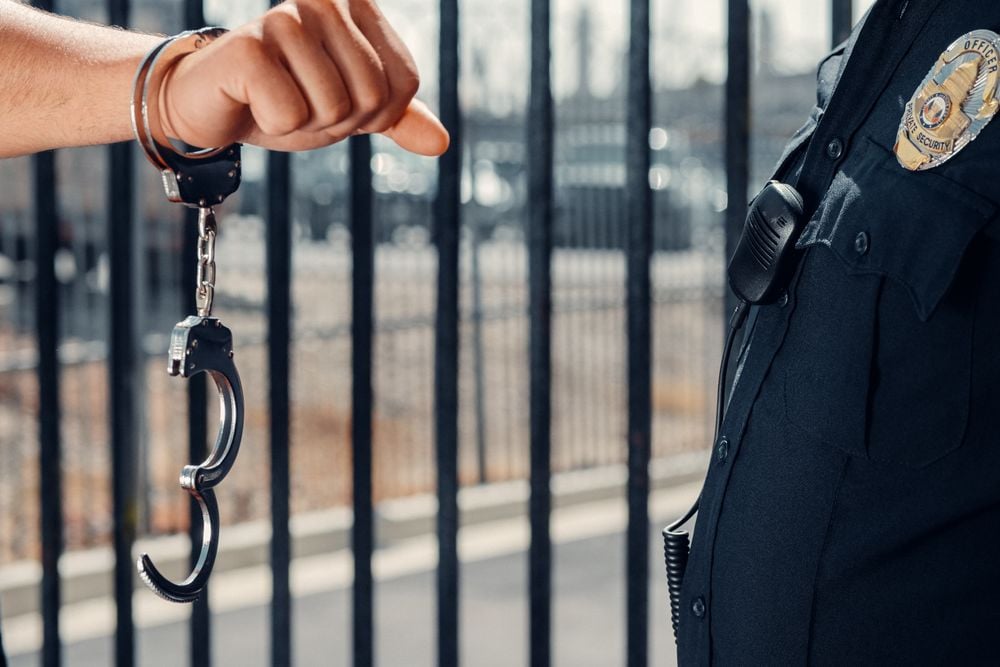
Metal clicked around my wrists. Once. Twice. Tight. Much too tight. The edges bit into the bones of my wrists.
The big one leaned in close to my ear. I could feel his breath, hot, smelling like cigarettes and coffee.
“You’ll sit in a cell for a few hours,” he said. He sounded satisfied. “Maybe it’ll teach you some manners.”
I didn’t scream.
I didn’t fight the cuffs. I didn’t thrash or kick or cry. I didn’t give them the reaction they were hunting for.
I just turned my head, slowly, against the cold metal of the car door. I looked at both of them over my shoulder.
“Are you sure,” I said, “you want to keep going with this?”
The big one laughed. It was an ugly sound, like a bark.
“Threatening us now? That’s cute.”
“No,” I said. “I’m telling you exactly where you are. You’ve detained me without cause. You’ve used physical force. You haven’t told me why I’m being stopped. You haven’t read me my rights. You haven’t given me your names. You haven’t called it in.” I took a breath. “Right now, this is still something you could walk back.”
“We’ll sort it out at the station,” the big one snapped.
He grabbed my arm again and started turning me toward the patrol car. He was gripping harder than he needed to. I could already feel the bruise forming.
I let a few seconds pass.
The gravel crunched under their boots. The sun was almost down now, just a sliver of orange over the fields. The evening was so quiet I could hear the wind moving through the wheat on both sides of the road, a soft hushing sound like someone saying shh.
Then I spoke again, as calm as I could make myself.
“Before we go anywhere,” I said, “I need one of you to reach into the right pocket of my shorts. There’s something in there. With my hands behind my back, I can’t get it myself.”
The two men looked at each other.
The younger one actually laughed out loud.
“Oh, this should be good,” he said. “What, you’re gonna slip us a bribe? You think that’s gonna save you?”
“Just look,” I said.
The big one hesitated.
It was only for half a second. Some instinct in him, maybe. Some flicker of doubt he’d never have admitted to.
Then he reached into the right pocket of my denim shorts and pulled out a small black leather case. It was about the size of a wallet.
He flipped it open. He did it more out of impatience than interest. He was already halfway through rolling his eyes.
And then he stopped moving completely.
For a long moment, he just stood there on the side of the road, staring down at the thing in his hand.
His eyes went from the photograph to the name to the gold seal stamped across the top of the identification card. I watched the color drain slowly out of his face, from his forehead down. It was like watching water drain out of a sink.
He read it again. Then again. Like he thought the words might rearrange themselves into something less terrible if he read them a third time.
His partner noticed right away. You couldn’t miss it. All the swagger had gone out of the big man’s shoulders in two seconds flat.
“What?” the younger one said. “What is it?”
The big one didn’t answer. He just held out the open case, and his hand was trembling a little. His partner took it and read it for himself.
It was my service identification.
My photograph. My name. Victoria Sokolova. My rank, Senior Inspector.
And under that, the name of the department I worked for.
Directorate of Internal Affairs.
The unit whose whole job is investigating complaints of exactly this kind of misconduct by police officers in the field.
I’d been on my way home from a work meeting. I was driving my own car, a six-year-old gray hatchback with a dent in the back bumper from a parking garage. I was off duty and in plain clothes: denim shorts, a white T-shirt, sneakers. My hair was in a messy ponytail.
That was the only reason they hadn’t recognized me. There was nothing to recognize. I was just a young woman on a quiet road.
Until I wasn’t.
The younger officer’s hands were shaking too as he handed the case back to his partner. His voice, when it came, had lost every trace of the swagger from a minute before.
“Why didn’t you…” He swallowed. “Why didn’t you say something?”
I met his eyes over my shoulder. I didn’t look away.
“Because I wanted to see how you treat ordinary people,” I said. “Now I have.”
There was a silence after that.
It was a heavy silence, the kind that presses down on a place like weather. The two of them stood there in the fading light. For the first time since those blue and red lights had appeared in my mirror, they didn’t look like officers of the law. They looked like two men who’d just watched the ground open up in front of their feet.
Then they both moved at once.
They fumbled with the cuffs. The big one’s hands were shaking so badly he dropped the key in the gravel. The younger one found it and got the cuffs open so fast the metal scraped my skin. I felt it tear. A thin line of blood came up along the inside of my left wrist.
The big one started talking immediately. The words tumbled over each other.
“This was a misunderstanding. A mix-up. You have to understand. You weren’t cooperating. You were being difficult. We thought you might have something in the car, we didn’t know who you…”
“I wasn’t cooperating,” I repeated. I was rubbing my wrist where the cuff had bitten in. My fingers came away red. “I asked for your names. I asked for the reason for the stop. I asked you not to put your hands on me.” I looked at him. “That’s not resistance. That’s the bare minimum anyone in this country is entitled to.”
“Look,” the younger officer said. There was something close to begging in his voice now. “Let’s just… let’s just forget this happened. Okay? No harm done. You’re fine. Nobody got hurt.”
I almost laughed at that. There was nothing funny about it.
I just held up my wrist so he could see the blood.
He looked at it. Then he looked away.
What neither of them realized was that the dashboard camera in my car had never stopped recording.
It was a small black box tucked behind my rearview mirror, about the size of a matchbox. It recorded everything, all the time, front and back. It had caught the whole stop from the moment the lights appeared in my mirror. The demand for documents. The refusal to explain. The papers tossed onto my roof. The door yanked open. The shove against the car. The cuffs. All of it, with audio and video.
And my phone, the one the younger officer had grabbed and shoved away, had already synced the footage to a secure cloud server. The dashcam was set up to do that automatically the moment it detected a sudden movement, like a door being yanked open.
I’d built that habit into all my devices years before, back when I first started this job. I’d learned quickly how often situations like this turned into one person’s word against another’s. And I’d learned whose word usually won.
None of that could be forgotten now. It was already done. It was already saved.
It was already evidence.
I picked my documents up off the roof of my car. They’d slid down into the gap by the windshield. One of them was crumpled.
I climbed back into my car. I closed the door. I put both hands on the steering wheel and let myself breathe.
Just for a few seconds.
My heart was still going fast. My left wrist throbbed. My shoulder ached where the younger one had wrenched my arm back. My cheek felt bruised where it had hit the door.
Under all the calm I’d kept up the whole time, there was something rawer. Mostly anger. And under the anger, a tired, familiar sadness that this was still happening. That men still thought they could treat a person this way because she was young, and alone, and driving down a quiet road at the wrong time.
My hands were shaking on the wheel. I made them stop.
Then I picked up my phone and made a call.
I should explain why I do what I do.
When I was twelve years old, my father was stopped on the road outside our town on his way home from work. He was a physics teacher at the secondary school, a quiet man with glasses and a cardigan with leather patches on the elbows. He’d never gotten so much as a parking ticket in his life.
Two traffic officers stopped him for “a routine check.” They asked him for money. My father said no, politely. He said he hadn’t done anything wrong.
They pulled him out of the car and beat him on the side of the road.
He came home at midnight with a broken nose and two cracked ribs. My mother drove him to the hospital. I sat in the back seat in my pajamas, holding his glasses. One lens was cracked straight across.
My father filed a complaint. He did everything right. He went to the district office. He wrote it all down. He gave them the date and time and location and a description of both men.
Nothing happened.
Six weeks later, he got a letter saying his complaint had been reviewed and “no violations had been found.” That was all. One paragraph. No names. No explanation.
My father folded that letter and put it in a drawer and never talked about it again.
But he stopped driving on that road. For the rest of his life, he took the long way home, an extra twenty minutes, every single day.
I was twelve. I remember thinking, Someday, I’m going to be the person who reads those complaints. And I’m going to actually read them.
It took fifteen minutes.
Fifteen minutes of me sitting in my car with the doors locked and the windows up. Fifteen minutes of the two officers standing by their patrol car in the dark, not talking to each other. The younger one kept looking at me through my windshield. The big one kept looking at the ground.
At one point, the big one walked over and tapped on my window. I didn’t roll it down.
“Listen,” he said through the glass. “Listen. We can work something out here.”
I just looked at him.
He went back to his car.
Then a second set of headlights turned onto the shoulder behind the patrol car.
It was a dark district vehicle, an official one. A heavyset man in his fifties got out of the driver’s side in a senior officer’s uniform. It was Colonel Gennady Markov, the district police chief. Two people climbed out of the back seat behind him. I recognized them both from my building, two of my colleagues from the Directorate, Inspector Pavel Grishin and Inspector Lena Arkhipova.
My supervisor, Major Irina Kovaleva, had made the calls for me. She was in another city that night. But she’d called Markov at home, and she’d called Pavel and Lena, and she’d gotten them all out of their houses in less than fifteen minutes.
Colonel Markov walked straight past the two patrol officers. He didn’t say a word to them. He didn’t even look at them.
He came to my window first.
I rolled it down.
“Inspector Sokolova,” he said. “Are you all right?”
“I’m fine,” I said.
I meant it, mostly.
“I’d like to show you something,” I said.
I pulled up the footage on my phone and handed it to him through the window. He held it in his big hands and watched it in silence.
His face didn’t move much at first. But I watched his jaw get tighter and tighter with every second that went by.
He watched the big officer toss my documents onto the roof of my car. He watched the younger one grab my wrist before I’d even unlocked my phone screen. He watched me ask, twice, calmly, for their names and a reason. He watched me get shoved against the car. He watched the cuffs go on.
He heard the big one’s voice, loud and clear on the audio, right by my ear.
You’ll sit in a cell for a few hours. Maybe it’ll teach you some manners.
When the footage ended, Colonel Markov looked up.
He didn’t look at me. He looked past me, at the two men standing beside their patrol car in the dark. They were both very still now and very pale. They had the specific look of men who understood that their whole careers were narrowing down to a single point.
Colonel Markov handed my phone back to me through the window.
Then he turned around and walked over to the patrol car.
“Badges,” he said. “Weapons. Both of you. Now.”
“Sir,” the big one started, “if I could just explain…”
“You’ll explain plenty,” Markov said. His voice was very quiet. “Not to me. To the review board. Badges and weapons. Now.”
They handed them over without another word.
There was nothing left to argue about.
Lena came over to my car. She crouched down by my open window and looked at my wrist.
“Vika,” she said softly. “You’re bleeding.”
“It’s just a scrape.”
“Let me see.”
She took my hand and turned it over in the light from her phone. The cuff had cut a thin red line all the way around. The skin around it was already purple.
“We need to photograph this,” she said. “Right now. Before it changes.”
“I know.”
“And you need to go to the hospital and have it documented. Your shoulder too. And your face.”
“I know, Lena.”
She looked at me for a long moment.
“Are you really okay?” she asked.
I opened my mouth to say yes.
Then I didn’t. I just sat there with my bleeding wrist in her hand, and for the first time that whole evening, my eyes filled up.
Lena didn’t say anything. She just held my hand.
Pavel drove me to the hospital in my own car. Lena followed in hers.
A tired young doctor in the emergency room photographed my wrist, my shoulder, and my cheek. He wrote down everything. Abrasion, contusion, soft tissue strain. When he asked how it happened, I told him the truth.
He looked up from his clipboard.
“Police officers did this?”
“Yes.”
He looked at me for a long moment. Then he wrote it down, carefully, in full sentences.
“My brother was stopped last year,” he said quietly, without looking up. “On the ring road. They took his whole paycheck. He didn’t report it.” He finished writing and signed his name. “He said there was no point.”
I didn’t know what to say to that. So I just said, “Thank you for writing it all down.”
“Of course,” he said. “Somebody should.”
I got home a little after midnight.
I didn’t take the hot shower I’d been dreaming about. I just sat on the edge of my bed in my clothes, with the lights off, holding my wrist.
Then I called my mother.
She picked up on the second ring, sleepy.
“Vika? What’s wrong? It’s midnight.”
“Nothing’s wrong, Mama,” I said. “I just wanted to hear your voice.”
She was quiet for a moment.
“Something happened,” she said. It wasn’t a question.
“Something happened,” I said. “I’m okay. I’ll tell you tomorrow. I promise.”
“Are you hurt?”
“A little. Not much.”
She was quiet again.
“Was it the police?” she asked.
I closed my eyes. Twenty years, and she still knew.
“Yes, Mama.”
I heard her breathe out, long and slow.
“Your father would be so angry,” she said finally. “And so proud. Both at once. You know that?”
“I know.”
“Go to sleep, my girl,” she said. “Call me in the morning.”
The days after that moved the way these things always move inside a big organization. Slowly, on paper, in meetings. And then all at once.
I filed my formal report the next morning at eight o’clock. I attached the dashcam footage and the phone recording and the hospital photographs. I laid out everything in order, in the same flat, careful language I used for every case that crossed my desk.
I’d written hundreds of these reports over seven years. Always about someone else.
It felt strange, writing one about myself.
I kept catching myself trying to edit out the parts that made me look less composed than I wanted to remember being. Like the way my voice had shaken, just slightly, when the cuffs went on. Or the way I’d sat in my car afterward with my hands trembling on the wheel. Or the way I’d cried in front of Lena.
I’d delete a sentence. Then I’d stare at the screen. Then I’d make myself type it back in.
The truth mattered more than how it made me look. That’s the first thing I tell every witness. It would have been a strange kind of hypocrisy to forget it the first time it was about me.
Word moved fast through the Directorate. It always does.
By the second day, people I barely knew were stopping by my desk. People from other floors. From the archives. From accounting.
“Is it true? Was that you? In the video?”
Somebody had already gotten a copy of the dashcam footage. I never found out who. It was going around quietly on people’s phones. People would show it to each other in the break room and then go quiet when I walked in.
I didn’t like that. I didn’t like being a video.
But there was nothing I could do about it.
Word moved even faster through the district precinct where the two officers worked.
The big one’s name turned out to be Sergeant Igor Volkov. He was forty-four years old with twelve years on the force. The younger one was Officer Denis Sadov, twenty-six, with three years.
On the third day, Major Kovaleva called me into her office.
She’s a small, gray-haired woman in her late fifties, with reading glasses on a chain and a voice like a librarian. She’s also the toughest person I’ve ever met. She’s been with the Directorate for twenty-two years. People who’ve sat across from her in an interview room say they’d rather face a firing squad.
She closed her office door behind me.
“Sit down, Vika.”
I sat.
She put a stack of folders on the desk between us. They were old folders, the brown cardboard kind, soft at the corners from years in a filing cabinet. Some of them had coffee rings on the covers.
“After your report came in,” she said, “I asked records to pull everything they had on Volkov. Every complaint. Every one, going back to when he started.”
I looked at the stack.
“How many?”
“Three that were ever formally filed,” Major Kovaleva said. “Three that we know about. God knows how many people never bothered.” She pushed the folders across the desk toward me. “None of them went anywhere. None of them were followed up. They were stamped and filed and left to rot.”
I opened the first folder.
The first complaint was from a delivery driver named Ruslan Tagirov. Four years ago. He said he’d been pulled over outside the city limits, ordered out of his van, and searched without cause. They threw his packages out on the side of the road and went through all of them. They took two hundred in cash from his wallet. There was a description of the officer: very tall, shaved head, heavy build.
The investigating officer’s note at the bottom said: Complainant could not provide badge number. Unable to identify officer. Closed.
The second complaint was from a woman named Valentina Petrovna Zueva, seventy-one years old. Two years ago. She said an officer stopped her on the same stretch of road where I’d been stopped. He told her one of her headlights was out. It wasn’t. He told her he’d have to impound her car unless she paid a fine on the spot, in cash, directly to him. She paid him four thousand. It was her whole pension for the month.
Very tall. Shaved head. Rude.
No corroborating evidence. Closed.
The third complaint was from a seventeen-year-old named Artyom Belov. Eighteen months ago. He was driving his mother’s car with a broken taillight. He said an officer handcuffed him and made him sit on the side of the road for two hours in the rain because he “talked back.” What he’d said was “I’m sorry, I’ll get it fixed tomorrow, sir.”
Very big. Bald head. Called me a little punk.
Complainant is a minor with an attitude. Officer’s account contradicts complainant’s. Closed.
I closed the last folder and put my hand flat on top of the stack.
“Three people,” I said. “Three people tried.”
“Three people tried,” Major Kovaleva said. “And they got exactly what your father got.”
I looked up at her sharply. I’d never told her about my father. I’d never told anyone at work.
She took off her reading glasses.
“I read your file when I hired you, Vika,” she said. “Your father’s complaint was in the old system. I went looking for it. I wanted to know why a top student with a law degree would want to work in a department everybody hates.” She folded her glasses and set them on the desk. “Now I know.”
I didn’t say anything. I couldn’t.
“This hadn’t just been one bad evening,” Major Kovaleva said. “It’s a pattern. It’s been a pattern for years. It just never had proof solid enough to stick.” She put her hand on top of mine, on top of the folders. “Until now.”
I asked her for permission to talk to them. The three complainants.
“It’s not standard,” she said.
“I know.”
“You’re a witness in this case, Vika. Not the investigator.”
“I’m not going to interview them,” I said. “I just want to tell them. That somebody finally read their complaints.”
Major Kovaleva looked at me for a long time.
“Take Lena with you,” she said. “And don’t discuss your own case.”
Valentina Petrovna lived in a small apartment on the fifth floor of an old building with no elevator. It took her almost a full minute to come to the door after we knocked. When she opened it, she looked at us suspiciously over the chain.
She was tiny, with white hair in a bun and a cardigan buttoned all the way up.
“Who are you?”
I showed her my ID. She read it carefully, all of it, moving her lips.
“Internal Affairs,” she said slowly. “What do you want with me?”
“Valentina Petrovna,” I said. “Two years ago, you filed a complaint about a traffic officer who took four thousand from you on the road outside town.”
Her face changed. She went very still.
“Nobody ever called me back,” she said.
“I know,” I said. “I’m sorry. I’m here because we’ve reopened it. We think we know who he was. And he’s been suspended.”
She stared at me for a long time over the chain.
Then she closed the door. I heard the chain slide off. She opened it again, all the way.
“Come in,” she said. “I’ll make tea.”
We sat in her tiny kitchen. The walls were covered in photographs of grandchildren. She poured tea from an old china pot into cups with roses on them.
“I didn’t eat meat for a month,” she said. “After he took that money. That was my pension. I had to choose between food and my heart medication.” She stirred her tea slowly. “I chose the medication.”
Lena put her hand over her mouth.
“I told my son,” Valentina Petrovna said. “He said, ‘Mama, why did you even bother filing a complaint? You know they protect each other.’ I said, ‘Because it was wrong. Because someone should know.’” She looked at me. “I thought nobody ever read it.”
“I read it,” I said. “Three days ago. Every word.”
She looked at me for a long time. Her eyes were wet.
“You’re very young,” she said.
“I’m twenty-nine.”
“That’s very young,” she said. She reached across the table and patted my hand. Her fingers were cold and dry and light as paper. “Thank you for reading it.”
Ruslan the delivery driver didn’t want to talk to us.
He met us on the street outside his apartment building and stood with his arms crossed.
“Four years,” he said. “Four years, and now you care?”
“I know,” I said. “You’re right. It should have been four years ago.”
“I lost a day’s pay. I lost my job, almost. My boss thought I stole the packages.” He shook his head. “I went to the district office. I sat there for five hours. They told me I was lying.”
“You weren’t lying.”
He looked at me. Then he looked at my wrist. I’d forgotten I wasn’t wearing long sleeves. The bruise had gone yellow and green by then, a ring all the way around.
“He did that to you?” Ruslan said.
I didn’t answer. I wasn’t supposed to discuss my case.
Ruslan looked at my wrist for a long time.
“Okay,” he said finally. “Okay. What do you need from me?”
Artyom was eighteen now. He lived with his mother in a little house on the edge of town. He was skinny and awkward, with acne on his chin. He sat at the kitchen table with his arms crossed and wouldn’t look at me.
His mother did most of the talking.
“He came home soaking wet,” she said. “Two hours, in the rain. In handcuffs. On the side of the road. Over a taillight.” She was shaking with anger. “And the man laughed at him. Called him a little punk. Told him he’d ruin his life if he complained.”
“I complained anyway,” Artyom said quietly. He was still looking at the table.
“You did,” I said. “And you were right to.”
He looked up at me for the first time.
“They said I had an attitude,” he said. “In the letter. They said I was a minor with an attitude.”
“I know,” I said. “I read it. I’m sorry.”
“I didn’t have an attitude,” Artyom said. His voice cracked. “I said, ‘I’m sorry, sir.’ I said, ‘I’ll fix it tomorrow.’ That’s all I said.”
“I believe you,” I said.
He looked at me for a long moment. Then he put his head down on his crossed arms on the table. His shoulders started to shake.
His mother put her hand on his back.
I looked out the kitchen window and let him cry.
The review board convened twice.
I was asked to testify both times. I sat in a plain room with gray walls and a long table. Across from me were five senior officers, some of whom I’d worked beside for years. Colonel Markov was one of them. Major Kovaleva was not, because she was my supervisor, which is a conflict of interest.
I walked them through the footage frame by frame. I answered every question without adding anything or leaving anything out. When one of them asked why I hadn’t identified myself at the start of the stop, I told them the truth.
“I thought about it,” I said. “When he asked for my documents. My ID was in my pocket. I could have shown it right then, and none of this would have happened.”
“Why didn’t you?”
I took a breath.
“Because if I had,” I said, “he would have been polite to me. He would have apologized. He would have let me go. And then he would have pulled over the next person who didn’t have an ID in her pocket.” I looked at the board. “I wanted to be treated the way everybody else is treated. Because that’s the only way to know how everybody else is treated.”
One of the board members, an older man with a gray mustache, frowned.
“Some people might call that entrapment, Inspector.”
“I didn’t do anything to make him do it,” I said. “I didn’t provoke him. I didn’t lie to him. I asked for his name and a reason. That’s what any citizen is entitled to ask.” I paused. “If asking those two questions is enough to entrap a police officer, then the problem isn’t me.”
The man with the gray mustache looked at me for a long time. Then he wrote something down.
I wasn’t there for revenge.
I kept telling myself that. And I believed it. Mostly.
I was there because this was exactly the kind of thing my job existed to catch. If I let it slide because it had happened to me personally, then I’d have no right to hold anyone else to a different standard. I’d have no right to sit across from the next officer or read the next complaint.
But I’ll be honest. There were nights during those weeks when I lay awake and thought about Volkov’s breath against my ear. Maybe it’ll teach you some manners. And I felt something hot and ugly in my chest that wasn’t professional at all.
I didn’t let it into the hearing room. That was the best I could do.
Sergeant Volkov sat through his hearing with his arms crossed and very little to say.
He was wearing a suit instead of his uniform. It was too tight across the shoulders. He looked smaller somehow. Older.
When the board pressed him, he tried the same thing he’d tried on the roadside. He said I’d been uncooperative. Hostile. That I’d made a sudden movement toward the passenger seat, toward something he couldn’t see. That he’d felt threatened. That force had been necessary to control the situation.
The board played the footage.
All of it. Every second, start to finish, with the sound turned up.
There was no controlling anything in it. There was no threat from my side. There was nothing but a young woman sitting in a gray hatchback with her hands on the steering wheel, calmly asking two men why they were treating her this way.
When the footage ended, the room was silent.
The man with the gray mustache looked at Volkov over his glasses.
“Sergeant,” he said, “at what point in this recording did you feel threatened?”
Volkov didn’t answer.
“Was it when she said good evening?” the man asked. “Or when she asked your name?”
Volkov stared at the table.
Then they read the three old complaints out loud. Ruslan’s. Valentina Petrovna’s. Artyom’s. Every word. Very tall. Shaved head. Called me a little punk.
By the end of it, even Volkov had stopped arguing.
He just sat there, staring at his big hands folded on the table.
His partner, Denis Sadov, took a different approach.
He sat down in the chair across from the board, pale and nervous, and his hands shook the whole time. His mother was waiting in the hallway outside. I’d passed her on the way in. She was holding a handkerchief.
When they asked him what happened on the road that night, he was quiet for a long time.
“I knew,” he said finally. “During the stop. I knew something was wrong. We didn’t have a real reason to pull her over. Sergeant Volkov said, ‘Let’s check that one,’ when she drove past the bus shelter. I asked why. He said, ‘She looks like she’s got money.’”
Somebody on the board wrote that down.
“And when he got angry,” Sadov said, “it came from nowhere. She didn’t do anything. She just asked his name. I knew we couldn’t detain her. I knew we couldn’t cuff her.”
“Then why did you grab her wrist?” one of the board members asked. “Why did you put the cuffs on her?”
Sadov looked down at the table.
“Because I was afraid,” he said quietly. “Of what it would look like. To contradict a senior officer. In front of a civilian.” He swallowed. “When I started, they told me, ‘Your partner is your family. You back him up no matter what.’ I thought that’s what I was doing.”
He looked up. For the first time, he looked at me.
“I’m sorry,” he said. “I’m sorry I grabbed your wrist. I’m sorry I put the cuffs on. I’m sorry I didn’t say anything. I should have said, ‘Igor, stop.’ Just two words. I should have said them.”
It didn’t excuse what he’d done.
But it was honest. And the board noted the difference.
So did I.
The decision came down three weeks later.
Sergeant Igor Volkov was dismissed from the force. The list of violations was long. Unlawful detention. Excessive use of force. Abuse of authority. Conduct unbecoming an officer. And, after the three old complaints were reinvestigated with the new evidence, extortion. Nobody on the board argued for anything less than termination.
The prosecutor’s office opened a criminal case on the extortion charges. That would take months more. Maybe years. But it was open. It was real.
Officer Denis Sadov kept his job. But he was demoted two ranks and reassigned to a desk in the records department for a minimum of one year. There was a formal note in his file that would follow him for the rest of his career.
Present during, and failed to intervene in, an unlawful detention.
I heard the outcome the same way everyone else in the Directorate did, through an internal memo.
But Major Kovaleva made a point of telling me first, in person, out of respect for what I’d been through. She called me into her office and closed the door and handed me the memo before it went out.
I read it twice, standing up.
Then I sat down in the chair across from her desk and just sat there for a while.
I wasn’t sure what I felt.
It wasn’t triumph. It didn’t feel like winning. It felt more like something that had needed to be set right for a very long time finally being set right. That’s a quieter, heavier kind of relief than people expect.
“How do you feel?” Major Kovaleva asked.
“I don’t know,” I said honestly. “Tired.”
She nodded.
“That’s usually how it feels,” she said. “When it’s real.”
A few people in the Directorate treated me differently after that.
They were a little warier, a little more careful about what they said around me. They’d stop talking when I came into the break room. One guy in the archives actually asked me, half joking, if I was recording him.
I understood the instinct. It stung a little. But I understood.
Far more people came up to me in the weeks after that to say, quietly, that they were glad someone had finally done something about Volkov. Officers from his own precinct. Officers from other districts. A traffic cop I’d never met stopped me in the parking garage one evening.
“I worked with Volkov for two years,” he said. “Everybody knew. Everybody. We used to call that stretch of road his tollbooth.” He shook his head. “People complained before. Nothing ever came of it. I stopped reporting things a long time ago.”
“Why?”
“Because you get labeled,” he said. “Snitch. Rat. Nobody backs you up on a call.” He looked at me. “It took you. A random stop on an empty road. A woman who happened to carry the one ID in this country that could actually hold him accountable.”
He shook my hand, and then he walked away.
I never even learned his name.
That part stayed with me longest.
Longer than the fear I’d felt with my cheek against the cold metal of my own car door. Longer than the ache in my wrist, which took almost three weeks to fade.
It wasn’t really about me.
It could have been anyone on that road that evening. Someone with no ID in her pocket. No camera behind her mirror. No department ready to listen.
For most people Volkov had stopped over the years, it had simply ended the way it started. With money taken. With an apology nobody meant. With a slap on the wrist that changed nothing. And with the quiet understanding that complaining wouldn’t do any good.
I thought about Ruslan sitting for five hours in the district office while they told him he was lying. I thought about Valentina Petrovna choosing between food and her heart medication. I thought about Artyom sitting in the rain in handcuffs for two hours because he’d said I’m sorry, sir.
I thought about my father, folding that one-paragraph letter and putting it in a drawer and taking the long way home for the rest of his life.
None of them had gotten justice at the time. It took my case cracking the door open before anyone even went back to look at theirs.
That’s not justice. Not really. That’s luck.
I’ve been trying ever since to make it less about luck.
In October, I got three letters at the Directorate.
The first was from Valentina Petrovna. It was handwritten on lined paper in shaky blue ink. The prosecutor’s office had arranged for Volkov’s seized assets to repay the money he’d taken from the people he’d extorted. She’d gotten her four thousand back.
I bought a chicken, she wrote. A whole one. And I made soup for my grandchildren. I told them about you. My granddaughter is eleven. She says she wants to be a police inspector now. I told her, only if you’re a good one.
The second was from Ruslan. It was a text message, actually, which Lena forwarded to me. Tell the inspector thanks. My boss apologized. Took him four years, but he did it.
The third letter was from Artyom.
It was typed and printed, with the paper folded in thirds. I could tell he’d worked on it. There were no spelling mistakes.
Dear Inspector Sokolova,
I’m writing to tell you that I got accepted to the police academy. I start in January.
My mom thinks I’m crazy. She says after what happened, how could I want to be a cop?
But I keep thinking about what you said in my kitchen. You said, “I believe you.” Nobody else ever said that to me. Not the district office. Not the man who wrote the letter.
I want to be the kind of officer who says that. Who reads the complaints. Who says, “I believe you.”
Thank you,
Artyom Belov
I read it three times at my desk. Then I folded it back up and put it in my top drawer, next to a photograph of my father in his cardigan with the leather elbow patches.
A month after it happened, I drove down that same stretch of road again.
I was on my way to another meeting on the other side of town. Another meeting that would probably run over. Another room of people saying the same thing six different ways.
I slowed down automatically as I passed the bus shelter. Then the spot on the shoulder where it had happened. I glanced at it in my mirror without meaning to, the way you glance at a scar.
Nothing marked it, of course. It was just an ordinary patch of gravel beside an ordinary field. The wheat had been harvested since that evening. The fields were short golden stubble now, all the way to the horizon, with big round hay bales scattered across them like someone had dropped a handful of coins.
There was no patrol car behind the bus shelter anymore.
I thought about my father and his twenty-minute detour, every day, for the rest of his life.
I didn’t take the long way.
I kept driving.
The radio was playing something I liked for once, an old song my father used to whistle while he graded papers at the kitchen table. The windows were down. The air smelled like cut hay and dust and the first cold edge of autumn.
I kept to the speed limit. Ninety exactly.
And for the first time in weeks, the road ahead of me felt like just a road again. Quiet and open and entirely my own.

Specialty: Legal & Financial Drama
Michael Carter covers stories where money, power, and personal history collide. His writing often explores courtroom battles, business conflicts, and the subtle strategies people use when pushed into a corner. He focuses on grounded, realistic storytelling with attention to detail and believable motivations.