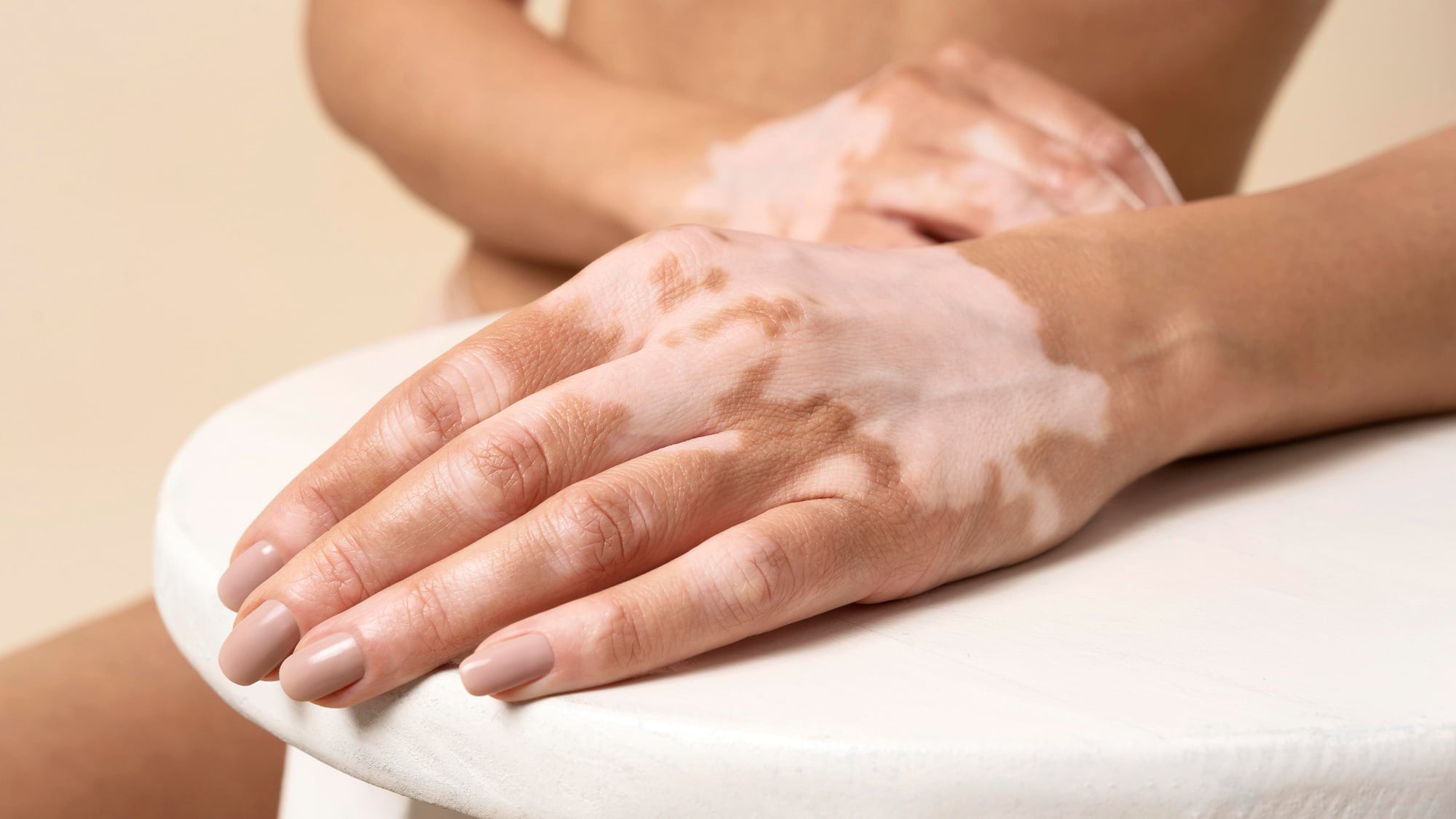
Unretouched
Part One: Sophie
My daughter, Sophie, is eight years old, and she is the most beautiful person I have ever seen.
I know every mother says that. I don’t care. It’s true.
She has dark curly hair that refuses to stay in a ponytail. She has big brown eyes with lashes so long that strangers comment on them in the grocery store. She has a gap between her front teeth that whistles when she says words with an s in them.
And she has vitiligo.
If you don’t know what vitiligo is, I didn’t either until Sophie was four.
It’s a skin condition. The cells that make pigment in the skin stop working in certain places. Nobody knows exactly why. It’s not contagious. It doesn’t hurt. It isn’t dangerous.
But it leaves white patches on the skin. Smooth, pale, irregular shapes, like spilled milk on a dark table.
The first patch showed up on Sophie’s left hand when she was four.
A small white spot on the back of her knuckle, about the size of a pea. I thought it was paint. I tried to wash it off in the bathtub.
It didn’t wash off.
By five, there was another one on her elbow. By six, a patch around her right eye that looked a little like a butterfly. By seven, patches on her knees, her neck, the back of her other hand, and a white streak through her eyebrow.
Our dermatologist at Vanderbilt, Dr. Okafor, sat with me in a little exam room and explained it gently.
“It’s not your fault,” she said. “It’s not anything you did or didn’t do. It’s genetic, partly. It often runs in families.”
“Nobody in our family has it,” I said.
Dr. Okafor nodded slowly. “That you know of,” she said.
I didn’t think anything of it at the time.
My name is Heather Brooks. I’m thirty-six years old.
I’m a second-grade teacher in Franklin, Tennessee, just south of Nashville. My husband, Jason, is a physical therapist. We have one child. We live in a small brick house with a big backyard and an old swing set Jason built from a kit.
We spend a lot of our time teaching Sophie to love herself.
Part Two: The Playground
Kids can be cruel. I’ve been a teacher for thirteen years. I know that better than anybody.
But knowing it and watching it happen to your own child are two very different things.
It started in first grade.
A boy named Carson pointed at the patch around Sophie’s eye during recess. He said she looked like a cow. The other kids laughed. One of them started mooing.
Sophie came home and locked herself in the bathroom. I found her sitting on the floor with a washcloth, scrubbing her face so hard it was red and raw.
“I want it to come off,” she sobbed. “Mom, make it come off.”
I sat on the bathroom floor with her for an hour.
I held her face in my hands. I kissed every white patch. The one by her eye. The one on her eyebrow. The one on her chin.
“These are yours,” I told her. “They’re part of you. And everything that’s part of you is beautiful.”
She didn’t believe me. Not that night.
In second grade, it got worse.
A girl named Kennedy wouldn’t hold Sophie’s hand during a game of Red Rover. She said she didn’t want to catch it. The teacher had to explain to the whole class that vitiligo wasn’t contagious.
Sophie told me later that the explanation was worse than the original thing. Because now everybody knew. Everybody was looking.
Jason and I did everything we could think of.
We found a counselor who specialized in kids with visible differences. We bought her books with characters who looked different. We found a doll online with vitiligo patches, made by a company in Canada. Sophie named her Patches. She sleeps with her every night.
We found a Facebook group for parents of kids with vitiligo. We found a model named Winnie Harlow, who has vitiligo and has been on magazine covers all over the world. We printed a picture of her and put it on the refrigerator.
Slowly, it got better.
By third grade, Sophie stopped wearing long sleeves in September. She stopped covering her face with her hair. When a new kid asked her about her skin, she’d say, “It’s called vitiligo. It’s like a map. Want to see where Canada is?”
She’d point to a patch on her forearm that was shaped, if you squinted, a little bit like Canada.
The new kid usually laughed. And then they usually became friends.
I was so proud of her I could barely breathe.
I never imagined that after all of that, she’d face the same cruelty from her own aunt.
Part Three: Amanda
My younger sister is Amanda. She’s twenty-nine. Seven years younger than me.
When we were growing up in Murfreesboro, I was the one who took care of her. Our parents both worked long hours. Our dad drove a truck for a freight company. Our mom worked the register at a Kroger.
I made Amanda’s breakfast. I walked her to school. I braided her hair every morning. I sat with her when she had nightmares.
She followed me around like a puppy.
When she was nine, something happened.
I was sixteen. I’d just gotten my driver’s license. I remember because I drove her to the dermatologist myself, in Mom’s old Corolla, because Mom couldn’t get off work.
There was a patch on the back of Amanda’s right hand. White. Smooth. About the size of a quarter.
The dermatologist said it was vitiligo.
Amanda cried in the car the whole way home. I bought her a milkshake at Sonic and let her pick the music.
When we got home, Mom took one look at the patch and her face went tight.
My mother, Brenda, is a good woman. I want to say that clearly. She worked hard her whole life and loved us the best she knew how.
But my mother was raised by a woman who thought appearances were everything. Grandma Pearl ironed her dish towels and wore lipstick to take out the trash. She told us that a lady never let anyone see her flaws.
Mom learned that from her. And she taught it to Amanda.
“We’ll cover it,” Mom said that night, looking at the patch on Amanda’s hand. “Nobody needs to know.”
She bought Amanda a tube of concealer from the Walgreens on Memorial Boulevard. She showed her how to dab it on. How to blend it with her fingertip. How to set it with powder.
Amanda was nine years old.
She wore makeup on her hands every single day after that.
When more patches came, she covered those too. One on her other hand. One on her wrist. One on her neck, just under her jawline.
By high school, she’d stopped wearing short sleeves completely. She wore long sleeves even in July. She refused to go swimming. She wore gloves to her prom.
I tried to tell her it didn’t matter.
I told her she was beautiful. I told her the patches were nothing to be ashamed of.
But I was seventeen and then eighteen and then nineteen and gone to college in Knoxville. And Mom was there every morning, with the concealer, telling her to cover up.
By the time Amanda was in her twenties, I almost forgot about it.
She was so good at hiding it. She’d perfected her makeup. She wore long sleeves and high collars. She’d built a whole wardrobe around covering her skin.
She was a social media manager for a fancy boutique in Nashville. She had twelve thousand followers on Instagram. Every picture was perfect. Every angle chosen. Every photo edited.
She never once posted a picture of her hands.
Part Four: The Wedding
Amanda got engaged last October.
His name is Ryan Callahan. He’s thirty-one. He’s a high school history teacher in Brentwood. He’s quiet and kind and funny, and he looks at my sister like she hung the moon.
I liked him the first time I met him.
The wedding was set for June. At a little white Methodist church in Leiper’s Fork, a tiny town outside Franklin with one main street and a general store and fields full of horses.
Amanda had planned every detail. She’d spent a year on it.
She’d hired a photographer from Nashville. A famous one, apparently. Somebody who’d shot weddings for country music stars. Four thousand dollars for eight hours.
Sophie was thrilled.
She’d never been to a wedding before. She talked about it for months. What would the cake look like? Would there be dancing? Would Aunt Amanda look like a princess?
She asked if she could be a flower girl. Amanda said she already had one, Ryan’s little niece. Sophie was disappointed but said okay.
In May, Sophie and I went dress shopping at a little boutique in downtown Franklin.
She tried on six dresses. She picked a pink one. Pale pink, with short puffy sleeves and a full skirt that twirled when she spun around. It had little white flowers embroidered around the hem.
She spun in front of the mirror for ten minutes.
“Mom,” she said. “Do you think Aunt Amanda will like it?”
“I think she’ll love it,” I said.
The dress had short sleeves.
Sophie’s arms showed. Every patch. The one shaped like Canada on her forearm. The ones on her elbows. The one on the back of each hand.
She didn’t even think about it. She just loved the dress.
That’s how far she’d come.
Part Five: The Phone Call
A week before the wedding, Amanda called me.
It was a Sunday evening. I was in the kitchen making spaghetti. Sophie was in the living room watching a movie with Jason.
I answered on speaker.
“Hey, Amanda! Are you getting nervous?”
She didn’t answer my question.
“Listen,” she said. “I need you to come alone. Don’t bring Sophie.”
I stopped stirring the sauce.
“What?” I said. “Why?”
She sighed. A long, impatient sigh, like I’d asked something stupid.
“We’re spending thousands on photography, Heather,” she said. “Four thousand dollars. For one day.”
“I know,” I said. “So?”
“So her skin condition will draw attention,” Amanda said. “It’ll ruin the aesthetic.”
I turned off the burner.
“The aesthetic,” I repeated.
“I’ve planned every detail of these pictures,” Amanda said. “The colors. The lighting. The flowers. Everything is soft and neutral and perfect. And Sophie’s skin is going to stand out in every single group photo.”
She paused.
“Please don’t make this difficult,” she said.
I couldn’t believe what I was hearing.
I took the phone off speaker. I walked out the back door onto the porch so Sophie wouldn’t hear.
“Amanda,” I said. “You’re ashamed of your own niece?”
“I’m not ashamed,” Amanda said. “I’m being realistic. People are going to look at my wedding pictures for the rest of my life. My kids are going to look at them. I don’t want everyone staring at—”
She stopped.
“At what?” I said.
“Stop being dramatic!” Amanda snapped. “It’s my wedding! I’m allowed to have the pictures I want!”
I hung up.
I stood on the back porch, shaking. My hands were trembling so hard I almost dropped the phone.
Through the kitchen window, I could see Sophie in the living room. She was curled up on the couch next to Jason, watching Moana. Her arm was flung over the back of the couch. Canada was showing.
She was laughing at something on the screen.
Part Six: The Idea
At first, I decided not to go at all.
How could I celebrate someone who’d treated my daughter like that? How could I sit in a church pew and smile at my sister after she’d called my child a problem for her pictures?
I told Jason that night, after Sophie went to bed.
He was quiet for a long time.
“She said ruin the aesthetic,” he said.
“Those were her exact words.”
He rubbed his face with both hands.
“What are you going to tell Sophie?” he asked.
That was the part that kept me up.
Sophie had been talking about this wedding for months. She’d picked out her dress. She’d practiced dancing in the living room. She’d made a card for Aunt Amanda with glitter and stickers that said Congratulations! in purple marker, with three t’s in it.
How do you tell an eight-year-old she’s not invited to her aunt’s wedding because of her skin?
I lay awake until two in the morning.
And somewhere around one-thirty, staring at the ceiling, I thought about a nine-year-old girl in the back seat of Mom’s old Corolla.
Crying over a milkshake from Sonic. With a white patch on the back of her right hand.
And then an idea came to me.
Amanda wanted perfect wedding pictures?
Fine.
I’d make sure nothing ruined her precious pictures.
Part Seven: The Box
I spent the next five days preparing.
I told nobody what I was planning. Not my mother. Not my friends. Not even Jason.
He asked me once, on Wednesday night, when he found me at the kitchen table at midnight with a pile of old photo albums.
“What are you doing?” he asked.
“Making a wedding gift,” I said.
He looked at the albums. He looked at me.
“Heather,” he said carefully. “Are you about to do something you’ll regret?”
“I don’t know,” I said honestly. “I hope not.”
The albums were from Mom’s house. I’d driven to Murfreesboro on Tuesday afternoon after school. I’d told Mom I wanted to look at old pictures before the wedding. To make something nice for Amanda.
Mom had pulled out every album she had. Thirty years of family photos. Christmas mornings. Birthday parties. School pictures. Beach vacations to Gulf Shores.
I went through every one.
I was looking for pictures of Amanda.
Not the pictures after she was nine. Not the ones with long sleeves and gloves and careful angles.
The ones before.
I found them.
Amanda at four, in a red swimsuit, running through a sprinkler in our backyard. Laughing so hard her eyes were closed.
Amanda at six, in her Easter dress, holding a basket of eggs. Her hands were bare.
Amanda at eight, in a tank top at a Fourth of July picnic. Holding a sparkler. Bare arms. Bare hands.
And then I found the ones I really needed.
Amanda at nine. After the dermatologist. A picture from the fall, at the county fair. She was holding a cotton candy. You could see the white patch on her hand clearly, before she’d learned to cover it.
She was smiling. A real smile.
Amanda at ten, at her birthday party. In a T-shirt. Blowing out candles. You could see the patches on both hands. And one on her wrist.
She was laughing.
There were only a few of those. Mom must have stopped taking them. Or thrown them away.
But there were enough.
I took them to a print shop in Franklin.
I had them enlarged. Cleaned up. Restored. The old ones were faded and scratched. The man at the print shop fixed them carefully. He didn’t edit anything. I told him not to.
“Don’t touch the skin,” I said. “Leave everything exactly how it is.”
He looked at the pictures. He looked at me. He nodded.
I bought a white leather photo album. The nice kind. With gold lettering on the front.
I had the cover engraved.
I put the pictures inside. One on each page. In order. Amanda at four, at six, at eight, at nine, at ten.
And at the very end, I added one more picture.
It was a picture I’d taken myself, two weeks earlier. On my phone, in our backyard.
Sophie. In her pink wedding dress, spinning on the grass. Her skirt flying out around her. Her arms spread wide. Every patch showing in the sunlight.
She was laughing so hard her eyes were closed.
Exactly like her aunt at four, running through the sprinkler.
Then I wrote a letter.
It took me three days. I wrote it eleven times. I’m a second-grade teacher. I spend my days helping seven-year-olds put their feelings into words. I couldn’t put my own into words.
On the eleventh try, I got it right.
I sealed it in an envelope. I tucked it inside the back cover of the album.
Then I wrapped the whole thing in plain white paper and tied it with a pink ribbon. The same pale pink as Sophie’s dress.
Part Eight: The Church
On the wedding day, I left Sophie at home with Jason.
I didn’t tell her the truth. Not yet. I told her she’d gotten sick and couldn’t go. She had a little cold that week, so it wasn’t completely a lie.
She cried anyway.
“But I have my dress,” she said. “I was going to spin.”
“I know, baby,” I said. “I’m so sorry.”
Jason walked me to the car.
“You’re really not going to tell me what’s in the box?” he asked.
“Not yet,” I said.
He looked at me for a long moment.
“Keep your phone on,” he said. “Just in case.”
I drove to Leiper’s Fork alone.
Twenty-five minutes down winding country roads. Past horse farms and white fences and old stone walls. The box was on the passenger seat, wrapped in white paper with its pink ribbon.
I didn’t turn on the radio.
The church was small and white with a tall steeple. Built in 1872. There was a gravel parking lot full of nice cars. A horse and carriage was waiting by the front steps, decorated with white roses.
I was late. On purpose.
The ceremony had already started when I pulled into the lot. I could hear the organ through the open windows.
I picked up the box.
I walked up the stone steps.
I quietly opened the big wooden doors and stepped inside.
Part Nine: The Altar
It was beautiful.
I’ll give Amanda that. The church was full of white flowers. White roses and white peonies and white hydrangeas, everywhere. White candles in the windows. White ribbons on every pew.
Everything was soft and neutral and perfect.
Exactly like she’d planned.
Amanda stood at the altar in her wedding gown.
It was stunning. Ivory satin with a long train. A high lace collar that came all the way up her neck.
And long sleeves. Lace sleeves that came all the way down to her wrists.
And gloves. White satin gloves, up to her elbows.
In June. In Tennessee.
Ryan stood beside her, smiling at her like she was the only person in the room.
The photographer was crouched in the side aisle with a big camera, shooting the ceremony. A second shooter stood in the balcony.
The pastor was an older man with white hair and reading glasses. He was halfway through his message. Something about love being patient and kind.
My mother was sitting in the front row. In a pale blue dress with a matching hat.
She turned around when she heard the door. She saw me. She saw the box.
She frowned.
I walked down the center aisle.
Not fast. Not slow. Just walking. With the box in my hands.
People started to turn around. Whispers. A woman in the third row nudged her husband.
Amanda hadn’t noticed me yet. She was looking at Ryan.
The pastor was saying, “…and love does not boast, it is not proud…”
I stopped at the end of the aisle. Right in front of the altar.
“Excuse me!” I said.
My voice echoed off the old wooden walls.
The pastor stopped mid-sentence.
The organist took her hands off the keys.
Every head in that church turned and looked at me.
“Before you continue,” I said, “I have a wedding gift for my sister.”
Part Ten: The Gift
Amanda turned around.
She saw me. Her face went white. Then red.
“Heather,” she hissed. “What are you doing? We’re in the middle of the ceremony.”
“I know,” I said. “I’m sorry. This won’t take long.”
Ryan looked confused. He looked at Amanda. He looked at me.
My mother was standing up in the front row. “Heather Lynn,” she said in her warning voice. The one she used when I was ten.
The photographer had stopped shooting. She was standing in the side aisle with her camera lowered, watching.
I held out the box.
“This is for you, Amanda,” I said quietly. “I wanted you to have it before you got married.”
She didn’t take it.
“Are you insane?” she said. “Get out. Right now. You’re ruining everything.”
“I’m not here to ruin anything,” I said. “I’m here because you told me something last week. You told me not to bring Sophie because she’d ruin your pictures.”
The church went dead silent.
A hundred and fifty guests. Not one of them made a sound.
Amanda’s face went from red to white again.
“That’s not—” she started.
“You said her skin would ruin the aesthetic,” I said. “Those were your words.”
Ryan turned and looked at his bride.
“Amanda,” he said quietly. “Is that true?”
Amanda didn’t answer him.
I held out the box again.
“So I made sure nothing would ruin your pictures,” I said. “I brought you some new ones. Pictures nobody’s ever going to edit. Pictures that are already perfect.”
I set the box on the little table at the front of the altar. The one with the unity candle.
“Open it,” I said. “Please. And then I’ll leave.”
Amanda stared at the box.
For a long moment, she didn’t move.
Then, slowly, with her white satin gloves, she untied the pink ribbon.
Part Eleven: The Album
She tore off the white paper.
She looked at the white leather album. At the gold lettering on the cover.
She read it.
Her hands started to shake.
The gold letters said:
AMANDA
Unretouched.
She opened the cover.
The first page. Amanda at four, in a red swimsuit, running through the sprinkler. Laughing with her eyes closed.
She turned the page.
Amanda at six. Easter dress. Bare hands holding a basket of eggs.
Amanda at eight. Fourth of July. Sparkler. Bare arms.
She turned the page again.
Amanda at nine. The county fair. Cotton candy.
The white patch on the back of her right hand. Clear as day. Before the concealer. Before the long sleeves. Before the gloves.
She was smiling.
Amanda made a sound I’d never heard her make.
A small, broken sound. Like something cracking.
My mother had come up behind her. She was looking over Amanda’s shoulder at the album. Her hand was over her mouth.
Amanda turned the page.
Amanda at ten. Birthday party. T-shirt. Blowing out the candles. Patches on both hands, and one on her wrist.
She was laughing.
Ryan was looking at the album too.
He was standing right beside her. He was looking at the picture of a ten-year-old girl in a T-shirt, with white patches on her hands, laughing at her birthday party.
He looked up at Amanda. At her long lace sleeves. At her white satin gloves.
His face changed.
He understood.
Amanda turned to the last page.
Sophie. In her pink dress. Spinning in our backyard. Her arms spread wide. Every patch showing. Laughing with her eyes closed.
Exactly like her aunt at four, running through the sprinkler.
The letter was tucked into the back cover.
Amanda pulled it out with shaking gloved fingers.
She looked at me.
“Read it,” I said. “Please.”
Part Twelve: The Letter
She opened the envelope.
She unfolded the letter.
She started to read it to herself. Then she stopped. She looked out at the church. At a hundred and fifty faces.
Then she did something I didn’t expect.
She started to read it out loud.
Dear Amanda,
When you were nine years old, I drove you home from the dermatologist in Mom’s old Corolla. You cried the whole way. I bought you a strawberry milkshake at Sonic and let you play the Backstreet Boys as loud as you wanted.
You asked me if you were ugly now.
I told you no. I told you that you were the most beautiful person I’d ever seen. I meant it then. I mean it now.
Her voice cracked. She kept reading.
That night, Mom bought you concealer. And for twenty years, you’ve been covering up the most beautiful parts of yourself.
I should have stopped her. I was sixteen. I didn’t know how. I’m sorry.
Last week, you told me not to bring Sophie to your wedding. You said her skin would ruin your pictures.
I was so angry I couldn’t see straight. I almost didn’t come.
But then I remembered the girl in the back seat of the Corolla. And I realized you weren’t saying it about Sophie.
You were saying it about you.
The church was completely silent.
Amanda’s hands were shaking so badly the letter rattled.
Sophie has vitiligo because you do. Because Grandma Pearl’s sister did. Because it runs in our family, and nobody ever talked about it.
Dr. Okafor told me that, when Sophie was diagnosed. I didn’t tell you. I didn’t want to make you feel worse.
But Sophie doesn’t hide. She wears short sleeves. She tells kids at school her arm has a map of Canada on it. She picked out a pink dress with puffy sleeves for your wedding, and she spun in it for ten minutes in front of the mirror.
She’s eight years old, Amanda. And she’s braver than either of us ever was.
I’m not here to embarrass you. I’m not here to ruin your wedding.
I’m here because I want you to know something before you walk out of this church as somebody’s wife.
You were never something that needed to be fixed.
Neither is she.
Happy wedding day. I love you.
Heather
Amanda lowered the letter.
She looked at me.
Tears were running down her face, through her perfect makeup.
Part Thirteen: The Gloves
Nobody said anything for a long time.
My mother was crying in the front row. The pastor had taken off his reading glasses. The photographer was standing completely still in the side aisle.
Ryan stepped closer to his bride.
“Amanda,” he said softly. “Look at me.”
She looked at him.
“I’ve known for two years,” Ryan said.
Amanda stared at him.
“What?”
“Your hands,” Ryan said gently. “I’ve known since our third date. You fell asleep on my couch watching a movie. You’d washed your hands before dinner and forgotten to put the makeup back on.”
He smiled.
“I sat there and looked at them for an hour,” he said. “I thought they were the most beautiful hands I’d ever seen.”
Amanda’s face crumpled.
“Why didn’t you say anything?” she whispered.
“Because you’d worked so hard to hide them,” Ryan said. “I thought you’d tell me when you were ready.”
He reached out. He took her gloved hands in his.
“I’ve been waiting two years,” he said. “I didn’t want to marry you in gloves, Amanda. I wanted to marry you.”
Amanda stood at the altar of a hundred-and-fifty-year-old church in her ivory satin gown, holding her sister’s letter and her fiancé’s hands.
Then she let go of Ryan’s hands.
She reached up to her left elbow, where the white satin glove ended.
She started to pull it off.
Slowly. One finger at a time.
The whole church watched.
She pulled the glove all the way off. She dropped it on the floor of the altar.
On the back of her left hand, there was a white patch. About the size of a quarter. Another one on her wrist. Another one on her thumb.
She pulled off the other glove.
Her right hand. The patch I’d seen in the back seat of Mom’s Corolla twenty years ago. Bigger now. Spreading across her knuckles like a little cloud.
She held up both hands. In front of a hundred and fifty people.
She was shaking. Crying. Her makeup was running down her face.
Then she reached up to the high lace collar of her dress.
The one that came all the way up her neck.
She unbuttoned the top two buttons. She folded the lace down.
Under her jawline, on the left side of her neck, there was another patch. Pale and smooth. The shape of a crescent moon.
She’d been hiding it under turtlenecks and high collars since she was twelve.
She stood there.
Bare hands. Bare neck. In front of everyone she knew.
“This is me,” Amanda said. Her voice was barely a whisper. “This is what I look like.”
Part Fourteen: The Photographer
For a moment, nobody moved.
Then the photographer walked out of the side aisle.
She was in her forties, with short gray hair and black clothes and two cameras around her neck. Her name, I found out later, was Elena Ruiz. She’d been photographing weddings in Nashville for nineteen years.
She walked right up to the altar.
She looked at Amanda.
“Can I say something?” she asked.
Amanda nodded. She couldn’t speak.
“I’ve shot over six hundred weddings,” Elena said. “Country singers. Football players. Senators. I’ve seen every kind of perfect you can imagine.”
She held up her camera.
“And I can tell you something,” she said. “The pictures people remember aren’t the perfect ones. They’re the true ones.”
She looked at Amanda’s bare hands.
“I’d be honored to photograph you,” Elena said. “Exactly like this. No retouching. Not one patch.”
Amanda started sobbing.
Ryan pulled her into his arms. She cried into his tuxedo.
Over his shoulder, she looked at me.
“Heather,” she said. “Where’s Sophie?”
“At home,” I said. “With Jason.”
“Is she really sick?”
“She has a little cold,” I said. “But no. I told her that because I didn’t know how to tell her the truth.”
Amanda closed her eyes.
“Can she still come?” she asked.
I looked at my watch.
It was 2:40. The ceremony was supposed to end at three. The reception started at four.
“It’s twenty-five minutes from our house,” I said.
Amanda turned to the pastor.
“Reverend Hawkins,” she said. “Can we take a break? Thirty minutes?”
The pastor smiled. He put his reading glasses back on.
“Miss Amanda,” he said. “I’ve been marrying people in this church for forty-one years. I think the Lord can wait half an hour.”
Part Fifteen: Twenty-Five Minutes
I called Jason from the church steps.
He answered on the first ring.
“Is everything okay?” he said.
“Put Sophie in her dress,” I said. “The pink one. And drive to the church. As fast as you safely can.”
He didn’t ask any questions. I heard him calling her name before he hung up.
Inside the church, nobody left.
A hundred and fifty guests sat in their pews and waited. People started talking quietly. Some of them came up to the altar to hug Amanda. Ryan’s mother hugged her for a long time. Ryan’s grandmother, who was ninety-one, patted her bare hand and said, “Honey, I’ve had liver spots since 1987. Join the club.”
Amanda laughed through her tears.
My mother came over to me on the church steps.
She sat down next to me. In her pale blue dress and her matching hat.
She didn’t say anything for a long time.
“I bought her that concealer,” she said finally. “When she was nine.”
“I know, Mom.”
“My mother bought it for her sister,” Mom said. “Aunt Lottie. She had the same thing. On her face. Grandma Pearl made her wear makeup every day of her life. Even in the hospital at the end.”
She wiped her eyes.
“I thought I was protecting Amanda,” she said. “I thought I was keeping her from getting hurt.”
“You were doing what you were taught,” I said.
“I taught her to be ashamed,” Mom said. “And then she tried to teach Sophie the same thing.”
She looked at me.
“And you stopped it,” she said. “In the middle of a church.”
At 3:08, Jason’s car pulled into the gravel lot.
The back door flew open before the car had completely stopped.
Sophie climbed out.
She was wearing the pink dress. Pale pink, with short puffy sleeves and a full skirt and little white flowers embroidered around the hem. Her curly hair was half in a ponytail and half falling out. She had her doll, Patches, tucked under one arm.
Her arms were bare. Canada was showing.
She ran across the gravel. Up the stone steps.
“Mom!” she said. “Daddy said I’m going to the wedding after all! Is it true? Am I really?”
Before I could answer, the church doors opened.
Amanda was standing there. In her ivory gown, with her bare hands and her unbuttoned collar.
Sophie stopped.
She looked up at her aunt.
She looked at Amanda’s hands. At the white patches on the backs. At the one on her wrist and the one on her thumb.
She looked at the crescent moon on Amanda’s neck.
Sophie’s eyes got very big.
“Aunt Amanda,” she said slowly. “You have vitiligo too?”
Amanda knelt down on the church steps. In her four-thousand-dollar wedding gown.
She held out her hands to her niece.
“I do,” she said. “I’ve had it since I was nine. Just like you.”
Sophie looked at Amanda’s hands.
Then she put her own hand next to Amanda’s. Her small hand, with the white patch on the back of her knuckle. Next to Amanda’s hand, with the white patch across her knuckles like a cloud.
They matched.
“Why didn’t you ever tell me?” Sophie asked.
Amanda’s face crumpled.
“Because I was scared,” she said. “I was scared people would think I was ugly. So I hid it. For twenty years.”
Sophie thought about that for a long moment.
Then she reached up and touched the crescent moon on her aunt’s neck.
“That one’s pretty,” Sophie said. “It looks like the moon.”
Amanda laughed and cried at the same time.
“Do you know what yours looks like?” she asked.
Sophie held out her forearm. She pointed.
“Canada,” she said proudly.
Part Sixteen: The Flower Girl
Ryan’s niece, Lily, was the flower girl.
She was six. She had a little white basket full of rose petals. She’d been sitting in the front pew for thirty minutes, bored, swinging her legs.
When Sophie walked into the church in her pink dress, Lily looked at her for a long moment.
Then she walked over and held out her basket.
“Do you want to help me?” Lily asked. “There’s a lot of petals.”
So there were two flower girls.
Lily in white. Sophie in pink.
They walked down the aisle together, holding hands. Throwing rose petals on the floor. Sophie threw hers so hard they hit the third row. Everybody laughed.
Then Amanda walked down the aisle again.
Our father had died four years earlier. So she walked with Mom. Mom held her arm, and Amanda held her bouquet in her bare hands. White roses and peonies.
Her collar was unbuttoned. The crescent moon was showing.
She didn’t cover it.
Elena Ruiz shot the whole thing.
She crouched in the aisle and photographed Amanda walking toward Ryan. Bare hands. Bare neck. Tears running down her face. Smiling so wide it looked like it hurt.
At the altar, Amanda handed her bouquet to her maid of honor.
Then she turned around and looked out at the church.
She found me in the second row. She looked at me for a long time.
Then she looked down at Sophie, sitting next to me in her pink dress.
“Sophie,” Amanda said. “Come here.”
Sophie looked at me. I nodded.
She walked up to the altar.
Amanda knelt down again. She took Sophie’s hand.
“I want you to stand right here,” Amanda said. “Next to me. For the whole ceremony. Is that okay?”
Sophie nodded so hard her ponytail fell all the way out.
Part Seventeen: The Vows
The pastor started over from the beginning.
He read about love being patient and kind. About love not being proud.
When he got to the vows, Ryan went first.
He’d written his own. He took a folded piece of paper out of his tuxedo pocket. He looked at it.
Then he put it back in his pocket.
“I had something written,” he said. “But I want to say something else.”
He took Amanda’s bare hands in his.
“Amanda,” he said. “I promise to love every part of you. The parts you show and the parts you hide.”
He ran his thumb over the white patch on the back of her hand.
“And I promise,” he said, “that you’ll never have to hide anything from me again.”
Then it was Amanda’s turn.
She’d written vows too. She’d been practicing them for weeks. She had them on a little card tucked into her bouquet.
She didn’t use them either.
“Ryan,” she said. Her voice was shaking. “I’ve spent twenty years trying to be perfect. I thought if I could just hide the parts of me that were different, I’d be good enough.”
She looked down at their joined hands.
“I almost made a little girl feel the same way,” she said. “I almost taught her to hide.”
She looked at Sophie, standing beside her.
“I promise,” Amanda said, “to stop hiding. And to teach our kids, if we’re lucky enough to have them, that nothing about them ever needs to be covered up.”
She looked at Ryan.
“And if they get my skin,” she said, “I promise to tell them it’s a map.”
Sophie giggled.
The pastor pronounced them husband and wife.
Ryan kissed his bride. The whole church stood up and cheered.
Sophie threw the last of Lily’s rose petals in the air, and they came down on everyone like snow.
Part Eighteen: The Pictures
After the ceremony, Elena Ruiz took the family pictures.
On the lawn outside the church. Under a big oak tree. With the horses watching from the field across the road.
She arranged everyone in a group. Amanda and Ryan in the middle. Ryan’s family on one side. Our family on the other.
Then she stopped.
“Wait,” she said.
She walked over to Sophie. She knelt down.
“Will you stand in the very front?” she asked. “Right in the middle? Next to your aunt?”
Sophie looked at me.
I nodded.
Sophie stood in the front. In the middle. Next to Amanda.
Amanda put her bare hand on Sophie’s shoulder.
Elena raised her camera.
“Okay, everybody,” she said. “On three, say Canada.”
The whole family laughed.
Elena took the picture.
It’s the picture that hangs over Amanda and Ryan’s fireplace now. Twenty by thirty inches, in a white frame.
It’s not the posed one. It’s not the perfect one.
It’s the one where everybody’s laughing. Where Ryan’s grandmother has her head thrown back. Where my mother is wiping her eyes. Where Jason is holding my hand.
And in the very front, in the middle, a little girl in a pink dress with her arms flung wide, laughing so hard her eyes are closed.
With her aunt’s bare hand resting on her shoulder.
Two white patches. Side by side.
Part Nineteen: The Dance
At the reception, at a big barn in Leiper’s Fork with string lights and long wooden tables, Amanda did something nobody expected.
She changed out of her wedding gown.
She’d planned it all along. A second dress, for dancing. But she’d planned something with long sleeves. A high collar.
She didn’t wear that one.
She came out of the bridal room in a simple white sundress.
Sleeveless. With thin straps.
Her arms were bare for the first time in twenty years. There were patches on her elbows, her forearms, her shoulders. Pale and smooth and scattered like constellations.
She walked into the middle of the barn.
People stopped talking.
Then Ryan walked over to his bride. He took her hand.
The band started playing. An old song. “Isn’t She Lovely.”
He’d requested it. He’d told the band that afternoon, after the ceremony.
They danced.
In the middle of the barn, under the string lights. Amanda in her sleeveless white dress. Ryan in his tuxedo.
Halfway through the song, Ryan stepped back.
He held out his hand.
To Sophie.
Sophie looked at me. I nodded.
She ran out to the dance floor in her pink dress.
Ryan picked her up and set her feet on his shoes, the way my father used to do with me.
And they danced. The three of them. Amanda and Ryan and Sophie.
Sophie spun in her pink dress. Her skirt flew out around her. Her arms spread wide.
Every patch showing, under the string lights.
Amanda spun too.
For the first time since she was nine years old, my sister danced with her arms bare.
Part Twenty: Grandma Pearl
At the end of the night, my mother found me by the dessert table.
She was holding something. A small, framed photograph. Black and white. Old.
“I brought this,” she said. “I was going to give it to Amanda as a wedding gift. I almost didn’t.”
She handed it to me.
It was a picture of a young woman. Maybe twenty. In a 1950s dress, sitting on a porch swing.
She had a big white patch across her cheek and forehead. Another one on her chin. Another one on her neck.
She was smiling.
“Aunt Lottie,” Mom said quietly. “Grandma Pearl’s sister. 1956. Before Grandma made her start wearing makeup.”
“I found it in Grandma’s things after she died,” Mom said. “It was in an envelope at the very bottom of her cedar chest. With a note.”
“What did the note say?”
Mom took a breath.
“It said, The only picture of Lottie where she looks like Lottie.”
I looked at the photograph for a long time.
At a young woman on a porch swing in 1956, with white patches on her face, smiling like she didn’t have a care in the world.
“Give it to Amanda, Mom,” I said. “Tonight.”
Mom gave it to her.
Amanda looked at it for a long time. Then she started crying again. She’d been crying all day.
“She looks happy,” Amanda said.
“She was,” Mom said. “Before.”
Amanda looked at the picture. Then she looked across the barn at Sophie, who was dancing with Ryan’s little niece Lily, both of them spinning in circles.
“Four generations,” Amanda said quietly. “Lottie. Me. Sophie.”
She looked at Mom.
“Lottie was the first one who had to hide,” she said. “Sophie’s going to be the first one who doesn’t.”
Part Twenty-One: One Year Later
That was a year ago.
Amanda and Ryan live in a little house in Brentwood with a yellow front door. Amanda still works in social media. She still has a big Instagram following.
She’s lost some followers. She’s gained a lot more.
Three days after the wedding, she posted a picture.
The one under the oak tree. The whole family laughing. Sophie in the front. Amanda’s bare hand on her shoulder.
The caption said:
I hid my vitiligo for 20 years. On my wedding day, my sister gave me back the girl I was before I learned to be ashamed. And my 8-year-old niece showed me what brave looks like. This picture is unretouched. So am I.
It went viral. Two million likes. Hundreds of thousands of comments. People with vitiligo from all over the world. Teenagers who’d been hiding. Parents of kids who’d been bullied. A woman in Brazil who’d worn gloves every day for thirty years.
Amanda answered as many of them as she could.
She doesn’t wear gloves anymore. Or long sleeves in summer. Or high collars.
She still wears makeup sometimes. On her eyes and her lips. But not on her hands. Not on her neck.
The crescent moon shows all the time now.
She and Sophie have a standing date. Every other Saturday. They go to the pool at the YMCA in Franklin.
Amanda learned to swim last summer. At twenty-nine. She hadn’t been in a pool since she was nine.
Sophie taught her.
Last month, Amanda called me.
“Heather,” she said. “I have news.”
“What kind of news?”
She was quiet for a second.
“I’m pregnant,” she said.
I screamed so loud Jason came running from the backyard.
“It’s due in December,” Amanda said. “Ryan’s already painting the nursery. Yellow.”
Then she was quiet again.
“Heather,” she said. “What if the baby has it? The vitiligo?”
I thought about Lottie on her porch swing in 1956. About a nine-year-old girl in the back seat of a Corolla with a strawberry milkshake. About an eight-year-old in a pink dress, spinning on the lawn of a little white church.
“Then the baby will have a map,” I said. “And two people who already know how to read it.”
Amanda laughed. Then she cried. She cries a lot now. She says it’s the pregnancy.
I think it’s something else.
I think it’s twenty years of tears she never let herself cry.
Sophie’s nine now. She’s in fourth grade.
Last week, a new girl started in her class. A girl named Maya, from Atlanta. She has vitiligo too. A big patch on her cheek and one on her arm.
On Maya’s first day, a boy named Tyler pointed at her and said she looked like a Dalmatian.
Sophie stood up.
In the middle of the classroom. In front of everybody.
She rolled up her sleeve. She showed the class her forearm.
“This is Canada,” she said. “And Maya’s is the shape of Florida.”
She looked at Tyler.
“My aunt has the moon on her neck,” she said. “And she got married with her arms showing, and a famous photographer took her picture, and two million people liked it.”
She sat back down.
“So,” she said. “Dalmatians are actually really cute.”
The whole class laughed. Even Tyler.
Maya sat with Sophie at lunch.
They’ve been best friends ever since.
People ask me sometimes what was in the box.
The wedding gift. The one I walked down the aisle with in the middle of my sister’s ceremony.
They’ve heard the story. They think it was some kind of revenge. Some way to humiliate Amanda in front of her guests.
I tell them it was just pictures.
Old pictures, from a little girl’s childhood. Before somebody handed her a tube of concealer and told her she wasn’t good enough the way she was.
Pictures nobody had ever edited.
Pictures nobody ever would.
Amanda wanted perfect wedding pictures.
She got them.
They’re just not the kind she thought she wanted.

Adrian Hawthorne is a celebrated author and dedicated archivist who finds inspiration in the hidden stories of the past. Educated at Oxford, he now works at the National Archives, where preserving history fuels his evocative writing. Balancing archival precision with creative storytelling, Adrian founded the Hawthorne Institute of Literary Arts to mentor emerging writers and honor the timeless art of narrative.