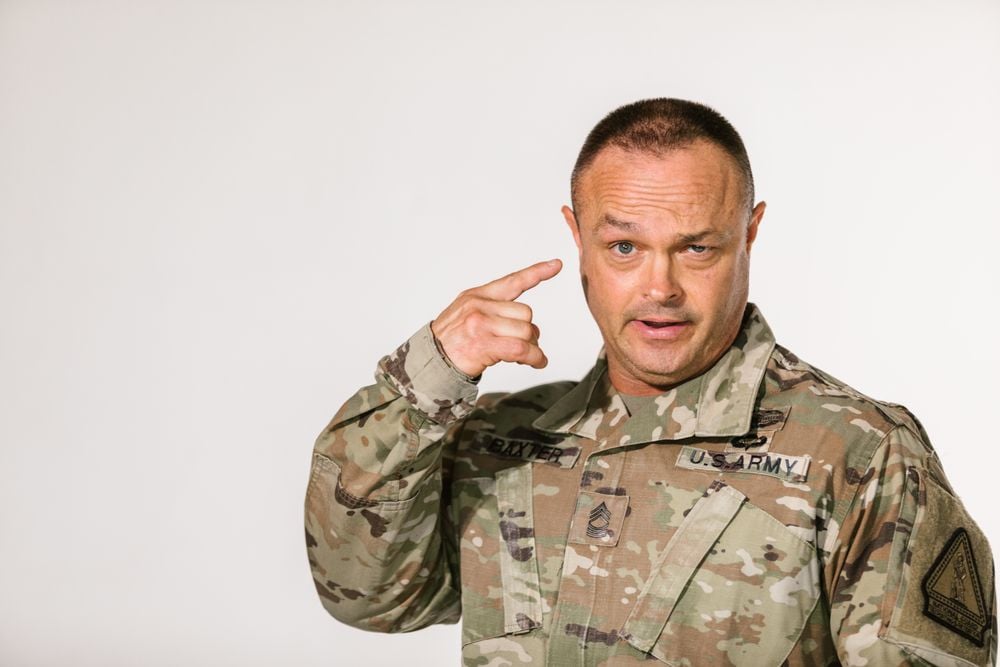
The soldier held the salute long enough for everyone in the driveway to understand that it wasn’t for show.
“Major,” he said, with his eyes fixed on me. “The convoy is secure. We are ready to move on your order.”
Behind him, three dark vehicles sat at the curb with their engines running. Frost was still on the lawn. Somewhere down the street, a dog was barking at the whole thing.
Julian’s Audi keys stopped spinning around his finger.
My father stepped out onto the porch with the newspaper still pressed against his chest. My mother and my sister, Harper, stood behind him in the open doorway, my mother in her pink robe, Harper in a cream sweater with her coffee mug in both hands.
None of them said a word.
I returned the salute. Then I lowered my hand and rested it on the curve of my stomach, because the baby had started kicking the second the vehicles pulled up.
“At ease,” I said. “I need one secured case from the upstairs bedroom and the cardboard box beside the garage door. Nothing else.”
“Yes, ma’am.”
He turned and signaled to another member of the team. A younger soldier with a shaved head walked toward the house.
Then he stopped at the bottom of the porch steps. He didn’t take another step.
“Permission to enter, ma’am?” he asked.
That question mattered more than anyone in my family understood.
For seven months, they had walked through David’s house like my permission didn’t matter. They had moved the furniture. They had filled the closets. They had invited their friends over for card games and argued over who got which room, and not once had any of them asked the person whose name was on the deed.
Now a uniformed stranger, a twenty-two-year-old kid I’d never met, was showing me more respect at my own front door than my own family had shown me the morning after I buried my husband.
“Permission granted,” I said. “Straight upstairs. First door on the left.”
To understand how I ended up standing in my own driveway on Thanksgiving morning, eight months pregnant, in my husband’s old Army T-shirt, with my whole family staring at me like they’d never seen me before, I have to go back.
Not very far. Just about three hours.
And then a little further than that.
My name is Maya Cole. I’m thirty-four years old.
I’ve been in the United States Army for twelve years.
My family thought I worked in an office.
That’s not entirely their fault. That’s what I told them. When I was commissioned, I was given a short, simple explanation I was allowed to share about my job. I work in Department of Defense administration. That was it. That was all I could say. So I said it at every Christmas dinner and every birthday party for twelve years, and after a while, my family stopped asking questions.
They decided I pushed paper somewhere in a beige building. They decided my job was boring. They decided that when I disappeared for four or five months at a time, it was because I was “on assignment,” and that probably meant sitting at a different desk in a different beige building.
I let them believe it. I had to.
I met David at an officer training course in Virginia, eleven years ago.
He sat next to me on the first day, and he was eating an apple so loudly that I finally turned to him and said, “Are you planning on finishing that before the lecture, or should I take notes for both of us?”
He looked at me. He took another very loud bite.
“You can take notes for both of us,” he said with his mouth full.
I hated him for about two weeks.
Then I didn’t.
We got married four years later, at a courthouse in North Carolina, on a Tuesday, because that was the only day we were both stateside at the same time. My parents drove down. Harper didn’t come. She said she had a work thing. My mother cried through the whole ceremony, which took nine minutes.
David did the same kind of work I did. We couldn’t talk about it with anyone else, but we could talk about it with each other, late at night, in whispers, in whatever little apartment we were living in that year. That was one of the things that made us fit. We never had to explain.
Five years ago, we bought a house. Our first real house. A two-story place in a quiet neighborhood with a big maple tree and a two-car garage and a kitchen that hadn’t been updated since 1985.
David fixed it up himself. Every time he was home between deployments, he’d work on it. He replaced the kitchen cabinets. He patched the drywall in the upstairs hallway where some previous owner had obviously punched a hole. He built a desk into the corner of our bedroom under the big window, out of oak, because he said I needed a place to sit and think where the light was good.
He paid every single mortgage payment. Every month, on the first, automatically, from his account. He was funny about it.
“My one job,” he used to say. “Keep the roof over your head.”
In March, I found out I was pregnant.
We’d been trying for two years. We’d almost stopped hoping.
I took the test in the upstairs bathroom at five in the morning, and I didn’t even wait for the full three minutes. I just sat on the edge of the tub and watched the second line show up, slowly, like a photograph developing.
I walked into the bedroom holding it. David was still asleep, flat on his back, one arm over his eyes.
I sat down on the bed next to him and held the test in front of his face.
He opened one eye. He looked at it.
He opened the other eye.
He sat straight up so fast he hit his head on the reading lamp.
The next day, he went out and bought a baby blanket. Soft yellow cotton, with little gray elephants on it. He brought it home in a paper bag and laid it out on our bed and just looked at it.
“It’s too early to buy stuff,” I told him. “It’s bad luck.”
“It’s a blanket, Maya,” he said. “Blankets can’t be bad luck.”
He folded it very carefully and put it in the top drawer of the dresser.
Three weeks later, he left on his last deployment.
In April, two officers in dress uniforms knocked on my front door.
I knew before I opened it. Everyone in our world knows. Two officers in dress uniforms on your front porch on a weekday morning only means one thing.
They said David had been killed during an operation overseas. They said they were very sorry. They said that, because of the nature of the operation, his remains hadn’t been recovered yet. They said they would do everything they could.
I thanked them. I closed the door. I sat down on the floor of the front hallway with my back against the wall.
I was nine weeks pregnant.
That night, I called my parents.
They lived three hours away, in the house I grew up in. My father, Gary, was a retired insurance adjuster. My mother, Diane, had been a church secretary for thirty years. They were the kind of people who had the same thing for dinner every Tuesday and went to bed at ten o’clock and never, ever talked about anything uncomfortable at the table.
My mother answered. I told her.
She was quiet for a second. Then she said, “Oh, Maya. Oh, honey. We’re coming. We’ll be there tomorrow.”
They came the next afternoon with two suitcases and a casserole.
And they never left.
At first, I was grateful.
I really was. I couldn’t do anything. I couldn’t eat. I couldn’t sleep. I’d wake up at three in the morning and reach for David’s side of the bed, and it would be cold, and I’d remember all over again.
My mother made meals. My father mowed the lawn. They answered the phone when people called. They sat with me.
After about two weeks, I said, “You can stay as long as you want. Really. I’d like you here.”
My father nodded. My mother hugged me.
That was the invitation. That was all I ever said.
It was open-ended. I didn’t think it needed to be anything else. They were my parents.
But slowly, over seven months, things changed.
It happened so gradually that I didn’t really notice until it was too late.
First, they moved into the bigger guest room instead of the small one. Then my mother rearranged the kitchen cabinets. “It makes more sense this way, honey.” Then my father moved David’s recliner out of the living room and into the basement, because he said his back needed the couch.
Then my father’s poker friends started coming over on Thursday nights. Three or four men I’d never met, in my dining room, eating chips and laughing loudly until eleven o’clock. My father never asked me. He just told me.
“The fellas are coming over tonight. You don’t mind.”
It wasn’t a question.
And then my parents started calling it their house.
Not on purpose, maybe. Just little things. My mother on the phone with her sister: “You should come visit us at the house sometime.” My father telling the neighbor: “We’re thinking about putting in a new fence.”
We.
I’d hear it from upstairs, lying in bed with my hand on my stomach, and I’d tell myself it didn’t matter. They were helping. They were grieving too. They loved David.
I was so tired. Everything was so heavy. It was easier not to fight about little things.
So I didn’t.
I’d learn later that every time I stayed quiet, they took it as permission for the next thing.
In early November, I got the call.
They’d recovered David’s remains.
He came home on a military transport plane on a gray Tuesday morning. I stood on the tarmac in my dress uniform, with my parents behind me in their church clothes, while six soldiers carried his flag-draped casket down the ramp.
My mother whispered, “Why are you wearing that?”
“Because I’m in the Army, Mom.”
“I know, but… you work in an office. Do office people wear those?”
I didn’t answer her.
The funeral was the day before Thanksgiving. At a national cemetery an hour away.
There were officers there my parents had never met. Men and women in uniform who came up to me afterward and hugged me and said things like, “He saved my life in ‘19,” and “There’s no one I’d rather have had beside me,” and “We’ll never forget what he did.”
My father stood off to the side in his gray suit, watching all of this.
At one point, a colonel I’d served under came over and shook his hand.
“Your son-in-law was one of the finest soldiers I ever served with,” the colonel said. “And your daughter is one of the best officers I’ve ever commanded. You should be very proud of both of them.”
My father nodded and said, “Thank you.”
But I saw his face. He was confused. He didn’t understand what the colonel meant. Commanded? Officer? He looked at me across the cemetery like he was trying to work out a puzzle.
And I could see that he didn’t like the feeling.
Later, I’d understand that this was where it started. That day. At the cemetery. My father standing at the edge of a crowd of people who knew things about David, and about me, that he didn’t know.
He hated feeling like a guest.
Harper and her husband, Julian, came to the funeral too.
Harper is three years younger than me. She’s beautiful in a careful, polished way. She works in real estate. She’s always had a sharp edge, even when we were kids. When we were little, she used to tell people I was adopted, just to see my face.
Julian was her second husband. They’d been married about a year. He ran some kind of financial consulting business. He drove a black Audi, wore a lot of expensive quarter-zip sweaters, and called everybody “boss.” I’d met him exactly three times.
They’d recently sold their condo in the city. They were “between places,” Harper said, while they looked for a house in my area. Julian was opening a satellite office nearby and needed to be closer to some new clients.
“Mom said we could crash at your place for a couple of weeks,” Harper told me after the funeral. “Just until our new place closes. That’s okay, right?”
Mom said.
I was standing at my husband’s grave. I’d just been handed a folded flag. My hands were still shaking.
“Fine,” I said.
They moved into the small guest room that night. The one my parents had moved out of.
Julian brought in four suitcases, a monitor, a desk chair, and a printer.
Which brings me back to Thanksgiving morning.
The morning after the funeral.
I came downstairs at seven-thirty in my sweatpants and David’s old Army T-shirt. It was the only thing I owned that still fit over my stomach. It was soft from about a thousand washes, and it still smelled a little like him, if I pressed my face into the collar.
I hadn’t slept. My back hurt. The baby had been kicking all night.
The kitchen smelled like coffee and onions. My mother was already chopping celery for the stuffing. My father was at the kitchen table with the newspaper. Harper was leaning against the counter with her mug.
Julian was sitting in David’s chair at the head of the table, scrolling on his phone, spinning his car keys around one finger.
Nobody said good morning.
I poured myself a glass of water. I could feel them all looking at me.
“Maya,” Harper said. “We need to talk about the room.”
“What room?”
“Your room,” she said. “The big bedroom. Julian needs an office. He has client calls starting Monday, and he can’t do them from the guest room. It’s tiny, and the Wi-Fi’s terrible in there. Your room has that desk. And the light’s better.”
I turned around and looked at her.
“David built that desk,” I said.
“I know. That’s why it’s perfect.” She smiled. “It’s just sitting there. You don’t even use it.”
“Where am I supposed to sleep?” I said.
There was a little pause.
My mother didn’t look up from her celery.
“Well,” she said, “your father set up the camping cot in the garage. Just for now. Until Harper and Julian’s place closes.”
I stared at her.
“The garage.”
“It’s insulated,” my father said, without lowering the newspaper. “Mostly. There’s the space heater.”
“It’s twenty-eight degrees outside,” I said. “I’m eight months pregnant.”
“It’s temporary, Maya,” Harper said. “Don’t be so dramatic. It’s a couple of weeks.”
That’s when I noticed the boxes.
Three cardboard boxes, stacked by the door to the garage. I recognized my handwriting on the side of one of them. M – SWEATERS.
They’d already packed my things.
While I was sleeping. Or while I was lying awake upstairs, listening to the baby kick, they’d gone into my bedroom closet and taken my clothes off the hangers and put them in boxes.
“You packed my stuff,” I said.
“Just the basics,” my mother said. “So you wouldn’t have to. You’ve been through so much, honey. We wanted to help.”
Then she pointed with her knife toward the garage door.
“Just put your things beside Julian’s car,” she said. “But don’t block it. He has to get out early tomorrow.”
Julian laughed.
He didn’t even look up from his phone. He just laughed. A short, easy laugh, like my mother had made a cute joke.
“Yeah, don’t scratch the Audi,” he said. “That’s my baby.”
He spun his keys around his finger.
I stood there in my kitchen. In my husband’s T-shirt. With my glass of water.
I looked at my mother, chopping celery. I looked at my father, behind his newspaper. I looked at Harper, leaning against the counter David installed, holding a mug from a set David’s mother gave us for our wedding.
I thought about the cemetery. The folded flag. The colonel shaking my father’s hand.
I thought about how tired I was. How much my back hurt. How I hadn’t slept in four days.
I thought about how much easier it would be to just say yes. To pick up the boxes and carry them into the garage and lie down on the cot and pull the blankets over my head and not have to fight with anyone about anything. Not today. Not the day after I buried David.
“Okay,” I said.
Harper smiled.
“See?” she said to Julian. “I told you she’d be fine with it.”
I picked up the first box. M – SWEATERS.
I carried it through the door into the garage.
It was freezing in there. I could see my breath. Julian’s black Audi was parked on the left side, gleaming. My car was on the right. Someone had unfolded the old green camping cot along the back wall, between the lawnmower and David’s workbench. There was a pillow on it. One thin blanket. A little space heater sat next to it, not plugged in.
I set the box down beside the Audi. Carefully. Not blocking it.
I went back in and got the second box, and then the third.
The third box was smaller. It was the one I’d packed myself, months ago, and kept on the floor of my closet. Two of my uniforms, folded. My medical file from the OB. A stack of photographs of David and me from different deployments. And the yellow blanket with the gray elephants on it.
I put that one down next to the garage door, on the cold concrete.
Then I sat down on the camping cot in the freezing garage with my hands on my stomach.
And that’s when my phone rang.
It was a number I knew. A secure line.
I answered it.
“Major Cole,” a man’s voice said. “This is Colonel Reese. Are you somewhere you can talk?”
I looked around the garage.
“Yes, sir.”
He didn’t explain much. He couldn’t, on the phone. He told me the risk assessment had changed overnight. He told me some of the information connected to David’s final mission was no longer being treated as contained. He told me that people who might want that information might also know who I was. And where I lived.
“Your pregnancy has raised your priority, Major,” he said. “We’re not taking any chances. I’m sending a team. We’re moving you to protected temporary housing until we have a better picture. They’ll also secure the materials you have at your residence.”
“How long until they get here?”
“About an hour.”
I looked at the camping cot. At the space heater that wasn’t plugged in. At my breath fogging in the air.
“Sir,” I said. “I’ll be ready.”
I didn’t tell my family.
I went back inside the house. I walked past the kitchen, where my mother was now stuffing the turkey and Harper was laughing at something on Julian’s phone. Nobody looked up.
I went upstairs to my bedroom.
They’d already started setting it up as Julian’s office. His monitor was on David’s desk. His printer was on my nightstand. My side of the bed had been stripped down to the mattress.
I opened the bottom drawer of David’s desk with the key I kept on a chain around my neck. I took out the compact gray field case that held our secured materials. I checked the seal. It hadn’t been touched.
I set it on the bare mattress.
Then I sat down next to it and waited.
I’d been sitting there about forty minutes when I heard the engines.
Then I heard my father’s voice downstairs, very loud.
“What in the world…?”
I went down the stairs and out the front door.
And that’s how I ended up in the driveway, on Thanksgiving morning, while a soldier held a salute in front of my whole family.
The young soldier with the shaved head went upstairs.
Harper pushed past my mother in the doorway and came out onto the porch.
“What is this?” she demanded. “Some kind of performance?”
The soldier in front of me, the team leader, didn’t even look at her. His name tape said ORTIZ. He was a sergeant first class, maybe forty, with gray in his eyebrows and a face like a closed door.
He hadn’t come to scare my family. He hadn’t come to settle a fight about bedrooms or make anyone apologize. His orders were narrow. Find me. Make sure I was okay. Secure the classified materials. Get me to protected housing.
The convoy was there because of the risk.
The humiliation happening in that driveway belonged entirely to my family.
My father finally found his voice.
“You’re a major?”
“I am.”
“In the Army?”
“Yes.”
He looked from me to the three dark vehicles at the curb. Then back at me. At David’s old T-shirt stretched tight over my stomach. At my sweatpants and my bare ankles and my sneakers with no socks.
“But you said you worked in an office,” he said.
“I said my work involved Department of Defense administration,” I said. “That was the cover I was authorized to give you.”
Harper crossed her arms.
“So you lied to us,” she said. “For twelve years.”
“I protected classified work for twelve years.”
“That’s the same thing.”
“No, Harper,” I said. “It isn’t.”
Julian was still standing by the Audi with his keys in his hand. He’d come out onto the driveway when the convoy pulled up, to make sure nobody blocked his car.
He looked at Harper.
“You told me she’d already left the service,” he said.
Harper’s head snapped around toward him.
“I said she was basically done.”
“You said she’d agreed to let me use the room,” Julian said. “Last week. On the phone. Before we even drove down. You said she’d already said yes.”
That sentence landed harder than his laugh had in the kitchen.
Harper hadn’t just assumed I’d give up my bedroom after the funeral.
She’d promised it to him. A week before. Before David was even in the ground. Before anybody had asked me anything.
I looked at my sister.
She wouldn’t look at me.
My mother came down the porch steps, pulling her pink robe tighter around her.
“We can talk about all of this inside,” she said. She was using her church voice. Soft and reasonable. “The neighbors don’t need to see military trucks sitting in the driveway on Thanksgiving.”
Across the street, Mrs. Patterson was standing on her porch in her bathrobe, holding her little white dog.
“The vehicles aren’t here for the neighbors, Mom,” I said.
My father’s embarrassment turned into anger. I watched it happen. His face went red, starting at his neck.
“You brought armed men to your family’s home,” he said. “On Thanksgiving.”
“This is my home,” I said.
His mouth went tight.
“We’ve lived here for seven months.”
“Because I invited you to stay,” I said. “After David was reported dead.”
“You needed us.”
“I needed my parents,” I said. “That’s not what I got.”
The young soldier came back out the front door carrying the gray field case.
He walked down the steps and set it on the ground beside me. He crouched down and checked the seal without opening it. He looked up at Ortiz and nodded once.
Then he went to the side of the garage, opened the side door, and came back out carrying the small cardboard box from beside the garage door. The one with my uniforms and my medical file and David’s photographs and the yellow blanket.
He carried it with both arms, carefully, like it was something breakable.
Harper watched him. She looked confused. Like she couldn’t understand why anyone would handle that box with care. She’d ordered it into the garage that morning. To her, it was just stuff I needed to get out of the way.
The soldier put it in the back of the lead vehicle and strapped it down.
Ortiz turned to me.
“Major,” he said, “are all occupants authorized to remain at this location after your departure?”
It was a routine security question. He had to ask it. He needed to know who’d be in the house, so he could put it in his report.
It wasn’t an offer to throw anybody out.
But every single face in that doorway changed.
I looked at my mother first.
She’d known David paid the mortgage. She’d watched him replace the kitchen cabinets, two summers ago, sweating in the July heat. She’d brought him lemonade. She’d stood in that same kitchen this morning and told me to put my things beside Julian’s car.
Then I looked at my father. He’d treated my grief like bad manners for seven months. Like it was something that made the house uncomfortable. Like it was something I should be able to put away when company came over.
Then I looked at Harper.
She was standing in the doorway at the bottom of the stairs. Right below the bedroom she’d promised to her husband.
“They’re authorized to remain temporarily,” I said. “I’ll provide written notice about future access today.”
My father took one step forward on the porch.
“You’re throwing your parents out?”
“I’m ending an arrangement that you abused.”
“On Thanksgiving?”
“You ordered your pregnant daughter into a freezing garage on Thanksgiving morning,” I said.
“That was temporary!”
“So is your permission to live here.”
My mother pressed both her hands together, like she was praying.
“Please,” she said. “Please, Maya. Lower your voice.”
“I’m not raising it,” I said.
And I wasn’t.
That was what scared them most. I could see it.
They’d expected grief to make me fall apart. Scream. Cry. Beg. They wanted me to break down in the driveway so they could point at it and say, See? She’s not okay. She’s not thinking straight. She needs us to make the decisions.
Instead, I took out my phone.
I’d been writing the message in my head since the moment Ortiz saluted.
I typed it out standing in the driveway with my free hand on my stomach.
It went to my parents, Harper, and Julian.
It said that no room in the house could be turned into a business office. That no personal property could be removed, packed, or moved. That nobody had permission to say they owned the house, or to act like they did.
It said I was withdrawing my parents’ open-ended permission to live there, and that I would follow the normal legal process for their departure, with proper written notice and a reasonable amount of time.
I didn’t make up a deadline in the driveway. I didn’t ask the soldiers to throw anybody out. It wasn’t their job, and it wasn’t how I wanted to do it.
I just made a record.
Something nobody could rewrite later.
I pressed send.
Four phones went off within seconds of each other.
Julian read his first.
Then he looked up at Harper.
“You told me your parents owned this place,” he said.
Harper lowered her voice.
“They practically do.”
“No,” I said. “They don’t.”
Julian turned to my father on the porch.
“Is your name on the deed?” he asked.
My father didn’t answer.
“Is Harper’s?”
Again, no answer.
Julian looked at the Audi. Then back at the house. Then at the soldiers. Then at me.
For the first time that morning, he didn’t look like a rich guy picking out his new office. He looked like a man who’d just realized his wife had walked him into the middle of a family fight built on a lie.
That didn’t make him innocent.
He’d been sitting in that kitchen when they told a pregnant widow to go sleep in a garage. He’d laughed when my mother told me not to block his car. He’d made a joke about his Audi.
But it changed the shape of things.
Harper had promised him something she didn’t have. She’d been so sure I’d never stand up to her in front of him.
“I’m leaving,” Julian said.
Harper stared at him.
“What?”
“I’m not moving my business into a house you don’t own.”
“You were excited about it ten minutes ago!”
“I was told it had been offered.”
“You heard her say okay!” Harper said. “In the kitchen! You were right there!”
“I heard her say it,” Julian said, “after you told her to sleep in a garage.”
He didn’t apologize to me.
He just walked to the Audi, opened the door, and tossed his travel coffee mug into the cup holder. He started the engine.
Harper ran down the driveway and slapped the passenger window with the flat of her hand.
“Julian! Don’t you dare leave me here!”
He rolled the window down a few inches.
“You need to tell me what else you lied about,” he said.
Then he backed out of the driveway, very carefully, around the military vehicles, and drove away down the street.
Harper stood there at the end of the driveway, watching the Audi turn the corner.
Mrs. Patterson’s little white dog barked twice.
My father pointed at me from the porch.
“You’ve destroyed your sister’s marriage,” he said.
“I told the truth about my house.”
“You embarrassed her husband.”
“He embarrassed himself.”
Harper turned around and came back up the driveway toward me. Her face was red. Her eyes were wet.
“You couldn’t let me have one thing,” she said.
I looked past her at the house.
The house David had rebuilt between deployments, one weekend at a time. The cabinets. The drywall. The desk under the window. I looked at the frost on the lawn. I looked at the cardboard box strapped into the back of the lead vehicle.
“You tried to take my bedroom,” I said, “before the flowers from my husband’s funeral had even wilted.”
“You always get treated like you’re special!” Harper said.
The bitterness in her voice was older than that morning.
I knew that. I’d heard it before.
It was there when David and I missed her birthday because we were deployed. It was there when we missed her first wedding. It was there when we came home and couldn’t explain where we’d been, and the whole family sat around the Thanksgiving table and decided that our silence meant our jobs were boring and unimportant. Or worse. That we thought we were too good to talk to them.
Harper had taken all that old resentment and turned it into a story. A story where I was weak, and dependent, and lucky that anybody put up with me in my own house.
“I didn’t ask you to admire my work,” I said. “I expected you to respect my grief.”
She laughed. A sharp, ugly laugh.
“Your grief has controlled this house for seven months.”
“No,” I said. “Your impatience has.”
The baby shifted inside me. Then a dull cramp tightened across my lower back. It wrapped around me like a belt being pulled tight.
I put one hand on the side of the lead vehicle to steady myself.
Ortiz noticed immediately.
“Major,” he said quietly. “We need to move.”
I nodded.
My mother came down the driveway fast, her slippers slapping on the concrete.
“You can’t leave like this,” she said.
“The convoy has orders, Mom.”
“I mean with us angry.”
“You were already angry,” I said, “when you thought I was powerless.”
Her eyes filled with tears.
But I couldn’t treat tears as proof that somebody was sorry anymore. I’d seen too many of them in seven months. Tears when I didn’t want to go to my father’s poker night. Tears when I asked her to put the kitchen cabinets back the way they were. Tears had always been the thing that made me give in.
“Please come inside,” she said. “Please. I’ll make your father apologize.”
“I don’t need you to make him say words he doesn’t mean.”
“We’re your family, Maya.”
“Then you should have acted like it,” I said, “before the uniform showed up.”
I climbed into the back seat of the lead vehicle.
It smelled like cold vinyl and coffee. Someone had laid a folded gray blanket across the seat for me. I didn’t know who. Nobody mentioned it.
Ortiz handed me the seat belt and waited while I buckled it. He watched to make sure I fastened it low, under my stomach, not across it.
My mother stood beside the open door with her robe pulled tight.
“Where are they taking you?” she said.
“I can’t tell you.”
“When are you coming back?”
“I can’t tell you that either.”
Her face tightened. She’d heard me say that exact sentence a hundred times over twelve years. I can’t tell you. And every time, she’d heard it as I won’t tell you.
She was hearing it now, finally, the way it was meant.
Right before Ortiz closed the door, my father called out from the porch.
“You think those people care about you more than we do?”
I looked at the soldier holding my door. At the folded gray blanket across my knees that someone had put there without being asked. At the cardboard box in the back, strapped down so David’s photographs wouldn’t slide around during the drive.
“I think they understand the difference,” I said, “between duty and ownership.”
The door shut.
As the convoy pulled away, I watched the mailbox go past the window. The one David had painted dark green, with our house number in white.
I felt it then. The first clean break. Between the life David and I had built and protected, and the version of that life my family had decided to take over.
I didn’t feel like I’d won anything.
I just felt exhausted.
The drive took almost two hours. I don’t know where we went. I didn’t ask, and nobody said. I fell asleep against the window somewhere along the way, and when I woke up, Ortiz was gently saying, “Ma’am. We’re here.”
The temporary quarters were a plain apartment on the third floor of a building I’d never seen before. A small kitchen. A gray couch. A bedroom with a double bed. A table by a window that looked out on a parking lot and some bare trees.
The young soldier with the shaved head carried in my cardboard box and set it down on the table. Then he set the gray field case next to it.
“Is there anything else you need, ma’am?” Ortiz asked.
“No,” I said. “Thank you, Sergeant.”
He hesitated at the door.
“Ma’am,” he said. “I served with Captain Cole in 2017. Briefly. Six weeks.” He paused. “He talked about you the whole time. Drove us all crazy.”
I didn’t say anything. I couldn’t.
Ortiz nodded once and closed the door behind him.
By then, the adrenaline was gone. My hands had started shaking and wouldn’t stop.
I went into the kitchen to get a glass of water.
I opened the refrigerator.
Someone had stocked it. Bottled water. A carton of eggs. A bowl of fruit. Apples, bananas, oranges. Saltine crackers on the counter.
And a box of ginger tea. The exact kind I’d been drinking every morning for months because it was the only thing that helped my nausea.
I don’t know how they knew. Someone must have checked. Someone must have asked.
Those ordinary things almost broke me more than the funeral had.
Because David used to do that.
Every single time I came home from a deployment, the refrigerator would be full. Even if he’d only gotten home a few hours before me himself. Even if he was exhausted. He’d go to the grocery store and fill it with the things I liked. Eggs. Fruit. Whatever I could keep down.
He never made speeches about taking care of me. He never said, “Look what I did for you.”
He just checked my tires. He filled my gas tank. He washed my favorite coffee mug and left it upside down on a dish towel by the coffeemaker. He made sure there was food I could eat.
I sat down on the kitchen floor of that strange apartment, with my back against the refrigerator, in David’s old T-shirt stretched over my stomach.
And I cried.
Not the way I’d cried at the funeral, quietly, in my dress uniform, with everyone watching. Not the way I’d cried for seven months, at three in the morning, into my pillow so my parents wouldn’t hear.
I cried loud. Ugly. Until I couldn’t breathe. Until my throat hurt. Until the baby started kicking, like she was asking me what was wrong.
I cried until I could breathe again without fighting it.
Nobody told me I was ruining Thanksgiving.
I slept for eleven hours.
When I woke up, my phone was full of messages.
Harper said I’d humiliated her in front of Julian. She said I’d done it on purpose. She said I’d planned the whole thing.
My father wrote that I’d become arrogant and ungrateful. That the Army had changed me. That he didn’t recognize his own daughter.
My mother sent seven messages. They all said the same thing, in slightly different words. Please call us. Please. We can fix this privately. Just call.
I read them all.
Then I answered just once, to all of them.
I will communicate about the house in writing. I am not discussing my orders. I need space to grieve and protect my pregnancy.
My father replied in less than a minute.
After everything we did for you?
I turned my phone face down on the table.
During the next week, their stories kept changing.
First, my father said the garage was warmer than I remembered. He said he’d checked the thermometer. He said it was fifty-five degrees in there, easy.
Then Harper said she’d only meant for me to stay in the garage for a few hours. While Julian held one client meeting. Then I could have had my room back.
Then my father said he’d thought the black bracelet I always wore on my wrist, the memorial bracelet with David’s name and rank engraved on it, was just a sentimental thing. He hadn’t known it meant anything.
Then my mother said everyone had just been so tired after the funeral. That holidays put so much pressure on families. That they’d all been careless, and nobody had meant anything by it.
None of those explanations answered the real question.
Why had four grown adults looked at a pregnant widow standing in a freezing kitchen the morning after her husband’s funeral, and decided that her bedroom mattered less than Julian’s convenience?
The answer came from Harper.
She didn’t mean to give it to me.
She called from my mother’s phone, after I stopped answering hers. I picked up because I thought it was my mother.
“Julian moved into a hotel,” Harper said. No hello. “He says he can’t trust me.”
“I’m sorry you’re hurting,” I said.
“No, you’re not.”
“I’m sorry you’re hurting,” I said again. “I’m not sorry I corrected the lie.”
“You could have just agreed and sorted it out later!”
“That’s what you expected.”
“Because you always give in eventually!” she said.
Her words sat there between us on the phone.
That was the plan.
That was the whole thing. There’d never been a misunderstanding. Not about the temperature in the garage. Not about my pregnancy. Not about who owned the house.
Harper had told Julian the room was his because she was sure I’d give it up rather than start a fight after David’s funeral.
And my parents had backed her up because me giving in had become part of how the house worked. Every time I stayed quiet to keep the peace, they took it as permission for the next thing. The cabinets. The recliner. The poker nights. The room.
The garage.
“You didn’t think I agreed,” I said slowly. “You thought I could be forced to agree.”
Harper started crying.
“Do you know what it’s like being your sister?” she said. “You disappear for months. You never explain anything. You come back and you can’t talk about where you were. And then military vehicles show up in the driveway like you’re some important person in a movie.”
“I’m not in a movie, Harper.”
“You made us look insignificant,” she said.
“I was trying to stay alive,” I said. “And keep other people safe.”
She went quiet.
For years, my family had decided that my secrecy meant I was rejecting them. Because that explanation protected their pride.
It was easier for them to believe that David and I thought we were too important to talk to them, than to accept that some parts of our lives just couldn’t be shared. With anyone. Not because we didn’t love them. Because we weren’t allowed.
But resentment didn’t explain the garage.
It only explained why they felt like they had the right to punish me when I was too tired to fight back.
“I can’t fix your marriage,” I told her. “I can’t make Julian trust you. And I won’t tell him your lie was harmless. Because it wasn’t.”
“So that’s it?” Harper said.
“For now,” I said. “Yes.”
I hung up before she could turn my boundary into another argument.
The legal process for the house went forward. Quietly. No drama.
I talked to a lawyer on base, a JAG officer named Captain Liu who was very calm and very good. She helped me write everything properly. I sent my parents formal written notice. I made sure nobody could use the house for Julian’s business. I gave my parents the full amount of time the law required to find somewhere else to live. More than that, actually. I gave them sixty days instead of thirty.
My father fought me every step of the way. Through text messages. Long, angry text messages, sent late at night.
But he never once gave me a real reason why he had the right to stay after I’d taken back my permission. He couldn’t. There wasn’t one.
He just wanted to argue about gratitude. After everything we did for you. After we dropped our whole lives for you.
Gratitude was easy to argue about. Because you could stretch gratitude to cover almost anything.
So I didn’t argue about it. Every time, I just brought it back to the practical things. Dates. Access. Belongings. Which day the movers were coming.
My mother stopped repeating his accusations after about two weeks.
She started asking different questions instead. Practical ones.
Which of the dishes are yours, and which did we bring?
Should the old dresser in the guest room stay?
Where did David keep the spare garage door opener?
I answered every single one. Without bringing up the bigger hurt. Without making it about anything else.
The blue plates are mine. The white ones with the flowers are yours.
The dresser stays. It was David’s grandmother’s.
The spare opener is in the junk drawer by the back door, under the takeout menus.
Then, three days before they were supposed to leave, my mother texted me.
Could I see you? Just me. Alone. I won’t stay long.
I thought about it for a whole day.
Then I said yes.
We met at the house in the middle of a Tuesday afternoon.
The convoy was long gone. The frost had melted. The driveway looked painfully ordinary. Just a driveway. Just a house. Mrs. Patterson was walking her little white dog across the street, and she waved at me, a little uncertainly.
I let myself in with my key.
My mother was standing in the front hallway, next to a row of taped-up moving boxes. She was wearing jeans and an old green sweater, not her pink robe. Her hair wasn’t done. She looked older than I’d ever seen her.
She was holding the spare house key in her palm.
“I knew the house was yours,” she said.
“I know,” I said.
“I knew David paid for it. Every month. I knew your father’s name was never on anything. Not the deed. Not the mortgage. Nothing.”
I waited.
She looked toward the door to the garage.
“When Harper said Julian needed your room,” she said, “I knew it was wrong. I knew it right away. I also knew your father wanted to prove that we still had some authority over you.”
“Why?” I said.
She was quiet for a long time.
“Because the funeral made him feel shut out,” she said finally. “There were all those officers there. All those people in uniform who knew things about David that we didn’t. There were parts of the service we didn’t understand. When they did the rifles, and the bugle, and they folded the flag and gave it to you. Your father didn’t know what any of it meant. That colonel came up and said you were one of the best officers he’d ever commanded, and your father didn’t even know you were an officer.”
She swallowed.
“He hated feeling like a guest in David’s life,” she said.
“So he treated me like a guest in my own home,” I said.
“Yes,” my mother said.
It was the first answer anyone had given me without trying to make the cruelty sound like an accident.
My mother closed her fingers around the key.
“I went along with it,” she said. Her voice was shaking. “Because I liked believing you needed us. If you needed us, then I didn’t have to admit how much we were taking from you.”
The truth was uglier than a misunderstanding.
But it finally made that Thanksgiving morning make sense.
They hadn’t sent me to the garage because they thought it was warm enough out there.
They’d done it because they needed me to stay the weakest person in the house. The grieving widow. The pregnant daughter who couldn’t take care of herself. The one who needed them.
And when the convoy showed up, and the soldier saluted me in the driveway, it terrified them. Because it showed them something they’d been working very hard not to see.
“I’m not asking you to forgive me today,” my mother said.
“Good,” I said.
She nodded once.
“Your father wants me to keep this key,” she said. “In case you change your mind.”
“And what do you want?” I said.
My mother looked down at her closed hand for a long moment.
Then she opened it. She took my hand, turned it palm up, and placed the key in it.
“I want to stop pretending,” she said, “that your boundaries are attacks on me.”
The key was cold against my skin.
It didn’t fix what she’d done. I knew that. She knew that.
I didn’t invite her to stay. I didn’t hug her. I didn’t tell her it was okay.
But giving that key back, with no conditions, no strings, no If you’ll just call your father, was the first choice she’d made in seven months that actually cost her something.
I closed my hand around it.
“Thank you,” I said.
She nodded. Then she went back to taping boxes.
My father left two days later.
He loaded the last of the boxes into his car himself. He didn’t speak to me. He didn’t call. He didn’t text. He just drove away.
My mother texted me from the road. We’re on our way home. The spare garage opener is back in the junk drawer.
Harper moved her things out of the small guest room the same week. She sent me one short message.
I won’t contact you again unless you contact me first.
I read it a few times. Then I wrote back.
Okay.
I accepted that boundary. It seemed fair. It was the first one she’d ever offered me.
Julian never used the house as an office. I never asked Harper what happened between them after that. I heard from my mother, much later, that they were trying counseling. That he’d moved back in, eventually. That it was hard.
I didn’t ask for more details.
Their marriage was theirs to fix.
The house was still mine.
But I didn’t move back right away.
Too much of that kitchen still belonged to the morning my father called my grief an inconvenience. Too much of that garage still felt like the place my family had tried to put me when they thought I had nowhere else to go.
I stayed in the secure apartment through December and January. My orders changed twice. My medical team checked on me every week. The threat assessment slowly came back down. Ortiz stopped by once in early January, just to see how I was. He brought me a bag of the ginger tea.
“Supply run,” he said, like it was nothing.
My daughter was born on a snowy night in late January.
Seven pounds, one ounce. A full head of dark hair, just like David’s. She came out screaming and mad about it, red-faced and furious, and the nurse laughed and said, “She’s got opinions already.”
“She gets that from her father,” I said.
They put her on my chest, and she stopped screaming. She opened her eyes and looked up at me, cross-eyed and serious.
I named her Avery.
That was David’s middle name. David Avery Cole.
My mother met her only after she agreed to the rules I set.
I wrote them down, so they’d be clear.
No surprise visits.
No questions about my work.
No criticism of how I grieve.
No contact through Harper or my father. Only through me.
She read them. She didn’t argue. Not about a single one.
She just wrote back, I understand. Thank you for letting me meet her.
The first time she visited, Avery was two weeks old.
My mother knocked on the door of my apartment. She didn’t use a key. She didn’t have one.
She came in carrying two bags of groceries. She set them down on the kitchen counter. Then she stopped.
She didn’t open my cabinets. She didn’t put anything away. She didn’t rearrange my refrigerator. She just left the bags sitting there on the counter.
Then she turned around and looked at me.
“Where would you like me to sit?” she asked.
It was a small question.
Such a small question.
But I noticed it.
I pointed at the armchair by the window. She sat down. I put Avery in her arms.
My mother looked down at her granddaughter for a long time without saying anything. Her eyes were wet. She touched Avery’s tiny fist with one fingertip, very gently, the way you’d touch a bird.
“Hello, Avery,” she whispered. “I’m your grandma. I’ve got a lot to learn.”
That cardboard box from the garage stayed with me through every move.
From the house to the secure apartment. From the secure apartment, in March, back to the house, after I’d repainted the kitchen and moved David’s recliner back up from the basement and taken down every one of Julian’s command hooks from the bedroom wall.
The bottom of the box had gotten soft from sitting on the freezing concrete that Thanksgiving morning. So when Avery came home, I reinforced it with packing tape, three layers, and put it on the floor beside her crib.
Inside, I kept David’s old Army T-shirt. The one I’d worn that morning in the driveway. The photographs from our deployments. His black memorial bracelet, with his name and rank engraved on it. And the soft yellow blanket with the little gray elephants that he’d bought the day after we found out about her.
The box had once held the things my family ordered out of my bedroom. The things they’d decided were in the way.
Now it held the pieces of David’s life that I would give our daughter someday, when she was old enough to understand them.
One evening in April, my mother was visiting. It was her fourth or fifth visit. She’d started coming every other Sunday, for two hours, the way we’d agreed.
I went into the kitchen to warm up a bottle. When I came back, she wasn’t in the living room.
I found her in Avery’s room.
She was kneeling on the floor beside the cardboard box. Avery was asleep in the crib above her.
My mother had a package in her hands. Clear plastic sleeves. Archival sleeves, the kind museums use, to keep old photographs from fading or getting damaged.
She hadn’t opened the box.
She was just kneeling there next to it, holding the package of sleeves in both hands, waiting.
When she heard me in the doorway, she looked up.
“I saw these at the craft store,” she said quietly. “I thought of David’s pictures. They won’t last forever in a cardboard box. Not without protection.”
She held the package a little tighter.
“May I help you protect these?” she asked.
I stood in the doorway with Avery’s bottle in my hand and thought about it.
I thought about Thanksgiving morning. My boxes stacked by the garage door. My mother pointing with her celery knife. Just put your things beside Julian’s car. But don’t block it.
I thought about the key, cold in my palm.
I thought about Where would you like me to sit?
I thought about the fact that she’d asked. That she hadn’t just opened the box. That she’d knelt there and waited for me.
Then I set the bottle down on the dresser.
I sat down on the floor beside my mother.
I lifted the lid of the box myself.
And I took out the first photograph. David and me in the desert, years ago, sunburned and squinting, his arm around my shoulders, both of us laughing at something one of the guys had said off camera.
I looked at it for a moment.
Then I handed it to her.

Lila Hart is a dedicated Digital Archivist and Research Specialist with a keen eye for preserving and curating meaningful content. At TheArchivists, she specializes in organizing and managing digital archives, ensuring that valuable stories and historical moments are accessible for generations to come.
Lila earned her degree in History and Archival Studies from the University of Edinburgh, where she cultivated her passion for documenting the past and preserving cultural heritage. Her expertise lies in combining traditional archival techniques with modern digital tools, allowing her to create comprehensive and engaging collections that resonate with audiences worldwide.
At TheArchivists, Lila is known for her meticulous attention to detail and her ability to uncover hidden gems within extensive archives. Her work is praised for its depth, authenticity, and contribution to the preservation of knowledge in the digital age.
Driven by a commitment to preserving stories that matter, Lila is passionate about exploring the intersection of history and technology. Her goal is to ensure that every piece of content she handles reflects the richness of human experiences and remains a source of inspiration for years to come.