The One Who Sews
Part One: The Folding Table
It went across a folding table in Grandma’s farm yard for a hundred and fifty dollars.
The sale was on a Saturday in early October. Bright and cold, the way it gets in western Minnesota when the corn is half out and the soybeans are done. The yard was full of pickups. People from three counties walked between rows of folding tables with coffee in paper cups, picking up Grandma’s things and turning them over and setting them back down.
Her Pyrex bowls. Her canning jars. Her button tin. Her church shoes.
Her whole life, laid out on tables with masking-tape price tags.
I was standing one step away when it sold.
The auctioneer was a young man from Glenwood with a microphone clipped to his jacket. He’d been going down the row of tables by the machine shed since ten o’clock. Lawn mower. Two snow shovels. A box of Reader’s Digests.
Then he came to the Singer.
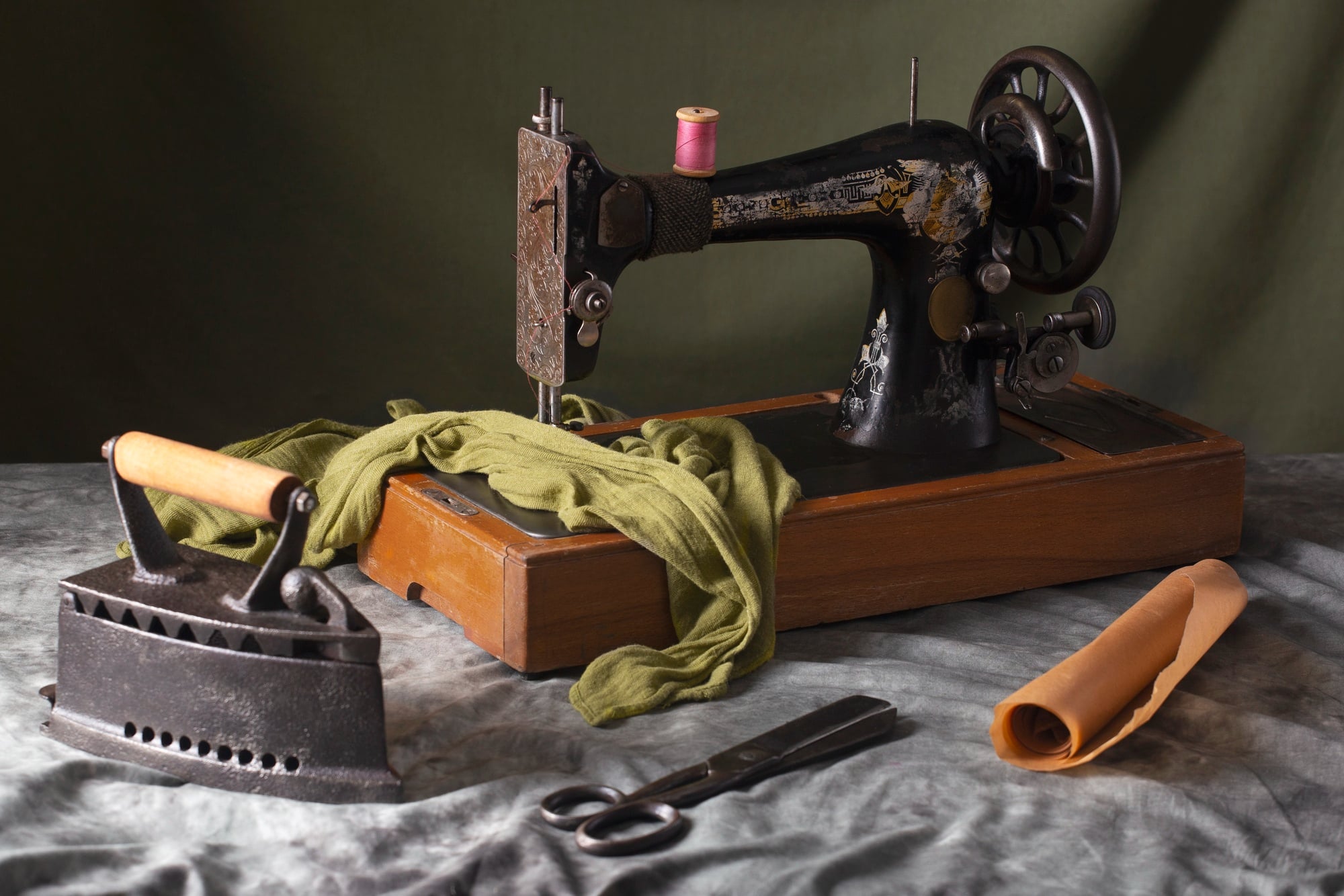
It was sitting on the end of a long folding table, by itself. Black and gold. A 1951 Singer 15-91, in its original wooden cabinet. The gold decals on the arm were worn thin where her hands had rested for seventy years. The little light on the front still had the same bulb she’d replaced in 1988.
“Here’s a nice one, folks,” the auctioneer said. “Old Singer. Runs good, I’m told. Who’ll give me fifty? Fifty dollars?”
A woman in the back said fifty.
A man in a seed cap said seventy-five.
The woman said a hundred.
The man said one-fifty.
“One-fifty, one-fifty, do I hear two?” the auctioneer said. “Two hundred for the Singer?”
He looked around the crowd.
He looked right at me.
I didn’t move.
“Sold,” the auctioneer said. “One-fifty. Number sixty-two.”
He moved on to a box of Christmas ornaments.
In my hand was a note card.
A small white index card, three by five, the kind with blue lines. I’d found it a week earlier in the top drawer of her sewing cabinet, tucked in with her pinking shears and her tape measure.
The handwriting was shaky. Slanted. Some of the letters went over the line.
The Singer goes to Abby. She’s the one who sews.
Part Two: Grandma Edna
My grandmother was Edna Lindquist.
She was born in 1933 in a farmhouse four miles from the one where she died. She married my grandfather, Arvid, in 1951. The Singer was his wedding present to her. He paid a hundred and twenty dollars for it at the Singer store in Alexandria. That was two months of his wages from the creamery.
She sewed on it for seventy-three years.
She made everything on that machine.
Her own wedding dress, the summer after she got it. Curtains for every window in the farmhouse. Arvid’s work shirts. Her daughters’ Easter dresses, every single year. Quilts for every grandchild. Christening gowns. Prom dresses. Halloween costumes.
When the church needed choir robes in 1969, she made twenty-two of them on that Singer. In three weeks.
She taught me to sew when I was seven.
My mother, Lorna, was Grandma’s younger daughter. She died when I was six. A car accident on Highway 29, in an ice storm, on her way home from her job at the hospital in Alexandria.
My father didn’t know what to do with a six-year-old girl. He was a long-haul trucker. He was gone three weeks out of every four.
So I spent most of my childhood at Grandma’s farm.
She put me on a kitchen chair next to the Singer when I was seven. She put a scrap of blue gingham under the presser foot. She put my hand on the fabric and her hand on top of mine.
“Slow,” she said. “Let the machine do the work. You just guide it.”
She pressed the knee lever. The needle went up and down. Chuk-chuk-chuk-chuk.
The fabric moved under our hands.
I made a potholder that afternoon. Crooked. Lumpy. The seams wandered all over the place.
She hung it on a nail by her stove.
It was still hanging there the day she died.
By ten, I could sew a straight seam. By twelve, I made my own skirt. By fifteen, I made my homecoming dress, and three girls at Brandon High School asked me where I bought it.
By eighteen, Grandma said I sewed better than she did.
She was lying. But it was the nicest thing anyone had ever said to me.
I’m thirty-six now.
I have a small alterations and tailoring business in Alexandria. Abby’s Alterations. A storefront on Broadway, between the coffee shop and the flower shop. I hem pants and take in wedding dresses and fix zippers for half the county.
I have two industrial machines in my shop and a modern Bernina in my spare room at home.
I didn’t need Grandma’s Singer to make a living.
I needed it for something else.
Part Three: Connie
My aunt Connie is Grandma’s older daughter.
She’s sixty-four. She lives in Glenwood, twenty miles from the farm. She’s a retired school secretary. She has short gray hair, a purple fleece jacket she wears from September to May, and a voice that can stop a hallway full of seventh graders without being raised.
She never learned to sew.
I don’t know the whole story. I only know pieces of it.
I know that when Connie was a girl, Grandma tried to teach her. On the same Singer. And I know that something went wrong. Connie broke a needle. Then another. Then she ran the needle through the tip of her finger and needed stitches at the clinic in Glenwood.
She never sat at the Singer again.
When my mother was alive, she and Connie fought. About everything. About who Grandma loved more. About who got the better Easter dress. About who got to sit in the front seat of the Buick.
Mom was the one who sewed. Connie was the one who didn’t.
Then Mom died.
And I was the little girl who sat at the Singer every Saturday.
I think Connie looked at me sometimes and saw her sister.
I think it hurt.
For the last four years of Grandma’s life, Connie took care of her.
I want to say that clearly. I want to be fair.
Grandma had a stroke at eighty-seven. She couldn’t drive anymore. She couldn’t do stairs. She couldn’t sew. Her right hand wouldn’t close all the way.
Connie drove out to the farm every day. Twenty miles each way. She cooked Grandma’s meals. She managed her pills. She took her to every doctor’s appointment in Alexandria and Fergus Falls. She bathed her. She did her laundry.
I came on weekends. Saturdays and Sundays. Connie came every single day.
When Grandma died in August, at ninety-one, Connie was holding her hand.
I was driving out from Alexandria. I got there forty minutes too late.
Part Four: The Will
The will was simple.
Grandma had it drawn up in 2015, at a lawyer’s office in Glenwood. Before the stroke. Before everything.
The farm and the land went to be sold, and the money split between Connie and me. Half for Connie. Half for me, for my mother’s share.
The household goods went to Connie.
Everything in the house. Furniture. Dishes. Linens. Jewelry. Tools.
And Connie was the executor.
There was no mention of the Singer.
The lawyer read it to us at Grandma’s kitchen table the week after the funeral. Connie and me and my husband, Nate. And Connie’s daughter, Megan.
When he finished, nobody said anything about the sewing machine.
A week later, I was helping Connie clean out the house. Packing boxes for the estate sale.
I opened the top drawer of the sewing cabinet.
And I found the card.
I read it standing in the middle of Grandma’s sewing room. The little room off the kitchen with the north window and the faded yellow wallpaper.
The Singer goes to Abby. She’s the one who sews.
I don’t know when she wrote it. There was no date.
But the handwriting was shaky. Shakier than her Christmas cards had been. It must have been after the stroke. After her right hand stopped closing all the way.
She’d written it left-handed, maybe. Or with her bad right hand, one letter at a time.
I carried it into the kitchen. Connie was at the table, wrapping Grandma’s good china in newspaper.
I held it out to her.
She read it.
Then she handed it back.
“A note isn’t a will, honey,” she said.
She was right.
I’m not a lawyer. But I knew enough. A will has to be signed. Witnessed. Notarized. A three-by-five card in a sewing drawer, with no date and no witness, isn’t anything a court would recognize.
The will left the household goods to Connie. The Singer was a household good.
It was hers.
And I was not going to sue my own aunt over a sewing machine.
Not the woman who’d driven forty miles a day for four years to take care of my grandmother. Not my mother’s sister. Not the only family I had left on that side.
I kept my mouth shut.
Part Five: The Sale
So on that Saturday in October, I stood one step from the folding table and watched the auctioneer sell Grandma’s Singer for a hundred and fifty dollars.
To a gray-haired man in a green seed cap.
He paid at the cashier’s table by the garage. He came back with a ticket. Number 62.
He picked up the Singer. The machine and the cabinet together. It’s heavy. Close to eighty pounds.
He carried it off past the dish tables. Past the rows of Grandma’s Pyrex and her canning jars and her church shoes.
He loaded it into the bed of a blue Chevy pickup. He covered it with a moving blanket.
He drove away down the gravel road.
I stood in the yard with the note card in my hand.
I didn’t cry. Not then.
My husband, Nate, was out running a grain cart for his brother. It was the middle of harvest. The corn on the Larson place was ready, and it was supposed to rain Tuesday. Nobody takes a Saturday off in the middle of harvest.
He’d texted me that morning. You okay? I can come.
I’d texted back. Stay. I’m fine.
I wasn’t fine.
Part Six: By the Coffee Pot
Later, after most of the buyers had gone home, I found Connie by the coffee pot.
They’d set up a big silver urn on a folding table by the back porch. The Lutheran church ladies had run it all day. Coffee and bars. Lemon bars and scotcheroos and Grandma’s own recipe for rhubarb dream bars, made by Mrs. Sundquist from down the road.
Connie was pouring herself a cup. She was still in her purple fleece. Her face was tired.
She saw me coming. She knew what I was going to say.
“You sold it,” I said.
“I sold it,” Connie said.
“For a hundred and fifty dollars.”
“That’s what it brought.”
I didn’t say anything.
Connie stirred powdered creamer into her coffee. Slowly. Round and round.
“You want to know why,” she said.
“Yes.”
She set down the spoon.
She looked out at the farm yard. At the empty folding tables. At the cars pulling out onto the gravel road.
“Megan,” she said.
Megan is Connie’s only daughter. She’s thirty-four. Two years younger than me.
We were close when we were little. We rode bikes down the gravel road. We slept in the hayloft on hot summer nights. We fought over who got to sit in the front seat of Grandma’s Buick, just like our mothers did.
We drifted apart after high school. After my mom died. After the fighting between Connie and me got worse.
“Megan’s raising Kaylee alone,” Connie said. “Since the divorce. Three years now. Jason doesn’t pay a dime.”
I knew that.
“She works at the Walmart in Alexandria,” Connie said. “Cashier. Thirty hours a week. She can’t get full-time.”
I knew that too.
“Kaylee’s eleven,” Connie said. “She’s wanted to dance since she was five. Since she saw The Nutcracker on TV one Christmas.”
She smiled a little. Despite herself.
“She used to dance around Grandma’s kitchen in her socks,” Connie said. “Spinning. Twirling. Falling into the cupboards.”
“There’s a dance studio in Alexandria,” Connie said. “On Fillmore Street. Lessons are sixty-five dollars a month. Plus shoes. Plus costumes. Plus recital fees.”
She looked at me.
“Megan can’t afford it,” she said. “So I pay for it. Out of my pension.”
She took a sip of her coffee.
“And I drive her,” Connie said. “Every Tuesday. Forty minutes each way. Because Megan works till six.”
I didn’t say anything.
“The money from the household goods,” Connie said. “The dishes. The furniture. The jewelry. The Singer. All of it.”
She looked at the yard.
“It’s going to Kaylee’s dance lessons,” she said. “For as long as it lasts.”
Then she looked at me.
“An old machine in your spare room doesn’t help anybody, Abby,” she said.
Her voice wasn’t mean. Just tired.
“Lessons help Kaylee,” she said.
That stung.
Because part of it was true.
I would have taken the Singer home. I would have set it in my spare room, next to my Bernina. I would have oiled it once a year and dusted it and looked at it.
And I would have sewn on my Bernina. Because it’s faster. Because it has forty-two stitch patterns and a needle threader and an automatic buttonholer.
The Singer would have sat there.
A memorial. A museum piece.
Connie was right.
An old machine sitting in a spare room doesn’t help anybody.
I didn’t say anything else.
I poured myself a cup of coffee. I took a rhubarb dream bar. I walked back to the yard and started folding up tables.
Part Seven: Number 62
On Sunday, I came back to help take down the rest of the tables.
Nate came too. The rain had held off. His brother gave him the morning.
We folded tables and stacked chairs and hauled boxes of unsold things to Connie’s van for the Goodwill in Alexandria.
When we were almost done, I went to close the gate at the end of the driveway.
There was a clipboard hanging on the gatepost. On a nail. With a pen on a string.
The sale’s sign-in sheet.
Every buyer at an estate sale signs in when they arrive. Name, town, phone number. They get a number. They use the number to bid.
I flipped through the pages.
Number one, Arlene Sundquist, Brandon. Number two, Dale Peterson, Garfield. Number three.
I kept flipping.
Number 62.
Merle Haugen. Herman.
There was a phone number. And a rural route address. County Road 7.
Herman is a little town forty minutes west of Alexandria. Population four hundred. A grain elevator and a bar and a Lutheran church and not much else.
I took a picture of the sign-in sheet with my phone.
I didn’t tell Nate. Not yet.
I didn’t know what I was going to do.
I just knew I couldn’t stop thinking about the man in the green seed cap, carrying Grandma’s Singer past the dish tables.
Part Eight: Merle Haugen
Monday after my last client, I drove out to his farm.
My last client was Mrs. Bergstrom, who needed her Sunday slacks hemmed. She left at four-fifteen. I locked up the shop. I got in my car. I drove west on Highway 27.
I didn’t call first.
I don’t know why. I think I was afraid that if I called, he’d say no. And then I’d have to stop.
County Road 7 is gravel. It runs north out of Herman through flat, open farmland. Sugar beets and wheat and soybeans, all harvested. Shelterbelts of cottonwood and green ash. A big sky turning gold in the late afternoon.
The Haugen farm was four miles up. A white farmhouse. A red barn with the paint peeling. A machine shed. A flagpole in the front yard with the flag at full staff.
The blue Chevy pickup was parked by the house.
I sat in my car in his driveway for five minutes.
Then I got out and knocked.
He opened the door. The gray-haired man in the green seed cap.
He was seventy, I’d guess. Tall and thin, with big rough hands and a face like old leather. He was wearing a flannel shirt and work jeans and slippers.
He looked at me.
He knew who I was before I said a word. I could see it on his face.
“You’re the granddaughter,” he said.
“Yes, sir,” I said. “Abby. Abby Thorson. Edna Lindquist was my grandmother.”
He looked at me for a long moment.
“You were standing by the table,” he said. “When I bought her.”
“Yes, sir.”
“You looked like somebody was selling your dog,” he said.
I didn’t know what to say.
He stepped aside.
“Come in,” he said. “Coffee’s on.”
Part Nine: The Kitchen Window
His kitchen was small and clean.
Yellow linoleum. White cabinets. An oilcloth on the table, red and white checks. A calendar from the Herman Farmers Elevator on the wall, still turned to September.
And by the window, in the late afternoon light, Grandma’s Singer.
It was sitting in its wooden cabinet. The lid was open. The machine was up. The light was on.
It was shining.
He’d cleaned it. Every inch of it. The black enamel gleamed. The gold decals glowed. The chrome on the handwheel caught the light.
And he’d oiled it. I could smell it from the doorway. Sewing machine oil. Thin and clean.
“Cord was cracked,” Merle said.
He was standing behind me. Pouring two cups of coffee.
“Old rubber,” he said. “From the fifties. Dangerous. Could’ve caught fire. I put a new one on her yesterday. Got the part from a fella in Morris who fixes them.”
He set a cup of coffee on the table.
“Motor’s good,” he said. “Belt’s good. Timing’s good. Somebody took real good care of her.”
“My grandmother,” I said.
“I figured,” Merle said.
He sat down at the kitchen table. He gestured for me to sit across from him.
I sat.
“My wife sewed,” Merle said. “Lorraine. Forty-six years married.”
He looked at the Singer.
“She had one just like that,” he said. “A 15-91. Black and gold. Her mother’s. She made all my shirts on it. All the kids’ clothes. Every quilt in this house.”
He swallowed.
“She passed three years ago,” he said. “Pancreatic cancer. Six weeks from the diagnosis to the funeral.”
“I’m sorry,” I said.
He nodded.
“After she was gone,” Merle said, “my daughter took the machine. To her house in Fargo. She doesn’t sew. It sits in her basement. In a corner. Under a sheet.”
He looked at the window.
“I miss the sound,” he said quietly. “Chuk-chuk-chuk. In the evenings. When I was reading the paper and she was sewing at the kitchen window.”
“When I saw that Singer on the table Saturday,” he said, “I just wanted to hear it again.”
He looked at me.
“I’m not proud of it,” he said. “Buying a dead woman’s sewing machine so I could pretend my wife was still here.”
I didn’t say anything for a long time.
The kitchen clock ticked. Outside the window, a combine was crawling across a field a mile away, its headlights coming on in the dusk.
“Tell me why you want it,” Merle said.
Part Ten: The Card
I reached into my purse.
I took out the note card. The three-by-five index card with the blue lines.
I set it on his red-and-white oilcloth.
Merle picked it up.
He held it close to his face. He didn’t have his reading glasses.
He read it.
Then he read it again.
The Singer goes to Abby. She’s the one who sews.
He set it down on the table very carefully. Like it might break.
“Her handwriting,” he said.
“Yes.”
“After a stroke, maybe,” he said. “Lorraine’s got shaky like that. At the end.”
“Yes,” I said. “After a stroke.”
“And the will?” Merle asked.
“Left the household goods to my aunt,” I said. “She was the executor. She sold it.”
“And this card?”
“Isn’t a will,” I said. “My aunt said so. She’s right.”
Merle looked at the card for a long time.
“Why’d your aunt sell it?” he asked.
So I told him.
About Megan. About Kaylee, eleven years old, who’s wanted to dance since she was five. About sixty-five dollars a month and forty minutes each way every Tuesday. About Connie paying for it out of her school secretary’s pension.
About an old machine in your spare room doesn’t help anybody.
Merle listened without interrupting.
When I finished, he nodded slowly.
“She’s not wrong,” he said.
“I know,” I said.
I reached into my purse again.
I took out four hundred dollars. Four hundred-dollar bills. I’d stopped at the bank in Alexandria on my lunch break.
I folded them once.
I set them on the table. Next to the note card.
Merle looked at the money.
“I only paid a hundred and fifty,” he said.
“I know,” I said.
I looked at him.
“I’d rather overpay,” I said, “than have you think I talked you out of it.”
He was quiet for a long time.
Then he picked up the four bills. He looked at them.
“My granddaughter’s twelve,” he said. “Lives in Fargo. With my daughter. The one with Lorraine’s machine in the basement.”
He folded the bills again.
“She’s been asking her mother to teach her to sew,” Merle said. “Her mother can’t. And she won’t let her touch Lorraine’s machine. Says it’s too old. Too valuable.”
He looked at me.
“The extra two-fifty,” he said, “is going to a new machine. For my granddaughter. A modern one. So she can learn.”
He put the money in his shirt pocket.
“Lorraine would like that,” he said.
Then he stood up.
He walked to the window. He put his big rough hands on either side of the Singer’s cabinet.
He lifted it.
Eighty pounds. Seventy years old. He carried it out of his kitchen and down the porch steps and across the yard to my car himself.
He set it in my back seat. Carefully. He wrapped it in the same moving blanket he’d used on Saturday.
Then he stood back and looked at it.
“You’ll use it,” he said. It wasn’t a question.
“Yes, sir,” I said.
“Not just look at it,” Merle said. “Use it.”
“I promise,” I said.
He nodded.
He put his hand on the roof of my car. He looked at the Singer in the back seat for a long moment.
“Bring me something you make on it,” he said. “Someday. A potholder. Anything.”
“I will,” I said.
I drove home in the dark with Grandma’s Singer in my back seat.
I cried the whole way. Forty minutes.
Part Eleven: The Phone Call
On Tuesday, I called Connie.
I waited until evening. Until I knew she’d be home from driving Kaylee to dance.
I sat at my kitchen table with my phone. Nate was in the living room watching the news. The Singer was in our spare room, next to my Bernina.
I’d already oiled it. I’d already threaded it. I’d already sewn one straight seam on a scrap of blue gingham.
Chuk-chuk-chuk-chuk.
Connie answered on the third ring.
“Abby,” she said. Wary.
I hadn’t called her to fight.
I want to be clear about that. I’d thought about it all day. All the things I could say. You sold it out from under me. You knew what that card meant. You were angry at my mother and you took it out on me.
I didn’t say any of them.
“Connie,” I said. “I’ve got Grandma’s Singer back.”
The line went silent.
“What?” Connie said.
“I found the buyer,” I said. “On the sign-in sheet. Merle Haugen, from Herman. I drove out yesterday. I bought it back.”
Connie didn’t say anything for a long time.
I could hear her breathing. I could hear her TV in the background. Wheel of Fortune.
“How much did you pay him?” she asked finally.
“Doesn’t matter,” I said.
“Abby,” Connie said. “If you’re calling to rub it in—”
“I’m not,” I said.
I took a breath.
“Send Kaylee on Saturdays,” I said.
Silence.
“What?”
“Send Kaylee to my house on Saturdays,” I said. “In the mornings. I’ll teach her to sew on Grandma’s Singer.”
I paused.
“Free,” I said.
The line went quiet for a long time.
So long I thought she’d hung up. I looked at my phone. The call was still connected. Forty-two seconds of silence.
“Why would you do that?” Connie said finally.
Her voice was strange. Not angry. Not suspicious.
Confused.
I looked down the hall toward the spare room. Toward the Singer by the window. The black and gold. The light still on.
“Because that’s what the machine is for,” I said.
Connie didn’t answer.
“Grandma taught me on it,” I said. “When I was seven. Every Saturday. She put my hand on the fabric and her hand on top of mine.”
I swallowed.
“Kaylee’s eleven,” I said. “She’s Grandma’s great-granddaughter. She should learn on Grandma’s machine.”
“She doesn’t sew,” Connie said. “She dances.”
“Dancers need costumes,” I said.
There was another long pause.
“I’ll ask Megan,” Connie said quietly.
Then she hung up.
Part Twelve: The First Saturday
Kaylee came the first Saturday in November.
Megan dropped her off at nine o’clock. She didn’t come in. She sat in her old Ford Focus in my driveway and waved through the windshield and drove away as soon as Kaylee got to the door.
Kaylee stood on my front porch in a pink puffy coat and a knit hat with a pom-pom. She was holding a backpack in both hands.
She looked terrified.
“Hi, Kaylee,” I said.
“Hi,” she said. Barely a whisper.
I hadn’t seen her in two years. Not since a Christmas at Grandma’s farm, before the second stroke. She’d been nine. Shy. Hiding behind her mother’s legs.
She was taller now. Skinny. Long brown hair in a ponytail. She had Megan’s big brown eyes and Connie’s stubborn chin.
She stood like a dancer. Even scared. Feet turned out a little. Back straight.
I brought her inside. I made her hot chocolate with marshmallows. I showed her the spare room.
She stopped in the doorway.
She looked at the Singer.
It was sitting by the window in its wooden cabinet. The lid was open. The machine was up. The little light was on.
I’d set a kitchen chair next to it. The same way Grandma did for me.
“That was Great-Grandma Edna’s,” Kaylee said.
“It was,” I said. “Did you ever see her sew on it?”
Kaylee shook her head.
“Grandma Connie said it was too old,” she said. “She said it might bite.”
I laughed.
“It doesn’t bite,” I said. “I promise. Sit down.”
She sat down on the kitchen chair.
She sat at the Singer like it might bite. Hands in her lap. Shoulders up by her ears. Leaning away from the needle.
“Okay,” I said. “First, we need a bobbin.”
I opened the little attachment box.
It was a small cardboard box. Green and gold, with the Singer logo on the lid. It came with the machine in 1951. It held all the extra parts. Presser feet and bobbins and a screwdriver and a buttonholer.
Connie had thrown it in with the machine at the sale. I don’t think she even looked inside.
I opened it to get a bobbin.
Grandma’s thimble was in the back corner.
It was silver. Old. Worn thin on one side, the side that pressed against the needle for seventy years. There was a tiny dent near the top.
I’d seen it on her finger every Saturday of my childhood. Her middle finger. Right hand.
I’d thought it was lost. We couldn’t find it after she died. Connie looked everywhere.
It had been here the whole time. In the attachment box. In the back corner.
I held it in my hand for a long moment.
Then I turned to Kaylee.
“Give me your hand,” I said.
She held out her right hand. Hesitant.
I put Grandma’s thimble on her middle finger.
It was too big.
It slid down past her first knuckle. It wobbled.
Kaylee looked at it.
“It doesn’t fit,” she said.
“It will,” I said. “Someday.”
She wore it all morning anyway.
Part Thirteen: Something Else in the Box
That first morning, after Kaylee went home, I sat down at the Singer by myself.
I picked up the attachment box to put it away.
Something slid in the bottom.
It was a folded piece of paper. Tucked under the cardboard insert that held the presser feet. I’d missed it when I took out the bobbin.
I unfolded it.
It was another index card. Three by five. Blue lines.
The same shaky handwriting.
Abby — Teach Connie.
She always wanted to learn. She was too proud to ask after the needle.
Don’t let her be too proud forever.
— G.
I sat at the Singer for a long time.
I read it four times.
Then I folded it up. I put it back in the attachment box. Under the cardboard insert. Where Grandma had hidden it.
I didn’t tell anyone.
Not yet.
Part Fourteen: Pillowcases and Pot Holders
Kaylee came every Saturday after that.
Nine o’clock to noon. Megan dropped her off and picked her up. She never came inside.
We started slow.
The first Saturday, Kaylee sewed straight lines on paper. No thread. Just the needle punching holes along lines I’d drawn with a ruler. Back and forth. Over and over.
“Let the machine do the work,” I told her. “You just guide it.”
She stuck her tongue out of the corner of her mouth when she concentrated. Exactly like Grandma did.
The second Saturday, she sewed straight lines on fabric. Scraps of muslin. Then curves. Then corners.
The third Saturday, she learned to thread the machine. It took her forty minutes. She threaded it wrong six times.
On the seventh try, she got it.
She sat back in her chair and grinned. The first real grin I’d seen on her.
We made pillowcases in November.
She picked out the fabric herself at the Jo-Ann’s in Alexandria. Purple with little white ballet slippers. One for her and one for her mom.
Her seams were crooked. Her hems wandered. One pillowcase came out two inches shorter than the other.
She was so proud she carried them out to Megan’s car in both arms.
We made pot holders for Christmas.
Twelve of them. Quilted. Red and green.
One for her mom. One for her grandma Connie. One for her dance teacher, Miss Rachel. One for her best friend at school.
One for me.
And one more.
She asked me to drive her to Herman. On a Saturday in December, right before Christmas.
We drove out County Road 7. Snow on the fields. The shelterbelts black against the white.
Merle Haugen answered the door in his flannel shirt and slippers.
He looked at me. Then he looked down at Kaylee, standing on his porch in her pink puffy coat.
She held out a pot holder. Red and green. Quilted. A little crooked.
“I made this,” Kaylee said. “On Great-Grandma Edna’s machine. Abby said you fixed the cord.”
Merle took the pot holder.
He held it in his big rough hands for a long time.
Then he went inside and hung it on a nail by his stove.
Right next to an old one. Faded blue gingham. The one Lorraine made on her mother’s 15-91 in 1975.
Part Fifteen: The Recital Letter
In January, Kaylee brought me the recital letter.
She pulled it out of her backpack on a Saturday morning. Folded in half. Wrinkled. She set it on the table next to the Singer.
“Miss Rachel sent it home,” she said. “For the spring recital.”
I read it.
Lakes Area Dance Academy Spring Recital. Saturday, April 19. Alexandria Area High School Auditorium.
Costume fee for Level 3 Lyrical: $85.
Costumes must be paid for by February 1.
Kaylee was looking at the floor.
“Grandma Connie already paid for January lessons,” she said quietly. “And February. And new shoes. My old ones got too small.”
She swallowed.
“Mom says we can’t do the costume,” she said. “She says maybe I can sit out the recital this year.”
I looked at the letter.
There was a picture printed at the bottom. Black and white. A girl in the costume.
A simple leotard. Pale lavender. Long sleeves. And a skirt. Flowing chiffon, cut on the bias, three layers, ending just above the knee. A little satin sash at the waist.
“Kaylee,” I said. “Can I call your dance teacher?”
I called Miss Rachel that afternoon.
She was young. Twenty-eight, maybe. She’d danced with a ballet company in Minneapolis before coming home to Alexandria to open her own studio.
I told her who I was. I told her about Kaylee. About the Singer. About Saturdays.
“Could Kaylee make her own costume?” I asked.
There was a pause on the line.
“Her own costume?” Miss Rachel said.
“If it matched,” I said. “Exactly. Same color. Same cut. Same fabric.”
Miss Rachel was quiet for a moment.
Then she laughed. A warm, surprised laugh.
“Honestly?” she said. “If it matches the other girls, I don’t care who sews it.”
Part Sixteen: Nine Saturdays
Kaylee pinned and ripped and sewed that skirt for nine Saturdays.
We drove to the Jo-Ann’s in Alexandria and found the chiffon. Pale lavender. Almost the exact shade on the recital letter. We found matching satin for the sash. Eleven dollars and forty cents, total. I paid. She insisted on paying me back out of her allowance.
I made her a paper pattern. Three layers. Cut on the bias, so the chiffon would flow when she moved.
She pinned it to the fabric herself. Every single pin.
Chiffon is the hardest fabric there is to sew.
It’s slippery. It shifts. It puckers. It frays the second you look at it. Professional seamstresses dread it.
Kaylee was eleven.
She cut the first layer crooked. She had to start over.
She cut the second layer right. Then she sewed the side seam and it puckered so badly it looked like a crumpled tissue.
She ripped it out with Grandma’s seam ripper. She sewed it again.
It puckered again.
She ripped it out again.
I taught her French seams. The way Grandma taught me. Sew the seam with the wrong sides together. Trim it close. Turn it. Sew it again with the right sides together. So the raw edge is trapped inside and never frays.
It doubles the work. Triples it, for a beginner.
Kaylee did every seam twice.
She cried once.
Over the zipper.
The leotard was store-bought, but the skirt needed an invisible zipper in the back. Seven inches. Invisible zippers are fussy. They have to be exactly right, or they show.
She put it in wrong. Then wrong again. Then she broke the needle on the metal pull.
She put her head down on the Singer’s cabinet and sobbed.
“I can’t do it,” she said. “I’m not good enough. I should just sit out the recital.”
I sat down next to her.
I didn’t say anything for a while. I just put my hand on her back.
Then I opened the attachment box. I took out a new needle. I handed it to her.
“Your great-grandma broke more needles than you’ve ever seen,” I said. “Hundreds. In seventy years.”
Kaylee lifted her head.
“Really?” she said.
“Your grandma Connie broke two,” I said. “When she was your age. On this exact machine. Then she sewed right through her finger.”
Kaylee’s eyes went wide.
“Grandma Connie sewed?”
“She tried,” I said. “Once. She got scared. She never tried again.”
Kaylee looked at the broken needle in her hand.
She looked at the zipper.
She wiped her eyes on the sleeve of her sweatshirt.
“Show me again,” she said.
She did not quit.
Part Seventeen: The Last Saturday in March
The last Saturday in March, the costume was done.
Three layers of pale lavender chiffon. Cut on the bias. French seams on every edge. An invisible zipper in the back that was, in fact, invisible. A satin sash at the waist with a bow she’d tied and retied eleven times until it was perfect.
She tried it on with her leotard in my spare room.
She stood in front of the mirror on the closet door.
She spun.
The skirt flew out around her. All three layers. Floating. Settling. Like lavender smoke.
She spun again.
She looked at herself in the mirror for a long time.
“I made this,” she said quietly.
“You made this,” I said.
She changed back into her sweatshirt and jeans. She hung the costume carefully on a padded hanger.
She was standing in the doorway of the spare room, holding it with both hands, when the doorbell rang.
I went to the front door.
I expected Megan. In her Ford Focus. Waving through the windshield.
It was Connie.
She was standing on my front porch. In her purple fleece.
The same purple fleece. The one she wore at the estate sale. By the coffee pot.
She had not set foot in my house in years.
Not since my wedding, eight years ago. Not since Grandma’s first stroke. Not since the fighting got bad.
She’d driven Kaylee to dance every Tuesday for six years. She’d driven past my house on Highway 27 a hundred times.
She’d never stopped.
“Megan’s car won’t start,” she said. “Battery. I came to get Kaylee.”
She didn’t look at me. She looked past me, into the house.
“Is she ready?” she asked.
Part Eighteen: The Hem
Kaylee came out of the sewing room before I could answer.
She was holding the costume on its hanger with both hands. Out in front of her. Like it was made of glass.
She saw her grandmother on the porch.
She stopped.
Then she walked to the door.
She held up the hanger.
“Grandma,” she said. “I made this.”
Her voice was shaking.
“All of it,” she said. “On Great-Grandma Edna’s machine.”
Connie looked at the costume.
She didn’t say anything.
She reached out with one hand.
She touched the hem.
She ran her fingers along the bottom edge of the chiffon. The narrow rolled hem. The one Kaylee had sewn three times until it was even all the way around.
Then she took the skirt in both hands, gently, still on the hanger.
She turned it over.
She looked at the seams.
She looked at them for a long time.
The French seams. Every one sewn twice. Raw edges trapped inside, clean and narrow, a quarter inch wide. Exactly the way Grandma Edna sewed every seam on every dress for seventy-three years.
Exactly the way she’d tried to teach Connie, sixty years ago, before the needle.
Connie’s hand was trembling.
Then she looked at me.
Part Nineteen: What Connie Said
She didn’t say anything for a long moment.
Her eyes were wet. Her chin was trembling. The stubborn chin. The one Kaylee has.
“French seams,” she said finally.
Her voice was barely a whisper.
“Mom’s French seams,” she said.
“She taught Kaylee,” I said. “Through me.”
Connie looked down at the skirt.
At the seams. At the hem. At the invisible zipper.
“She tried to teach me,” Connie said. “These. When I was ten. On that machine.”
She swallowed.
“I sewed my finger,” she said. “I had to get four stitches at the clinic in Glenwood. I never sat down at it again.”
She let go of the skirt.
She looked at me.
“Your mother sewed,” Connie said. “Lorna. Like you. She could sew anything.”
Her voice cracked.
“And then she died,” Connie said. “And Mom had you. Every Saturday. At that machine. Teaching you the French seams. The same way she taught Lorna.”
She wiped her eyes.
“And I was the one who didn’t sew,” she said.
“I sold it, Abby,” Connie said. “At the sale. I want you to know I knew exactly what I was doing.”
She took a breath.
“I read that card,” she said. “She’s the one who sews. And I thought, Mom left Abby the thing she loved most. And she left me the dishes.”
She shook her head.
“Four years,” she said. “I drove out there every day for four years. I held her hand when she died. And she left you the Singer.”
I didn’t say anything.
I didn’t know what to say.
“So I sold it,” Connie said. “For Kaylee. That part’s true. But not only for Kaylee.”
She looked at me.
“I sold it because I was angry,” she said. “At Mom. At Lorna. At you. At a sewing machine I couldn’t use.”
Kaylee was standing very still between us. Holding her costume.
“Grandma,” she said quietly. “Abby says you broke two needles. When you were my age.”
Connie looked down at her granddaughter.
“I did,” she said.
“I broke one,” Kaylee said. “On the zipper. I cried.”
She held up the costume a little higher.
“But I didn’t quit,” she said.
Connie put her hand over her mouth.
Part Twenty: The Other Card
I went back into the house.
Into the spare room. To the Singer by the window.
I opened the attachment box. I lifted the cardboard insert.
I took out the second card.
I came back to the front door. Connie was still standing on the porch. Kaylee was beside her, holding the costume.
I held out the card.
Connie looked at it.
She looked at the shaky handwriting. Slanted. Going over the lines.
She took it.
She read it.
Abby — Teach Connie.
She always wanted to learn. She was too proud to ask after the needle.
Don’t let her be too proud forever.
— G.
She read it again.
Then my aunt Connie, sixty-four years old, retired school secretary, a woman who could stop a hallway full of seventh graders without raising her voice, stood on my front porch in her purple fleece and cried.
Not quietly. Not politely.
She cried like a little girl. Like a ten-year-old with four stitches in her finger.
Kaylee put the costume on the porch railing. She put her arms around her grandmother’s waist.
I stood in the doorway.
“Where did you find this?” Connie said finally.
“In the attachment box,” I said. “Under the presser feet. The first Saturday.”
She looked at me.
“In November,” she said. “You’ve had this since November.”
“Yes.”
“Why didn’t you give it to me?”
I thought about it.
“Because I didn’t want you to come because of a note,” I said. “I wanted you to come because of Kaylee.”
Connie looked at the card for a long time.
“She knew,” she said quietly. “She knew I always wanted to learn.”
“She knew,” I said.
“She never said anything,” Connie said. “Not once. In sixty years.”
“She was waiting,” I said. “For you to ask.”
Connie laughed through her tears.
“I’m sixty-four,” she said. “I’m too old to learn to sew.”
Kaylee looked up at her.
“Grandma,” she said. “It’s not that hard. You just let the machine do the work.”
She took Connie’s hand.
“You just guide it,” Kaylee said.
Part Twenty-One: Saturday Mornings
Connie came the next Saturday.
Nine o’clock. She drove Kaylee herself. She parked in my driveway, got out of her car, and walked up to the front door.
She was still wearing the purple fleece.
She was holding a box of scotcheroos.
“I brought bars,” she said. “For coffee.”
“Come in,” I said.
That’s how it’s been ever since.
Every Saturday. Nine to noon.
Kaylee at the Singer. Connie at my Bernina. Me in between, going back and forth with a pincushion on my wrist and Grandma’s seam ripper in my pocket.
Connie was terrible at first.
Worse than Kaylee. She held the fabric too tight. She pressed the pedal too hard. She panicked every time the needle came near her fingers.
She broke a needle the second Saturday. She went white.
Kaylee handed her a new one from the attachment box.
“Great-Grandma Edna broke hundreds,” Kaylee said. “Abby said.”
By the fifth Saturday, Connie could sew a straight seam.
By the tenth, she made a pillowcase. Purple, with little yellow daisies. For her own bed.
By the fifteenth, she made a French seam.
Her first one. On a scrap of muslin.
She sat back from my Bernina and stared at it for a long time.
Then she turned it over and looked at the inside. The raw edge trapped clean and narrow.
“Look at that,” she whispered. “Look at that, Mom.”
Part Twenty-Two: The Recital
The recital was on April 19th.
Alexandria Area High School Auditorium. Seven o’clock.
Connie drove. Megan sat beside her. I sat behind them with Nate. He’d taken the night off from planting.
Merle Haugen came too.
He drove forty minutes from Herman. He wore a pressed shirt and his good seed cap. He brought his granddaughter from Fargo. A twelve-year-old named Ella, with braces and a new Brother sewing machine she’d been learning on for three months.
“Two-fifty,” Merle whispered to me as he sat down. “Best money I ever spent.”
Kaylee danced fourth.
Level 3 Lyrical. Eight girls in pale lavender. A slow, sweeping piece to a piano song I didn’t know.
Seven of the girls wore store-bought costumes. Eighty-five dollars each.
One of them wore a costume she made herself. On her great-grandmother’s 1951 Singer. With French seams and an invisible zipper and a satin bow tied eleven times.
Nobody could tell the difference.
That was the point.
But I could tell.
When Kaylee spun, her skirt flew out around her like lavender smoke. All three layers. Floating. Settling.
The bias cut made it move like water.
The French seams held.
Connie was crying in the seat in front of me. Megan was holding her hand.
Merle Haugen was sitting very still, watching the girl in the lavender skirt.
“Lorraine would’ve loved that,” he said quietly. “The way it moves.”
When Kaylee came out for her bow at the end, she was looking for us in the audience. Searching the rows.
She found her grandmother.
She held up her right hand.
On her middle finger, too big, sliding down past her first knuckle, was Grandma Edna’s silver thimble.
She’d danced with it on.
The whole time.
Part Twenty-Three: What the Machine Is For
After the recital, in the high school parking lot, Connie found me by my car.
The other families were taking pictures. Kaylee was surrounded by girls from her class. Megan was hugging Miss Rachel.
Connie stood beside me in her purple fleece.
She didn’t say anything for a while.
“Abby,” she said finally. “I want to give you something.”
She reached into her purse.
She took out a check. Made out to me. In her neat school-secretary handwriting.
$150.
“For the Singer,” she said. “What it sold for. It wasn’t mine to sell. Not really.”
I looked at the check.
“Connie,” I said. “I don’t want your money.”
“I know,” she said. “But I want you to have it.”
I thought about it.
Then I handed it back to her.
“Put it toward next year’s costume,” I said. “Kaylee’s going to want to make it herself.”
Connie looked at the check. Then at me.
“You’re impossible,” she said.
“I learned it from Grandma,” I said.
She laughed. Then she did something she hadn’t done since my wedding.
She hugged me.
“She was right, you know,” Connie said into my shoulder. “Mom. On that card.”
“Which card?”
“The first one,” Connie said. “She’s the one who sews.”
She pulled back. She looked at me.
“You’re the one who sews,” she said. “You always were. Like Lorna.”
She looked over at Kaylee, laughing with her friends in the parking lot. Still in her lavender skirt.
“And now there’s another one,” Connie said.
I looked at Kaylee too.
“Two more,” I said.
Connie looked at me.
“You,” I said. “You made a French seam last Saturday.”
She laughed.
Then she cried.
Then she did both, standing in the parking lot of Alexandria Area High School in her purple fleece.
Part Twenty-Four: Now
It’s October again now.
A year since the estate sale. The corn is half out. The soybeans are done. The sky is bright and cold.
The farm sold in June. A young couple from Wadena. They have three kids and two dogs. They’re turning the sewing room into a nursery.
The Singer is in my spare room.
By the window. In its wooden cabinet. The black enamel gleaming. The gold decals worn thin where Grandma’s hands rested for seventy years. Where my hands rest now. And Kaylee’s.
And, on Saturdays, Connie’s.
There are four kitchen chairs in my spare room now.
Kaylee. Connie. Merle’s granddaughter, Ella, who drives down from Fargo with her mother once a month. And Megan.
Megan started coming in August.
She sat in my driveway in her Ford Focus for twenty minutes the first time. Then she came inside. She’s making a quilt. For Kaylee’s bed. Lavender and white.
Merle comes too, sometimes.
He doesn’t sew. He sits at my kitchen table with a cup of coffee and the newspaper.
He says he just likes the sound.
Chuk-chuk-chuk-chuk.
The two index cards are framed now.
Side by side. On the wall above the Singer. In a simple wooden frame Nate made in the machine shed.
The Singer goes to Abby. She’s the one who sews.
Abby — Teach Connie. Don’t let her be too proud forever.
Last Saturday, Kaylee was working on next year’s recital costume.
She’s twelve now. She moved up to Level 4. Contemporary. The costume is a deep blue jumpsuit with a sheer overskirt.
She’s making it herself.
She’s using French seams.
At eleven o’clock, she stopped sewing.
She pulled Grandma’s thimble off her middle finger. She held it up to the light from the window.
Then she put it back on.
It doesn’t wobble anymore.
It doesn’t slide down past her knuckle.
“Abby,” she said. “Look.”
She held up her hand.
“It fits,” she said.
Connie looked up from my Bernina. She was working on a dress. Her first one. Navy blue, for church.
She looked at the thimble on her granddaughter’s finger.
She looked at the two cards framed on the wall.
She looked at me.
She didn’t say anything.
She didn’t have to.
Grandma Edna wrote that the Singer went to me because I’m the one who sews.
She was right.
But I think she knew something else, too. Something she never wrote on any card.
A sewing machine sitting in a spare room doesn’t help anybody.
Connie said that by the coffee pot at the estate sale. She was right too.
A sewing machine is only worth what it teaches.
The hands it guides. The seams it holds. The girl it gets through a zipper without quitting.
The woman it finally lets sit down, sixty years later, and ask.
Let the machine do the work, Grandma used to say. You just guide it.
I used to think she was talking about the fabric.
She wasn’t.

Specialty: Quiet Comebacks & Personal Justice
David Reynolds focuses on stories where underestimated individuals regain control of their lives. His writing centers on measured decisions rather than dramatic outbursts — emphasizing preparation, patience, and the long game. His characters don’t shout; they act.