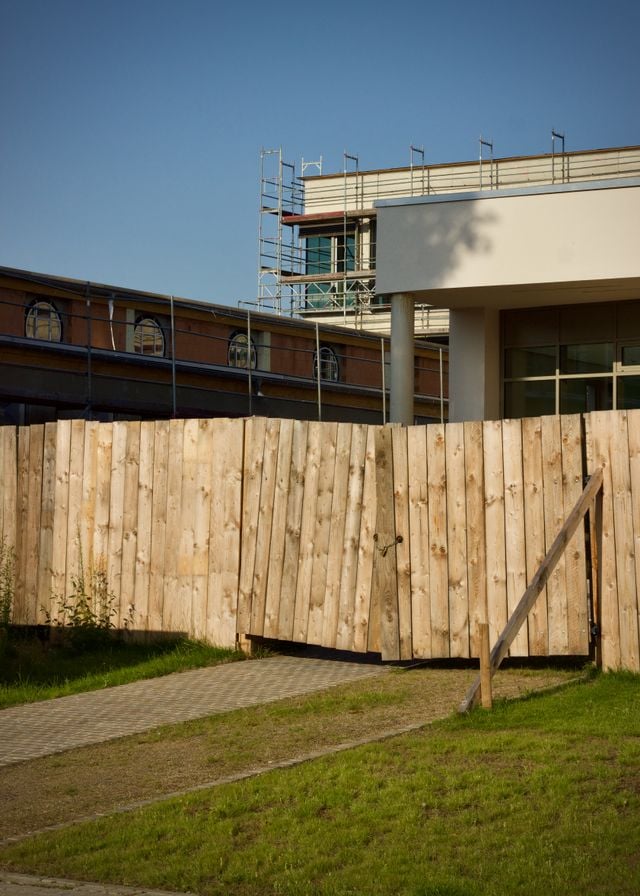
“Take one step past that fence and I’ll have you arrested for trespassing.”
Tyler Bennett said it from his new backyard, with one hand resting on the top rail of the fence he’d built eight feet inside my property.
He was wearing a light blue polo shirt and expensive sunglasses pushed up on his head. He was holding a cup of coffee. He looked like a man in a commercial for lawn fertilizer.
I looked at him.
Then I looked down at the bright orange survey flag sticking out of the grass, three feet from his shoe. On his side of the fence.
“That’s my land,” I said.
He smiled.
“Not anymore.”
I wish I could tell you that I laughed. That I thought he was joking, or confused, or just a guy who’d gotten some bad information from his fence company.
I didn’t laugh.
Because by then, I understood something about Tyler Bennett.
He wasn’t confused.
He knew exactly what he was doing.
My name is Jason Miller. I’m forty-three years old. I’m a commercial electrician. I wire office buildings and warehouses and the occasional hospital wing. I’ve been doing it since I was nineteen.
I’ve lived in my little brick house outside Raleigh, North Carolina, for eleven years.
I bought it after my divorce.
My ex-wife, Dana, and I had been married for fourteen years. We didn’t hate each other at the end. We were just two people who’d stopped knowing how to talk. She kept the big house in Cary, and I took what I could afford, which wasn’t much.
I looked at nine houses that spring. The real estate agent kept trying to show me condos. Low maintenance, she said. Perfect for a single guy.
Then she showed me this one.
It was small. Two bedrooms. A kitchen that hadn’t been touched since the eighties. A bathroom with pink tile.
But it had two things I could afford to love without worrying they’d ever leave me.
An old oak tree.
And a backyard.
It wasn’t anything fancy. Just a rectangle of grass, a little bigger than most on the street. Enough room for a grill and a storage shed and a vegetable garden I mostly failed at.
And the oak tree. A huge old white oak at the back of the lot, maybe a hundred years old, with branches as thick as a man’s body. The first time I saw it, I stood under it for ten minutes without saying anything.
The real estate agent said, “Mr. Miller? Are you okay?”
I said, “I’ll take it.”
That first summer, my daughter, Emma, was ten. She stayed with me every other weekend and two weeks in July.
The first weekend she came, she walked out into the backyard and looked up at that oak tree and said, “Dad. We need a swing.”
So I built one.
I bought a thick piece of white oak at the lumber yard and sanded it smooth myself in the garage. I drilled the holes. I bought marine rope, the kind they use on boats, so it wouldn’t rot. I climbed a twenty-foot ladder, which I’m not proud of, and tied it to the lowest big branch with a knot an old electrician taught me when I was an apprentice.
Emma sat on that swing every weekend for eight years.
When she was ten, she swung so high I thought she’d end up in the branches. When she was thirteen, she sat on it and cried about a boy named Tanner who didn’t like her back. When she was sixteen, she sat on it and practiced her driver’s test questions out loud. When she was eighteen, the night before she left for college, she sat on it with me in the dark, and neither of us said much, and that was fine.
She’s twenty-one now. She’s a junior at UNC Wilmington, studying marine biology. She doesn’t come home as often as I’d like.
But the swing is still there.
I knew every inch of that yard.
I’d mowed it every Saturday morning, April through October, for eleven summers. Same pattern every time. Front to back, then side to side, then the edges with the string trimmer. I could have done it with my eyes closed.
There was a straight line along the eastern edge of my property. The side next to the house that Tyler and Ashley Bennett bought last year. A line where my grass met the old gravel strip by the drainage ditch, and a row of little monkey grass plants the previous owners had put in. I’d followed that line with my mower for eleven years. It ran from the corner of their house all the way to the ditch at the back.
Which was why I noticed immediately when eight feet of my yard disappeared.
It happened on a Thursday in late April.
I’d started mowing the night before, after work, but it got too dark to finish. I’d left the mower in the yard, near the eastern side, planning to do the last strip in the morning before my shift.
I came outside at six-thirty in the morning with my coffee.
My mower was still sitting right where I’d left it.
The grass in front of it wasn’t.
A brand-new cedar privacy fence stood there.
Six feet tall. Golden-brown boards, still smelling like fresh-cut wood. It ran from the back corner of Tyler’s house in a perfectly straight line all the way down to the drainage ditch.
And the straight mowing line I’d followed for eleven years disappeared behind it.
I stood there in my work boots, holding my coffee, staring at it.
I’d been at a job site in Durham all day Wednesday. Twelve hours. I’d come home after dark and mowed until I couldn’t see. I’d noticed some trucks in the Bennetts’ driveway, but I hadn’t thought anything of it. People get work done on their houses all the time.
They’d built the whole thing in one day. While I was gone.
Eight feet of my lawn had become part of Tyler Bennett’s backyard overnight.
I walked the fence. All the way down to the ditch and all the way back.
I walked it again.
I went and got my tape measure out of my truck. I measured from the corner of my house to the fence. Then I went inside and dug out the closing papers from when I bought the house, in a fireproof box in my closet, and found the survey that came with it. I measured again.
The numbers didn’t match.
They weren’t even close.
I stood in my kitchen with the old survey in one hand and the tape measure in the other. My coffee had gone cold.
Then I called a surveyor.
His name was Carl Jennings.
He’d done some work for one of the general contractors I wire buildings for. He was about sixty, with a gray mustache and a farmer’s tan and a truck full of equipment that cost more than my house. He’d been surveying land in Wake County for thirty-five years.
He came out two days later, on a Saturday morning.
He didn’t say much. He didn’t ask me any questions about the fence or the neighbors. He just got to work.
He went out to the street and found the concrete monuments. Little markers buried at the corners of the block that the original surveyors put in when the neighborhood was built in 1974. He set up his equipment, a yellow tripod with a thing on top that looked like a camera, and took measurements. He checked his numbers against the recorded plat, the official map at the county.
Then he walked into my backyard with a metal detector.
He swept it back and forth along the ground near the fence. It beeped. He knelt down and dug in the dirt with a little trowel.
He pulled out a rusty iron pin. About as thick as a pencil. Buried six inches deep.
“Original property pin,” he said. “Put in when this lot was platted.”
It was in my grass. Eight feet from Tyler’s fence.
Carl walked the whole line. He found two more pins. One at the street, and one at the back, by the drainage ditch, buried in the mud. Both of them right where the plat said they’d be.
Then he drove bright orange plastic flags into the ground every twenty feet or so along the true boundary.
Every single flag landed well beyond Tyler’s fence. Some of them were right up against the back of his brand-new landscaping.
Carl stood there and looked at the line of orange flags. Then he looked at the fence.
“You’re not imagining this,” he said.
“How far?” I said.
He checked his tablet.
“Between seven feet, eight inches and eight feet, four inches,” he said. “Depending on the section. It gets wider toward the back.”
I stared at the fence.
I did the math in my head. My lot is about sixty feet deep from the back of the house to the ditch.
“That’s almost four hundred square feet,” I said.
Carl shook his head.
“Closer to five hundred,” he said. “By the time you get to the rear.”
I photographed everything.
The flags. The pins. Carl’s equipment. The fence. The gap between the fence and the flags. I took pictures from every angle. I took a video walking the whole line.
Carl printed out a certified survey for me in his truck. Official. Signed and stamped, with his license number.
Before he left, he stood in my driveway and looked over at Tyler’s house for a long time.
“In thirty-five years,” he said, “I’ve seen a lot of fences end up a little off. A foot. Two feet. Usually it’s an honest mistake. Some guy eyeballs it, or the fence company guesses.”
He looked at me.
“I’ve never seen one off by eight feet,” he said. “Not by accident.”
That night, I emailed Tyler.
I wrote it three times before I sent it. The first version had some words in it that my mother wouldn’t have liked. The second version was a little better. The third one, I finally got right.
Professional. Calm. No threats.
Tyler,
I had the property line surveyed. It appears your new fence was installed approximately eight feet inside my parcel. I’ve attached the certified survey and measurements. Please let me know when you’d like to discuss having the fence relocated.
Jason
I attached Carl’s survey and six of my best photographs. I read it over one more time.
I pressed send.
I should tell you a little about the Bennetts.
They’d moved into the house next door eight months earlier, in August. Before that, the house belonged to an older couple named the Pattersons, who’d lived there for twenty-two years. Mrs. Patterson used to bring me tomatoes from her garden. Mr. Patterson and I used to stand at the property line on Saturday mornings and talk about the Carolina Panthers. When they moved to Florida to be near their grandkids, I helped Mr. Patterson load the moving truck.
Tyler and Ashley were younger. Mid-thirties. No kids. Tyler worked in commercial real estate, something with office parks. He drove a white Range Rover. Ashley was a dental hygienist. She drove a little gray Subaru and always waved at me when she pulled into the driveway.
When they first moved in, Tyler had come over with a six-pack of beer to introduce himself. We stood on my porch and talked for twenty minutes. He asked me about the neighborhood. The schools. The property taxes. Whether the drainage ditch ever flooded.
He asked a lot of questions about property lines, actually. Where mine was. Where the Pattersons’ fence used to be, before they took it down. How big my lot was.
At the time, I just thought he was a new homeowner, curious about everything.
In October, he borrowed my extension ladder to clean his gutters. He brought it back two weeks later with a bent rung and didn’t say anything about it.
I let it go. You let things go with neighbors. That’s how it works.
Three days passed after my email.
Nothing.
Then four days.
Then five.
I checked my email every hour at work. I checked my phone in the truck between jobs. Nothing.
After a week, I walked over and knocked on his front door.
Ashley answered.
She’d been friendly enough since they moved in. Always waving. Once she’d even brought over a plate of cookies at Christmas, with a little card that said Happy Holidays from the Bennetts!
But her smile disappeared the second she saw me on her porch.
She didn’t say hello. She just turned her head and called back into the house.
“Tyler?”
He came out of the kitchen, wiping his hands on a dish towel. He stepped out onto the porch and pulled the door half closed behind him.
“Hey, Jason.”
“Hey,” I said. “You get my email?”
He nodded.
“Oh, yeah,” he said.
That was all.
Just Oh, yeah.
I waited for him to say something else. He didn’t.
“So,” I said. “What are we doing about the fence?”
Tyler rubbed the back of his neck. He looked out at the street.
“Honestly?” he said. “Moving it would cost a fortune. The posts are already set in concrete. The landscaping’s all done. We just put in the sod last weekend.”
I waited.
And then he actually shrugged.
“You’ve still got plenty of yard,” he said.
For a second, I thought I’d misunderstood him.
“You’re asking me,” I said slowly, “to give you eight feet of my property. Because fixing your mistake would be expensive.”
“Fences end up a little off all the time,” he said. “It happens. Nobody’s fence is perfect.”
“Eight feet isn’t a little off, Tyler.”
He smiled. That easy smile. The real estate smile.
“Look, we’re pretty busy right now,” he said. “Lot going on. Maybe we can talk about it some other time.”
Then he went inside and closed the door.
I stood on his porch for a long time, staring at his front door. There was a wreath on it. Fake flowers. Spring colors.
Then I walked back to my house.
That afternoon, I walked the entire boundary again. Slowly this time. On my side of the fence, looking over the top.
The fence was six feet tall. I’m six feet, one inch. If I stood on my tiptoes, I could just see over it.
Behind Tyler’s fence, on my eight feet of land, there was fresh sod. Bright green, still with the seams showing between the rolls.
There were ornamental stones. Big flat river rocks, gray and white, arranged in a curving border.
There were two Japanese maples. Dark red leaves. Still in their burlap root balls, planted in fresh mulch. I knew a little about trees. Those were expensive maples. Probably three or four hundred dollars each.
And at the very back, near the ditch, there was a brand-new concrete pad. About ten feet by ten feet. With an electrical conduit sticking up out of one corner.
For a hot tub.
All of it looked expensive.
And all of it had been designed around land he didn’t own.
That night, after dinner, I sat at my kitchen table with my laptop and pulled up the Wake County parcel map.
The county has a website where you can look up any property. They call it the GIS map. You type in an address, and it shows you an aerial photograph with the property lines drawn over it in yellow.
I typed in my address.
The yellow lines came up. My lot. My house. My oak tree.
And on the eastern side, the yellow property line ran straight through the middle of Tyler’s new backyard. Eight feet on the other side of his fence.
The county records hadn’t changed. The fence hadn’t changed anything.
My deed still showed that strip as mine. My property tax bill, which I’d paid every year for eleven years, still showed it as mine.
The fence didn’t make my land Tyler’s.
It just trapped my land inside his perfect backyard.
The next morning, before work, I went to the post office and sent Tyler a certified letter.
Same message as the email. More formal. I gave him thirty days to correct the encroachment. I attached Carl’s survey again, and a printout of the county parcel map with the line highlighted.
I paid for the green card that comes back to you with his signature, so I’d have proof he got it.
The green card came back three days later. Ashley had signed for it.
His response came by text message that same night.
Stop harassing us. The fence stays.
I sat in my truck in my driveway and read that text about fifty times.
Stop harassing us.
One polite email. One knock on the door. One letter.
I thought about texting him back. I typed out about six different responses. Some of them were very creative.
I deleted all of them.
And then I called a lawyer.
Her name was Rachel Monroe.
She specialized in real estate disputes. Boundary fights, easements, contractor problems, that kind of thing. A guy I worked with at the electrical company had used her when his neighbor’s tree fell on his garage and the neighbor’s insurance company tried to weasel out of paying.
“She’s tough,” he told me. “But she’s honest. She won’t tell you what you want to hear. She’ll tell you what’s true.”
Her office was in a converted old house in downtown Raleigh, with creaky wooden floors and big windows and a black cat named Easement who slept on a radiator in the waiting room.
Rachel was in her forties, with short dark hair and reading glasses she kept pushing up on her head. She shook my hand firmly and sat me down at a round table in her office.
I brought everything I had. Carl’s certified survey. My deed and closing papers. My photographs. The email I’d sent. The certified letter and the green card. Tyler’s text.
And something else, too.
The night before, I’d gone on the county permit website and found the permit Tyler had filed for his fence. Any homeowner who wants to build a fence over a certain height in our county has to apply for one. The applications are public. I’d printed it out.
Rachel went through everything slowly. She didn’t say a word for about fifteen minutes. She just read.
Then she got to the fence permit, and she frowned.
“His fence permit,” she said.
“What about it?”
“He applied using a site drawing,” she said. “Look.”
She turned the paper around so I could see it.
It was a simple drawing. A rectangle for Tyler’s house. A rectangle for his lot. And a dotted line showing where the fence would go.
And the dotted line on the drawing was on the correct boundary.
Not where Tyler’s fence actually was.
The real line. The one Carl’s orange flags marked. The one the county map showed.
“He knew?” I said.
Rachel tapped the permit with her pen.
“He certified this placement when he applied,” she said. “Right here. That’s his signature. He drew the fence on the correct property line. Then he had it built eight feet inside your yard.”
For the first time since that Thursday morning in April, my anger turned into something different.
Something colder.
The fence hadn’t accidentally wandered eight feet.
Somebody had moved it after the county approved it.
On purpose.
Rachel sent Tyler a formal demand letter the next day. On her law firm’s letterhead.
It said the fence and landscaping were encroaching on my property. It cited Carl’s survey, the recorded plat, the county records, and Tyler’s own fence permit. It said that if the encroachments weren’t removed within thirty days, we would file a lawsuit asking the court to order their removal.
Tyler responded by putting a padlock on his gate.
Two days later, I came home early from a job. It was a Wednesday, about three in the afternoon.
Tyler was in his backyard, in my eight feet, spreading mulch.
He had a wheelbarrow full of dark brown mulch and a pitchfork. He was spreading it around the base of the Japanese maples. On my land.
I didn’t think about it. I just walked across my yard toward the orange survey flags.
I didn’t touch the fence. I just walked up to it. To the very edge of my side.
Tyler dropped the pitchfork and rushed across his yard.
“Don’t you cross that fence,” he said.
“I’m standing on my property, Tyler.”
“Take one more step,” he said, “and I’ll call the cops.”
I pointed over the fence at the orange flag. It was stuck in the grass right beside his foot. Carl had driven it in just inside the line, on my side of the true boundary.
“That flag marks my boundary,” I said.
Tyler looked down at it.
Then he kicked it over.
Just like that. Kicked it right out of the ground. It flew a few feet and landed in the fresh mulch.
“Your surveyor can stick his little flags wherever he wants,” Tyler said.
I stared at the orange flag lying on its side in his mulch.
Then Tyler leaned over the fence. Close. Close enough that I could smell his cologne.
“I built the fence,” he said quietly. “It’s my yard now.”
Behind him, at the back of his yard, I saw two men in work clothes I hadn’t noticed before.
They were putting together a wooden frame. Big beams. Four tall posts, set in concrete.
A pergola. A big one. The kind you see in magazines, with climbing vines and string lights.
And one corner of it was sitting directly on my property.
Rachel had told me very clearly not to touch the fence.
“Not yet,” she’d said. “Not one board. Not one nail. Don’t give him anything he can use against you. Let the paperwork do the work.”
So I didn’t.
I turned around and walked back to my house without saying another word. I went inside. I made myself a glass of iced tea. My hands were shaking.
And then I opened the county permit website on my laptop again.
I searched for any permits connected to Tyler’s address.
The pergola permit wasn’t there. He hadn’t applied for one.
Neither was the electrical permit for the hot tub. As an electrician, I knew he needed one. You can’t just run a 240-volt line to a hot tub in your backyard without an inspection. I’d pulled that kind of permit a hundred times for clients.
But there was something else on the list.
Something I hadn’t seen before. It had been filed about six weeks earlier.
Tyler had applied for a pool.
A big one. An in-ground concrete pool. Sixteen feet by thirty-two feet, according to the application. With a deck around it.
I clicked on the application. There was a site plan attached.
I studied it for a long time.
The county requires pools to be set back at least ten feet from the property line. That’s the rule in our county. Ten clear feet. It’s in the code.
And on Tyler’s site plan, which the county had approved, the pool was drawn exactly ten feet from the correct property line. The real one.
But I knew Tyler. By now, I knew exactly how Tyler worked.
So I went out back again and looked over the fence.
In Tyler’s yard, near the back, someone had pounded wooden stakes into the ground and run bright pink string between them. A big rectangle. The outline of where the pool would be dug.
I got out my tape measure. I measured from Carl’s orange flags, on my side of the fence, to the pink string, as best as I could reach.
According to the real survey, Tyler’s pool was going to sit less than three feet from my property line.
Not ten. Three.
He’d measured his setback from his fence. Not from the actual boundary.
I called Rachel.
I told her everything. The pergola. The hot tub pad without an electrical permit. The pool application. The stakes. The pink string.
She was quiet for several seconds.
Then she said, “Jason. Listen to me. Don’t touch a single board.”
“I haven’t.”
“Good. Don’t.”
“Why?” I said. “What are you thinking?”
“Because if he pours that pool where those stakes are,” she said slowly, “he’s about to put roughly sixty thousand dollars’ worth of concrete in the ground. Three feet from a property line that he knew about and signed off on. Using a fence that he put on your land as his measuring point.”
She paused.
“And every single dollar of that concrete is going to be his problem,” she said. “Not yours.”
I stood at my kitchen window with the phone against my ear.
And outside, a big concrete mixer truck was backing slowly into Tyler’s driveway, beeping.
The concrete truck stopped halfway down Tyler’s driveway.
My phone was still against my ear.
“Jason,” Rachel said. “Is that a truck I hear?”
“Concrete truck,” I said. “Backing into his driveway right now.”
“Okay. Listen carefully. Do not go over there. Do not confront him. Do not touch the fence. And whatever happens next, let me handle it.”
“I understand.”
“I mean it, Jason. Stay inside.”
“I’m staying inside.”
“Good. I’m going to call the county building department right now. I’ll call you back.”
She hung up.
I stood at my kitchen window and watched.
The concrete truck had stopped. The driver climbed down out of the cab. Tyler came out of his house, walking fast, waving his arms at the driver. Pointing at the backyard. Pointing at his watch.
He looked impatient. Confident.
Like a man who believed the most expensive thing in his backyard was also the most powerful.
He had no idea what was about to happen.
My phone rang eight minutes later.
“I just got off the phone with the county building department,” Rachel said. “I explained the situation. I emailed them Carl’s survey and the photos you sent me. They’re sending an inspector out right now to verify the pool placement. I also requested an emergency review of the permit.”
“How long?”
“They said within the hour. The inspector was already in the area.”
I looked out the window. The concrete truck driver was leaning against his truck, smoking a cigarette. Tyler was on his phone, pacing.
“What happens if they start pouring before he gets here?” I said.
“Then that’s sixty thousand dollars he’s going to have to break up with a jackhammer,” Rachel said. “But I don’t think they will. The pool contractor has to do a pre-pour inspection first. It’s required. They’re probably waiting for that anyway.”
Twenty minutes later, a white county pickup truck pulled into Tyler’s driveway, behind the concrete mixer.
A man got out. Fifties. Reflective yellow vest. Clipboard. A hard hat under one arm. He walked up to the pool contractor, a big guy in a sweat-stained T-shirt, shook his hand, and asked to see the approved site plan.
Tyler hung up his phone and walked over immediately.
I’d opened my kitchen window a crack. I could hear most of what they were saying.
“Everything is approved,” Tyler said. “We’ve already paid the contractor. Half up front. There’s no reason to delay this. The truck’s here. The concrete’s mixing.”
The inspector didn’t argue with him.
He just took a folded piece of paper out of his clipboard and opened it up.
It was Carl’s survey. Rachel had emailed it to the county.
He held it next to the approved site plan. He looked at the stakes and the pink string in Tyler’s yard.
Then he walked toward the fence.
He took out a long measuring tape. He measured from the pink string to the fence.
He measured again.
Then he walked to the gate in the fence, the one Tyler had padlocked, and looked over it, into my yard. At Carl’s orange flags.
He took out a different tool. A little handheld device. He pointed it at one of the flags, then at the pink string.
He looked at the screen for a long time.
Then he pulled out his phone and made a call.
Tyler’s smile disappeared.
“What are you doing?” he said. “Who are you calling?”
The inspector finished his call and turned toward him.
“Mr. Bennett,” he said. “Who established this property line?”
Tyler pointed at the fence.
“That’s the boundary,” he said. “Right there. That’s my property line.”
“No, sir,” the inspector said. “According to the recorded plat and a certified survey, it isn’t. The actual boundary is approximately eight feet east of this fence. Those orange flags in your neighbor’s yard.”
Tyler laughed. A short, nervous laugh.
“Well, that’s a disagreement between neighbors,” he said. “It’s a civil matter. It has nothing to do with the pool.”
The inspector looked over at the concrete truck. The barrel on the back was still turning slowly, mixing.
“Mr. Bennett,” he said, “it has everything to do with the pool. Your approved setback is measured from the actual property boundary. Not from a fence you’ve installed on somebody else’s land.”
Tyler went silent.
The inspector kept walking. He checked the pergola. He looked at the concrete pad for the hot tub, with the electrical conduit sticking out of it. He wrote something on his clipboard.
He took pictures. A lot of pictures.
A few minutes later, he walked back to his truck and took out a sheet of bright red paper. He stapled it to a wooden stake and pushed the stake into the ground near the driveway, where everybody on the street could see it.
I could read the big letters from my kitchen window.
STOP WORK ORDER.
The pool contractor took one look at the red paper and shut down his equipment. He walked over to the concrete truck and said something to the driver. The driver threw his cigarette on the ground, climbed into his cab, and turned off the mixer.
The barrel stopped turning.
Tyler followed the inspector around the yard, talking fast. Demanding explanations. Waving his hands.
I couldn’t hear most of it through my window.
But I heard one sentence very clearly. The inspector said it loud enough for the whole street to hear.
“You cannot pour concrete until this is resolved, Mr. Bennett.”
And then, for the first time since that fence appeared in April, Tyler Bennett looked genuinely frightened.
He stood in his driveway, next to the stopped concrete truck, staring at the red STOP WORK sign. His face had gone pale. He put both hands on top of his head.
Then he turned around.
And he saw me. Standing at my kitchen window.
He pointed straight at my house.
“YOU!” he yelled. “This is because of YOU!”
I stepped away from the window.
My phone rang again.
It was Rachel.
“Good news,” she said.
“I saw,” I said. “Red sign. Concrete truck shut off. He’s yelling at my house.”
“Don’t respond to him,” she said. “The county has suspended all the pool work pending an investigation. No concrete. No digging. Nothing. But there’s something else.”
“What?”
“I got a copy of the original pool permit submission,” she said. “From the county. The whole file.”
“And?”
“Jason, the original drawing he submitted to the county shows the correct boundary. The real one. And the pool is drawn ten feet away from it. Exactly where it’s supposed to be.”
I leaned back against my kitchen counter.
“So he changed the placement,” I said. “After it was approved.”
“That’s what we’re looking into. The pool contractor has a revised layout. A different drawing. Not the one the county approved. And it has Tyler’s signature on it. It places the pool much closer to the boundary. Using the fence as the reference line.”
I closed my eyes.
This wasn’t a misunderstanding.
It wasn’t a sloppy fence company or a bad measurement or a guy who didn’t read the instructions.
It was a plan.
A deliberate plan.
And now we had paperwork connecting him to every single step of it.
The next morning, Rachel asked me to come to her office.
Easement the cat was asleep on the radiator again. He opened one eye when I walked in and closed it.
Rachel had three folders on her desk. Lined up side by side.
The first folder had my deed and Carl’s certified survey in it.
The second one had Tyler’s fence permit, his pool application, and the revised construction drawings.
The third one had photographs. A lot of them. Some were from the county inspector.
Rachel opened the third folder first.
“Look at this,” she said.
It was a photograph of Tyler standing in his backyard.
It was taken before the fence went up. There were no boards yet. Just a row of fence posts lying on the grass, and a line of pink string stretched between stakes.
The string was on the correct property line. Exactly where Carl’s orange flags were now.
And in Tyler’s hands was a copy of the original survey. The one that came with his house when he bought it. I recognized the layout. I had the same kind of survey for mine.
He was looking right at it. Holding it open. Standing on the line.
The date stamp in the corner was the Tuesday before the fence went up.
“Where did you get this?” I said.
“The fence contractor gave it to the county,” Rachel said. “They took it while they were documenting the job site. Standard practice. They take pictures before they start. To protect themselves.”
She put another photograph beside it.
Same backyard. Same day. Later in the afternoon, according to the time stamp.
The pink string had been moved. It was eight feet closer to Tyler’s house now.
And Tyler was pointing at it. Talking to a man in a fence company T-shirt. The man had his hands on his hips. He did not look happy.
“According to the fence company’s job notes,” Rachel said, “Tyler told them that he’d worked out an agreement with you. That you’d agreed to the new line. That the fence represented the agreed property line, and you were fine with it.”
“There was no agreement,” I said.
“I know,” Rachel said. “And the fence company is very upset about it. They’ve told the county that they were lied to. They’re cooperating fully.”
Rachel leaned back in her chair.
“And that’s why this next part matters so much,” she said.
She slid a printed email across the desk to me.
It was an email Tyler had sent to the pool contractor. Three weeks earlier.
The subject line was in all capital letters.
FINAL POOL PLACEMENT — DO NOT CHANGE.
The message underneath was short.
Use the fence as the reference point for the final layout. Not the old plan. The neighbor won’t object once the work is finished. We have already established the boundary through the existing fence.
I read it twice.
Then I read it a third time.
The neighbor won’t object once the work is finished.
I looked up at Rachel.
“He thought he could make it permanent,” I said. “By building over it. Building so much stuff on it that I couldn’t do anything about it.”
Rachel nodded.
“That’s what it appears he was trying to do,” she said. “Make it so expensive to undo that you’d feel like you had to let it go. But an improperly placed fence doesn’t automatically transfer ownership of someone else’s property in this state, Jason. Not like this. Not in eight months. Not when you’ve been paying taxes on it the whole time and objected right away in writing.”
I sat there quietly for a long time.
For eleven years, that strip of grass had been mine.
I’d mowed it every Saturday. I’d paid taxes on it every single year. I’d raked the leaves off it every fall, from the oak tree. I’d pulled weeds out of the monkey grass. My daughter had chased lightning bugs across it on summer nights when she was twelve.
And Tyler had decided that because he could afford some contractors and some Japanese maples, he could just take it.
Rachel closed the folder.
“We’re filing for a court order,” she said. “We’re asking the court to require him to remove the fence, the pergola, and every other structure that’s encroaching on your property. And to restore your land to the way it was. We’re also asking for compensation for the damage and for your legal costs, where the law allows us to recover them.”
“What about the fence?” I said.
“We’ll address that too.”
I nodded.
“Then let’s finish this,” I said.
Three days later, Tyler knocked on my door.
It was a Saturday morning. I almost didn’t recognize him.
His expensive polo shirt was wrinkled, like he’d slept in it. His hair was uncombed. He had dark circles under his eyes. He hadn’t shaved.
And the confident smile he always wore was completely gone.
“Jason,” he said. “We need to talk.”
I opened the door, but I didn’t step aside. I didn’t invite him in.
“About what?” I said.
He glanced over his shoulder at the street. Like he was worried someone might see him standing there.
“Can we handle this privately?” he said. “Just between us? Without the lawyers?”
I waited.
He lowered his voice.
“Look,” he said. “Things have gotten totally out of hand. The county is making a huge deal out of nothing.”
“Nothing?” I said.
“The pool contractor is charging me for the delay. Every day that truck sits there, I’m paying. And they had to dump a whole load of concrete. Do you know what that costs? I’ve already lost thousands.”
I looked at him.
“You built a fence on my property, Tyler.”
He sighed. Like I was being difficult.
“Come on,” he said. “It’s eight feet. Eight feet, Jason. You barely even use that part of the yard.”
I almost smiled.
Because that was the same argument he’d been making since the very first day. You’ve still got plenty of yard.
He still believed the problem was how much I used my land.
Not the fact that it was mine.
“I use my entire property, Tyler,” I said.
He rubbed his forehead.
“Okay,” he said. “Okay. What if I pay you five thousand dollars? Cash. Right now. We call it even. You keep the rest of your yard, I keep the fence. We’ll get a lawyer to draw up some papers, make it all official. Everybody walks away happy.”
I stared at him.
“Five thousand dollars.”
“It’s a fair offer,” he said. “That’s more than fair for a strip of grass.”
I stepped back slightly in my doorway.
“Your fence is sitting on land I own,” I said. “Your landscaping is sitting on land I own. Your pergola is sitting on land I own. Your hot tub pad is sitting on land I own. And now your pool project has been stopped by the county because you gave your contractor a layout that doesn’t match the real property line. A line you drew yourself. On your own fence permit.”
His expression hardened.
“You’re really going to destroy my whole backyard over this?” he said.
“No, Tyler,” I said.
I looked him straight in the eye.
“You did that yourself.”
He stood there on my porch for a long moment. His jaw was working.
Then he shook his head slowly.
“You’re going to regret making an enemy out of me,” he said.
I didn’t answer.
I just closed the door.
Through the little window beside my front door, I watched him stand on my porch for several seconds. Staring at my door. His hands were in fists.
Then he turned around and walked back across the lawn to his house.
He tried to make me regret it, too.
The next week, I got a letter from the county code enforcement office. Somebody had filed an anonymous complaint about my property.
The complaint said my storage shed was too close to the property line. And that the utility trailer I keep parked in my driveway, for hauling equipment, was a violation of the neighborhood ordinance.
A code enforcement officer came out on a Tuesday afternoon. A young woman named Officer Delgado. She measured my shed. It was fourteen feet from the property line on the other side. Well within the rules. She checked my trailer. It was registered, insured, and parked on my driveway, which was allowed.
“Everything looks fine, Mr. Miller,” she said. She closed her clipboard. Then she glanced over at Tyler’s fence, and at the red STOP WORK sign that was still stuck in his yard. She raised her eyebrows a little.
“Neighbor trouble?” she said.
“Something like that,” I said.
She nodded.
“I’ll note in the file that the complaint was unfounded,” she said.
I forwarded her report to Rachel. Rachel added it to the second folder.
The following week brought another surprise.
Ashley came to my house. Alone.
It was a Thursday evening, around seven. I was cleaning up after dinner. I heard a soft knock at the door. Not a doorbell. Just a soft knock, like she wasn’t sure she wanted me to hear it.
When I opened the door, she looked exhausted.
Her eyes were red, like she’d been crying. She was still in her scrubs from the dental office. She kept twisting her wedding ring around and around on her finger.
“Jason,” she said. “Can I talk to you? For just a minute?”
I looked past her. Tyler’s Range Rover wasn’t in the driveway.
“Sure,” I said.
I opened the door and let her in.
She didn’t sit down right away. She stood in my living room and looked out the back window. At my backyard. At the fence. At the orange flags.
“I owe you an apology,” she said.
I waited.
She took a deep breath.
“I knew Tyler wanted to move the fence,” she said. “I didn’t know exactly how far. I didn’t know it would be eight feet. But I knew he was planning to take some of your yard.”
I felt my jaw tighten.
“Why didn’t you say anything?” I said. “Why didn’t you stop him?”
She looked down at the floor.
“He told me the property line was wrong,” she said. “That’s what he said. He said the Pattersons had made an agreement with the previous owner of your house, years ago, before you bought it. A handshake agreement. To move the line over. But nobody ever updated the county records. He said he was just putting the fence where it was supposed to be. Where everybody had agreed it was.”
I shook my head.
“That’s not true,” I said. “There was never any agreement. I’ve known Bill Patterson for ten years. He never said one word about it. I’ll call him right now. In Florida. You can ask him yourself.”
“I know,” Ashley said quietly. “I know it’s not true. I know that now.”
She opened her purse. She pulled out a folded piece of paper.
“I found this in his office,” she said. “On Sunday. In his desk drawer.”
She handed it to me.
It was a printout. A real estate listing for a house in our neighborhood. A house three streets over that had sold the summer before. Tyler had highlighted one section in yellow.
It talked about how houses with bigger, fenced-in backyards sold for a lot more money in our area. Private, fully-fenced backyard oasis with pool and pergola. Perfect for entertaining!
And underneath the listing, in Tyler’s handwriting, in black pen, there was a calculation.
Additional usable land: approx. 500 sq. ft.
Estimated resale increase: $35,000–$50,000.
+ pool + pergola + hot tub = $80K–$100K?
I stared at that piece of paper for a long time.
Ashley’s voice was very quiet.
“He said nobody would spend thousands of dollars fighting over a strip of grass,” she said. “He said you were a nice guy. A reasonable guy. He said you’d complain for a while, and then you’d give up eventually. He said nice guys always do.”
I looked up at her.
“And the pool?” I said.
She swallowed hard.
“He wanted to finish everything,” she said. “The pool, the pergola, the hot tub. All of it. Before you could get a court order. He kept saying that once everything was done, once it was all built and the concrete was poured, you’d be a lot more likely to accept a settlement. Because who’s going to make somebody rip out a whole pool over eight feet of grass?”
I couldn’t believe it.
This wasn’t just about a fence. It never had been.
It was about making the theft so expensive to undo that I’d feel like I had no choice but to surrender. He’d been counting on it. Counting on me being too polite. Too tired. Too reasonable.
He’d been counting on me being a nice guy.
Ashley put the paper down on my kitchen table.
“I’m sorry, Jason,” she said. Her voice cracked. “I really am. I should have said something in April. I should have said something the day you came to our door. I just… I didn’t want to fight with him. You don’t know what he’s like when he doesn’t get his way.”
I looked at her for a long moment.
“Thank you for telling me,” I said.
She nodded. She wiped her eyes with the back of her hand.
She hesitated at the door.
“There’s one more thing,” she said. “Tyler’s been talking to a real estate agent. A woman from his office. He wants to list the house next spring.”
“Sell it?”
“He wants to finish the backyard, list it for way more than we paid, and buy something bigger. In North Raleigh.” She looked down. “He never wanted to live here. Not really. It was always about flipping it.”
That explained everything.
He wasn’t building a backyard for his family. He wasn’t building a place to have barbecues and raise kids and grow old.
He was manufacturing extra value. On my land. For a house he was planning to sell.
And then he was going to leave. And I’d be left with a new neighbor, a pool three feet from my property line, and a legal mess that would follow both houses forever.
I went to the kitchen drawer and got one of Rachel’s business cards. I handed it to Ashley.
“Tell your husband I have the documents,” I said. “All of them. Everything else can go through my attorney from now on.”
She took the card and looked at it.
“Okay,” she said.
She left. I watched her walk across the lawn, through the dark, to her front door. She stood there for a moment with her hand on the doorknob before she went inside.
That night, I took a picture of the handwritten calculation and sent it to Rachel.
Her response came back within three minutes. At 10:14 p.m.
This is important evidence. Thank you. Get some sleep.
I called Bill Patterson in Florida the next morning, too. Just to be sure.
He picked up on the second ring. I could hear seagulls in the background.
“Jason! How’s my old tomato garden doing?”
I told him everything.
He was quiet for a long time.
“An agreement?” he said finally. “To move the line? Jason, I never made any agreement with anybody about that property line. Not in twenty-two years. The line’s the line. It’s been the same since 1974. Who’s saying that?”
“The new owner.”
“Well, he’s lying,” Bill said. “And you can tell him I said so. You want me to write something down? Sign it in front of a notary? I’ll do it today.”
He did. A notarized letter, three paragraphs, mailed to Rachel’s office. It arrived four days later.
At the bottom, Bill had written a P.S. in his shaky handwriting.
Give that oak tree a pat for me.
Six weeks later, we went to court.
It was a hearing in front of a judge in the Wake County Courthouse downtown. A small courtroom on the fourth floor, with wood paneling and fluorescent lights and an American flag in the corner.
Tyler arrived wearing a navy suit. He had a lawyer with him, a tall man with gray hair and an expensive briefcase.
Ashley came too. But she didn’t sit with Tyler. She sat by herself, several rows behind him, near the door.
I sat at the table beside Rachel. I was wearing my one suit. The same one I’d worn to my divorce. It was a little tight now.
My hands were sweating.
Tyler’s lawyer went first.
He argued that the fence had been installed as part of a larger landscaping project. That it was a good-faith improvement. That my client, Mr. Miller, as he called me, hadn’t suffered any meaningful financial damage. That the strip of land in question was small, rarely used, and of minimal value.
He also suggested that the exact boundary was disputed. That there was confusion. That there might have been some informal agreement with the previous owners.
Then he sat down.
Rachel stood up.
She didn’t raise her voice. Not once the whole time.
She didn’t need to.
She just put the evidence in front of the judge. One piece at a time. Calmly. In order. Like she was laying out cards on a table.
First, Carl Jennings’s certified survey. With the original iron pins, the measurements, the photographs.
Then the original property plat from 1974.
Then the county records. My deed. My tax records, showing I’d paid taxes on that strip for eleven years.
Then Bill Patterson’s notarized letter. I never made any agreement with anybody about that property line.
Then Tyler’s own fence permit. The one with the drawing showing the fence on the correct boundary. With Tyler’s signature on it.
Then the fence contractor’s photographs. Tyler standing on the correct line, holding his survey. Then Tyler, later that same day, pointing at the moved string.
Then the revised pool drawing. With Tyler’s signature.
And finally, the email.
FINAL POOL PLACEMENT — DO NOT CHANGE. Use the fence as the reference point. The neighbor won’t object once the work is finished.
The judge examined every single document. Slowly. He was an older man, maybe sixty-five, with white hair and half-moon reading glasses. He didn’t say anything while he read.
The courtroom was so quiet I could hear the clock ticking on the wall.
Then he put the papers down and looked over his glasses at Tyler.
“Mr. Bennett,” he said. “Did you know this fence was being installed inside Mr. Miller’s property?”
Tyler shifted in his chair.
“I believed,” he said, “that there was some uncertainty about the boundary, Your Honor.”
The judge picked up the fence permit. He held it up.
“Your own permit application,” he said, “shows that you knew exactly where the boundary was. You drew it. Right here. You signed it.”
Tyler’s lawyer leaned over and whispered something in his ear.
The judge kept going.
“And can you explain to me,” he said, “why you instructed the pool contractor to use the fence as the reference point for your pool? When the plans the county approved showed a completely different location?”
Tyler didn’t answer right away.
He looked at his lawyer. His lawyer looked at the table.
“Well,” Tyler said finally. “I thought the fence represented the… practical boundary.”
The judge took off his glasses. He folded them and set them on the desk in front of him.
“Mr. Bennett,” he said. “Property ownership is not established by what is convenient for you.”
The whole courtroom went quiet.
Behind me, I heard Ashley make a small sound. Like a breath catching.
Rachel stood up again.
She asked the court for an order requiring Tyler to remove the fence, the pergola, the hot tub pad, and every other encroachment from my property. To restore the affected land to its prior condition. And to pay the damages and costs the court found legally recoverable.
The judge looked through the evidence one final time.
Then he issued his ruling.
Tyler had thirty days to remove every encroaching structure from my property.
He was responsible for restoring the damaged portion of my land. New sod. New topsoil where needed. Everything back the way it was.
The court awarded me compensation for the documented damage, Carl’s survey fees, and some of my legal costs.
And the pool work would stay suspended until the county approved a new construction plan that complied with the setback rules. Measured from the real property line.
But the most important part came at the very end.
The judge looked straight at Tyler.
“I want to be clear about one thing, Mr. Bennett,” he said. “Your fence did not give you ownership of this land. Your landscaping did not give you ownership of this land. Your pergola did not give you ownership of this land. Nothing you built on that strip gives you any claim to it whatsoever.”
He put his glasses back on.
“That strip belongs to Mr. Miller,” he said. “Every square foot of it.”
I looked across the courtroom at Tyler.
He wasn’t smiling anymore.
He was staring down at the table in front of him. His lawyer was already packing up his briefcase.
Behind me, Ashley had already left. I heard the courtroom door swing closed.
Thirty-two days later, I stood in my backyard on a Saturday morning, with a cup of coffee, and watched a crew take down the cedar fence.
Tyler had hired them. The court had ordered him to. He’d taken every single one of the thirty days, plus two more. Rachel had sent him a reminder letter on day thirty-one.
The crew pulled the posts out first. They used a machine that grabbed each post and yanked it up out of the ground, concrete footing and all. Big chunks of concrete came up with them, like teeth.
Then they took down the panels. One by one. Stacked them on a flatbed trailer in the driveway.
Then the decorative trim. The fancy little caps on top of each post that Tyler had paid extra for.
A second crew came that afternoon and took apart the pergola. It took four of them three hours. They broke up the hot tub pad with a jackhammer and hauled it away in a dumpster.
A landscaping crew came the next week.
They carefully dug up the two Japanese maples and moved them into Tyler’s yard. On his side of the real line. One of the landscapers was very gentle with them. He kept talking to the trees while he moved them. I liked him.
They took out the river rocks. They pulled up the fresh sod Tyler had laid on my land and put down new topsoil and new grass. The same kind of grass I’d always had. Bermuda. Nothing fancy.
By late afternoon on the second day, the whole eastern boundary was visible again.
The monkey grass along the gravel strip was gone. It had been crushed under the fence. But I could plant more.
Carl came back the following Monday to check the restoration.
He walked the line with his equipment and his yellow tripod. He found the original iron pins again. He checked his measurements against the plat.
Then he stood at the back of my yard, near the drainage ditch, and looked up the whole length of the line.
He smiled under his gray mustache.
“Back where it belongs,” he said.
I stood there and looked across the grass.
Almost five hundred square feet.
My five hundred square feet.
The same straight mowing line I’d followed for eleven years. Running from the corner of Tyler’s house all the way down to the ditch.
Tyler stood on his back porch and watched the whole thing.
He didn’t say a word. He hadn’t spoken to me since the hearing.
His pool project had been canceled completely. The first contractor had walked off the job. They’d sent him a bill for the wasted work, the dumped concrete, the equipment rental, the delays. Ashley told me later it was over twenty thousand dollars.
The real estate agent from his office had withdrawn from listing the house after she reviewed all the unresolved construction violations. She said she couldn’t sell a house with a STOP WORK order and an active lawsuit attached to it.
His perfect backyard had turned into a very expensive lesson.
A week later, I was grilling dinner on a Friday evening when Emma came home.
She’d driven up from Wilmington for the weekend. Two and a half hours. She hadn’t visited in almost two months. I’d told her about the fence on the phone, a little at a time, over the spring. I hadn’t wanted to worry her.
She came around the side of the house with her backpack still over her shoulder. She stopped at the edge of the patio.
She looked at the new grass along the eastern side. A slightly different shade of green than the rest of the yard. You could still see the seams.
“Dad,” she said. “Is this the part they took?”
I nodded.
She walked over and stood on it. She looked down at her sneakers in the new grass.
“I remember playing here when I was little,” she said. “Catching lightning bugs. Right here. Remember? I used to put them in the pickle jar.”
“I remember,” I said.
She looked over at the oak tree. At the swing hanging from the low branch, swaying a little in the breeze.
I smiled.
“You used to swing so high,” I said, “I thought you’d end up in the branches.”
She laughed.
Then she looked over at Tyler’s house.
There were no lights on in the back. The yard behind his house looked strange now. Smaller. With the two Japanese maples crowded in close to the patio, and a big rectangle of bare dirt where the pool was supposed to go.
“Did he really think he could just take it?” Emma said.
I flipped a burger on the grill.
“I think he believed nobody would make him give it back,” I said.
Emma shook her head.
“That’s ridiculous,” she said.
I smiled.
“Some people,” I said, “mistake being able to afford something for having the right to own it.”
She looked at me for a long time. The way she used to look at me when she was little and I’d said something she was going to think about later.
“I’m glad you didn’t give up, Dad,” she said.
I looked out at the boundary. At the one orange survey flag Carl had left in the ground, at the very back corner, near the ditch. He’d said I could keep it.
“Me too,” I said.
That night, after dinner, Emma sat on the swing.
She’s twenty-one. She’s too big for it now, really. Her knees come up too high.
But she sat on it anyway, in the dark, under the oak tree, swinging slowly back and forth.
I sat on the grass next to her. On the new grass. On my eight feet.
Neither of us said much.
That was fine.
Three months later, I got a letter from the county.
It confirmed that the final inspection had been completed, and that the encroachment on my property had been fully resolved.
I filed it in the fireproof box in my closet. With my deed, and Carl’s survey, and the court order, and Bill Patterson’s notarized letter with the P.S. about the oak tree.
Then I went outside and sat beneath the old oak.
The wooden swing was still there. The grass was green. The new part had grown in, and you couldn’t see the seams anymore.
The fence was gone.
And for the first time in months, my backyard felt like my backyard again.
Tyler eventually hired a different contractor to redesign his pool area. Inside the legal setback. Ten feet from the real property line.
It was a much smaller pool. About half the size. And it cost him considerably more than his original plan, because he had to pay for engineering drawings all over again, and new permits, and a new contractor who charged extra because of “the history.”
I heard through another neighbor, Mrs. Okafor across the street, that he’d decided to sell the house after all.
But the buyer’s attorney had requested copies of all the property records during the inspection period. And discovered the entire dispute. The lawsuit. The court order. The STOP WORK notice. The code enforcement complaint he’d filed against me.
The sale was delayed for three months until every outstanding issue was resolved.
Ashley moved out in the fall.
I didn’t ask why. It wasn’t my business.
The day she left, she drove her little gray Subaru out of the driveway. She stopped at the end, by the mailbox. She rolled down her window and waved at me. I was on my porch.
I waved back.
That was the last time I saw her.
I never celebrated Tyler’s financial problems.
People asked me if I did. Guys at work. My brother. Even Emma, once.
“Doesn’t it feel good, Dad? Watching him lose all that money?”
It didn’t. Not really.
I didn’t need to celebrate. I’d never wanted his house. I’d never wanted his money. I’d never wanted his backyard.
I’d just wanted what was mine.
One Saturday morning in October, I was mowing the grass along the eastern boundary.
Front to back. Then side to side. Following the same straight line I’d followed for eleven years.
Tyler came out of his back door.
He walked across his yard and stopped near where the old fence line used to be. Right at the edge of his grass. Right where it met mine.
For a moment, I thought he was going to say something. Something angry, maybe.
He just stood there. He looked down at the grass. Then he looked at me.
“Nice yard,” he muttered.
I switched off the mower.
It got very quiet. Just the birds in the oak tree.
“Thanks,” I said.
He stood there awkwardly. His hands in his pockets. He looked down at the grass again.
Then he said something I never expected.
“I probably should’ve handled things differently,” he said.
I looked at him for a long moment.
“Probably,” I said.
He nodded once.
And then he turned around and walked back into his house.
That was the whole conversation.
No apology. No handshake. No let’s be friends. No beer on the porch.
And I was perfectly fine with that.
Because sometimes, the best ending isn’t watching someone lose everything.
Sometimes it’s just watching them learn that they can’t take something from you just because they think you’re too polite to fight back.
I looked up at the old oak tree. At the swing moving a little in the breeze.
Then I looked at the grass, stretching all the way from the corner of the house to the drainage ditch.
Eight feet never seemed like much to Tyler.
But to me, it was something a lot bigger than eight feet.
It was my home. The first thing I ever built for myself after my life fell apart. It was my daughter’s memories. Lightning bugs in a pickle jar. A swing that went so high I thought she’d end up in the branches. It was eleven years of Saturday mornings and hard work and property tax checks.
And it was the simple right to decide what happened on my own land.
I started the mower again.
And this time, I cut every single inch of my yard.
Including the strip that Tyler Bennett once told me wasn’t mine anymore.

Lila Hart is a dedicated Digital Archivist and Research Specialist with a keen eye for preserving and curating meaningful content. At TheArchivists, she specializes in organizing and managing digital archives, ensuring that valuable stories and historical moments are accessible for generations to come.
Lila earned her degree in History and Archival Studies from the University of Edinburgh, where she cultivated her passion for documenting the past and preserving cultural heritage. Her expertise lies in combining traditional archival techniques with modern digital tools, allowing her to create comprehensive and engaging collections that resonate with audiences worldwide.
At TheArchivists, Lila is known for her meticulous attention to detail and her ability to uncover hidden gems within extensive archives. Her work is praised for its depth, authenticity, and contribution to the preservation of knowledge in the digital age.
Driven by a commitment to preserving stories that matter, Lila is passionate about exploring the intersection of history and technology. Her goal is to ensure that every piece of content she handles reflects the richness of human experiences and remains a source of inspiration for years to come.