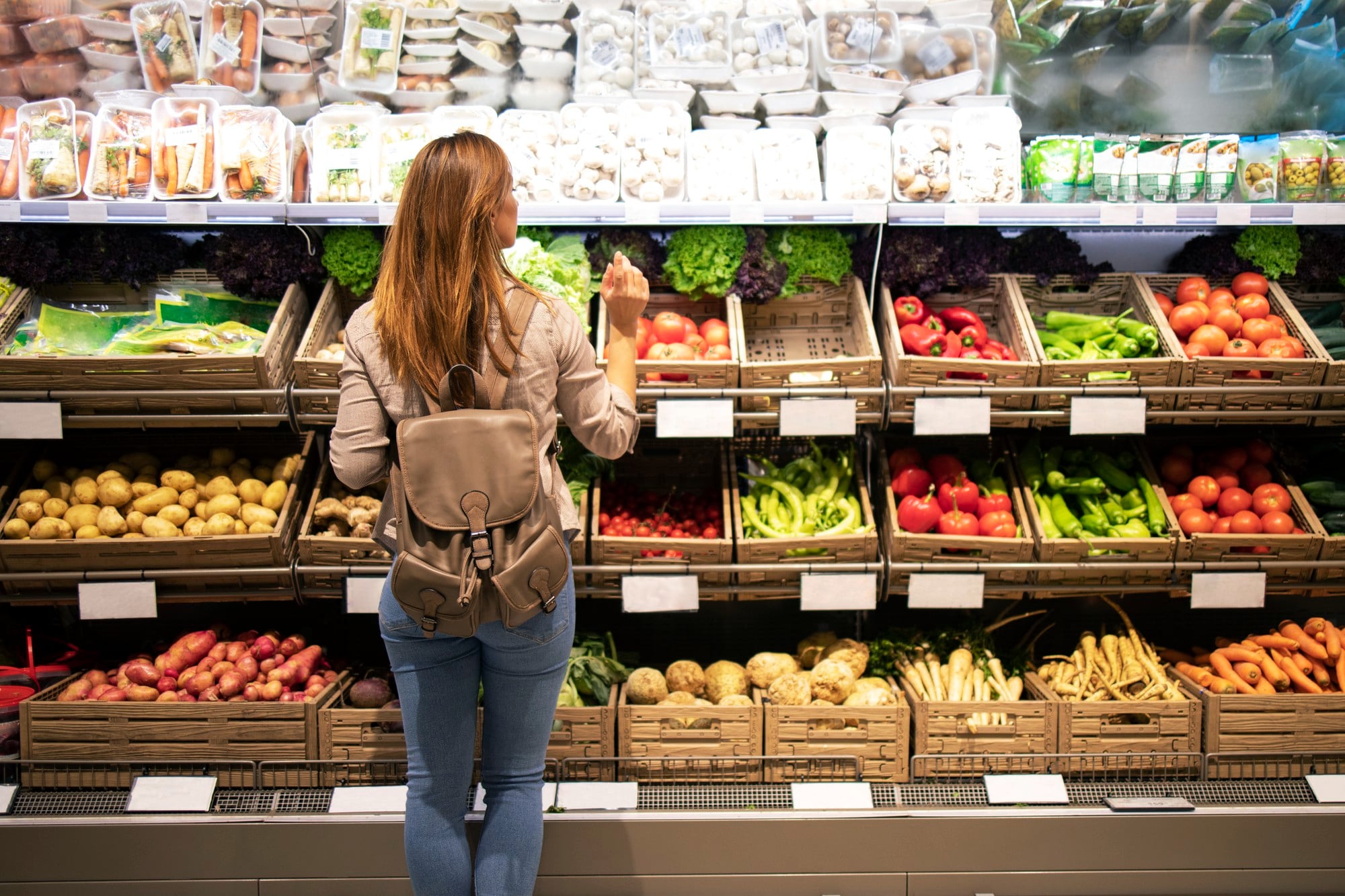
Aisle Seven
“Mom, Max put a cucumber in his pocket,” Sophie said.
“It’s for later!” my five-year-old protested.
“Put it back, honey. We have a cart.”
Max looked at me with his big brown eyes. Then he looked at the cart. Then he pulled a whole English cucumber, wrapped in plastic, out of the front pocket of his hoodie. Half of it had been sticking out the top the whole time.
He laid it in the cart very gently, next to the bananas, like he was putting a baby down for a nap.
“I was saving it,” he said.
“I know you were, buddy.”
It was Saturday, and I’d brought all three kids shopping.
That’s not something I’d recommend. Not at the Meijer on 28th Street in Grand Rapids at ten-thirty on a Saturday morning, when every family in Kent County is there buying the same gallon of milk. But it was my weekend. Brian had them every other weekend, and this wasn’t his.
So there I was. Sophie, eight, walking beside the cart with her hand on the side of it, the way she always does, like she’s helping steer. Max, five, wandering off every thirty seconds to look at something. And Rosie, two, in the cart seat, chewing on the strap of my purse.
Three kids. One cart. One mom.
Brian and I had divorced ten months earlier.
It was final on a Tuesday in January. Kent County Circuit Court, Family Division. Twenty-two minutes in a courtroom on the fifth floor. Joint legal custody. I got primary physical custody. Brian got every other weekend and Wednesday dinners. Child support of eleven hundred and forty dollars a month, calculated by the Michigan formula.
I kept the house. I refinanced it in my name alone in March, at six and seven-eighths percent, which made my stomach hurt every time I looked at the payment.
We weren’t enemies, Brian and me. We’d just stopped being anything else.
His mother, Carol, still treated that like I’d personally ruined her life.
Carol Haldane. Sixty-two. She lives in Wyoming, Michigan, the suburb, not the state, in a split-level with a perfect lawn. She plays bridge on Tuesdays and works the front desk at the Methodist church on Wednesdays.
She hasn’t spoken to me directly since the divorce. Not once. At Rosie’s second birthday party, which Brian hosted, she stood on the other side of the room and talked about me to Brian’s aunt, loud enough for me to hear.
She drops the kids’ birthday presents off at Brian’s apartment. Never at my house.
We were choosing cereal when she appeared.
Aisle seven. Cereal and breakfast bars. Sophie and Max were in a negotiation about Froot Loops. I’d said one box of something sugary. They each wanted a different one.
“Froot Loops have colors,” Max was explaining. “Colors are vitamins.”
“That’s not how vitamins work,” Sophie said.
“Then how come they’re so pretty?”
And then a voice behind me, sharp and bright.
“Well, well. All alone with three children again?”
I turned around.
Carol was standing at the end of the aisle with her own cart. A small one, the kind with the basket on top. She had a box of Special K and a carton of eggs and a bag of those little clementines. She was wearing her church coat, camel-colored, and her hair was done.
She was smiling. The smile she uses at bridge when she’s about to take a trick.
“Hi, Carol,” I said.
“Where’s Brian?” she asked.
She knew where Brian was. It wasn’t his weekend. Brian was probably at his apartment in Kentwood, sleeping until noon.
“You could call him and ask,” I said.
Sophie leaned toward me. She didn’t whisper very well. She never has.
“Should we tell her his phone works?”
“Sophie,” I whispered.
Carol frowned. “I was only asking.”
“Then we’ve answered,” I said.
She stood there for a second. Then she pushed her little cart forward. Into the aisle. Right up next to mine. She looked down into my cart, the way a customs officer looks into a suitcase.
She inspected our cart.
Bananas. Apples. A gallon of two percent. Bread. Peanut butter. A bag of baby carrots. The cucumber. Two boxes of mac and cheese. A package of chicken thighs. Diapers for Rosie. A box of Goldfish crackers the size of a microwave.
And on top, a frozen pizza. DiGiorno. Pepperoni.
“Frozen pizza?” Carol said. “Really?”
“It’s for Friday night,” I said.
Friday is pizza night at our house. It has been since Sophie was three. We put a blanket on the living room floor and eat pizza and watch a movie. It’s the one night I don’t have to cook.
“It’s Saturday, Mom,” Sophie corrected.
“Then I’m planning ahead.”
The man behind us smiled.
He was standing a few feet back, holding a box of Cheerios and a basket. Tall, maybe forty, in a Detroit Tigers cap and a flannel shirt. He had a little boy with him, maybe four, sitting in his cart, eating a granola bar out of the wrapper.
He’d been there the whole time. Waiting to get past us. He caught my eye and smiled. Not a pitying smile. Just a smile. Like he’d been there.
Chapter Two: Dragging
Carol wasn’t finished.
She leaned on the handle of her cart. She looked at Rosie in the cart seat, chewing on my purse strap. At Max, who was now trying to put the Froot Loops back on the top shelf by throwing them. At Sophie, standing by my elbow with her arms crossed.
“You know,” she said. Loud. Loud enough for the whole aisle. “If you spent less time running around with these children, you might find yourself a husband.”
My face went hot.
The man in the Tigers cap stopped smiling. A woman at the other end of the aisle, reading the side of a box of granola, looked up. A teenage boy stocking oatmeal at the end cap stopped stocking.
“Carol, please,” I said quietly.
She didn’t stop. She never stops. That’s the thing about Carol. Once she gets going, it’s like a train.
“No man will ever want a woman dragging around three kids,” she said.
There it was. Out in the open. In aisle seven of the Meijer on 28th Street, next to the Cheerios.
I didn’t say anything. I couldn’t. My throat had closed up.
Because she’d said out loud the exact thing I’d been lying awake thinking every night for ten months. At thirty-four. With three kids under nine. With a mortgage in my name and a car with a hundred and fifty thousand miles on it and a job doing twelve-hour shifts as a respiratory therapist at Spectrum.
Who’s going to want that?
Max looked up.
He’d been crouched on the floor by the bottom shelf, looking at the Lucky Charms leprechaun. He stood up. He looked at his grandmother very seriously.
“Are we dragging?” he asked. “I have legs.”
“Not now, buddy,” I said, trying not to laugh.
I couldn’t help it. The corners of my mouth went up. I bit my lip. Behind me, I heard the man in the Tigers cap make a sound. Like a cough. Except it wasn’t a cough.
Max looked down at his legs. He bent one knee. Then the other. Proving it.
“See?” he said to Carol. “Legs.”
Carol folded her arms.
She didn’t think it was funny. Carol never thinks anything is funny unless she says it.
“Someone has to tell your mother the truth,” she said. To Max. To my five-year-old. “She’s not getting any younger. And she’s got three of you. That’s a lot of baggage.”
Baggage.
Sophie’s arms uncrossed.
Sophie put her cereal back on the shelf.
She’d been holding a box of Cinnamon Toast Crunch, her choice for the week. She set it back exactly where she found it. Carefully. Lined up with the others. She’s like that. She lines up her shoes in her closet.
Then she turned around and looked at her grandmother.
“Grandma,” she said. “Can I ask you something?”
“What?” Carol said.
“Promise you won’t get mad?”
“Of course,” Carol said. She smiled a little. A grandmother smile. Like she thought Sophie was going to ask for a cookie.
Sophie glanced at me.
Then at the shoppers who’d stopped to listen. The man in the Tigers cap. The woman with the granola. The teenage stock boy. A couple of other people who’d drifted in from the end of the aisle when Carol started talking.
My daughter has her father’s eyebrows and my mouth and absolutely no fear of anybody.
I knew that look. I opened my mouth to stop her.
I didn’t make it in time.
She took a deep breath. And she shouted one sentence. Not mean. Not angry. Just loud. Clear. Curious. The way eight-year-olds ask questions in church.
“If no man wants a lady with three kids, then why is Daddy marrying Miss Amber? She has three kids AND a dog!”
The whole aisle burst into laughter.
The man in the Tigers cap laughed so hard he had to put his hand on his cart. The woman with the granola laughed. The teenage stock boy laughed so hard he dropped a canister of Quaker Oats, and it rolled down the aisle and hit my cart.
Somebody at the end of the aisle said, “Oh, honey,” and kept laughing.
I didn’t laugh. I couldn’t.
Because I didn’t know.
Brian was getting married?
Carol’s face went pale as people around us kept laughing.
Not red. Not angry. Pale. White. Like somebody had pulled the color out of her.
She looked at Sophie. Her mouth opened. Closed. Opened again.
“Who taught you to say that?” she demanded, staring at Sophie.
Sophie looked surprised. Like it was a strange question.
“Nobody,” she said. “I can count.”
Another round of laughing from the end of the aisle.
“Daddy showed us the ring,” Sophie said. “Last weekend. At his apartment. It’s in a little blue box. He made us pinky promise not to tell anybody till he told Grandma.” She stopped. Her eyes got big. She looked at me. “Oh no.”
Max tugged on Carol’s coat.
“Miss Amber’s dog is named Biscuit,” he told her helpfully. “He licks your face.”
Chapter Three: Who Taught You
Carol didn’t say anything.
She stood there in aisle seven with her camel coat and her little cart with the Special K and the eggs and the clementines. With half the cereal aisle at the Meijer on 28th Street looking at her.
She looked at me.
For a second, I saw something in her face that I’d never seen there before. Not anger. Not superiority. Something else.
It looked like fear.
Then she turned her cart around. Right there in the aisle. Three-point turn. She bumped into the shelf of Pop-Tarts and knocked two boxes on the floor. She didn’t pick them up.
She pushed her cart out of aisle seven, fast, toward the front of the store.
She didn’t say goodbye.
The aisle went quiet again. People went back to their shopping. The teenage stock boy chased down his oatmeal. The woman with the granola smiled at me and shook her head and walked away.
The man in the Tigers cap came up beside me. He bent down and picked up the two boxes of Pop-Tarts Carol knocked over. He put them back on the shelf.
“Your daughter,” he said quietly, “is going to run the world someday.”
“She already runs my house,” I said.
He laughed. He looked at Max, who was showing his legs to the man’s little boy.
“For what it’s worth,” he said, “my wife used to say a woman with three kids isn’t dragging anything. She’s leading a parade.”
He tipped his cap. He pushed his cart past us, toward the dairy aisle.
Used to say.
I watched him go.
Sophie was standing next to me with her face bright red.
“Mom,” she whispered. “I broke my pinky promise.”
“I know, baby.”
“Daddy’s going to be so mad.”
“Daddy’s going to be fine,” I said.
I didn’t know if that was true.
We finished shopping. I don’t remember most of it. I remember Max getting the Froot Loops. I remember Rosie throwing a sippy cup at the checkout. I remember the cashier, an older woman with a name tag that said DEB, who’d apparently heard about aisle seven from somebody, because she gave Sophie a sticker and said, “I heard you’re a math whiz.”
In the parking lot, I buckled everybody into the minivan. Rosie in the car seat. Max in the booster. Sophie in the back row.
Then I sat in the driver’s seat with my hands on the wheel and didn’t start the engine.
“Sophie,” I said. “Tell me about the ring.”
She told me.
Brian had sat them down on the couch last Saturday. At his apartment in Kentwood. He’d been dating Amber for six months. I knew about Amber. I’d met her once, briefly, at a soccer game. A nurse at Corewell. Divorced. Three kids.
He’d shown them a little blue box. Inside was a diamond ring.
“He said he was going to ask her,” Sophie said. “At Thanksgiving. At her mom’s house. And he wanted us to know first.” She paused. “He said we were going to have three more brothers and sisters. And a dog.”
“Biscuit,” Max added.
“And he made you promise not to tell Grandma,” I said.
“Till he told her,” Sophie said. “He said Grandma might be upset.”
I looked in the rearview mirror at my daughter.
“Why did Daddy think Grandma would be upset?” I asked.
Sophie thought about it.
“Because Grandma always says stuff about Miss Amber,” she said. “At Daddy’s house. When we’re there. She says Miss Amber’s a divorcee with three kids and what does Daddy want with all that.” She looked out the window. “Daddy always tells her to stop. She never stops.”
Chapter Four: Ten Months
Here’s what you need to know about Brian and me.
We met in college. Grand Valley State. I was studying respiratory therapy. He was in business. We met at a Halloween party. He was dressed as a hot dog. I was dressed as a ketchup bottle. Separately. Not on purpose.
Everybody said it was fate. We got married at twenty-three. Sophie at twenty-six. Max at twenty-nine. Rosie at thirty-two.
We didn’t fight. That was the thing. Everybody asks what happened, like there must have been something. An affair. Drinking. Money.
There wasn’t anything. We just stopped. He stopped coming home for dinner. He started working later at the insurance agency. He’d come home at eight and eat standing at the counter and go downstairs to watch TV.
I’d put three kids to bed alone and lie in our bed alone and listen to the TV through the floor.
I asked him to go to counseling. Twice. He said he was too busy.
The third time, after Rosie was born, I didn’t ask. I sat down at the kitchen table one night at eleven o’clock, after the kids were asleep, and I said, “Brian, I can’t do this anymore. I’m already doing it alone. I might as well be alone.”
He looked at me for a long time.
“Okay,” he said.
That’s all. Okay.
His mother never forgave me.
Carol thinks I left her son. That’s the story she tells at bridge. At church. At the Meijer. That I walked out on a good man with a good job because I was selfish.
She doesn’t know about the eleven o’clock nights. She doesn’t know about the counseling he wouldn’t go to. She doesn’t know that I cried in the shower every night for two years so the kids wouldn’t hear me.
She doesn’t know any of it. Because I never told her. Because it wasn’t her business.
The divorce was civil. Brian didn’t fight me on custody. He didn’t fight me on the house. He moved into an apartment in Kentwood and took the kids every other weekend and Wednesday nights.
He’s actually better at it now. That’s the strange part. Now that it’s just him and them, every other weekend, he shows up. He takes them to the zoo. He coaches Max’s T-ball team. He learned to do Sophie’s French braids from YouTube.
I don’t know why he couldn’t do that when we were married. Maybe he didn’t know how to be a husband and a father at the same time. Maybe he only had room for one.
And then, six months ago, he met Amber.
She’s a nurse. On the pediatric floor at Corewell Health, the big hospital downtown. Thirty-six. Divorced two years. Her husband left her for a woman he met at a CrossFit gym.
She has three kids. Two girls and a boy. Nine, seven, and four.
And a dog. A golden retriever named Biscuit, who, according to Max, licks your face.
I called Brian from the Meijer parking lot.
He picked up on the fourth ring. Sleepy.
“Nat? What’s wrong? Are the kids okay?”
“The kids are fine,” I said. “Your mother’s not.”
He was quiet for a second.
“What happened?”
Chapter Five: Brian
I told him.
All of it. Aisle seven. The frozen pizza. You might find yourself a husband. No man will ever want a woman dragging around three kids. Are we dragging, I have legs.
And then Sophie.
When I got to the part about Miss Amber and the dog, Brian made a sound I hadn’t heard him make in five years.
He laughed. Really laughed. So hard he started coughing.
“She said that?” he gasped. “In the Meijer? Out loud?”
“At the top of her lungs. In front of the whole cereal aisle. A guy dropped a thing of oatmeal.”
He laughed harder. I could hear him on the other end, wheezing.
“Brian,” I said. “It’s not funny.”
“It’s a little funny, Nat.”
I didn’t say anything. Then I started laughing too. In the minivan, in the Meijer parking lot, with three kids in the back seat staring at me.
When we stopped, there was a long silence on the line.
“I’m sorry,” he said. “That she found out that way. That you found out that way.”
“Were you going to tell me?”
“Yes,” he said. “Next week. After I told Mom.” He paused. “I was scared to tell her. I’ve been scared for a month.”
“Why?”
He was quiet for a long time.
“Because she’s been saying things,” he said. “About Amber. For six months. Every Sunday when I go over for dinner. About how she’s divorced. How she’s got three kids. How she’s too old for me. How she’s just looking for a man to pay her bills.” He sighed. “How no man wants a woman dragging around three kids.”
I closed my eyes.
“She says that to you too?”
“She’s been saying it my whole life, Nat,” Brian said. “About everybody. About every single mom on our street growing up. About her own sister.” He paused. “I never knew why. I just thought that’s how she was.”
“And now you’re marrying one,” I said.
“I’m marrying one,” he said. “Amber. With three kids and a dog.” He took a breath. “And she’s the best thing that’s ever happened to me. Besides our kids.”
I didn’t say anything.
“I mean that, Nat,” he said. “I know I was a lousy husband. I know I checked out. I know you did it all alone. Amber doesn’t let me check out. She won’t let me.” He laughed softly. “And her kids. They’re great. They’re so great. Sophie and her oldest, Maddie, are already best friends.”
“Brian,” I said. “Your mother looked scared. In the store. When Sophie said it. Not mad. Scared.”
He was quiet.
“I’ve never seen her look like that,” I said. “Not in twelve years.”
“Me neither,” Brian said. “I don’t know what that means.”
That night, after the kids were asleep, my phone rang.
I was sitting on the couch folding laundry. Six people’s worth, it felt like. Three kids go through a lot of socks.
I looked at the screen. A number I didn’t recognize. A landline. A 616 area code.
I almost didn’t answer. Then I did.
“Hello?”
There was a long silence on the line. Then a voice. Thin. Shaky.
“Natalie,” Carol said. “It’s Carol. Can you come over? Tomorrow? I need to talk to you.”
Chapter Six: Carol’s Kitchen
I went on Sunday afternoon.
Brian took the kids. I didn’t tell him why. I just asked if he could watch them for a couple of hours, and he said yes. He’s good about that now.
Carol’s house in Wyoming is a split-level on a quiet street with big maple trees. Red brick on the bottom, white siding on top. The lawn was perfect, even in November. Not a leaf on it.
I sat in my minivan in her driveway for five minutes before I got out.
She opened the door before I knocked. She must have been watching from the window.
She looked different. Smaller. She was wearing a gray cardigan and slacks and no makeup. Her hair wasn’t done. It was flat on one side, like she’d slept on it.
“Thank you for coming,” she said. Very formally. Like I was the insurance adjuster.
She stepped back. I went in.
Her kitchen was spotless. White cabinets, granite counters, a bowl of plastic lemons on the island. She had coffee made. She’d set out two mugs and a plate of Pepperidge Farm cookies on a doily.
We sat down at her kitchen table. Across from each other.
Neither of us said anything for a long time.
“How long have you known?” she asked finally. “About Brian. And that woman.”
“Amber,” I said.
“Amber,” she repeated. Like the word tasted funny.
“I found out yesterday,” I said. “Same time as you. In the cereal aisle.”
Carol looked at me. Like she was trying to decide if I was lying.
“He didn’t tell you?”
“He was scared to tell you,” I said. “He was going to tell you first. He made the kids promise.”
She looked down at her coffee.
“He’s scared of me,” she said quietly. Not a question.
“Carol,” I said. “Everybody’s a little scared of you.”
I thought she’d get angry. I’d never said anything like that to her. Not in twelve years.
She didn’t get angry. She just sat there, holding her coffee mug in both hands. Then she nodded.
“I know,” she said.
She looked out the kitchen window. At her perfect lawn. At the maple trees.
“Do you know why I said it?” she asked. “In the store. About no man wanting a woman with three kids?”
“Because you think I ruined Brian’s life.”
“No,” Carol said. “That’s not why.”
She got up from the table. She went to a drawer by the refrigerator. She took out a photograph. An old one. A Polaroid, faded orange, with the white border yellowed.
She set it on the table in front of me.
It was a young woman. Maybe twenty-five. Long brown hair, parted in the middle. Bell-bottom jeans. Standing in front of a laundromat. Holding a baby on her hip. With two little girls holding onto her legs on either side.
The young woman wasn’t smiling.
“That’s me,” Carol said. “In 1989. In front of the Duds ‘N Suds on Division Avenue. Where I worked.”
I looked at the baby on her hip.
“That’s Brian,” she said. “He was eight months old. And those are his sisters. Kim and Lisa.”
Chapter Seven: 1989
I knew Brian had two older sisters. Kim lives in Phoenix. Lisa lives in Traverse City. I’d met them both. Nice women. They didn’t come home much.
I knew Brian’s father was a man named Gerald Haldane. A retired accountant. Quiet. He died four years ago. Pancreatic cancer.
What I didn’t know was in that photograph.
“Gerald’s not Brian’s father,” Carol said.
I looked up at her.
“He adopted all three of them,” she said. “When Brian was two. But their father was a man named Rick Petrowski.” She said the name like it was a stone in her mouth. “He drove a truck for Meijer. Out of the distribution center in Lansing.”
She sat back down across from me.
“He left in March of ‘89,” she said. “When Brian was eight months old. He went out on a run to Fort Wayne and called me from a pay phone at a truck stop and said he wasn’t coming back.”
“I was twenty-six,” Carol said. “With three kids. Kim was five. Lisa was three. Brian was a baby. I had a high school diploma and no job and a rented duplex in Wyoming and a car that didn’t start half the time.”
“Did he pay child support?”
She laughed. A short, hard laugh.
“The State of Michigan ordered him to pay four hundred dollars a month,” she said. “He paid it twice. Then he moved to Arkansas and nobody could find him. Friend of the Court sent letters. He never answered.”
“So I got a job at the Duds ‘N Suds,” she said. “Folding other people’s laundry. Three dollars and thirty-five cents an hour. I took the kids with me. Brian slept in a laundry basket under the counter.”
I looked at the photograph. At the baby on her hip. At the young woman who wasn’t smiling.
“Rick’s mother came to see me,” Carol said. “That summer. Evelyn Petrowski. She came to the laundromat on a Tuesday afternoon. In her church clothes.”
Carol’s voice changed. It got very flat. Very quiet.
“She stood at the counter,” Carol said. “In front of all the customers. And she said she was sorry her son left. And then she said, You’d better find yourself a new husband quick, Carol. Before you get any older.”
She stopped. She swallowed.
“And then she said, No man will ever want a woman dragging around three kids.”
The kitchen was very quiet. I could hear the refrigerator humming. A clock ticking somewhere in the living room.
“She said those exact words,” I said.
“Those exact words,” Carol said. “I’ve never forgotten them. Not one day in thirty-six years.”
“So I did what she said,” Carol said. “I found myself a husband quick. Gerald came into the laundromat that fall with a bag of dress shirts. He was forty-one. An accountant at a firm downtown. Never been married. He asked me to dinner.”
She looked down at her hands.
“I married him eight months later,” she said. “At the courthouse. He adopted the kids. He bought this house. He paid for everything. Braces and college and Kim’s wedding.”
“That sounds like a good man,” I said.
“He was a good man,” Carol said. “He was a kind, decent, boring man. And I didn’t love him.”
I stared at her.
“Not like that,” she said. “Not the way you’re supposed to. He was safe. He was a roof and a paycheck and somebody to say ‘my husband’ about at church. I married him because a woman stood in a laundromat and told me nobody else would ever want me.”
She put her hand flat on the photograph.
“And I was married to him for thirty-two years,” she said. “And I was lonely every single day.”
She was crying now. Not loudly. Just tears running down her face, falling on the table, on the Polaroid.
“When you left Brian,” she said, “I was so angry. I couldn’t understand it. He didn’t hit you. He didn’t drink. He didn’t cheat. He had a good job. And you just left. With three kids.” She shook her head. “Who does that? Who walks away from a roof and a paycheck with three kids?”
“Somebody who was lonely every single day,” I said quietly.
Carol looked up at me.
For a long time, she didn’t say anything.
“Yes,” she whispered finally. “I suppose that’s who.”
Chapter Eight: Sophie
I picked up the kids from Brian’s at five.
Sophie was quiet in the car. She sat in the back row looking out the window. She hadn’t said much since the Meijer.
When we got home, she went straight to her room and closed the door.
I knocked.
“Come in,” she said.
She was sitting on her bed with her knees pulled up, hugging her stuffed rabbit, Mr. Hops. She’s had him since she was two. He’s missing an eye.
I sat down on the edge of her bed.
“Hey,” I said. “What’s wrong?”
“I made Grandma sad,” she said. “In the store. I broke my pinky promise to Daddy and I made Grandma sad. And everybody laughed at her.”
She buried her face in Mr. Hops.
“I’m a bad person,” she said.
I put my hand on her back.
“Sophie,” I said. “Look at me.”
She lifted her face. Her eyes were red.
“You’re not a bad person,” I said. “You’re the most honest person I know. You asked a question. It was a fair question.”
“But everybody laughed.”
“Everybody laughed because it was true,” I said. “And because you’re eight and you said it really loud.” I almost smiled. “And because Max had just told her he had legs.”
Sophie almost smiled too. Then she didn’t.
“Why does Grandma say mean things about you?” she asked. “And about Miss Amber?”
I thought about the Polaroid. The young woman in front of the laundromat with a baby on her hip and two little girls holding her legs. Not smiling.
“Because somebody said something mean to Grandma,” I said. “A long, long time ago. When she was a young mom with three kids, just like me. And she believed it. And she carried it around for thirty-six years.”
Sophie thought about that.
“Like a backpack?” she asked.
“Like a really heavy backpack,” I said. “That she never took off.”
“That sounds tiring,” Sophie said.
“It is,” I said. “I think it’s very tiring.”
Sophie was quiet for a long time. Then she sat up.
“Can I say sorry to her?” she asked. “For yelling in the store?”
“You can.”
“Not for what I said,” Sophie said. She was very serious. “What I said was true. Just for yelling it. And for making people laugh at her.”
I looked at my daughter. Eight years old. Lining up her shoes in her closet. Lining up her cereal boxes on the shelf.
“That,” I said, “is exactly the right kind of sorry.”
She wrote Carol a card. That night. At the kitchen table. With markers.
On the front, she drew a picture of the cereal aisle. Three stick figures. A big one with a cart. A little one with a cucumber sticking out of his pocket. A medium one with her mouth wide open.
And off to the side, a stick figure in a brown coat, with a frown.
Inside, in her careful eight-year-old handwriting, she wrote:
Dear Grandma, I am sorry I yelled in the store. I should have used my inside voice. I am not sorry for my question because it was a good question. Mom says you have a heavy backpack. I hope you can put it down. Love, Sophie. P.S. Max says he still has legs.
We mailed it on Monday.
On Wednesday, Brian called me.
“Mom called,” he said. “Last night. She asked me to bring Amber for dinner. On Sunday. With her kids.” He paused. “All of them. And the dog.”
“The dog?”
“She said, bring the dog,” Brian said. “She said, I’d like to meet Biscuit.”
Chapter Nine: Amber
I met Amber properly that Friday.
Brian asked me to. He said she wanted to meet me before Sunday. She was nervous. About Carol. About me. About everything.
We met at a coffee shop on Wealthy Street. Just the two of us. I got there first. I sat by the window with a latte I didn’t want.
She came in at four-fifteen. In her scrubs. Purple, with little cartoon bears on them. She’d come straight from her shift on the pediatric floor.
She saw me. She stopped in the doorway. Then she came over and sat down across from me.
“Hi,” she said. “I’m Amber. I’m so sorry. I don’t know what to say.”
She was pretty. Not glamorous. Tired pretty. Thirty-six, with blonde hair pulled back in a ponytail and dark circles under her eyes and freckles across her nose. She had a smear of something on her scrubs that might have been applesauce.
“You don’t have to say anything,” I said.
“Sophie told my Maddie about the store,” Amber said. “At Brian’s last weekend. Maddie told me.” She put her hands over her face. “Three kids AND a dog. In the Meijer. In front of everybody.”
“I’m sorry.”
“Don’t be sorry,” Amber said. She took her hands away. She was laughing. “It’s the best thing I’ve ever heard.”
We talked for an hour.
About Brian. About the kids. About her ex-husband, who left for a woman from CrossFit and moved to Denver and pays his child support exactly on time through Friend of the Court and never calls.
About being a single mom. About twelve-hour shifts and daycare pickups and the way everybody looks at you in the grocery store when you’ve got three kids and one cart.
“Brian’s mom,” Amber said finally. “Carol. She hates me. Doesn’t she?”
I thought about the Polaroid. About the laundromat on Division Avenue. About Evelyn Petrowski in her church clothes.
“I don’t think she hates you,” I said. “I think you scare her.”
“Why would I scare her?”
“Because you’re her,” I said. “Thirty-six years ago. With three kids and a man who left. And you didn’t settle for the first guy who walked into the laundromat with a bag of dress shirts.” I paused. “You waited. And you found someone you actually love.”
Amber stared at me.
“I don’t understand,” she said.
“You will,” I said. “Sunday.”
Then she asked me a question I didn’t expect.
“Natalie,” she said. “Are you okay with this? With me? With Brian getting married again? With your kids having a stepmom?”
I looked at her for a long time.
I thought about it honestly. Brian checked out of our marriage for four years. He came home late and ate standing at the counter and watched TV in the basement. He didn’t go to counseling. He let me do it all alone.
And now, with her, he showed up. He learned French braids. He coached T-ball.
Was I okay with that?
“I’m not going to pretend it doesn’t sting,” I said. “It does. A lot. That he couldn’t do it for me.”
Amber nodded slowly.
“But my kids get a dad who shows up now,” I said. “And three more brothers and sisters. And a dog who licks your face.” I picked up my latte. “So yes. I’m okay with it.”
Amber’s eyes filled up. She reached across the table and squeezed my hand.
“For what it’s worth,” she said, “he talks about you. All the time. About how you did everything. About how he wishes he’d done more.” She let go. “He says you’re the strongest person he’s ever known.”
I didn’t know what to say to that. So I didn’t say anything.
“And for what it’s worth,” Amber said, “I don’t think you’re dragging anybody anywhere.”
“Max would agree,” I said. “He has legs.”
Chapter Ten: Sunday Dinner
I wasn’t supposed to be there.
It was Brian’s dinner. Brian and Amber and her kids and his mother. I wasn’t invited. I was planning to drop my kids off at Carol’s at four and pick them up at seven.
But at noon on Sunday, Carol called me.
“Natalie,” she said. “Would you come too? To dinner? I’d like you to be there.”
I didn’t know what to say.
“Please,” she said. “I think I need you there.”
So at four o’clock, I pulled into Carol’s driveway in my minivan with my three kids.
Brian’s car was already there. And Amber’s. A Honda Pilot with a dog crate in the back and a bumper sticker that said MY CHILD IS AN HONOR STUDENT AT WYOMING ELEMENTARY.
I could hear barking from inside the house.
Carol opened the door. She was wearing a dress. Navy blue, with little white flowers. Her hair was done. She had lipstick on.
She looked terrified.
“Come in,” she said. “Everybody’s in the living room.”
Everybody was in the living room.
Brian on the couch. Amber next to him, sitting very straight with her hands in her lap. Her three kids lined up on the floor in front of the TV. Maddie, nine, with long blonde hair like her mom’s. Ava, seven, with glasses. And Jack, four, in a dinosaur shirt.
And a golden retriever, lying on Carol’s good cream-colored carpet, wagging his tail so hard he was thumping the coffee table.
“Biscuit!” Max shouted.
He ran across the living room and threw himself on the dog. Biscuit licked his whole face.
“See?” Max said to Carol, laughing. “He licks your face. I told you.”
Six kids. One dog. Four adults. In Carol’s living room in Wyoming, Michigan, with the plastic lemons on the kitchen island and the perfect lawn outside.
Nobody knew what to say.
Then Sophie walked over to Maddie, on the floor by the TV.
“Hi,” she said. “Want to see my grandma’s porcelain birds? She has like a hundred. You’re not allowed to touch them.”
Maddie jumped up. They ran to the curio cabinet in the dining room.
Carol had made a pot roast. With carrots and potatoes and onions. And a green salad. And rolls from the Meijer bakery. And a chocolate sheet cake.
She’d set the dining room table with her good china. The china she got for her wedding to Gerald in 1990. With every leaf in the table.
Thirteen place settings. Eleven people. And the high chair for Rosie. And a bowl on the floor in the corner, with Biscuit’s name written on a sticky note above it.
We sat down. Carol at the head of the table. Brian on one side. Me on the other. Amber next to Brian. Kids everywhere in between.
Carol didn’t eat. She sat there with her hands folded in her lap. She looked down the long table at all of us.
Then she stood up.
“I want to say something,” she said.
Everybody stopped. Forks in the air. Even the kids.
“Before we eat,” Carol said. “I need to say something. To Amber. And to Natalie. And to all you children.”
She took a breath. Her hands were shaking. She held onto the back of her chair.
“When I was twenty-six,” she said, “I had three children and a husband who left me at a truck stop in Indiana. And a woman told me that no man would ever want a woman dragging around three kids.”
The table was dead silent.
Brian stared at his mother. His mouth was open. He’d never heard this. Not once in his whole life.
“I believed her,” Carol said. “I believed her so much I married the first man who asked me. Your grandfather Gerald.” She looked at Brian. “He was a good man, Brian. He was good to you. I want you to know that. But I married him because I was scared. Not because I loved him.”
Brian’s face went white.
“And I’ve spent thirty-six years,” Carol said, “saying that same terrible sentence to every woman I could. To my sister when her husband left. To Natalie, in the Meijer, in front of everybody. Because if it was true for them, then I didn’t settle. Then I didn’t have a choice.”
Her voice broke.
“But it wasn’t true,” she said. “It was never true. It was just something a mean old woman said in a laundromat. And I carried it around for thirty-six years like it was the Bible.”
She turned to Amber.
“Amber,” she said. “I’ve said terrible things about you. To Brian. Every Sunday. For six months.” She swallowed. “I’m sorry. You have three beautiful children. And a dog who’s going to ruin my carpet.” She almost smiled. “And my son loves you. I can see it. He never looked at anybody like that before. Not even…”
She stopped. She looked at me.
“Not even me,” I said gently. “It’s okay, Carol. It’s true.”
Then she turned to me.
“Natalie,” she said. “You left my son because you were lonely every single day. I know that now. Because I was too. For thirty-two years.”
She looked down the long table. At all six kids.
“You were braver than I was,” she said. “Both of you. You didn’t settle. You didn’t marry the first man with a bag of dress shirts.” She wiped her eyes with her napkin. “And look. Look at all these children. Look at this table.”
Nobody said anything for a long time.
Then Sophie put down her fork.
“Grandma,” she said. “Can I ask you something?”
Carol looked at her. Her face did something complicated.
“Promise you won’t get mad?” Sophie asked.
Somebody at the end of the table snorted. I think it was Brian.
“I promise,” Carol said.
Sophie looked around the table. At all six kids. At Biscuit under the table, eating a roll Jack had dropped.
“Did you put down your backpack?” she asked.
Carol stared at her.
Then she laughed. Not a bridge laugh. A real laugh. From somewhere deep, somewhere that hadn’t laughed in a long time.
“Yes, honey,” she said. “Yes. I think I just did.”
Chapter Eleven: The Wedding
Brian proposed to Amber at Thanksgiving. At her mother’s house in Holland, like he planned. With all six kids standing behind him, holding up signs they made with markers. WILL YOU. MARRY. OUR DAD. AND US. AND BISCUIT.
Max held the BISCUIT sign upside down.
Amber said yes before he finished getting down on one knee.
The wedding was in June. At a little park on Reeds Lake in East Grand Rapids. Under a white tent, with folding chairs and mason jars full of daisies.
All six kids were in it. Maddie and Sophie were flower girls. Ava and Rosie were “junior flower girls,” which meant Ava carried Rosie down the aisle. Jack and Max were ring bearers. Max carried the rings on a pillow and walked very, very slowly, like they might explode.
Biscuit wore a bow tie.
I went. I sat in the third row. On the groom’s side.
People looked at me funny. The ex-wife, at the wedding. But Brian asked me. And Amber asked me. And Sophie asked me, very seriously, three different times.
“You have to be there, Mom,” she said. “Who else is going to make sure Max doesn’t eat the rings?”
Carol sat in the front row.
She wore a lavender dress and a big hat and she cried through the whole ceremony. When the pastor asked, “Who gives this woman?”, Amber’s mother stood up. And then, after a second, so did Carol.
She didn’t say anything. She just stood up next to Amber’s mother. In her lavender dress and her big hat. And held her hand over her heart.
Amber saw. She started crying so hard the pastor had to wait.
At the reception, Carol gave a toast.
Nobody asked her to. She just stood up after the best man and tapped her glass with a fork and waited until the whole tent was quiet.
“I have something to say to my new daughter-in-law,” she said.
Brian put his face in his hands. Amber squeezed his arm.
“Amber,” Carol said. “A long time ago, a woman told me something terrible. And for thirty-six years, I believed it. And I said it to other people. To women I should have helped instead.”
She raised her glass.
“So here’s what I’d like to say instead,” she said. “To you. And to Natalie. And to every woman under this tent who’s ever pushed a grocery cart with three kids in it.”
She looked down the long table at all six children. Biscuit was under it, eating cake.
“You’re not dragging anybody,” Carol said. “You’re leading a parade.”
I looked up. Startled.
That was what the man in the Tigers cap said. In the cereal aisle. My wife used to say a woman with three kids isn’t dragging anything. She’s leading a parade.
Carol couldn’t have heard him. She’d already gone.
I looked at her across the tent. She was looking right at me.
She winked.
Later, when the DJ was playing and the kids were all on the dance floor doing the Cha-Cha Slide wrong, Carol came and sat next to me at my table.
“How did you know?” I asked. “About the parade?”
“I didn’t leave the store,” she said. “In November. After Sophie. I went to the end of the aisle and stood behind the Pop-Tarts. I was shaking too hard to drive.”
“You heard him.”
“I heard him,” Carol said. She was quiet for a moment. “I went home and I thought about it all night. Leading a parade. Nobody ever said anything like that to me. Not in thirty-six years.”
She looked out at the dance floor. At Sophie and Maddie holding hands. At Max and Jack trying to slide on their knees across the parquet.
“I wish somebody had,” she said.
Chapter Twelve: Aisle Seven, Again
It’s November again now. A year since the Meijer.
Brian and Amber live in a five-bedroom house in Kentwood with six kids every other weekend and three kids the rest of the time and Biscuit all the time. Brian says it’s the loudest place he’s ever lived. He says he’s never been happier.
I still live in my house. With my three. The mortgage is still too high. I still work twelve-hour shifts at Spectrum. I still put a blanket on the living room floor on Friday nights for pizza.
I’m not married. I’m not dating anybody.
I’m okay.
Carol comes over on Tuesday nights now. She quit bridge. She says she never liked it anyway.
She helps Sophie with her math homework. She reads to Rosie. She lets Max teach her how to play Minecraft, which she does very badly and very seriously.
She brings dinner. Pot roast, mostly. Sometimes chicken and dumplings. She stays until the kids are in bed. Then she and I sit at the kitchen table and drink decaf and talk.
She told me about Evelyn Petrowski. And the laundromat on Division. And Gerald, who was kind and boring and never once asked her what she wanted.
I told her about Brian. The eleven o’clock nights. The TV through the floor. The shower.
We cried a lot, those first few Tuesdays. Now we mostly laugh.
Last Saturday, Carol and I went grocery shopping. Together. With all three kids.
The Meijer on 28th Street. Ten-thirty in the morning. Every family in Kent County buying the same gallon of milk.
Carol pushed the cart. Rosie rode in the seat. Max walked beside her, holding onto the side. Sophie held my hand.
We turned into aisle seven.
Cereal and breakfast bars. Same aisle. Same Froot Loops. Same Cheerios.
Max stopped in the middle of the aisle. He looked up at the shelves.
“This is where Sophie yelled,” he announced. To nobody. To everybody.
A woman reading the side of a box of granola looked up. It wasn’t the same woman. But she smiled anyway.
Carol stopped the cart.
She looked at the shelves. At the spot where she’d stood a year ago in her camel coat with her little cart.
Then she turned to Max.
“Max,” she said. “Are you dragging?”
He looked at her. Then down at his legs. He bent one knee. Then the other.
“No, Grandma,” he said, very seriously. “I have legs.”
“I know you do, honey,” Carol said. “I know.”
Sophie let go of my hand. She walked up the aisle to the Cinnamon Toast Crunch. She took a box off the shelf.
Then she looked back at her grandmother.
“Grandma,” she said. “Can I ask you something?”
Carol laughed. Out loud. In the middle of aisle seven.
“Promise you won’t get mad?” Sophie said.
“I promise,” Carol said.
Sophie held up the box of cereal.
“Can I get two this week?” she asked. “One for me and one for Maddie? She’s coming over Wednesday.”
Carol looked at me.
I shrugged.
“Your table,” I said. “Your call.”
She thought about it. Then she reached up to the top shelf and took down a second box of Cinnamon Toast Crunch. And a box of Froot Loops, for Max. And a box of Lucky Charms, for nobody in particular, just because the leprechaun was smiling.
She put them all in the cart.
“Six kids eat a lot of cereal,” she said.
We pushed the cart down aisle seven. Carol and me. Side by side. With Rosie in the seat and Max holding on and Sophie out front, leading the way, holding a box of Cinnamon Toast Crunch over her head like a flag.
A man stocking oatmeal at the end cap watched us go by. It wasn’t the same teenage boy. It was an older man, with gray hair.
He smiled.
“That’s quite a crew you’ve got,” he said.
Carol stopped. She looked at him. Then at me. Then at the three kids, spread out in front of the cart.
“It’s not a crew,” she said. “It’s a parade.”
And then she pushed the cart forward, and we followed Sophie out of aisle seven, all of us, nobody dragging anybody, every one of us on our own two legs.

Ethan Blake is a skilled Creative Content Specialist with a talent for crafting engaging and thought-provoking narratives. With a strong background in storytelling and digital content creation, Ethan brings a unique perspective to his role at TheArchivists, where he curates and produces captivating content for a global audience.
Ethan holds a degree in Communications from Zurich University, where he developed his expertise in storytelling, media strategy, and audience engagement. Known for his ability to blend creativity with analytical precision, he excels at creating content that not only entertains but also connects deeply with readers.
At TheArchivists, Ethan specializes in uncovering compelling stories that reflect a wide range of human experiences. His work is celebrated for its authenticity, creativity, and ability to spark meaningful conversations, earning him recognition among peers and readers alike.
Passionate about the art of storytelling, Ethan enjoys exploring themes of culture, history, and personal growth, aiming to inspire and inform with every piece he creates. Dedicated to making a lasting impact, Ethan continues to push boundaries in the ever-evolving world of digital content.