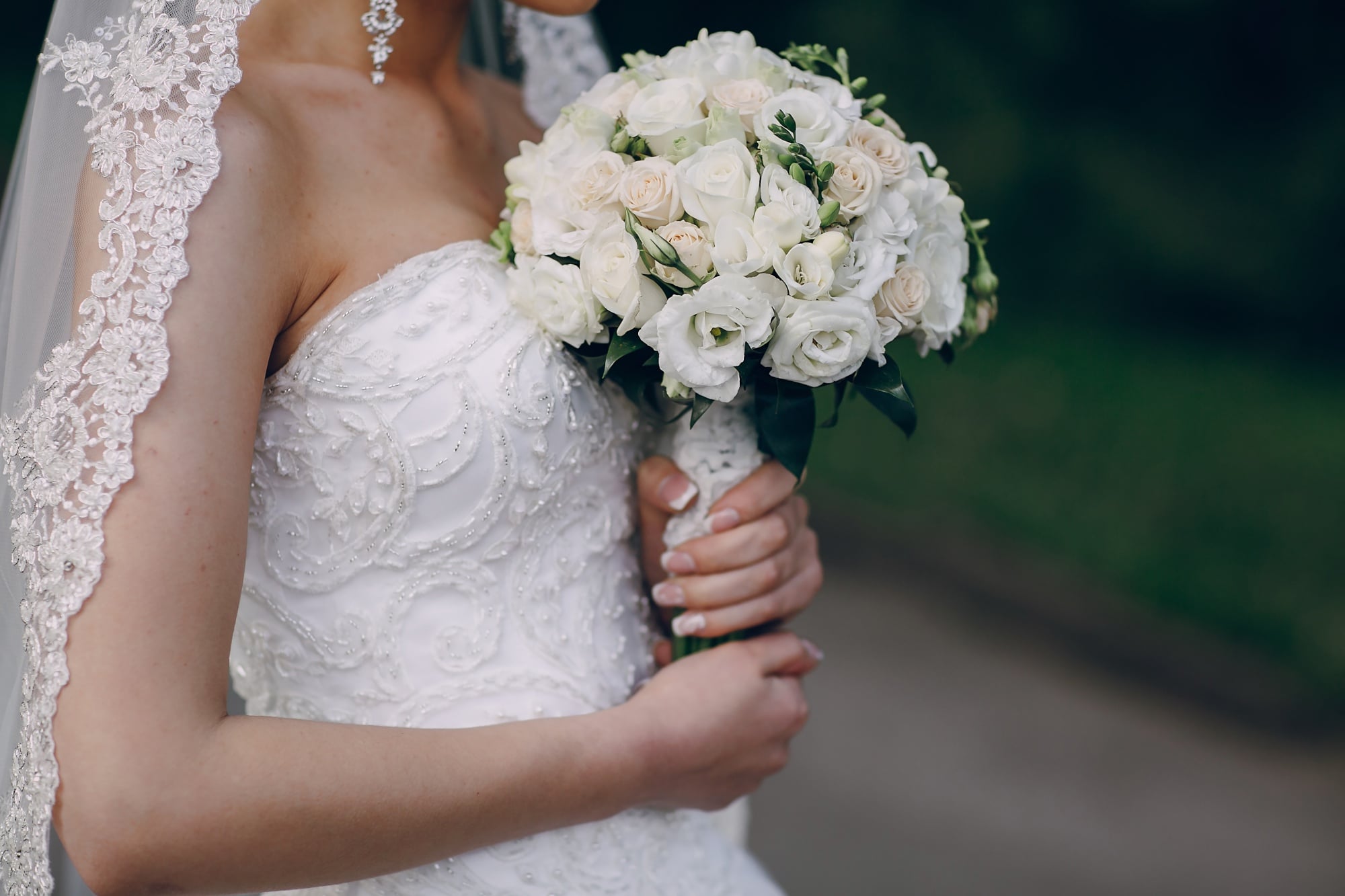
Walking In As Myself
Part One: Seven Times
“Mom, does my dress look okay?”
“Sweetheart, you’ve asked me six times.”
“Seven,” my sister said.
“Thank you, Claire. Very helpful.”
We were in the bride’s room at St. Andrew’s Methodist Church in Lexington, Kentucky. A small room off the side of the sanctuary with a full-length mirror, a pink velvet loveseat, and a box of tissues on every flat surface. Somebody’s grandmother had cross-stitched Love Is Patient and hung it over the door in 1974.
It was 1:40 in the afternoon. The ceremony started at two.
I stood in front of the mirror and looked at myself.
The dress was simple. Ivory. Fitted at the top with lace sleeves, flowing at the bottom. I’d bought it off the rack at a little bridal shop on Main Street, because I didn’t have the energy for six months of fittings.
My shoes were flat. I couldn’t do heels yet. My feet still went numb sometimes.
And my head was bare.
Part Two: The Year
I lost my hair during treatment the year before.
My name is Molly Graham. I’m twenty-nine years old.
Two years ago, I was a kindergarten teacher at Cassidy Elementary in Lexington. I had a classroom full of five-year-olds and a fiancé named Ben and a wedding date set for the following June.
I also had a lump in my neck that I thought was a swollen gland.
It wasn’t a swollen gland.
Hodgkin lymphoma. Stage three.
My oncologist at the UK Markey Cancer Center was a calm, kind woman named Dr. Reyes. She sat with Ben and me in a small exam room with a box of tissues on the counter and told us everything.
The good news: Hodgkin lymphoma is one of the most curable cancers there is. Especially in young people.
The bad news: the cure would take six months of chemotherapy. And then radiation.
And then a long, slow road back.
We postponed the wedding.
Part Three: The Hair
My hair started falling out three weeks after my first chemo infusion.
I had long hair. Down to the middle of my back. Dark brown and thick and wavy. The kind of hair people stopped me in the grocery store to ask about. My kindergarteners used to braid it during quiet time.
It came out in the shower first.
A handful. Then another. Then a clump so big it clogged the drain.
I stood in the shower and stared at it in my hand.
Ben found me there twenty minutes later. Sitting on the floor of the shower with the water running cold. Holding a fistful of my own hair.
He didn’t say anything.
He turned off the water. He wrapped me in a towel. He sat down on the wet floor and held me while I cried.
That night, my mother came over with her clippers.
My mother, Anne, is fifty-six. She’s a retired nurse. She worked in the emergency room at St. Joseph Hospital for thirty years.
She’s tough and warm and practical. She doesn’t believe in waiting for bad things to get worse.
She sat me down in a kitchen chair in the middle of my little apartment. She put a towel around my shoulders.
“We’re not going to let it fall out in clumps,” she said. “We’re going to take it. On our terms.”
She held up the clippers.
“Ready?” she asked.
I wasn’t.
I nodded anyway.
She shaved my head in fifteen minutes.
Ben held my hand the whole time. Claire sat on the counter and cried. Dad stood in the doorway with his hands in his pockets, looking at the floor.
When it was done, Mom handed me a mirror.
I looked at myself.
A pale, round, unfamiliar head. Big eyes. A face I didn’t recognize.
“Oh,” I said.
Then Ben leaned over and kissed the top of my bare head.
“There you are,” he said.
Part Four: Ben
I need to tell you about Ben.
Ben Whitaker is thirty-one. He’s a high school biology teacher at Henry Clay High School. He coaches the cross-country team. He’s tall and lanky and slightly awkward, with glasses and a laugh like a goose honking.
We met at a teachers’ conference in Louisville four years ago. He sat next to me in a session about classroom management and fell asleep and snored.
I elbowed him. He woke up and apologized. Then he asked me to lunch.
He’s the steadiest person I’ve ever known.
He came to every chemo infusion. Every single one. Twelve of them, every other Tuesday, for six months. He took personal days from school. He sat in a vinyl chair next to me for five hours at a time while the drugs dripped into my port.
He brought crossword puzzles and bad snacks and a portable speaker that played the Hamilton soundtrack on a loop.
He held my hair back when I threw up. Then, when I didn’t have hair anymore, he held my head.
He shaved his own head the week after Mom shaved mine.
He didn’t tell me he was going to do it. He just showed up at my apartment one Saturday morning with a box of donuts and no hair.
I stared at him.
“What did you do?” I said.
“It was getting long,” he said. “It was in my eyes.”
It wasn’t getting long. His hair was always short.
He kept it shaved the whole six months. His students called him Coach Cue Ball.
He didn’t care.
Part Five: Judith
Ben’s mother, Judith, is sixty.
She lives in a big brick house in the Chevy Chase neighborhood of Lexington with Ben’s father, Robert, who’s a cardiologist.
She’s elegant. Tall and slim, with perfect posture and perfect makeup and perfect blonde hair, cut in a sleek bob. She wears pearls to the grocery store. She chairs the garden club and the Junior League alumnae association and the fundraising committee for the Lexington Philharmonic.
She never liked me.
I knew it the first time Ben brought me home for dinner. She looked at my thrift-store dress and my sensible shoes and my kindergarten teacher’s hands with the faint marker stains on the knuckles.
“A kindergarten teacher,” she said. “How sweet.”
She said sweet the way some people say sad.
She was polite. Always. She sent birthday cards. She invited me to Christmas. She asked about my students.
But I always felt like I was being measured. And coming up short.
When I was diagnosed, Judith sent flowers.
A big arrangement of white lilies. With a card that said, Thinking of you. — The Whitakers.
She didn’t call. She didn’t visit.
Then, two months into chemo, she came to my apartment.
I was lying on the couch in sweatpants, bald, gray, exhausted. Ben was at work.
Judith stood in my doorway in her camel coat and her pearls and looked at me for a long time.
“Have you thought about a wig?” she asked.
I blinked at her.
“I’ve looked into it,” I said. “They’re expensive. And itchy. And I’m home most of the time anyway.”
“There’s a woman in Louisville,” Judith said. “She makes custom wigs. Real human hair. You can’t tell the difference.”
She handed me a business card.
“I could take you,” she said. “For a fitting.”
“That’s very kind,” I said. “But I think I’m okay for now.”
Judith looked at my bare head.
“Well,” she said. “Keep the card. In case you change your mind.”
She paused.
“For the wedding,” she said.
Part Six: Postponed Twice
We postponed the wedding twice.
The first time was the original date. June. I was in the middle of chemo. I could barely stand.
We moved it to October.
In September, my scan showed a spot. A small one. In my chest. The doctors weren’t sure if it was cancer or scar tissue.
They wanted to do radiation to be safe. Five days a week for four weeks.
We postponed again.
I cried for a week. Ben didn’t.
“Molly,” he said. Holding my hands at our kitchen table. “I don’t care when we get married. I don’t care if it’s October or next June or ten years from now.”
He squeezed my fingers.
“I’m not going anywhere,” he said. “I’m already married to you. We’re just waiting for the paperwork.”
Radiation ended in November.
In January, Dr. Reyes called me into her office.
She was smiling.
“Your PET scan is clean,” she said. “No evidence of disease.”
She leaned forward.
“You’re in remission, Molly,” she said.
I didn’t say anything for a long time.
Then I put my face in my hands and cried so hard Dr. Reyes had to get a nurse.
We set the date that night.
October 14th. A Saturday. At St. Andrew’s Methodist Church, where I grew up. Where my parents were married in 1990.
Part Seven: Short Hair
By October, my hair had started to grow back.
Barely.
It’s not like it was. It came back different. That happens sometimes after chemo. It was short and soft and fuzzy, about half an inch long. And curly. Tight little curls all over my head, like a baby lamb.
And it wasn’t dark brown anymore. It was lighter. Almost auburn.
I looked like somebody else.
Some days I loved it. Some days I didn’t recognize myself in the mirror.
But it was mine.
And I was alive.
Part Eight: The Veil Question
In September, three weeks before the wedding, my mother asked me about a veil.
We were at her kitchen table in the little house where I grew up. Eating leftover lasagna and looking at seating charts.
“You could wear a long one,” Mom said. “Cathedral length. It would cover your head. If you wanted.”
I thought about it.
I’d thought about it a lot.
“No,” I said.
Mom looked at me.
“I spent a year hiding,” I said. “Under hats. Under scarves. Under blankets on the couch.”
I touched my short, fuzzy curls.
“I want Ben to see me,” I said. “All of me. The way I am now.”
Mom put down her fork.
She reached across the table and took my hand.
“Then that’s exactly how you’re walking in,” she said.
Part Nine: Judith’s Calls
Judith called me four times in September.
The first time, she asked about a wig.
“The woman in Louisville can still do a rush order,” she said. “Three weeks. I’ll pay for it.”
“No, thank you, Judith,” I said.
The second time, she asked about a veil.
“A long one,” she said. “Cathedral length. It would be very elegant.”
“I’m not wearing a veil,” I said.
The third time, she asked about the photographer.
“Have you talked to him about angles?” she said. “There are ways to photograph a bride so certain things aren’t so…noticeable.”
“No, Judith,” I said.
The fourth time, she called Ben.
I wasn’t there. I found out later.
She called him at school. During his lunch period. He stepped out into the hallway to take it.
“Benjamin,” she said. “Your father and I have invited two hundred people to this wedding. Partners from Robert’s practice. The entire board of the Philharmonic. The Garden Club.”
She paused.
“Do you understand what people are going to think,” she said, “when your bride walks down the aisle bald?”
Ben told me he stood in the hallway of Henry Clay High School for a long time.
Then he said something he’d never said to his mother in thirty-one years.
“Mom,” he said. “If you say one more word about Molly’s hair, don’t come to the wedding.”
He hung up.
Judith didn’t call again.
She sent an RSVP card. Robert and Judith Whitaker. Two attending.
I thought it was over.
Part Ten: The Wedding Day
So that brings us back to the bride’s room. 1:40 in the afternoon. October 14th.
My mother. My sister. The pink velvet loveseat. Love Is Patient over the door.
“Are you sure you don’t want a veil?” Mom asked.
One more time. Gently. Just to be sure.
“I want Ben to see me,” I said. “All of me.”
Mom smiled.
“Then that’s exactly how you’re walking in,” she said.
She stepped behind me. She looked at me in the mirror. My short auburn curls. My lace sleeves. My bare, healthy face.
She put her hands on my shoulders.
“You’re beautiful,” she said.
Claire came and stood beside her.
“You look like a fairy,” she said. “A really tough fairy.”
I laughed.
Part Eleven: The Doors
An hour later, Dad took my arm outside the church doors.
My father, Paul, is fifty-eight. He’s an electrician. Big and quiet, with a gray mustache and enormous calloused hands. He cried at every chemo appointment he came to. He tried to hide it behind the hospital coffee cup. It never worked.
He was wearing a gray suit he’d rented from the Men’s Wearhouse. It was too tight in the shoulders.
“Ready?” he asked.
I looked at the double doors. At the stained glass windows on either side. At the sunlight coming through them in red and gold and blue.
I could hear the organ playing softly inside. The murmur of two hundred people.
“Is it too late to elope?” I asked.
Dad smiled.
“Your mother would find us,” he said.
I laughed.
Then the music started.
Part Twelve: Halfway
The doors opened.
St. Andrew’s is an old church. Built in 1892. Red brick. White columns. Tall stained glass windows down both sides. Wooden pews, dark and polished from a hundred and thirty years of Sunday mornings.
It was full.
Two hundred people. My side on the left. Ben’s on the right.
My side was smaller. Teachers from Cassidy Elementary. My kindergarten parents. Nurses from the oncology floor at Markey who’d taken care of me. Dr. Reyes, in a blue dress, sitting in the fourth row.
My grandmother. Ninety-one years old. In a wheelchair at the end of the second pew.
Ben’s side was bigger. Doctors in expensive suits. Women in pearls and hats. The board of the Philharmonic. The Garden Club.
Everyone stood up.
And then I saw Ben.
He was waiting at the altar. In a navy suit. His hair was back now, short and dark, but he’d buzzed it again for the wedding. To match mine.
He was smiling.
The biggest, goofiest, most wonderful smile I’ve ever seen.
He was crying.
Dad and I started walking.
Slowly. One step at a time. My flat shoes on the old red carpet.
Past my kindergarten parents, who waved. Past the nurses from Markey, who were already crying. Past Dr. Reyes, who gave me a thumbs up.
I made it halfway down the aisle.
Then Judith stood up.
Part Thirteen: The Wig
She was sitting in the second pew on Ben’s side. The aisle seat. Next to Robert.
She was wearing a pale blue suit and pearls. Her blonde bob was perfect.
She stood up.
“Judith?” I said.
She stepped out into the aisle.
Right in front of me. Blocking my way.
She was holding something.
A blonde wig.
Long. Shoulder-length. Honey-colored. Real human hair, carefully styled in loose waves. The kind from the woman in Louisville.
She held it out to me with both hands.
“Put this on,” she said. “Quickly.”
I stared at it.
“What?” I said.
Judith’s voice rose.
Loud enough for the whole church to hear.
“Your bald head,” she said, “is an embarrassment to our family!”
Part Fourteen: The Music Stopped
The music stopped.
The organist took her hands off the keys. The last chord hung in the air. Then it faded.
Two hundred people stood frozen in the pews.
“Mom!” Ben shouted.
From the altar. His face had gone white.
“What are you doing?”
“Saving the photographs!” Judith said.
She turned and looked at him.
“Two hundred people, Benjamin,” she said. “The photographer. The videographer. These pictures will be on your mantel for fifty years.”
She turned back to me.
“Put it on,” she said. “We can still salvage this.”
“Judith,” I said. My voice was shaking. “Please move.”
“Don’t be stubborn,” Judith said. “Everyone’s staring.”
“Because you’re holding a wig,” Dad said quietly beside me, “in the middle of a wedding.”
A few guests let out nervous laughs.
I wanted to disappear.
I wanted to turn around and run back up the aisle and through the doors and into the parking lot. I wanted to crawl under the pink velvet loveseat in the bride’s room. I wanted to pull a hat over my head and a blanket over my body and never come out.
A year of chemo. Twelve infusions. Four weeks of radiation. A clean PET scan.
And I was standing in the middle of the aisle at my own wedding, with my mother-in-law holding a wig in front of my face.
My hand went to my head.
To my short auburn curls.
Ben started down the aisle.
He came down the three steps from the altar. Fast. His face was red now. His jaw was clenched.
“Put that away, Mom,” he said. “Right now.”
But my mother was already standing.
Part Fifteen: Mom
She was in the front pew on my side. The aisle seat. Where the mother of the bride sits.
She was wearing a dark green dress and a matching jacket. Her hair was short and silver, in a neat pixie cut.
She stood up.
She stepped out into the aisle.
“Excuse me, Judith,” she said.
Judith turned.
She saw my mother.
She rolled her eyes.
“Oh,” Judith said. “Don’t you start.”
My mother didn’t answer her.
She turned to my sister, sitting beside her in the front pew.
“Claire,” she said. “Hold my purse.”
Claire took it. She looked confused.
“Mom?” I whispered.
My mother looked at me.
At my lace sleeves. My bare face. My short auburn curls.
At my hand, still pressed against my head.
“You spent a year fighting to get here,” she said.
Her voice was steady. Quiet. Firm.
“You are not hiding today,” she said.
Part Sixteen: The Pastor
Then she turned to the pastor.
Pastor James Holloway had been the pastor at St. Andrew’s for twenty-two years. He baptized me. He confirmed me. He sat with my family in the hospital the night I was diagnosed.
He was standing at the altar in his white robe. Holding his Bible. Frozen.
“Pastor James,” my mother said. “Could you help me with something?”
She walked up the aisle toward him.
Past Judith. Past me. Past Ben, who was standing in the aisle now, a few feet from his mother.
She went up the three steps to the altar.
She leaned close to Pastor James.
She said something to him. Quietly. Nobody could hear.
He listened.
His face changed.
He looked at my mother for a long time.
Then he looked at Judith.
Then back at my mother.
“Are you certain, ma’am?” he asked quietly.
“Absolutely,” Mom said.
Pastor James set down his Bible on the altar.
He stepped behind my mother.
He reached up with both hands.
And when he stepped aside to let her through, the entire church went silent.
Part Seventeen: Mom’s Hair
My mother was bald.
The pastor had unpinned her wig.
Her short, silver, neat pixie cut. The one she’d worn for fifteen years. The one she got done every six weeks at a salon on Euclid Avenue.
It wasn’t hers.
Pastor James was holding it in his hands. A soft silver wig, with a mesh cap and a row of tiny bobby pins along the edge.
And my mother stood at the altar of St. Andrew’s Methodist Church with her head completely bare.
Smooth. Pale. A few faint scars above her left ear.
Not a single hair.
I couldn’t breathe.
I knew.
I’d always known. Since I was fourteen.
But I’d never seen it. Not in fifteen years. Not once.
Part Eighteen: Fifteen Years
My mother had breast cancer when I was fourteen.
Stage two. Triple negative. Aggressive.
She had a double mastectomy and eight rounds of chemotherapy and six weeks of radiation. At St. Joseph Hospital, where she worked in the ER.
She lost her hair. All of it. In the spring of 2010.
It never grew back.
That happens sometimes. Rarely. One in a few hundred patients. A specific kind of chemotherapy damages the hair follicles permanently.
Permanent chemotherapy-induced alopecia, the doctors called it.
Mom got her first wig in the fall of 2010. A silver pixie cut. The closest thing she could find to her real hair, before it went.
She wore it to work. To church. To my high school graduation. To Claire’s wedding. To every Christmas and every Thanksgiving and every birthday party for fifteen years.
She never once took it off in front of anyone but Dad. Not even Claire and me.
I asked her about it once. When I was sixteen.
“Why don’t you ever go without it?” I said. “Even at home?”
Mom was quiet for a long time.
“Because people look at you differently,” she said finally. “When they can see you’ve been sick. They feel sorry for you. They look at you like you might break.”
She touched her wig.
“I didn’t want you girls to look at me like that,” she said. “Every day. Over breakfast.”
When I lost my hair, I asked her to show me.
Just once. So I’d know it was okay.
She couldn’t.
“I’m sorry, honey,” she said. “I just—I can’t.”
Part Nineteen: What Mom Said
My mother stood at the altar.
Bald. In her dark green dress. Under the stained glass.
Two hundred people stared at her.
She didn’t look at them.
She looked at Judith.
“Judith,” she said.
Her voice carried through the whole church. She didn’t need a microphone. Thirty years in an emergency room teaches you how to make yourself heard.
“I’ve worn a wig for fifteen years,” she said.
Judith didn’t say anything. She was still holding the blonde wig in both hands.
“I had breast cancer in 2010,” Mom said. “My hair never came back. I’ve hidden it every single day since.”
She looked out at the church. At two hundred faces.
“From my husband’s coworkers. From the women at church. From my own daughters.”
“I hid it,” Mom said, “because I believed exactly what you just said.”
She looked at Judith.
“That it was an embarrassment,” she said. “That people would look at me and see a sick woman. That the right thing to do was cover it up so nobody had to be uncomfortable.”
“And then my daughter got sick,” Mom said.
She looked at me.
“And I watched her lose her hair at twenty-eight,” she said. “And I shaved her head in her kitchen. And I watched her look at herself in the mirror and say, Oh.”
Her voice cracked.
“And she asked me to show her mine,” Mom said. “Just once. So she’d know it was okay.”
She looked down.
“And I couldn’t,” she said. “I was too ashamed.”
The church was completely silent.
“My daughter is braver than I am,” Mom said.
She looked at me.
“She spent a year fighting,” she said. “Twelve rounds of chemo. Four weeks of radiation. And three weeks ago, she sat at my kitchen table and told me she wanted to walk down this aisle without a veil.”
She smiled through her tears.
“She said, I want Ben to see me. All of me.”
She turned back to Judith.
“So if anybody in this church,” Mom said, “needs to be embarrassed about a bald head today—”
She touched her own bare scalp.
“It should be me,” she said. “For hiding mine for fifteen years.”
Part Twenty: Walking Down
Then my mother walked down the three steps from the altar.
She walked down the aisle.
Past Pastor James, still holding her silver wig.
Past the front pews.
She stopped beside me.
She took my hand.
“Come on, sweetheart,” she said quietly. “Let’s get you married.”
Judith was still standing in the aisle.
Blocking our way.
Holding the blonde wig.
My mother looked at her.
She didn’t say anything.
She just waited.
For a long moment, Judith didn’t move.
Then Ben reached her.
He’d come all the way down the aisle from the altar. He stood beside his mother. He looked at the wig in her hands.
“Mom,” he said quietly. “Please.”
Judith looked at her son.
Then she looked at my mother. Bald. In her green dress. Holding my hand.
Then she looked at me.
Her face did something I’d never seen it do.
It cracked.
Her chin trembled. Her eyes filled. Her perfect makeup started to run.
She looked down at the blonde wig in her hands.
Then she stepped aside.
Part Twenty-One: The Aisle
Dad took my left arm.
Mom took my right.
We walked down the rest of the aisle together. The three of us.
My father in his too-tight rented suit. My mother, bald, in her green dress. Me in my lace sleeves and my short auburn curls.
Nobody laughed this time.
Halfway down the aisle, somebody started clapping.
I never found out who. Someone in the back. On my side, I think.
Then someone else joined in.
Then the nurses from Markey. Then my kindergarten parents. Then Dr. Reyes, in the fourth row, standing and clapping with tears running down her face.
Then Ben’s side.
The doctors in their expensive suits. The Garden Club. The board of the Philharmonic.
Two hundred people stood in the pews of St. Andrew’s Methodist Church and clapped.
For a bald bride and her bald mother.
The organist started playing again.
When we got to the front, Mom let go of my hand.
She kissed me on the cheek.
“You’re beautiful,” she whispered.
Then she kissed the top of my head.
Right on my short auburn curls.
Then she walked back to the front pew.
Bald. With her head up.
She sat down next to Claire.
She didn’t take back her wig.
Part Twenty-Two: The Vows
Ben was standing at the altar again.
He held out his hand.
Dad put my hand in his.
Dad’s hand was shaking. His eyes were red. He leaned over and whispered in Ben’s ear.
I found out later what he said.
Take care of her. She’s the toughest person I know.
Ben nodded.
“I know, sir,” he said.
Pastor James cleared his throat.
He still had my mother’s silver wig in one hand. He looked at it. He set it carefully on the altar rail, next to his Bible.
He looked out at the congregation.
“Well,” he said. “In twenty-two years, I’ve never had a wedding quite like this one.”
A few people laughed. Softly.
“Let’s begin again,” he said.
Ben and I wrote our own vows.
Ben went first.
He took a folded piece of paper out of his suit pocket. He looked at it.
Then he put it back.
“Molly,” he said. “I had something written. But I want to say something else.”
He took both of my hands.
“A year ago,” he said, “I sat in a vinyl chair next to you every other Tuesday. For five hours. While they put poison in your veins to save your life.”
His voice cracked.
“And every single Tuesday,” he said, “you’d look at me and say, I’m sorry you have to do this.”
He shook his head.
“I never had to do anything,” he said. “I got to. I got to sit next to the bravest person I’ve ever met.”
He reached up. He put his hand on my head. On my short, soft auburn curls.
“I don’t care what your hair looks like,” he said. “Long or short or gone. Brown or red or gray. I’ll love every version of you. For the rest of my life.”
Then it was my turn.
I didn’t have anything written down.
“Ben,” I said. “You shaved your head for me. You told me it was getting in your eyes.”
Ben laughed. The goose-honk laugh.
“It wasn’t getting in your eyes,” I said. “Your hair was always short.”
“I know,” he said.
“You came to every chemo,” I said. “You held my head when I threw up. You played the Hamilton soundtrack four hundred times.”
“Four hundred and twelve,” Ben said.
Everybody laughed.
“I promise,” I said, “to never hide from you. Not my hair. Not my scars. Not my fears.”
I looked at my mother in the front pew. Bald. Holding Claire’s hand.
“I promise to let you see all of me,” I said. “Always.”
Pastor James pronounced us husband and wife.
Ben kissed me.
Then he kissed the top of my head.
Part Twenty-Three: Judith
Judith wasn’t in the pew when we walked back up the aisle.
Robert was sitting alone. Ben’s father. Looking straight ahead. His face was very pale.
The blonde wig was lying on the seat next to him.
I found her twenty minutes later.
In the women’s restroom in the church basement. The old one with the pink tile and the broken hand dryer.
She was sitting on the little bench by the sinks. In her pale blue suit. Her makeup was ruined. She was holding a wad of paper towels.
She was crying.
She looked up when I came in.
In my wedding dress.
“Molly,” she said. “You shouldn’t be down here. The photographer—”
“The photographer can wait,” I said.
I sat down on the bench next to her.
My dress took up most of the bench. Judith had to scoot over.
Neither of us said anything for a long time.
Then Judith reached up.
She put both hands on either side of her perfect blonde bob.
She pulled.
It came off.
Part Twenty-Four: Thirty-Five Years
Judith’s hair was thin.
Not bald. But thin. Wispy and gray, close to her scalp, with patches where there was nothing at all. Bare spots the size of coins.
She held her blonde wig in her lap.
She didn’t look at me.
“Alopecia,” she said. “Since I was twenty-five.”
I stared at her.
“It started six months after I married Robert,” she said. “Little patches. Then bigger ones. The doctors said it was autoimmune. Stress, maybe. There was no cure.”
She smoothed the blonde wig in her lap.
“Robert’s mother noticed,” she said. “At Thanksgiving. 1990. In front of the whole family.”
She was quiet for a long time.
“She said,” Judith said, “Robert, your wife is going bald. You’d better do something about that before people talk.”
“She took me to a wig maker in Louisville the next week,” Judith said. “The same woman I gave you the card for. Her mother, actually.”
She looked at the wig.
“I’ve worn one every day since,” she said. “Thirty-five years. To the grocery store. To the garden club. To bed, sometimes.”
She swallowed.
“Robert’s never seen me without it,” she said. “Not once. Not in thirty-five years.”
“Ben doesn’t know,” she said.
I sat on the bench in my wedding dress and didn’t know what to say.
“When Ben brought you home,” Judith said, “the first time. With your long brown hair. I was so jealous I couldn’t breathe.”
She laughed. It wasn’t a happy sound.
“And then you got sick,” she said. “And you lost it all. And you didn’t wear a wig. You just—walked around. Bald. To the grocery store. To church.”
She looked at me.
“Like it was nothing,” she said. “Like it wasn’t the most humiliating thing that could happen to a woman.”
“I thought I was protecting you,” Judith said. “With the wig. With the phone calls. With today.”
Her voice broke.
“I thought I was doing for you what my mother-in-law did for me,” she said. “Saving you from what people would say.”
She put her face in her hands.
“I became her,” she said. “Robert’s mother. Thirty-five years, I hated that woman. And I became her.”
Part Twenty-Five: What I Said
I sat there for a long time.
In the church basement. In my wedding dress. With my mother-in-law crying next to me, holding her blonde wig in her lap.
Then I reached over.
I put my hand on her thin gray hair.
Gently. The way my mother put her hand on my head a year ago, after she shaved it in my kitchen.
Judith flinched.
Then she went still.
“Judith,” I said. “Do you know what my mom said? At the altar?”
Judith nodded.
“If anybody needs to be embarrassed about a bald head today, it should be me. For hiding mine for fifteen years.”
“I don’t think anybody needs to be embarrassed,” I said. “Not my mom. Not me. Not you.”
I looked at her.
“I think we’ve all just been scared,” I said. “For a really long time.”
Judith didn’t say anything.
She just sat there with my hand on her head.
“You don’t have to take it off,” I said. “Not today. Not ever, if you don’t want to.”
I looked at the blonde wig in her lap.
“But you don’t have to put it back on either,” I said. “Not for me.”
Judith looked at the wig for a long time.
Then she looked at me.
“Would you help me?” she asked.
I thought she meant help her put it back on.
“With what?” I asked.
Judith took a breath.
“Would you help me find Ben?” she said.
Part Twenty-Six: Ben
We found him in the fellowship hall.
He was standing by the cake table with his groomsmen. Laughing at something. Holding a cup of punch.
He saw me come in. In my wedding dress.
He smiled.
Then he saw his mother behind me.
He stopped smiling.
Judith was walking slowly. In her pale blue suit. With her makeup washed off.
With her thin gray hair, and the bare patches, uncovered.
The blonde wig was in my hand.
The fellowship hall went quiet.
Ben set down his cup of punch.
He walked across the room to his mother.
He stopped in front of her.
“Mom?” he said quietly.
Judith looked up at her son.
Thirty-one years old. Six-foot-two. With his short, buzzed hair.
“Benjamin,” she said. “I’m so sorry.”
Her voice was shaking.
“For the wig,” she said. “For the phone calls. For what I said to your wife.”
She touched her own thin hair.
“I’ve had alopecia since before you were born,” she said. “I’ve worn a wig every day of your life.”
She looked at him.
“I never told you,” she said. “I never told your father. I was so ashamed.”
Ben didn’t say anything for a long time.
Then he did what he’d done for me a year ago. On the wet floor of my shower.
He put his arms around his mother.
He held her.
She broke down. Right there in the fellowship hall. Sobbing into her son’s navy suit.
He held her for a long time.
Then he kissed the top of her head.
Right on her thin gray hair.
“There you are,” Ben said.
Part Twenty-Seven: Robert
Ben’s father, Robert, was standing in the doorway of the fellowship hall.
He’d come downstairs looking for his wife.
He saw her.
He didn’t move for a long time.
Then he walked across the room.
He stopped in front of Judith. Ben stepped back.
Robert looked at his wife.
At her thin gray hair. At her bare patches. At her ruined makeup.
Thirty-five years.
“Judy,” he said quietly.
Judith looked up at him. Terrified.
“I’ve known,” Robert said.
Judith stared at him.
“Since 1991,” Robert said. “I came home early from the hospital. You were in the bathroom with the door cracked. You had it off. You were crying.”
He swallowed.
“I didn’t say anything,” he said. “I thought—if you wanted me to know, you’d tell me. I didn’t want to embarrass you.”
He shook his head.
“So I pretended,” he said. “For thirty-four years.”
“You knew,” Judith whispered. “This whole time.”
“This whole time,” Robert said.
He reached up. He put his hand on her cheek.
“You’re the most beautiful woman I’ve ever known,” he said. “With or without.”
He paused.
“I should’ve told you that in 1991,” he said.
Part Twenty-Eight: The Photographs
We took the photographs on the front steps of St. Andrew’s.
At five o’clock. In the golden October light. With the maple trees on the church lawn turning red and orange.
The photographer was a young woman named Tasha. She’d been hired by Judith. She’d been told, I found out later, to photograph the bride from flattering angles.
She threw that instruction away.
The first picture she took was of me and Ben. On the church steps. Ben’s hand on my short auburn curls.
The second was of me and my mother.
Mom, bald, in her green dress. Me, with my curls, in my lace sleeves.
Our foreheads touching.
The third was the one that hangs over our fireplace now.
Tasha arranged it herself. She lined up the families on the church steps. Mine on the left. Ben’s on the right.
My father in his rented suit. Claire in her bridesmaid dress. My grandmother in her wheelchair.
Robert in his tuxedo.
And three women in the front row.
My mother on the left. Bald.
Judith on the right. Her thin gray hair uncovered. Her blonde wig left in the car.
And me in the middle. With my short auburn curls.
Tasha took the picture.
Then she lowered her camera.
She was crying.
“I’ve photographed a hundred and forty weddings,” she said. “I’ve never taken one like that.”
Part Twenty-Nine: The Reception
At the reception, there was a mother-son dance.
Ben and Judith. To “Wonderful World.” Louis Armstrong.
Judith walked onto the dance floor without her wig.
The guests went quiet. The Garden Club. The board of the Philharmonic. The doctors from Robert’s practice.
Judith stood in the middle of the dance floor in her pale blue suit. With her thin gray hair under the ballroom lights.
She held out her hand to her son.
They danced.
Halfway through the song, my mother stood up from her table.
She walked onto the dance floor. Bald. In her green dress.
She tapped Ben on the shoulder.
“May I cut in?” she asked.
Ben stepped back.
My mother and Judith danced together.
Two women in their fifties and sixties. One bald. One with thin gray hair. Swaying to Louis Armstrong in the middle of a ballroom at the Lexington Country Club.
They didn’t really dance. They just held on to each other.
Judith was crying.
My mother said something to her. I couldn’t hear.
I asked Mom later what she said.
“I told her,” Mom said, “that I’d been hiding for fifteen years. And she’d been hiding for thirty-five.”
She smiled.
“I said, That’s fifty years of hiding between us, Judith. Don’t you think that’s enough?”
Part Thirty: One Year Later
It’s October again now.
One year.
Ben and I live in a little brick house near Woodland Park. I’m back at Cassidy Elementary. Teaching kindergarten. My five-year-olds don’t remember me with long hair. They only know me with short auburn curls.
They call me Mrs. Whitaker. And sometimes, when they forget, Miss Molly.
My hair is about two inches long now. Still curly. Still auburn.
I keep it short. I like it.
My PET scans are still clean. Every three months. Dr. Reyes says if I make it to five years, I’m considered cured.
I’m at twenty-one months.
My mother doesn’t wear her wig anymore.
Not to church. Not to the grocery store. Not to Claire’s house for Sunday dinner.
She got her silver wig back from Pastor James after the wedding. She put it in a box in her closet. She hasn’t taken it out since.
At first, people stared.
At church. At the Kroger on Euclid. At her book club.
She stared back.
After a while, they stopped.
Part Thirty-One: Judith
Judith doesn’t wear hers anymore either.
Not every day. Not yet.
But most days.
She goes to the garden club without it. She chairs the Philharmonic fundraising committee without it.
Two women on the committee quit. Judith said good riddance.
Three new women joined.
In March, she started a support group.
Uncovered. For women with hair loss. Alopecia. Chemo. Thyroid disease. Anything.
It meets the first Tuesday of every month. In the fellowship hall at St. Andrew’s Methodist Church.
My mother co-leads it with her.
There are thirty-four members now. Women from all over Lexington. Old and young. Black and white. Rich and poor.
Some of them come in wigs. Some of them come in scarves. Some of them come bald.
Nobody cares which.
At the first meeting, Judith stood up in front of eleven nervous women in folding chairs.
She took off her wig.
She held it up.
“I wore this for thirty-five years,” she said. “Because a woman told me at Thanksgiving in 1990 that I was an embarrassment.”
She looked at the wig in her hand.
“And then I said the same thing,” she said, “to my son’s bride. In the middle of her wedding. While she was walking down the aisle.”
She set the wig on the table.
“I’m here,” Judith said, “because I don’t want any of you to waste thirty-five years like I did.”
Part Thirty-Two: The Wig
Last week, Judith gave me something.
She came over to our house on a Sunday afternoon. With a box.
A white cardboard box. Tied with a pink ribbon.
She handed it to me on the front porch.
“Open it,” she said.
I untied the ribbon.
I opened the box.
Inside was the blonde wig.
The one from the wedding. Long. Shoulder-length. Honey-colored. Real human hair, styled in loose waves.
The one she held out to me in the middle of the aisle.
I looked at her.
“Judith,” I said. “I don’t want this.”
“I know,” Judith said. “I’m not giving it to you to wear.”
She reached into the box. Under the wig.
There was an envelope.
I opened it.
Inside was a receipt. From an organization called Wigs for Kids. In Ohio. They make free wigs for children who’ve lost their hair to cancer and alopecia.
Donation received: One human hair wig. Blonde, shoulder-length.
Donation received: $5,000. In honor of Molly Graham Whitaker.
“I’m sending the wig to them,” Judith said. “Tomorrow. They’ll take it apart and use the hair. For a little girl. Somewhere.”
She looked at me.
“Somebody who wants to wear it,” she said. “Not somebody who’s being told she has to.”
She was quiet for a moment.
“And the money,” she said, “is for the next one. And the one after that.”
I looked at the receipt.
Then I looked at my mother-in-law.
At her thin gray hair, in the October sunlight on my front porch.
I hugged her.
“Thank you, Judith,” I said.
“Don’t thank me,” she said into my shoulder. “Thank your mother.”
She pulled back.
“She stood up first,” Judith said. “In the church. When I was too ashamed to.”
She smiled.
“Somebody always has to stand up first,” she said.
Part Thirty-Three: Walking In
Last night, Ben and I watched our wedding video.
For the first time. A year later.
Tasha’s videographer captured all of it.
The doors opening. The organ. Me and Dad walking down the aisle.
Judith standing up. The wig.
Your bald head is an embarrassment to our family!
I watched my own face.
At the moment she said it. My hand going to my head. My shoulders curling in. My eyes looking for a way out.
Then I watched my mother stand up.
Claire, hold my purse.
You spent a year fighting to get here. You are not hiding today.
I watched Pastor James unpin her wig.
I watched two hundred people go silent.
I watched my mother stand bald at the altar of the church where she was married.
I paused the video right there.
On my mother’s face.
Ben looked at me.
“You okay?” he asked.
I looked at the screen.
At my mother. Fifty-six years old. Bald. Under the stained glass. With her head up.
Fifteen years of hiding. Ended in one moment. For me.
“I spent a year fighting to get to that aisle,” I said. “And I almost ran away. Right there in the middle of it.”
I touched my short auburn curls.
“And she wouldn’t let me,” I said.
Ben took my hand.
“She didn’t just stand up for you,” he said. “She stood up for herself. And for my mom. And for everybody in that church who’d ever hidden anything.”
I pressed play.
On the screen, my mother walked down the three steps from the altar.
She took my hand.
Come on, sweetheart. Let’s get you married.
And we walked.
My father on one side. My mother on the other. Me in the middle.
Down the aisle.
With nothing covered.
And nothing to hide.

Lila Hart is a dedicated Digital Archivist and Research Specialist with a keen eye for preserving and curating meaningful content. At TheArchivists, she specializes in organizing and managing digital archives, ensuring that valuable stories and historical moments are accessible for generations to come.
Lila earned her degree in History and Archival Studies from the University of Edinburgh, where she cultivated her passion for documenting the past and preserving cultural heritage. Her expertise lies in combining traditional archival techniques with modern digital tools, allowing her to create comprehensive and engaging collections that resonate with audiences worldwide.
At TheArchivists, Lila is known for her meticulous attention to detail and her ability to uncover hidden gems within extensive archives. Her work is praised for its depth, authenticity, and contribution to the preservation of knowledge in the digital age.
Driven by a commitment to preserving stories that matter, Lila is passionate about exploring the intersection of history and technology. Her goal is to ensure that every piece of content she handles reflects the richness of human experiences and remains a source of inspiration for years to come.