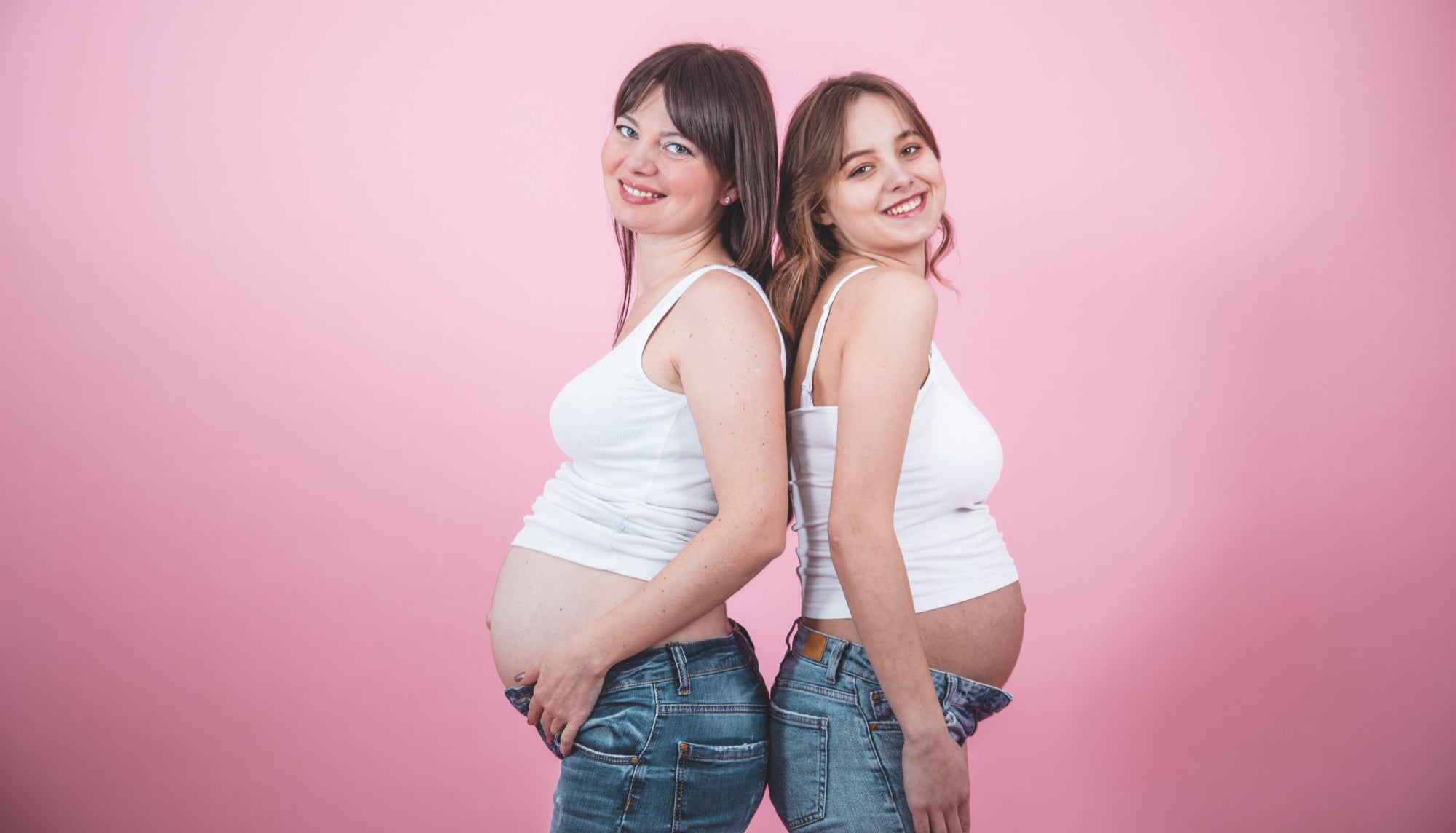
Like Sisters
Part One: The House Next Door
My name is Sarah Lindell. I’m thirty-two years old.
I never expected the happiest chapter of my life to lead to a medical appointment that would leave me terrified for my unborn child.
And I never expected that appointment to answer a question I didn’t even know I’d been asking my whole life.
My best friend, Emily Carver, is thirty-one.
We’ve been inseparable for twenty-five years.
We grew up in neighboring houses on Sycamore Lane in Westbrook, Ohio. A small town east of Columbus with one high school, one Dairy Queen, and a water tower painted like a giant baseball.
My house was yellow with white shutters. Hers was blue with a red door. There was a gap in the hedge between our backyards that our fathers never fixed, because by the time they noticed it, we’d worn a dirt path through it.
We met when I was seven and she was six.
She was sitting on her back steps crying because her goldfish had died. I came through the hedge with a shoebox and a garden trowel and said, “We should have a funeral.”
We buried him under her mother’s rose bush. I said a prayer. She sang “Twinkle, Twinkle, Little Star” because it was the only song she knew all the words to.
After that, we were never apart.
We attended the same schools. Westbrook Elementary, Westbrook Middle, Westbrook High.
We shared countless adventures. Building forts in the woods behind the Methodist church. Sneaking into the community pool after closing. Driving to Columbus at sixteen to see a concert we’d lied to our parents about.
We supported each other through our first crushes, our first kisses, our first heartbreaks. When Tommy Reinhart dumped me at the junior prom, Emily poured a cup of red punch down the back of his tuxedo.
When Emily’s father had his heart attack our senior year, I slept on her bedroom floor for two weeks.
Our mothers frequently joked that we behaved more like sisters than best friends.
“Look at you two,” my mother, Marie, would say. Watching us lie on the trampoline in the backyard, finishing each other’s sentences. “Peas in a pod.”
“Same nose,” Emily’s mother, Barbara, would say. Laughing. “Same stubborn chin. Are you sure the hospital didn’t mix them up?”
They’d laugh.
Then sometimes they’d look at each other.
And stop laughing.
I never thought anything of it.
Part Two: The Dream
For as long as I can remember, Emily and I shared one particular dream.
We wanted to become mothers. And watch our children grow up together.
We planned it when we were ten. Lying in a tent in my backyard with flashlights.
We’d live next door to each other. Our kids would cut through a hedge. They’d have a dirt path. They’d bury goldfish together and pour punch on boys who were mean to them.
“Pinky swear,” Emily said.
“Pinky swear,” I said.
Unfortunately, life didn’t unfold the way we’d imagined.
I married a man named Kevin when I was twenty-four. He was charming and funny and sold medical devices. We bought a little house in Columbus. We tried to have a baby.
Two years later, I found out he’d been having an affair with a woman from his office.
My marriage ended five years ago. It left me heartbroken and uncertain about my future. I moved back to Westbrook. I rented a small house three blocks from Sycamore Lane.
I’m a pediatric nurse at the children’s hospital in Columbus. I take care of other people’s babies all day.
Emily never married.
She had several serious relationships. A teacher. A firefighter. A sweet, quiet man named Paul she dated for four years, who left because he didn’t want children.
She’s a librarian at the Westbrook Public Library. The children’s section. She does story time on Tuesday and Thursday mornings with a puppet named Mr. Biscuit.
By the time we reached our thirties, we’d both grown tired of waiting for the right partners.
Part Three: The Idea
Then, one evening, Emily suggested something completely unexpected.
It was a Friday night in October. We were sitting on my back porch with a bottle of wine and a bag of Doritos. It was cold. We had blankets over our legs.
We’d been talking about babies. Again. Like always.
“Sarah,” Emily said. “What if our children weren’t simply childhood friends?”
I smiled.
“What do you mean?”
She leaned forward. She had that look. The one she used to get when she wanted to sneak into the community pool.
“What if they actually shared the same biological father?” she said. “They could be brother and sister. Or two sisters. Or two brothers.”
She grinned.
“Real siblings,” she said. “Not just like siblings.”
At first, I thought she was joking.
But Emily had already considered the possibilities.
She’d been researching for months. She pulled out her phone and showed me. Fertility clinics in Columbus. Sperm banks. Donor profiles. Success rates. Costs.
We could both become mothers through fertility treatment, she said. Using sperm from the same donor.
Our children would share a biological connection. Half-siblings.
And we could raise them together. Next door. Just like we’d always hoped.
“Emily,” I said. “That’s crazy.”
“I know,” she said.
“Like, really crazy.”
“I know,” she said. “But think about it.”
The idea was unconventional.
But it gradually began to make sense.
Part Four: Daniel
After months of consultations, medical examinations, and careful discussions, we chose a fertility clinic.
The Columbus Reproductive Health Center. A big modern building on the north side of the city with glass walls and a fountain in the lobby.
They worked with a sperm bank called Heritage Cryobank. One of the oldest in Ohio. Founded in 1981.
We spent three weekends at Emily’s kitchen table, scrolling through donor profiles on her laptop.
Height. Weight. Eye color. Hair color. Education. Medical history. A short essay from each donor about why he’d decided to donate.
We selected a donor named Daniel.
That wasn’t his real name. The bank used first names only. Donor #4471, “Daniel.”
According to the profile, he was thirty-five. Six feet tall. Brown hair, hazel eyes. A PhD in biochemistry. He’d donated in graduate school, in 2014.
He’d passed every required medical screening. Genetic carrier testing for cystic fibrosis, spinal muscular atrophy, Tay-Sachs, and two hundred other conditions. All negative.
His essay was what sold us.
I was raised by a single mother, he wrote. I never knew my father. She told me he was a good man who couldn’t be there. I’m donating because I want to help people build families. Families come in all shapes. Mine was just me and my mom. And it was enough.
“He sounds kind,” Emily said.
“He sounds like us,” I said.
We completed the procedures in January.
Both of us. Same week. Same clinic. Same doctor.
And then we waited.
Part Five: Two Pink Lines
Then something wonderful happened.
I became pregnant.
I found out on a Tuesday morning in February. I took the test in my bathroom at six a.m. before my shift at the hospital. I sat on the edge of the tub and stared at those two pink lines until my alarm went off.
Then I called Emily.
She screamed so loud I had to hold the phone away from my ear.
Three weeks later, Emily discovered she was expecting too.
She showed up at my front door at eleven o’clock at night in her pajamas. Holding the test in her hand. Crying.
We stood in my doorway hugging for ten minutes.
We were overwhelmed with happiness.
We bought tiny baby clothes. A matching pair of onesies that said BEST FRIENDS and BEFORE WE WERE BORN.
We compared ultrasound pictures. We had our appointments on the same days, back to back, so we could go together.
We discussed names. Hundreds of names. We made lists on the refrigerator.
We imagined our children celebrating birthdays together. Cutting through a hedge. Burying goldfish.
For the first time in years, everything seemed to be falling into place.
Part Six: The Call
But during the fifth month of our pregnancies, our excitement turned into fear.
At twenty weeks, the clinic recommended an expanded genetic screening.
It’s a newer test. More detailed than the standard ones. They draw your blood and look at the baby’s DNA floating in it. It can find chromosomal problems and some genetic conditions.
It can also show things you weren’t looking for.
We both had our blood drawn on the same day. In early June.
Two weeks later, one morning, the genetics clinic called.
I was at work. On the pediatric floor. Changing an IV bag for a four-year-old with pneumonia.
My phone buzzed in my scrub pocket. I didn’t recognize the number.
I answered in the hallway.
“Sarah Lindell?”
“Yes?”
“This is Rachel. I’m a nurse with the Genetics Center at Ohio State. Dr. Harrison needs to speak with you and Emily Carver as soon as possible.”
Something in her voice immediately worried me.
I’ve been a nurse for ten years. I know that voice. I’ve used that voice.
“Is there a problem with our babies?” I asked.
Rachel hesitated.
“Please come to the clinic,” she said. “The doctor will explain everything.”
“When?”
“Today,” she said. “If you can. Three o’clock.”
I called Emily immediately.
She was at the library. In the middle of story time. I could hear the kids singing in the background.
“Em,” I said. “We need to go to the genetics clinic. Today. At three.”
There was a long pause.
“Both of us?” she said.
“Both of us.”
Part Seven: Dr. Harrison
Neither of us said much during the drive.
Forty minutes from Westbrook to Columbus. I drove. Emily sat in the passenger seat with both hands on her belly, looking out the window at the cornfields.
At one point, she reached over and took my hand.
She didn’t let go until we parked.
The Genetics Center is on the fourth floor of a medical building at Ohio State. A quiet waiting room with soft chairs and a fish tank and framed pictures of DNA helixes on the walls.
Rachel came to get us. She took us down a long hallway to a corner office.
When we entered Dr. Harrison’s office, he was studying two genetic reports.
They were displayed side by side on two computer monitors on his desk. Columns of numbers and letters and colored bars.
He was in his sixties. Gray hair. Wire glasses. A kind face.
He didn’t greet us with his usual reassuring smile.
Instead, he examined the results again.
Then he got up, walked past us, and slowly closed the office door.
He sat back down.
He looked at both of us.
“Before we discuss these findings,” he said, “I need to confirm something.”
Emily gripped my hand.
“What is it, Doctor?” she said.
“Are you absolutely certain,” Dr. Harrison said, “that the same sperm donor was used for both pregnancies?”
“Yes,” we answered together.
“Donor 4471,” I said. “Daniel. From Heritage Cryobank.”
He nodded slowly.
He looked at the screens once more.
His expression grew increasingly serious.
“The genetic similarities between your babies,” he said, “are not entirely what we expected.”
I felt my heartbeat quicken.
“But they share the same biological father,” Emily said. “Wouldn’t that explain the similarities?”
“It would explain some of them,” Dr. Harrison said carefully.
He pointed at the screens.
“Half-siblings share about twenty-five percent of their DNA,” he said. “That’s what we’d expect between your babies.”
He paused.
“These two fetuses,” he said, “share closer to thirty-seven percent.”
I stared at the numbers on the screen. I didn’t understand them.
But I understood the look on his face.
“These preliminary findings,” Dr. Harrison said, “suggest there may be another biological connection we haven’t accounted for.”
I instinctively placed my hands over my stomach.
“Doctor, please tell us,” I said. “Are our babies sick?”
He looked at me. Then at Emily.
“We haven’t established that either child has a medical condition,” he said. “Further testing is necessary.”
He paused before continuing.
“I’ve worked in this field for twenty-seven years,” he said. “I’ve rarely encountered a situation like this.”
He folded his hands on the desk.
“If these results are confirmed,” he said, “there is something extremely important you both need to understand. About your children’s biological relationships. And possible medical risks.”
Emily’s hand tightened around mine.
“Then tell us,” she whispered.
Dr. Harrison took a slow breath.
“First,” he said, “I need to ask you both a question about your families.”
I stared at him.
“What question?”
He looked directly into my eyes.
“Sarah,” he said. “Emily.”
He paused.
“Are you absolutely certain,” he said, “that the two of you aren’t biologically related?”
Part Eight: The Question
For several seconds, neither of us could speak.
Are you absolutely certain the two of you aren’t biologically related?
I looked at Emily.
She looked at me.
Same nose.
Same stubborn chin.
Are you sure the hospital didn’t mix them up?
“That’s—” Emily started. “That’s impossible. We’re not related. We met when I was six. Over a dead goldfish.”
“Our parents are completely different people,” I said. “My dad was Swedish. From Minnesota. Her dad’s family is Irish. From Boston.”
Dr. Harrison nodded slowly.
“I understand,” he said. “And I’m not saying you are. I’m saying the numbers suggest it.”
He pointed to a colored bar on one of the screens.
“If two mothers are unrelated,” he said, “and they use the same donor, their babies share about twenty-five percent of their DNA. Through the father.”
He pointed to another number.
“If the two mothers are themselves half-sisters,” he said, “the babies would share more. About thirty-seven percent. Through the father and through the mothers.”
He looked at us.
“That’s what these numbers show,” he said.
“Half-sisters,” I repeated.
“There’s something else,” Dr. Harrison said.
Part Nine: Runs of Homozygosity
He pulled up a different screen.
A long graph. Colored bars. Some of them highlighted in red.
“These are called runs of homozygosity,” he said. “Long stretches of DNA where a baby inherited the exact same sequence from both parents.”
He pointed.
“Every person has a few,” he said. “Short ones. It’s normal.”
He pointed at the red bars.
“These are long,” he said. “Longer than we’d expect from two unrelated parents.”
He looked at both of us.
“Both of your babies show this pattern,” he said. “To a similar degree.”
“What does that mean?” I asked. My voice was barely a whisper.
Dr. Harrison took off his glasses.
“It means,” he said carefully, “that in addition to the two of you possibly being related to each other, there may also be a biological relationship between each of you and the donor.”
The room went completely silent.
“Between us,” Emily said slowly, “and Daniel.”
“Yes,” Dr. Harrison said.
“What kind of relationship?” I asked.
He was quiet for a long moment.
“The pattern is consistent,” he said, “with the mother and the donor being half-siblings.”
I couldn’t breathe.
“That’s not possible,” Emily said. “We don’t know him. We don’t even know his real name. He’s an anonymous donor from a sperm bank.”
“I know,” Dr. Harrison said gently.
He put his glasses back on.
“That’s why I asked about your families,” he said.
Part Ten: The Risks
He explained the risks.
Slowly. Carefully. The way I explain things to frightened parents at the hospital.
When two parents are closely related, he said, their child has a higher chance of inheriting two copies of the same rare recessive gene. One from each parent.
Most of the time, that’s harmless.
Sometimes, it causes a genetic condition.
“For children of unrelated parents,” Dr. Harrison said, “the background risk of a serious birth defect or genetic disorder is about three to four percent.”
He paused.
“For children of half-siblings,” he said, “it’s higher. Studies vary. Maybe six to nine percent.”
“So there’s a ninety percent chance they’re fine,” Emily said.
“Roughly,” Dr. Harrison said. “Yes.”
He looked at her.
“But I can’t tell you which group your baby is in,” he said. “Not yet. Not without more testing.”
He recommended an amniocentesis. For both of us. And whole-exome sequencing. A test that looks at every gene in the baby’s DNA.
It would take three weeks to get the results.
He also recommended something else.
“You need to talk to your mothers,” he said.
Part Eleven: The Drive Home
We sat in my car in the parking garage for an hour.
Neither of us said anything for a long time.
Then Emily laughed.
A strange, broken laugh.
“Same nose,” she said. “Same stubborn chin.”
She put her face in her hands.
“Our mothers used to joke about it,” she said. “Every single week.”
“And then they’d stop laughing,” I said quietly.
Emily looked at me.
“You noticed that too?” she said.
“Every time,” I said.
“Sarah,” she said. “What if it’s true?”
I looked out the windshield at the concrete wall of the parking garage.
“Then we’ve been sisters for twenty-five years,” I said. “And didn’t know it.”
Emily reached over and took my hand.
“We always knew it,” she said.
Part Twelve: Two Mothers
We went to see our mothers that night.
Together.
My mother, Marie, still lives in the yellow house on Sycamore Lane. She’s sixty-five. My dad, Erik, died of a stroke six years ago.
Emily’s mother, Barbara, still lives in the blue house next door. She’s sixty-four. Emily’s dad, Mike, is sixty-seven. Retired from the post office. Still alive. Still fixing things in his garage.
We knocked on my mother’s door at seven o’clock.
She opened it in her apron. She’d been baking. She saw our faces.
She stopped smiling.
“Mom,” I said. “Can you call Barbara? We need to talk to both of you.”
My mother looked at me for a long time.
Then she looked at Emily.
Then she took off her apron.
“I’ll call her,” she said quietly.
Barbara came through the hedge. The same gap our fathers never fixed. The same dirt path Emily and I wore down when we were little.
She came into my mother’s kitchen. She sat down at the table.
The two of them sat side by side. Two women in their sixties who’d been next-door neighbors for thirty-two years.
I set the genetics reports on the kitchen table.
“Dr. Harrison asked us a question today,” I said. “At the genetics clinic.”
My voice was shaking.
“He asked if Emily and I are biologically related,” I said.
My mother put her hand over her mouth.
Barbara closed her eyes.
Neither of them said That’s ridiculous.
Neither of them said Of course not.
They looked at each other.
Part Thirteen: 1993
It was Barbara who spoke first.
“Your father couldn’t have children,” she said to Emily.
Emily stared at her.
“Mike had the mumps,” Barbara said. “When he was nineteen. It made him sterile. We didn’t find out until we’d been trying for three years.”
She looked at her hands.
“He was so ashamed,” she said. “He made me promise never to tell anyone. Not his family. Not you.”
Then my mother spoke.
“Your father had a low sperm count,” she said to me. “Almost none. The doctors said we’d never conceive naturally.”
She looked at me.
“Erik was devastated,” she said. “He was so proud. He made me swear the same thing.”
“So we went to a fertility clinic,” Barbara said.
“In Columbus,” my mother said.
They looked at each other.
“Dr. Gerald Whitcomb,” Barbara said quietly. “The Whitcomb Fertility Clinic. On High Street.”
“He was the best,” my mother said. “Everybody said so. He’d helped hundreds of women.”
“He told us he used donor sperm from medical students,” Barbara said. “Anonymous. Screened. Healthy. Young men from Ohio State.”
“He said the donors were matched to our husbands,” my mother said. “Same coloring. Same build. So no one would ever know.”
“I went in March of 1993,” Barbara said. “Emily was born in December.”
“I went in April of 1992,” my mother said. “Sarah was born in January of 1993.”
Emily and I looked at each other.
“We didn’t know,” my mother said. “We didn’t know about each other.”
She looked at Barbara.
“We’d just moved here,” she said. “Erik got a job at the Honda plant in Marysville. We bought the yellow house in 1992.”
“We moved in next door in 1993,” Barbara said. “Mike got transferred to the Westbrook post office.”
“It was years before we figured it out,” Barbara said.
Part Fourteen: The Hedge
“How?” I asked.
My mother was quiet for a long moment.
“You and Emily,” she said. “When you were eight and seven. You were playing in the backyard. Running through the sprinkler.”
She smiled sadly.
“You both had the same birthmark,” she said. “A little brown spot behind your left knee. The exact same shape. Like a little bean.”
I looked at Emily.
I have that birthmark. Behind my left knee.
Emily has it too.
We used to call them our twin beans.
“I mentioned it to Barbara,” my mother said. “Laughing. Over the hedge. I said, Look, they even have the same birthmark.”
She looked at Barbara.
“And Barbara got very quiet,” my mother said.
“That night,” Barbara said, “I came through the hedge. After the girls were asleep. I knocked on Marie’s back door.”
She looked at my mother.
“I asked her if she’d ever been to Dr. Whitcomb,” Barbara said.
“I almost fainted,” my mother said.
“We sat at this kitchen table until two in the morning,” Barbara said. “With a bottle of wine. Figuring it out.”
She looked at us.
“Dr. Whitcomb told both of us we were getting sperm from a medical student,” she said. “Both of us. The same year. And our daughters had the same birthmark and the same nose and the same chin.”
“We didn’t know for sure,” my mother said. “There were no DNA tests back then. Not like now.”
“But we knew,” Barbara said quietly.
“Why didn’t you tell us?” Emily asked.
Her voice was shaking.
The two women looked at each other.
“Because of your fathers,” my mother said.
“They never knew about each other,” Barbara said. “Erik didn’t know Mike had been to Dr. Whitcomb. Mike didn’t know about Erik.”
“And they’d made us promise,” my mother said. “Never to tell anyone. Ever.”
“And because of you two,” Barbara said.
She looked at Emily and me.
“You loved each other so much,” she said. “You were so happy. Running through that hedge. Burying goldfish. Pinky swearing in tents.”
She wiped her eyes.
“We didn’t want to take that away,” she said. “We didn’t want to make it complicated. We thought, What difference does it make? They’re already sisters.”
“So we kept the secret,” my mother said. “For twenty-four years.”
Part Fifteen: The Donor
“Mom,” I said. “There’s more.”
I told them about the runs of homozygosity. The red bars on Dr. Harrison’s screen.
The pattern that suggested each of us was also related to the donor.
My mother went white.
“Daniel,” she said. “The donor’s name is Daniel?”
“That’s what the bank calls him,” I said. “Donor 4471. He’s thirty-five. A biochemist. He was raised by a single mother. He never knew his father.”
Barbara put both hands flat on the kitchen table.
“Heritage Cryobank,” she said. “In Columbus.”
“Yes,” Emily said.
Barbara looked at my mother.
“Marie,” she said. “When was Heritage founded?”
My mother shook her head.
“I don’t know.”
I pulled out my phone. I looked it up.
Heritage Cryobank. Founded 1981 by Dr. Gerald Whitcomb, M.D.
The kitchen went silent.
Part Sixteen: The Most Shocking Discovery
It took six weeks to confirm everything.
Emily and I both did a DNA test. One of those home kits. Spit in a tube. Mail it in.
We took the tests the same night. At my kitchen table. With the genetics reports and a box of Kleenex.
The results came back on a Thursday in August.
Same day. Ten minutes apart.
At the top of my DNA Relatives list, there was one name.
Emily Carver. Predicted relationship: Half-sister. Shared DNA: 24.8%.
At the top of Emily’s list, my name.
Sarah Lindell. Half-sister.
And below that, on both of our lists, there were more.
So many more.
Jennifer Mattox. Half-sibling.
Brian Okafor. Half-sibling.
Laura Delancey. Half-sibling.
Matthew Pruitt. Half-sibling.
Forty-three of them.
Forty-three half-siblings. Born between 1979 and 1997. Most of them in Ohio. All of them conceived at the Whitcomb Fertility Clinic on High Street in Columbus.
All of them sharing about twenty-five percent of their DNA with each other.
And one more.
Daniel Whitcomb. Half-sibling. Shared DNA: 25.3%.
Part Seventeen: Daniel Whitcomb
His name was Daniel Whitcomb.
He was thirty-five. A research biochemist at a pharmaceutical company in Indianapolis.
He was Dr. Gerald Whitcomb’s son.
Not his legitimate son.
Dr. Whitcomb had been married for forty years. He had three children with his wife. Daniel wasn’t one of them.
Daniel’s mother was a nurse who’d worked at the Whitcomb Fertility Clinic in the late 1980s. A single woman who wanted a baby. Dr. Whitcomb offered to help her.
She never knew the truth either. She thought she was getting donor sperm from a medical student.
She raised Daniel alone. In Dayton. She told him his father was a good man who couldn’t be there.
In 2014, when Daniel was a graduate student at Ohio State, he needed money.
His mother had cancer. Her insurance didn’t cover everything.
He saw a flyer on a bulletin board in the chemistry building. Earn up to $1,500/month. Become a sperm donor. Heritage Cryobank.
He didn’t know who founded Heritage Cryobank.
He didn’t know that the man who ran it was his biological father.
He didn’t know that Dr. Gerald Whitcomb, by then seventy years old and semi-retired, still sat on the board and still reviewed the donor profiles personally.
He didn’t know that his biological father had looked at his application, read his name, seen his mother’s name on the medical history, and approved him anyway.
Part Eighteen: The Letter
We found out about the last part from Daniel himself.
He reached out to us in September. Through the DNA website.
A short message.
Sarah and Emily,
I just found out I have forty-three half-siblings. And that two of them used my donated sperm to conceive.
I don’t know what to say. I’m so sorry. I didn’t know.
I’d like to meet you. If you’re willing. I understand if you’re not.
— Daniel
We met him at a coffee shop in Columbus.
On a rainy Saturday afternoon. Both of us, seven months pregnant, waddling through the door with umbrellas.
He was sitting at a table in the corner. Tall. Brown hair. Hazel eyes. Wire glasses.
He stood up when he saw us.
And I knew him.
Not his face. I’d never seen it before.
But his nose.
And his stubborn chin.
Emily grabbed my arm.
“Oh my God,” she whispered. “Sarah. He looks like us.”
He was crying before we even sat down.
“I’m so sorry,” Daniel said. “I’m so, so sorry.”
“It’s not your fault,” Emily said.
“It feels like my fault,” Daniel said.
He told us everything he’d learned.
About his mother. About Dayton. About the flyer on the bulletin board.
About the investigative reporter from the Columbus Dispatch who’d called him two weeks earlier. Who’d been researching Dr. Whitcomb for a year, ever since another half-sibling filed a lawsuit.
“He did it at least forty-four times,” Daniel said. “Probably more. Used his own sperm instead of donor sperm. For eighteen years.”
He swallowed.
“And then he ran a sperm bank,” he said. “And let his own son donate to it. Knowing that his son had forty-three half-siblings in central Ohio.”
He looked at our bellies.
“He knew this could happen,” Daniel said quietly. “And he didn’t care.”
Part Nineteen: The Results
The amniocentesis results came back in late August.
Three weeks of waiting. Three weeks of not sleeping.
Dr. Harrison called us both into his office. Same day. Same time.
He was smiling this time.
“I have good news,” he said.
He pulled up the reports on his two monitors.
“We sequenced every gene in both babies,” he said. “We looked for every recessive condition we know how to look for.”
He looked at us.
“We didn’t find anything,” he said.
Emily started crying.
I started crying.
Dr. Harrison handed us a box of tissues.
“I need to be honest with you,” he said. “This doesn’t guarantee they’ll be completely healthy. There are things we can’t test for. The risk is still a little higher than average.”
He leaned forward.
“But both of your babies,” he said, “look perfectly healthy. Every test. Every scan.”
He paused.
“Your daughter, Sarah,” he said. “And your son, Emily.”
We’d decided not to find out the sex. We’d wanted it to be a surprise.
Dr. Harrison realized what he’d said. He looked horrified.
“Oh no,” he said. “I’m so sorry. Did you not—”
Emily laughed so hard she had to hold her belly.
“A boy,” she said. “I’m having a boy.”
“And I’m having a girl,” I said.
We looked at each other.
“A brother and a sister,” Emily said.
“Cousins,” I said.
“Half-siblings,” Emily said.
We started laughing. We couldn’t stop. Two pregnant women in a genetics office at Ohio State, laughing until we cried.
Dr. Harrison just sat there, smiling, handing us tissues.
Part Twenty: Our Fathers
There was one more thing.
Emily’s father, Mike, was still alive.
Sixty-seven. Retired from the post office. Fixing lawnmowers in his garage.
He still didn’t know.
Barbara told him in September. After the DNA results came back.
She sat him down in their kitchen. She told him everything. About Dr. Whitcomb. About the forty-three half-siblings. About Daniel.
About Marie and Erik next door.
Emily told me what happened next.
Her father didn’t say anything for a long time.
Then he got up from the table. He walked out the back door. Across the yard.
To the hedge.
He stood at the gap in the hedge. The one he and my father never fixed. The one Emily and I wore a dirt path through.
He stood there for a long time.
Looking at my mother’s yellow house.
Then he walked through it.
He knocked on my mother’s back door.
My mother opened it.
“Marie,” Mike said. “Did Erik know?”
My mother shook her head.
“No,” she said. “He never knew about you. And you never knew about him.”
Mike stood on her back porch for a long time.
“Thirty years,” he said quietly. “Erik and I mowed our lawns side by side every Saturday for thirty years. We shared a snowblower. We watched Buckeye games together.”
He swallowed.
“And neither of us ever said a word,” he said.
“He was ashamed,” my mother said. “Like you were.”
Mike looked at the hedge.
“We should’ve fixed that hedge,” he said. “Erik and I always said we would.”
He shook his head.
“Glad we never did,” he said.
Part Twenty-One: The Lawsuit
Dr. Gerald Whitcomb was eighty-one years old.
He lived in a big house in Upper Arlington. He still sat on the board of Heritage Cryobank.
The Columbus Dispatch published the story in October.
Fertility Doctor Fathered at Least 44 Children Through Fraud, Investigation Finds.
Front page. Above the fold. With a photograph of Dr. Whitcomb in a white coat from 1987.
Forty-four half-siblings joined the lawsuit.
Emily and I were two of them.
Daniel was another.
Our mothers joined too. Marie and Barbara. Along with thirty-one other women who’d gone to the Whitcomb Fertility Clinic between 1979 and 1997.
At the time, Ohio had no law making fertility fraud a crime.
There was no statute. Nothing that said a doctor couldn’t use his own sperm without consent. Nobody had imagined a doctor would do it.
So the lawsuit was civil. Fraud. Medical battery. Intentional infliction of emotional distress.
The case settled out of court in March. For an undisclosed amount.
Heritage Cryobank closed in April.
In June, the Ohio legislature passed a bill.
The Fertility Fraud Act. Making it a felony for a doctor to use his own reproductive material without a patient’s written consent.
My mother and Barbara drove to Columbus to watch the governor sign it.
They stood side by side in the back of the room in the Statehouse. Holding hands.
Part Twenty-Two: Hope and Erik
My daughter was born on October 3rd.
Seven pounds, one ounce. Dark hair. A little brown birthmark behind her left knee.
Shaped like a bean.
Emily’s son was born on October 24th.
Eight pounds, four ounces. Dark hair. Hazel eyes.
A little brown birthmark behind his left knee.
I named my daughter Hope.
Emily named her son Erik.
After my father.
“Your dad taught me to ride a bike,” Emily said, when I asked her why. “On Sycamore Lane. He ran behind me holding the seat for three blocks. And when I wobbled, he said, Keep going, kiddo. I’ve got you.”
She looked down at her son.
“He was my dad too,” she said. “In every way that mattered. I just didn’t know it.”
Part Twenty-Three: Uncle Dan
Daniel came to the hospital.
Both times.
He stood in the doorway of my room at Riverside Methodist, holding a stuffed giraffe. He didn’t come in. He just stood there.
“Can I see her?” he asked.
I held Hope up so he could see.
He looked at her for a long time.
At her nose. Her stubborn chin.
“She’s beautiful,” he whispered.
“Come here,” I said.
He came in. He sat in the chair beside my bed.
I put Hope in his arms.
He held her like she was made of glass.
He started crying.
“I don’t know what I’m supposed to be to her,” he said. “Her father? Her uncle? Her half-uncle? Her—”
He stopped.
“There isn’t a word for what I am,” he said.
I thought about it for a long time.
“How about Uncle Dan?” I said.
Daniel looked at me.
“She has a mom,” I said. “And an Aunt Emily. And a cousin who’s also her brother. And a grandma and a Grandma Barbara next door. And a Grandpa Mike.”
I smiled.
“She could use an Uncle Dan,” I said.
Daniel looked down at the baby in his arms.
“Uncle Dan,” he said quietly.
He smiled through his tears.
“I can do that,” he said.
Part Twenty-Four: Sycamore Lane
Emily and I live on Sycamore Lane now.
The house across the street from my mother’s yellow house came up for sale in the spring. A little brick ranch. Emily bought it.
The house across the street from Barbara’s blue house came up for sale in the summer. A white Cape Cod. I bought it.
So now there are four of us. Four houses. Two on each side of the street.
My mother and Barbara, side by side. With the hedge between them.
Emily and me, side by side. With a new hedge between us.
Mike planted it last fall.
A row of boxwoods. Small. Neat. Between our two front yards.
He left a gap in the middle.
“For the kids,” he said. When Emily asked him why. “So they can wear a path through it.”
He looked across the street at the old hedge between his house and my mother’s. At the dirt path Emily and I wore down when we were seven and six.
“Erik and I always said we’d fix that gap,” he said. “We never did.”
He smiled.
“I’m not making that mistake twice,” he said.
Part Twenty-Five: Forty-Three
We met the others in June.
All forty-three half-siblings. And Daniel. And their families.
At a park in Columbus. On a hot Saturday afternoon.
It was the strangest, most wonderful day of my life.
Forty-four people who’d never met each other. Walking across the grass toward each other.
With the same nose. The same stubborn chin.
The same little brown birthmark behind the left knee.
A woman named Jennifer Mattox, from Cincinnati, saw Emily and me and stopped in her tracks.
She pulled up the leg of her capris.
The bean.
Then a man named Brian Okafor, from Toledo. Then a woman named Laura Delancey, from Akron.
All of them pulling up pant legs and skirts.
All of them laughing and crying.
By the end of the afternoon, forty-four people were sitting on picnic blankets in a park in Columbus, comparing birthmarks.
Our mothers came too.
Marie and Barbara. Sitting side by side in lawn chairs in the shade. Watching their daughters and their grandchildren and forty-two other people who shared their daughters’ faces.
At one point, Barbara leaned over to my mother.
“Same nose,” she said quietly.
My mother laughed.
“Same stubborn chin,” she said.
And this time, they didn’t stop laughing.
Part Twenty-Six: What We Learned
People ask us sometimes how we feel about it.
About Dr. Whitcomb. About the fraud. About finding out we’re half-sisters after twenty-five years of being best friends.
About having babies with our own half-brother’s sperm.
They expect us to be angry.
Sometimes we are.
Dr. Whitcomb took something from forty-four families. He took their right to know. Their right to choose. Their right to the truth about where they came from.
He took it from our mothers, who spent twenty-four years carrying a secret they shouldn’t have had to carry.
He took it from our fathers, who mowed their lawns side by side for thirty years and never knew they were sharing the same shame.
He took it from Daniel, who grew up believing his father was a good man who couldn’t be there.
He never apologized. Not once.
He died in January. Of a stroke. At eighty-two.
None of us went to the funeral.
But here’s the other thing we’ve learned.
Emily and I chose each other. When we were seven and six. Over a dead goldfish.
We didn’t know we were sisters. We didn’t know we shared a father. We didn’t know about the birthmarks or the noses or the stubborn chins.
We just knew we belonged together.
DNA didn’t make us sisters.
It just told us what we already knew.
Part Twenty-Seven: The Path
It’s October again now.
Hope and Erik turned one this month. Three weeks apart.
We had a joint birthday party. In the backyard of the yellow house on Sycamore Lane. My mother’s house. Where it all started.
Everyone came.
My mother and Barbara and Mike. Daniel and his girlfriend, a sweet nurse named Priya. Jennifer Mattox from Cincinnati, with her twins. Brian Okafor from Toledo. A dozen other half-siblings and their kids.
Fifty people in my mother’s backyard.
Hope and Erik sat side by side in matching high chairs. Wearing matching onesies that said BEST FRIENDS and BEFORE WE WERE BORN.
They had a cake. One cake. Shaped like a goldfish.
Emily’s idea.
Hope put both hands in it.
Erik put his face in it.
Everybody laughed.
Later, after the cake and the presents and the singing, Emily and I sat on my mother’s back porch steps.
The same steps where I sat at seven years old, with a shoebox and a garden trowel, looking through the hedge at a little girl crying over a goldfish.
We watched our babies on a blanket in the grass. Hope was trying to crawl. Erik was eating a leaf.
Daniel was lying on his back next to them, letting them climb on his chest. Uncle Dan.
“Sarah,” Emily said. “Can I tell you something?”
“Always.”
“When Dr. Harrison asked us that question,” Emily said. “Are you absolutely certain you aren’t biologically related?”
“I remember,” I said.
“I was terrified,” Emily said. “For the babies. For us.”
She looked at me.
“But part of me,” she said, “a tiny part, was thinking, Please say yes.”
I looked at her.
“Me too,” I said.
She smiled.
She held out her pinky finger.
“Pinky swear,” she said.
“About what?” I asked.
Emily looked out at the yard. At Hope and Erik on the blanket. At the old hedge between my mother’s house and hers. At the dirt path we wore down twenty-five years ago.
Still there.
“That they’ll know,” she said. “From the very beginning. Who they are. Where they came from. All of it.”
She looked at me.
“No secrets,” she said. “Not one. Not ever.”
I hooked my pinky around hers.
“Pinky swear,” I said.
Out on the blanket, Hope finally figured out how to crawl.
She crawled straight across the grass. Past Uncle Dan. Past Grandma Barbara’s lawn chair.
Toward the hedge.
Toward the gap.
Emily and I watched her go.
Neither of us got up to stop her.
Some paths you’re meant to find on your own.
Even if you’ve been walking them your whole life.

Adrian Hawthorne is a celebrated author and dedicated archivist who finds inspiration in the hidden stories of the past. Educated at Oxford, he now works at the National Archives, where preserving history fuels his evocative writing. Balancing archival precision with creative storytelling, Adrian founded the Hawthorne Institute of Literary Arts to mentor emerging writers and honor the timeless art of narrative.