The invitation came on a Tuesday afternoon, ordinary as breathing. My son Michael’s voice on the phone carried that careful tone he’d developed since his father died—the one that treated me like fine china that might crack at any moment.
“Mom, come for dinner Friday night. Just family, nothing fancy.”
I was sixty-three, not ancient and certainly not fragile, but grief has a way of making people around you walk on eggshells, tiptoeing through conversations as if any wrong word might shatter whatever fragile peace you’ve managed to construct from the ruins of your life.
“I’d love to,” I told him, meaning it. The farmhouse where Robert and I had raised our children felt cavernous these days, filled with forty years of memories and the particular silence that comes after a long marriage ends—not with divorce or anger, but with a heart attack on a Wednesday morning while he was checking the fence line in the north pasture. Two years had passed since that morning, since I’d found him face down in the tall grass, his work gloves still on his hands, his thermos of coffee spilled and seeping into the earth beside him.
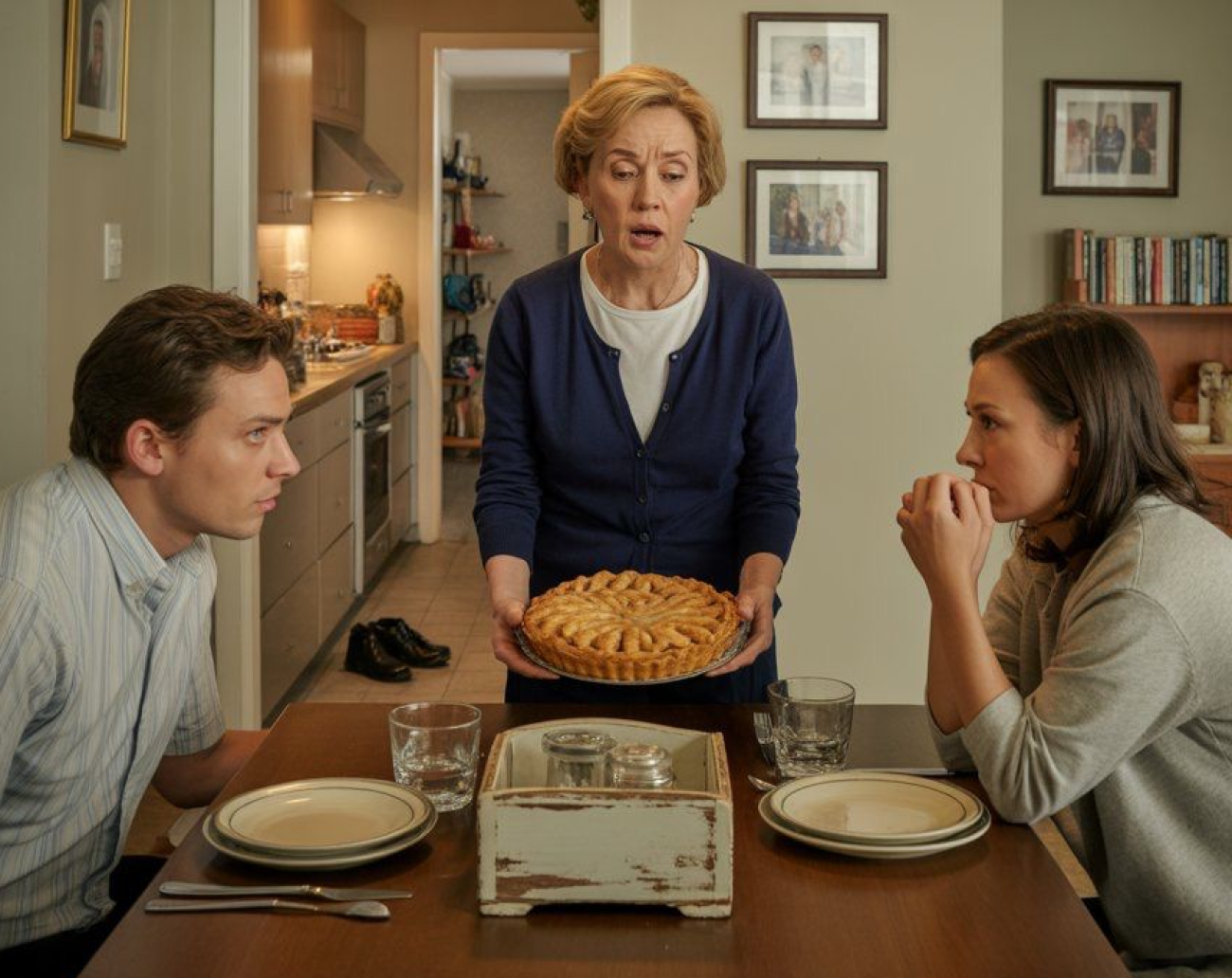
I arrived at Michael’s house at six-thirty on Friday evening, carrying an apple pie I’d baked that afternoon because keeping my hands busy stopped them from shaking. The house was a modest colonial in a quiet Millbrook neighborhood, the kind of place where families put down roots and children played in sprinklers on summer lawns. My daughter-in-law Vanessa answered the door, beautiful in that carefully maintained way—highlighted hair, expensive athleisure wear, a smile that never quite reached her eyes but always appeared at the right moments.
“Brittney,” she said, kissing the air near my cheek with practiced precision. “You shouldn’t have. We have dessert.”
“I wanted to,” I said simply, handing her the pie. The house smelled of roasted chicken and something else, something I couldn’t quite place. A cologne maybe, or aftershave—masculine and familiar in a way that tugged at something deep in my memory, but the thought slipped away before I could catch it.
“Where’s Emma?” I asked, looking for my granddaughter, expecting to hear her voice calling from upstairs or see her running down the hallway to greet me.
“Sleepover at Madison’s house,” Vanessa said, something strange flickering across her face. “We thought it would be nice—just the adults tonight.”
Something in her tone made me pause, made the hair on the back of my neck prickle with an instinct I couldn’t name. But Michael appeared from the kitchen before I could analyze the feeling, wiping his hands on a dishcloth, his face drawn in a way that made him look older than his thirty-six years.
“Mom, you made it.” He hugged me, and I felt the tension in his shoulders, the way he held me just a beat too long, the way his breath caught as if he was preparing himself for something difficult.
“Of course I made it,” I said, pulling back to study his face more carefully. “Are you feeling all right? You look tired. Have you been sleeping?”
“Work’s been crazy,” he said, not meeting my eyes—a tell I’d known since he was seven years old and lying about who broke the living room lamp. “Come on, let’s eat. Everything’s ready.”
The dining room table was set with Vanessa’s good china—the set her mother had given them, cream-colored with gold trim that caught the light. Candles flickered in crystal holders I’d never seen them use before. Classical music played softly from hidden speakers, something by Mozart or Beethoven, elegant and formal. It was lovely and meticulous and completely unlike the casual family dinners we usually shared, where we ate off everyday plates and talked over whatever was playing on the television.
And then I saw it. My breath caught in my throat like a physical thing, sharp and painful.
Four place settings. Four plates arranged with geometric precision. Four sets of silverware catching the candlelight. Four wine glasses standing like sentries.
But there were only three of us.
The fourth place was set at the head of the table—Robert’s place, the position he’d always occupied in our own home for forty-one years. The seat of the patriarch, the father, the man who was supposed to guide and protect his family. The man who’d been dead for two years.
“Michael.” My voice came out steadier than I felt, years of farm life teaching me to stay calm in crisis. “Why are there four places?”
He turned pale. Actually pale, the color draining from his face like someone had opened a tap and let it all run out. Vanessa’s hand flew to her mouth, her perfectly manicured fingers trembling.
For a moment, nobody spoke. The classical music continued its pleasant meandering, completely at odds with the sudden tension that filled the room like smoke, thick and choking.
“Michael,” I said again, more firmly this time, using the voice I’d used when he was a child and I knew he was hiding something. “What’s going on?”
He exchanged a look with Vanessa, one of those married-couple looks that communicates volumes in a glance—fear, uncertainty, resignation. She gave a tiny shake of her head, but he straightened his shoulders like a man preparing to jump into cold water, knowing it would hurt but doing it anyway.
“Mom,” he said slowly, carefully, each word weighted with meaning I couldn’t yet understand. “There’s something we never told you. About Dad.”
The room tilted slightly. I reached for the back of a chair to steady myself, my fingers gripping the wood so hard my knuckles went white.
“Please sit,” Vanessa said, her voice gentler than I’d heard it in months, almost kind.
“Tell me,” I said, not moving, not sitting, standing there in my nice dress with my apple pie cooling on the counter and my world about to shift on its axis.
Michael sat across from me, his hands flat on the table like he was trying to anchor himself to something solid. “Dad didn’t die the way you think he did.”
“He had a heart attack.” My voice sounded strange to my own ears—distant and hollow, like I was hearing myself from underwater. “In the north pasture. Dr. Morrison said it was massive, instantaneous. He said Robert wouldn’t have suffered.”
“That’s true,” Michael said quickly. “But there’s more, Mom. In the months before he died, Dad was investigating something. Something that scared him more than I’d ever seen him scared. Something he’d been carrying for our entire lives.”
I stared at my son, this man I’d given birth to thirty-six years ago, whose scraped knees I’d bandaged and whose nightmares I’d soothed, whose first words had been “mama” and whose proudest moment had been graduating college. I stared at him and realized I didn’t know what he was about to say, but I knew it would change everything.
“What are you talking about?” I whispered.
Vanessa stood abruptly, her chair scraping against the hardwood with a sound like a scream. “I’ll get the box.”
“What box?” I asked, but she was already gone, her heels clicking rapidly across the floor, each step echoing in the terrible silence.
Michael rubbed his face with both hands, a gesture so like Robert it made my heart ache. “A few weeks before he died, Dad came to me. He was agitated—more worried than I’d ever seen him. He gave me a box. A locked box. And he made me promise to keep it safe, to tell no one about it, not even you. He said if anything happened to him, I should wait two years and then I should tell you everything.”
“Two years?” I repeated numbly, my mind struggling to process. “Why two years? Why not tell me immediately? Why keep secrets?”
“He said you’d need time to grieve first,” Michael said, his voice cracking. “Time to be strong enough to handle what was inside. Time to heal from losing him before you had to face losing everything you thought you knew about him.”
Vanessa returned carrying a small wooden box, maybe eight inches square, with brass corners and a keyhole in the front. She set it on the table between us with a soft thunk that seemed to echo in my chest.
I recognized it immediately, and the recognition felt like betrayal.
Robert’s tackle box. The one his father had made for him fifty years ago, carved from walnut with their initials intertwined on the lid: R.C. plus J.C.—Robert Caldwell and James Caldwell, father and son, a legacy passed down through generations.
“This was in the basement,” I said slowly, memories flickering. “I saw it down there last month when I was looking for the Christmas decorations. I remember thinking I should go through Robert’s old fishing gear.”
“No,” Michael said quietly, almost apologetically. “That was a different box. Dad made a replica—same wood, same design, same initials. He made it specifically to leave in its place so you wouldn’t know this one was gone. So you wouldn’t ask questions.”
My husband had deceived me. The man I’d slept beside for forty-one years, the man I’d trusted with my life and my heart and my future, the man who’d held my hand during childbirth and whispered that he loved me every night before we fell asleep—he’d hidden things from me, created elaborate deceptions, constructed false boxes to cover his tracks.
“Open it,” I said, my voice hard now, anger beginning to cut through the shock.
“Mom, are you sure you’re ready for this?” Michael asked, genuine concern in his eyes.
“Open it,” I repeated, each word clipped and final.
Michael produced a small brass key from his pocket, his hands shaking as he inserted it into the lock. The mechanism clicked with a sound that seemed impossibly loud, and the lid lifted with a soft creak that made me think of coffins and graves and secrets buried deep.
Inside, the box was divided into compartments lined with red velvet, like a jeweler’s display case designed for precious things. But instead of jewelry, it held documents and photographs. And on top of everything, carefully placed where it couldn’t be missed, was a letter in Robert’s handwriting—my name written across the envelope in his familiar scrawl, the letters formed by the same hand that had written me love notes and grocery lists and forty-one years of Christmas cards.
My fingers trembled as I picked it up and slid my nail under the flap, tearing it open with more force than necessary. The paper inside was thick, expensive—the kind Robert would never have bought for ordinary correspondence.
“Brittney,” it began, and I could hear his voice in my head as I read. “If you’re reading this, I’m gone. I’m sorry for the secrets. I’m sorry for the lies. I’m sorry for the deception that lasted our entire marriage. But most of all, I’m sorry for what you’re about to discover. Our life together was real—never doubt that. My love for you was real, the truest thing in my entire existence. But my past… my past belonged to someone else entirely. Someone I had to kill to survive. Burn everything in this box after you’ve read it. Trust no one. And whatever you do, don’t let them know you know. Your life may depend on it. I love you. I’ve always loved you. I will love you beyond death. —R.”
My hands shook so hard the paper rattled, making a sound like dry leaves in autumn wind. “What does this mean?” I whispered, looking up at Michael. “Who are ‘they’? What did your father do?”
Michael’s face was drawn, aged beyond his years in the flickering candlelight. “I don’t know, Mom. Dad never told me specifics. He just said that when the two years were up, you’d need to know the truth about who he really was before he came to Millbrook. About why he never talked about his family, why there were no photographs from his childhood, why we never met his relatives. About the money.”
“What money?” The question came out sharper than I intended.
Vanessa pulled a photograph from the box with trembling fingers and slid it across the table. The image showed a young man in his twenties, handsome and confident, standing in front of a mansion I didn’t recognize—the kind of house that appeared in magazines about old money and East Coast dynasties. He wore an expensive suit that probably cost more than our monthly grocery budget, and he had his arm around a beautiful woman in pearls and a designer dress.
The young man was Robert. But he looked different—his hair styled in a way he’d never worn it with me, his expression more arrogant, his entire bearing that of someone from a world I’d never known and never wanted to know.
“Who is that woman?” I whispered, jealousy and confusion warring in my chest.
“We don’t know,” Michael said. “But look at the date on the back.”
I flipped the photo over with nerveless fingers. Written in faded ink, the handwriting elegant and unfamiliar: “Newport, July 1982.”
July 1982. The month before Robert had arrived in Millbrook forty-three years ago, driving a beat-up truck and looking for farm work. The month before he’d walked into Harrigan’s Diner where I was waitressing, ordered coffee and pie, and asked in that quiet voice if I knew anyone who was hiring. The month before he’d smiled at me and I’d felt something shift in my chest, something that felt like recognition. The month before our life together began.
“There’s more,” Michael said quietly, pulling out a yellowed newspaper clipping. The paper was so old it crackled in his fingers, brittle with age and secrets. The headline read: “Prominent Boston Family Heir Missing. Foul Play Suspected.”
The photograph accompanying the article showed the same young man from the other photo—Robert, but not Robert. The name beneath it wasn’t Robert Caldwell. It was “James Whitmore III.”
My vision swam. I gripped the table edge, willing myself not to faint, not to collapse, not to give in to the shock that was threatening to pull me under like a riptide.
“Mom,” Michael said, and I heard the fear in his voice, heard him struggling with whether to continue. “I think Dad was running from something. Or someone. I think he witnessed something or knew something dangerous. And I think whoever he was running from might have found him.”
The doorbell rang, cutting through the tension like a knife.
We all froze. The sound echoed through the house, jarring and wrong, impossibly loud in the sudden silence. Nobody moved. The candles continued to flicker. The classical music played on, oblivious.
Vanessa’s face went white, all the color draining away. “We’re not expecting anyone,” she whispered, her voice barely audible.
Michael stood slowly, moving toward the window like a man approaching a snake, careful and tense. He lifted the edge of the curtain with one finger and peered out into the darkness. When he turned back, his expression confirmed my worst fears—the nameless dread that had been building since I’d walked into this house.
“There’s a car in the driveway,” he said, his voice tight. “Black sedan. Tinted windows. Two men in suits just got out. They look… official. And wrong.”
The doorbell rang again, longer this time, more insistent, the sound pressing against us like a physical weight.
“Don’t answer it,” I heard myself say, and was surprised by how hard my voice sounded, how certain. Years of farm life had taught me to trust my instincts, and every instinct I had was screaming danger. “Michael, is there a back door?”
“Mom, what are you—”
“Is there a back door?” I repeated, louder now, urgent.
“Yes. Through the kitchen.”
I grabbed the box, shoving Robert’s letter into my purse along with the photograph and the newspaper clipping, my hands moving with a certainty that surprised me. This was muscle memory from a life I’d never lived—or maybe from a woman I’d never met inside myself, someone stronger and more decisive than the gentle farm wife everyone thought they knew.
“Brittney, you can’t just—” Vanessa started, reaching for me.
“Listen to me very carefully,” I said, looking at both of them with an intensity that made them go still. “You’re going to answer that door in exactly thirty seconds. You’re going to tell them I left an hour ago. That I had dinner with you and went home. You’re going to act natural, surprised they’re here, confused about what they want. Can you do that?”
They stared at me like I’d grown a second head, like the woman they thought they knew had been replaced by someone else entirely.
The doorbell rang a third time. Now there was knocking too—firm, authoritative, the kind of knocking that said whoever was outside wasn’t going away, wasn’t taking no for an answer.
“Can you do that?” I repeated, more urgently, my eyes locked on Michael’s.
He nodded slowly, understanding beginning to dawn. Vanessa looked terrified but managed a small nod of agreement.
“Good,” I said, already turning toward the kitchen. “Don’t call me. Don’t text me. Don’t try to contact me at all. I’ll reach out when it’s safe. Take care of Emma. Keep her away from the house for a few days.”
“Mom, wait—where are you going?” Michael called after me.
But I was already gone, slipping through the kitchen and out the back door into the October darkness, Robert’s box clutched against my chest like armor. My heart pounded with something that felt like fear but tasted like fury, sharp and metallic on my tongue.
My husband had been someone else. Someone important enough that people were still looking for him forty-three years later. Someone who’d lied to me for our entire marriage, who’d built our life on a foundation of deception so complete I’d never suspected, never questioned, never doubted.
And now he was dead. And they—whoever they were—were coming for me.
I didn’t know who “they” were or what they wanted or what Robert had done that made them search for more than four decades. But I was going to find out, even if discovering the truth destroyed everything I thought I knew about my life.
I drove for twenty minutes before I allowed myself to think, before I let the shock and fear and anger wash over me in waves. The farmhouse was forty minutes from Michael’s neighborhood, back roads all the way, and I kept checking my rearview mirror for headlights that followed too closely or stayed too constant, paranoia making my hands grip the steering wheel until they ached.
Nothing. Just darkness and the occasional deer’s eyes reflecting in my high beams, bright and startled before vanishing into the trees.
My hands had stopped shaking by the time I pulled into the gravel driveway. The house rose up against the October sky, dark except for the porch light I’d left on—a habit from the years when Robert would work late and I’d wait up, wanting him to come home to warmth and light rather than darkness.
“Robert,” I whispered into the empty car. “James. Whoever you were. What did you do? What were you running from? And why didn’t you trust me enough to tell me the truth?”
I sat in the car for a full minute, engine off, listening to the tick of cooling metal and the distant sound of coyotes on the ridge, their howls lonely and wild. Then I grabbed the wooden box and my purse and went inside, locking the door behind me and throwing the deadbolt for the first time in memory, the metal sliding home with a sound that felt like finality.
The house felt different now, transformed by knowledge I couldn’t unknow. Every shadow seemed to hide something. Every creak of settling wood made me flinch. I’d lived here for forty-one years, but suddenly it felt like enemy territory—a place where secrets had been living in the walls, breathing in the darkness, waiting all this time to be discovered.
I made coffee, strong and black, and spread the contents of Robert’s box across the kitchen table under the harsh fluorescent light. No more romantic candlelight and classical music. No more gentle revelations. This required clinical clarity, the kind of focus I’d used when dealing with sick animals or difficult births on the farm—the ability to look at hard truths without flinching.
The newspaper clipping was dated August 15, 1982. I read it three times, absorbing every detail, every word choice, every implication.
“James Whitmore III, 26, heir to the Whitmore textile fortune, has been missing for three weeks. Boston police confirm they are investigating possible foul play after bloodstains were found in his Beacon Hill apartment. Whitmore was last seen leaving the Harbor Club on July 23. His father, James Whitmore Jr., has offered a $100,000 reward for information leading to his whereabouts or to those responsible for his disappearance.”
One hundred thousand dollars in 1982. Real money, the kind that would motivate people to search for a very long time, to never give up, to keep looking even decades later when everyone else had moved on.
I pulled out more photographs, my hands moving mechanically through the box. Robert—James—at charity galas in tuxedos, at yacht clubs with sailboats in the background, at polo matches wearing expensive casual wear. Always surrounded by beautiful people, always looking like he belonged to a world that was light-years away from Millbrook, Pennsylvania. A world of privilege and power and the kind of wealth that most people only saw in movies.
Then I found the wedding announcement, and my heart stopped completely.
“The engagement of Miss Caroline Ashford Peyton to Mr. James Whitmore III is announced by her parents, Mr. and Mrs. Reginald Peyton of Greenwich, Connecticut. A June wedding is planned at the Peyton family estate.”
The photograph showed a young woman with perfect bone structure and a smile full of white teeth and old money—the kind of woman who’d grown up with every advantage, who’d never known want or struggle or uncertainty. She was beautiful in that cultivated way that money can buy, polished and elegant and utterly unlike me.
Caroline Ashford Peyton. Not the woman in pearls from the earlier photograph—someone else. Someone Robert-James had been engaged to marry. Someone who might still be alive, still be looking for answers, still be searching for the man who’d disappeared three weeks before their wedding.
I was so absorbed in the photographs, in trying to reconcile these images with the man I’d known, that I didn’t hear the car until gravel crunched in the driveway, loud and close.
My blood turned to ice in my veins. Every muscle in my body went rigid.
I switched off the kitchen light and moved to the window, careful to stay behind the curtain, my heart hammering so hard I could feel it in my throat. A dark SUV sat in the driveway, engine running but headlights off—a predator in the darkness, waiting and watching.
No one got out. They just sat there, a shadow presence, letting me know I was being watched, letting the fear build and spread like poison through my system.
My phone buzzed, making me jump. A text from Michael: “Mom, where are you? Those men said they were from Dad’s estate lawyer’s office. They have questions about his will and some irregularities in the probate. Are you okay? Please answer.”
The “estate lawyer’s office” at nine o’clock on a Friday night. Coming without an appointment. Without advance notice. With tinted windows and watching my house like criminals instead of attorneys.
I didn’t respond to Michael’s text. Instead, I gathered the contents of the box as quietly as I could, shoving everything back inside with shaking hands. I needed a place to hide it—not the basement, too obvious. Not my bedroom, too personal, the first place they’d look. The attic. The crawl space behind the chimney where Robert had stored old farm records and files from decades past.
I was halfway up the attic stairs, moving as quietly as possible, when I heard it: the soft click of someone testing the back door handle, rattling it gently to see if it was locked.
They weren’t just watching anymore. They were coming inside.
I moved faster, climbing into the dark attic and pulling the stairs up behind me, wincing at every groan of wood. The attic was cramped and dusty, filled with forty years of accumulated life—Christmas decorations, old furniture we couldn’t bear to throw away, boxes of clothes Emma had outgrown, the physical residue of a family’s history.
I crawled on my hands and knees toward the chimney, feeling my way through the darkness, pulled away the sheet of plywood Robert had used to cover the crawl space, and shoved the wooden box deep inside, as far back as my arm would reach.
Below me, I heard the unmistakable sound of breaking glass—sharp and final, the sound of decisions being made and lines being crossed.
They were inside my house. Inside the sanctuary Robert and I had built together, violating the space where we’d raised our children and celebrated our anniversaries and grown old together.
I stayed frozen in the attic, barely breathing, pressing myself against the rafters as footsteps moved through my house below. Two sets, maybe three—heavy boots, confident and unhurried. They weren’t trying to be quiet anymore. Drawers opened and closed with sharp reports. Furniture scraped across floors. They were searching methodically, professionally, and they weren’t being gentle about it.
“Nothing down here,” a man’s voice said—educated, Boston accent, the kind of voice that came from good schools and better connections. “Check upstairs.”
Footsteps on the stairs, heavy and purposeful.
“Bedrooms clear,” another voice called after a few minutes. “No sign of anyone. Car’s here though, so she can’t be far. Check the outbuildings.”
The footsteps retreated. Through a gap in the attic boards, I could see flashlight beams sweeping across the yard, heading toward the barn and equipment shed, methodically searching every structure on the property.
I had maybe five minutes before they’d think to check the attic.
I scrambled down from the attic as quietly as I could and grabbed my purse from the hall table. My car keys were inside, along with my phone and wallet—everything I’d need to run. The house was a disaster around me—drawers pulled out, cushions overturned, papers scattered everywhere like snow. They’d been thorough, professional. But they hadn’t found what they were looking for because they didn’t know me, didn’t know how a farm wife thinks, didn’t know where a woman who’d lived here for forty years would hide something precious.
I slipped out the front door and around the side of the house, staying in the shadows, my body remembering skills I’d never learned—or maybe finding reserves of courage I’d never needed to tap. Through the barn door, I could see flashlights bobbing, hear voices shouting to each other in frustration.
My car was blocked in by their SUV, trapped in my own driveway.
I’d have to walk. The nearest neighbor was Ben Morrison’s farm, two miles through the woods on an old deer path I’d walked hundreds of times in daylight but never in darkness. Ben was eighty years old, a widower like me, Robert’s closest friend and a man who’d survived Vietnam with wounds both visible and hidden. He had guns. He had experience. And most importantly, he’d promised Robert years ago that he’d look after me if anything ever happened.
I started running, staying off the road, following the deer path by instinct and moonlight. My sensible shoes—chosen for a nice dinner with my son—were not made for cross-country hiking. Within a hundred yards, I’d twisted my ankle on a root hidden in darkness. Pain shot up my leg, sharp and immediate. I kept going, ignoring it, branches whipping at my face and tearing at my clothes.
Behind me, I heard shouting—they’d discovered I wasn’t in the outbuildings, had figured out I’d run.
“Fan out!” someone barked. “She can’t have gotten far on foot!”
I ran harder, my breath coming in gasps, my twisted ankle screaming protest with every step. The woods were pitch-black except for the occasional glimpse of moon through the canopy. I’d walked this path hundreds of times, knew every landmark in daylight, but now every tree looked the same, every shadow threatened to send me sprawling.
A flashlight beam swept across the trees to my right, too close, searching.
I dropped to the ground behind a fallen log, pressing myself flat against the damp earth, trying not to breathe too loudly, my heart hammering so hard I was sure they could hear it. The beam passed over me, paused, came back slowly.
Footsteps approached, careful and methodical. Branches snapped under heavy boots. I could see the outline of a man now, tall and broad-shouldered, holding a flashlight in one hand and something else in the other—something that could have been a phone or a gun, I couldn’t tell in the darkness.
I grabbed a handful of dirt and small rocks, wound up like Michael had taught me to throw a softball years ago, and hurled it as hard as I could to my left, away from the path to Ben Morrison’s farm.
The man spun toward the sound immediately, his flashlight beam following, his entire attention focused on where the rocks had landed.
I bolted in the opposite direction, running low and fast.
“There!” he shouted. “She’s running!”
But I had a head start now, and I knew these woods. I veered off the deer path onto a narrower track that wound between dense underbrush, sacrificing speed for cover. Branches tore at my clothes and skin, drawing blood I couldn’t feel because of the adrenaline flooding my system. The Morrison place was close now—I could see the faint glow of his security light through the trees, yellow and artificial and promising safety.
I burst out of the woods into Ben Morrison’s backyard just as lights blazed on in the house, as motion sensors detected my frantic approach. The back door flew open and Ben appeared, shotgun in hand, wearing pajamas and a ratty bathrobe but standing like the soldier he’d been fifty years ago—solid, ready, dangerous.
“Brittney,” he said sharply, his voice cutting through my panic. “What in the hell—”
“Ben, please,” I gasped, limping toward him, my ankle nearly giving out. “I need help. There are men chasing me. They broke into my house. They’re looking for something Robert left behind.”
He didn’t hesitate, didn’t ask questions, didn’t demand explanations. Ben Morrison had seen combat, had faced down enemies in jungles half a world away, and he recognized danger when he saw it written across a woman’s face in the middle of the night.
“Inside. Now,” he ordered, stepping aside to let me through.
I stumbled across the threshold and he locked the door behind us, flipping off the lights so we stood in darkness. We moved to the window together, both of us breathing hard, and watched as flashlight beams emerged from the tree line, sweeping across his yard.
“How many?” Ben asked quietly, his voice dropping into a register I’d never heard before—combat mode, calculating and cold.
“Three, maybe four. They came in a dark SUV. Ben, they’re not just burglars. They’re looking for something specific, something connected to Robert’s past. Something he kept hidden our entire marriage.”
Ben was quiet for a moment, still watching the lights through the window. Then he said something that made my blood run cold: “Robert told me trouble might come looking someday.”
I looked at him sharply, disbelief and betrayal warring in my chest. “You knew? You knew he had secrets?”
“I knew he had a past he didn’t talk about,” Ben said carefully, his eyes never leaving the window. “I knew he was more than what he appeared to be. You don’t live next to someone for forty years without learning to read the signs. The way he always kept his back to walls in public. The way he’d tense up whenever a certain kind of car drove past. The way he’d scan faces in crowds like he was looking for someone—or afraid someone was looking for him.”
He finally looked at me, and in his eyes I saw understanding and something like pity.
“Robert and I talked toward the end,” Ben said quietly. “He knew his heart was failing—the doctor had told him months before he died. He made me promise that if anything happened to him, if trouble ever showed up at your door, I’d make sure you were safe. He was terrified something would happen to you because of his past.”
A flashlight beam swept across Ben’s yard, closer now, more deliberate.
“They’re coming,” I whispered.
Ben moved to a position beside the window, shotgun at the ready, his body relaxed but alert. “My truck’s in the garage. Keys are in the ignition—always are. You go out the front door, get in the truck, and drive straight to the police station in town. Don’t stop for anything. Don’t look back.”
“Ben, I can’t leave you here alone—”
“I’m an eighty-year-old man with a gun defending my own property against trespassers,” he said grimly, a hint of something fierce showing through his age. “I’ve been waiting for an excuse to use this shotgun for twenty years. Besides, someone needs to call Sheriff Patterson and get law enforcement out here. That someone is you. I’ll be fine.”
He looked at me with sudden intensity. “But Brittney—before you go, you need to know something. Robert loved you more than anything in this world. He told me so himself, right before he died, when he knew the end was close. He said you were the only real thing in his whole damn life. That everything else—his past, his name, his family—all of it was lies and shadows. But you and Michael and Emma, this life you built together—that was true. That was real. Whatever you discover about him, don’t forget that.”
My eyes burned with tears I didn’t have time to shed. “Thank you,” I whispered, my voice breaking.
“Front door’s unlocked. Garage is attached. You’ve got maybe three minutes before they’re on the porch,” he said. “Go.”
I squeezed his arm—this man who’d been Robert’s friend, who was now risking himself for me—and ran through the dark house to the front door, into the garage, where his ancient Ford pickup sat waiting like a loyal dog. The engine roared to life and I backed out of the driveway with the headlights off, using only moonlight to navigate the road until I was far enough away that they wouldn’t see which direction I’d gone.
Behind me, I heard the boom of Ben’s shotgun—a warning shot, I hoped, meant to scare rather than kill.
I flipped on the headlights and drove faster, taking back roads toward town, my hands shaking on the steering wheel, my mind racing. My phone rang, the sound jarring in the enclosed space. A number I didn’t recognize. Against every instinct, against all common sense, I answered because I needed to know who was hunting me.
“Mrs. Caldwell,” a woman’s voice said—cultured and cold, educated and entitled, the voice of someone who’d never been told no in her entire life. “Or should I say… Mrs. Whitmore? Though I suppose he never actually married you under his real name, did he? So perhaps you’re not legally married at all. How unfortunate.”
My hands tightened on the steering wheel until my knuckles went white. “Who is this?”
“Someone who’s been looking for James Whitmore for forty-three years,” she said, each word precise and sharp as a surgical instrument. “Someone who deserves answers after being abandoned without explanation. Someone with very little patience left and even less mercy.”
The line went dead, cutting off before I could respond, before I could demand more information.
I stared at the phone in my shaking hand, then at the dark road ahead that seemed to stretch into infinity, and realized with sickening certainty that this was only the beginning. The first move in a game I didn’t understand but would have to learn quickly if I wanted to survive.
They knew who I was. They knew about Robert’s true identity. And they knew I had something they wanted—something worth killing for, worth hunting for, worth destroying my entire life to obtain.
I didn’t know what Robert had been running from or what secrets he’d kept hidden for forty-three years. But I was about to find out, whether I wanted to or not.
And somehow, I knew that once I learned the truth, nothing would ever be the same again.
The woman on the phone had called him James Whitmore. She’d known his real name. She’d been searching for him for over four decades. And her voice had carried not just anger, but something deeper—betrayal, obsession, the kind of fury that comes from wounds that never healed.
I thought about the wedding announcement in Robert’s box. Caroline Ashford Peyton. The woman he’d been engaged to marry. The woman who’d probably spent forty-three years wondering what happened to her fiancé, why he’d disappeared three weeks before their wedding, whether he was dead or alive or had simply abandoned her.
And now she knew the truth. Or at least part of it. She knew James Whitmore had survived, had created a new life, had married someone else and built a family while she’d been left behind to deal with the questions and the shame and the endless not-knowing.
I understood, in that moment, that I wasn’t just running from people who wanted information. I was running from someone who wanted revenge.
The road blurred in front of me as tears finally came, hot and angry and frightened. I cried for the man I’d thought I knew, for the life I’d thought we’d built, for the forty-one years that suddenly felt like they’d been constructed on sand instead of solid ground.
But I also cried for Robert himself—for whatever had been so terrible that he’d had to abandon his entire identity, leave behind his family and his name, and spend four decades looking over his shoulder. For whatever he’d witnessed or known or done that made him believe running was his only option.
And I cried for myself—for the woman who’d wake up tomorrow in a world where nothing was certain anymore, where every memory had to be re-examined, where even love itself had become a question mark.
But I was still alive. Still free. Still fighting.
And as long as that remained true, I would find answers. I would discover what Robert had been protecting, what he’d been running from, and why people were still hunting him even after death.
I owed him that much.
I owed myself that much.
The farmhouse, the broken windows, the violated sanctuary—all of it could wait. First, I had to survive. Then I would learn the truth.
And then, finally, I would decide what to do with it.
The road stretched ahead into darkness, and I followed it toward an uncertain future, carrying Robert’s secrets and my own stubborn determination to survive.
Whatever came next, I would face it. Not as the gentle farm wife everyone thought they knew.
But as the woman I’d discovered I could be when pushed beyond every limit—strong, fierce, and absolutely unwilling to give up.
The story wasn’t over. It was only just beginning.
And I intended to see it through to the end, no matter where that end might lead or what it might cost.
Because that’s what you do when you’ve spent forty-one years loving someone—you fight for the truth, even when the truth is terrifying. Especially when the truth is terrifying.
Robert had spent his life running from the past. But I wasn’t Robert.
I was going to run straight toward it, find every answer, uncover every secret.
And then I was going to decide, once and for all, whether the man I’d loved had been worth the lies he’d told.

Ethan Blake is a skilled Creative Content Specialist with a talent for crafting engaging and thought-provoking narratives. With a strong background in storytelling and digital content creation, Ethan brings a unique perspective to his role at TheArchivists, where he curates and produces captivating content for a global audience.
Ethan holds a degree in Communications from Zurich University, where he developed his expertise in storytelling, media strategy, and audience engagement. Known for his ability to blend creativity with analytical precision, he excels at creating content that not only entertains but also connects deeply with readers.
At TheArchivists, Ethan specializes in uncovering compelling stories that reflect a wide range of human experiences. His work is celebrated for its authenticity, creativity, and ability to spark meaningful conversations, earning him recognition among peers and readers alike.
Passionate about the art of storytelling, Ethan enjoys exploring themes of culture, history, and personal growth, aiming to inspire and inform with every piece he creates. Dedicated to making a lasting impact, Ethan continues to push boundaries in the ever-evolving world of digital content.