By the time most Americans saw the clip — forty-nine seconds of grainy hallway footage, sharpened only by the tension in the voices — the news cycle had already detonated. An Afghan national had opened fire on two young National Guardsmen in the shadow of the White House, killing one and leaving the other fighting for his life. Within hours, the arrest of another Afghan national, this time for making terroristic threats in Michigan, had added a second shockwave.
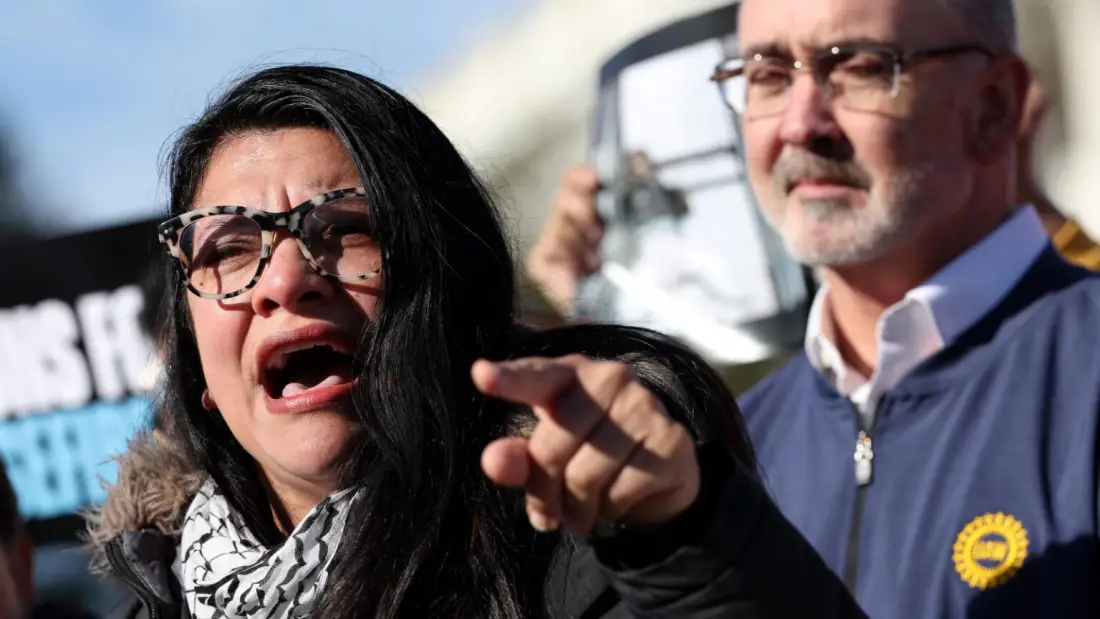
And somewhere in the swirl of outrage, grief, and political maneuvering, a video from the previous year resurfaced — a confrontation between a Fox Business reporter and Rep. Rashida Tlaib that took place in a marble hallway few people could have located on a map before it became a national battlefield.
The confrontation, once a minor political scuffle, had been quiet for months. But after the ambush in Washington, the old clip had a new purpose. And like everything else in America these days, it became a prism through which people saw what they already believed — for better or worse.
CHAPTER 1: THE AMBUSH IN THE CITY OF MONUMENTS
Thanksgiving Eve in Washington, D.C. is usually quiet.
Federal buildings glow with their sterile white lights. Motorcades thin out. Foot traffic slows on Pennsylvania Avenue, where heavy jackets and hurrying steps signal that winter is settling in. Most people are thinking about planes to catch, turkeys to carve, families to see.
Twenty-year-old National Guard Specialist Sarah Beckstrom and twenty-four-year-old Staff Sgt. Andrew Wolfe were on duty, near a fence line not far from where tourists take photos of the White House through the bars.
A routine patrol. A night shift. Simple facts that would later feel cruelly ironic.
Authorities say a man approached them with a handgun — fast, deliberate, quiet. Two shots cracked the air. Then two more.
Wolfe managed to call for help, bleeding heavily. Beckstrom was unresponsive. Witnesses described screams echoing across the lawn, the eerie distortion of sirens bouncing off the federal buildings, the shimmer of blue lights on the sidewalk where the two soldiers had stood moments earlier.
By morning, both young Guardsmen were national news. One clinging to life. One gone.
Her name became a headline before most Americans even had their coffee:
“National Guard Soldier Sarah Beckstrom, 20, Dead After Ambush Near White House.”
Her face — open, earnest, barely out of adolescence — was splashed across every network.
And then came the alleged shooter’s background.
Rahmanullah Lakanwal, 29. Afghan national. Entered the U.S. through the Biden-era humanitarian parole program in 2021.
That changed everything.
What had been a tragedy became a political earthquake.
CHAPTER 2: ANOTHER ARREST, ANOTHER SHOCK
Meanwhile, two states away, police in Michigan arrested another Afghan national — this one on charges of making terroristic threats.
He wasn’t connected to the D.C. shooting. But to millions of Americans absorbing both stories in the same news cycle, the distinction felt academic.
Two arrests. Two Afghan nationals. One dead soldier.
And then, like a lit match falling on old tinder, the resurfaced video ignited.
CHAPTER 3: THE DEARBORN CHANTS
The footage came from April 5, 2024.
Ramadan. A chilly spring evening in Dearborn, Michigan — a city where Arabic and English mix easily in conversations on sidewalks, where mosques rise beside coffee shops, where families have lived in the same neighborhoods for generations.
It was the International Day of Al-Quds, an annual demonstration tied to solidarity with Palestinians. Hundreds gathered outside the Henry Ford Centennial Library, waving flags, chanting slogans familiar from protests around the world.
But amid the usual chants, a handful of attendees shouted something darker — in Arabic:
“Death to America.”
“Death to Israel.”
The Detroit News would later confirm the translation. Videos captured the moment. The clip spread, warped by outrage, then context, then more outrage.
But the political explosion didn’t happen until Fox Business reporter Hillary Vaughn approached Rep. Rashida Tlaib inside the halls of Congress, holding her phone like a microphone.
The hallway was crowded — echoes off the stone, staffers shuffling past, cameras flashing. Vaughn began politely:
“At a rally in your district people were chanting ‘death to America,’ do you condemn—?”
Tlaib cut her off.
“I do not talk to Fox News.”
The exchange escalated:
“Is chanting ‘death to America’ racist?” Vaughn asked.
“I’m talking about your racist tropes,” Tlaib answered, walking away. “You know exactly what you do.”
It lasted less than a minute — but now, in the wake of the D.C. shooting, those 49 seconds returned with nuclear force.
CHAPTER 4: BLAME, GRIEF, AND A COUNTRY RIPPING APART IN REAL TIME
After the shooting, President Trump delivered a grim update:
“One of the National Guardsmen has died from her wounds.”
His voice was sharp, angry, grieving — and pointed.
A reporter asked why he blamed Biden for the attack.
Trump stared at him.
“Because they let him. Are you stupid?” he snapped. “They came in on a plane, along with thousands that shouldn’t be here.”
For his supporters, the answer was overdue honesty.
For his critics, it was reckless rhetoric.
But the facts were uncontested:
Lakanwal entered through a Biden-era parole program created during the chaotic 2021 Afghanistan withdrawal.
That reality alone poured gasoline on a national debate already ablaze.
CHAPTER 5: WASHINGTON RESPONDS — AND THE PARTIES RETREAT TO THEIR CORNERS
The White House responded first — fast, furious, and unequivocal.
Spokeswoman Abigail Jackson released a fiery statement:
“This animal would’ve never been here if not for Joe Biden’s dangerous policies… Democrats are defending terrorists instead of protecting Americans.”
On the other side of the aisle, Rep. Debbie Wasserman Schultz took a very different angle on CNN.
Her voice wavered between frustration and accusation as she argued:
“This wouldn’t have happened if Trump hadn’t deployed National Guard troops into cities.”
She said the presence of troops made them targets — a bold claim, controversial even within her own party.
When asked if she blamed the attacker or the policy, she answered:
“The president should look inward first.”
The clash — Biden’s immigration policy versus Trump’s domestic security orders — suddenly crystallized into a single question:
Who failed these soldiers?
Neither party agreed. Both claimed moral high ground. And Americans watching from home saw only a widening fracture.
CHAPTER 6: DEARBORN REACTS — A CITY IN THE CROSSHAIRS
As the old video of the chants spread, Dearborn residents felt the sudden weight of national scrutiny.
Mayor Abdullah Hammoud, himself an Arab American, spoke quickly and firmly:
“The hateful rhetoric heard does not reflect our community. We reject all inflammatory and violent statements.”
But nuance dies on the internet.
Commentators flooded social media. Some accused the city of harboring extremism. Others defended it fiercely. Some simply mourned the soldier whose name now symbolized a national failure.
And through all of it, the video of Tlaib refusing to condemn the chants ricocheted across platforms — stripped of context, expanded into narrative, melted into partisanship.
CHAPTER 7: THE SLOW UNRAVELING OF TRUST
To understand the fury around this story, you have to understand the emotional architecture beneath it.
Americans — across the political spectrum — feel unsafe. Violent crime. Immigration surges. Uncertainty abroad. Polarization at home.
Into that mixture came:
-
A young woman murdered in uniform
-
An alleged attacker admitted through a rushed policy
-
A second Afghan national arrested for terroristic threats
-
A resurfaced video showing a congresswoman refusing to denounce “death to America” chants
-
Political leaders blaming each other more than the suspect
The story wasn’t just tragedy. It became a symbol.
A symbol of distrust.
A symbol of policy failure.
A symbol of national fracture.
CHAPTER 8: THE HUMAN THREAD — SARAH BECKSTROM
Lost in the political chaos was the story of the person at the center of it.
Sarah Beckstrom wasn’t a talking point.
She was a 20-year-old who enlisted because she “wanted to be part of something bigger.”
She played soccer in high school. She loved apple pie from a diner near her base.
Her friends said she always volunteered for the lousy shifts, because someone had to do them.
Her mother released a short statement:
“Sarah wanted to serve. She believed in this country. We want answers. We want accountability.”
It was the quietest sentence in a storm of loud voices — and the most honest one.
CHAPTER 9: A COUNTRY GRAPPLING WITH ITS SHADOWS
The week after the shooting, America talked about everything except what it didn’t want to examine too closely:
-
The moral tension of resettling wartime allies
-
The failures of rushed vetting systems
-
The strain between immigrant communities and national security fears
-
The politicization of law enforcement
-
The weaponization of individual tragedies for partisan gain
Instead, the fight became about the things most easily turned into content:
A 49-second video.
A heated Trump remark.
An angry CNN clip.
A statement from the White House.
A Twitter war.
But beneath the noise, the real questions sat untouched, heavy, waiting:
How did this man get in?
How did he go unnoticed?
How did he reach two Guardsmen near the White House?
What does this mean for security?
And who will take responsibility?
Those answers would not arrive in a news cycle.
CHAPTER 10: HISTORY MOVES IN ECHOES
Within a week, political operatives were already folding the story into fundraising emails.
Immigration activists condemned the rhetoric.
Republican strategists sharpened talking points.
Democratic aides urged their members to stay “on message.”
And in that sense, nothing had changed.
But something had changed in the country.
A line had been crossed — again.
A trust had been broken — again.
A tragedy had been absorbed into partisan combat — again.
And as with every American political story of the last decade, the human cost was overshadowed by the political opportunity.
EPILOGUE — THE QUIET AFTER THE STORM
Long after the cameras left the crime scene, long after reporters stopped refreshing their social feeds for new statements, long after the talking heads moved on to the next frenzy, one thing remained:
A mother without her daughter.
A capital city shaken.
A nation arguing about what it refuses to admit scares it.
A resurfaced video without closure.
And a political class ready to fight again tomorrow.
It was, in the end, a story about America in 2025 — fractured, exhausted, furious, afraid, and yet somehow still insisting that the next argument is the most important one.
The tragedy stayed real for the families.
The politics stayed real for the politicians.
And the questions stayed real for a country that seems less sure every year of what it is, what it wants, and how to get there.
But for one brief moment — in the hallway at Walter Reed, where Andrew Wolfe recovered beside the empty bed that should have held his friend — the noise faded.
And what remained was the truth political narratives always leave behind:
Real lives.
Real consequences.
Real grief.
Everything else was just the echo.

Adrian Hawthorne is a celebrated author and dedicated archivist who finds inspiration in the hidden stories of the past. Educated at Oxford, he now works at the National Archives, where preserving history fuels his evocative writing. Balancing archival precision with creative storytelling, Adrian founded the Hawthorne Institute of Literary Arts to mentor emerging writers and honor the timeless art of narrative.