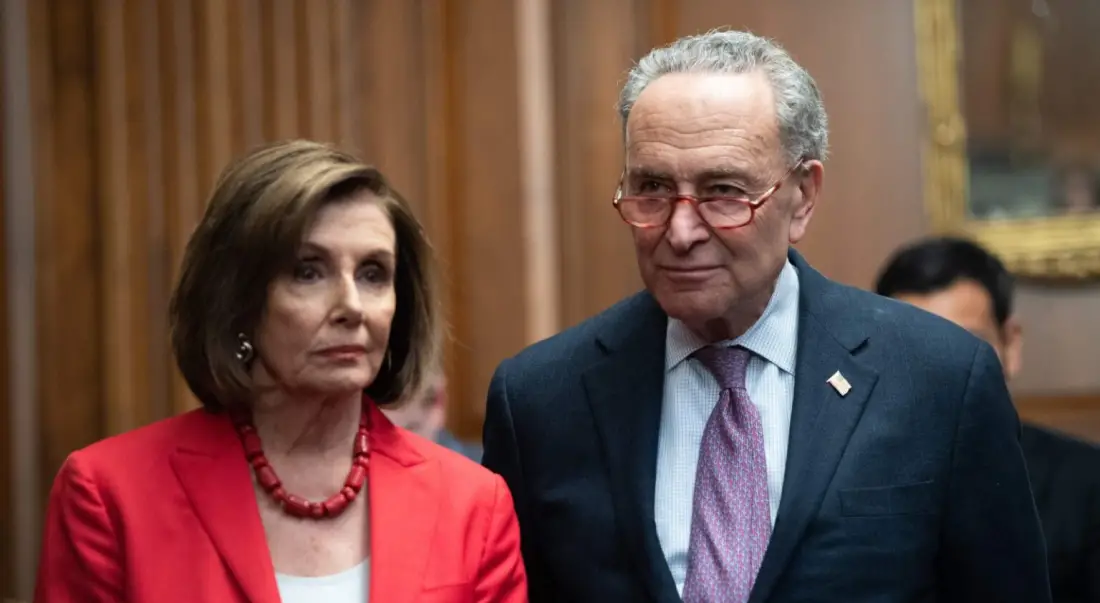
In the marble quiet of the U.S. Capitol, shortly after lunchtime and only a few hours before the Senate floor would again convulse into debate, something unusual happened. A bloc of Democrats — some senior, some relatively new, all politically cautious — broke ranks and walked toward a vote that would send ripples through Washington’s already heated ecosystem.
The chamber, worn by a year of shutdowns, tariff fights, and competing visions of America’s economic future, had expected a tight vote. What happened instead was a moment of bipartisan alignment: more than a dozen Democrats joined Republicans to confirm President Donald Trump’s pick for U.S. ambassador to China — former Georgia senator David Perdue.
For a nominee tied closely to Trump and for a post as geopolitically sensitive as Beijing, the vote wasn’t inevitable. It wasn’t even expected. But it was revealing.
It showed a Democratic Party uneasy with its own identity, frustrated by internal fractures, and increasingly constrained by a series of political miscalculations that had culminated in a government shutdown many voters — even those who had supported Joe Biden in 2020 — saw as pointless.
Perdue’s confirmation wasn’t the story itself. It was the spark that illuminated a political landscape undergoing seismic shifts.
I. A Nominee From Trump’s Inner Circle Walks Into the Senate
David Perdue’s return to Washington came with symbolic weight.
A longtime businessman, former senator, and staunch ally of Donald Trump, Perdue had been a central figure in Trump’s political orbit. In 2022, he even challenged Georgia’s Republican governor, Brian Kemp, in a primary triggered by Trump’s fury over Kemp’s refusal to overturn election results.
That bid failed. But Perdue’s loyalty to Trump never wavered. And Trump, who prizes loyalty as currency, rewarded it.
So when the Senate took up Perdue’s nomination to serve as ambassador to China, few expected Democratic support. China policy remains one of the most politically explosive issues in Washington — and Democrats have spent years branding Trump’s trade wars as reckless.
But then came the vote: 64 to 27 in favor of cloture, a high threshold requiring bipartisan buy-in.
The optics were unmistakable.
More than a dozen Democratic senators — including some from states where progressive activists have long demanded a hard line against Trump — voted to advance his nominee.
Why? The reasons were layered and political. But among Democrats watching the vote from the cloakroom, one truth lingered:
The party could not risk looking obstructionist again. Not after what happened during the shutdown.
II. The Shutdown That Broke the Dam
When the federal government shut down for 41 days — the longest shutdown since the late 2010s — Democrats hoped they could force Republicans to extend expiring Affordable Care Act subsidies.
These subsidies, set to end December 1, had been passed by Democrats themselves in 2021. Yet as the expiration date approached, their leadership viewed the moment as leverage.
It turned out to be a catastrophic miscalculation.
The focus groups that stunned party strategists
In a pair of Engagious/Sago focus groups conducted with swing voters in Georgia — voters who had supported Joe Biden in 2020 but then shifted to Trump in 2024 — seven out of thirteen said Democrats looked worse than Republicans by the time the shutdown collapsed.
Only two blamed Republicans more. Four blamed both. But the headline was unavoidable: Democrats, not Republicans, had failed the political test.
Trilya M., a 53-year-old logistics supervisor from Loganville, summarized the sentiment bluntly:
“They gave in to the Republicans. They didn’t stand their ground. And now…it’s going to affect the people on the Affordable Care Act.”
Christine L., a 54-year-old from Peachtree City, was even harsher:
“It really does make them look bad.”
These weren’t conservatives. These were voters who supported Joe Biden and, in several cases, had opposed Trump for years.
Their frustration was not ideological. It was practical — rooted in a perception that Democrats had not only failed to win concessions, but had prolonged the pain for nothing.
Even participants who approved of Trump’s current administration still expected Democrats to be the guardians of healthcare affordability. That expectation wasn’t met.
Rich Thau, who moderated the groups, didn’t sugarcoat his assessment:
“Democrats gave swing voters — who already hold the party in profoundly low esteem — yet another reason to mistrust them.”
III. A Party That Lost the Room
The sense of disarray wasn’t limited to Georgia.
Across the country, rank-and-file Democrats expressed frustration in polls, phone town halls, and local party meetings. The shutdown had been sold as a moral stand, a necessary fight. When it ended with no major policy gains, it felt — to many — like a self-inflicted wound.
A New York Post editorial captured the frustration among everyday Democratic voters:
“Democrats pointlessly kept the government shut down…purely to satisfy their squalling left flank’s need to ‘resist’ President Donald Trump.”
The editorial wasn’t coming from a sympathetic source. But it echoed a real sentiment emerging inside the party:
The Democratic leadership had misread the terrain — again.
And now, with Perdue’s vote happening just weeks later, Democratic senators were acutely aware that they could not afford another appearance of obstruction or dysfunction.
Thus came the bipartisan support for Perdue. It wasn’t simply a vote for the man. It was a vote for political triage.
IV. The Youth Defection No One Wants to Discuss
As Democratic senators tried to steady the ship, another warning sign emerged: young voters — traditionally a core progressive bloc — were slipping away.
A new survey conducted quietly by party-aligned researchers found that:
-
Fewer young voters trust Democrats on cost-of-living issues.
-
More believe Democrats are “performative” rather than effective.
-
A significant share now sees Trump as more credible on economic pragmatism.
The reasons vary, but one dynamic stands out: the cost of living. Inflation may have cooled statistically, but groceries, rent, and child care remain stubbornly expensive.
And younger voters are deeply sensitive to economic reality — not political messaging.
One young respondent summed it up:
“Both parties talk. Trump actually did something about prices.”
That shift doesn’t mean young voters are pro-Trump. But it does suggest they are no longer reliably pro-Democrat.
This adds new pressure: the Democratic coalition, once broad and emotionally cohesive, is now fracturing.
V. Inside the Senate: Tension Behind the Vote
The vote to confirm David Perdue became a proxy for something bigger: a recalibration.
Why Democrats helped confirm Trump’s nominee
Several Democratic senators — all speaking anonymously to reporters afterward — pointed to three reasons:
-
China policy is too important to politicize.
Perdue’s experience and Trump’s teamwork with him during the first trade war gave him credibility. -
The party can’t look like it’s reflexively blocking everything Trump does.
After the shutdown embarrassment, Democrats needed to project competence. -
Their internal numbers looked bad.
Voter frustration was rising. Leaders wanted to avoid feeding the narrative that Democrats were playing politics instead of governing.
One moderate Democrat summarized the calculation candidly:
“After the shutdown mess, we needed a win — or at least not another loss.”
Even progressives who voted no stayed unusually quiet. They recognized that another intra-party fight would worsen their public image.
Meanwhile, Republicans were happy to capitalize on Democratic disarray.
Majority members described the Perdue vote as evidence that Trump’s agenda was becoming irresistible on issues of national security, trade, and foreign policy.
VI. What Swing Voters Are Really Saying
The most striking element of the Engagious/Sago groups wasn’t the dissatisfaction — it was the confusion.
When participants were asked:
“Who is the leader of the Democratic Party?”
One answered:
“I have no idea anymore.”
Another:
“Whoever it is, they’re not doing the job.”
This uncertainty isn’t trivial. A party that cannot articulate its leadership loses credibility, especially compared to a Republican Party now unified under a single, dominant figure — Trump — who has restructured the GOP into a populist-nationalist coalition that defies traditional labels.
Swing voters were also blunt about what they saw as Democrats’ biggest weakness:
-
Mixed messaging on the economy
-
A failure to communicate clear goals
-
A perception of caring more about political fights than practical results
VII. A Party Losing Its Advantage on Affordability
Among Democratic strategists, one trend is especially alarming:
Trump is winning the affordability narrative — even among voters who don’t like him personally.
This aligns with the administration’s recent actions:
-
Rolling back tariffs on grocery staples
-
Signing agreements with drug companies to lower prescription costs
-
Launching cost-focused trade negotiations
-
Publicizing inflation reductions
Whether or not voters credit Trump for improved economic conditions, the perception that he is prioritizing affordability is sticking — especially among middle-class families.
The shutdown hurt Democrats because it appeared to place ideological theatrics above real-world affordability concerns.
And David Perdue’s confirmation vote underscored that Democrats, at least in the Senate, seem to recognize the need to repair that damage.
VIII. The Age-Limit Question
One surprising takeaway from the Georgia focus groups was the overwhelming support for a constitutional amendment to impose an upper age limit for presidents.
Ten of the thirteen participants agreed with the idea. Most suggested a cutoff between 65 and 75.
This issue cuts across ideology. It reflects deeper worries about:
-
Leadership stability
-
Mental acuity
-
Long-term planning
-
A desire for generational change
For Democrats, this is politically sensitive — their most influential leaders remain among the oldest in American history.
For Republicans, Trump is also older — but he has successfully framed himself as vigorous, energetic, and combative, while Democrats have struggled to project similar dynamism.
The age question shows that voter anxiety isn’t just about party loyalties. It’s about confidence in leadership.
IX. The New Democratic Reality
By the time the Senate finished voting and reporters began filing stories about Perdue’s confirmation, one takeaway was clear:
This wasn’t just a vote. It was a recalibration.
A subtle but significant acknowledgment from Democrats:
-
They misplayed the shutdown
-
They lost the affordability narrative
-
Young voters are slipping
-
Swing voters are unconvinced
-
The party’s identity is muddled
-
Its leadership is uncertain
Confirming Perdue didn’t solve these problems.
But it signaled a willingness — perhaps for the first time in months — to avoid further self-inflicted wounds.
As one Democratic strategist said privately:
“We’re trying to stop the bleeding. That’s what the Perdue vote was. A tourniquet.”
X. Where This Leaves 2026
With midterm elections less than a year away, Democrats face a stark reality:
-
Trump’s favorability is rising in swing states
-
Economic messaging is working for Republicans
-
Democratic voters are demoralized
-
Young voters are disengaging
-
Older voters view Democrats as disorganized
-
Congress appears reactive, not strategic
Republicans now control the Senate, the House, and the White House — a political configuration Democrats haven’t confronted since the early 2000s.
Their margin for error is razor thin.
And as Democrats fight to find direction, Trump moves forward with a sharpened political strategy, aggressive economic agenda, and a unified party behind him.
That’s why the Perdue vote matters.
It isn’t about China.
It isn’t about Perdue.
It’s about a party trying — perhaps belatedly — to recalibrate in a political era it no longer fully understands.
Conclusion: A Coalition at a Crossroads
The story of David Perdue’s confirmation is really the story of a Democratic Party caught between its aspirations and its vulnerabilities.
A party wrestling with:
-
A fractured base
-
A confused identity
-
A loss of confidence among key voter blocs
-
Rising internal skepticism about its leaders
-
A resurgent Republican Party with clear messaging
Democrats may still recover — but the path forward is narrower than ever.
And the voters who once gave them the benefit of the doubt are now watching with skepticism, impatience, and, increasingly, resignation.
As one Georgia swing voter put it simply:
“I just want someone who gets stuff done. I don’t care about the drama anymore.”
That sentiment — more than any shutdown, vote, or internal dispute — may shape the next chapter of American politics.

Ethan Blake is a skilled Creative Content Specialist with a talent for crafting engaging and thought-provoking narratives. With a strong background in storytelling and digital content creation, Ethan brings a unique perspective to his role at TheArchivists, where he curates and produces captivating content for a global audience.
Ethan holds a degree in Communications from Zurich University, where he developed his expertise in storytelling, media strategy, and audience engagement. Known for his ability to blend creativity with analytical precision, he excels at creating content that not only entertains but also connects deeply with readers.
At TheArchivists, Ethan specializes in uncovering compelling stories that reflect a wide range of human experiences. His work is celebrated for its authenticity, creativity, and ability to spark meaningful conversations, earning him recognition among peers and readers alike.
Passionate about the art of storytelling, Ethan enjoys exploring themes of culture, history, and personal growth, aiming to inspire and inform with every piece he creates. Dedicated to making a lasting impact, Ethan continues to push boundaries in the ever-evolving world of digital content.