The Envelope That Changed Everything
“She will get nothing. Dad hated her.”
That’s what my sister, Karen, said the moment I stepped into the room. No greeting, no eye contact. Just that sharp, cutting sentence, loud enough for everyone to hear, like she wanted it to echo off the mahogany walls. The words landed in my chest like a physical blow. My grip on my ten-year-old son Eli’s hand tightened. His small fingers curled back around mine, warm and trembling.
I hadn’t even taken a seat, but the message was clear. I wasn’t welcome. I wasn’t family. I was just a loose end they were here to snip clean.
Karen sat at the head of the table, perfectly poised in a gray pantsuit, her dark hair scraped into the tight bun she wore when she wanted to feel superior. Her lipstick was sharp red—classic Karen war paint for a battle I didn’t know I’d walked into.
Then came the voice I dreaded even more, my Uncle Rick, my dad’s older brother. He let out a dry laugh, leaning back in his chair with a smug smirk. “Even her kid knows she’s worthless,” he muttered, nodding toward Eli as if he wasn’t a person.
Eli lowered his eyes to the floor. My heart cracked a little deeper.
I swallowed hard, my throat like sandpaper. I led Eli to the farthest chair at the end of the long table, away from the pack. The chair creaked as I sat, and Eli climbed up beside me, his hands folded in his lap, trying to disappear.
“You know this is pointless, right?” Karen said, her voice smooth and cold. “Dad rewrote the will. Cut you out completely. Said you were dead to him.”
I didn’t respond. Why did I even come? I thought maybe, just maybe, there’d be something. A note, a line, a sign that he remembered me. Instead, I was back in the one place I’d promised myself I’d never return to, surrounded by people who had already buried me long before they buried him.
It had been eight years since I’d stepped foot in a room like this with my family. Eight years since I’d packed up a life they said I didn’t deserve, took Eli—just two at the time—and left without looking back. Not because I wanted to, but because every conversation with my father, Charles Morrison, ended in shouting, and every family gathering felt like walking barefoot across glass.
The invitation to the will reading had been a shock. I wondered if it was a mistake, or a cruel, final joke. But Eli, with his quiet, certain wisdom, had insisted we go. “We should go, Mom,” he’d said. “Maybe there’s something you need to hear.”
So we came. I wore the plain black dress I hadn’t touched since my mother’s funeral. He wore a little button-up shirt he’d picked out himself.
Karen, the perfect daughter, had stayed, had cared for Dad, and had told her version of my story until it became gospel. Julia abandoned the family. Julia couldn’t handle real life. Julia ran away.
They never asked why I left. They didn’t care that my father stopped speaking to me after I refused to stay in a marriage that was tearing me apart. They didn’t know that when I showed up on his porch with Eli in one arm and a suitcase in the other, he shut the door in my face without saying a word.
So I stopped trying. I built a quiet life for Eli and me. I worked at a small nonprofit organization that provided counseling services to families in crisis. The irony wasn’t lost on me—I spent my days helping other people rebuild relationships while my own family remained fractured.
Our little apartment wasn’t much to look at, but Eli had filled it with his artwork and science projects. We had movie nights every Friday, and he helped me plant tomatoes on our tiny balcony each spring. We were building something real together, something honest.
Still, a fragile hope persisted that maybe, in the end, Dad had regretted something. Now, sitting in that room, I felt foolish for that hope.
The conference room felt like a courtroom where I’d already been convicted. The mahogany table reflected the faces of people who had written me out of their story years ago.
Uncle Rick had appointed himself the family patriarch after my mother died, dispensing judgment nobody asked for. He owned a small chain of automotive repair shops and treated every conversation like a business negotiation he was determined to win.
Cousin Marie sat quietly beside him, her expression carefully neutral. She had always been the peacekeeper, but even she couldn’t bridge the gap between me and the rest of them.
The family lawyer, Mr. Connor, shuffled through his papers with practiced efficiency. He’d been handling our family’s legal affairs for over twenty years.
“I think we can begin,” Mr. Connor said, adjusting his reading glasses.
I held Eli’s hand under the table, drawing strength from his steady presence. He had insisted on coming despite my attempts to leave him with my neighbor. “I want to be there for you, Mom,” he’d said.
Mr. Connor’s voice filled the room as he began reading from the will. Each bequest felt like another confirmation of my exile. The primary residence—the house where I’d grown up—went to Karen. The lake property went to Uncle Rick. The vintage car collection went to Cousin David. The investment portfolio was divided among various relatives who had maintained their status as acceptable family members.
“And as previously declared,” Mr. Connor read, his voice flat, “my daughter, Julia, will not receive a portion of this estate.”
There it was. The final rejection, delivered with legal precision. I felt the familiar sting of tears but refused to let them fall. Not here. Not in front of them.
Karen’s satisfied smile cut through me like a blade. Uncle Rick nodded approvingly. The message was clear: I had chosen my path, and this was the consequence.
Eli squeezed my hand tighter. His small face was serious, almost adult in its composure.
“I think that concludes—” Mr. Connor began, but Eli interrupted him.
“You forgot something,” my son said, his young voice cutting through the adult certainty in the room.
The room froze. All eyes turned to Eli, who was sitting straighter now, his backpack clutched in his lap.
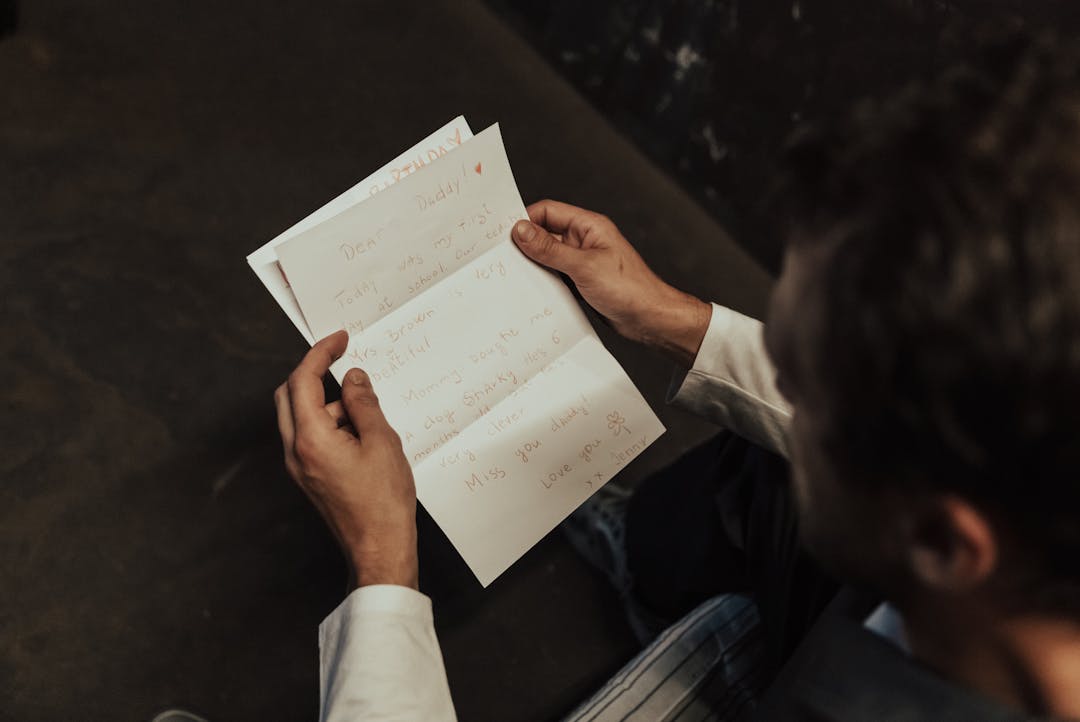
He reached into his backpack and pulled out a small, crumpled white envelope. My name was written on the front in my father’s unmistakable handwriting, and underneath it: FOR THE LAWYER ONLY. IF IT GETS UGLY.
The envelope looked old, handled, as if it had been carried around for months.
“Eli, where did you get that?” I asked.
“Grandpa gave it to me,” he said simply. “The day we visited him, just me and him. You were at the grocery store. He told me to keep it safe and only give it to the lawyer if people were being mean to you.”
I remembered that afternoon. I had left Eli with Dad for an hour while I ran errands, one of the few times they’d been alone together. I’d been surprised when Dad suggested it. I had no idea they had spoken beyond polite pleasantries.
Karen’s face had gone pale. Uncle Rick leaned forward, his earlier smugness replaced by something that looked like fear.
Mr. Connor reached across the table with trembling fingers. “May I see that, son?”
Eli handed over the envelope without hesitation. Inside was a small black flash drive and another folded note in my father’s handwriting. Mr. Connor read it silently, his expression changing from confusion to understanding.
“Everyone,” he said, his voice quieter now, “there appears to be an addendum to Mr. Charles Morrison’s will. A video message recorded before the final version of this document was signed. It was sealed with specific instructions to be played only if there were disputes about the inheritance distribution.”
The silence in the room was deafening. Karen’s perfect composure cracked slightly.
“This is ridiculous,” Karen said, but her voice lacked its earlier confidence.
Mr. Connor ignored her protest and reached for his laptop. “Per his explicit instructions, I am legally bound to play this recording.”
The laptop screen flickered to life, and suddenly my father was there—older than I remembered, frailer, sitting at the desk in his home office. The same desk where he’d helped me with homework as a child, where he’d told me I was no longer welcome in his house eight years ago.
“Hello, Julia,” he said, looking directly into the camera.
His voice filled the silent room, and I stopped breathing.
“If you’re watching this,” he continued, his hands clasped before him on the desk, “then I’m gone. And I’m guessing things didn’t go well at the will reading.” He paused, swallowed hard. “I need to tell you something I should have said years ago. I was wrong.”
The words hit me like a physical blow. My hands gripped the arms of my chair so tightly my knuckles went white.
“I believed what others told me about you,” Dad continued, his voice heavy with remorse. “I believed that you left because you didn’t care about this family. I believed that your struggles were weakness, that your choices were betrayal. I didn’t ask questions. I didn’t listen. When you came to me for help, I shut the door in your face. I shut the door on you and my grandson.”
Across the table, Karen had gone completely still. Uncle Rick stared at the screen.
“I thought being strong meant being proud,” Dad’s voice cracked slightly. “I thought that if you walked away from what I wanted for you, it was disrespect. But strength… strength is protecting your child. It’s choosing their safety over other people’s expectations. And you did that, Julia. You did what I was too stubborn to support.”
Tears were flowing freely down my cheeks now. Eli’s small hand found mine under the table and held on tight.
“I had a conversation with Eli recently,” Dad continued, and I saw him smile for the first time in the recording. “Just the two of us, while you were out. I asked him about his life, about you. He told me about your apartment, about movie nights and the garden you planted together. He said something I can’t stop thinking about.”
Dad leaned closer to the camera, his eyes bright with unshed tears.
“He said, ‘My mom is the safest place in the world.'”
A sob escaped my throat despite my efforts to stay quiet. Eli squeezed my hand tighter.
“When I heard that,” Dad continued, “I realized I had failed at the most important job I ever had. I was supposed to be your safe place, and instead I became another source of pain. I was supposed to protect you, and instead I chose my pride over my daughter.”
The recording continued, each word landing like a stone in still water, creating ripples that would change everything.
“I want you to know,” Dad said, looking directly into the camera, “that I understand now why you left. Your ex-husband was controlling, manipulative. The warning signs were there, but I was too invested in appearances to see them. When you finally found the courage to leave him, I should have celebrated your strength. Instead, I punished you for embarrassing the family.”
He shook his head, the regret visible in every line of his face.
“You came to me with a two-year-old child, asking for help, and I turned you away because I was angry that your marriage didn’t work out the way I had planned. I was more concerned about what people would think than about your safety or Eli’s wellbeing.”
The man on the screen took a shaky breath.
“So I’m doing something I should have done years ago. I’m choosing you over my pride. The will that was just read to you is not my final will. It was a decoy, written to appease the family members who have spent years poisoning me against you.”
Karen gasped audibly. Uncle Rick’s face turned red.
“My real will,” Dad continued, “leaves the house to you and Eli. The savings account, the investment portfolio, the life insurance policy—it’s all yours. There’s also a college fund I’ve been building for Eli since he was born. I know it doesn’t undo the damage I’ve done, but I want you to have the security I failed to provide when you needed it most.”
The room erupted. Karen stood so quickly her chair toppled backward. Uncle Rick was muttering under his breath, his face purple with rage. But I couldn’t focus on their reactions. I was transfixed by my father’s image on the screen.
“I know you’ve built a good life without my help,” he said. “Eli told me about your work at the counseling center, about how you help other families. I’m proud of you, Julia. I’m proud of the woman you became despite my failures as a father.”
He leaned back in his chair, looking older and more fragile than I had ever seen him.
“If the family is angry about this decision, let them be angry. You earned this inheritance through eight years of being an excellent mother under impossible circumstances. You earned it by choosing love over fear, by protecting your child when no one would protect you.”
Dad’s voice softened as he reached the end of his message.
“I can’t ask for your forgiveness,” he said. “I don’t deserve it. But I can do this one last thing right. I can make sure you and Eli have the financial security to build whatever life you choose.”
He looked directly into the camera one more time, his eyes glistening with tears.
“Tell my grandson that Grandpa is sorry it took so long to understand what really mattered. Tell him that his mother is the strongest person I ever knew, and that he should be proud to be her son.”
The video flickered and went dark, leaving us all in stunned silence.
Karen grabbed her purse and stormed toward the door. “This is insane,” she spat. “He wasn’t in his right mind. We’ll contest this.”
Uncle Rick stood more slowly, his face a mask of barely controlled fury. “This family sacrificed for him, and he leaves everything to the daughter who abandoned us.”
But their protests felt hollow now, echoes from a story that had already ended. Mr. Connor was shuffling through papers, pulling out what I assumed was the real will.
“There will be paperwork to complete,” Mr. Connor said once the room had cleared of everyone except Eli and me. “But everything is in order. Your father was very thorough in his planning.”
I nodded, still unable to speak through the tightness in my throat. The inheritance was substantial—enough to pay off my student loans, to buy a real house with a yard for Eli, to establish security I’d never had.
But more than the money was the gift of knowing that my father had finally seen me clearly. Had finally understood that leaving an abusive marriage wasn’t weakness, that protecting my child wasn’t betrayal.
Eli had been remarkably calm throughout the entire proceedings, as if he had known all along how this would end.
“How long have you been carrying that envelope?” I asked him as we walked to our car.
“Since the day Grandpa gave it to me,” he said matter-of-factly. “He made me promise to keep it safe. He said sometimes grown-ups get confused about what’s important, but kids usually know.”
I stopped walking and knelt down to look at him directly. This ten-year-old child had carried the weight of family secrets, had known exactly when and how to reveal them.
“You knew what was in there, didn’t you?” I asked.
He nodded solemnly. “Grandpa told me he was sorry for being mean to you. He said he wanted to fix it but didn’t know how to say the words while he was still alive. So he put them in the video instead.”
I pulled him into a hug, this wise small person who had somehow managed to preserve the most important conversation of my life.
That night, in our small apartment that would soon be traded for a house with a yard and room to grow, Eli and I sat together on the couch watching one of our Friday night movies.
“Are you sad about Grandpa?” he asked during a quiet moment.
I considered the question carefully. “I’m sad that we couldn’t fix things while he was alive,” I told Eli. “But I’m grateful that he found a way to tell me he understood, even after he was gone.”
The inheritance meant we could move into a real house. It meant I could continue my work at the counseling center without worrying about making ends meet. It meant Eli could go to college without student loans.
But perhaps most importantly, it meant that the story my family had been telling about me—the story of abandonment and selfishness and failure—had been rewritten by the one person whose opinion had always mattered most.
Over the following weeks, as the legal paperwork was processed and the inheritance was transferred, I began to understand the true scope of what my father had done. He hadn’t just left me money; he had left me validation, recognition, the acknowledgment that my choices had been right even when they were difficult.
With the inheritance, I was able to establish a fund at the counseling center that would provide emergency financial assistance to families in transition. Women who needed help with security deposits, children who needed school supplies, families who needed a bridge to stability—the money my father left became a resource for healing that extended far beyond our family.
Eli threw himself into the plans for our new house with enthusiasm. We spent hours looking at listings online, talking about the features that mattered most: a big kitchen where we could cook together, a yard where he could practice baseball, space for both of us to pursue our hobbies.
The house we eventually chose was a modest colonial in a quiet neighborhood near good schools. It had been built in the 1950s and carried the kind of warm energy that comes from being truly loved. The previous owners had maintained a vegetable garden in the backyard, and Eli was already planning what we would plant in the spring.
Karen’s threatened legal challenge never materialized. Perhaps she realized that contesting a will based on a video recording would only draw attention to the reasons behind Dad’s final decision.
Uncle Rick’s automotive shops faced financial difficulties that winter, and I heard he had hoped Dad’s inheritance might help solve his cash flow problems. I felt a moment of sympathy for him, understanding that his anger might have been rooted in his own financial fears.
But I didn’t feel obligated to rescue him. The inheritance was meant to provide security for Eli and me, and to support the work I was doing to help other families heal.
Cousin Marie reached out to me a few months later, asking if we could meet for coffee. She apologized for her silence during the will reading, explained that she had never known the full story of why I had left.
We began rebuilding a careful friendship, one that acknowledged the damage while working toward something healthier. She became one of the few family members who was welcome in our new home.
A year after the inheritance, Eli and I were working in our garden when he asked a question that stopped me in my tracks.
“Mom, do you think Grandpa knew he was going to die soon when he gave me that envelope?”
I looked at my son, this remarkable child who had understood the gravity of what he was carrying.
“I think he did,” I said honestly. “I think he knew his time was limited, and he wanted to make sure his real feelings were heard, even if he couldn’t say them directly.”
Eli nodded thoughtfully, pulling weeds from around the tomato plants. “It’s kind of like he was still taking care of us, even after he couldn’t be here anymore.”
The simple wisdom of that observation took my breath away. My father had found a way to provide for us that extended beyond money. He had given us the gift of knowing we were loved, that our choices had been understood and respected, that the family story could be rewritten with truth.
Today, five years after that life-changing afternoon in the lawyer’s office, Eli is fifteen and thriving in high school. He plays baseball and volunteers at the animal shelter and maintains the kind of easy confidence that comes from knowing he is unconditionally loved.
I still work at the counseling center, but now as the director of a program that has expanded to serve three times as many families. The emergency assistance fund we established has helped hundreds of women and children transition to safety.
The house has become exactly what we hoped: a place of warmth and laughter and growth. Eli’s friends gather in our kitchen for after-school snacks, and the vegetable garden produces enough to share with neighbors.
Sometimes I think about the alternative timeline, the one where Eli hadn’t carried that envelope, where my father’s real feelings had died with him. In that version, Karen would have inherited everything, the family narrative about my abandonment would have remained unchanged.
But children see things differently than adults. They notice the conversations that happen in quiet moments, the regret in old eyes, the love that exists alongside disappointment. Eli saw his grandfather clearly enough to understand that the public story wasn’t the whole truth.
The inheritance changed our lives in practical ways—financial security, educational opportunities, the ability to help others. But the real gift was the rewriting of our family story, the understanding that love can persist through mistakes and misunderstandings, that redemption is possible even after death.
My father couldn’t change the years of silence between us, couldn’t undo the pain of that closed door. But he could acknowledge the truth, could provide for the future, could ensure that his final act was one of love rather than rejection.
And in doing so, he taught his grandson—and reminded his daughter—that it’s never too late to choose love over pride, understanding over judgment, healing over harm.
The envelope Eli carried contained more than a video and a revised will. It contained the possibility of a different ending, the promise that even damaged love could find a way to heal, the hope that children could grow up believing they were truly seen and valued for exactly who they were.
That, perhaps, was the most valuable inheritance of all.

Lila Hart is a dedicated Digital Archivist and Research Specialist with a keen eye for preserving and curating meaningful content. At TheArchivists, she specializes in organizing and managing digital archives, ensuring that valuable stories and historical moments are accessible for generations to come.
Lila earned her degree in History and Archival Studies from the University of Edinburgh, where she cultivated her passion for documenting the past and preserving cultural heritage. Her expertise lies in combining traditional archival techniques with modern digital tools, allowing her to create comprehensive and engaging collections that resonate with audiences worldwide.
At TheArchivists, Lila is known for her meticulous attention to detail and her ability to uncover hidden gems within extensive archives. Her work is praised for its depth, authenticity, and contribution to the preservation of knowledge in the digital age.
Driven by a commitment to preserving stories that matter, Lila is passionate about exploring the intersection of history and technology. Her goal is to ensure that every piece of content she handles reflects the richness of human experiences and remains a source of inspiration for years to come.