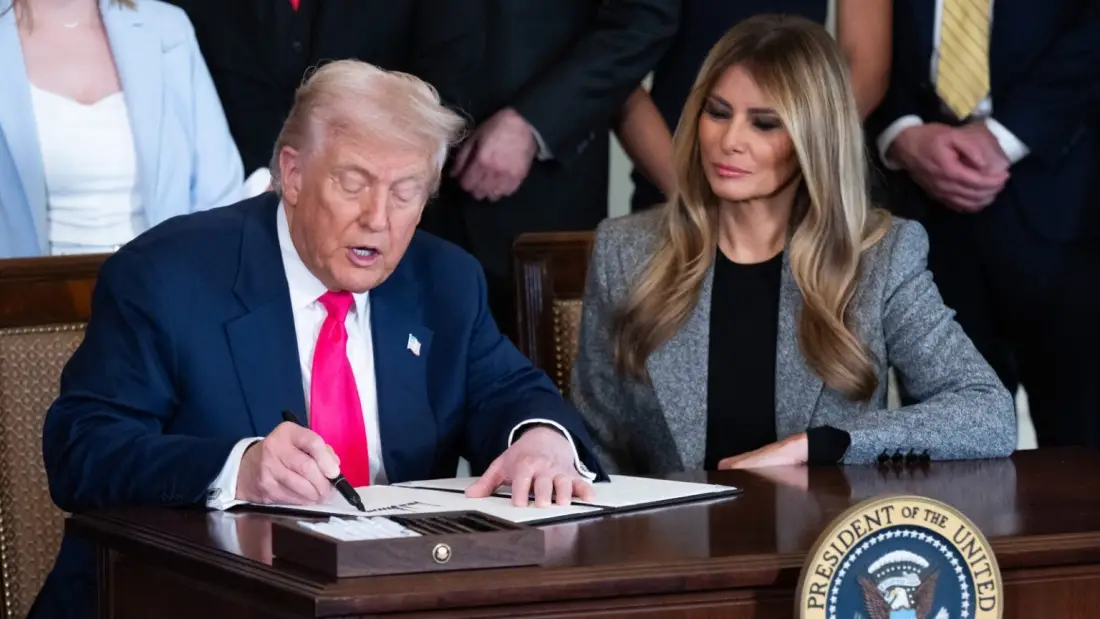
The announcement didn’t come from a podium. There was no East Room ceremony, no choreographed signing, no presidential backdrop draped in flags. Instead, it appeared the way much of Donald Trump’s political oxygen appears these days — as a late-night, all-caps blast on TruthSocial.
But the message was unmistakable: Trump wanted credit. Not partial credit, not qualified credit — credit on a historic scale.
He declared himself, in a phrase that ricocheted instantly across political circles, “THE AFFORDABILITY PRESIDENT.”
And he insisted Republican lawmakers start saying it, repeating it, and making it the drumbeat of their midterm message.
In Trump’s telling, the proof rested in a sweeping series of executive actions and private agreements with pharmaceutical giants — deals he said were slashing prescription drug prices at rates the country had never witnessed.
“500%, 600%, 700%, and more,” he wrote, referring to what he described as unprecedented price drops, crediting his invocation of “favored nations” authorities that tied U.S. drug prices to lower costs abroad.
Whether his figures were rhetorical, aspirational, or literal hardly mattered in the moment. What mattered was the narrative Trump was hammering: after decades of soaring costs, he alone was forcing big pharma to bend.
And with a presidential tone that blended self-assurance with a campaigner’s urgency, he ended his post with the unmistakable command:
“Republicans… TALK LOUDLY AND PROUDLY!”
The statement landed against a political landscape defined by two truths: Americans remain exhausted by years of inflation, and neither party has fully convinced them it can deliver lasting relief.
Trump, sensing an opening, stepped directly into that vacuum — and made affordability the centerpiece of his renewed economic pitch.
CHAPTER 1: A Country Struggling to Breathe
When Trump declared himself the “affordability president,” the phrase resonated because it tapped into a national anxiety very difficult to quantify, but impossible to ignore.
Even with inflation cooled from its pandemic highs, the average family still felt pushed to the brink. Grocery staples — eggs, bread, chicken, cooking oil — had become symbols of frustration. Rent climbed. Car insurance surged. Medical bills remained a quiet crisis for millions.
The Democratic Party, which once positioned itself as the guardian of social programs and cost protections, had spent the four previous years fending off criticism that its policies — from energy restrictions to supply-chain mismanagement — had contributed to price spikes.
Meanwhile, Republicans were struggling with a challenge of their own: framing their policies not simply as ideological victories, but as tangible improvements to daily life.
Into this muddled terrain, Trump dropped a message that was both simple and emotionally calibrated:
Life is getting cheaper — because of me.
Whether that was entirely accurate mattered less in the political arena than whether it felt true.
For many voters, who had watched grocery receipts shrink modestly and certain drug prices dip, the message hit its target.
CHAPTER 2: The Drug Deal Breakthrough
What Trump highlighted first — and most aggressively — were the pharmaceutical deals.
Behind closed doors, his administration had leaned heavily on global leverage and domestic pressure to force major companies to cut prices on their most in-demand drugs. Among the most symbolic: new agreements with Novo Nordisk and Eli Lilly, manufacturers of the GLP-1 medications currently dominating the weight-loss market.
Prices for those drugs had skyrocketed under Biden. Insurance coverage was inconsistent. Out-of-pocket costs reached into hundreds or even thousands per month for some patients.
To the administration’s supporters, the new deals were a breakthrough. To Trump, they were an opportunity to draw a contrast:
“No other President has been able to do this, BUT I HAVE!”
His claim wasn’t entirely wrong. No modern president — Republican or Democrat — had so aggressively tied U.S. drug prices to foreign benchmarks. No administration had tried to force the industry to defend its profit margins so publicly.
And although Democrats argued his numbers were exaggerated, the deals did create real pressure — real savings — in a system that had remained stagnant for decades.
In describing it as “a revolution in medicine,” Trump wasn’t aiming for understatement.
CHAPTER 3: A Food Fight — Literally
What came next was unexpected, even for a president known for dramatic shifts: Trump moved to roll back tariffs on grocery staples.
It wasn’t subtle. It wasn’t gradual. It wasn’t couched in policy language. It was framed the way Trump frames most things — as a promise delivered.
Just days earlier, rising food costs had emerged as Democrats’ most potent attack line in off-year elections. Polls showed even Trump voters were frustrated that everyday items still cost significantly more than they had pre-pandemic.
So Trump acted.
Beef, coffee, bananas, tomatoes, and other imported staples — all once subject to retaliatory tariffs — were suddenly exempt.
The executive order didn’t read like a traditional trade memo. It read more like a rebuke:
“Certain agricultural products shall not be subject to reciprocal tariffs,” the directive declared.
Treasury Secretary Scott Bessent made the case on cable news:
“This is going to bring prices down very quickly.”
This was the other side of Trump’s trade philosophy — the part rarely discussed in debates:
Tariffs as leverage, not destiny.
Pressure, then relief.
Hardball, then handshake.
It wasn’t ideological. It was transactional — and deeply political.
In lifting tariffs on common food items, Trump wasn’t changing his worldview. He was executing it.
CHAPTER 4: Democrats Push Back — and Quietly Panic
Democrats immediately argued the move was an admission of guilt — proof that tariffs had contributed to inflation all along.
Progressives said the rollback contradicted years of Trump insisting that tariffs hurt foreign exporters, not Americans.
But beneath their public messaging, party strategists saw something more dangerous: Trump was inching into their rhetorical territory.
He wasn’t talking about GDP.
He wasn’t talking about corporate tax cuts.
He wasn’t even talking about traditional Republican economics.
He was talking about eggs.
And bananas.
And prescription drugs.
And gas.
He was talking about the things people could touch, buy, cook, or pick up off a pharmacy shelf.
And in politics, tangibility beats theory every time.
CHAPTER 5: A New Economic Narrative Emerges
Trump’s advisers had spent months refining his economic message. They knew the old talking points — deregulation, manufacturing, American energy — still mattered, but they weren’t enough.
People vote with their receipts.
And so a new narrative began forming, piece by piece:
-
America’s grocery bill is shrinking → because Trump negotiated tariff rollbacks.
-
Prescription drug prices are plunging → because Trump forced global parity.
-
Gas prices are steadying → because of domestic production increases.
-
Inflation is cooling → because of targeted executive actions.
Trump began stitching these points into a broader argument:
“I am restoring affordability.”
It wasn’t academic. It wasn’t polished. But it was effective.
CHAPTER 6: The Favored Nations Gambit
Behind the political theater was a technical but powerful policy shift: Trump’s invocation of “favored nations status.”
Under this policy — controversial even within the pharmaceutical world — the United States could effectively demand matching prices based on what other developed countries pay for the same drugs.
It was, in essence, an ultimatum:
“Give us the best price in the world — or lose access to the biggest market in the world.”
No past administration had dared to push this concept beyond academic discussion. Trump didn’t just push it; he weaponized it.
Critics warned it would stifle innovation. Supporters said drug companies had exploited Americans for too long.
The truth was somewhere in the middle.
But in political terms, Trump’s framing was flawless:
“Americans shouldn’t pay more than Europeans for the same pill.”
Few voters disagreed.
CHAPTER 7: The Trade Shockwave
After the grocery tariff rollback came a wave of new trade deals with Argentina, Guatemala, Ecuador, and El Salvador — agreements that sliced duties on imported produce.
These negotiations revealed the full cycle of Trump’s tariff strategy:
-
Impose tariffs to gain leverage.
-
Force countries to the table.
-
Optimize deals to benefit U.S. consumers.
U.S. Trade Representative Jamieson Greer described it candidly:
“This is give and take. Now we have a critical mass of agreements… good timing.”
It was the type of comment that enraged traditional free-trade Republicans — but pleased economists seeking targeted relief for consumers.
Trump wasn’t creating a permanent tariff war.
He was creating a revolving door of pressure and reward.
And it was working.
CHAPTER 8: The Shadow of the Midterms
As all of this unfolded, the calendar loomed. The 2026 midterms were no longer a distant political horizon — they were creeping into the foreground.
Democrats were sharpening a narrative:
“Life got more expensive under Trump.”
Trump was building the counterpunch:
“Life got cheaper because of Trump.”
Republicans, as Trump complained in his TruthSocial post, had been quieter than he liked. He wanted them louder — and bolder.
To GOP lawmakers, the message was unmistakable:
Run on affordability.
Run on prices.
Run on the drug deals.
Run on the tariffs.
Run on household economics.
And do it loudly.
CHAPTER 9: A Vice President Steps In
Vice President JD Vance added his own voice to the narrative — and he did so with a blend of realism and optimism.
Speaking at a Breitbart News event, Vance acknowledged what many advisers hesitate to say publicly:
“We get it. Americans don’t feel the improvement yet.”
And then he added the administration’s core promise:
“The boom is coming.”
Vance wasn’t dismissing people’s frustrations. He was validating them — a rare move in modern politics.
He pointed out that even though egg prices had dropped from their Biden-era peak, they were still too high for many families. That humility — or at least the appearance of humility — was intentional.
The administration was trying to build patience.
Patience for tariffs to relax.
Patience for drug prices to fall.
Patience for groceries to stabilize.
Patience for wages to rise.
The political gamble was clear:
If affordability improves by mid-2026, Republicans can run on victory.
If it doesn’t, Democrats will run on anger.
CHAPTER 10: The Critics Reload
Democrats, meanwhile, were struggling to mount a unified counterargument.
Some said Trump’s claims were exaggerated.
Some said his deals were unstable.
Some argued the savings were short-term illusions.
Some predicted supply chain shortages.
But none could deny the reality:
Drug companies had publicly announced price cuts.
Tariffs had been eased.
Countries had signed new trade agreements.
Food prices were stabilizing.
Policy experts warned that tying drug prices to foreign markets could lead to rationing or slowed pharmaceutical innovation, but those concerns were abstract to families trying to refill insulin prescriptions.
For many voters, the question wasn’t philosophical:
“Did my grocery bill go down? Yes or no?”
“Did my medication get cheaper? Yes or no?”
“Is my paycheck stretching further? Yes or no?”
Political theory collapses under the weight of real life.
CHAPTER 11: The Narrative Battle Ahead
The fight over affordability wasn’t simply about economics — it was about identity.
Trump wanted to brand himself as the man who made America financially livable again.
Democrats wanted to brand him as the man whose erratic policies caused instability.
But Republicans had a card Democrats feared:
People don’t need to believe in affordability.
They need to feel it.
A price cut felt in the wallet is more persuasive than a debate segment or a statistic.
And that was the quiet genius of Trump’s push.
EPILOGUE: The Quiet Truth Beneath the Headlines
As the political war intensifies, something simple and human remains at the center of the story:
Parents are trying to afford groceries without cutting meals.
Retirees are trying to stretch fixed incomes.
Young families are trying to afford childcare and prescriptions.
Workers are trying to keep their cars running, their rent paid, their budgets intact.
People want affordability.
They don’t care how it arrives.
They care that it arrives.
Trump believes he has delivered it — or is delivering it still.
Democrats insist he hasn’t.
Economists debate it.
Reporters analyze it.
Politicians weaponize it.
But families just want relief.
And in that gap — between policy and lived experience — the 2026 election will be decided.

Ethan Blake is a skilled Creative Content Specialist with a talent for crafting engaging and thought-provoking narratives. With a strong background in storytelling and digital content creation, Ethan brings a unique perspective to his role at TheArchivists, where he curates and produces captivating content for a global audience.
Ethan holds a degree in Communications from Zurich University, where he developed his expertise in storytelling, media strategy, and audience engagement. Known for his ability to blend creativity with analytical precision, he excels at creating content that not only entertains but also connects deeply with readers.
At TheArchivists, Ethan specializes in uncovering compelling stories that reflect a wide range of human experiences. His work is celebrated for its authenticity, creativity, and ability to spark meaningful conversations, earning him recognition among peers and readers alike.
Passionate about the art of storytelling, Ethan enjoys exploring themes of culture, history, and personal growth, aiming to inspire and inform with every piece he creates. Dedicated to making a lasting impact, Ethan continues to push boundaries in the ever-evolving world of digital content.