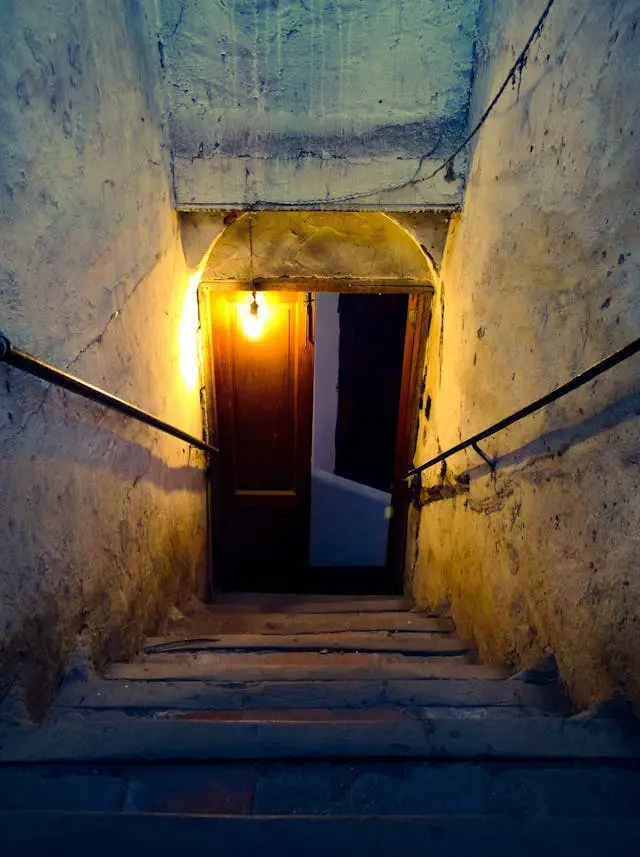
The Command Center
The basement door slammed shut above us, a violent crack of wood against frame, followed immediately by the distinctive, metallic thunk of a deadbolt sliding into place.
“Trevor!” I screamed, my voice shredding as I scrambled back up the stairs, my knees protesting with every step. I pounded on the door with both fists, the vibrations rattling through my arms. “Trevor, what are you doing? Let us out!”
My son’s voice came through the door, muffled by the heavy oak but chillingly clear. It was a tone I had never heard from him—cold, detached, final.
“Mom, Dad, you’re staying down there. You’re too old to manage this house anymore. We’re taking over. You’ll stay in the basement where it’s safe until I can get you into a proper facility. It’s for your own good. You’re not capable anymore.”
“Trevor! Baby, please!” I was crying now, tears hot and stinging on my cheeks. “We’re fine! We don’t need a facility! This is our home!”
“Not anymore. It’s not.”
I heard his footsteps retreating, the heavy thud-thud-thud of his boots on the hardwood floor fading away. Then, silence. A profound, suffocating silence.
I collapsed onto the stairs, sobbing into my hands. The reality was a physical weight crushing my chest. We were locked in our own basement, in the house we had built, by the son we had raised.
My husband, William, stood at the bottom of the stairs. He wasn’t screaming. He wasn’t pounding. He was perfectly, terrifyingly calm.
“William, do something!” I shrieked, hysteria edging into my voice. “Call someone! Break down the door!”
He looked up at me, his face illuminated by the single bulb hanging from the rafters. His expression wasn’t one of fear or panic. It was something else entirely. A grim, steely resolve.
“Dorothy, come down here. Stop screaming. I need you to be quiet.”
“Quiet? Our son just locked us in the basement! He’s planning to put us in a nursing home! How can you be calm right now?”
“Because,” William said softly, turning and walking toward his workshop area in the far corner of the basement, “I have a secret. Something Trevor doesn’t know about. Something that’s going to make him regret the day he was born.”
I stared at the man I had been married to for fifty years. “What secret?”
He smiled. Actually smiled. It was a shark’s smile.
“Come here. Let me show you what I’ve been working on for the past decade. This house has more surprises than our son could ever imagine.”
I wiped my tears with the back of my hand and walked down the stairs, my legs trembling. William was moving stacks of cardboard boxes in his workshop, revealing a section of the wall I had always assumed was just paneling. He pressed a specific knot in the wood, and a hidden panel slid open with a soft hiss.
Behind it lay a sophisticated system of monitors, switches, and glowing LED controls that looked like something out of a spy movie, not a suburban basement in Durham, North Carolina.
“William… what is this?” I breathed.
“Insurance,” he said quietly. “I’ve been installing it piece by piece for ten years. Ever since I retired. This basement isn’t a prison, Dorothy. It’s a command center. And by tomorrow morning, Trevor is going to realize he made the biggest mistake of his life.”
I watched as the monitors flickered to life, one by one, showing crisp, high-definition views of every room in our house. The kitchen. The living room. Our bedroom. Trevor’s face, visible in the guest room he’d commandeered, looked satisfied, victorious.
“What did you do?” I whispered.
“I made sure,” William said, his eyes fixed on the screens, “that nobody could ever take this house from us. Not burglars, not scammers, and certainly not our own son.”
The Foundation
To understand the magnitude of this betrayal, you have to understand the foundation it was built on.
My name is Dorothy Anne Thompson. I was born in 1954 in Richmond, Virginia, to parents who taught me that a home wasn’t just wood and brick—it was dignity. I married William in 1973. We were young, broke, and hungry. He was a journeyman electrician; I was a school cafeteria server.
In 1978, we bought this three-bedroom ranch in Durham for $48,000. We scraped together every penny for the down payment. William worked days as a union electrician and nights running his own small contracting business. He wired every inch of this house himself, running conduit through walls, installing panels, creating the electrical infrastructure that powered our life.
“This house is our foundation,” he used to say, wiping grease from his hands after another long day. “Everything we build, we build on this. Nobody takes this from us.”
We paid off the mortgage in twenty years through sacrifice and discipline. We raised three children here: Trevor, Janelle, and Ronald. We taught them the value of a dollar, the importance of honest work, the dignity of ownership.
But Trevor… Trevor was always different. He wanted the shortcut. The easy win. He resented us for making him work for his first car, for refusing to pay his credit card bills in college. He dropped out after two years because he thought he was too smart for formal education, that he could make it on his own terms.
He became an insurance salesman, making good money but spending better. He married Kesha, and together they lived a life of leased luxury cars, designer clothes, and maxed-out credit cards. They were drowning in debt, but to the outside world, they were thriving. The image mattered more than the reality.
Then, six months ago, the strange behavior started.
Trevor began posting on Facebook about our “cognitive decline.” He manufactured stories about William getting confused at the grocery store, about me forgetting lunches we never scheduled. He called our doctor, creating a medical paper trail of concerned inquiries about our mental state. He called Adult Protective Services twice, filing false reports of unsafe living conditions and neglect.
He was building a case for guardianship. We didn’t realize it at the time, but every post, every call, every concerned email to relatives was part of a calculated plan to have us declared incompetent so he could control our assets.
Three weeks ago, he showed up at our door with a moving truck and a sob story. “We got evicted, Mom. Just for a few weeks until we find a new place. Please.”
We let them in. We let the fox into the henhouse.
Within days, they took over. Kesha went through my jewelry box, taking pieces she thought I wouldn’t notice. Trevor rifled through our financial documents late at night, photographing bank statements and investment portfolios. They isolated us from Janelle and Ronald, telling them we were “overwhelmed” and needed space.
And yesterday, Trevor lured us into the basement under the guise of checking a water leak he claimed to have spotted.
The moment we reached the bottom of the stairs, he’d run back up and slammed the door.
And now, here we sat in what we thought was our prison.
William pulled a plastic tote from under his workbench. “I stocked emergency supplies years ago,” he said, handing me a bottle of water and a protein bar. “I planned for intruders, for disasters, for worst-case scenarios. I never thought the intruder would be my own blood.”
The Horror Show
We spent the rest of that day and into the evening watching the monitors. It was a horror show in high definition.
We watched Trevor ransack our home office, pulling out files and photographing everything. Our bank statements showing $340,000 in savings. Our investment portfolios. The deed to the house, now worth $485,000 according to the most recent assessment.
We watched him make phone call after phone call, his voice captured perfectly by the hidden microphones William had installed throughout the house.
“Yeah, I need to talk to someone about emergency guardianship,” Trevor said, pacing in our kitchen. “My parents are elderly, maybe seventy-two, seventy-five. They’re declining fast. Cognitive issues. I’ve had to confine them for their own safety.”
My blood ran cold. He was twenty-eight years away from the truth—we were in our early seventies and sharp as tacks—but he was spinning a narrative of helpless, confused elderly people who needed to be saved from themselves.
Another call, this one to someone named Rick: “Yeah, the house is worth almost half a million. But here’s the thing—they’re healthy. They could live another fifteen, twenty years. I can’t wait that long. I’m buried in debt, man. Guardianship is the only way to access the assets now.”
There it was. The raw, ugly truth. He wasn’t trying to protect us. He was trying to liquidate us.
We watched Kesha in our bedroom, trying on my pearl necklace—the one William had given me for our twenty-fifth anniversary—before stuffing it into her purse. She took my diamond earrings, my mother’s brooch, several pieces I’d collected over decades.
We watched Trevor examine William’s vintage watch collection, the Omega that had been his father’s, the Rolex he’d bought himself after thirty years with the union. Trevor photographed each piece, probably researching their value online.
“They’re robbing us,” I whispered, tears streaming down my face. “Our own son is robbing us blind.”
“I know, baby,” William said, his hand resting on my knee. “But look at the red lights on the console. We’re recording everything. Every theft. Every word. Every lie. All in 4K with crystal-clear audio.”
That evening, we watched Trevor make another call, this one to a lawyer.
“I need to file an emergency guardianship petition first thing tomorrow morning,” he said. “My parents are incompetent. I have them safely confined in the basement—for their own protection, of course. But I need legal authority over their finances immediately. They have substantial assets that need to be managed properly.”
The lawyer must have asked about documentation because Trevor laughed. “Oh, I’ve got documentation. Six months of concerned social media posts, calls to their doctor, APS reports. And I’ll testify that they’ve been wandering, forgetting things, living in unsafe conditions. Who’s going to contradict me? They’re locked in a basement.”
He was going to erase us. Declare us invalid, incompetent, and sell our lives piece by piece to cover his debts.
William’s jaw was set like stone. “We have enough,” he said. “More than enough. Tonight, we move.”
The Escape
We waited until the house fell silent.
By 1:15 AM, Trevor had finally passed out in our bed—our bed, the one we’d shared for fifty years—after drinking most of a six-pack of William’s beer. Kesha was asleep beside him, her phone still clutched in her hand, probably mid-scroll through social media. The grandkids were in the guest room, innocent casualties in this war.
William turned to his control panel. His fingers moved across the touchscreen with practiced confidence.
“First step,” he whispered. “Freedom.”
He entered a six-digit code. With a soft click barely audible through the ceiling, the electronic deadbolt Trevor had installed on the basement door disengaged. William had wired it into his system years ago, a backup in case of emergency. Every lock in this house ultimately answered to him.
We walked up the stairs slowly, quietly, our hearts pounding. We opened the door carefully, wincing at the slight creak of hinges, and stepped into the hallway.
The air smelled different up here—stale beer, Kesha’s heavy perfume, the scent of takeout containers left on the kitchen counter. The smell of invasion.
“Now,” William whispered, pulling out his smartphone. He had an app synced to the entire security system. “Watch this.”
He tapped a button labeled PERIMETER LOCKDOWN.
Throughout the house, a series of soft mechanical whirs echoed as the smart locks William had installed on every bedroom door activated. The deadbolts slid home with quiet precision.
“They’re trapped,” William said, his voice devoid of emotion. “Trevor and Kesha are locked in the master suite. The kids are safe in the guest room, but they can’t get out either. Nobody can leave until I decide to let them leave.”
Poetic justice. They locked us in; now they were the prisoners.
I wanted to scream at them through the door. I wanted to kick it and tell them how much they’d hurt us. But William shook his head.
“We do this right. We do this legally. No revenge, just justice.”
We walked into the living room—our living room, with the furniture we’d chosen, the photos we’d hung, the life we’d built. William picked up the landline phone, the one that still worked because he’d insisted on maintaining it as a backup.
He dialed 911.
“This is William Thompson at 2847 Maple Street in Durham,” he said, his voice steady and clear. “My son locked my wife and me in our basement forty-eight hours ago. We managed to escape. He is currently inside the house, along with his wife. We have extensive video evidence of false imprisonment, elder abuse, grand larceny, and conspiracy to commit fraud. We need officers immediately.”
The operator asked him to confirm the information, clearly surprised by the specificity and calm of his report. William repeated everything, adding that we were safe, that the perpetrators were contained, and that we had documentation of everything.
“Officers are en route,” the operator said. “Stay on the line with me.”
Twelve minutes later—William timed it—three squad cars pulled up outside, their lights flashing silently in the predawn darkness.
We met them at the door. The sergeant, a woman in her forties named Martinez, listened as we gave a brief overview. Then we showed them.
We took them to the basement, showed them the deadbolt Trevor had installed, the sophisticated lock that could only be opened from outside. We showed them the command center, the monitors still displaying every room. We showed them the recording of Trevor’s calls, his theft, his plans.
“Mr. Thompson,” Sergeant Martinez said, her eyes wide as she watched Trevor discuss liquidating our assets, “this is the most comprehensive evidence gathering I’ve seen in twenty years on the force.”
“I was a master electrician for forty-five years,” William said simply. “I know how to wire a house. And I know how to protect what’s mine.”
The officers went upstairs. They gathered outside the master bedroom door, which was still locked. Through the monitor, we could see Trevor and Kesha sleeping peacefully, unaware that their world was about to collapse.
“Mr. Thompson, can you unlock this door?” Sergeant Martinez asked.
William pressed a button on his phone. Click. The deadbolt disengaged.
The officers burst in, weapons drawn, flashlights blazing. “Police! Let me see your hands! Now!”
Trevor sat up, blinking in the harsh light, wearing nothing but boxers and a look of utter confusion. “What? What’s going on? What are you doing in my—”
“Trevor Thompson, you are under arrest for false imprisonment, elder abuse, attempted fraud, and grand larceny.”
“No! No, you don’t understand! My parents are confused! They have dementia! They can’t take care of themselves! I was protecting them!”
“Your parents seem pretty sharp to me, Mr. Thompson,” Sergeant Martinez said, snapping the handcuffs on his wrists. “And they have forty-eight hours of high-definition video showing exactly what you did. You have the right to remain silent…”
They led him down the stairs in his boxers and handcuffs. When he saw us standing in the living room—alive, free, and clearly competent—his face went white as chalk.
“Dad… how? You couldn’t have… the door was locked…”
“Forty-five years as a master electrician,” William said, his voice steady as a rock. “You think I don’t know how to wire my own house? Every lock, every camera, every system in this building answers to me. You locked us in the command center, son. Big mistake.”
Kesha was led out in handcuffs next, weeping hysterically and claiming she was just doing what Trevor told her, that she didn’t know it was wrong. The stolen jewelry found in her purse—my jewelry, pieces I’d worn for decades—said otherwise.
Our daughter Janelle arrived twenty minutes later, having been called by the police. She was still in her pajamas, her hair uncombed, fury and relief warring on her face. She burst through the door and wrapped us both in a crushing hug.
“Oh my God, oh my God,” she sobbed. “I knew something was wrong. Trevor told me you guys were sick, that you didn’t want visitors, that you needed space. I should have known. I should have come anyway.”
“He’s very good at lying,” William said quietly. “He’s had practice.”
As the police cars drove away, carrying Trevor and Kesha toward booking and jail cells, William and I stood on the porch. The sun was just beginning to crest over the horizon, painting the sky in shades of orange and pink.
“You saved us,” I said, leaning into his solid warmth.
“We saved each other,” he replied. “We’re a team. Always have been.”
The Legal Process
The legal process was slow, methodical, and thorough.
Trevor was charged with felony false imprisonment, elder abuse, attempted fraud, and grand larceny. Kesha was charged as an accomplice to theft and fraud. The District Attorney assigned to the case called William’s video evidence “a prosecutor’s dream.”
“There’s no ‘he said, she said’ here,” she told us during a meeting at her office. “We have video of the imprisonment. We have audio of him discussing his plans. We have footage of the theft. We have his calls to lawyers about guardianship. This is as close to an airtight case as I’ve ever seen.”
Trevor’s lawyer tried to argue that the recordings were illegal, that we had violated his privacy, that the evidence should be suppressed. The judge shot it down immediately.
“A homeowner has every right to install security systems in their own home,” the judge ruled. “The defendant was not in a place where he had any reasonable expectation of privacy. He was in someone else’s home, committing crimes. The recordings are admissible.”
Faced with overwhelming evidence and the possibility of eight to twelve years in prison if convicted at trial, Trevor took a plea deal.
The sentence: Four years in state prison. Eligible for parole after thirty months. Full restitution for all stolen items and financial damages. A permanent restraining order preventing him from coming within 500 feet of us or our property.
At the sentencing hearing, the judge asked if we wanted to speak. William stood up slowly. He looked older that day, as if the weight of the betrayal had finally settled fully into his bones.
“Your Honor,” he said, his voice trembling slightly, “that man is my son. I taught him to ride a bike. I taught him to wire a light socket. I paid for his education, his first car, his wedding. I gave him every opportunity a father could give.”
He paused, gathering himself. “And he chose to lock his seventy-two-year-old parents in a dark basement to steal the roof over our heads. He saw us not as people, not as his parents, but as assets to be liquidated. He was willing to have us declared incompetent and institutionalized so he could pay off his credit cards.”
William’s voice hardened. “I love my son. But he needs to understand that evil has consequences. I will not stand in the way of justice.”
Trevor wept as they led him away in shackles. “Mom! Dad! I’m sorry! I’m so sorry!”
“You’re only sorry you got caught,” I whispered, too quietly for him to hear.
Kesha got eighteen months of probation, 500 hours of community service, and court-ordered restitution. She moved back to her mother’s house with the kids. We saw them occasionally, supervised visits arranged through Janelle. The children were innocent in this war, and we wouldn’t punish them for their parents’ sins.
The Aftermath
Life slowly returned to something resembling normal, though nothing would ever be quite the same.
We stayed in our home. We refused to even consider leaving, refused to let Trevor’s betrayal drive us from the place we’d built together.
I started a support group at our church: “Protecting Yourself from Family Exploitation.” Twenty-three people showed up the first night, mostly elderly folks who had experienced or feared similar situations. I told them our story—all of it. I told them about the warning signs we’d missed, the isolation tactics, the gaslighting, the manufactured narrative of incompetence.
“You are never too old to protect what’s yours,” I told them. “You are never too confused to know when you’re being abused. And you always have the right to defend your home, your assets, and your dignity.”
William installed similar security systems in three other homes in our neighborhood, all for elderly couples who wanted the same protection we’d built. He charged cost for materials and refused payment for labor.
“I’m retired,” he said. “I’ve got time. And if I can keep one more family safe from what we went through, it’s worth it.”
One year after Trevor’s sentencing, a letter arrived from the state prison. It was six pages long, handwritten in Trevor’s familiar scrawl.
Mom and Dad,
I don’t deserve your forgiveness. I know that. I’m not writing to ask for it. I’m writing because being in here—the isolation, the consequences, the time to think—has stripped away every lie I told myself.
I told myself I was helping you. I told myself you were getting old and needed me to manage things. I told myself that guardianship was for your own good. But it was all bullshit. It was greed. Pure, simple greed.
I was drowning in debt—$87,000 in credit cards, two car payments we couldn’t afford, a lifestyle we couldn’t maintain. And instead of being an adult and dealing with it, I decided to use you as a life raft. I decided that your assets were my solution.
I am deeply, truly sorry. Not because I got caught, but because I finally understand what I did. I locked my own parents in a basement. I was going to erase you, declare you incompetent, sell your home. The home you built. The home Dad wired with his own hands.
I don’t know if I’ll ever be worthy of the name Thompson again. But I’m trying. I’m taking classes here. I’m working in the prison workshop. I’m trying to become a man who deserves to be your son.
I love you. I’m sorry. I understand if you never want to see me again.
Trevor
I cried when I read it. The words felt genuine in a way nothing from Trevor had felt in years. William read it silently, then folded it carefully and placed it in his desk drawer.
“Do you believe him?” I asked.
“I believe he’s suffering,” William said after a long pause. “And suffering brings clarity. But trust? Trust is like this house, Dorothy. Once it burns down, you can’t just move back in and pretend it never happened. You have to clear the rubble. You have to rebuild it brick by brick, wire by wire. And that takes years.”
Five Years Later
Five years have passed since that terrible night in the basement.
William is seventy-seven now; I’m seventy-five. We move slower than we used to. My knees ache when it rains, and William’s hands shake slightly when he holds his coffee cup in the morning. But we are here. We are in our home.
Our house is worth over $600,000 now. It is mortgage-free, maintained, and secure. The security system William installed has been upgraded twice, now featuring motion sensors, facial recognition, and backup power that could run for three days.
Trevor was released on parole two years ago. He lives in Charlotte now, working in a warehouse, loading trucks for $16 an hour. It’s honest work—the first honest work he’s done in years. He sends a check every month for the restitution, $200 that the court ordered. He’s paid back about $15,000 so far. At this rate, it will take him another decade to settle the debt.
He hasn’t tried to visit. The restraining order expired after three years, but he hasn’t come. Janelle tells us he’s different now. Humbler. Quieter. He’s in therapy. He’s reconciled with Kesha, and they’re trying to rebuild their lives on a foundation of honesty rather than appearances.
“He asks about you,” Janelle told us last month. “He wants to know if you’re okay. But he’s too ashamed to reach out.”
“Good,” William said. “Shame is appropriate.”
Last Sunday, we had a family dinner. Janelle, Ronald, and their families—spouses, children, grandchildren—filled the house with noise and laughter and life. Fourteen people around the table we’d bought forty years ago, eating pot roast I’d made using my mother’s recipe.
After dessert, as the younger kids played in the backyard and the adults lingered over coffee, Janelle asked the question that hangs over every aging parent.
“Mom, Dad… have you thought about the future? About what happens as you get older? About the house?”
William and I looked at each other. We’d had this conversation many times, just the two of us.
“We have,” William said. “We’ve updated our wills with an estate attorney. Everything is in order. The house goes to you and Ronald, divided equally. Trevor is disinherited. We have the legal documentation to ensure it stands, including a detailed explanation of why.”
“But,” I added, looking around at our family, “we aren’t going anywhere. This is our home. We fought for it. And as long as we’re capable of living here, this is where we’ll be.”
“And if the day comes when we can’t manage it,” William said firmly, “we will make that decision. Not a doctor giving recommendations. Not a social worker making suggestions. And certainly not a child locking us in a basement. We will decide our own fate.”
Everyone was quiet for a moment, the weight of what we’d been through still present even years later.
Ronald raised his glass. “To Mom and Dad. The toughest people I know.”
We all drank to that.
Later that evening, after everyone had gone home and we’d finished the dishes, William and I sat on the back porch. The sun was setting, casting long shadows across the yard we’d tended for forty-five years. The tomato plants I’d put in that spring were heavy with fruit. William’s workshop light glowed softly in the basement window.
“You know what I realized?” I asked, taking his hand.
“What’s that?”
“We won. Trevor tried to take everything from us, and we won.”
William nodded slowly. “We did. But I wouldn’t say we won. More like… we survived. And we protected what was ours.”
“Do you think we’ll ever see him again? Really see him, I mean. Not just hear about him through Janelle.”
William looked at the sunset, the sky painted in shades of orange and purple. “Maybe. If he does the work. If he proves, over years, that he’s changed. If he understands that trust isn’t given, it’s earned. But that’s not a decision for today. Maybe not a decision for this year, or next year. Maybe not ever.”
He squeezed my hand. “But I’m okay with that. My job isn’t to redeem my son. My job is to protect my wife and our home. And I did that. We did that together.”
“Fifty-five years,” I said. “Fifty-five years of being a team.”
“Fifty-five years,” he echoed. “And God willing, many more.”
“We’d be over a hundred,” I laughed. “You better keep that security system updated.”
“Already planning the next upgrade,” he said with a small smile. “Drone surveillance, maybe. Really go all out.”
We sat there as the stars came out, safe in our fortress, protected by love and technology and the unshakeable determination that nobody—not strangers, not scammers, and certainly not our own children—would ever take this home from us.
William’s secret saved us. The cameras, the locks, the decade of careful planning. But the real secret wasn’t the technology, impressive as it was.
The real secret was that we never underestimated the value of what we had built. We knew that a home is more than a financial asset; it is a history, a testament to years of labor and love and sacrifice. And when you understand that, you defend it with everything you have.
We are Dorothy and William Thompson. We are seventy-five and seventy-seven years old. We built this house with our own hands and our own money. We defended it when our own son tried to steal it.
And we are still here.
Nobody is taking this house from us. Not ever.

Lila Hart is a dedicated Digital Archivist and Research Specialist with a keen eye for preserving and curating meaningful content. At TheArchivists, she specializes in organizing and managing digital archives, ensuring that valuable stories and historical moments are accessible for generations to come.
Lila earned her degree in History and Archival Studies from the University of Edinburgh, where she cultivated her passion for documenting the past and preserving cultural heritage. Her expertise lies in combining traditional archival techniques with modern digital tools, allowing her to create comprehensive and engaging collections that resonate with audiences worldwide.
At TheArchivists, Lila is known for her meticulous attention to detail and her ability to uncover hidden gems within extensive archives. Her work is praised for its depth, authenticity, and contribution to the preservation of knowledge in the digital age.
Driven by a commitment to preserving stories that matter, Lila is passionate about exploring the intersection of history and technology. Her goal is to ensure that every piece of content she handles reflects the richness of human experiences and remains a source of inspiration for years to come.
Here is another great story from Lila Hart.
The “on the edge of your seat” drama made
the reader feel like they were right there….part of the story. She is a talented and delightful
writer and I look forward to more adventures
from her desk.