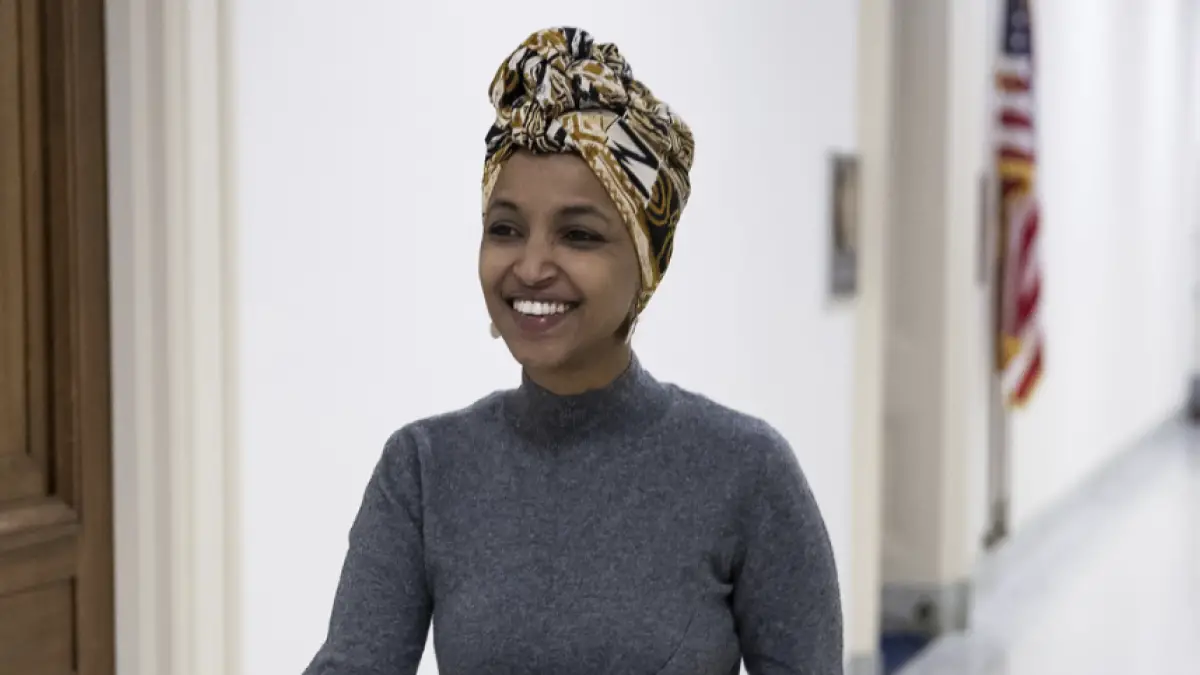
In American politics, feuds are rarely simple disagreements. They accumulate weight over months, even years, until they become symbolic battles — shorthand for deeper cultural divides, anxieties, and resentments simmering across the nation. The latest clash between President Donald Trump and Rep. Ilhan Omar (D-MN) fits squarely into that category: a confrontation that began long before either of their most recent comments, but which has intensified in the wake of a tragedy that shook Washington.
Earlier this month, a brief online moment — a single image posted by the White House — reignited old hostilities. It was a photo taken during a 2024 campaign stop: Donald Trump smiling through a McDonald’s drive-thru window, waving toward supporters. The picture had been unremarkable at the time. But when the White House reposted it on X with a pointed reply to a resurfaced clip of Ilhan Omar dismissing concerns about deportation, the meaning became unmistakably clear.
It was not a policy message. It was not a formal statement.
It was a taunt. A trigger. A spark.
Within hours, the image spread across social media platforms. Commentators interpreted it as the political equivalent of a “goodbye wave” — Trump’s way of mocking the congresswoman’s confidence in her legal status and her long-standing dismissal of threats to her citizenship. The reply was sly, provocative, and unmistakably personal.
But beneath the memes and cable news panels, a far bigger story was brewing — one that touched on immigration policies, national security anxieties, Somali-American identity, and a broader debate about who “belongs” in the United States.
And just as the meme circulated, tragedy struck Washington.
A Shooting Near the White House Changes Everything
On the night before Thanksgiving, two National Guard members — 20-year-old Sarah Beckstrom and 24-year-old Staff Sgt. Andrew Wolfe — were ambushed and shot near the White House. Authorities quickly identified the shooter as Rahmanullah Lakanwal, a 29-year-old Afghan national who had entered the United States under the Biden administration’s Operation Allies Welcome program.
Both guardsmen were transported to the hospital in critical condition. By Friday morning, Beckstrom — the youngest in her unit — had succumbed to her wounds. Her death sent a wave of grief through military communities and provided the White House with a harrowing illustration of what it called the “dangerous consequences of Biden-era refugee vetting failures.”
Trump delivered the news himself during a press conference.
Then came the question — a reporter asked why he blamed Biden for the attack.
Trump stared incredulously.
“Because they let him! Are you stupid? Are you a stupid person?” he snapped.
“They came in on a plane, along with thousands of other people that shouldn’t be here.”
The president’s response, harsh and unfiltered even by Trumpian standards, instantly shifted the national conversation. Immigration, refugee policy, and national security — issues that had been simmering on the back burner — were thrust to the forefront once again.
And in that volatile environment, the feud with Ilhan Omar re-emerged with new intensity.
How the Omar Clip Resurfaced — and Why It Hit Harder Now
The clip at the center of the feud was nearly a year old. In an October 2024 interview on The Dean Obeidallah Show, Omar had been asked whether she feared that Trump, if re-elected, would attempt to revoke her citizenship or deport her.
Her answer was casual, even dismissive:
“I have no worry. I don’t know how they’d take away my citizenship and deport me…
I’m not the 8-year-old who escaped war anymore. I’m grown. My kids are grown.
I can go live wherever I want.”
At the time, her remarks drew attention from conservative circles but did not dominate national headlines.
What changed everything was timing.
After the shooting of the National Guard members, Trump’s renewed focus on immigration — particularly Somali and Afghan communities — meant Omar’s comments were suddenly politically combustible. The White House reposted the McDonald’s photo as a direct reply. The message was unmistakable: if Omar claimed she wasn’t afraid of deportation, Trump appeared ready to call her bluff.
From there, the feud escalated quickly.
Trump Revives an Old Allegation — and Pushes It Harder Than Before
Speaking to reporters aboard Air Force One days after the viral post, Trump brought up one of the most controversial allegations ever associated with Omar: the claim that she had married her brother as part of a fraudulent immigration scheme.
The accusation has circulated online for years, though investigations by news outlets have found no official documentation to conclusively verify or disprove it. Omar has consistently denied it, calling it a racist smear.
Trump, however, leaned fully into it:
“She supposedly came into our country by marrying her brother,” he said.
“If that’s true, she shouldn’t be a congresswoman — and we should throw her the hell out of the country.”
The language was blunt, jarring, and more forceful than his past comments on the matter. But it also signaled something deeper: Trump was positioning Omar not merely as a political opponent, but as a symbol of what he portrays as America’s failed immigration experiment.
In the same exchange, he broadened his attack:
“Somalis have caused us a lot of trouble, and they cost us a lot of money…
We’re not taking their people anymore — in fact, we’re sending them back.”
It was a sweeping statement, one that distanced him from past Republican administrations that supported Somali refugee resettlements. It also reflected a growing shift among some conservative voters who see immigration — especially from Muslim-majority nations — as not just a security question but an existential cultural one.
For Omar, whose district includes one of the largest Somali communities in the United States, the attack was both political and personal.
Omar Fires Back: “Lying Buffoon”
Omar responded days later, dismissing Trump as:
“a lying buffoon spreading fabricated stories.”
She denied Trump’s claim that Somalia’s president had refused to take her back, calling it pure fiction. She accused Trump of using her identity — as a Muslim, as a refugee, as an immigrant — to stoke racial animosity.
The congresswoman’s defenders argued that Trump’s rhetoric was not merely political theater, but a dangerous effort to single out a minority community already facing backlash after the D.C. shooting.
The president’s critics warned that his remarks risked fueling anti-Muslim sentiment. His supporters countered that Omar has historically shown contempt for America’s institutions and traditions, making her an easy lightning rod.
The American public, in other words, split along familiar lines.
But beneath the noise, a more investigative question arises:
Why is the Trump–Omar feud resurging now?
And what does it reveal about the current political climate?
Part I: Why the Feud Matters Again (An Investigative Breakdown)
To understand why this old rivalry is back with renewed potency, we have to look beyond the headlines.
1. Immigration Is Once Again the Dominant National Issue
Following the tragedy in Washington, the administration moved quickly to highlight failures in the Biden-era refugee vetting process. Trump has demanded a full re-review of every Afghan and Somali refugee admitted between 2021 and 2024.
Omar is one of the most visible faces of that era’s immigration advocacy.
Her presence makes the issue more personal — for both sides.
2. Minnesota Has Become a Symbolic Battleground
Minnesota’s Somali-American community is the largest in the country. Recent investigations into fraud, gang activity, and overseas money transfers (including allegations involving Al-Shabaab) have made it a point of political contention.
Though Omar has no connection to those cases, Trump is using the broader narrative to reinforce his position.
3. Trump’s 2026 Midterm Strategy Requires an Enemy
In political strategy, opponents know that nothing galvanizes a base faster than a clear villain. For Trump, Omar — outspoken, progressive, culturally distinct — fits the bill.
4. Omar’s Own Public Statements Have Made Her a Target
Her past quotes:
-
“Some people did something” (referring to 9/11)
-
criticism of U.S. foreign policy
-
accusations of systemic oppression
…have made her one of the GOP’s favorite rhetorical opponents.
The resurfaced deportation clip came at a moment when emotions were already heightened.
Part II: The Somali-American Community Responds
While the feud escalated in Washington, reactions in Minneapolis and the surrounding Somali-American neighborhoods were complex.
Mixed Feelings About Omar
Many Somali-Americans revere Omar as a trailblazer.
Others — particularly older, more conservative members of the community — view her as a controversial figure whose political battles sometimes overshadow local needs.
Fear of Backlash
With the Afghan shooting dominating headlines and Trump promising to “send them back,” Somali families expressed renewed fear of profiling and increased hostility.
Several community organizations called emergency meetings to prepare for possible tensions.
Behind Closed Doors: Democratic Strategists Are Worried
Privately, several Democratic operatives admit that Omar’s public persona — bold, confrontational, unapologetically ideological — complicates their messaging.
One strategist, speaking anonymously, said:
“She’s influential, but she’s polarizing. When Trump attacks her, it lands differently than if he attacked another member of Congress.”
Another added:
“This is the nightmare scenario — a violent incident, refugees in the headlines, and Omar back in the center of it.”
Part III: Trump’s Strategy Is Broader Than Omar
The president’s escalation isn’t just a feud.
It’s an opening salvo in a broader immigration offensive.
Officials close to Trump have outlined a multi-pronged approach:
1. Ending Refugee Programs from High-Risk Nations
Somalia and Afghanistan are at the top of the list.
2. Revoking Status for Certain Migrant Groups
Trump has floated revoking visas and green cards for individuals deemed “non-assimilating.”
3. Deportation Prioritization
Including the possibility of deporting naturalized citizens found guilty of major crimes — a legal gray area that is likely to face numerous court challenges.
4. Reviving the “Muslim Ban” Framework
Though not explicitly stated, officials say the new plan will be “a more sophisticated version.”
Omar is symbolically tied to all of these debates.
Part IV: What Happens Next?
As the feud escalates, both sides appear ready to use the confrontation to their political advantage.
Trump’s Political Gain
For Trump:
-
Omar is an easy symbol of “failed immigration policy”
-
The feud excites his base
-
It fits his law-and-order message following the D.C. shooting
The timing is perfect for his narrative.
Omar’s Political Gain
For Omar:
-
She becomes a high-profile target of Trump
-
Her supporters rally behind her
-
She raises money off the controversy
-
She reasserts her position as a progressive leader willing to stand up to Trump
The conflict energizes both her national and district-level base.
The Risk for Both
But there are dangers:
-
Heightened rhetoric could provoke real-world tensions
-
Somali-American communities could face hostility
-
The public conversation could drift into xenophobia
-
Democrats may struggle to defend Omar without appearing weak on security
-
Republicans risk being portrayed as targeting minorities
-
The feud may overshadow substantive policy questions
Both sides are walking a tightrope — willingly.
Conclusion: A Feud That Says More About America Than About Two Politicians
The clash between Donald Trump and Ilhan Omar is not new.
But this moment is different.
The context is heavier. A young National Guard member is dead. Immigration is back at the center of national debate. Tribal politics are once again sharpening along cultural and ethnic lines.
Omar represents a new America — multicultural, outspoken, increasingly diverse.
Trump represents an older America — anxious about change, nostalgic for the past, focused on tradition, security, and national identity.
Their fight is, in many ways, a reflection of the country’s identity crisis.
No matter who “wins” the feud, the underlying conflict — over belonging, over assimilation, over what America should be — is not going away.
It’s only beginning.

Adrian Hawthorne is a celebrated author and dedicated archivist who finds inspiration in the hidden stories of the past. Educated at Oxford, he now works at the National Archives, where preserving history fuels his evocative writing. Balancing archival precision with creative storytelling, Adrian founded the Hawthorne Institute of Literary Arts to mentor emerging writers and honor the timeless art of narrative.