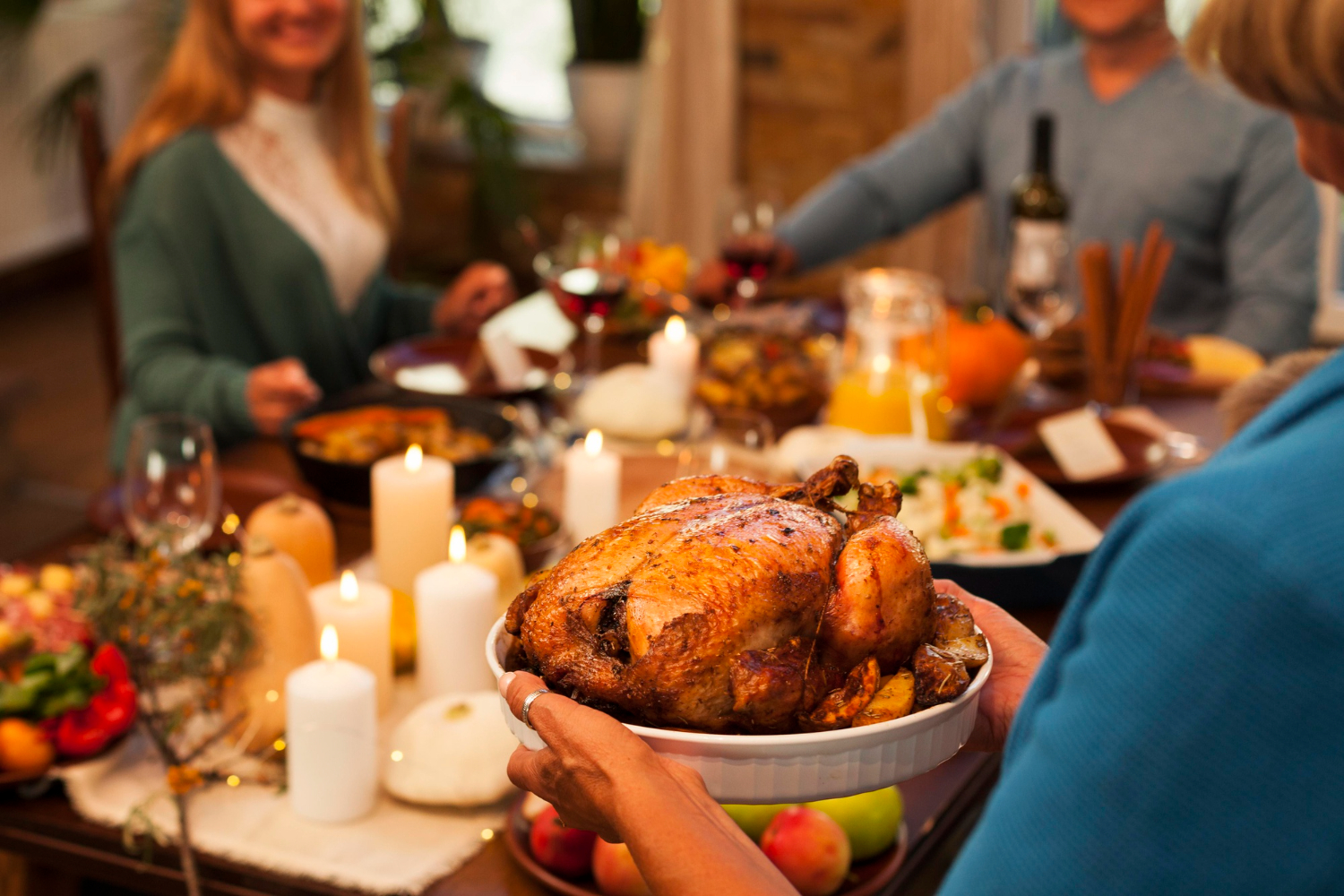
The cranberry sauce gleamed under the dining room chandelier like drops of blood on bone china. I’d bought that chandelier three years ago when the old one finally gave out, just like I’d paid for the new roof, the kitchen renovation, and the property tax bill that would have sent my parents into foreclosure. Nobody mentioned those things, of course. My financial contributions had become as invisible as I was, present but unacknowledged, necessary but unappreciated.
“Madison, pass the rolls,” my sister Victoria said without looking at me. She never looked at me anymore, not directly. Over the past decade, I’d become furniture in this house—somewhere between the credenza holding family photos that rarely included me and the expensive area rug I’d helped purchase last spring. I handed her the basket of Whole Foods rolls, the kind Mom bought now that arthritis made baking difficult. I knew this because I’d been driving her to rheumatologist appointments for eighteen months, always scheduling them around my lunch breaks from the marketing firm where I’d clawed my way to Senior Director.
“These are cold,” Victoria announced, dropping a roll onto her plate with theatrical disgust. “Mom, didn’t you warm them?”
“I forgot, honey. It’s been such a hectic day.”
Hectic. The word hung in the air like smoke. My mother had spent the afternoon arranging store-bought dishes on serving platters while I’d been at the office until noon, then stopped at four different stores collecting everything she’d texted me to grab. The turkey alone had cost two hundred dollars from that organic farm she’d seen on some cooking show. I’d picked it up yesterday, driving forty minutes each way because the farm was “on my side of town”—which somehow made it my responsibility.
My father carved the bird with surgical precision, which made sense considering he’d been a surgeon before retirement. “Excellent choice this year, Patricia,” he said to my mother. “Much better than last year’s dry disaster.”
Last year’s turkey had been my responsibility too. I’d cooked it in their oven while juggling a product launch crisis on my laptop, trying to prevent a multimillion-dollar account from walking while also basting every thirty minutes. Apparently, I’d failed at the more important task.
Around the table sat the usual suspects: my parents at either end like king and queen of their diminishing empire; Victoria and her husband Brandon on one side with their thirteen-year-old daughter Lily; and me alone on the other side, the odd number that never fit the equation. Brandon worked in middle management at a telecommunications company, the sort of job that sounded important at parties but barely covered their mortgage—the mortgage on the house I’d co-signed for three years ago when their credit couldn’t secure the loan alone.
“So, Madison, how’s work going?” Brandon asked, attempting conversation the way someone might attempt defusing a bomb—carefully and with visible anxiety.
“It’s—”
But he’d already turned to my father, asking about the Patriots game. Victoria’s phone buzzed and she checked it immediately, smiling at whatever message had arrived, typing rapidly under the table. Probably texting her friends about their upcoming Cancun trip, the one I’d overheard her discussing with Mom last week. I wasn’t invited, naturally. My presence would dampen the mood, remind everyone of the walking ATM who funded their lifestyle but wasn’t quite family enough for vacation photos.
The meal continued with its familiar rhythm: Dad holding court on politics, Mom fussing over whether everyone had enough food, Victoria performing her role as the cherished daughter who could do no wrong, and me eating in silence while mentally calculating how much this dinner had cost me. Not just in money—though that number was staggering—but in time, energy, and the slow erosion of whatever relationship we’d once had.
I remembered being seven years old, watching Victoria open birthday presents while I sat cross-legged on the carpet with my smaller pile. Even then, the distribution had been uneven. Mom had explained that Victoria needed more because she was older, more social, had more expenses. The explanation changed over the years, but the inequality remained constant as gravity. When I got my first job at sixteen babysitting the neighbor’s kids, Mom had asked to borrow my earnings to cover Victoria’s homecoming dress. The loan was never repaid, establishing a pattern that continued through college—where I worked three part-time jobs while Victoria pledged a sorority funded by our parents—and into my twenties, when I climbed the corporate ladder while she floated between yoga instructor, life coach, and aspiring jewelry designer.
Now I made a quarter-million dollars a year. And somehow, I still felt like that seven-year-old with the smaller pile of presents.
“Dinner was wonderful, Patricia,” my father declared, pushing back from his empty plate with satisfaction. “Shall we move to the living room?”
We migrated like birds following an ancient migratory pattern. The living room furniture was new from last year after Mom decided the old set looked dated. I’d split the cost with Dad, though his contribution had been roughly a quarter of mine. The throw pillows were from Restoration Hardware. The handwoven area rug had cost more than most people’s monthly rent. The coffee table book about Tuscan villas was more expensive than most actual coffee tables.
Mom disappeared into the kitchen, returning with a stack of cream-colored envelopes. My stomach tightened in a way I didn’t immediately understand, some primal instinct sensing danger before my conscious mind caught up.
“I want to do something special this year,” Mom announced, her voice taking on that sugary quality she used when she wanted everyone’s attention. “A little bonus for everyone who helps around here.”
She handed the first envelope to Dad with a kiss on his cheek. He opened it, smiled, and tucked what looked like a check into his shirt pocket without showing anyone the amount. The second envelope went to Victoria.
“For being such a wonderful daughter and helping me so much this year.”
Victoria’s eyes widened as she looked inside. “Mom, this is too much.”
“Nonsense, sweetie. You deserve it.”
Brandon received the third envelope. “For taking such good care of my daughter and granddaughter.” Lily got the fourth, her teenage face lighting up with delight. “Oh my god, Grandma, thank you so much!”
Mom handed out two more envelopes, and I realized with distant surprise that Uncle Richard and Aunt Susan were here, sitting on the loveseat. When had they arrived? Had they been at dinner? The entire evening had taken on a dreamlike quality, sounds muffled and colors too bright, as if I were watching everything through water.
Everyone received an envelope. Everyone except me.
Mom settled back into her chair with the satisfied expression of a cat in cream. The silence stretched for exactly three seconds—I counted them—before Victoria laughed, the sound sharp as breaking glass.
“Guess you don’t count, Madison.”
Seven words. Fourteen syllables. The summation of thirty-two years of being the acceptable daughter, the reliable one, the bank that never closed. Every head turned toward me. Dad’s expression was carefully neutral, the way doctors look when delivering bad news they’ve given a hundred times before. Brandon had the grace to appear uncomfortable, shifting in his seat and studying his hands. Lily was already counting her money, oblivious to the tension. Uncle Richard found something fascinating about his own envelope. Aunt Susan suddenly became very interested in the Tuscan villa coffee table book.
Victoria’s smile could have cut diamonds.
I took a bite of the pumpkin pie I’d brought, letting the cinnamon and nutmeg dissolve on my tongue while I chewed slowly, deliberately. Everyone waited for my reaction—tears, anger, the dramatic scene that would let them paint me as unstable, ungrateful, difficult. The unstable sister who couldn’t handle a little joke, who took everything too seriously, who made holidays uncomfortable with her emotional outbursts.
Instead, I smiled. “This pie is delicious,” I said calmly. “I should get the recipe.”
The confusion on Victoria’s face was almost worth the betrayal. Almost.
I stayed another hour, making small talk, laughing at Dad’s jokes, complimenting Mom’s hosting skills. I hugged everyone goodbye, wished them Happy Thanksgiving, and drove home to my apartment in the city—the one I’d bought with my own money and decorated with furniture nobody else had opinions about. The one where no one asked me for anything except to be myself.
Then I opened my laptop and got to work.
My phone buzzed at 11:47 p.m. Victoria’s name lit up the screen: “Did you seriously just close our accounts?”
I didn’t respond. I was too busy working through the systematic list I’d started compiling around the time Mom had begun handing out envelopes like party favors to everyone except the person who’d made them possible.
The joint account I’d opened with my parents three years ago to help them “manage expenses”—really to quietly funnel money into their lifestyle without the embarrassment of asking directly—CLOSED. My name removed as account holder. The automatic transfers flowing from my checking account into theirs every month, totaling $3,000 that I’d barely noticed leaving because what’s three thousand dollars when you’re making good money and family needs help? CANCELLED.
Victoria’s credit card, the one that was technically in my name because her credit was still recovering from her “entrepreneurial phase” when she’d tried to launch an essential oils pyramid scheme—FROZEN, then CANCELLED. The college fund I’d been contributing to for Lily, depositing $500 every month for the past five years because “she’s your niece and you don’t have kids of your own, so it’s not like the money matters to you”—I couldn’t touch what was already there, but I stopped the automatic deposits and removed myself as account administrator.
The family cell phone plan that somehow included Victoria’s entire household despite being in my name—CANCELLED. They’d have until the end of the billing cycle to figure out their own plan. The car insurance bundle that included Victoria’s SUV with my sedan for a supposed discount that mysteriously only benefited her premium—I called the company and split the policies. Her rate would triple by morning.
The streaming services. The cloud storage. The Costco membership they all used. The Amazon Prime account where packages arrived at their houses weekly. Line by line, I severed every financial tie that bound us together, every thread I’d woven thinking it was building connection when really it was just enabling them to take without ever having to acknowledge what they were taking.
My phone started ringing at 12:03 a.m. Mom’s name flashing. I let it go to voicemail. At 12:07, Dad called. Voicemail again. At 12:15, Victoria called back, followed by three rapid-fire texts: “You’re being ridiculous.” “It was just a joke.” “Call Mom back. She’s crying.”
I poured myself a glass of wine, the expensive kind I kept for special occasions, and settled onto my couch. Outside my window, the city glittered like scattered diamonds across black velvet. Inside, my apartment was quiet, peaceful, mine. My phone continued buzzing for hours, but I’d turned off the sound. I watched the screen light up silently with each call and message, like distant lightning from a storm that couldn’t reach me anymore.
The next morning, I woke to forty-seven missed calls and sixty-three text messages. I ignored them all through my yoga session, my shower, my carefully prepared breakfast of avocado toast and black coffee. At 9:30 a.m., someone pounded on my door hard enough to rattle the frame.
Victoria stood in the hallway still wearing yesterday’s clothes, mascara smudged beneath her eyes, hair uncombed and wild. She’d never looked less like the Golden Child our parents had always cherished.
“What the hell is wrong with you?” She pushed past me into my apartment without invitation, bringing the smell of stale perfume and desperation. “Do you know what you’ve done?”
“I’ve stopped paying for your life,” I said calmly, closing the door. “Would you like coffee?”
“This isn’t funny, Madison! Brandon’s card got declined at the grocery store this morning. In front of everyone! We have nothing for Lily’s breakfast.”
“There’s a grocery store on every corner in this city. I’m sure they take cash.”
“We don’t have cash! Everything’s in the account you just closed!” Her voice pitched higher, cracking on the last word.
I leaned against my kitchen counter, cradling my coffee mug in both hands, feeling its warmth seep into my palms. “You mean the account I was funding? The one where I deposited money every month so you could pretend to have financial stability?”
“You never said anything about that being your money.”
“I never said it wasn’t. But I suppose when someone’s paying for everything, you stop asking questions about where the money comes from. It’s easier that way, isn’t it? Easier to just take and assume it will always be there.”
Her face cycled through expressions—shock melting into anger, anger hardening into disbelief, disbelief cracking to reveal something that might have been understanding if it had lasted longer than a heartbeat.
“You’re really going to do this over a stupid envelope?”
“This has nothing to do with an envelope, Victoria.” I set down my mug with deliberate care. “This has to do with thirty-two years of being treated like an ATM with a pulse. This has to do with every time I covered your rent, paid your credit card bills, bought your daughter’s school supplies, co-signed your loans, funded your lifestyle, and never heard ‘thank you.’ Never heard anything except ‘what else can you do, what else can you give, what else can you sacrifice so we can live comfortably while you work sixty-hour weeks and eat dinner alone in your apartment.'”
“We’re family! Family helps each other!”
“Family doesn’t laugh when someone gets deliberately excluded from a gesture of appreciation. Family doesn’t treat each other like the help who should be grateful for the privilege of serving.”
“You’re being dramatic.”
I walked to my door and opened it, the morning air from the hallway cool against my flushed face. “I have plans today. You should leave.”
“Madison, please.” Her voice shifted, taking on a pleading quality I’d never heard before. “Brandon already called Dad. We’re supposed to have a family meeting tomorrow to sort this out. Just fix this before then and we can all move past it.”
“I’m not coming to any family meeting.”
“You have to.”
“Actually, I don’t. That’s what you’re all about to learn. I don’t have to do anything I don’t want to anymore. I don’t have to fund your life, I don’t have to accept being treated as less than, and I don’t have to pretend that your ‘joke’ was funny when we both know it was just the quiet part said out loud.”
She stood there, mouth opening and closing soundlessly. Finally, she grabbed her purse and stormed toward the elevator, pausing just before the doors closed to deliver one final attack: “You’re going to regret this!”
The elevator doors slid shut on her red, twisted face, and I closed my apartment door, locking both deadbolts with a satisfying click. Standing in my entryway, I waited for the guilt to come, the second-guessing, the voice that would tell me I’d overreacted. But it never came. Instead, I felt lighter, as if I’d been carrying a weight for so long I’d forgotten what it felt like to stand up straight.
I didn’t regret it. Not even a little.
Monday morning arrived with crystalline clarity, the kind of cold November day where everything seems sharper, more defined. I walked into my office building with my head high, nodding to the security guard who’d worked there for years but whose name my family had never bothered to learn despite hearing me mention him dozens of times. My assistant Jennifer greeted me with her usual warm smile.
“How was Thanksgiving?”
“Illuminating,” I replied, and her eyebrows rose with curiosity, but she knew me well enough not to push.
Tuesday brought a letter delivered to my office by courier. Mom’s handwriting on the envelope, the same careful script that had addressed all those other envelopes on Thanksgiving. Inside was a card with a generic message about gratitude—purchased, not handwritten—and a check for five hundred dollars, the same amount she’d given everyone else.
Too little, too late, and entirely missing the point. I deposited the check, then used it to buy the designer handbag I’d been eyeing for months, the one I’d hesitated over because it seemed frivolous. Every time I carried it after that, I’d remember that the price of my self-respect was far higher than they’d ever imagined, and worth every penny I’d refused to give them.
The calls didn’t stop. My voicemail became a chronicle of desperation masked as righteousness. Dad left messages about “family legacy,” conveniently forgetting that when Grandma Rose had died, she’d left me out of her will entirely, giving everything to Victoria because “Madison is so successful, she doesn’t need it.” Mom’s messages alternated between tearful guilt trips and icy disappointment. But the most revealing message came from Brandon on Wednesday afternoon, his voice tight with barely controlled panic.
“Madison, I know we’ve had our differences, but Lily is asking why you won’t return her calls. Can we at least talk about the college fund? We had plans based on that money. She’s counting on it for her future.”
Plans built on my money. Made without my input. Assumed as guaranteed as sunrise. As if my contributions were an entitlement rather than a gift, something owed rather than given freely out of love that had never been reciprocated.
Work became my sanctuary. The office was the one place where my value was clear and quantifiable, where my contributions were acknowledged and rewarded rather than expected and dismissed. My team delivered a presentation that had the clients nodding enthusiastically before we’d finished the third slide. Afterward, my boss Catherine pulled me aside, her sharp eyes assessing.
“Whatever’s going on in your personal life, you’re channeling it productively,” she said. “I’m putting your name forward for the executive track. There’s a VP position opening in March. The board’s already impressed with your work, but this presentation sealed it.”
Thursday morning brought an email from my father’s accountant, Harold Peterson, a man I’d met twice at family gatherings where he’d barely acknowledged my existence.
“Subject: Urgent: Mitchell Family Trust Matters. Madison, your father asked me to contact you directly. He’s too proud to beg, but they need help. Without your contributions, they’re looking at bankruptcy within six months. Your mother’s medical expenses are climbing. The retirement accounts are nearly depleted. I’m speaking to you as a family friend—please reconsider.”
I read the email three times, waiting to feel something. Guilt? Obligation? The familiar squeeze of anxiety that had accompanied every family request for the past decade? Instead, I felt nothing but a distant sort of pity, the kind you feel for strangers in news stories about financial hardship.
I typed my reply carefully: “Harold, thank you for reaching out. I recommend they consult with a bankruptcy attorney. I won’t be providing financial support. Best regards, Madison.”
That afternoon, Victoria appeared at my office, somehow bypassing security. She burst into my space looking like she hadn’t slept in days, her eyes wild and red-rimmed.
“You’re killing them,” she announced without preamble. “Dad’s stress is making his heart condition worse. Mom is having panic attacks. This is on you, Madison. Their blood is on your hands.”
“Sit down, Victoria, or security will escort you out.” I kept my voice level, professional, the same tone I used with difficult clients.
She deflated into the chair across from my desk like a balloon losing air. “How much?” she asked finally, her voice small.
“Excuse me?”
“How much do you want? To help them? I know you’re angry, but they’re going to lose everything. Name your price. What will it take for you to stop this?”
“I don’t want anything from any of you. I’m not negotiating. I’m not making deals. I’m not accepting apologies wrapped around requests for money. I’m done, Victoria. Completely, irrevocably done.”
“You can’t just be done with family!”
“Watch me.” I stood, walking to my office door and opening it. “I have a meeting in five minutes. Goodbye, Victoria.”
She started crying then, big heaving sobs that would have moved me a week ago. “Brandon’s talking about leaving me,” she gasped out between shuddering breaths. “The financial pressure—he can’t handle it. He’s already looking at apartments. I’m going to be alone in that house we can’t afford, and my own sister won’t help me.”
It was a lie, or at least an exaggeration. I could tell by the way her eyes darted to my face, checking to see if the manipulation was working, if she’d found the right button to push. Another performance, another attempt to extract what she wanted without ever having to acknowledge what she’d done.
“I’m sorry your marriage is struggling,” I said, and I meant it, because despite everything, I didn’t want her to suffer. I just refused to keep setting myself on fire to keep her warm. “But I won’t be paying your mortgage, or your car payment, or your credit cards, or anything else. You’re going to have to figure it out the way millions of other people do—by living within your means.”
“You’ll regret this!” she screamed as security arrived to escort her out. “When they’re gone and you’re alone, you’ll wish you’d been there for them! You’ll wish you’d been a better daughter!”
Her voice echoed down the hallway, then faded. I closed my door and returned to my desk, hands shaking slightly but resolve firm.
“Maybe,” I whispered to the empty office. “But I’ll still have my self-respect.”
The following Wednesday, my phone rang from an unknown number. Against my better judgment, I answered. “Madison Mitchell?”
“Yes?”
“This is Karen Rodriguez from First National Bank. We’re calling about a loan application listing you as a co-signer. The applicants are Brandon and Victoria Hughes. We need to verify some information.”
My blood went cold. “I didn’t co-sign any loan.”
“That’s what we needed to confirm. We received an application with what appears to be a forged signature. The handwriting analysis flagged it immediately—whoever signed your name didn’t match any of the documents we have on file for you. We’ll be declining the application and reporting this to our fraud department.”
After I hung up, I sat at my desk staring at nothing, the rage I’d been holding at bay finally breaking through the dam I’d built. They’d tried to forge my signature. They’d attempted to legally bind me to their debt without my knowledge or consent. This wasn’t just entitlement anymore. This was criminal.
I called my attorney that afternoon. By Friday, I’d filed police reports for attempted identity theft and fraud, sent cease and desist letters to my entire family, and frozen my credit. The legal machinery ground forward with implacable momentum, and for once, I wasn’t trying to stop it or smooth things over or make everything comfortable for everyone else.
My parents called that evening, Dad’s voice tight with barely controlled fury. “Madison, we need to talk about these legal actions. Victoria made a mistake, but involving lawyers and police is extreme. You’re going to destroy her life over this.”
“Victoria tried to commit fraud using my identity. That’s not a mistake, Dad. That’s a crime. A deliberate, calculated crime that could have ruined my credit and my life.”
“She’s desperate! You cut them off without warning!”
“I gave thirty-two years of warning. Nobody was paying attention because nobody wanted to see what they didn’t want to acknowledge. You were all perfectly happy taking my money as long as you never had to thank me for it or treat me with basic respect.”
“You’re throwing away your family over money,” he said, his voice heavy with disappointment that once would have crushed me.
The laugh that escaped me was bitter enough to taste. “I’m not throwing away anything, Dad. You all made it very clear on Thanksgiving what my value is to this family. I’m simply accepting that assessment and acting accordingly. You decided I don’t count. I’m just agreeing with you.”
“I raised you better than this,” he said, playing his final card, the disappointment of the patriarch whose word should be law.
“You raised me to believe family was supposed to love each other, support each other, treat each other with kindness and respect. Turns out you were teaching Victoria those lessons, and I was just the example of what happens when you don’t fit the preferred mold. I learned the lesson, Dad. Just not the one you thought you were teaching.”
I hung up before he could respond. My hands were shaking, but my resolve was iron.
Winter settled over the city with unusual gentleness. I spent my first holiday season in years without the weight of family obligations, without the exhausting dance of pretending everything was fine while slowly drowning in their unspoken demands. I worked on Christmas, volunteering to cover for colleagues with young children who wanted the day with family. I found surprising peace in the quiet office, accomplishing more in those silent hours than I had in weeks.
The fraud case moved forward through the legal system with bureaucratic efficiency. Victoria and Brandon pleaded guilty to attempted fraud as part of a deal to avoid jail time. They received probation, hefty fines, and criminal records that would follow them for years. I didn’t attend the hearing—my attorney handled everything—but I did insist on one thing: a permanent restraining order. They were to have no contact with me, no attempts to reach out, no showing up at my home or office. The legal system drew a line in permanent ink that I’d been unable to draw myself for thirty-two years.
Spring arrived with cherry blossoms and my promotion. Executive Director, a corner office, a thirty-percent salary increase that I immediately started saving because I’d learned that having money meant freedom, meant choices, meant never having to depend on people who saw you as a resource rather than a person. I bought a house in a quiet suburb, a three-bedroom Craftsman with a garden where I could grow tomatoes and herbs. My first dinner party was intimate: six friends from work, good wine, catered food that I didn’t have to cook while managing everyone else’s demands. Nobody asked me for money. Nobody treated me like anything other than what I was—a successful woman who’d earned her place through talent and determination.
It was the best Thanksgiving I’d ever had, even though it happened in April.
I never heard from my parents directly again. Occasionally I’d see updates through the grapevine—they’d downsized to a smaller house, Dad had taken a part-time consulting job, Mom had adjusted her spending. They survived, as I’d always known they would, because the crisis had never been as dire as they’d claimed. They’d just grown accustomed to a lifestyle subsidized by my guilt and their entitlement.
Victoria’s social media showed her working retail, living in a rental. Her posts about “gratitude” and “finding yourself” and “what really matters” felt performative, the kind of forced wisdom people adopt when they have no choice but to accept their circumstances. I never reached out. The restraining order made it illegal, but more than that, I had no desire to reopen that wound.
In August, I met Daniel at a work conference. He was funny, kind, financially independent, and refreshingly direct. When I told him about Thanksgiving over dinner one evening, carefully editing out the parts that still felt raw, he nodded thoughtfully.
“Good for you,” he said simply. “Family is supposed to be the people who make your life better, not worse. Sometimes the family you choose is better than the one you were born into.”
We hosted Thanksgiving that year at my house. Daniel’s parents flew in from Oregon, warm and welcoming people who hugged me like I mattered. My friends from work came, along with Jennifer and her husband. Twenty people crowded into my dining room, passing dishes and sharing stories and laughing without keeping score. Nobody calculated who brought what or who owed whom. Nobody made cutting remarks disguised as jokes. Nobody was excluded.
At the end of the evening, after everyone had left and Daniel was loading the dishwasher, I stood in my living room looking at the beautiful chaos of a successful gathering. Plates stacked on the counter, wine glasses clustered on the coffee table, the lingering scent of turkey and pie and happiness. My phone buzzed with a text from an unknown number.
“I saw your Facebook photos. Looks like you found a new family to use.”
Victoria, still lurking on the edges of my life, still believing that relationships were transactional, that love was something you traded for resources rather than something freely given and received.
I deleted the message without responding. Daniel came up behind me, wrapping his arms around my waist. “You okay?”
“More than okay.” I leaned back against him, feeling the solid warmth of someone who chose to be there, who didn’t need anything from me except my company. “That was the best Thanksgiving I’ve ever had.”
“First of many,” he said, kissing my temple.
The envelope Mom had skipped me with that Thanksgiving had contained five hundred dollars. The accounts I’d shut down had been funneling roughly seven thousand dollars a month into my family’s pockets—thirty-six thousand dollars a year. Over three years, I’d given them over a quarter of a million dollars, not counting the larger expenses I’d covered, the co-signed loans, the gifts that were never reciprocated.
But what they’d really lost wasn’t the money. It was me. The daughter and sister who’d loved them despite everything, who’d kept showing up and helping and hoping that eventually they’d see her as more than a resource to be exploited. They’d lost someone who would have given them anything if they’d just treated her with basic dignity and respect.
And I’d gained something immeasurably more valuable. I gained proof that I was worth more than they’d ever acknowledged. I gained a chosen family who valued me for who I was rather than what I could provide. I gained the freedom to build a life on my own terms, surrounded by people who celebrated my successes instead of resenting them, who included me instead of excluding me, who loved me instead of using me.
Years later, when people asked if I regretted it, if I missed my family, if I ever thought about reaching out and trying to repair things, I’d think about that moment. Victoria’s laugh. Mom’s satisfied smile as she skipped over me. The weight of that excluded envelope and everything it represented.
Then I’d smile and say, “I didn’t lose my family. I upgraded.”
Because the truth was, I’d spent thirty-two years being part of a family that never really wanted me—just my money, my time, my willingness to be less than so they could feel like more than. Now I had a family that wanted me for exactly who I was. A family that celebrated my presence instead of tolerating it. A family that understood that love isn’t something you buy or earn through endless sacrifice—it’s something you give freely and receive with gratitude.
And that difference made all the difference in the world.

Ethan Blake is a skilled Creative Content Specialist with a talent for crafting engaging and thought-provoking narratives. With a strong background in storytelling and digital content creation, Ethan brings a unique perspective to his role at TheArchivists, where he curates and produces captivating content for a global audience.
Ethan holds a degree in Communications from Zurich University, where he developed his expertise in storytelling, media strategy, and audience engagement. Known for his ability to blend creativity with analytical precision, he excels at creating content that not only entertains but also connects deeply with readers.
At TheArchivists, Ethan specializes in uncovering compelling stories that reflect a wide range of human experiences. His work is celebrated for its authenticity, creativity, and ability to spark meaningful conversations, earning him recognition among peers and readers alike.
Passionate about the art of storytelling, Ethan enjoys exploring themes of culture, history, and personal growth, aiming to inspire and inform with every piece he creates. Dedicated to making a lasting impact, Ethan continues to push boundaries in the ever-evolving world of digital content.