I. The Morning the Tone Shifted
The sky above Washington carried that pale, undecided gray so common in late November, the kind that seems to hesitate between winter and fall. By the time the Cabinet Room lights blinked on inside the West Wing, the city was already humming with a strange mix of holiday quiet and political urgency.
Aides filtered in first — flipping open binders, adjusting microphones, and placing printed packets at each leather-backed chair. The nameplates were familiar: Secretaries, advisors, agency heads. But the tension in the room was new, almost tactile.
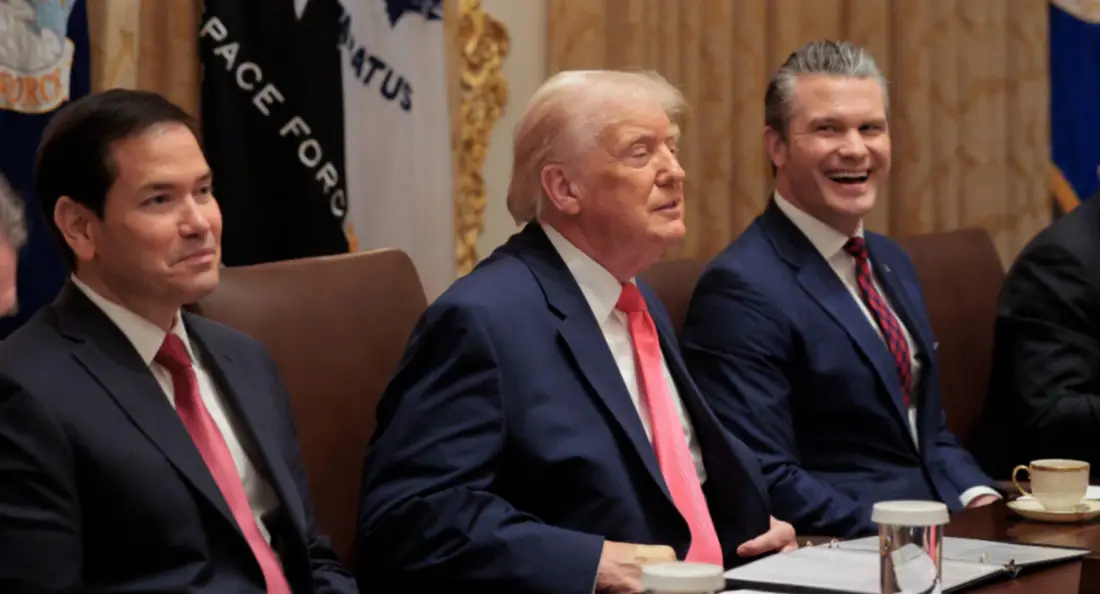
President Donald Trump’s ninth Cabinet meeting of the year was scheduled for 9:00 a.m. sharp. He arrived early.
He walked in with the brisk, almost impatient pace that aides privately referred to as his “decision mode,” the version of him that tended to appear only after an event he saw as avoidable, preventable, or tied to something he had warned about years earlier.
On the Cabinet table before him lay a stack of briefing folders — one from Homeland Security, one from the Pentagon, and one thick binder bound in dark blue. Across its cover, stamped in clean serif lettering, were four words that would define the entire meeting:
“Domestic Incident Response — Afghan National Case.”
The president didn’t sit immediately. He instead paused behind his chair, hands on the backrest, surveying the room as Cabinet members took their seats. The silence was heavy, almost ceremonial, broken only by the shuffle of papers and the hum of a heating vent.
He cleared his throat — softly, but enough to pull every pair of eyes in his direction.
“We have a lot to talk about,” he said.
And with that, the slow-burn crisis that had been unfolding since Thanksgiving week took on an official name — a moment that marked the shift from reaction to policy overhaul.
II. The Shooting That Redefined the Debate
Four days earlier, two members of the D.C. National Guard had been attacked just blocks from the White House. In the cold glimmer of pre-dawn light, the news broke: a 20-year-old soldier, Sarah Beckstrom, had been shot and left in critical condition; her colleague, Staff Sgt. Andrew Wolfe, was fighting for his life beside her. Within hours, authorities identified the suspect — an Afghan national who had entered the United States under the Biden administration’s 2021 humanitarian parole program.
By the end of Thanksgiving weekend, Beckstrom was dead. Wolfe, though stabilized, remained in guarded condition.
The details were devastating in their simplicity. The suspect, Rahmanullah Lakanwal, had overstayed his visa and evaded follow-up vetting. He had no apparent ties to terrorist organizations but had made threats online and displayed erratic behavior. A series of bureaucratic gaps — each small on its own — had somehow aligned into one catastrophic failure.
Inside the West Wing, the emotional reaction quickly fused with policy urgency. By Sunday morning, the president had instructed Homeland Security to identify “every entry point, every loophole, every rubber stamp” that allowed Lakanwal to remain in the country.
On Monday night, as Air Force One touched down after a trip to the Midwest, Trump vented his anger to reporters in the press cabin.
“Because they let him! Are you stupid?” he snapped when asked why he blamed Joe Biden for the tragedy. “He came in on a plane — like thousands of others — people who should’ve never been allowed here.”
It was classic Trump: blunt, raw, and certain.
But beneath the sharp language was a real policy pivot — one that would dominate the Cabinet meeting less than 12 hours later.
III. A Freeze Unlike Any Other
As Cabinet members opened their briefing packets, one directive stood out: a total, across-the-board freeze on Afghan visa processing. Not just humanitarian parole — but every category, including Special Immigrant Visas (SIVs) for Afghans who once assisted U.S. forces.
It was, for many in the national security sphere, the most dramatic immigration reversal since the early years of Trump’s first term.
The directive had been signed late Sunday evening. It instructed the State Department, U.S. Citizenship and Immigration Services, and consular sections abroad to “suspend, hold, or cancel” all Afghan-origin applications until further notice.
No exceptions. No case-by-case approvals.
Even Pentagon officials, accustomed to abrupt policy shifts, were stunned by the scope.
Across the Potomac at the Pentagon, the freeze triggered immediate internal debate. A handful of veterans’ advocacy groups had already sent letters urging caution, warning that many SIV applicants genuinely risked death at the hands of the Taliban. Others, however, argued that the program had become too large, too opaque, and too vulnerable to exploitation.
By Tuesday morning, the freeze was in full effect.
And the Cabinet meeting would determine what came next.
IV. “We’re Reviewing Everything” — The Cabinet Room Briefings Begin
Secretary of Homeland Security Alan Kipling was the first to speak. A soft-spoken career official with a reputation for precision, he rarely allowed emotion into his briefings. But today, as he adjusted his glasses and began reading from his notes, there was something weighted in his voice.
“Mr. President,” he began, “as of 7:00 a.m. this morning, all visa and benefit processing for Afghan nationals has been halted. All field offices have acknowledged receipt. Compliance is total.”
“Good,” Trump said quietly. “Continue.”
“We are also undertaking a full review of the vetting protocols used from 2021 through 2024,” Kipling continued. “That includes biometric checks, secondary interviews, and follow-up monitoring for at-risk profiles.”
“How many green cards are we talking about?” Trump asked.
Kipling inhaled slowly.
“We’re still gathering the exact total,” he said. “But it’s likely to be in the tens of thousands.”
A murmur rippled through the room.
The president leaned forward, elbows on the table.
“Then review them all,” he said. “Every single one.”
Across from him, Secretary of State Douglas Masterson nodded.
“It’s already underway,” he said. “Our consulates have paused discretionary benefits. That includes family reunification, humanitarian exemptions, and visa reissuance.”
“Good,” Trump repeated.
But the real lightning strike came next — from the Justice Department binder lying unopened before the Attorney General.
V. The Asylum Freeze — A Quiet Earthquake
Attorney General Pam Bondi opened her briefing with a line that caught several Cabinet members off guard:
“Mr. President, as of this morning, all affirmative asylum decisions have been paused.”
Trump blinked.
“All?” he asked.
“Yes,” Bondi said. “Every asylum case under review by USCIS is on hold until new national security protocols are approved.”
The pause did not affect defensive asylum cases in immigration court, but the impact was massive nonetheless. Affirmative asylum — handled by USCIS, not judges — accounts for tens of thousands of cases annually. It affects individuals from Central America, the Middle East, Africa, and parts of Asia.
Bondi flipped to the next page of her notes.
“Given the gaps discovered in the Lakanwal case, this step is necessary to prevent further national security vulnerabilities.”
A tense silence followed.
Trump exhaled, nodding slowly.
“This should have happened years ago,” he said.
And in that moment, it became clear that the administration was stepping into a new phase — one defined not by reactive enforcement but by structural reengineering.
VI. The Politics of a Single Tragedy
Outside the White House gates, the political world was already responding.
Democratic leaders condemned the freeze as sweeping and “inhumane,” arguing that the vast majority of Afghan refugees had nothing to do with the attack. Republicans, meanwhile, rallied behind the measures, claiming they reflected what voters demanded.
Cable news panels lit up with the debate.
Immigration hawks praised the freeze as “long overdue.”
Refugee advocates warned of “devastating implications for families who risked their lives for the U.S. military.”
At the center of the storm were the two National Guard members whose names were now etched into the national conversation.
Sarah Beckstrom — a 20-year-old with a shy smile, known for keeping extra handwarmers in her backpack to share during winter duty shifts.
Andrew Wolfe — a 24-year-old mentor figure to new enlistees, remembered for refusing promotions because he preferred working directly with recruits.
Their stories had already transformed a single shooting into a national reckoning.
And inside the Cabinet Room, their names were invoked repeatedly.
VII. The President’s Pivot — “We’re Not Taking Their People Anymore”
The president’s stance had been evolving for weeks, but the D.C. shooting hardened it into something unequivocal.
Over the Thanksgiving weekend, he posted a message that ricocheted across social media:
“We will permanently pause migration from third-world countries.”
At first, many assumed it was rhetorical hyperbole. But by Monday morning, the message had been translated into draft policy documents sitting before multiple Cabinet secretaries.
The proposed plan would:
-
halt immigration from high-risk countries
-
shift the U.S. toward a merit-based system
-
eliminate most discretionary visas
-
end or freeze programs tied to extended family sponsorship
-
prioritize economic self-sufficiency
-
terminate visa lottery programs
-
expand the list of “restricted-entry” countries
It was, by any definition, the most far-reaching immigration proposal in modern U.S. history.
Inside the Cabinet Room, Trump reiterated the point in blunt terms.
“America’s generosity should not be repaid with violence,” he said. “We’re not taking their people anymore — not until we know exactly who they are.”
No one at the table disagreed.
VIII. The Caribbean Strike and a Broader Strategy
Midway through the meeting, attention shifted to a separate but related matter — the recent U.S. military strike on a suspected drug-smuggling vessel in the Caribbean.
Defense Secretary Pete Hegseth explained the situation with the calm cadence of someone accustomed to high-stakes briefings.
“The vessel refused to stop despite repeated warnings,” he said. “Vice Adm. Bradley authorized the strike under counter-narcotics authority. It was lawful.”
A second strike had followed — controversial, but ultimately validated by internal review.
Though seemingly unrelated to immigration, the connection became clear as Hegseth spoke:
Criminal networks use migration routes. Smuggling routes mirror trafficking routes. Terror cells sometimes piggyback on narcotics corridors.
To Trump, the issues converged on a single theme: the need for order.
“We can’t secure the homeland,” he said, “if we can’t secure the waters around it.”
Vice Adm. Bradley was scheduled to brief congressional defense committees later in the week — a sign the administration expected intense scrutiny.
IX. The Human Layers Behind the Policies
Every sweeping policy shift hides a human dimension — one that rarely makes headlines but shapes the political reality.
As the meeting continued, three different stories lingered in the background:
1. The Afghan family waiting in Doha
They had completed their interviews. Their background checks had cleared. Their departure date had been scheduled. And then, hours before boarding, their approval vanished with a single notification: “Processing paused pending further review.”
2. The Somali mother in Minneapolis
She had applied for family reunification for her teenage son. The father had died two years earlier. The boy lived with relatives in Mogadishu, attending school sporadically due to fighting. The freeze meant her application was now in limbo.
3. The veteran in Texas who once worked alongside an Afghan interpreter
He received a message from the interpreter’s wife: “Please tell me what is happening. Our case says ‘pending.’ Does this mean we are denied?”
He had no answers.
These human stories did not stop the policies — but they existed in the shadows of every decision being made.
And the Cabinet knew it.
X. Inside the Strategy — “We’re Fixing What They Broke”
White House Chief of Staff Matthew Cole laid out the broader political message.
“Mr. President, the country is with you on this,” he said. “The public wants enforcement, vetting, and control. They want order restored.”
He handed Trump a polling summary.
Support for stricter vetting had climbed 19 points since the D.C. shooting. Trust in “broad humanitarian admissions” had dropped by double digits. A majority supported pausing asylum approvals until vetting was strengthened.
Beyond the polling, the administration’s internal strategy centered on a simple premise:
The public responds to clarity.
The president summarized it in his own style:
“They messed up immigration for years,” he said. “We’re fixing what they broke.”
XI. How We Got Here — A Slow-Burning Prequel
The dramatic decisions of late November did not appear out of nowhere. They were the culmination of years of political whiplash.
The Biden era — a rapid expansion of parole, asylum, and refugee admissions.
Millions were admitted, and vetting systems strained beyond capacity.
The public reaction — growing frustration as crime, homelessness, and economic strain dominated headlines.
Even cities once proud of their sanctuary policies began begging for federal help.
The Trump return — a promise to restore security and rethink decades-old immigration norms.
The shooting of two National Guard members accelerated what was already a major political shift.
XII. The Meeting’s Final Hour — Roadmaps and Deadlines
The last hour of the meeting was all business.
Deadlines. Taskings. Follow-up memos.
-
Homeland Security would produce a vetting overhaul plan within 14 days.
-
USCIS would prepare a step-by-step pathway for asylum restructuring.
-
State would identify which visa programs could be replaced with merit-based models.
-
The Justice Department would propose legal standards for terminating asylum, parole, or residency for individuals deemed national security risks.
-
The Pentagon would submit a report on migration-linked threats in the Caribbean and Central America.
Aides scribbled notes. Laptops clicked. Coffee ran cold.
Outside the White House, tourists gathered behind the black iron fence, unaware of the sweeping decisions being made inside.
XIII. The President’s Closing Words
As the meeting wound down, Trump leaned back in his chair, arms crossed, chin lifted slightly — the posture of someone who believed the moment required resolve more than rhetoric.
“This shouldn’t have taken a tragedy,” he said. “But now that it’s happened, we’re going to fix the entire system. Every part of it.”
He paused.
“No more excuses. No more loopholes. Not anymore.”
The Cabinet members nodded, some solemnly, some with a kind of seasoned acceptance.
In that moment, the course of U.S. immigration policy shifted — not in a fiery speech, not in a campaign rally, but in a quiet, fluorescent-lit room where the weight of the decisions hung heavier than the words themselves.
XIV. Aftermath: What Happens Next
Outside the West Wing, reporters waited for readouts. Advocacy groups drafted statements. Legislators prepared press releases. But the effects would unfold slowly, over months — quietly reshaping the landscape:
-
Afghan families stuck in limbo.
-
Asylum applicants stalled indefinitely.
-
Visa categories frozen, then redefined.
-
A sweeping national review of past admissions.
-
A new era of merit-based priorities.
-
The possibility of a long-term “pause” on migration from multiple regions.
And layered beneath it all — the memory of two young National Guard members whose names had already become part of the nation’s evolving immigration debate.
XV. The Slow-Burn Reality
In Washington, sweeping decisions rarely feel dramatic in the moment. They materialize in sterile conference rooms, in policy memos, in quiet nods over coffee cups. But once in motion, they shape lives for generations.
This Cabinet meeting — held under a gray, indecisive sky — was one of those moments.
A ripple that would become a wave.
A wave that would reshape immigration, national security, political identity — and the country’s understanding of what safety, sovereignty, and responsibility mean in an era where the lines between them grow blurrier every year.
And it all began with one tragedy, one suspect, and one early-morning meeting in the West Wing.

Ethan Blake is a skilled Creative Content Specialist with a talent for crafting engaging and thought-provoking narratives. With a strong background in storytelling and digital content creation, Ethan brings a unique perspective to his role at TheArchivists, where he curates and produces captivating content for a global audience.
Ethan holds a degree in Communications from Zurich University, where he developed his expertise in storytelling, media strategy, and audience engagement. Known for his ability to blend creativity with analytical precision, he excels at creating content that not only entertains but also connects deeply with readers.
At TheArchivists, Ethan specializes in uncovering compelling stories that reflect a wide range of human experiences. His work is celebrated for its authenticity, creativity, and ability to spark meaningful conversations, earning him recognition among peers and readers alike.
Passionate about the art of storytelling, Ethan enjoys exploring themes of culture, history, and personal growth, aiming to inspire and inform with every piece he creates. Dedicated to making a lasting impact, Ethan continues to push boundaries in the ever-evolving world of digital content.